<?xml version="1.0" encoding="ISO-8859-1"?><article xmlns:mml="http://www.w3.org/1998/Math/MathML" xmlns:xlink="http://www.w3.org/1999/xlink" xmlns:xsi="http://www.w3.org/2001/XMLSchema-instance">
<front>
<journal-meta>
<journal-id>0187-7151</journal-id>
<journal-title><![CDATA[Acta botánica mexicana]]></journal-title>
<abbrev-journal-title><![CDATA[Act. Bot. Mex]]></abbrev-journal-title>
<issn>0187-7151</issn>
<publisher>
<publisher-name><![CDATA[Instituto de Ecología A.C., Centro Regional del Bajío]]></publisher-name>
</publisher>
</journal-meta>
<article-meta>
<article-id>S0187-71512007000200003</article-id>
<title-group>
<article-title xml:lang="en"><![CDATA[A new variety of Cyrtocarpa edulis (Anacardiaceae)]]></article-title>
<article-title xml:lang="es"><![CDATA[Una nueva variedad de Cyrtocarpa edulis (Anacardiaceae)]]></article-title>
</title-group>
<contrib-group>
<contrib contrib-type="author">
<name>
<surname><![CDATA[León de la Luz]]></surname>
<given-names><![CDATA[José Luis]]></given-names>
</name>
<xref ref-type="aff" rid="A01"/>
</contrib>
<contrib contrib-type="author">
<name>
<surname><![CDATA[Pérez Navarro]]></surname>
<given-names><![CDATA[José Juan]]></given-names>
</name>
<xref ref-type="aff" rid="A01"/>
</contrib>
</contrib-group>
<aff id="A01">
<institution><![CDATA[,Centro de Investigaciones Biológicas del Noroeste S.C  ]]></institution>
<addr-line><![CDATA[La Paz Baja California Sur]]></addr-line>
<country>México</country>
</aff>
<pub-date pub-type="pub">
<day>00</day>
<month>00</month>
<year>2007</year>
</pub-date>
<pub-date pub-type="epub">
<day>00</day>
<month>00</month>
<year>2007</year>
</pub-date>
<numero>79</numero>
<fpage>63</fpage>
<lpage>67</lpage>
<copyright-statement/>
<copyright-year/>
<self-uri xlink:href="http://www.scielo.org.mx/scielo.php?script=sci_arttext&amp;pid=S0187-71512007000200003&amp;lng=en&amp;nrm=iso"></self-uri><self-uri xlink:href="http://www.scielo.org.mx/scielo.php?script=sci_abstract&amp;pid=S0187-71512007000200003&amp;lng=en&amp;nrm=iso"></self-uri><self-uri xlink:href="http://www.scielo.org.mx/scielo.php?script=sci_pdf&amp;pid=S0187-71512007000200003&amp;lng=en&amp;nrm=iso"></self-uri><abstract abstract-type="short" xml:lang="en"><p><![CDATA[Cyrtocarpa edulis var. glabra, an endemic taxon restricted to the southwestern portion of the Baja California Peninsula, is described and illustrated. This new variety only occurs along an arid coastal strip of the Pacific Ocean. The principal character by which it differs from the typical variety is the glabrous condition of the leaves, flowers, and fruits.]]></p></abstract>
<abstract abstract-type="short" xml:lang="es"><p><![CDATA[Se describe e ilustra a Cyrtocarpa edulis var. glabra, un taxon endémico restringido al sector sud-occidental de la Península de Baja California. Esta nueva variedad sólo ocupa una árida franja costera del Océano Pacífico. La principal característica que la hace diferir de la variedad típica es la condición glabra de las hojas, flores y frutos]]></p></abstract>
<kwd-group>
<kwd lng="en"><![CDATA[Anacardiaceae]]></kwd>
<kwd lng="en"><![CDATA[Baja California]]></kwd>
<kwd lng="en"><![CDATA[Cyrtocarpa]]></kwd>
<kwd lng="en"><![CDATA[Mexico]]></kwd>
<kwd lng="en"><![CDATA[Pacific coast]]></kwd>
<kwd lng="es"><![CDATA[Anacardiaceae]]></kwd>
<kwd lng="es"><![CDATA[Baja California]]></kwd>
<kwd lng="es"><![CDATA[Costa del Pacífico]]></kwd>
<kwd lng="es"><![CDATA[Cyrtocarpa]]></kwd>
<kwd lng="es"><![CDATA[México]]></kwd>
</kwd-group>
</article-meta>
</front><body><![CDATA[ <p align="center"><font face="verdana" size="4"><b>A new variety of <i>Cyrtocarpa edulis </i>(Anacardiaceae)</b></font></p>         <p align="center">&nbsp;</p>         <p align="center"><font face="verdana" size="3"><b>Una nueva variedad de <i>Cyrtocarpa edulis</i> (Anacardiaceae)</b></font></p>          <p align="justify"><font face="verdana" size="2">&nbsp;</font></p>          <p align="center"><font face="verdana" size="2"><b>Jos&eacute; Luis Le&oacute;n de la Luz y Jos&eacute; Juan P&eacute;rez Navarro</b></font></p>          <p align="justify"><font face="verdana" size="2">&nbsp;</font></p>          <p align="justify"><font face="verdana" size="2"><i>Centro de Investigaciones Biol&oacute;gicas del Noroeste, Apdo. postal 128, 23000 La Paz, Baja California Sur, M&eacute;xico.</i> <a href="mailto:jlleon04@cibnor.mx">jlleon04@cibnor.mx</a>.</font></p>          <p align="justify"><font face="verdana" size="2">&nbsp;</font></p>          <p align="justify"><font face="verdana" size="2">Recibido en mayo de 2005.    <br> Aceptado en diciembre de 2006.</font></p>          ]]></body>
<body><![CDATA[<p align="justify"><font face="verdana" size="2">&nbsp;</font></p>          <p align="justify"><font face="verdana" size="2"><b>ABSTRACT</b></font></p>          <p align="justify"><font face="verdana" size="2"><i>Cyrtocarpa edulis</i> var. <i>glabra,</i> an endemic taxon restricted to the southwestern portion of the Baja California Peninsula, is described and illustrated. This new variety only occurs along an arid coastal strip of the Pacific Ocean. The principal character by which it differs from the typical variety is the glabrous condition of the leaves, flowers, and fruits.</font></p>              <p align="justify"><font face="verdana" size="2"><b>Key words:</b> Anacardiaceae, Baja California, <i>Cyrtocarpa,</i> Mexico, Pacific coast.</font></p>              <p align="justify"><font face="verdana" size="2">&nbsp;</font></p>              <p align="justify"><font face="verdana" size="2"><b>RESUMEN</b></font></p>              <p align="justify"><font face="verdana" size="2">Se describe e ilustra a <i>Cyrtocarpa edulis</i> var. <i>glabra,</i> un taxon end&eacute;mico restringido al sector sud&#45;occidental de la Pen&iacute;nsula de Baja California. Esta nueva variedad s&oacute;lo ocupa una &aacute;rida franja costera del Oc&eacute;ano Pac&iacute;fico. La principal caracter&iacute;stica que la hace diferir de la variedad t&iacute;pica es la condici&oacute;n glabra de las hojas, flores y frutos.</font></p>              <p align="justify"><font face="verdana" size="2"><b>Palabras clave: </b>Anacardiaceae, Baja California, Costa del Pac&iacute;fico, <i>Cyrtocarpa,</i> M&eacute;xico.</font></p>              <p align="justify"><font face="verdana" size="2">&nbsp;</font></p>              <p align="justify"><font face="verdana" size="2"><i>Cyrtocarpa</i> (Brandegee) Standley is a genus of five species of American trees: <i>C. velutinifolia</i> (Cowan) J. D. Mitchell &amp; Daly in Guyana, <i>C. caatingae</i> J. D. Mitchell &amp; Daly in Brazil, <i>C. procera</i> Kunth and <i>C. kruseana</i> R. M. Fonseca in several southern and western states of Mexico, as well as <i>C. edulis</i> (Brandegee) Standley, which is restricted to the southern portion of the Baja California Peninsula, Mexico (Shreve &amp; Wiggins, 1964; Wiggins, 1980). Brandegee (1900) described the latter species in the genus <i>Tapirira,</i> once considered a widespread tropical genus, inhabiting as far as northwestern North America (Manchester, 1977) but currently restricted to tropical Mexico and southern South America (Terrazas and Wendt, 1995). Later, Standley (1923) transferred this taxon to <i>Cyrtocarpa</i> because of the dense pubescence on fruit and leaves and the straight embryo; in contrast, the leaves of some <i>Tapirira</i> species are densely pubescent, but the fruits are almost glabrous, and the embryo is curved.</font></p>              ]]></body>
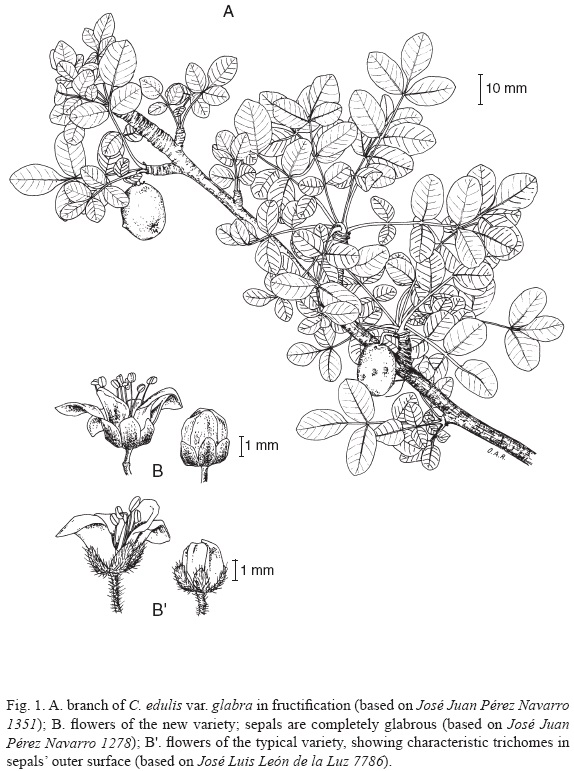
<body><![CDATA[<p align="justify"><font face="verdana" size="2">The "ciruelo del monte", as <i>C. edulis</i> is commonly known, represents one of the characteristic sarcocaulescent life&#45;forms inhabiting the Cape Region of the Baja California Peninsula, which extends from the southern tip of the peninsula up to parallel 25&deg; N, and is considered the transition between the dry&#45;subtropical zone and the Sonoran Desert province (Le&oacute;n de la Luz et al., 2000). The flesh of the fruit (a drupe) is edible and has a slightly acid taste. Local inhabitants can gather several kilograms from a single wild tree, which they eat or sell in local markets.</font></p>              <p align="justify"><font face="verdana" size="2">Some of these trees grow up to 8 m, their fleshy stems and arms of wooden appearance often exhibit bizarre&#45;looking twisted branches. The plants prefer deep sandy soils and level terrain, but also are found marginally in more arid conditions on back dunes and on islands in the southern Gulf of California. The species also inhabits marginally the dry tropical forest in the mountains of the Cape Region, but it is less abundant there. According to Turner et al. (1995), its distribution in the mountains may be restricted to areas of deep soil and limited by intolerance to shade in the foothills and low winter temperatures in the highlands.</font></p>              <p align="justify"><font face="verdana" size="2">Recently, while collecting plants on the back dunes along the coast of the Pacific shore between the town of Todos Santos and the Magdalena Plains of the Sonoran Desert, we found several individuals of <i>C. edulis</i> that attracted our attention because of the glabrous condition of leaves, flowers, and fruits. After being unable to encounter glabrous plants among specimens of this species in the herbaria of ENCB, HCIB, and SD we have decided to propose these as a new variety of <i>C. edulis.</i></font></p>              <p align="justify"><font face="verdana" size="2"><b>Cyrtocarpa edulis</b> (Brandegee) Standley var. <b>glabra</b> Le&oacute;n de la Luz &amp; P&eacute;rez&#45;Navarro var. nov. <a href="#f1">Fig. 1</a></font></p>              <p align="center"><font face="verdana" size="2"><a name="f1"></a></font></p>              <p align="center"><font face="verdana" size="2"><img src="/img/revistas/abm/n79/a3f1.jpg"></font></p>              <p align="justify"><font face="verdana" size="2"><i>C. edulis</i> var. <i>edulis</i> similis, frutex usque 1.5 m altus; foliolis glabris, calyce, corolla et drupa glabris.</font></p>              <p align="justify"><font face="verdana" size="2">Spreading shrub, with thick trunk up to 1.5 m high, and then prostrate branches, basal diameter up to 0.30 m; wood soft with smooth pale gray bark. Leaves glabrous, pinnately compound, 4&#45;8 cm long; leaflets 7 to 11, elliptic&#45;ovate, 0.8&#45;3 cm long, obtuse at apex, almost sessile on an almost terete rachis. Flowers white with green shading, sepals glabrous, ca. 1 mm long, margins scarious, petals 1.5&#45;3 mm long. Fruit an oblong&#45;ovoid drupe, 1.5&#45;2 cm long, glabrous, green to yellow when ripe, fleshy with bittersweet taste.</font></p>              <p align="justify"><font face="verdana" size="2">Type: Mexico. Baja California Sur: Boca del Carrizal, 5 km north of Ejido Melit&oacute;n Alb&aacute;&ntilde;ez, municipality of La Paz, 23&deg;39'02.85" N, 110&deg;30'11.62" W, 5 m above high tide, 28 June 1996, coastal dunes, <i>Jos&eacute; Juan P&eacute;rez Navarro 209;</i> specimen with flowers and immature fruit (holotype: HCIB 9054).</font></p>              <p align="justify"><font face="verdana" size="2">Paratypes: Boca del Carrizal, aprox. 1.5 km W of Ejido Melit&oacute;n Alb&aacute;&ntilde;ez, La Paz, 19 May 2000, <i>Jos&eacute; Juan P&eacute;rez Navarro 1251;</i> HCIB 14749. Playa Las Tunas, near arroyo La Bayita, Todos Santos, La Paz, 29 September 2000, <i>Jos&eacute; Juan P&eacute;rez Navarro 1351,</i> HCIB 14748. Arroyo del Rancho La Vieja, 4 km al S de Punta Conejo, 12 May 2005, <i>Jos&eacute; Luis Le&oacute;n de la Luz 10781,</i> HCIB 21424.</font></p>              ]]></body>
<body><![CDATA[<p align="justify"><font face="verdana" size="2"><i>C. edulis</i> var. <i>glabra</i> differs from the typical variety by the complete absence of trichomes on the leaf surface, sepals, and fruits (<a href="#f1">Fig. 1</a>). The prostrate habit also occurs in populations of the typical variety when growing near the coast in sandy soil.</font></p>          <p align="justify"><font face="verdana" size="2">Distribution and habitat: Both varieties of <i>C. edulis</i> are sympatric, since near the glabrous populations some prostrate individuals of the typical variety occur. However, their recognition as separate varieties is justified by the differences in leaf, flower, and fruit pubescence, although the prostrate habit is likely attributed to soil properties (sand dunes). A population near Punta Conejo (24&deg;03'58.55'' N; 110&deg;59'23.92'' W) grows on calcareous soils; there, the individuals are more abundant than those found at the type locality (Boca del Carrizal).</font></p>              <p align="justify"><font face="verdana" size="2">The range of this new variety extends approximately 90 km in length in a backdune strip of 200&#45;400 m width (from 23&deg;39' N, 110&deg;28' W to at least 24&deg;04' N; 111&deg;01' W), where individuals of this species can be considered as "sparcely distributed." At this moment, human impacts on this area are limited.</font></p>              <p align="justify"><font face="verdana" size="2">&nbsp;</font></p>             <p align="justify"><font face="verdana" size="2"><b>ACKNOWLEDGEMENTS</b></font></p>             <p align="justify"><font face="verdana" size="2">We are grateful to Oscar Armend&aacute;riz for his excellent illustration of the new variety. We appreciate the courtesies extended by the herbarium curators of SD and ENCB. We also appreciate very much the participation of our herbarium colleagues Raymundo and Miguel Dom&iacute;nguez, as well as of the anonymous reviewers of <i>Acta Bot&aacute;nica Mexicana.</i></font></p>              <p align="justify"><font face="verdana" size="2">&nbsp;</font></p>             <p align="justify"><font face="verdana" size="2"><b>LITERATURE CITED</b></font></p>             <!-- ref --><p align="justify"><font face="verdana" size="2">Brandegee, T. S. 1900. A new <i>Tapirira</i> from Baja California. Zoe 5(4): 78&#45;79.    &nbsp;&nbsp;&nbsp;&nbsp;&nbsp;&nbsp;&nbsp;&nbsp;[&#160;<a href="javascript:void(0);" onclick="javascript: window.open('/scielo.php?script=sci_nlinks&ref=020124&pid=S0187-7151200700020000300001&lng=','','width=640,height=500,resizable=yes,scrollbars=1,menubar=yes,');">Links</a>&#160;]<!-- end-ref --></font></p>              ]]></body>
<body><![CDATA[<!-- ref --><p align="justify"><font face="verdana" size="2">Le&oacute;n de la Luz, J. L., J. J. P&eacute;rez Navarro and A. Breceda. 2000. A transitional xerophytic&#45;tropical plant community of the Cape Region, Baja California. J. Veg. Sci. 11: 555&#45;564.    &nbsp;&nbsp;&nbsp;&nbsp;&nbsp;&nbsp;&nbsp;&nbsp;[&#160;<a href="javascript:void(0);" onclick="javascript: window.open('/scielo.php?script=sci_nlinks&ref=020126&pid=S0187-7151200700020000300002&lng=','','width=640,height=500,resizable=yes,scrollbars=1,menubar=yes,');">Links</a>&#160;]<!-- end-ref --></font></p>          <!-- ref --><p align="justify"><font face="verdana" size="2">Manchester, S. R. 1977. Wood of <i>Tapirira</i> (Anacardiaceae) from the Paleogene Carno Formation of Oregon. Rev. Paleobot. Palyno. 23: 119&#45;127.    &nbsp;&nbsp;&nbsp;&nbsp;&nbsp;&nbsp;&nbsp;&nbsp;[&#160;<a href="javascript:void(0);" onclick="javascript: window.open('/scielo.php?script=sci_nlinks&ref=020128&pid=S0187-7151200700020000300003&lng=','','width=640,height=500,resizable=yes,scrollbars=1,menubar=yes,');">Links</a>&#160;]<!-- end-ref --></font></p>             <!-- ref --><p align="justify"><font face="verdana" size="2">Shreve, F. and I. L. Wiggins. 1964. Vegetation and flora of the Sonora Desert. 2 vols. Stanford University Press. Stanford. 1740 pp.    &nbsp;&nbsp;&nbsp;&nbsp;&nbsp;&nbsp;&nbsp;&nbsp;[&#160;<a href="javascript:void(0);" onclick="javascript: window.open('/scielo.php?script=sci_nlinks&ref=020130&pid=S0187-7151200700020000300004&lng=','','width=640,height=500,resizable=yes,scrollbars=1,menubar=yes,');">Links</a>&#160;]<!-- end-ref --> </font></p>             <!-- ref --><p align="justify"><font face="verdana" size="2">Standley, P. C. 1923. Anacardiaceae. In: Trees and shrubs of Mexico. Contr. U.S. Natl. Herb. 23(3): 655&#45;672.    &nbsp;&nbsp;&nbsp;&nbsp;&nbsp;&nbsp;&nbsp;&nbsp;[&#160;<a href="javascript:void(0);" onclick="javascript: window.open('/scielo.php?script=sci_nlinks&ref=020132&pid=S0187-7151200700020000300005&lng=','','width=640,height=500,resizable=yes,scrollbars=1,menubar=yes,');">Links</a>&#160;]<!-- end-ref --></font></p>             <!-- ref --><p align="justify"><font face="verdana" size="2">Terrazas, T. and T. Wendt. 1995. Systematic wood anatomy of the genus <i>Tapirira</i> Aublet (Anacardiaceae): a numerical approach. Brittonia 47: 109&#45;129.    &nbsp;&nbsp;&nbsp;&nbsp;&nbsp;&nbsp;&nbsp;&nbsp;[&#160;<a href="javascript:void(0);" onclick="javascript: window.open('/scielo.php?script=sci_nlinks&ref=020134&pid=S0187-7151200700020000300006&lng=','','width=640,height=500,resizable=yes,scrollbars=1,menubar=yes,');">Links</a>&#160;]<!-- end-ref --></font></p>              ]]></body>
<body><![CDATA[<!-- ref --><p align="justify"><font face="verdana" size="2">Turner, R. M., J. E. Bowers and T. L. Burgess. 1995. Sonoran desert plants: an ecological atlas. University of Arizona Press. Tucson. 504 pp.    &nbsp;&nbsp;&nbsp;&nbsp;&nbsp;&nbsp;&nbsp;&nbsp;[&#160;<a href="javascript:void(0);" onclick="javascript: window.open('/scielo.php?script=sci_nlinks&ref=020136&pid=S0187-7151200700020000300007&lng=','','width=640,height=500,resizable=yes,scrollbars=1,menubar=yes,');">Links</a>&#160;]<!-- end-ref --></font></p>              <!-- ref --><p align="justify"><font face="verdana" size="2">Wiggins, I. L. 1980. Flora of Baja California. Stanford University Press. Stanford. 1025 pp.    &nbsp;&nbsp;&nbsp;&nbsp;&nbsp;&nbsp;&nbsp;&nbsp;[&#160;<a href="javascript:void(0);" onclick="javascript: window.open('/scielo.php?script=sci_nlinks&ref=020138&pid=S0187-7151200700020000300008&lng=','','width=640,height=500,resizable=yes,scrollbars=1,menubar=yes,');">Links</a>&#160;]<!-- end-ref --></font></p>       ]]></body><back>
<ref-list>
<ref id="B1">
<nlm-citation citation-type="journal">
<person-group person-group-type="author">
<name>
<surname><![CDATA[Brandegee]]></surname>
<given-names><![CDATA[T. S.]]></given-names>
</name>
</person-group>
<article-title xml:lang="en"><![CDATA[A new Tapirira from Baja California]]></article-title>
<source><![CDATA[Zoe]]></source>
<year>1900</year>
<volume>5</volume>
<numero>4</numero>
<issue>4</issue>
<page-range>78-79</page-range></nlm-citation>
</ref>
<ref id="B2">
<nlm-citation citation-type="journal">
<person-group person-group-type="author">
<name>
<surname><![CDATA[León de la Luz]]></surname>
<given-names><![CDATA[J. L.]]></given-names>
</name>
<name>
<surname><![CDATA[Pérez Navarro]]></surname>
<given-names><![CDATA[J. J.]]></given-names>
</name>
<name>
<surname><![CDATA[Breceda]]></surname>
<given-names><![CDATA[A.]]></given-names>
</name>
</person-group>
<article-title xml:lang="en"><![CDATA[A transitional xerophytic-tropical plant community of the Cape Region, Baja California]]></article-title>
<source><![CDATA[J. Veg. Sci.]]></source>
<year>2000</year>
<volume>11</volume>
<page-range>555564</page-range></nlm-citation>
</ref>
<ref id="B3">
<nlm-citation citation-type="journal">
<person-group person-group-type="author">
<name>
<surname><![CDATA[Manchester]]></surname>
<given-names><![CDATA[S. R.]]></given-names>
</name>
</person-group>
<article-title xml:lang="en"><![CDATA[Wood of Tapirira (Anacardiaceae) from the Paleogene Carno Formation of Oregon]]></article-title>
<source><![CDATA[Rev. Paleobot. Palyno.]]></source>
<year>1977</year>
<volume>23</volume>
<page-range>119-127</page-range></nlm-citation>
</ref>
<ref id="B4">
<nlm-citation citation-type="book">
<person-group person-group-type="author">
<name>
<surname><![CDATA[Shreve]]></surname>
<given-names><![CDATA[F.]]></given-names>
</name>
<name>
<surname><![CDATA[Wiggins]]></surname>
<given-names><![CDATA[I. L.]]></given-names>
</name>
</person-group>
<source><![CDATA[Vegetation and flora of the Sonora Desert]]></source>
<year>1964</year>
<page-range>1740</page-range><publisher-loc><![CDATA[Stanford ]]></publisher-loc>
<publisher-name><![CDATA[Stanford University Press]]></publisher-name>
</nlm-citation>
</ref>
<ref id="B5">
<nlm-citation citation-type="journal">
<person-group person-group-type="author">
<name>
<surname><![CDATA[Standley]]></surname>
<given-names><![CDATA[P. C.]]></given-names>
</name>
</person-group>
<article-title xml:lang="en"><![CDATA[Anacardiaceae]]></article-title>
<source><![CDATA[Trees and shrubs of Mexico. Contr. U.S. Natl. Herb.]]></source>
<year>1923</year>
<volume>23</volume>
<numero>3</numero>
<issue>3</issue>
<page-range>655-672</page-range></nlm-citation>
</ref>
<ref id="B6">
<nlm-citation citation-type="journal">
<person-group person-group-type="author">
<name>
<surname><![CDATA[Terrazas]]></surname>
<given-names><![CDATA[T.]]></given-names>
</name>
<name>
<surname><![CDATA[Wendt]]></surname>
<given-names><![CDATA[T.]]></given-names>
</name>
</person-group>
<article-title xml:lang="en"><![CDATA[Systematic wood anatomy of the genus Tapirira Aublet (Anacardiaceae): a numerical approach]]></article-title>
<source><![CDATA[Brittonia]]></source>
<year>1995</year>
<volume>47</volume>
<page-range>109-129</page-range></nlm-citation>
</ref>
<ref id="B7">
<nlm-citation citation-type="book">
<person-group person-group-type="author">
<name>
<surname><![CDATA[Turner]]></surname>
<given-names><![CDATA[R. M.]]></given-names>
</name>
<name>
<surname><![CDATA[Bowers]]></surname>
<given-names><![CDATA[J. E.]]></given-names>
</name>
<name>
<surname><![CDATA[Burgess]]></surname>
<given-names><![CDATA[T. L.]]></given-names>
</name>
</person-group>
<source><![CDATA[Sonoran desert plants: an ecological atlas]]></source>
<year>1995</year>
<page-range>504</page-range><publisher-loc><![CDATA[Tucson ]]></publisher-loc>
<publisher-name><![CDATA[University of Arizona Press]]></publisher-name>
</nlm-citation>
</ref>
<ref id="B8">
<nlm-citation citation-type="book">
<person-group person-group-type="author">
<name>
<surname><![CDATA[Wiggins]]></surname>
<given-names><![CDATA[I. L.]]></given-names>
</name>
</person-group>
<source><![CDATA[Flora of Baja California]]></source>
<year>1980</year>
<page-range>1025</page-range><publisher-loc><![CDATA[Stanford ]]></publisher-loc>
<publisher-name><![CDATA[Stanford University Press]]></publisher-name>
</nlm-citation>
</ref>
</ref-list>
</back>
</article>
