<?xml version="1.0" encoding="ISO-8859-1"?><article xmlns:mml="http://www.w3.org/1998/Math/MathML" xmlns:xlink="http://www.w3.org/1999/xlink" xmlns:xsi="http://www.w3.org/2001/XMLSchema-instance">
<front>
<journal-meta>
<journal-id>0187-6236</journal-id>
<journal-title><![CDATA[Atmósfera]]></journal-title>
<abbrev-journal-title><![CDATA[Atmósfera]]></abbrev-journal-title>
<issn>0187-6236</issn>
<publisher>
<publisher-name><![CDATA[Universidad Nacional Autónoma de México, Instituto de Ciencias de la Atmósfera y Cambio Climático]]></publisher-name>
</publisher>
</journal-meta>
<article-meta>
<article-id>S0187-62362014000300002</article-id>
<title-group>
<article-title xml:lang="en"><![CDATA[Rossby-Haurwitz wave perturbations under tropical forcing]]></article-title>
</title-group>
<contrib-group>
<contrib contrib-type="author">
<name>
<surname><![CDATA[PÉREZ-GARCÍA]]></surname>
<given-names><![CDATA[ISMAEL]]></given-names>
</name>
<xref ref-type="aff" rid="A01"/>
</contrib>
</contrib-group>
<aff id="A01">
<institution><![CDATA[,Universidad Nacional Autónoma de México Centro de Ciencias de la Atmósfera ]]></institution>
<addr-line><![CDATA[ D.F.]]></addr-line>
<country>México</country>
</aff>
<pub-date pub-type="pub">
<day>00</day>
<month>00</month>
<year>2014</year>
</pub-date>
<pub-date pub-type="epub">
<day>00</day>
<month>00</month>
<year>2014</year>
</pub-date>
<volume>27</volume>
<numero>3</numero>
<fpage>239</fpage>
<lpage>249</lpage>
<copyright-statement/>
<copyright-year/>
<self-uri xlink:href="http://www.scielo.org.mx/scielo.php?script=sci_arttext&amp;pid=S0187-62362014000300002&amp;lng=en&amp;nrm=iso"></self-uri><self-uri xlink:href="http://www.scielo.org.mx/scielo.php?script=sci_abstract&amp;pid=S0187-62362014000300002&amp;lng=en&amp;nrm=iso"></self-uri><self-uri xlink:href="http://www.scielo.org.mx/scielo.php?script=sci_pdf&amp;pid=S0187-62362014000300002&amp;lng=en&amp;nrm=iso"></self-uri><abstract abstract-type="short" xml:lang="es"><p><![CDATA[Este trabajo explora el flujo zonal en forma de polinomios de Legendre. El flujo básico se divide en un flujo zonal simétrico y una onda de Rossby-Haurwitz (RH). Varias características (más realistas) de este flujo zonal lo hacen particularmente interesante, como las corrientes en chorro con dirección oeste en latitudes medias y un viento con dirección del este alrededor del ecuador, muy similar al flujo medio horizontal del periodo diciembre-enero a 200 mb. El flujo zonal se combina con la onda RH para evaluar las etapas tempranas del mecanismo de acciones de bloqueo en el Pacífico nororiental. Se llevó a cabo una simulación numérica utilizando un modelo barotrópico lineal con forzamiento tropical y disipación para analizar la respuesta extratropical del mecanismo de reforzamiento de torbellinos en los sistemas de alta presión a lo largo de la costa occidental de Norteamérica.]]></p></abstract>
<abstract abstract-type="short" xml:lang="en"><p><![CDATA[This study explores the zonal flow in the form of Legendre polynomials. The basic flow is divided into a zonally symmetric flow and a Rossby-Haurwitz (RH) wave. Several features of this (more realistic) zonal flow make it particularly interesting, such as the midlatitude westerly jet streams and an easterly wind around the equator, which closely resembles the mean horizontal flow at 200 mb of the December-February period. The zonal flow is combined with the RH wave, in order to test the blocking formation mechanism on early stages for the northeastern Pacific. A numerical simulation has been performed using a linear barotropic model with tropical forcing and damping to check the extra-tropical response of the mechanism of eddies reinforcement of the ridge along the western coast of North America.]]></p></abstract>
<kwd-group>
<kwd lng="en"><![CDATA[Rossby-Haurwitz wave]]></kwd>
<kwd lng="en"><![CDATA[Legendre polynomials]]></kwd>
<kwd lng="en"><![CDATA[normal mode stability]]></kwd>
<kwd lng="en"><![CDATA[northeastern Pacific blocking formation mechanism]]></kwd>
<kwd lng="en"><![CDATA[tropical forcing]]></kwd>
<kwd lng="en"><![CDATA[Pacific-North American pattern]]></kwd>
</kwd-group>
</article-meta>
</front><body><![CDATA[  	    <p align="center"><font face="verdana" size="4"><b>Rossby&#45;Haurwitz wave perturbations under tropical forcing</b></font></p> 	    <p align="center">&nbsp;</p>  	    <p align="center"><font face="verdana" size="2"><b>ISMAEL P&Eacute;REZ&#45;GARC&Iacute;A</b></font></p>  	    <p align="center"><font face="verdana" size="2"><i>Centro de Ciencias de la Atm&oacute;sfera, Universidad Nacional Aut&oacute;noma de M&eacute;xico, Circuito de la Investigaci&oacute;n Cient&iacute;fica s/n, Ciudad Universitaria, 04510 M&eacute;xico, D.F.</i> E&#45;mail: <a href="mailto:ismael@unam.mx" target="_blank">ismael@unam.mx</a></font></p>     <p align="center">&nbsp;</p>  	    <p align="center"><font face="verdana" size="2">Received February 19, 2013; accepted May 5, 2014</font></p> 	    <p align="center">&nbsp;</p>  	    <p align="justify"><font face="verdana" size="2"><b>RESUMEN</b></font></p>  	    <p align="justify"><font face="verdana" size="2">Este trabajo explora el flujo zonal en forma de polinomios de Legendre. El flujo b&aacute;sico se divide en un flujo zonal sim&eacute;trico y una onda de Rossby&#45;Haurwitz (RH). Varias caracter&iacute;sticas (m&aacute;s realistas) de este flujo zonal lo hacen particularmente interesante, como las corrientes en chorro con direcci&oacute;n oeste en latitudes medias y un viento con direcci&oacute;n del este alrededor del ecuador, muy similar al flujo medio horizontal del periodo diciembre&#45;enero a 200 mb. El flujo zonal se combina con la onda RH para evaluar las etapas tempranas del mecanismo de acciones de bloqueo en el Pac&iacute;fico nororiental. Se llev&oacute; a cabo una simulaci&oacute;n num&eacute;rica utilizando un modelo barotr&oacute;pico lineal con forzamiento tropical y disipaci&oacute;n para analizar la respuesta extratropical del mecanismo de reforzamiento de torbellinos en los sistemas de alta presi&oacute;n a lo largo de la costa occidental de Norteam&eacute;rica.</font></p> 	    ]]></body>
<body><![CDATA[<p align="justify">&nbsp;</p>  	    <p align="justify"><font face="verdana" size="2"><b>ABSTRACT</b></font></p>  	    <p align="justify"><font face="verdana" size="2">This study explores the zonal flow in the form of Legendre polynomials. The basic flow is divided into a zonally symmetric flow and a Rossby&#45;Haurwitz (RH) wave. Several features of this (more realistic) zonal flow make it particularly interesting, such as the midlatitude westerly jet streams and an easterly wind around the equator, which closely resembles the mean horizontal flow at 200 mb of the December&#45;February period. The zonal flow is combined with the RH wave, in order to test the blocking formation mechanism on early stages for the northeastern Pacific. A numerical simulation has been performed using a linear barotropic model with tropical forcing and damping to check the extra&#45;tropical response of the mechanism of eddies reinforcement of the ridge along the western coast of North America.</font></p>  	    <p align="justify"><font face="verdana" size="2"><b>Keywords:</b> Rossby&#45;Haurwitz wave, Legendre polynomials, normal mode stability, northeastern Pacific blocking formation mechanism, tropical forcing, Pacific&#45;North American pattern.</font></p> 	    <p align="justify">&nbsp;</p>  	    <p align="justify"><font face="verdana" size="2"><b>1. Introduction</b></font></p>  	    <p align="justify"><font face="verdana" size="2">During the period from December 2009 to February 2010, the sea surface temperature (SST) in the central Pacific was anomalously warm. The Northern Hemisphere winter of 2009&#45;2010 was notable for its low&#45;frequency anomalous behavior because it was extremely cold in many places (P&eacute;rez&#45;Garc&iacute;a <i>et al.</i>, 2010; Wang <i>et al.</i>, 2010; Kim <i>et al.,</i> 2011; Ratnam <i>et al.</i> , 2012). <a href="/img/revistas/atm/v27n3/a2f1.jpg" target="_blank">Figure 1</a> shows the 200&#45;hPa geopotential height, a meridional dipole&#45;like structure in its incipient stages that extended from the western North America to the southwest of Mexico on January 27,</font> <font face="verdana" size="2">2010. A convective heating over the tropical central and eastern Pacific linked to a teleconnection called the Pacific&#45;North American pattern (PNA) (Wallace and Gutzler, 1981), is known to have influenced the extratropical circulation over the northeastern Pacific, Canada, and the southeastern USA.</font></p>  	    <p align="justify"><font face="verdana" size="2">Many theories have been proposed to understand the onset and maintenance of the teleconnection patterns and the synoptic blocking events in the atmosphere (Hoskins and Karoly, 1981; Haines and Marshall, 1987). The PNA manifests itself as a warm ridge (southerly flow) along the western</font> <font face="verdana" size="2">coast, and a cold trough over eastern North America (Rex, 1950; Lejenas and Okland, 1983). The use of a one&#45;level barotropic model to simulate the extra tropical response to a fixed tropical heating has been reported in several studies (Simmons, 1982; Brans&#45;tator, 1983; Held and Kang, 1987; Sardeshmukh and Hoskins, 1988; Grimm and Silva&#45;Dias, 1995), which found that the remote response to (steady) tropical forcing has an equivalent barotropic structure, and that energy propagation is influenced by both zonal and meridional variations of the basic&#45;state flow. Simmons <i>et al.</i> (1983) show structures similar to the observed PNA when the barotropic model is linearized about the zonally varying flow (300 hPa mean of January flow). These flow patterns are related to the more unstable normal mode associated with barotropic instability. Hoskins and Ambrizzi (1993) examine the most frequent trajectories of the Rossby waves in a longitudinally varying flow, and found that the jet stream can act as waveguides in the atmosphere.</font></p>  	    <p align="justify"><font face="verdana" size="2">This study aims to increase the understanding of the northeastern Pacific blocking formation mechanism in its incipient stages, in connection</font> <font face="verdana" size="2">with the Rossby&#45;Haurwitz (RH) wave. Due to its importance, numerical simulations were performed with a barotropic model on a basic flow regarded as the sum of a zonally symmetric flow and an RH wave component. Midlatitude westerly jet streams are embedded within the zonally symmetric flow. In addition, linearized barotropic models through the zonally symmetric state are easier to simulate than those observed in the zonally asymmetric flow, because time&#45;averaged basic flows generally do not satisfy the steady barotropic vorticity equation (BVE). Section 2 of this paper highlights some previous research related to the BVE on the sphere with forcing and damping, and also a brief description of the up&#45;to&#45;date solutions to the normal mode instability. In Section 3, the basic flow is constructed analytically; the selection of such basic flow allows for the application of analytical methods, which increase its potential use in persistent anomalies and low&#45;frequency variability studies. The non&#45;divergent vorticity equation for the vorticity perturbations, which is numerically time&#45;integrated and has a steady tropical divergence forcing and damping, is addressed in Section 4. In</font> <font face="verdana" size="2">order to test the extra&#45;tropical response to tropical forcing, we explore the mechanism in which eddies can reinforce the warm ridge along the western coast of North America.</font></p> 	    <p align="justify">&nbsp;</p>  	    ]]></body>
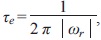
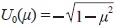
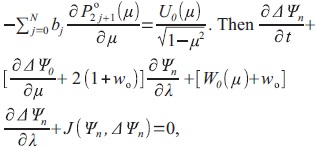
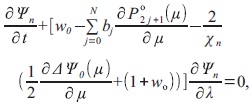
<body><![CDATA[<p align="justify"><font face="verdana" size="2"><b>2. Barotropic vorticity equation and linear instability on a sphere</b></font></p>  	    <p align="justify"><font face="verdana" size="2">A viscous two&#45;dimensional incompressible rotating fluid on a unit sphere is governed by a non&#45;linear BVE with forcing S and damping F, whose non&#45;dimensional form can be written as:</font></p>  	    <p align="center"><img src="/img/revistas/atm/v27n3/a2e1.jpg"></p>  	    <p align="justify"><font face="verdana" size="2">where<i><img src="/img/revistas/atm/v27n3/a2e1.1.jpg"></i> is the stream function; <img src="/img/revistas/atm/v27n3/a2e1.2.jpg"> and<i> &lambda;</i> are the latitude and longitude;<i><img src="/img/revistas/atm/v27n3/a2e1.3.jpg"></i> is the absolute vorticity; <i>&Delta;</i> is the Laplace operator;</font></p>      <p align="center"><img src="/img/revistas/atm/v27n3/a2e1.4.jpg"></p>  	    <p align="justify"><font face="verdana" size="2">is the Jacobian;<img src="/img/revistas/atm/v27n3/a2e1.5.jpg"> is the horizontal wind vector</font> <font face="verdana" size="2">with eastward and northward components <i>u<sub>&#968;</sub></i> and v<sub>&#968;</sub>, respectively; and <b><i>k</i></b> is the normal vector to unit sphere. The term<i> <img src="/img/revistas/atm/v27n3/a2e1.7.jpg"></i> is the Rayleigh friction coefficient, where <i>v</i> is the viscous dissipation constant, and <i>s</i> &#8805; 1 must be a real number (Skiba, 1989).</font></p>     <p align="justify"><font face="verdana" size="2">Eq. (1) captures many features of the large scale dynamics of the barotropic atmosphere while providing a deeper understanding of the teleconnection patterns (Hoskins and Karoly, 1981; Simmons, 1982; Brans&#45;tator, 1985; Sardeshmukh and Hoskins, 1985, 1988; Held and Kang, 1987; Haarsma and Opsteegh, 1989; Lau and Peng, 1992), and also the synoptic blocking events in the atmosphere (Shutts, 1983; Buizza and Molteni, 1996; Nakamura <i>et al.,</i> 1997; Nascimento and Ambrizzi, 2002). Another well&#45;known mechanism for the generation of low&#45;frequency variability is the instability of non&#45;zonal basic flow as proposed by Simmons <i>et al.</i> (1983).</font></p>  	    <p align="justify"><font face="verdana" size="2">There are four widely&#45;accepted solutions of BVE (for the ideal flow): the simple zonal flows <i>&#936;(&#956;)</i>, more complicated flows called RH waves, the Wu&#45;Verkley (WV) wave (Wu and Verkley, 1993) and modons (Tribbia, 1984; Verkley, 1984, 1987, 1990; Neven, 1992). RH waves are very useful for interpreting the large&#45;scale wave structures in the atmospheric circulation of midlatitudes. Nevertheless, in tropical latitudes these structures cannot easily be described in terms of RH waves. Therefore, RH waves are still far from real atmospheric conditions in these regions, because the primary store of atmospheric kinetic energy is the zonal mean flow, and the growth of perturbations most often results from transfer of mean energy to the perturbations. This study explores how the change in the mean flow alters the evolution of the perturbations to the flow. Thus, the total flow was divided into a zonal symmetric flow <i>&#936;<sub>o</sub>(&#956;)</i> and a wavy flow. It is in the interest of this study to observe the zonal symmetric flow, with the midlatitude westerly jet streams and a weak easterly wind around the equator (<a href="/img/revistas/atm/v27n3/a2f2.jpg" target="_blank">Fig. 2a</a>). These zonal flows <i>&#936;<sub>o</sub>(&#956;)</i> are assumed in the form of a linear combination of Legendre polynomials.</font></p>  	    <p align="justify"><font face="verdana" size="2">The basic model used in the present study was the non&#45;divergent vorticity equation for the vorticity perturbations linearized about the basic flow<img src="/img/revistas/atm/v27n3/a2e1.8.jpg">:</font></p>  	    <p align="center"><img src="/img/revistas/atm/v27n3/a2e2.jpg"></p>  	    ]]></body>
<body><![CDATA[<p align="justify"><font face="verdana" size="2">where <i>&ccedil;' = &xi;' + 2&micro;</i> and <i>&xi;'</i> are the absolute and relative vorticities of the perturbation, respectively,</font></p>      <p align="center"><font face="verdana" size="2"><i><img src="/img/revistas/atm/v27n3/a2e2.1.jpg"></i></font></p>  	    <p align="justify"><font face="verdana" size="2">is the BVE operator linearized about the basic flow, <b><i>v<sub>&#936;</sub></i></b> is the non&#45;divergent component of the basic wind, the tilde represent basic flow, and primes are referred to infinitesimal perturbation, which in the form of a normal mode</font></p>  	    <p align="center"><img src="/img/revistas/atm/v27n3/a2e2.2.jpg"></p>  	    <p align="justify"><font face="verdana" size="2">leads to the spectral problem</font></p>  	    <p align="center"><img src="/img/revistas/atm/v27n3/a2e3.jpg"></p>  	    <p align="justify"><font face="verdana" size="2">for the linearized operator <i><img src="/img/revistas/atm/v27n3/a2e3.1.jpg"></i><img src="/img/revistas/atm/v27n3/a2e3.2.jpg"> where <img src="/img/revistas/atm/v27n3/a2e3.3.jpg">is the eigenvalue and <i>G</i> the eigenfuction. In the normal mode (linear) stability analysis, the basic state must be regarded as a steady state. Eq. (3) is then solved by representing all variables as series of spherical harmonics and using a triangular truncation <i>T<sub>M</sub></i> for some <i>M,</i> reducing Eq. (3) to a discrete spectral problem</font></p>  	    <p align="center"><img src="/img/revistas/atm/v27n3/a2e4.jpg"></p>  	    <p align="justify"><font face="verdana" size="2">for a matrix <i>L</i> with elements</font></p>     <p align="center"><img src="/img/revistas/atm/v27n3/a2e4.1.jpg"></p> 	    ]]></body>
<body><![CDATA[<p align="justify"><font face="verdana" size="2">where <img src="/img/revistas/atm/v27n3/a2e4.2.jpg">is the triad nonlinear interaction coefficient, and</font></p>  	    <p align="center"><font face="verdana" size="2"><i><img src="/img/revistas/atm/v27n3/a2e4.3.jpg"></i></font></p>  	    <p align="justify"><font face="verdana" size="2">is the complex element of a diagonal matrix <i>D</i>. We used here the complex index <img src="/img/revistas/atm/v27n3/a2e4.4.jpg">by Platzman (1962) and Skiba (1989), the Kronecker delta <img src="/img/revistas/atm/v27n3/a2e4.5.jpg">and <i><img src="/img/revistas/atm/v27n3/a2e4.6.jpg"></i> It follows from <i>D<sub>aY</sub></i>, that the linear drag <i><img src="/img/revistas/atm/v27n3/a2e4.8.jpg"></i> shifts the spectrum of <i>L</i> along the real axis to the left by value <i>&sigma;</i> (Zhang, 1988). Indeed, for a <i>k</i>th eigenvalue with a linear drag <i>a</i> can be represented as <img src="/img/revistas/atm/v27n3/a2e4.9.jpg">and the stream function of a normal mode is</font></p>  	    <p align="center"><font face="verdana" size="2"><img src="/img/revistas/atm/v27n3/a2e4.10.jpg"></font></p>  	    <p align="justify"><font face="verdana" size="2">Thus, the instability <img src="/img/revistas/atm/v27n3/a2e4.11.jpg"> decreases with a, where <img src="/img/revistas/atm/v27n3/a2e4.12.jpg">is the initial phase of the mode. The diagonal term <i><img src="/img/revistas/atm/v27n3/a2e4.13.jpg"></i> rised with <i>v</i>, and <i>n<sub>Y</sub></i> increasing the distance between eigenvalues and the</font> <font face="verdana" size="2">net effect of horizontal diffusion is the damping of small scale motion for a large power <i>s.</i></font></p> 	    <p align="justify">&nbsp;</p>  	    <p align="justify"><font face="verdana" size="2"><b>3. Zonal circulation and superimposed Rossby&#45;Haurwitz perturbation</b></font></p>  	    <p align="justify"><font face="verdana" size="2">In this section the interaction between a zonal flow and an RH wave is addressed. This interaction is of particular importance to the theory of the general circulation of the atmosphere. As a representative of the mean zonal wind profile and also appropriate to the BVE, the distribution of the climatological zonal wind at 500 mb is analyzed after Kasahara (1980). <a href="/img/revistas/atm/v27n3/a2f1.jpg" target="_blank">Figure 1</a> in Kasahara (1980) (not shown) shows the four mean zonal wind distributions of the four different seasons corresponding to December, January, February (DJF); March, April, May (MAM); June, July, August (JJA); and September, October, November (SON). Over the regions of the subtropical NH jet stream, zonal wind speed decreased from DJF to JJA. However, from JJA to DJF, zonal wind increased with time. Within the NH the expected zonal wind pattern is that zonal wind will increase with time, due to the seasonal changes from JJA to DJF, and also an increment in the temperature gradient between the North Pole and the equator. The zonal wind behavior</font> <font face="verdana" size="2">in the SH is the opposite. As the seasonal transition from winter to summer develops, the temperature gradients should decrease between the South Pole and the equator, and zonal wind should diminish as well. Therefore the zonal wind profile is directly related to the evolution of the lower level temperature field. Consequently, a zonally symmetric flow with horizontal shear can be constructed analytically. The simplest example is a flow defined by<img src="/img/revistas/atm/v27n3/a2e4.15.jpg"> if <i>n</i> is odd, in which <i>P<sub>n</sub> (&#956;)</i> is a Legendre polynomial, with <i>a</i> as an arbitrary constant. The zonal symmetric flow is then analytically formulated so that the midlat&#45;itude westerly jet streams are preserved with a weak easterly wind around the equator. Not only should the zonal wind profile be consistent with climatology, but attention must also be given to the vorticity of the zonal flow in the equatorial region as noted by Wu (1993). The effect of the zonally symmetric flow, given by a linear combination of two Legendre polynomials, <i>P<sub>1</sub> (&#956;)</i>, and <i>P<sub>n</sub> (&#956;) </i>on the Rossby wave distribution was studied by Karunin (1970) and Wu (1992) for <i>n</i> = 3.</font></p>  	    <p align="justify"><font face="verdana" size="2">Observational evidence indicates that the zonal flow pattern can be approximately represented by a linear combination of seven Legendre polynomials of odd parity (Baer, 1968):</font></p>  	    <p align="center"><img src="/img/revistas/atm/v27n3/a2e5.jpg"></p>  	    ]]></body>
<body><![CDATA[<p align="justify"><font face="verdana" size="2">where <i>N = 7</i> and <i>b<sub>0</sub> =</i> &#45;0.2677, <i>b<sub>1</sub> =</i> 8.20 x 10<sup>&#45;2</sup>, <i>b<sub>2</sub></i> = &#45;5.95 x 10<sup>&#45;2</sup>, <i>b<sub>3</sub></i> = 1.061 x 10<sup>&#45;2</sup>, <i>b<sub>4</sub></i> = 2.1981 x 10<sup>&#45;3</sup>, <i>b<sub>5</sub></i>=&#45;3.11 x 10<sup>&#45;3</sup>, <i>b<sub>6</sub></i>=2.51 x 10<sup>&#45;3</sup> and <i>b<sub>7</sub></i>=&#45;6.415 x 10<sup>&#45;4</sup>. Thezonal flow has the maximum westerly of 33ms<sup>&#45;1</sup> at 35&deg; north and south, and an easterly wind of 5 ms<sup>&#45;1</sup> at the equator. This zonal wind field resembles the upper troposphere during the northern winter (<a href="/img/revistas/atm/v27n3/a2f2.jpg" target="_blank">Fig. 2a</a>).</font></p>      <p align="justify"><font face="verdana" size="2">Several papers have been devoted to the linear instability of the zonal flows since Rayleigh (1880). We used the Rayleigh&#45;Kuo necessary condition for the instability (Kuo, 1949): If <i>&Psi;<sub>0</sub> (&micro;)</i> is let to be a zonal flow on the sphere, then a normal mode may</font> <font face="verdana" size="2">be unstable only if the derivative <img src="/img/revistas/atm/v27n3/a2e5.1.jpg">of the absolute</font> <font face="verdana" size="2">vorticity <i><img src="/img/revistas/atm/v27n3/a2e5.2.jpg"></i> of flow<i> </i><i>&Psi;<sub>0</sub> (&micro;)</i> changes its sign at least in one point of the interval (&#45;1, +1). Then</font> <font face="verdana" size="2"><img src="/img/revistas/atm/v27n3/a2e5.3.jpg">changes its sign at least in one point of the interval (&#45;1, +1). Thus Eq. (5) may have an unstable normal mode (P&eacute;rez&#45;Garc&iacute;a, 2001), being almost the only useful instability condition</font> <font face="verdana" size="2">known for zonal flow described by a linear combination of Legendre polynomials. The numerical algorithm developed for the normal mode instability of arbitrary steady flow (P&eacute;rez&#45;Garc&iacute;a and Skiba 2001) has been previously tested for the zonal low with a linear combination of two Legendre polynomials (zonal RH waves), <i>P<sub>1</sub>(&micro;)</i> and <i>P<sub>n</sub>(&micro;)</i>. Now, if the same numerical algorithm is tested for the zonally symmetric low (Eq. 5), where <i>2j+1</i> is odd, the amplitude of modes can be symmetric or antisymmetric around the equator. There are few unstable modes; a mode <i>&psi;'</i> is unstable if <i><img src="/img/revistas/atm/v27n3/a2e5.4.jpg"></i> decaying if <i>w<sub>r</sub></i> &lt; 0, neutral if <img src="/img/revistas/atm/v27n3/a2e5.5.jpg"> and stationary if &#969;<i><sub>i</sub></i>= 0. The main parameters of the first two most unstable modes are given in <a href="#t1">Table I</a>, and the isolines of the real part of the amplitudes <i>&#936;<sub>r</sub> (&#955;,</i> <i>&#956;)</i> are presented</font> <font face="verdana" size="2">in <a href="/img/revistas/atm/v27n3/a2f3.jpg" target="_blank">Figure 3a</a>, <a href="/img/revistas/atm/v27n3/a2f3.jpg" target="_blank">b</a>. The e&#45;folding time<i><img src="/img/revistas/atm/v27n3/a2e5.6.jpg"></i>period <img src="/img/revistas/atm/v27n3/a2e5.7.jpg">and the spectral number<i> <img src="/img/revistas/atm/v27n3/a2e5.6.1.jpg"></i>(Skiba, 2000; Skiba and P&eacute;rez&#45;Garc&iacute;a, 2004) are also given in <a href="#t1">Table I</a>. Unstable perturbations are observed in the neighborhood of subtropical jets, and the dominant zonal wavenumber of the modes are <i>m</i> = 7 and <i>m</i> = 5.</font></p>     <p align="center"><a name="t1"></a></p>     <p align="center"><img src="/img/revistas/atm/v27n3/a2t1.jpg"></p>      <p align="justify"><font face="verdana" size="2">The RH wave has proved to be very useful for interpreting the large&#45;scale wave structures in the atmospheric circulation of midlatitudes. On the tropical latitudes these structures cannot easily be described in term of RH waves. Assume at a moment <i>t</i> that a basic wave is the sum of a zonal symmetric flow <i>&#936;<sub>o</sub></i> (&#956;) and an RH wave, then the basic flow can be written as:</font></p>  	    <p align="center"><img src="/img/revistas/atm/v27n3/a2e6.jpg"></p>  	    <p align="justify"><font face="verdana" size="2">where</font></p> 	    <p align="justify"><img src="/img/revistas/atm/v27n3/a2e6.1.jpg"></p>  	    <p align="justify"><font face="verdana" size="2">and</font></p>  	    <p align="justify"><img src="/img/revistas/atm/v27n3/a2e6.2.jpg"></p>  	    ]]></body>
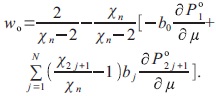
<body><![CDATA[<p align="justify"><font face="verdana" size="2">is a constant denoting the angular phase speed of the RH wave, <i>w<sub>o</sub></i> is the strength of solid&#45;body rotation flow, and <i><img src="/img/revistas/atm/v27n3/a2e6.3.jpg"></i> is the Legendre function of degree <i>n </i>and the <i>a<sub>m</sub></i> wave amplitude. The RH wave <i>RH(m, n) </i>is steady when <i>c<sub>nRH</sub></i> = 0, and<img src="/img/revistas/atm/v27n3/a2e6.5.jpg"> One may also consider the homogeneous spherical polynomials of the degree <i>n</i>:</font></p> 	    <p align="center"><font size="2" face="verdana"><img src="/img/revistas/atm/v27n3/a2e6.6.jpg"></font> </p> 	    <p align="justify"><font face="verdana" size="2">as a perturbation of the basic flow <i>&#936;<sub>o</sub></i> (&#956;) &#45; <i>w<sub>o </sub>&#956;.</i> This perturbation is a linear combination of the 2n + 1 spherical harmonics, moving in the X&#45; direction with</font>	</p> 	    <p align="justify"><font face="verdana" size="2">the speed</font><img src="/img/revistas/atm/v27n3/a2e6.7.jpg"></p>  	    <p align="justify">&nbsp;</p>  	    <p align="justify"><font face="verdana" size="2">When the basic stream function is <i><img src="/img/revistas/atm/v27n3/a2e6.8.jpg"> <img src="/img/revistas/atm/v27n3/a2e6.9.jpg"></i> at time t, Eq. (1) for the ideal flow <img src="/img/revistas/atm/v27n3/a2e6.10.jpg"> and without any external forcing leads to</font></p>  	    <p align="center"><img src="/img/revistas/atm/v27n3/a2e6.11.jpg"></p> 	    <p align="justify"><font face="verdana" size="2">Let the zonal&#45;mean zonal wind <img src="/img/revistas/atm/v27n3/a2e6.12.jpg"><i> <img src="/img/revistas/atm/v27n3/a2e6.13.jpg"></i>and the zonal&#45;mean angular velocity that relates</font> <font face="verdana" size="2">to the zonal&#45;mean stream function (Chen, 1993) and</font> <font face="verdana" size="2">zonal&#45;mean wind by<i> <img src="/img/revistas/atm/v27n3/a2e6.14.jpg"></i></font></p>     <p align="center"><img src="/img/revistas/atm/v27n3/a2e6.16.jpg"></p>     <p align="justify"><font face="verdana" size="2">in which<b><i> <img src="/img/revistas/atm/v27n3/a2e6.17.jpg"></i></b>is an eigenfunction of the Laplace operator</font> <font face="verdana" size="2">with eigenvalue<img src="/img/revistas/atm/v27n3/a2e6.18.jpg"><i>so</i> using</font></p>  	    ]]></body>
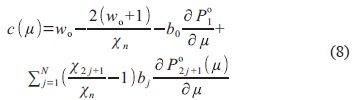
<body><![CDATA[<p align="center"><img src="/img/revistas/atm/v27n3/a2e6.19.jpg"></p>  	    <p align="justify"><font face="verdana" size="2">one shows easily that</font></p>  	    <p align="center"><img src="/img/revistas/atm/v27n3/a2e6.20.jpg"></p> 	    <p align="justify"><font face="verdana" size="2">from which it follows that a zonally propagating solution can be generally expressed in the form </font><img src="/img/revistas/atm/v27n3/a2e6.21.jpg"></p> 	    <p align="justify"><font face="verdana" size="2">where</font></p>  	    <p align="center"><img src="/img/revistas/atm/v27n3/a2e7.jpg"></p>  	    <p align="justify"><font face="verdana" size="2">is the phase speed. Then, by noting that </font></p> 	    <p align="justify"><font face="verdana" size="2"><img src="/img/revistas/atm/v27n3/a2e7.1.jpg">the following</font></p>  	    <p align="justify"><font face="verdana" size="2">assertion is valid:</font></p>  	    <p align="justify"><font face="verdana" size="2"><b>Proposition.</b> Letting<i><img src="/img/revistas/atm/v27n3/a2e7.2.jpg"></i> be the linear combination of the LP flow (Eq. 5), for any N, and <img src="/img/revistas/atm/v27n3/a2e7.3.jpg"><img src="/img/revistas/atm/v27n3/a2e7.4.jpg">the basic RH wave, then the <img src="/img/revistas/atm/v27n3/a2e7.5.jpg"><img src="/img/revistas/atm/v27n3/a2e7.6.jpg">flow is a wave propagating zonally with angular velocity<i> c (u)</i> given by</font></p>  	    ]]></body>
<body><![CDATA[<p align="center"><img src="/img/revistas/atm/v27n3/a2e8.jpg"></p>  	    <p align="justify"><font face="verdana" size="2"><img src="/img/revistas/atm/v27n3/a2e8.1.jpg"> its latitudinal derivative</font></p>  	    <p align="center"><img src="/img/revistas/atm/v27n3/a2e8.2.jpg"></p>  	    <p align="justify"><font face="verdana" size="2">The pattern of the phase velocity (Eq. 7) for an RH wave embedded within a zonal flow is then analized:</font></p>  	    <p align="center"><img src="/img/revistas/atm/v27n3/a2e9.jpg"></p>  	    <p align="justify"><font face="verdana" size="2">On one hand, the second term of Eq. (9) when compared with the observed zonal flow increases about 30% within the jet stream regions, while the increment in different latitudes is of the same order as <i>U<sub>o</sub></i> (&#956;). On the other hand, the third term of Eq. (9) shows values of the same order as <i>U<sub>o</sub> (&#956;)</i> within the jet stream regions. In accordance with the RH wave theory and also using Eq. (9), without zonal&#45;mean zonal wind <i>U<sub>o</sub> (&#956;)</i> long RH waves propagate more quickly than short RH waves against the direction of the zonal flow. When the zonal&#45;mean zonal wind <i>U<sub>o</sub> (&#956;)</i> is added to the situation, short RH waves move faster in the direction of the zonal flow because of their initial small speed against this flow. RH waves</font></p>  	    <p align="justify"><font face="verdana" size="2">embedded in the zonal flow exhibited decreasing speed as the RH wave number decreased. The wave <i>&#936;</i> is steady when <i>c</i> = 0, and</font></p>  	    <p align="center"><img src="/img/revistas/atm/v27n3/a2e9.1.jpg"></p>  	    <p align="justify"><font face="verdana" size="2">The horizontal structure of the steady wave</font></p>  	    <p align="center"><img src="/img/revistas/atm/v27n3/a2e10.jpg"></p>  	    ]]></body>
<body><![CDATA[<p align="justify"><font face="verdana" size="2">with <i>a</i> = 5 x 10<sup>6</sup>, <i>n</i> = 6, and <i>m</i> = 3 is shown in <a href="/img/revistas/atm/v27n3/a2f2.jpg" target="_blank">Figure 2b</a>. The scheme developed above is particularly interesting because it replicates some of the most important features of the zonal flow, e.g. the midlatitude westerly jet streams that closely resemble the mean horizontal flow at the upper troposphere during the boreal winter (<a href="/img/revistas/atm/v27n3/a2f1.jpg" target="_blank">Fig. 1</a>). These basic waves are also frequently called planetary waves due to their known global structures.</font></p>  	    <p align="justify"><font face="verdana" size="2">The numerical normal mode stability of the RH (3,6) wave has been studied by P&eacute;rez&#45;Garc&iacute;a (2001). The skill of the (normal mode stability) algorithm of this study has been checked by comparing it with the numerical stability results (Skiba and P&eacute;rez&#45;Garc&iacute;a, 2006, 2009) using the analytical solution obtained by Skiba (2000).</font></p> 	    <p align="justify">&nbsp;</p>  	    <p align="justify"><font face="verdana" size="2"><b>4. The extratropical response to tropical forcing</b></font></p>  	    <p align="justify"><font face="verdana" size="2">We now consider the barotropic model of the extra&#45;tropical response to tropical forcing. The forcing at Eq. (2) associated with divergence is expressed as <i>S',</i> specified by</font></p>  	    <p align="center"><img src="/img/revistas/atm/v27n3/a2e10.2.jpg"></p>  	    <p align="justify"><font face="verdana" size="2">where <b><i>v<sub>x</sub></i></b> is the irrotational wind. The Rossby wave source <i>(S')</i> contains contributions from both the vortex stretching effect and the advection of absolute vorticity by the divergent flow. Eq. (2) is numerically integrated (similarly to P&eacute;rez&#45;Garc&iacute;a and Skiba, 1999) in the sphere using the spectral transform technique by representing all variables in a series of spherical harmonics truncated at <i>T<sub>42</sub>.</i> The case <img src="/img/revistas/atm/v27n3/a2e10.4.jpg">has been considered, being <i>a</i> a linear damping with a time scale of 14.7 days so that linear instability is inhibited, <i>v</i> is</font> <font face="verdana" size="2">a biharmonic diffusion, and <i>v</i> = 2.338&#215;10<sup>16</sup> m<sup>4</sup> <i>s<sup>&#45;&#185;</sup></i>(Sardeshmukh and Hoskins, 1988).</font></p>      <p align="justify"><font face="verdana" size="2">Numerical simulations are performed with linear barotropic models with a tropical divergence forcing and damping. This scheme was chosen in order to test the extratropical response to tropical forcing that includes a hypothetical mechanism by which eddies can reinforce the ridge along the western coast of North America. Some models that linearized about a zonally symmetric flow have shown important differences from those that linearized about the zonally asymmetric climatological flow, as reported by Borges and Sardeshmukh (1995). In the present study we used Eq. (10) as the basic flow, because climatological basic flows are not maintained only by barotropic processes.</font></p>  	    <p align="justify"><font face="verdana" size="2">In order to examine the propagation of stationary Rossby wave trains in the model, a circular region of steady divergence (Hoskins and Karoly's blob &#91;1981&#93;) on the equator is introduced (<a href="/img/revistas/atm/v27n3/a2f4.jpg" target="_blank">Fig. 4a</a>) and the resulting steady perturbation on this longitudinally varying basic flow is determined by integrating the model based on Eq. (2) to a steady state. The source <i>S</i> is approximated to be<i><img src="/img/revistas/atm/v27n3/a2e10.6.jpg"></i> and is shown in <a href="/img/revistas/atm/v27n3/a2f4.jpg" target="_blank">Figure 4b</a>, being similar to the model of Sardeshmukh and Hoskins (1988). The response on day 35, when a</font> <font face="verdana" size="2">steady state is almost reached, can be observed in <a href="/img/revistas/atm/v27n3/a2f5.jpg" target="_blank">Figure 5b</a>. The wave activity emanates from the region of the divergence and propagates eastwards and polewards in almost great&#45;circle paths.</font></p>  	    <p align="justify"><font face="verdana" size="2">Dramatically, the numerical simulations reinforce the warm ridge along the western coast of North America, as seen in <a href="/img/revistas/atm/v27n3/a2f5.jpg" target="_blank">Figures 5a</a> and <a href="/img/revistas/atm/v27n3/a2f1.jpg" target="_blank">1</a>. The magnitude of the extratropical response exhibits more sensitivity, as seen in <a href="/img/revistas/atm/v27n3/a2f5.jpg" target="_blank">Figure 5b</a>. Finally, there is no wave propagation between both hemispheres because the equatorial region is controlled by easterly winds.</font></p> 	    ]]></body>
<body><![CDATA[<p align="justify">&nbsp;</p>  	    <p align="justify"><font face="verdana" size="2"><b>5. Conclusions</b></font></p>  	    <p align="justify"><font face="verdana" size="2">This paper has explored a basic flow for the BVE with a more realistic zonal flow. The selection of the basic flow allows the application of analytical methods, which increase its potential use in persistent anomalies and low&#45;frequency variability studies. These basic waves form a different set from RH waves, WV waves, and modons. Their global structures closely resemble the mean horizontal flow at the upper troposphere during the boreal winter. Such basic waves compose an RH wave embedded within a zonal flow, clearly different from the known RH wave solution. RH waves are useful for interpreting the large&#45;scale wave structures in the atmospheric circulation of midlatitudes. Never&#45;theless, these structures cannot easily be described in terms of RH waves on the tropical regions.</font></p>  	    <p align="justify"><font face="verdana" size="2">Numerical experiments were performed using the non&#45;divergent vorticity equation for the vorticity perturbations using the basic wave, with linear damping, diffusion and a tropical forcing included. In order to examine the propagation of stationary Rossby wave trains in the model, a circular region of steady divergence was introduced on the equator, located at 195&deg; E, and the resulting steady perturbation on this basic flow was determined by integrating the model based on Eq. (2) to a steady state. The wave activity emanates from the region of the divergence and propagates eastwards and polewards in almost great&#45;circle paths, and the magnitude of the extratropical response exhibited more sensitivity. A dramatical reinforcement of the ridge along the western coast of North America was observed, very similar to the Pacific&#45;North American (PNA) pattern. In the near future we will test the numerical normal mode stability algorithm with the basic flow.</font></p> 	    <p align="justify">&nbsp;</p>  	    <p align="justify"><font face="verdana" size="2"><b>Acknowledgments</b></font></p>  	    <p align="justify"><font face="verdana" size="2">I want to acknowledge Alejandro Aguilar and Marco A. Salas for their suggestions on the original manuscript of this paper and Alfonso Salas for his assistance in the computer graphics used in the preparation of this text. The author is also grateful to Claudio Amescua</font> <font face="verdana" size="2">and Alberto Alazraki for their helpful suggestions for improving the manuscript.</font></p> 	    <p align="justify">&nbsp;</p>  	    <p align="justify"><font face="verdana" size="2"><b>References</b></font></p>  	    <!-- ref --><p align="justify"><font face="verdana" size="2">Baer F., 1968. Studies in low&#45;order spectral systems. Tech. Rep. GA&#45;761. Colorado State University, Department of Atmospheric Physics, Fort Collins, CO.    &nbsp;&nbsp;&nbsp;&nbsp;&nbsp;&nbsp;&nbsp;&nbsp;[&#160;<a href="javascript:void(0);" onclick="javascript: window.open('/scielo.php?script=sci_nlinks&ref=1300296&pid=S0187-6236201400030000200001&lng=','','width=640,height=500,resizable=yes,scrollbars=1,menubar=yes,');">Links</a>&#160;]<!-- end-ref --></font></p>  	    <!-- ref --><p align="justify"><font face="verdana" size="2">Borges M. D. and P. J. Sardeshmukh, 1995. Barotropic Rossby wave dynamics of zonally varying upper&#45;level flows during Northern Winter. <i>J. Atmos. Sci.</i> <b>52,</b> 3779&#45;3797.    &nbsp;&nbsp;&nbsp;&nbsp;&nbsp;&nbsp;&nbsp;&nbsp;[&#160;<a href="javascript:void(0);" onclick="javascript: window.open('/scielo.php?script=sci_nlinks&ref=1300298&pid=S0187-6236201400030000200002&lng=','','width=640,height=500,resizable=yes,scrollbars=1,menubar=yes,');">Links</a>&#160;]<!-- end-ref --></font></p>  	    <!-- ref --><p align="justify"><font face="verdana" size="2">Branstator G. G., 1983. Horizontal energy propagation in a barotropic atmosphere with meridional and zonal structure. <i>J. Atmos. Sci.</i> <b>40,</b> 1689&#45;1708.    &nbsp;&nbsp;&nbsp;&nbsp;&nbsp;&nbsp;&nbsp;&nbsp;[&#160;<a href="javascript:void(0);" onclick="javascript: window.open('/scielo.php?script=sci_nlinks&ref=1300300&pid=S0187-6236201400030000200003&lng=','','width=640,height=500,resizable=yes,scrollbars=1,menubar=yes,');">Links</a>&#160;]<!-- end-ref --></font></p>  	    <!-- ref --><p align="justify"><font face="verdana" size="2">Branstator G. G., 1985. Analysis of general circulation model sea&#45;surface temperature anomaly simulations using a linear model. Part I: Forced solution. <i>J. Atmos. Sci.</i> <b>42,</b> 2225&#45;2241.    &nbsp;&nbsp;&nbsp;&nbsp;&nbsp;&nbsp;&nbsp;&nbsp;[&#160;<a href="javascript:void(0);" onclick="javascript: window.open('/scielo.php?script=sci_nlinks&ref=1300302&pid=S0187-6236201400030000200004&lng=','','width=640,height=500,resizable=yes,scrollbars=1,menubar=yes,');">Links</a>&#160;]<!-- end-ref --></font></p>  	    <!-- ref --><p align="justify"><font face="verdana" size="2">Buizza R. and F. Molteni, 1996. The role of finite&#45;time barotropic instability during the transition to blocking. <i>J. Atmos. Sci.</i> <b>53,</b> 1671&#45;1697.    &nbsp;&nbsp;&nbsp;&nbsp;&nbsp;&nbsp;&nbsp;&nbsp;[&#160;<a href="javascript:void(0);" onclick="javascript: window.open('/scielo.php?script=sci_nlinks&ref=1300304&pid=S0187-6236201400030000200005&lng=','','width=640,height=500,resizable=yes,scrollbars=1,menubar=yes,');">Links</a>&#160;]<!-- end-ref --></font></p>  	    <!-- ref --><p align="justify"><font face="verdana" size="2">Chen P., 1993. The barotropic normal modes in certain shear flows and the traveling waves in the atmosphere.</font> <font face="verdana" size="2"><i>J. Atmos. Sci.</i> <b>50,</b> 2054&#45;2064.    &nbsp;&nbsp;&nbsp;&nbsp;&nbsp;&nbsp;&nbsp;&nbsp;[&#160;<a href="javascript:void(0);" onclick="javascript: window.open('/scielo.php?script=sci_nlinks&ref=1300306&pid=S0187-6236201400030000200006&lng=','','width=640,height=500,resizable=yes,scrollbars=1,menubar=yes,');">Links</a>&#160;]<!-- end-ref --></font></p>  	    <!-- ref --><p align="justify"><font face="verdana" size="2">Grimm A. M. and P. L. Silva&#45;Dias, 1995. Use of barotropic models in the study of the extratropical response to tropical heat sources. <i>J. Meteorol. Soc. Jpn.</i> <b>73,</b></font> <font face="verdana" size="2">765&#45;780.    &nbsp;&nbsp;&nbsp;&nbsp;&nbsp;&nbsp;&nbsp;&nbsp;[&#160;<a href="javascript:void(0);" onclick="javascript: window.open('/scielo.php?script=sci_nlinks&ref=1300308&pid=S0187-6236201400030000200007&lng=','','width=640,height=500,resizable=yes,scrollbars=1,menubar=yes,');">Links</a>&#160;]<!-- end-ref --></font></p>  	    <!-- ref --><p align="justify"><font face="verdana" size="2">Haarma R. J. and J. D. Opsteegh, 1989. Nonlinear response to anomalous tropical forcing. <i>J. Atmos. Sci.</i> <b>46,</b> 3240&#45;3255.    &nbsp;&nbsp;&nbsp;&nbsp;&nbsp;&nbsp;&nbsp;&nbsp;[&#160;<a href="javascript:void(0);" onclick="javascript: window.open('/scielo.php?script=sci_nlinks&ref=1300310&pid=S0187-6236201400030000200008&lng=','','width=640,height=500,resizable=yes,scrollbars=1,menubar=yes,');">Links</a>&#160;]<!-- end-ref --></font></p>  	    <!-- ref --><p align="justify"><font face="verdana" size="2">Haines K. and J. Marshall, 1987. Eddy&#45;forced coherent structures as a prototype of atmospheric blocking. <i>Quar. J. Roy. Meteor. Soc.</i> <b>113</b>, 681&#45;704.    &nbsp;&nbsp;&nbsp;&nbsp;&nbsp;&nbsp;&nbsp;&nbsp;[&#160;<a href="javascript:void(0);" onclick="javascript: window.open('/scielo.php?script=sci_nlinks&ref=1300312&pid=S0187-6236201400030000200009&lng=','','width=640,height=500,resizable=yes,scrollbars=1,menubar=yes,');">Links</a>&#160;]<!-- end-ref --></font></p>  	    <!-- ref --><p align="justify"><font face="verdana" size="2">Held I. M. and I.&#45;S. Kang, 1987. Barotropic models of the extratropical response to El Ni&ntilde;o. <i>J. Atmos. Sci.</i> <b>44,</b> 3576&#45;3586.    &nbsp;&nbsp;&nbsp;&nbsp;&nbsp;&nbsp;&nbsp;&nbsp;[&#160;<a href="javascript:void(0);" onclick="javascript: window.open('/scielo.php?script=sci_nlinks&ref=1300314&pid=S0187-6236201400030000200010&lng=','','width=640,height=500,resizable=yes,scrollbars=1,menubar=yes,');">Links</a>&#160;]<!-- end-ref --></font></p>  	    <!-- ref --><p align="justify"><font face="verdana" size="2">Hoskins B. J. and D. Karoly, 1981. The steady linear response of a spherical atmosphere to thermal and orographic forcing. <i>J. Atmos. Sci.</i> <b>38,</b> 1179&#45;1196.    &nbsp;&nbsp;&nbsp;&nbsp;&nbsp;&nbsp;&nbsp;&nbsp;[&#160;<a href="javascript:void(0);" onclick="javascript: window.open('/scielo.php?script=sci_nlinks&ref=1300316&pid=S0187-6236201400030000200011&lng=','','width=640,height=500,resizable=yes,scrollbars=1,menubar=yes,');">Links</a>&#160;]<!-- end-ref --></font></p>  	    <!-- ref --><p align="justify"><font face="verdana" size="2">Hoskins B. J. and T. Ambrizzi, 1993. Rossby wave propagation on a realistic longitudinally varying flow. <i>J. Atmos. Sci.</i> <b>50,</b> 1661&#45;1671.    &nbsp;&nbsp;&nbsp;&nbsp;&nbsp;&nbsp;&nbsp;&nbsp;[&#160;<a href="javascript:void(0);" onclick="javascript: window.open('/scielo.php?script=sci_nlinks&ref=1300318&pid=S0187-6236201400030000200012&lng=','','width=640,height=500,resizable=yes,scrollbars=1,menubar=yes,');">Links</a>&#160;]<!-- end-ref --></font></p>  	    <!-- ref --><p align="justify"><font face="verdana" size="2">Karunin A. B., 1970. On Rossby waves in barotropic atmosphere in the presence of zonal flow. <i>Izv. Atmos. Ocean. Phys.</i> <b>6,</b> 1091&#45;1100.    &nbsp;&nbsp;&nbsp;&nbsp;&nbsp;&nbsp;&nbsp;&nbsp;[&#160;<a href="javascript:void(0);" onclick="javascript: window.open('/scielo.php?script=sci_nlinks&ref=1300320&pid=S0187-6236201400030000200013&lng=','','width=640,height=500,resizable=yes,scrollbars=1,menubar=yes,');">Links</a>&#160;]<!-- end-ref --></font></p>  	    <!-- ref --><p align="justify"><font face="verdana" size="2">Kasahara A., 1980. Effect of zonal flows on the free oscillations of a barotropic atmosphere. <i>J. Atmos. Sci.</i> <b>37,</b> 917&#45;929.    &nbsp;&nbsp;&nbsp;&nbsp;&nbsp;&nbsp;&nbsp;&nbsp;[&#160;<a href="javascript:void(0);" onclick="javascript: window.open('/scielo.php?script=sci_nlinks&ref=1300322&pid=S0187-6236201400030000200014&lng=','','width=640,height=500,resizable=yes,scrollbars=1,menubar=yes,');">Links</a>&#160;]<!-- end-ref --></font></p>  	    <!-- ref --><p align="justify"><font face="verdana" size="2">Kim W.&#45;M., S.&#45;W. Yeh, J.&#45;H. Kim, J.&#45;S. Kug and M.&#45;H. Kwon, 2011. The unique 2009&#45;2010 El Nino event: A fast phase transition of warm pool El Ni&ntilde;o to La Ni&ntilde;a. <i>Geophys. Res. Lett.</i> <b>38,</b> L15809, doi:10.1029/2011GL048521.    &nbsp;&nbsp;&nbsp;&nbsp;&nbsp;&nbsp;&nbsp;&nbsp;[&#160;<a href="javascript:void(0);" onclick="javascript: window.open('/scielo.php?script=sci_nlinks&ref=1300324&pid=S0187-6236201400030000200015&lng=','','width=640,height=500,resizable=yes,scrollbars=1,menubar=yes,');">Links</a>&#160;]<!-- end-ref --></font></p>  	    <!-- ref --><p align="justify"><font face="verdana" size="2">Kuo H. L., 1949. Dynamic instability of two&#45;dimensional non&#45;divergent flow in a barotropic atmosphere. <i>J. Meteorol.</i> <b>6,</b> 105&#45;122.    &nbsp;&nbsp;&nbsp;&nbsp;&nbsp;&nbsp;&nbsp;&nbsp;[&#160;<a href="javascript:void(0);" onclick="javascript: window.open('/scielo.php?script=sci_nlinks&ref=1300326&pid=S0187-6236201400030000200016&lng=','','width=640,height=500,resizable=yes,scrollbars=1,menubar=yes,');">Links</a>&#160;]<!-- end-ref --></font></p>  	    <!-- ref --><p align="justify"><font face="verdana" size="2">Lau K. M. and L. Peng, 1992. Dynamics of atmospheric teleconections during the northern summer. <i>J. Climate</i></font> <font face="verdana" size="2"><b>5,</b> 140&#45;158.    &nbsp;&nbsp;&nbsp;&nbsp;&nbsp;&nbsp;&nbsp;&nbsp;[&#160;<a href="javascript:void(0);" onclick="javascript: window.open('/scielo.php?script=sci_nlinks&ref=1300328&pid=S0187-6236201400030000200017&lng=','','width=640,height=500,resizable=yes,scrollbars=1,menubar=yes,');">Links</a>&#160;]<!-- end-ref --></font></p>  	    <!-- ref --><p align="justify"><font face="verdana" size="2">Lejenas H. and H. Okland, 1983. Characteristics of Northern Hemisphere blocking as determined from a long time series of observational data. <i>Tellus</i> <b>35,</b> 350&#45;362.    &nbsp;&nbsp;&nbsp;&nbsp;&nbsp;&nbsp;&nbsp;&nbsp;[&#160;<a href="javascript:void(0);" onclick="javascript: window.open('/scielo.php?script=sci_nlinks&ref=1300330&pid=S0187-6236201400030000200018&lng=','','width=640,height=500,resizable=yes,scrollbars=1,menubar=yes,');">Links</a>&#160;]<!-- end-ref --></font></p>  	    <!-- ref --><p align="justify"><font face="verdana" size="2">Nakamura H., M. Nakamura and J. L. Anderson, 1997. The role of high&#45; and low&#45;frequency dynamics in blocking formation. <i>Mon. Wea. Rev.</i> <b>125,</b> 2074&#45;2093.    &nbsp;&nbsp;&nbsp;&nbsp;&nbsp;&nbsp;&nbsp;&nbsp;[&#160;<a href="javascript:void(0);" onclick="javascript: window.open('/scielo.php?script=sci_nlinks&ref=1300332&pid=S0187-6236201400030000200019&lng=','','width=640,height=500,resizable=yes,scrollbars=1,menubar=yes,');">Links</a>&#160;]<!-- end-ref --></font></p>  	    <!-- ref --><p align="justify"><font face="verdana" size="2">Nascimento E. and T. Ambrizzi, 2002. The influence of atmospheric blocking on the Rossby wave propagation in Southern Hemisphere winter flows. <i>J. Meteor. Soc.</i></font> <font face="verdana" size="2"><i>Jpn.</i> <b>80,</b> 139&#45;159.    &nbsp;&nbsp;&nbsp;&nbsp;&nbsp;&nbsp;&nbsp;&nbsp;[&#160;<a href="javascript:void(0);" onclick="javascript: window.open('/scielo.php?script=sci_nlinks&ref=1300334&pid=S0187-6236201400030000200020&lng=','','width=640,height=500,resizable=yes,scrollbars=1,menubar=yes,');">Links</a>&#160;]<!-- end-ref --></font></p>  	    <!-- ref --><p align="justify"><font face="verdana" size="2">Neven E. C., 1992. Quadrupole modons on a sphere.</font> <font face="verdana" size="2"><i>Geophys. Astro. Fluid</i> <b>65,</b> 105&#45;126.    &nbsp;&nbsp;&nbsp;&nbsp;&nbsp;&nbsp;&nbsp;&nbsp;[&#160;<a href="javascript:void(0);" onclick="javascript: window.open('/scielo.php?script=sci_nlinks&ref=1300336&pid=S0187-6236201400030000200021&lng=','','width=640,height=500,resizable=yes,scrollbars=1,menubar=yes,');">Links</a>&#160;]<!-- end-ref --> </font></p> 	    <!-- ref --><p align="justify"><font face="verdana" size="2">P&eacute;rez&#45;Garc&iacute;a I. and Y. N. Skiba, 1999. Simulation of exact</font> <font face="verdana" size="2">barotropic vorticity equation solutions using a spectral</font> <font face="verdana" size="2">model. <i>Atm&oacute;sfera</i> <b>12,</b> 223&#45;243.    &nbsp;&nbsp;&nbsp;&nbsp;&nbsp;&nbsp;&nbsp;&nbsp;[&#160;<a href="javascript:void(0);" onclick="javascript: window.open('/scielo.php?script=sci_nlinks&ref=1300338&pid=S0187-6236201400030000200022&lng=','','width=640,height=500,resizable=yes,scrollbars=1,menubar=yes,');">Links</a>&#160;]<!-- end-ref --></font></p>  	    <!-- ref --><p align="justify"><font face="verdana" size="2">P&eacute;rez&#45;Garc&iacute;a I., 2001. An&aacute;lisis de la ecuaci&oacute;n de vorticidad barotr&oacute;pica atmosf&eacute;rica por medio del m&eacute;todo espectral. Ph. D. thesis. Universidad Nacional Aut&oacute;noma de M&eacute;xico, 265 pp.    &nbsp;&nbsp;&nbsp;&nbsp;&nbsp;&nbsp;&nbsp;&nbsp;[&#160;<a href="javascript:void(0);" onclick="javascript: window.open('/scielo.php?script=sci_nlinks&ref=1300340&pid=S0187-6236201400030000200023&lng=','','width=640,height=500,resizable=yes,scrollbars=1,menubar=yes,');">Links</a>&#160;]<!-- end-ref --></font></p>  	    <!-- ref --><p align="justify"><font face="verdana" size="2">P&eacute;rez&#45;Garc&iacute;a I. and Y. N. Skiba, 2001. Tests of a numerical algorithm for the linear instability study of flows on a sphere. <i>Atm&oacute;sfera</i> <b>14,</b> 95&#45;112.    &nbsp;&nbsp;&nbsp;&nbsp;&nbsp;&nbsp;&nbsp;&nbsp;[&#160;<a href="javascript:void(0);" onclick="javascript: window.open('/scielo.php?script=sci_nlinks&ref=1300342&pid=S0187-6236201400030000200024&lng=','','width=640,height=500,resizable=yes,scrollbars=1,menubar=yes,');">Links</a>&#160;]<!-- end-ref --></font></p>  	    <!-- ref --><p align="justify"><font face="verdana" size="2">P&eacute;rez&#45;Garc&iacute;a I., A. Aguilar and G. Zintz&uacute;n, 2010. Ciclones de latitudes medias y la acci&oacute;n de bloqueo, durante los episodios de El Ni&ntilde;o sobre M&eacute;xico. XIX Congreso de la OMMAC. November 18&#45;22, Saltillo, Coahuila, Mexico.    &nbsp;&nbsp;&nbsp;&nbsp;&nbsp;&nbsp;&nbsp;&nbsp;[&#160;<a href="javascript:void(0);" onclick="javascript: window.open('/scielo.php?script=sci_nlinks&ref=1300344&pid=S0187-6236201400030000200025&lng=','','width=640,height=500,resizable=yes,scrollbars=1,menubar=yes,');">Links</a>&#160;]<!-- end-ref --></font></p>  	    <!-- ref --><p align="justify"><font face="verdana" size="2">Platzman G. W., 1962. The analytical dynamics of the spectral vorticity equations. <i>J. Atmos. Sci.</i> <b>19,</b></font> <font face="verdana" size="2">313&#45;328.    &nbsp;&nbsp;&nbsp;&nbsp;&nbsp;&nbsp;&nbsp;&nbsp;[&#160;<a href="javascript:void(0);" onclick="javascript: window.open('/scielo.php?script=sci_nlinks&ref=1300346&pid=S0187-6236201400030000200026&lng=','','width=640,height=500,resizable=yes,scrollbars=1,menubar=yes,');">Links</a>&#160;]<!-- end-ref --></font></p>  	    <!-- ref --><p align="justify"><font face="verdana" size="2">Ratnam J. V., S. K. Behera, Y. Masumoto, K. Takahashi and T. Yamagata, 2012. Anomalous climatic conditions associated with the El Nino Modoki during boreal winter of 2009. <i>Clim. Dyn.</i> <b>39,</b> 227&#45;238.    &nbsp;&nbsp;&nbsp;&nbsp;&nbsp;&nbsp;&nbsp;&nbsp;[&#160;<a href="javascript:void(0);" onclick="javascript: window.open('/scielo.php?script=sci_nlinks&ref=1300348&pid=S0187-6236201400030000200027&lng=','','width=640,height=500,resizable=yes,scrollbars=1,menubar=yes,');">Links</a>&#160;]<!-- end-ref --></font></p>  	    <!-- ref --><p align="justify"><font face="verdana" size="2">Rayleigh L., 1880. On the stability, or instability, of certain fluid motions. <i>P. London Math. Soc.</i> <b>11,</b> 57&#45;70 (also in: <i>Scientific Papers,</i> vol. 1, Cambridge University Press, Cambridge, 1889, 474&#45;487,    &nbsp;&nbsp;&nbsp;&nbsp;&nbsp;&nbsp;&nbsp;&nbsp;[&#160;<a href="javascript:void(0);" onclick="javascript: window.open('/scielo.php?script=sci_nlinks&ref=1300350&pid=S0187-6236201400030000200028&lng=','','width=640,height=500,resizable=yes,scrollbars=1,menubar=yes,');">Links</a>&#160;]<!-- end-ref -->).</font></p>  	    <!-- ref --><p align="justify"><font face="verdana" size="2">Rex D. P., 1950. Blocking action in the middle troposphere and its effect upon regional climate. Part II: The climatology of blocking actions. <i>Tellus</i> <b>2,</b> 275&#45;301.    &nbsp;&nbsp;&nbsp;&nbsp;&nbsp;&nbsp;&nbsp;&nbsp;[&#160;<a href="javascript:void(0);" onclick="javascript: window.open('/scielo.php?script=sci_nlinks&ref=1300352&pid=S0187-6236201400030000200029&lng=','','width=640,height=500,resizable=yes,scrollbars=1,menubar=yes,');">Links</a>&#160;]<!-- end-ref --></font></p>  	    <!-- ref --><p align="justify"><font face="verdana" size="2">Sardeshmukh P. J. and B. J. Hoskins, 1985. Vorticity balance in the tropics during the 1982&#45;83 El Ni&ntilde;o&#45;Southern Os&#45;cilation event. <i>Quart. J. Roy. Meteor. Soc.</i> <b>111,</b> 261&#45;278.    &nbsp;&nbsp;&nbsp;&nbsp;&nbsp;&nbsp;&nbsp;&nbsp;[&#160;<a href="javascript:void(0);" onclick="javascript: window.open('/scielo.php?script=sci_nlinks&ref=1300354&pid=S0187-6236201400030000200030&lng=','','width=640,height=500,resizable=yes,scrollbars=1,menubar=yes,');">Links</a>&#160;]<!-- end-ref --></font></p>  	    <!-- ref --><p align="justify"><font face="verdana" size="2">Sardeshmukh P. J. and B. J. Hoskins, 1988. The generation of global rotational flow by steady idealized tropical divergence. <i>J. Atmos. Sci.</i> <b>45,</b> 1228&#45;1251.    &nbsp;&nbsp;&nbsp;&nbsp;&nbsp;&nbsp;&nbsp;&nbsp;[&#160;<a href="javascript:void(0);" onclick="javascript: window.open('/scielo.php?script=sci_nlinks&ref=1300356&pid=S0187-6236201400030000200031&lng=','','width=640,height=500,resizable=yes,scrollbars=1,menubar=yes,');">Links</a>&#160;]<!-- end-ref --></font></p>  	    <!-- ref --><p align="justify"><font face="verdana" size="2">Simmons A. J., 1982. The forcing of stationary wave motion by tropical diabatic heating. <i>Q. J. Roy. Meteor.</i></font> <font face="verdana" size="2"><i>Soc.</i> <b>108,</b> 503&#45;534.    &nbsp;&nbsp;&nbsp;&nbsp;&nbsp;&nbsp;&nbsp;&nbsp;[&#160;<a href="javascript:void(0);" onclick="javascript: window.open('/scielo.php?script=sci_nlinks&ref=1300358&pid=S0187-6236201400030000200032&lng=','','width=640,height=500,resizable=yes,scrollbars=1,menubar=yes,');">Links</a>&#160;]<!-- end-ref --></font></p>  	    <!-- ref --><p align="justify"><font face="verdana" size="2">Simmons A. J., J. M. Wallace and G. W. Branstator, 1983. Barotropic wave propagation and instability, and atmospheric teleconnection patterns. <i>J. Atmos. Sci.</i> <b>40,</b></font> <font face="verdana" size="2">1363&#45;1392.    &nbsp;&nbsp;&nbsp;&nbsp;&nbsp;&nbsp;&nbsp;&nbsp;[&#160;<a href="javascript:void(0);" onclick="javascript: window.open('/scielo.php?script=sci_nlinks&ref=1300360&pid=S0187-6236201400030000200033&lng=','','width=640,height=500,resizable=yes,scrollbars=1,menubar=yes,');">Links</a>&#160;]<!-- end-ref --></font></p>  	    <!-- ref --><p align="justify"><font face="verdana" size="2">Shutts G. J., 1983. The propagation of eddies in diffluent jet streams: Eddy vorticity forcing of "blocking" flow fields. <i>Q. J. Roy. Meteor. Soc.</i> <b>109,</b> 737&#45;761.    &nbsp;&nbsp;&nbsp;&nbsp;&nbsp;&nbsp;&nbsp;&nbsp;[&#160;<a href="javascript:void(0);" onclick="javascript: window.open('/scielo.php?script=sci_nlinks&ref=1300362&pid=S0187-6236201400030000200034&lng=','','width=640,height=500,resizable=yes,scrollbars=1,menubar=yes,');">Links</a>&#160;]<!-- end-ref --></font></p>  	    <!-- ref --><p align="justify"><font face="verdana" size="2">Skiba Y. N., 1989. <i>Mathematical problems of the dynamics of viscous barotropicfluid on a rotating sphere.</i> Indian Institute of Tropical Meteorology, Pune, India, 211 pp.    &nbsp;&nbsp;&nbsp;&nbsp;&nbsp;&nbsp;&nbsp;&nbsp;[&#160;<a href="javascript:void(0);" onclick="javascript: window.open('/scielo.php?script=sci_nlinks&ref=1300364&pid=S0187-6236201400030000200035&lng=','','width=640,height=500,resizable=yes,scrollbars=1,menubar=yes,');">Links</a>&#160;]<!-- end-ref --></font></p>  	    <!-- ref --><p align="justify"><font face="verdana" size="2">Skiba Y. N., 2000. On the normal mode instability of harmonic waves on a sphere, <i>Geophys. Astrophys. Fluid</i></font> <font face="verdana" size="2"><i>Dyn.</i> <b>92,</b> 115&#45;127.    &nbsp;&nbsp;&nbsp;&nbsp;&nbsp;&nbsp;&nbsp;&nbsp;[&#160;<a href="javascript:void(0);" onclick="javascript: window.open('/scielo.php?script=sci_nlinks&ref=1300366&pid=S0187-6236201400030000200036&lng=','','width=640,height=500,resizable=yes,scrollbars=1,menubar=yes,');">Links</a>&#160;]<!-- end-ref --></font></p>  	    <!-- ref --><p align="justify"><font face="verdana" size="2">Skiba Y. N. and I. P&eacute;rez&#45;Garc&iacute;a, 2004. On the structure and growth rate of unstable modes to the Rossby&#45;Haurwitz wave. <i>Numer. Meth. Part. D. E.</i> <b>21,</b> 368&#45;386.    &nbsp;&nbsp;&nbsp;&nbsp;&nbsp;&nbsp;&nbsp;&nbsp;[&#160;<a href="javascript:void(0);" onclick="javascript: window.open('/scielo.php?script=sci_nlinks&ref=1300368&pid=S0187-6236201400030000200037&lng=','','width=640,height=500,resizable=yes,scrollbars=1,menubar=yes,');">Links</a>&#160;]<!-- end-ref --></font></p>  	    <!-- ref --><p align="justify"><font face="verdana" size="2">Skiba Y. N., and I. P&eacute;rez&#45;Garc&iacute;a 2006. Testing of a numerical instability study algorithm with the Rossby&#45;Haur&#45;witz waves. <i>Int. J. Appl. Mathematics</i> <b>19,</b> 433&#45;460.    &nbsp;&nbsp;&nbsp;&nbsp;&nbsp;&nbsp;&nbsp;&nbsp;[&#160;<a href="javascript:void(0);" onclick="javascript: window.open('/scielo.php?script=sci_nlinks&ref=1300370&pid=S0187-6236201400030000200038&lng=','','width=640,height=500,resizable=yes,scrollbars=1,menubar=yes,');">Links</a>&#160;]<!-- end-ref --></font></p>  	    <!-- ref --><p align="justify"><font face="verdana" size="2">Skiba Y. N. and I. P&eacute;rez&#45;Garc&iacute;a, 2009. Numerical spectral method for normal&#45;mode stability study of ideal flows on a rotating sphere. <i>Int. J. Appl. Mathematics</i> <b>22,</b> 725&#45;758.    &nbsp;&nbsp;&nbsp;&nbsp;&nbsp;&nbsp;&nbsp;&nbsp;[&#160;<a href="javascript:void(0);" onclick="javascript: window.open('/scielo.php?script=sci_nlinks&ref=1300372&pid=S0187-6236201400030000200039&lng=','','width=640,height=500,resizable=yes,scrollbars=1,menubar=yes,');">Links</a>&#160;]<!-- end-ref --></font></p>  	    <!-- ref --><p align="justify"><font face="verdana" size="2">Tribbia J. J., 1984. Modons in spherical geometry. <i>Geophys. Astrophys. Fluid Dynam.</i> <b>30,</b> 131&#45;168.    &nbsp;&nbsp;&nbsp;&nbsp;&nbsp;&nbsp;&nbsp;&nbsp;[&#160;<a href="javascript:void(0);" onclick="javascript: window.open('/scielo.php?script=sci_nlinks&ref=1300374&pid=S0187-6236201400030000200040&lng=','','width=640,height=500,resizable=yes,scrollbars=1,menubar=yes,');">Links</a>&#160;]<!-- end-ref --></font></p>  	    <!-- ref --><p align="justify"><font face="verdana" size="2">Verkley W. T. M., 1984. The construction of barotropic modons on a sphere. <i>J. Atmos. Sci.</i> <b>41,</b> 2492&#45;2504.    &nbsp;&nbsp;&nbsp;&nbsp;&nbsp;&nbsp;&nbsp;&nbsp;[&#160;<a href="javascript:void(0);" onclick="javascript: window.open('/scielo.php?script=sci_nlinks&ref=1300376&pid=S0187-6236201400030000200041&lng=','','width=640,height=500,resizable=yes,scrollbars=1,menubar=yes,');">Links</a>&#160;]<!-- end-ref --></font></p>  	    <!-- ref --><p align="justify"><font face="verdana" size="2">Verkley W. T. M., 1987. Stationary barotropic modons in westerly background flows. <i>J. Atmos. Sci.</i> <b>44,</b> 2383&#45;2398.    &nbsp;&nbsp;&nbsp;&nbsp;&nbsp;&nbsp;&nbsp;&nbsp;[&#160;<a href="javascript:void(0);" onclick="javascript: window.open('/scielo.php?script=sci_nlinks&ref=1300378&pid=S0187-6236201400030000200042&lng=','','width=640,height=500,resizable=yes,scrollbars=1,menubar=yes,');">Links</a>&#160;]<!-- end-ref --></font></p>  	    <!-- ref --><p align="justify"><font face="verdana" size="2">Verkley W. T. M., 1990. Modons with uniform absolute vorticity. <i>J. Atmos. Sci.</i> <b>47,</b> 727&#45;745.    &nbsp;&nbsp;&nbsp;&nbsp;&nbsp;&nbsp;&nbsp;&nbsp;[&#160;<a href="javascript:void(0);" onclick="javascript: window.open('/scielo.php?script=sci_nlinks&ref=1300380&pid=S0187-6236201400030000200043&lng=','','width=640,height=500,resizable=yes,scrollbars=1,menubar=yes,');">Links</a>&#160;]<!-- end-ref --></font></p>  	    <!-- ref --><p align="justify"><font face="verdana" size="2">Wallace J. M. and D. S. Gutzler, 1981. Teleconnections in the geopotential height field during the Northern Hemisphere winter. <i>Mon. Wea. Rev.</i> <b>109,</b> 785&#45;812.    &nbsp;&nbsp;&nbsp;&nbsp;&nbsp;&nbsp;&nbsp;&nbsp;[&#160;<a href="javascript:void(0);" onclick="javascript: window.open('/scielo.php?script=sci_nlinks&ref=1300382&pid=S0187-6236201400030000200044&lng=','','width=640,height=500,resizable=yes,scrollbars=1,menubar=yes,');">Links</a>&#160;]<!-- end-ref --></font></p>  	    <!-- ref --><p align="justify"><font face="verdana" size="2">Wang C, H. Liu and S. Lee, 2010. The record&#45;breaking cold temperatures during the winter of 2009/2010 in the Northern Hemisphere. <i>Atmos. Sci. Lett.</i> <b>11</b>, 161&#45;168.    &nbsp;&nbsp;&nbsp;&nbsp;&nbsp;&nbsp;&nbsp;&nbsp;[&#160;<a href="javascript:void(0);" onclick="javascript: window.open('/scielo.php?script=sci_nlinks&ref=1300384&pid=S0187-6236201400030000200045&lng=','','width=640,height=500,resizable=yes,scrollbars=1,menubar=yes,');">Links</a>&#160;]<!-- end-ref --></font></p>  	    <!-- ref --><p align="justify"><font face="verdana" size="2">Wu P., 1992. On nonlinear structures and persistent anomalies in the atmosphere. Ph.D. thesis, Imperial College, University of London, 168 pp.    &nbsp;&nbsp;&nbsp;&nbsp;&nbsp;&nbsp;&nbsp;&nbsp;[&#160;<a href="javascript:void(0);" onclick="javascript: window.open('/scielo.php?script=sci_nlinks&ref=1300386&pid=S0187-6236201400030000200046&lng=','','width=640,height=500,resizable=yes,scrollbars=1,menubar=yes,');">Links</a>&#160;]<!-- end-ref --></font></p>  	    <!-- ref --><p align="justify"><font face="verdana" size="2">Wu P., 1993. Nonlinear resonance and instability of planetary waves and low&#45;frequency variability in the atmosphere. <i>J. Atmos. Sci.</i> <b>50,</b> 3590&#45;3607.    &nbsp;&nbsp;&nbsp;&nbsp;&nbsp;&nbsp;&nbsp;&nbsp;[&#160;<a href="javascript:void(0);" onclick="javascript: window.open('/scielo.php?script=sci_nlinks&ref=1300388&pid=S0187-6236201400030000200047&lng=','','width=640,height=500,resizable=yes,scrollbars=1,menubar=yes,');">Links</a>&#160;]<!-- end-ref --></font></p>  	    <!-- ref --><p align="justify"><font face="verdana" size="2">Wu P. and W. T. M. Verkley, 1993. Non&#45;linear structures with multivalued relationships &#45; exact solutions of the barotropic vorticity equation on a sphere. <i>Geophys. Astrophys. Fluid Dynam.</i> <b>69,</b> 77&#45;94.    &nbsp;&nbsp;&nbsp;&nbsp;&nbsp;&nbsp;&nbsp;&nbsp;[&#160;<a href="javascript:void(0);" onclick="javascript: window.open('/scielo.php?script=sci_nlinks&ref=1300390&pid=S0187-6236201400030000200048&lng=','','width=640,height=500,resizable=yes,scrollbars=1,menubar=yes,');">Links</a>&#160;]<!-- end-ref --></font></p>  	    <!-- ref --><p align="justify"><font face="verdana" size="2">Zhang Z., 1988. The linear study of zonally asymmetric barotropic flows. Ph. D. thesis, University of Reading, Berkshire, United Kingdom, 178 pp.    &nbsp;&nbsp;&nbsp;&nbsp;&nbsp;&nbsp;&nbsp;&nbsp;[&#160;<a href="javascript:void(0);" onclick="javascript: window.open('/scielo.php?script=sci_nlinks&ref=1300392&pid=S0187-6236201400030000200049&lng=','','width=640,height=500,resizable=yes,scrollbars=1,menubar=yes,');">Links</a>&#160;]<!-- end-ref --></font></p>      ]]></body><back>
<ref-list>
<ref id="B1">
<nlm-citation citation-type="book">
<person-group person-group-type="author">
<name>
<surname><![CDATA[Baer]]></surname>
<given-names><![CDATA[F.]]></given-names>
</name>
</person-group>
<source><![CDATA[Studies in low-order spectral systems. Tech. Rep. GA-761]]></source>
<year>1968</year>
<publisher-loc><![CDATA[Fort Collins^eCO CO]]></publisher-loc>
<publisher-name><![CDATA[Colorado State University, Department of Atmospheric Physics]]></publisher-name>
</nlm-citation>
</ref>
<ref id="B2">
<nlm-citation citation-type="journal">
<person-group person-group-type="author">
<name>
<surname><![CDATA[Borges]]></surname>
<given-names><![CDATA[M. D.]]></given-names>
</name>
<name>
<surname><![CDATA[Sardeshmukh]]></surname>
<given-names><![CDATA[P. J.]]></given-names>
</name>
</person-group>
<article-title xml:lang="en"><![CDATA[Barotropic Rossby wave dynamics of zonally varying upper-level flows during Northern Winter]]></article-title>
<source><![CDATA[J. Atmos. Sci.]]></source>
<year>1995</year>
<volume>52</volume>
<page-range>3779-3797</page-range></nlm-citation>
</ref>
<ref id="B3">
<nlm-citation citation-type="journal">
<person-group person-group-type="author">
<name>
<surname><![CDATA[Branstator]]></surname>
<given-names><![CDATA[G. G.]]></given-names>
</name>
</person-group>
<article-title xml:lang="en"><![CDATA[Horizontal energy propagation in a barotropic atmosphere with meridional and zonal structure]]></article-title>
<source><![CDATA[J. Atmos. Sci.]]></source>
<year>1983</year>
<volume>40</volume>
<page-range>1689-1708</page-range></nlm-citation>
</ref>
<ref id="B4">
<nlm-citation citation-type="journal">
<person-group person-group-type="author">
<name>
<surname><![CDATA[Branstator]]></surname>
<given-names><![CDATA[G. G.]]></given-names>
</name>
</person-group>
<article-title xml:lang="en"><![CDATA[Analysis of general circulation model sea-surface temperature anomaly simulations using a linear model. Part I: Forced solution]]></article-title>
<source><![CDATA[J. Atmos. Sci.]]></source>
<year>1985</year>
<volume>42</volume>
<page-range>2225-2241</page-range></nlm-citation>
</ref>
<ref id="B5">
<nlm-citation citation-type="journal">
<person-group person-group-type="author">
<name>
<surname><![CDATA[Buizza]]></surname>
<given-names><![CDATA[R.]]></given-names>
</name>
<name>
<surname><![CDATA[Molteni]]></surname>
<given-names><![CDATA[F.]]></given-names>
</name>
</person-group>
<article-title xml:lang="en"><![CDATA[The role of finite-time barotropic instability during the transition to blocking]]></article-title>
<source><![CDATA[J. Atmos. Sci.]]></source>
<year>1996</year>
<volume>53</volume>
<page-range>1671-1697</page-range></nlm-citation>
</ref>
<ref id="B6">
<nlm-citation citation-type="journal">
<person-group person-group-type="author">
<name>
<surname><![CDATA[Chen]]></surname>
<given-names><![CDATA[P.]]></given-names>
</name>
</person-group>
<article-title xml:lang="en"><![CDATA[The barotropic normal modes in certain shear flows and the traveling waves in the atmosphere]]></article-title>
<source><![CDATA[J. Atmos. Sci.]]></source>
<year>1993</year>
<volume>50</volume>
<page-range>2054-2064</page-range></nlm-citation>
</ref>
<ref id="B7">
<nlm-citation citation-type="journal">
<person-group person-group-type="author">
<name>
<surname><![CDATA[Grimm]]></surname>
<given-names><![CDATA[A. M.]]></given-names>
</name>
<name>
<surname><![CDATA[Silva-Dias]]></surname>
<given-names><![CDATA[P. L.]]></given-names>
</name>
</person-group>
<article-title xml:lang="en"><![CDATA[Use of barotropic models in the study of the extratropical response to tropical heat sources]]></article-title>
<source><![CDATA[J. Meteorol. Soc. Jpn.]]></source>
<year>1995</year>
<volume>73</volume>
<page-range>765-780</page-range></nlm-citation>
</ref>
<ref id="B8">
<nlm-citation citation-type="journal">
<person-group person-group-type="author">
<name>
<surname><![CDATA[Haarma]]></surname>
<given-names><![CDATA[R. J.]]></given-names>
</name>
<name>
<surname><![CDATA[Opsteegh]]></surname>
<given-names><![CDATA[J. D.]]></given-names>
</name>
</person-group>
<article-title xml:lang="en"><![CDATA[Nonlinear response to anomalous tropical forcing]]></article-title>
<source><![CDATA[J. Atmos. Sci.]]></source>
<year>1989</year>
<volume>46</volume>
<page-range>3240-3255</page-range></nlm-citation>
</ref>
<ref id="B9">
<nlm-citation citation-type="journal">
<person-group person-group-type="author">
<name>
<surname><![CDATA[Haines]]></surname>
<given-names><![CDATA[K.]]></given-names>
</name>
<name>
<surname><![CDATA[Marshall]]></surname>
<given-names><![CDATA[J.]]></given-names>
</name>
</person-group>
<article-title xml:lang="en"><![CDATA[Eddy-forced coherent structures as a prototype of atmospheric blocking]]></article-title>
<source><![CDATA[Quar. J. Roy. Meteor. Soc.]]></source>
<year>1987</year>
<volume>113</volume>
<page-range>681-704</page-range></nlm-citation>
</ref>
<ref id="B10">
<nlm-citation citation-type="journal">
<person-group person-group-type="author">
<name>
<surname><![CDATA[Held]]></surname>
<given-names><![CDATA[I. M.]]></given-names>
</name>
<name>
<surname><![CDATA[Kang]]></surname>
<given-names><![CDATA[I.-S.]]></given-names>
</name>
</person-group>
<article-title xml:lang="en"><![CDATA[Barotropic models of the extratropical response to El Niño]]></article-title>
<source><![CDATA[J. Atmos. Sci.]]></source>
<year>1987</year>
<volume>44</volume>
<page-range>3576-3586</page-range></nlm-citation>
</ref>
<ref id="B11">
<nlm-citation citation-type="journal">
<person-group person-group-type="author">
<name>
<surname><![CDATA[Hoskins]]></surname>
<given-names><![CDATA[B. J.]]></given-names>
</name>
<name>
<surname><![CDATA[Karoly]]></surname>
<given-names><![CDATA[D.]]></given-names>
</name>
</person-group>
<article-title xml:lang="en"><![CDATA[The steady linear response of a spherical atmosphere to thermal and orographic forcing]]></article-title>
<source><![CDATA[J. Atmos. Sci.]]></source>
<year>1981</year>
<volume>38</volume>
<page-range>1179-1196</page-range></nlm-citation>
</ref>
<ref id="B12">
<nlm-citation citation-type="journal">
<person-group person-group-type="author">
<name>
<surname><![CDATA[Hoskins]]></surname>
<given-names><![CDATA[B. J.]]></given-names>
</name>
<name>
<surname><![CDATA[Ambrizzi]]></surname>
<given-names><![CDATA[T.]]></given-names>
</name>
</person-group>
<article-title xml:lang="en"><![CDATA[Rossby wave propagation on a realistic longitudinally varying flow]]></article-title>
<source><![CDATA[J. Atmos. Sci.]]></source>
<year>1993</year>
<volume>50</volume>
<page-range>1661-1671</page-range></nlm-citation>
</ref>
<ref id="B13">
<nlm-citation citation-type="journal">
<person-group person-group-type="author">
<name>
<surname><![CDATA[Karunin]]></surname>
<given-names><![CDATA[A. B.]]></given-names>
</name>
</person-group>
<article-title xml:lang="en"><![CDATA[On Rossby waves in barotropic atmosphere in the presence of zonal flow]]></article-title>
<source><![CDATA[Izv. Atmos. Ocean. Phys.]]></source>
<year>1970</year>
<volume>6</volume>
<page-range>1091-1100</page-range></nlm-citation>
</ref>
<ref id="B14">
<nlm-citation citation-type="journal">
<person-group person-group-type="author">
<name>
<surname><![CDATA[Kasahara]]></surname>
<given-names><![CDATA[A.]]></given-names>
</name>
</person-group>
<article-title xml:lang="en"><![CDATA[Effect of zonal flows on the free oscillations of a barotropic atmosphere]]></article-title>
<source><![CDATA[J. Atmos. Sci.]]></source>
<year>1980</year>
<volume>37</volume>
<page-range>917-929</page-range></nlm-citation>
</ref>
<ref id="B15">
<nlm-citation citation-type="journal">
<person-group person-group-type="author">
<name>
<surname><![CDATA[Kim]]></surname>
<given-names><![CDATA[W.-M.]]></given-names>
</name>
<name>
<surname><![CDATA[Yeh]]></surname>
<given-names><![CDATA[S.-W.]]></given-names>
</name>
<name>
<surname><![CDATA[Kim]]></surname>
<given-names><![CDATA[J.-H.]]></given-names>
</name>
<name>
<surname><![CDATA[Kug]]></surname>
<given-names><![CDATA[J.-S.]]></given-names>
</name>
<name>
<surname><![CDATA[Kwon]]></surname>
<given-names><![CDATA[M.-H.]]></given-names>
</name>
</person-group>
<article-title xml:lang="en"><![CDATA[The unique 2009-2010 El Nino event: A fast phase transition of warm pool El Niño to La Niña]]></article-title>
<source><![CDATA[Geophys. Res. Lett.]]></source>
<year>2011</year>
<volume>38</volume>
</nlm-citation>
</ref>
<ref id="B16">
<nlm-citation citation-type="journal">
<person-group person-group-type="author">
<name>
<surname><![CDATA[Kuo]]></surname>
<given-names><![CDATA[H. L.]]></given-names>
</name>
</person-group>
<article-title xml:lang="en"><![CDATA[Dynamic instability of two-dimensional non-divergent flow in a barotropic atmosphere]]></article-title>
<source><![CDATA[J. Meteorol.]]></source>
<year>1949</year>
<volume>6</volume>
<page-range>105-122</page-range></nlm-citation>
</ref>
<ref id="B17">
<nlm-citation citation-type="journal">
<person-group person-group-type="author">
<name>
<surname><![CDATA[Lau]]></surname>
<given-names><![CDATA[K. M.]]></given-names>
</name>
<name>
<surname><![CDATA[Peng]]></surname>
<given-names><![CDATA[L.]]></given-names>
</name>
</person-group>
<article-title xml:lang="en"><![CDATA[Dynamics of atmospheric teleconections during the northern summer]]></article-title>
<source><![CDATA[J. Climate]]></source>
<year>1992</year>
<volume>5</volume>
<page-range>140-158</page-range></nlm-citation>
</ref>
<ref id="B18">
<nlm-citation citation-type="journal">
<person-group person-group-type="author">
<name>
<surname><![CDATA[Lejenas]]></surname>
<given-names><![CDATA[H.]]></given-names>
</name>
<name>
<surname><![CDATA[Okland]]></surname>
<given-names><![CDATA[H.]]></given-names>
</name>
</person-group>
<article-title xml:lang="en"><![CDATA[Characteristics of Northern Hemisphere blocking as determined from a long time series of observational data]]></article-title>
<source><![CDATA[Tellus]]></source>
<year>1983</year>
<volume>35</volume>
<page-range>350-362</page-range></nlm-citation>
</ref>
<ref id="B19">
<nlm-citation citation-type="journal">
<person-group person-group-type="author">
<name>
<surname><![CDATA[Nakamura]]></surname>
<given-names><![CDATA[H.]]></given-names>
</name>
<name>
<surname><![CDATA[Nakamura]]></surname>
<given-names><![CDATA[M.]]></given-names>
</name>
<name>
<surname><![CDATA[Anderson]]></surname>
<given-names><![CDATA[J. L.]]></given-names>
</name>
</person-group>
<article-title xml:lang="en"><![CDATA[The role of high- and low-frequency dynamics in blocking formation]]></article-title>
<source><![CDATA[Mon. Wea. Rev.]]></source>
<year>1997</year>
<volume>125</volume>
<page-range>2074-2093</page-range></nlm-citation>
</ref>
<ref id="B20">
<nlm-citation citation-type="journal">
<person-group person-group-type="author">
<name>
<surname><![CDATA[Nascimento]]></surname>
<given-names><![CDATA[E.]]></given-names>
</name>
<name>
<surname><![CDATA[Ambrizzi]]></surname>
<given-names><![CDATA[T.]]></given-names>
</name>
</person-group>
<article-title xml:lang="en"><![CDATA[The influence of atmospheric blocking on the Rossby wave propagation in Southern Hemisphere winter flows]]></article-title>
<source><![CDATA[J. Meteor. Soc. Jpn.]]></source>
<year>2002</year>
<volume>80</volume>
<page-range>139-159</page-range></nlm-citation>
</ref>
<ref id="B21">
<nlm-citation citation-type="journal">
<person-group person-group-type="author">
<name>
<surname><![CDATA[Neven]]></surname>
<given-names><![CDATA[E. C.]]></given-names>
</name>
</person-group>
<article-title xml:lang="en"><![CDATA[Quadrupole modons on a sphere]]></article-title>
<source><![CDATA[Geophys. Astro. Fluid]]></source>
<year>1992</year>
<volume>65</volume>
<page-range>105-126</page-range></nlm-citation>
</ref>
<ref id="B22">
<nlm-citation citation-type="journal">
<person-group person-group-type="author">
<name>
<surname><![CDATA[Pérez-García]]></surname>
<given-names><![CDATA[I.]]></given-names>
</name>
<name>
<surname><![CDATA[Skiba]]></surname>
<given-names><![CDATA[Y. N.]]></given-names>
</name>
</person-group>
<article-title xml:lang="en"><![CDATA[Simulation of exact barotropic vorticity equation solutions using a spectral model]]></article-title>
<source><![CDATA[Atmósfera]]></source>
<year>1999</year>
<volume>12</volume>
<page-range>223-243</page-range></nlm-citation>
</ref>
<ref id="B23">
<nlm-citation citation-type="">
<person-group person-group-type="author">
<name>
<surname><![CDATA[Pérez-García]]></surname>
<given-names><![CDATA[I.]]></given-names>
</name>
</person-group>
<source><![CDATA[Análisis de la ecuación de vorticidad barotrópica atmosférica por medio del método espectral]]></source>
<year>2001</year>
<page-range>265</page-range></nlm-citation>
</ref>
<ref id="B24">
<nlm-citation citation-type="journal">
<person-group person-group-type="author">
<name>
<surname><![CDATA[Pérez-García]]></surname>
<given-names><![CDATA[I.]]></given-names>
</name>
<name>
<surname><![CDATA[Skiba]]></surname>
<given-names><![CDATA[Y. N.]]></given-names>
</name>
</person-group>
<article-title xml:lang="en"><![CDATA[Tests of a numerical algorithm for the linear instability study of flows on a sphere]]></article-title>
<source><![CDATA[Atmósfera]]></source>
<year>2001</year>
<volume>14</volume>
<page-range>95-112</page-range></nlm-citation>
</ref>
<ref id="B25">
<nlm-citation citation-type="">
<person-group person-group-type="author">
<name>
<surname><![CDATA[Pérez-García]]></surname>
<given-names><![CDATA[I.]]></given-names>
</name>
<name>
<surname><![CDATA[Aguilar]]></surname>
<given-names><![CDATA[A.]]></given-names>
</name>
<name>
<surname><![CDATA[Zintzún]]></surname>
<given-names><![CDATA[G.]]></given-names>
</name>
</person-group>
<source><![CDATA[Ciclones de latitudes medias y la acción de bloqueo, durante los episodios de El Niño sobre México. XIX Congreso de la OMMAC. November 18-22]]></source>
<year>2010</year>
<publisher-loc><![CDATA[Saltillo^eCoahuila Coahuila]]></publisher-loc>
</nlm-citation>
</ref>
<ref id="B26">
<nlm-citation citation-type="journal">
<person-group person-group-type="author">
<name>
<surname><![CDATA[Platzman]]></surname>
<given-names><![CDATA[G. W.]]></given-names>
</name>
</person-group>
<article-title xml:lang="en"><![CDATA[The analytical dynamics of the spectral vorticity equations]]></article-title>
<source><![CDATA[J. Atmos. Sci.]]></source>
<year>1962</year>
<volume>19</volume>
<page-range>313-328</page-range></nlm-citation>
</ref>
<ref id="B27">
<nlm-citation citation-type="journal">
<person-group person-group-type="author">
<name>
<surname><![CDATA[Ratnam]]></surname>
<given-names><![CDATA[J. V.]]></given-names>
</name>
<name>
<surname><![CDATA[Behera]]></surname>
<given-names><![CDATA[S. K.]]></given-names>
</name>
<name>
<surname><![CDATA[Masumoto]]></surname>
<given-names><![CDATA[Y.]]></given-names>
</name>
<name>
<surname><![CDATA[Takahashi]]></surname>
<given-names><![CDATA[K.]]></given-names>
</name>
<name>
<surname><![CDATA[Yamagata]]></surname>
<given-names><![CDATA[T.]]></given-names>
</name>
</person-group>
<article-title xml:lang="en"><![CDATA[Anomalous climatic conditions associated with the El Nino Modoki during boreal winter of 2009]]></article-title>
<source><![CDATA[Clim. Dyn.]]></source>
<year>2012</year>
<volume>39</volume>
<page-range>227-238</page-range></nlm-citation>
</ref>
<ref id="B28">
<nlm-citation citation-type="journal">
<person-group person-group-type="author">
<name>
<surname><![CDATA[Rayleigh]]></surname>
<given-names><![CDATA[L.]]></given-names>
</name>
</person-group>
<article-title xml:lang="en"><![CDATA[On the stability, or instability, of certain fluid motions]]></article-title>
<source><![CDATA[P. London Math. Soc.]]></source>
<year>1880</year>
<month>18</month>
<day>89</day>
<volume>11</volume>
<page-range>57-70</page-range><page-range>474-487</page-range><publisher-loc><![CDATA[Cambridge ]]></publisher-loc>
<publisher-name><![CDATA[Cambridge University Press]]></publisher-name>
</nlm-citation>
</ref>
<ref id="B29">
<nlm-citation citation-type="journal">
<person-group person-group-type="author">
<name>
<surname><![CDATA[Rex]]></surname>
<given-names><![CDATA[D. P.]]></given-names>
</name>
</person-group>
<article-title xml:lang="en"><![CDATA[Blocking action in the middle troposphere and its effect upon regional climate. Part II: The climatology of blocking actions]]></article-title>
<source><![CDATA[Tellus]]></source>
<year>1950</year>
<volume>2</volume>
<page-range>275-301</page-range></nlm-citation>
</ref>
<ref id="B30">
<nlm-citation citation-type="journal">
<person-group person-group-type="author">
<name>
<surname><![CDATA[Sardeshmukh]]></surname>
<given-names><![CDATA[P. J.]]></given-names>
</name>
<name>
<surname><![CDATA[Hoskins]]></surname>
<given-names><![CDATA[B. J.]]></given-names>
</name>
</person-group>
<article-title xml:lang="en"><![CDATA[Vorticity balance in the tropics during the 1982-83 El Niño-Southern Os-cilation event]]></article-title>
<source><![CDATA[Quart. J. Roy. Meteor. Soc.]]></source>
<year>1985</year>
<volume>111</volume>
<page-range>261-278</page-range></nlm-citation>
</ref>
<ref id="B31">
<nlm-citation citation-type="journal">
<person-group person-group-type="author">
<name>
<surname><![CDATA[Sardeshmukh]]></surname>
<given-names><![CDATA[P. J.]]></given-names>
</name>
<name>
<surname><![CDATA[Hoskins]]></surname>
<given-names><![CDATA[B. J.]]></given-names>
</name>
</person-group>
<article-title xml:lang="en"><![CDATA[The generation of global rotational flow by steady idealized tropical divergence]]></article-title>
<source><![CDATA[J. Atmos. Sci.]]></source>
<year>1988</year>
<volume>45</volume>
<page-range>1228-1251</page-range></nlm-citation>
</ref>
<ref id="B32">
<nlm-citation citation-type="journal">
<person-group person-group-type="author">
<name>
<surname><![CDATA[Simmons]]></surname>
<given-names><![CDATA[A. J.]]></given-names>
</name>
</person-group>
<article-title xml:lang="en"><![CDATA[The forcing of stationary wave motion by tropical diabatic heating]]></article-title>
<source><![CDATA[Q. J. Roy. Meteor. Soc.]]></source>
<year>1982</year>
<volume>108</volume>
<page-range>503-534</page-range></nlm-citation>
</ref>
<ref id="B33">
<nlm-citation citation-type="journal">
<person-group person-group-type="author">
<name>
<surname><![CDATA[Simmons]]></surname>
<given-names><![CDATA[A. J.]]></given-names>
</name>
<name>
<surname><![CDATA[Wallace]]></surname>
<given-names><![CDATA[J. M.]]></given-names>
</name>
<name>
<surname><![CDATA[Branstator]]></surname>
<given-names><![CDATA[G. W.]]></given-names>
</name>
</person-group>
<article-title xml:lang="en"><![CDATA[Barotropic wave propagation and instability, and atmospheric teleconnection patterns]]></article-title>
<source><![CDATA[J. Atmos. Sci.]]></source>
<year>1983</year>
<volume>40</volume>
<page-range>1363-1392</page-range></nlm-citation>
</ref>
<ref id="B34">
<nlm-citation citation-type="journal">
<person-group person-group-type="author">
<name>
<surname><![CDATA[Shutts]]></surname>
<given-names><![CDATA[G. J.]]></given-names>
</name>
</person-group>
<article-title xml:lang="en"><![CDATA[The propagation of eddies in diffluent jet streams: Eddy vorticity forcing of "blocking" flow fields]]></article-title>
<source><![CDATA[Q. J. Roy. Meteor. Soc.]]></source>
<year>1983</year>
<volume>109</volume>
<page-range>737-761</page-range></nlm-citation>
</ref>
<ref id="B35">
<nlm-citation citation-type="book">
<person-group person-group-type="author">
<name>
<surname><![CDATA[Skiba]]></surname>
<given-names><![CDATA[Y. N.]]></given-names>
</name>
</person-group>
<source><![CDATA[Mathematical problems of the dynamics of viscous barotropicfluid on a rotating sphere]]></source>
<year>1989</year>
<page-range>211</page-range><publisher-loc><![CDATA[Pune ]]></publisher-loc>
<publisher-name><![CDATA[Indian Institute of Tropical Meteorology]]></publisher-name>
</nlm-citation>
</ref>
<ref id="B36">
<nlm-citation citation-type="journal">
<person-group person-group-type="author">
<name>
<surname><![CDATA[Skiba]]></surname>
<given-names><![CDATA[Y. N.]]></given-names>
</name>
</person-group>
<article-title xml:lang="en"><![CDATA[On the normal mode instability of harmonic waves on a sphere,]]></article-title>
<source><![CDATA[Geophys Astrophys. Fluid Dyn.]]></source>
<year>2000</year>
<volume>92</volume>
<page-range>115-127</page-range></nlm-citation>
</ref>
<ref id="B37">
<nlm-citation citation-type="journal">
<person-group person-group-type="author">
<name>
<surname><![CDATA[Skiba]]></surname>
<given-names><![CDATA[Y. N.]]></given-names>
</name>
<name>
<surname><![CDATA[Pérez-García]]></surname>
<given-names><![CDATA[I.]]></given-names>
</name>
</person-group>
<article-title xml:lang="en"><![CDATA[On the structure and growth rate of unstable modes to the Rossby-Haurwitz wave]]></article-title>
<source><![CDATA[Numer. Meth. Part. D. E.]]></source>
<year>2004</year>
<volume>21</volume>
<page-range>368-386</page-range></nlm-citation>
</ref>
<ref id="B38">
<nlm-citation citation-type="journal">
<person-group person-group-type="author">
<name>
<surname><![CDATA[Skiba]]></surname>
<given-names><![CDATA[Y. N.]]></given-names>
</name>
<name>
<surname><![CDATA[Pérez-García]]></surname>
<given-names><![CDATA[I.]]></given-names>
</name>
</person-group>
<article-title xml:lang="en"><![CDATA[Testing of a numerical instability study algorithm with the Rossby-Haur-witz waves]]></article-title>
<source><![CDATA[Int. J. Appl. Mathematics]]></source>
<year>2006</year>
<volume>19</volume>
<page-range>433-460</page-range></nlm-citation>
</ref>
<ref id="B39">
<nlm-citation citation-type="journal">
<person-group person-group-type="author">
<name>
<surname><![CDATA[Skiba]]></surname>
<given-names><![CDATA[Y. N.]]></given-names>
</name>
<name>
<surname><![CDATA[Pérez-García]]></surname>
<given-names><![CDATA[I.]]></given-names>
</name>
</person-group>
<article-title xml:lang="en"><![CDATA[Numerical spectral method for normal-mode stability study of ideal flows on a rotating sphere]]></article-title>
<source><![CDATA[Int. J. Appl. Mathematics]]></source>
<year>2009</year>
<volume>22</volume>
<page-range>725-758</page-range></nlm-citation>
</ref>
<ref id="B40">
<nlm-citation citation-type="journal">
<person-group person-group-type="author">
<name>
<surname><![CDATA[Tribbia]]></surname>
<given-names><![CDATA[J. J.]]></given-names>
</name>
</person-group>
<article-title xml:lang="en"><![CDATA[Modons in spherical geometry]]></article-title>
<source><![CDATA[Geophys. Astrophys. Fluid Dynam.]]></source>
<year>1984</year>
<volume>30</volume>
<page-range>131-168</page-range></nlm-citation>
</ref>
<ref id="B41">
<nlm-citation citation-type="journal">
<person-group person-group-type="author">
<name>
<surname><![CDATA[Verkley]]></surname>
<given-names><![CDATA[W. T. M.]]></given-names>
</name>
</person-group>
<article-title xml:lang="en"><![CDATA[The construction of barotropic modons on a sphere]]></article-title>
<source><![CDATA[J. Atmos. Sci.]]></source>
<year>1984</year>
<volume>41</volume>
<page-range>2492-2504</page-range></nlm-citation>
</ref>
<ref id="B42">
<nlm-citation citation-type="journal">
<person-group person-group-type="author">
<name>
<surname><![CDATA[Verkley]]></surname>
<given-names><![CDATA[W. T. M.]]></given-names>
</name>
</person-group>
<article-title xml:lang="en"><![CDATA[Stationary barotropic modons in westerly background flows]]></article-title>
<source><![CDATA[J. Atmos. Sci.]]></source>
<year>1987</year>
<volume>44</volume>
<page-range>2383-2398</page-range></nlm-citation>
</ref>
<ref id="B43">
<nlm-citation citation-type="journal">
<person-group person-group-type="author">
<name>
<surname><![CDATA[Verkley]]></surname>
<given-names><![CDATA[W. T. M.]]></given-names>
</name>
</person-group>
<article-title xml:lang="en"><![CDATA[Modons with uniform absolute vorticity]]></article-title>
<source><![CDATA[J. Atmos. Sci.]]></source>
<year>1990</year>
<volume>47</volume>
<page-range>727-745</page-range></nlm-citation>
</ref>
<ref id="B44">
<nlm-citation citation-type="journal">
<person-group person-group-type="author">
<name>
<surname><![CDATA[Wallace]]></surname>
<given-names><![CDATA[J. M.]]></given-names>
</name>
<name>
<surname><![CDATA[Gutzler]]></surname>
<given-names><![CDATA[D. S.]]></given-names>
</name>
</person-group>
<article-title xml:lang="en"><![CDATA[Teleconnections in the geopotential height field during the Northern Hemisphere winter]]></article-title>
<source><![CDATA[Mon. Wea. Rev.]]></source>
<year>1981</year>
<volume>109</volume>
<page-range>785-812</page-range></nlm-citation>
</ref>
<ref id="B45">
<nlm-citation citation-type="journal">
<person-group person-group-type="author">
<name>
<surname><![CDATA[Wang]]></surname>
<given-names><![CDATA[C]]></given-names>
</name>
<name>
<surname><![CDATA[Liu]]></surname>
<given-names><![CDATA[H.]]></given-names>
</name>
<name>
<surname><![CDATA[Lee]]></surname>
<given-names><![CDATA[S.]]></given-names>
</name>
</person-group>
<article-title xml:lang="en"><![CDATA[The record-breaking cold temperatures during the winter of 2009/2010 in the Northern Hemisphere]]></article-title>
<source><![CDATA[Atmos. Sci. Lett.]]></source>
<year>2010</year>
<volume>11</volume>
<page-range>161-168</page-range></nlm-citation>
</ref>
<ref id="B46">
<nlm-citation citation-type="">
<person-group person-group-type="author">
<name>
<surname><![CDATA[Wu]]></surname>
<given-names><![CDATA[P.]]></given-names>
</name>
</person-group>
<source><![CDATA[On nonlinear structures and persistent anomalies in the atmosphere]]></source>
<year>1992</year>
<page-range>168</page-range></nlm-citation>
</ref>
<ref id="B47">
<nlm-citation citation-type="journal">
<person-group person-group-type="author">
<name>
<surname><![CDATA[Wu]]></surname>
<given-names><![CDATA[P.]]></given-names>
</name>
</person-group>
<article-title xml:lang="en"><![CDATA[Nonlinear resonance and instability of planetary waves and low-frequency variability in the atmosphere]]></article-title>
<source><![CDATA[J. Atmos. Sci.]]></source>
<year>1993</year>
<volume>50</volume>
<page-range>3590-3607</page-range></nlm-citation>
</ref>
<ref id="B48">
<nlm-citation citation-type="journal">
<person-group person-group-type="author">
<name>
<surname><![CDATA[Wu]]></surname>
<given-names><![CDATA[P.]]></given-names>
</name>
<name>
<surname><![CDATA[Verkley]]></surname>
<given-names><![CDATA[W. T. M.]]></given-names>
</name>
</person-group>
<article-title xml:lang="en"><![CDATA[Non-linear structures with multivalued relationships - exact solutions of the barotropic vorticity equation on a sphere]]></article-title>
<source><![CDATA[Geophys. Astrophys. Fluid Dynam.]]></source>
<year>1993</year>
<volume>69</volume>
<page-range>77-94</page-range></nlm-citation>
</ref>
<ref id="B49">
<nlm-citation citation-type="">
<person-group person-group-type="author">
<name>
<surname><![CDATA[Zhang]]></surname>
<given-names><![CDATA[Z.]]></given-names>
</name>
</person-group>
<source><![CDATA[The linear study of zonally asymmetric barotropic flows]]></source>
<year>1988</year>
<page-range>178</page-range></nlm-citation>
</ref>
</ref-list>
</back>
</article>