<?xml version="1.0" encoding="ISO-8859-1"?><article xmlns:mml="http://www.w3.org/1998/Math/MathML" xmlns:xlink="http://www.w3.org/1999/xlink" xmlns:xsi="http://www.w3.org/2001/XMLSchema-instance">
<front>
<journal-meta>
<journal-id>0187-6236</journal-id>
<journal-title><![CDATA[Atmósfera]]></journal-title>
<abbrev-journal-title><![CDATA[Atmósfera]]></abbrev-journal-title>
<issn>0187-6236</issn>
<publisher>
<publisher-name><![CDATA[Universidad Nacional Autónoma de México, Instituto de Ciencias de la Atmósfera y Cambio Climático]]></publisher-name>
</publisher>
</journal-meta>
<article-meta>
<article-id>S0187-62362007000300006</article-id>
<title-group>
<article-title xml:lang="en"><![CDATA[Prediction of binary tropical cyclones path on northeastern Pacific Ocean]]></article-title>
</title-group>
<contrib-group>
<contrib contrib-type="author">
<name>
<surname><![CDATA[BUENDÍA]]></surname>
<given-names><![CDATA[E.]]></given-names>
</name>
<xref ref-type="aff" rid="A01"/>
</contrib>
<contrib contrib-type="author">
<name>
<surname><![CDATA[DELGADO]]></surname>
<given-names><![CDATA[O.]]></given-names>
</name>
<xref ref-type="aff" rid="A01"/>
</contrib>
<contrib contrib-type="author">
<name>
<surname><![CDATA[VILLICAÑA]]></surname>
<given-names><![CDATA[F.]]></given-names>
</name>
<xref ref-type="aff" rid="A01"/>
</contrib>
<contrib contrib-type="author">
<name>
<surname><![CDATA[AZPRA]]></surname>
<given-names><![CDATA[E.]]></given-names>
</name>
<xref ref-type="aff" rid="A01"/>
</contrib>
<contrib contrib-type="author">
<name>
<surname><![CDATA[SALGADO]]></surname>
<given-names><![CDATA[G.]]></given-names>
</name>
<xref ref-type="aff" rid="A02"/>
</contrib>
</contrib-group>
<aff id="A01">
<institution><![CDATA[,Universidad Nacional Autónoma de México Centro de Ciencias de la Atmósfera ]]></institution>
<addr-line><![CDATA[D. F. ]]></addr-line>
<country>México</country>
</aff>
<aff id="A02">
<institution><![CDATA[,Universidad de Guadalajara Instituto de Astronomía y Meteorología ]]></institution>
<addr-line><![CDATA[Guadalajara Jalisco]]></addr-line>
<country>México</country>
</aff>
<pub-date pub-type="pub">
<day>00</day>
<month>07</month>
<year>2007</year>
</pub-date>
<pub-date pub-type="epub">
<day>00</day>
<month>07</month>
<year>2007</year>
</pub-date>
<volume>20</volume>
<numero>3</numero>
<fpage>307</fpage>
<lpage>317</lpage>
<copyright-statement/>
<copyright-year/>
<self-uri xlink:href="http://www.scielo.org.mx/scielo.php?script=sci_arttext&amp;pid=S0187-62362007000300006&amp;lng=en&amp;nrm=iso"></self-uri><self-uri xlink:href="http://www.scielo.org.mx/scielo.php?script=sci_abstract&amp;pid=S0187-62362007000300006&amp;lng=en&amp;nrm=iso"></self-uri><self-uri xlink:href="http://www.scielo.org.mx/scielo.php?script=sci_pdf&amp;pid=S0187-62362007000300006&amp;lng=en&amp;nrm=iso"></self-uri><abstract abstract-type="short" xml:lang="es"><p><![CDATA[En este artículo, se presentan algunos resultados de la predicción numérica de la trayectoria de ciclones tropicales binarios (o sistemas binarios). Los sistemas analizados se presentaron entre 1984 y 2005, al sur de 20° latitud Norte en el Océano Pacífico nororiental adyacente a México. En esta zona, es común que los ciclones tropicales estén acompañados por agrupaciones nubosas u otro ciclón tropical, que podría ser un sistema convectivo de mesoescala (MCS), una depresión tropical, una tormenta tropical o un huracán, que establecen una interacción que puede afectar su trayectoria típica. Al simular un sistema binario en este trabajo, la habilidad del modelo de predecir la trayectoria de este tipo de ciclones tropicales fue mejorada. En todos los casos, la costa occidental de México fue afectada por este tipo de sistemas.]]></p></abstract>
<abstract abstract-type="short" xml:lang="en"><p><![CDATA[In this article, some results of numerical prediction of binary tropical cyclones (or binary systems) paths are presented. The analyzed systems were produced between 1984 and 2005, southward of 20° North latitude on northeastern Pacific Ocean adjacent to México. In this zone, it is common that tropical cyclones be accompanied by cloud clusters or another tropical cyclone that might be a mesoscale convective system, (MCS), a tropical depression, a tropical storm or a hurricane, establishing an interaction that is able to affect their typical tracks. When simulating a binary system in this work, the ability of the model to predict the path of this kind of tropical cyclones was improved. In all cases, western coast of México was affected by this kind of systems.]]></p></abstract>
<kwd-group>
<kwd lng="en"><![CDATA[Binary system]]></kwd>
<kwd lng="en"><![CDATA[numerical prediction]]></kwd>
<kwd lng="en"><![CDATA[trajectory]]></kwd>
<kwd lng="en"><![CDATA[México]]></kwd>
</kwd-group>
</article-meta>
</front><body><![CDATA[ <p align="center"><font face="verdana" size="4"> <b>Prediction of binary tropical cyclones path on northeastern Pacific Ocean</b></font></p>     <p align="center"><font face="verdana" size="2"> &nbsp;</font></p>     <p align="center"><font face="verdana" size="2"> E. BUEND&Iacute;A, O. DELGADO, F. VILLICA&Ntilde;A, E. AZPRA    <br> <i>Centro de Ciencias de la Atm&oacute;sfera, Universidad Nacional Aut&oacute;noma de M&eacute;xico    <br>  Circuito Exterior, Ciudad Universitaria, M&eacute;xico, D. F., 04510, M&eacute;xico </i>    <br> Corresponding author: E. Buend&iacute;a; e&#150;mail: <a href="mailto:buendia@servidor.unam.mx">buendia@servidor.unam.mx</a></font></p>     <p align="center"><font face="verdana" size="2"> G. SALGADO.    <br> <i>Instituto de Astronom&iacute;a y Meteorolog&iacute;a, Universidad de Guadalajara,     <br> Guadalajara, Jalisco, M&eacute;xico</i></font></p>     <p align="center"><font face="verdana" size="2"> &nbsp;</font></p>     ]]></body>
<body><![CDATA[<p align="center"><font face="verdana" size="2"> Received March 10, 2005; accepted January 17, 2007</font></p>     <p align="center"><font face="verdana" size="2"> &nbsp;</font></p>     <p align="justify"><font face="verdana" size="2"><b>RESUMEN</b></font></p>     <p align="justify"><font face="verdana" size="2">En este art&iacute;culo, se presentan algunos resultados de la predicci&oacute;n num&eacute;rica de la trayectoria de ciclones tropicales binarios (o sistemas binarios). Los sistemas analizados se presentaron entre 1984 y 2005, al sur de 20&deg; latitud Norte en el Oc&eacute;ano Pac&iacute;fico nororiental adyacente a M&eacute;xico. En esta zona, es com&uacute;n que los ciclones tropicales est&eacute;n acompa&ntilde;ados por agrupaciones nubosas u otro cicl&oacute;n tropical, que podr&iacute;a ser un sistema convectivo de mesoescala (MCS), una depresi&oacute;n tropical, una tormenta tropical o un hurac&aacute;n, que establecen una interacci&oacute;n que puede afectar su trayectoria t&iacute;pica. Al simular un sistema binario en este trabajo, la habilidad del modelo de predecir la trayectoria de este tipo de ciclones tropicales fue mejorada. En todos los casos, la costa occidental de M&eacute;xico fue afectada por este tipo de sistemas.</font></p>     <p align="justify"><font face="verdana" size="2">&nbsp;</font></p>     <p align="justify"><font face="verdana" size="2"><b>ABSTRACT</b></font></p>     <p align="justify"><font face="verdana" size="2">In this article, some results of numerical prediction of binary tropical cyclones (or binary systems) paths are presented. The analyzed systems were produced between 1984 and 2005, southward of 20&deg; North latitude on northeastern Pacific Ocean adjacent to M&eacute;xico. In this zone, it is common that tropical cyclones be accompanied by cloud clusters or another tropical cyclone that might be a mesoscale convective system, (MCS), a tropical depression, a tropical storm or a hurricane, establishing an interaction that is able to affect their typical tracks. When simulating a binary system in this work, the ability of the model to predict the path of this kind of tropical cyclones was improved. In all cases, western coast of M&eacute;xico was affected by this kind of systems.</font></p>     <p align="justify"><font face="verdana" size="2"><b>Keywords</b>: Binary system, numerical prediction, trajectory, M&eacute;xico.</font></p>     <p align="justify"><font face="verdana" size="2">&nbsp;</font></p>     <p align="justify"><font face="verdana" size="2"><b>1.</b>&nbsp;<b>Introduction</b></font></p>     ]]></body>
<body><![CDATA[<p align="justify"><font face="verdana" size="2">Since the second decade of last century, Fujiwhara (1921, 1923) began the study of binary vortexes, manifesting that they spin on a counterclockwise sense, establishing a mutual attraction, until merging and forming a bigger and more intense vortex. This behavior is known as Fujiwhara effect. Afterwards, in other studies (Brand, 1970; Jarrel <i>et al., </i>1978 and Neumann, 1982), it was determined that this effect not always is fulfilled in the atmosphere, according to the observations and predictions executed for the northwestern Pacific Ocean. In 1993 Lander and Holland added new facts about the Fujiwhara effect, postulating that binary tropical cyclonic vortexes can interrupt their interactions due to the influence of other atmospheric systems.</font></p>     <p align="justify"><font face="verdana" size="2">The study of binary cyclones was initiated in M&eacute;xico since 1996, with the purpose of improving the quality of hurricane path predictions (Buend&iacute;a <i>et al., </i>2004), given the non&#150;satisfactory results achieved when these cases were made in real time. It could be observed that the anomalous movement of a tropical cyclone accompanied by mesoscale convective system was not detected by the model until introducing a binary system in the initial data field.</font></p>     <p align="justify"><font face="verdana" size="2">&nbsp;</font></p>     <p align="justify"><font face="verdana" size="2"><b>2.&nbsp;Methodology</b></font></p>     <p align="justify"><font face="verdana" size="2">When a tropical system becomes tropical depression, tropical storm or hurricane and its position is reported accompanied by other outstanding convective disturbances, it is not clear if some of these disturbances have the possibility to have binary interaction with the cyclone, so that, the forecaster must determine through the satellite image analysis which of them is interacting with the cyclone. This interaction is detected by observing the satellite imagery sequences, received every 30 minutes prior to the forecast confection. Throughout them, Fujiwhara effect can be observed, therefore, when rawin&#150;sounde data at 0000 UTC and 1200 UTC are available, several analyses can be accomplished, including the position of the MCS within the geopotential height fields observed at levels of 700, 500 and 250 Hpa. This kind of interaction, most frequent upon the north&#150;eastern Pacific Ocean, can be observed in <a href="#t1">Table I</a>, where tropical binary cyclones developed within the period 1984&#150;2005 are shown. The first and second columns correspond to the pair of tropical cyclones, the third column indicates the years when they happened and in the fourth one are indicated the conditions or developing features of both tropical cyclones, when their interaction was initiated.</font></p>     <p align="center"><font face="verdana" size="2"> 	<a name="t1"></a></font></p>     <p align="center"><font face="verdana" size="2"> <img src="/img/revistas/atm/v20n3/a6t1.jpg"></font></p>     <p align="justify"><font face="verdana" size="2">In this article will be presented the results of the application of numerical predictions for the following cases of binary systems:</font></p>     <p align="justify"><font face="verdana" size="2">a) A tropical MCS interacting with another MCS that completes the Fujiwhara effect (1931). As a result, a more intense tropical cyclone is finally developed (Alma in 1996).</font></p>     <p align="justify"><font face="verdana" size="2">b) A tropical storm (Norman in 1996) interacting with a MCS, where this last element escaped from the system due to the interaction with a through, which constitute an example of rupture of the interaction between binary cyclones (Lander and Holland, 1993).</font></p>     ]]></body>
<body><![CDATA[<p align="justify"><font face="verdana" size="2">c) In order to know circumstances the binary tropical cyclones developed southward from 20&deg; North latitude would not affect Mexican coasts, several experiments were made with binary systems sown within historical geopotential height fields.</font></p>     <p align="justify"><font face="verdana" size="2">&nbsp;</font></p>     <p align="justify"><font face="verdana" size="2"><b>3. The model</b></font></p>     <p align="justify"><font face="verdana" size="2">In order to accomplish the tropical cyclone path prediction, it was used a filtered baroclinic model solved on a Mercator projection of the geographic area corresponding to Region IV. The squared mesh consists of 69 x 77 reticular points in intervals of 108 kilometers with east&#150;west cyclic boundary conditions. For north&#150;south boundary conditions it was considered that the stream functions are preserved constants at 750, 500 and 250 millibar levels (Buend&iacute;a <i>et al, </i>1981 and 1993). The final equations are:</font></p>     <p align="justify"><font face="verdana" size="2"><img src="/img/revistas/atm/v20n3/a6fo1.jpg"></font></p>     <p align="justify"><font face="verdana" size="2"><img src="/img/revistas/atm/v20n3/a6fo2.jpg"></font></p>     <p align="justify"><font face="verdana" size="2">Where <i>F<sub>1</sub> = </i>&Psi;<sub>250</sub> + &Psi;<sub>750</sub>, <i>F<sub>2</sub> </i>= &Psi;<sub>250</sub> &#150; &Psi;<sub>750</sub>, &Psi;<sub>250</sub> and &Psi;<sub>750</sub> are the stream functions in 250 and 750 millibar levels, respectively J and <img src="/img/revistas/atm/v20n3/a6s1.jpg"> represent respectively the Jacobian and Laplacian operators, <i>m </i>is the scale factor of Mercator projection, &lambda;<sup>2</sup> = <i>f</i> <sup>2</sup><sub>0</sub> /&sigma;(&Delta;<i>p</i>)<sup>2</sup> with <i>&lambda;<sup>-</sup></i><sup>1</sup> is called the radius deformation, <i>f</i><sub>0 </sub>is the Coriolis parameter at 30&deg; North latitude, s is static stability parameter and &Delta;<i>p</i><i> = </i>500 Hpa. Finally &part;/&part;&Delta; is the local variation expressed in finite differences advanced in the first time step and centered in the subsequent ones, with &Delta;<i>t </i>minutes, (Buend&iacute;a <i>et al., </i>1990 and 1995).</font></p>     <p align="justify"><font face="verdana" size="2">&nbsp;</font></p>     <p align="justify"><font face="verdana" size="2"><b>4. Outputs</b></font></p>     <p align="justify"><font face="verdana" size="2"><a href="#f1">In Figure 1a</a>, is shown the infrared satellite image of June 20/1200 UTC, 1996 when tropical storm Alma was localized, about 450 km south southeastward off Acapulco as a MCS within the intertropical convergence zone (ITCZ) (Avila, 1996), that was interacting with another vortex located about 630 kilometers southeastward off Alma. In few hours, binary circulation generated a tropical depression and 24 hours later it became into a tropical storm, having the shape shown in <a href="#f1">Figure 1b</a> corresponding to infrared satellite image received on June 21/1200 UTC, 1996.</font></p>     ]]></body>
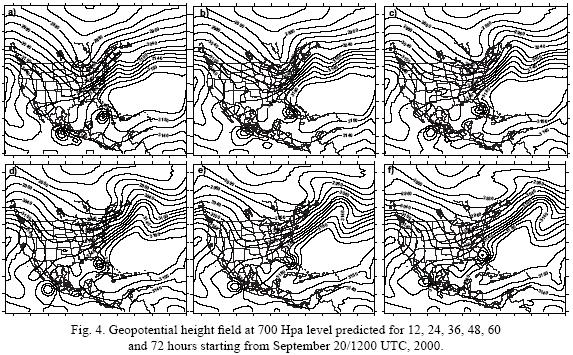
<body><![CDATA[<p align="center"><font face="verdana" size="2"> <a name="f1"></a></font></p>     <p align="center"><font face="verdana" size="2"> <img src="/img/revistas/atm/v20n3/a6f1.jpg"></font></p>     <p align="justify"><font face="verdana" size="2">The analyses of this situation provided the initial conditions for solving the model. <a href="/img/revistas/atm/v20n3/a6f2.jpg" target="_blank">Figure 2a</a> shows the 700 Hpa observed geopotential height field of June 21/1200 UTC, 1996 and also it can be seen the evolution of the Fujiwhara effect, since an hour and a half after running the model (<a href="/img/revistas/atm/v20n3/a6f2.jpg" target="_blank">Fig. 2b</a>), the counterclockwise circulation of the whole system has set the axis joining the cyclonic vortexes at east&#150;west position. This position was detected in the infrared satellite image received on June 22/0615 UTC at the University of Hawaii's station (<a href="/img/revistas/atm/v20n3/a6f2.jpg" target="_blank">Fig. 2c</a>). The model simulates the vortexes merger, in the three hours results (<a href="/img/revistas/atm/v20n3/a6f2.jpg" target="_blank">Fig. 2d</a>), as it is observed in <a href="/img/revistas/atm/v20n3/a6f2.jpg" target="_blank">Figure 2e</a> that shows the infrared satellite image of June 23/1200 UTC; afterwards, the tropical storm Alma moved parallel to the littoral.</font></p>     <p align="justify"><font face="verdana" size="2">The trajectory forecasted by the model fits adequately to the real one; however, the model run is faster than the actual displacement.</font></p>     <p align="justify"><font face="verdana" size="2">For the second kind of interaction, the example exposed in this article is the prediction of the binary system formed by the tropical storm Norman and another MCS on September 20/1200 UTC, 2000, which is observed in <a href="#f3">Figure 3a and 3b</a>, showing respectively an infrared satellite image and the observed 700 Hpa geopotential height field.</font></p>     <p align="center"><font face="verdana" size="2"> <a name="f3"></a></font></p>     <p align="center"><font face="verdana" size="2"> <img src="/img/revistas/atm/v20n3/a6f3.jpg"></font></p>     <p align="justify"><font face="verdana" size="2">In the infrared satellite image of <a href="#f3">Figure 3a</a>, it can be appreciated the tropical storm Norman located westward off Colima and Jalisco states, and the MCS was located southwestward off Guerrero and Oaxaca states. This binary system did not complete the Fujiwhara effect, since an escape was produced, according to Lander and Holland (1993). That is Fujiwhara effect was interrupted, as observed in <a href="#f4">Figure 4</a> with the prediction made by the model, printed every 12 hours.</font></p>     <p align="center"><font face="verdana" size="2"> <a name="f4"></a></font></p>     <p align="center"><font face="verdana" size="2"> <img src="/img/revistas/atm/v20n3/a6f4.jpg"></font></p>     ]]></body>
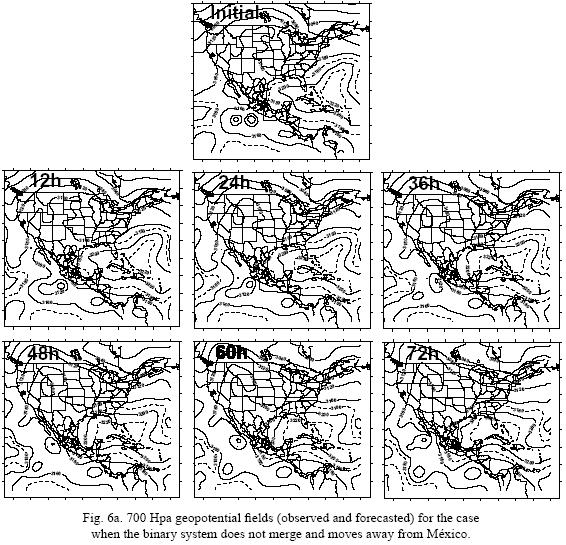
<body><![CDATA[<p align="justify"><font face="verdana" size="2">The forecast of the geopotential height field at 700 Hpa level valid for 12 hours could detect the Fujiwhara effect, which spun the cyclonic vortexes in a counterclockwise sense, making the distances between them decrease slightly. Twelve hours latter, the model run showed that the MCS was getting away itself from tropical storm Norman, because of its interaction with a through that was moving eastward, in such a way that in 36 hours forecast the MCS totally escaped from the influence of Fujiwhara effect, and it may be seen the tropical storm Norman isolated. Later, this tropical cyclone continued moving parallel to the Mexican west coast towards Baja California Peninsula.</font></p>     <p align="justify"><font face="verdana" size="2">The predictions valid for 60 and 72 hours were erroneous, because the tropical storm Norman really kept moving parallel to the continent, (<a href="#f4">Fig. 4</a>). The next day forecast, not shown in this article, detected this behavior of the storm.</font></p>     <p align="justify"><font face="verdana" size="2">The conclusion that has been obtained, after examining the model runs for each one of the cases presented in <a href="#t1">Table I</a>, is that at least one of the binary system elements affected the western coast of M&eacute;xico, as it is observed in <a href="#f5">Figure 5</a>, where real tracks of these systems have been graphically displayed.</font></p>     <p align="center"><font face="verdana" size="2"> <a name="f5"></a></font></p>     <p align="center"><font face="verdana" size="2"> <img src="/img/revistas/atm/v20n3/a6f5.jpg"></font></p>     <p align="justify"><font face="verdana" size="2">Finally, the third part of this paper, tries to find out on what circumstances binary systems do not penetrate to Mexican coasts. All cases were reanalyzed by means of the accomplishing of 87 runs of the model with the observed geopotential height field at 750, 500 and 250 Hpa levels, where the binary vortexes were bogus. Two outputs of these experiments are shown in <a href="#f6a">Figure 6a</a> and <a href="#f6b">6b</a>.</font></p>     <p align="center"><font face="verdana" size="2"> <a name="f6a"></a></font></p>     <p align="center"><font face="verdana" size="2"> <img src="/img/revistas/atm/v20n3/a6f6a.jpg"></font></p>     <p align="center"><font face="verdana" size="2"> <a name="f6b"></a></font></p>     <p align="center"><font face="verdana" size="2"> <img src="/img/revistas/atm/v20n3/a6f6b.jpg"></font></p>     ]]></body>
<body><![CDATA[<p align="justify"><font face="verdana" size="2"><a href="#f6a">Figure 6a</a>, represents the cases when the quasi&#150;stationary Atlantic anticyclone moves on westward, forcing a displacement of the binary system in the same direction, bringing about the escape or dissolution of Fujiwhara merger, putting away a vortex of the binary system from coasts of M&eacute;xico, as it is observed in forecasts every 12 hours in this figure.</font></p>     <p align="justify"><font face="verdana" size="2">In <a href="#f6b">Figure 6b</a>, the experiment consisted in bogusing the vortexes closer and with less intensity. In this case, apparently also will be produced an escape 36 hours ahead off the model run, but it did not happen; however, the vortexes merger was reached 42 hours after running the model, so that the forecast valid for 48 hours shows the tropical storm located southwestward from its initial position, and initiates an interaction with a MCS that at the beginning of the model run was located eastward off the binary system, as it may be seen in the predictions valid every 12 hours of <a href="#f6b">Figure 6b</a>. In both cases, binary systems get apart from Mexican coasts and do not penetrate to the country.</font></p>     <p align="justify"><font face="verdana" size="2">To M&eacute;xico, these results are very important, since they provide new elements to Mexican meteorologists that begin to overcome conclusions from Jarrel <i>et al. </i>(1978) and Lester <i>et al. </i>(1997) referred to how difficult is to achieve acceptable results in predicting binary systems, and they call up the attention about the high probability of having these combinations or interactions between tropical cyclones that land into M&eacute;xico.</font></p>     <p align="justify"><font face="verdana" size="2">&nbsp;</font></p>     <p align="justify"><font face="verdana" size="2"><b>5. Conclusions</b></font></p>     <p align="justify"><font face="verdana" size="2">The results evidence that making use of a simple baroclinic model, it is possible to forecast the binary tropical system paths, including the merger or escape of the vortexes.</font></p>     <p align="justify"><font face="verdana" size="2">The interaction between binary vortexes contributes to generate, besides the environmental conditions, a northwestward movement of them, with or without merger.</font></p>     <p align="justify"><font face="verdana" size="2">All the examined cases of binary tropical cyclones generated southward of 20&deg; North latitude on the northeastern Pacific Ocean from 1984 to 2005, penetrated the west coast of M&eacute;xico, either when it was produced the merger or the escape off the Fujiwhara effect, and then they moved parallel to the continent. Only tropical storm Rosa displaced itself directly towards the west coast, driven by a through (<a href="#f5">Fig. 5</a>).</font></p>     <p align="justify"><font face="verdana" size="2">The model yields satisfactory outputs because it is able to detect the attraction and counterclockwise rotation of the cyclonic vortexes forming the binary systems, which modifies the typical northwestward trajectory of the main storm, including if the vortexes merger occurs or not. In both cases, either the resulting cyclone or the cyclonic vortex that was initially located eastward off the binary system usually penetrates into the continent, and tends to move parallel to the coast, or with the eye over the continent or over the ocean. This result is illustrated by the tropical storm Alma.</font></p>     <p align="justify"><font face="verdana" size="2">If Fujiwhara circulation stops, one of the vortexes also moves parallel to the west coast, as tropical storm Norman did. It is true only when the semipermanent Atlantic anticyclone maintains its typical position.</font></p>     ]]></body>
<body><![CDATA[<p align="justify"><font face="verdana" size="2">The bogus tropical binary cyclones do not make landfall into M&eacute;xico when the quasi&#150;stationary Atlantic anticyclone displaces westward (Buend&iacute;a <i>et al., </i>2004).</font></p>     <p align="justify"><font face="verdana" size="2">&nbsp;</font></p>     <p align="justify"><font face="verdana" size="2"><b>Acknowledgments</b></font></p>     <p align="justify"><font face="verdana" size="2">The authors express their gratitude to Rafael Pati&ntilde;o, Alfonso Salas and Delibes Flores for their cooperation.</font></p>     <p align="justify"><font face="verdana" size="2">&nbsp;</font></p>     <p align="justify"><font face="verdana" size="2"><b>References</b></font></p>     <!-- ref --><p align="justify"><font face="verdana" size="2">Avila L., 1996. Hurricane Alma 20&#150;27 June 1996. Preliminary Report TPC/NHC, Microsoft Internet. 2&#150;7.</font>&nbsp;&nbsp;&nbsp;&nbsp;&nbsp;&nbsp;&nbsp;&nbsp;[&#160;<a href="javascript:void(0);" onclick="javascript: window.open('/scielo.php?script=sci_nlinks&ref=1265405&pid=S0187-6236200700030000600001&lng=','','width=640,height=500,resizable=yes,scrollbars=1,menubar=yes,');">Links</a>&#160;]<!-- end-ref --><!-- ref --><p align="justify"><font face="verdana" size="2">Brand S., 1970. Interaction of binary tropical cyclones of the western North Pacific. <i>Ocean J. Appl. Meteor. </i><strong>9</strong>, 433&#150;441.</font>&nbsp;&nbsp;&nbsp;&nbsp;&nbsp;&nbsp;&nbsp;&nbsp;[&#160;<a href="javascript:void(0);" onclick="javascript: window.open('/scielo.php?script=sci_nlinks&ref=1265406&pid=S0187-6236200700030000600002&lng=','','width=640,height=500,resizable=yes,scrollbars=1,menubar=yes,');">Links</a>&#160;]<!-- end-ref --><!-- ref --><p align="justify"><font face="verdana" size="2">Buend&iacute;a E., O. Delgado, F. Villica&ntilde;a, E. del Valle, R. Pati&ntilde;o y A. Gallegos, 1984. El modelo barocl&iacute;nico simple y su resoluci&oacute;n en la Cuarta Regi&oacute;n. <i>Rev. Geof&iacute;sica, </i>Institutto Panamericano de Geograf&iacute;a e Historia. <b>21, </b>125&#150;145.</font>&nbsp;&nbsp;&nbsp;&nbsp;&nbsp;&nbsp;&nbsp;&nbsp;[&#160;<a href="javascript:void(0);" onclick="javascript: window.open('/scielo.php?script=sci_nlinks&ref=1265407&pid=S0187-6236200700030000600003&lng=','','width=640,height=500,resizable=yes,scrollbars=1,menubar=yes,');">Links</a>&#160;]<!-- end-ref --><!-- ref --><p align="justify"><font face="verdana" size="2">Buend&iacute;a E., F. Villica&ntilde;a, O. Delgado, E. del Valle and F. G&oacute;mez, 1993. On the trajectory of cyclones likely to affect the Mexican Republic. <i>Atm&oacute;sfera </i><strong>5</strong>, 21&#150;30.</font>&nbsp;&nbsp;&nbsp;&nbsp;&nbsp;&nbsp;&nbsp;&nbsp;[&#160;<a href="javascript:void(0);" onclick="javascript: window.open('/scielo.php?script=sci_nlinks&ref=1265408&pid=S0187-6236200700030000600004&lng=','','width=640,height=500,resizable=yes,scrollbars=1,menubar=yes,');">Links</a>&#160;]<!-- end-ref --><!-- ref --><p align="justify"><font face="verdana" size="2">Buend&iacute;a E., O. Delgado, A. Meulenert and C. V&aacute;zquez. 2004. Interaction of binary cyclones in northeastern Pacific Ocean, <i>American Meteorol. Soc. </i>26th Conference on Hurricanes and Tropical Meteorology, 483&#150;484.</font>&nbsp;&nbsp;&nbsp;&nbsp;&nbsp;&nbsp;&nbsp;&nbsp;[&#160;<a href="javascript:void(0);" onclick="javascript: window.open('/scielo.php?script=sci_nlinks&ref=1265409&pid=S0187-6236200700030000600005&lng=','','width=640,height=500,resizable=yes,scrollbars=1,menubar=yes,');">Links</a>&#160;]<!-- end-ref --><!-- ref --><p align="justify"><font face="verdana" size="2">Dong K. and C. Neumann, 1983. On the relative motion of binary tropical cyclones. <i>Mon. Wea. Rev. </i><strong>111</strong>, 945&#150;953.</font>&nbsp;&nbsp;&nbsp;&nbsp;&nbsp;&nbsp;&nbsp;&nbsp;[&#160;<a href="javascript:void(0);" onclick="javascript: window.open('/scielo.php?script=sci_nlinks&ref=1265410&pid=S0187-6236200700030000600006&lng=','','width=640,height=500,resizable=yes,scrollbars=1,menubar=yes,');">Links</a>&#160;]<!-- end-ref --><!-- ref --><p align="justify"><font face="verdana" size="2">Fujiwhara S., 1921. The natural tendency towards symmetry of motion and its application as a principle of motion. <i>Q. J. R. Meteorol. Soc. </i><strong>47</strong>, 287&#150;293.</font>&nbsp;&nbsp;&nbsp;&nbsp;&nbsp;&nbsp;&nbsp;&nbsp;[&#160;<a href="javascript:void(0);" onclick="javascript: window.open('/scielo.php?script=sci_nlinks&ref=1265411&pid=S0187-6236200700030000600007&lng=','','width=640,height=500,resizable=yes,scrollbars=1,menubar=yes,');">Links</a>&#160;]<!-- end-ref --><!-- ref --><p align="justify"><font face="verdana" size="2">Fujiwhara S., 1923. On the growth and decay of vortical systems. <i>Q. J. R. Meteorol. Soc. </i><strong>49</strong>, 75&#150;104.</font>&nbsp;&nbsp;&nbsp;&nbsp;&nbsp;&nbsp;&nbsp;&nbsp;[&#160;<a href="javascript:void(0);" onclick="javascript: window.open('/scielo.php?script=sci_nlinks&ref=1265412&pid=S0187-6236200700030000600008&lng=','','width=640,height=500,resizable=yes,scrollbars=1,menubar=yes,');">Links</a>&#160;]<!-- end-ref --><!-- ref --><p align="justify"><font face="verdana" size="2">Fujiwhara S., 1931. Short note on the behavior of two vortices. <i>Proc. Phys. Math. Soc. Japan, Ser. </i><strong>13</strong>, 106&#150;110.</font>&nbsp;&nbsp;&nbsp;&nbsp;&nbsp;&nbsp;&nbsp;&nbsp;[&#160;<a href="javascript:void(0);" onclick="javascript: window.open('/scielo.php?script=sci_nlinks&ref=1265413&pid=S0187-6236200700030000600009&lng=','','width=640,height=500,resizable=yes,scrollbars=1,menubar=yes,');">Links</a>&#160;]<!-- end-ref --><!-- ref --><p align="justify"><font face="verdana" size="2">Holland G. J. and G. S. Dietachmayer, 1993. On the interaction of tropical&#150;cyclone&#150;scale vortices. III: Continuos barotropic vortices. <i>Q. J. R. Meteorol. Soc. </i><b>119</b>, 1381&#150;1389.</font>&nbsp;&nbsp;&nbsp;&nbsp;&nbsp;&nbsp;&nbsp;&nbsp;[&#160;<a href="javascript:void(0);" onclick="javascript: window.open('/scielo.php?script=sci_nlinks&ref=1265414&pid=S0187-6236200700030000600010&lng=','','width=640,height=500,resizable=yes,scrollbars=1,menubar=yes,');">Links</a>&#160;]<!-- end-ref --><!-- ref --><p align="justify"><font face="verdana" size="2">Jarrel J., D. Brand and S. Nicklin, 1978. An analysis of western North Pacific tropical cyclone forecast errors. <i>Mon. Wea. Rev. </i><b>106, </b>925&#150;937.</font>&nbsp;&nbsp;&nbsp;&nbsp;&nbsp;&nbsp;&nbsp;&nbsp;[&#160;<a href="javascript:void(0);" onclick="javascript: window.open('/scielo.php?script=sci_nlinks&ref=1265415&pid=S0187-6236200700030000600011&lng=','','width=640,height=500,resizable=yes,scrollbars=1,menubar=yes,');">Links</a>&#160;]<!-- end-ref --><!-- ref --><p align="justify"><font face="verdana" size="2">Lander M. and G. J. Holland, 1993. On the interaction of tropical&#150;cyclone&#150;scale vortices. Observations. <i>Q. J. R. Meteorol. Soc. </i><b>119, </b>1347&#150;1361.</font>&nbsp;&nbsp;&nbsp;&nbsp;&nbsp;&nbsp;&nbsp;&nbsp;[&#160;<a href="javascript:void(0);" onclick="javascript: window.open('/scielo.php?script=sci_nlinks&ref=1265416&pid=S0187-6236200700030000600012&lng=','','width=640,height=500,resizable=yes,scrollbars=1,menubar=yes,');">Links</a>&#160;]<!-- end-ref --><!-- ref --><p align="justify"><font face="verdana" size="2">Lester E. C. III, M. A. Boothe and R. L. Elsberry, 1997. Obsevational evidence for alternate modes of track&#150;altering binary tropical cyclone scenarios. <i>Mon. Wea. Rev. </i><b>125</b>, 2094&#150;2111.</font>&nbsp;&nbsp;&nbsp;&nbsp;&nbsp;&nbsp;&nbsp;&nbsp;[&#160;<a href="javascript:void(0);" onclick="javascript: window.open('/scielo.php?script=sci_nlinks&ref=1265417&pid=S0187-6236200700030000600013&lng=','','width=640,height=500,resizable=yes,scrollbars=1,menubar=yes,');">Links</a>&#160;]<!-- end-ref --><!-- ref --><p align="justify"><font face="verdana" size="2">Neumann C. J., 1982. Trends in forecasting the tracks of tropical Atlantic cyclones. <i>Bull. Amer. Meteor. Soc. </i><b>62, </b>1472&#150;1485.</font>&nbsp;&nbsp;&nbsp;&nbsp;&nbsp;&nbsp;&nbsp;&nbsp;[&#160;<a href="javascript:void(0);" onclick="javascript: window.open('/scielo.php?script=sci_nlinks&ref=1265418&pid=S0187-6236200700030000600014&lng=','','width=640,height=500,resizable=yes,scrollbars=1,menubar=yes,');">Links</a>&#160;]<!-- end-ref --><!-- ref --><p align="justify"><font face="verdana" size="2">Ritchie E. A. and G. J. Holland, 1993. On the interaction of tropical&#150;cyclone&#150;scale vortices. II: Discrete vortex patches. <i>Q. J. R. Meteorol. Soc. </i><b>119</b>, 1363&#150;1379.</font>&nbsp;&nbsp;&nbsp;&nbsp;&nbsp;&nbsp;&nbsp;&nbsp;[&#160;<a href="javascript:void(0);" onclick="javascript: window.open('/scielo.php?script=sci_nlinks&ref=1265419&pid=S0187-6236200700030000600015&lng=','','width=640,height=500,resizable=yes,scrollbars=1,menubar=yes,');">Links</a>&#160;]<!-- end-ref --><!-- ref --><p align="justify"><font face="verdana" size="2">Wang Y. and G. J. Holland, 1995. On the interaction of tropical&#150;scale&#150;vortices. IV: Baroclinic vortices. <i>Q. J. R. Meteorol. Soc. </i><b>121</b>, 95&#150;126.</font>&nbsp;&nbsp;&nbsp;&nbsp;&nbsp;&nbsp;&nbsp;&nbsp;[&#160;<a href="javascript:void(0);" onclick="javascript: window.open('/scielo.php?script=sci_nlinks&ref=1265420&pid=S0187-6236200700030000600016&lng=','','width=640,height=500,resizable=yes,scrollbars=1,menubar=yes,');">Links</a>&#160;]<!-- end-ref --> ]]></body><back>
<ref-list>
<ref id="B1">
<nlm-citation citation-type="book">
<person-group person-group-type="author">
<name>
<surname><![CDATA[Avila]]></surname>
<given-names><![CDATA[L.]]></given-names>
</name>
</person-group>
<source><![CDATA[Hurricane Alma 20-27 June 1996: Preliminary Report TPC/NHC]]></source>
<year>1996</year>
<page-range>2-7</page-range><publisher-name><![CDATA[Microsoft Internet]]></publisher-name>
</nlm-citation>
</ref>
<ref id="B2">
<nlm-citation citation-type="journal">
<person-group person-group-type="author">
<name>
<surname><![CDATA[Brand]]></surname>
<given-names><![CDATA[S.]]></given-names>
</name>
</person-group>
<article-title xml:lang="en"><![CDATA[Interaction of binary tropical cyclones of the western North Pacific]]></article-title>
<source><![CDATA[Ocean J. Appl. Meteor.]]></source>
<year>1970</year>
<volume>9</volume>
<page-range>433-441</page-range></nlm-citation>
</ref>
<ref id="B3">
<nlm-citation citation-type="journal">
<person-group person-group-type="author">
<name>
<surname><![CDATA[Buendía]]></surname>
<given-names><![CDATA[E.]]></given-names>
</name>
<name>
<surname><![CDATA[Delgado]]></surname>
<given-names><![CDATA[O.]]></given-names>
</name>
<name>
<surname><![CDATA[Villicaña]]></surname>
<given-names><![CDATA[F.]]></given-names>
</name>
<name>
<surname><![CDATA[del Valle]]></surname>
<given-names><![CDATA[E.]]></given-names>
</name>
<name>
<surname><![CDATA[Patiño]]></surname>
<given-names><![CDATA[R.]]></given-names>
</name>
<name>
<surname><![CDATA[Gallegos]]></surname>
<given-names><![CDATA[A.]]></given-names>
</name>
</person-group>
<article-title xml:lang="es"><![CDATA[El modelo baroclínico simple y su resolución en la Cuarta Región]]></article-title>
<source><![CDATA[Rev. Geofísica]]></source>
<year>1984</year>
<volume>21</volume>
<page-range>125-145</page-range><publisher-name><![CDATA[Institutto Panamericano de Geografía e Historia]]></publisher-name>
</nlm-citation>
</ref>
<ref id="B4">
<nlm-citation citation-type="journal">
<person-group person-group-type="author">
<name>
<surname><![CDATA[Buendía]]></surname>
<given-names><![CDATA[E.]]></given-names>
</name>
<name>
<surname><![CDATA[Villicaña]]></surname>
<given-names><![CDATA[F.]]></given-names>
</name>
<name>
<surname><![CDATA[Delgado]]></surname>
<given-names><![CDATA[O.]]></given-names>
</name>
<name>
<surname><![CDATA[del Valle]]></surname>
<given-names><![CDATA[E.]]></given-names>
</name>
<name>
<surname><![CDATA[Gómez]]></surname>
<given-names><![CDATA[F.]]></given-names>
</name>
</person-group>
<article-title xml:lang="en"><![CDATA[On the trajectory of cyclones likely to affect the Mexican Republic]]></article-title>
<source><![CDATA[Atmósfera]]></source>
<year>1993</year>
<volume>5</volume>
<page-range>21-30</page-range></nlm-citation>
</ref>
<ref id="B5">
<nlm-citation citation-type="confpro">
<person-group person-group-type="author">
<name>
<surname><![CDATA[Buendía]]></surname>
<given-names><![CDATA[E.]]></given-names>
</name>
<name>
<surname><![CDATA[Delgado]]></surname>
<given-names><![CDATA[O.]]></given-names>
</name>
<name>
<surname><![CDATA[Meulenert]]></surname>
<given-names><![CDATA[A.]]></given-names>
</name>
<name>
<surname><![CDATA[Vázquez]]></surname>
<given-names><![CDATA[C.]]></given-names>
</name>
</person-group>
<source><![CDATA[Interaction of binary cyclones in northeastern Pacific Ocean]]></source>
<year>2004</year>
<conf-name><![CDATA[ American Meteorol. Soc. 26th Conference on Hurricanes and Tropical Meteorology]]></conf-name>
<conf-loc> </conf-loc>
<page-range>483-484</page-range></nlm-citation>
</ref>
<ref id="B6">
<nlm-citation citation-type="journal">
<person-group person-group-type="author">
<name>
<surname><![CDATA[Dong]]></surname>
<given-names><![CDATA[K.]]></given-names>
</name>
<name>
<surname><![CDATA[Neumann]]></surname>
<given-names><![CDATA[C.]]></given-names>
</name>
</person-group>
<article-title xml:lang="en"><![CDATA[On the relative motion of binary tropical cyclones]]></article-title>
<source><![CDATA[Mon. Wea. Rev.]]></source>
<year>1983</year>
<volume>111</volume>
<page-range>945-953</page-range></nlm-citation>
</ref>
<ref id="B7">
<nlm-citation citation-type="journal">
<person-group person-group-type="author">
<name>
<surname><![CDATA[Fujiwhara]]></surname>
<given-names><![CDATA[S.]]></given-names>
</name>
</person-group>
<article-title xml:lang="en"><![CDATA[The natural tendency towards symmetry of motion and its application as a principle of motion]]></article-title>
<source><![CDATA[Q. J. R. Meteorol. Soc.]]></source>
<year>1921</year>
<volume>47</volume>
<page-range>287-293</page-range></nlm-citation>
</ref>
<ref id="B8">
<nlm-citation citation-type="journal">
<person-group person-group-type="author">
<name>
<surname><![CDATA[Fujiwhara]]></surname>
<given-names><![CDATA[S.]]></given-names>
</name>
</person-group>
<article-title xml:lang="en"><![CDATA[On the growth and decay of vortical systems]]></article-title>
<source><![CDATA[Q. J. R. Meteorol. Soc.]]></source>
<year>1923</year>
<volume>49</volume>
<page-range>75-104</page-range></nlm-citation>
</ref>
<ref id="B9">
<nlm-citation citation-type="journal">
<person-group person-group-type="author">
<name>
<surname><![CDATA[Fujiwhara]]></surname>
<given-names><![CDATA[S.]]></given-names>
</name>
</person-group>
<article-title xml:lang="en"><![CDATA[Short note on the behavior of two vortices]]></article-title>
<source><![CDATA[Proc. Phys. Math. Soc. Japan, Ser.]]></source>
<year>1931</year>
<volume>13</volume>
<page-range>106-110</page-range></nlm-citation>
</ref>
<ref id="B10">
<nlm-citation citation-type="journal">
<person-group person-group-type="author">
<name>
<surname><![CDATA[Holland]]></surname>
<given-names><![CDATA[G. J.]]></given-names>
</name>
<name>
<surname><![CDATA[Dietachmayer]]></surname>
<given-names><![CDATA[G. S.]]></given-names>
</name>
</person-group>
<article-title xml:lang="en"><![CDATA[On the interaction of tropical-cyclone-scale vortices. III: Continuos barotropic vortices]]></article-title>
<source><![CDATA[Q. J. R. Meteorol. Soc.]]></source>
<year>1993</year>
<volume>119</volume>
<page-range>1381-1389</page-range></nlm-citation>
</ref>
<ref id="B11">
<nlm-citation citation-type="journal">
<person-group person-group-type="author">
<name>
<surname><![CDATA[Jarrel]]></surname>
<given-names><![CDATA[J.]]></given-names>
</name>
<name>
<surname><![CDATA[Brand]]></surname>
<given-names><![CDATA[D.]]></given-names>
</name>
<name>
<surname><![CDATA[Nicklin]]></surname>
<given-names><![CDATA[S.]]></given-names>
</name>
</person-group>
<article-title xml:lang="en"><![CDATA[An analysis of western North Pacific tropical cyclone forecast errors]]></article-title>
<source><![CDATA[Mon. Wea. Rev.]]></source>
<year>1978</year>
<volume>106</volume>
<page-range>925-937</page-range></nlm-citation>
</ref>
<ref id="B12">
<nlm-citation citation-type="journal">
<person-group person-group-type="author">
<name>
<surname><![CDATA[Lander]]></surname>
<given-names><![CDATA[M.]]></given-names>
</name>
<name>
<surname><![CDATA[Holland]]></surname>
<given-names><![CDATA[G. J.]]></given-names>
</name>
</person-group>
<article-title xml:lang="en"><![CDATA[On the interaction of tropical-cyclone-scale vortices]]></article-title>
<source><![CDATA[Q. J. R. Meteorol. Soc.]]></source>
<year>1993</year>
<volume>119</volume>
<page-range>1347-1361</page-range></nlm-citation>
</ref>
<ref id="B13">
<nlm-citation citation-type="journal">
<person-group person-group-type="author">
<name>
<surname><![CDATA[Lester]]></surname>
<given-names><![CDATA[E. C. III]]></given-names>
</name>
<name>
<surname><![CDATA[Boothe]]></surname>
<given-names><![CDATA[M. A.]]></given-names>
</name>
<name>
<surname><![CDATA[Elsberry]]></surname>
<given-names><![CDATA[R. L.]]></given-names>
</name>
</person-group>
<article-title xml:lang="en"><![CDATA[Obsevational evidence for alternate modes of track-altering binary tropical cyclone scenarios]]></article-title>
<source><![CDATA[Mon. Wea. Rev.]]></source>
<year>1997</year>
<volume>125</volume>
<page-range>2094-2111</page-range></nlm-citation>
</ref>
<ref id="B14">
<nlm-citation citation-type="journal">
<person-group person-group-type="author">
<name>
<surname><![CDATA[Neumann]]></surname>
<given-names><![CDATA[C. J.]]></given-names>
</name>
</person-group>
<article-title xml:lang="en"><![CDATA[Trends in forecasting the tracks of tropical Atlantic cyclones]]></article-title>
<source><![CDATA[Bull. Amer. Meteor. Soc.]]></source>
<year>1982</year>
<volume>62</volume>
<page-range>1472-1485</page-range></nlm-citation>
</ref>
<ref id="B15">
<nlm-citation citation-type="journal">
<person-group person-group-type="author">
<name>
<surname><![CDATA[Ritchie]]></surname>
<given-names><![CDATA[E. A.]]></given-names>
</name>
<name>
<surname><![CDATA[Holland]]></surname>
<given-names><![CDATA[G. J.]]></given-names>
</name>
</person-group>
<article-title xml:lang="en"><![CDATA[On the interaction of tropical-cyclone-scale vortices. II: Discrete vortex patches]]></article-title>
<source><![CDATA[Q. J. R. Meteorol. Soc.]]></source>
<year>1993</year>
<volume>119</volume>
<page-range>1363-1379</page-range></nlm-citation>
</ref>
<ref id="B16">
<nlm-citation citation-type="journal">
<person-group person-group-type="author">
<name>
<surname><![CDATA[Wang]]></surname>
<given-names><![CDATA[Y.]]></given-names>
</name>
<name>
<surname><![CDATA[Holland]]></surname>
<given-names><![CDATA[G. J.]]></given-names>
</name>
</person-group>
<article-title xml:lang="en"><![CDATA[On the interaction of tropical-scale-vortices. IV: Baroclinic vortices]]></article-title>
<source><![CDATA[Q. J. R. Meteorol. Soc.]]></source>
<year>1995</year>
<volume>121</volume>
<page-range>95-126</page-range></nlm-citation>
</ref>
</ref-list>
</back>
</article>