
Javier de la Garza and Alejandro Arango. Reevaluating Signs of Identity
Teresa Eckmann
University of New Mexico
Resumen
]]> Examinando la obra de arte, las fuentes de inspiración y la filosofía artística de Alejandro Arango y Javier de la Garza, la autora, en este artículo, demuestra que la subversión es el aspecto clave del así denominado neo-mexicanismo, de moda en los años ochenta. La autora se enfoca en una serie de pinturas contenidas en La conquista de Arango e Inocencia perdida de De la Garza, exhibiciones presentadas en la ciudad de México en la Galería OMR a mediados de los años ochenta. Lo que motiva a cada artista al tratamiento particular de un tema común —la conquista— es revelado. La autora plantea cómo las obras de Arango y De la Garza sintetizan construcciones de identidad nacional, y propone que el arte neo-mexicanista no exalta ciegamente, y en cambio en ciertos momentos parodia de manera evidente un nacionalismo oficial que glorifica el pasado indígena al tiempo que ignora la gran presencia indígena privada de derechos civiles.
Abstract
Examining the artwork, sources of inspiration, and artistic philosophies of artists Alejandro Arango, and Javier de la Garza in this article, the author shows that subversion is a key aspect of the so-called neo-Mexicanist current of the 1980s. The author focuses on a series of paintings comprising Arango's La conquista (The Conquest) and De la Garza's Inocencia perdida (Lost Innocence), exhibitions presented in Mexico City at the Galería OMR in the mid-1 980s. What motivates each artist's particular treatment of a common theme—the Conquest—is revealed. Showing how Arango and De la Garza's artwork challenges essentializing constructions of national identity, the author proposes that neo-Mexicanist art does not blindly praise, but at times blatantly parodies an official nationalism that glorifies the indigenous past while it ignores the largely disenfranchised indigenous presence.
One is Mexican because he is Mexican — not because he is
painting serapes.
Javier de la Garza1
]]> Targeting those signs of cultural identity encoded as stereotype that are propagated through mass media and consumer culture, artists Alejandro Arango (b. 1950) and Javier de la Garza (b. 1954), explored with distinct results one direction within the neo-Mexicanist current of Mexican figurative painting of the 1980s. Both Arango and De la Garza used the Conquest of Mexico as the basis for developing bodies of work in the mid-1980s. The themes of machismo, mestizaje, and indigenismo run through this contemporary critique inspired by and poking fun at an es-sentializing discourse of mexicanidad. Here the artists approach painting with a skepticism that seeks to separate myth from reality, and to illustrate the reality of myth, through exaggerated form and strident color. De la Garza chooses to idealize his subjects; Arango distorts them. Drawing from the evocative aesthetic of publicity advertising, both artists seduce and intrigue the viewer — not in the hyper-realist way of an artist such as their contemporary Rafael Cauduro who at that time convincingly replicated Calvin Klein ads as in El San Sebastián (fig. 1) of 1986 — but with an artifice that smacks of saccharine and a sense of camp that delights. The Galería OMR presented Arango's individual exhibition La conquista (The Conquest) in November of 1986, and De la Garza's Inocencia perdida (Lost Innocence) three months later. A close examination of the content of these exhibitions, and the ideology behind the work, will clearly show that neo-Mexicanist art does not blindly praise, but at times blatantly parodies glorified nationalism.
The Stage
La conquista and Inocencia perdida are grounded in a national historical event of mythic proportions — the fall of Tenochtitlán in 1521 and the conquest of the Mesoamerican peoples by the Spaniards — that has been interpreted in visual form over the past five centuries. However, Arango and De la Garza's paintings are not about defeat, but about intrigue and seduction. La conquista awkwardly describes the union of Spaniards and indigenous women, while Inocencia perdida showcases the conquistadors' opponents, the Aztec warriors. These two artists draw from the same general themes that in- spired the academic "history painters" of the late-nineteenth century. They also express a similar penchant for invention and high drama similar to that found in works such as Leandro Izaguirre's El suplicio de Cuauhtemoc (Torture of Cuauhtémoc) of 1892 and Félix Parra's Episodios de la conquista (Episodes of the Conquest) of 1877. That both Arango and De la Garza have worked in stage design may partially account for the high element of theatricality apparent in these series. One should not be misled into regarding the work as a kind of national revivalist art. As Carlos Monsiváis points out in reference to neo-Mexicanist art, "There was a time when resorting to the symbols and colors of the village meant proclaiming national identity; today these extended and desolemnized proposals are reworking ideas from both the past and the present."2 In doing the latter, Arango and De la Garza attain results that are anachronistic, innovative, and satirical.
Twenty-eight works, predominantly large-scale paintings, comprised La conquista, while Inocencia perdida presented fifteen large-scale paintings. La batalla, the largest painting included in Arango's exhibition, measured five feet by ten feet, while De la Garza's paintings averaged nine and one-half feet by four and a half feet. For these two artists, the Conquest becomes a stage where deceit is vindicated with retro imagery. Familiar figures that include Hernán Cortés, La Malinche (doña Marina), Cuauhtémoc, conquistadores, and Indian women and warriors parade before us proclaiming official history to be fiction, invention, and fantasy.
Lost Innocence
Camp discloses innocence, but also, when it can, corrupts it. ]]>
Susan Sontag3
Several visual sources from art history, popular art, and the advertising industry inspired the imagery and philosophical stance of Inocencia perdida. De la Garza explains, "I purposefully set out to literally immerse myself in patriotic symbols, in the idea of machismo, and the [national] heroes — but not at any moment did I intend to participate in the Mexicanism [current]."4 Inocencia perdida's cast of characters appears to have stepped right out of an Olympic pantheon. Their hyper-sexualization and objectification reaches even further beyond the kitsch aesthetic propagated by the mid-twentieth century Mexican chromolithograph calendars of which De la Garza's series reminds us. The term kitsch refers to "art, writing, etc. of a pretentious, but shallow kind, calculated to have popular appeal."5 These brightly colored, illustrated calendars, commissioned by corporate sponsors, served as an early form of modern publicity as they promoted brands and products, as well as visions of an idealized and utopian Mexico.6 The calendars followed in the tradition of the romantic costumbrista art of the nineteenth century where foreign artists traveling through Mexico such as Claudio Linati and Eduardo Pingret created seemingly ethnographic, and decidedly stereotypical, portraits of the Mexican landscape and its inhabitants. From the 1930s to the 1970s, numerous artists working for calendar factories such as Galas de México participated in building a "Mexicana" image of the nation for the consumer industry, not unlike for example, the work of Norman Rockwell in the United States. De la Garza openly concedes that these chromolithographs, with a work such as Jesús Helguera's Gesto azteca of ca. 1961 (fig. 2) as a good example, served as a source of inspiration for his painting during the mid-to-late 1980s.

In an interesting twist of reappropriation, the Volkswagen Company of Mexico commisioned a calendar for the year 1990 that showcased a different painting by De la Garza for every month of the year (fig. 3). As a natural succession to Inocencia perdida, De la Garza turned from the chromolithographs to a complementary source: for many of the works included in the calendar, and in his second individual exhibition at the Galería OMR in the fall of 1989, he used photographs by Gabriel Figueroa from Mexican "Golden era" films such as Enemigos (1933), La perla (1945), Un día de vida (1950), and Una cita de amor (1956) all directed by Emilio Fernández (with the exception of Enemigos which was directed by Chano Urueta). Resorting to the use of the chromolithographs and film still shots as sources (among others) for his work, exemplifies a Mexican post-modernism that Cuban art historian Gerardo Mosquera has described as "defined by its incorporation of materials taken from art itself as a field external to the artistic act itself, that is, it incorporates a 'dead' art, an art which we look at in history; it also incorporates 'anti-art' or 'pseudo-art,' that is, art which belongs to other systems like kitsch and the 'savage' culture of our epoch."7

Confirming Mosquera's statement above, De la Garza explains how he conceived Inocencia perdida:
]]> I wanted to work on the theme of national heroes, to parody them, so I returned to my childhood memories. I went to the Zócalo in search of those laminated illustrations that as a child one buys to learn about heroes and the flag; they have a picture on the front and a historic description on the back. The funniest thing is what it says on the back — the "official" story that is one's primary school education — one that is basic, manipulated, and entertaining. I bought everything that I could find and returned to Paris. Cuauhtemoc was my first painting [in the series].8
One is immediately struck by the monumentality of De la Garza's portrayal of the young Aztec emperor Cuauhtémoc (fig. 4) who was defeated by Cortés in 1521. If this warrior were depicted full-length he would reach more than ten feet in height. The scale alone of the work demands that the viewer see it within the context of the legacy of Mexican Muralism. But absent from De la Garza's work is any stylistic and formal resemblance to David Alfaro Siqueiros's treatment of the same subject. We do not encounter in De la Garza's painting the narratives, dynamism and violence, or the overt anticolonial message that we find in murals treating similar subject matter such as Siqueiros's Cuauhtémoc Against the Myth of 1944, or The Torment of Cuauhtémoc of 1950. De la Garza recycles signs of the national in a contemporary context. The artist states, "I was living in Paris when the idea came to me to rework the concept of indigenism/Mexicanness but [in a way that was] 'modern' or up to date. They [the Aztec warriors] obviously had to be well nourished and attractive, with the presence of a tangible eroticism."9 Here Cuauhtémoc more closely resembles a Las Vegas performer than a typical depiction of the national hero. He stands in profile, erect, centrally placed, and framed by a panoramic landscape. Scantily draped from his waist is a patriotic and diminutive covering — the tri-color red, white, and green Mexican national flag. On his head he wears a Roman-like helmet with protruding feathers added — again patriotically tri-colored — the shape of which is reminiscent of either a horse's mane or a punk hairdo. His lips are painted ruby red and his skin is golden brown. We are witnessing the moment when, as De la Garza explains, the martyr says to Cortés, "Take your dagger, open my veins, let me bleed, until I die, etcetera."10 Rather than a familiar visual interpretation of the moment when the last Aztec emperor was tortured with fire by Cortés and the conquistadors as narrated in history books and in visual art, De la Garza appears to have "captured" Cuauhtémoc in an erotic encounter or in a melodramatic scene right out of a telenovela (soap opera). The homoeroticism evoked by the sensuous image would, acording to the artist, "turn the head of even the biggest macho."11

De la Garza's Inocencia perdida embodies a camp sensibility. In her brilliant essay defining the parameters of "camp" Susan Sontag states, "the essence of Camp is its love of the unnatural: of artifice and exaggeration... it is something of a private code, a badge of identity... a sensibility that, among other things, converts the serious into the frivolous."12 She goes on to say, "For Camp art is often decorative art, emphasizing texture, sensuous surface, and style at the expense of content."13 Camp succeeds when it results in enjoyment for the viewer, when it "reeks of self-love," and when it achieves the expression of a failed seriousness. De la Garza's work evokes a few additional key aspects of camp that are noted by Sontag in her essay: camp is playful, extravagant, theatrical, and more ironic than tragic. In camp, the past is viewed with sentimentality. At the core of camp lies a love of human nature. Camp delights even in its vulgarity.
Soñando en la venida (Dreaming of the Coming, fig. 5) presents a robust Indian king, perhaps the poet Nezahualcóyotl who ruled Texcoco during the fifteenth century, as he envisions the future arrival of the Spaniards. The sky transforms into the ocean upon which a ghostly ship approaches. Bare chested, wrapped in a royal blue loincloth with fabric folds that are sumptuously painted, wearing a crown with a quetzal plume, lit with a golden aura, with his fists ever so slightly clenched at his sides, the king gazes at the future both with apprehension and determination. He presents the perfect picture of male virility. The nopal behind him is a sign of his homeland. The doves and the roses add a further note of romantic kitsch to the scene. In perfect post-modern form, the artist has appropriated Anáhuac (fig. 6), an image painted in 1910 by Jorge Enciso that diverged from the European-influenced artwork of that time. In his own words Enciso described the work as "a big Indian two meters high. It shocked people accustomed to musqueteers and odalisques."14 Enciso's indigenous male represents a renewed nationalism. He embodies both sacrifice (his outstretched arms evoke the crucifixion) and triumph in his stance. De la Garza plunders the imagery of the past to address the exploitation of culture in the present. He explains: "I am interested in the image, the icon, and the message; that is what my work is based in — manipulation, displacement through criticism, the commonplace, and the distribution of exhausted images."15


The Mexico 86 series shares an affinity with photographs by Argentine-born, Mexican resident Gerardo Suter from the series El archivo fotográfico del profesor Retus (The Photographic Archive of Professor Retus) of 1985. Several of these photographs of pre-Hispanic monuments were exhibited in 17 Artistas de hoy en México.17 In subsequent exhibitions, Suter presented the series as if they were "snapshots" taken in the 1930s by a fictional archeolo-gist, Professor Retus ("Suter" spelled backwards) that were found in a suitcase among the ruins of the September 19, 1985 earthquake. Suter's intention behind a work such as Tollán 14 (fig. 7) was not to glorify the past, but in fact, to deride the foreigner's taste for the exotic. According to the artist, this intention backfired as ensuing series of ritualized, staged photographs, particularly De esta tierra, del cielo y los infiernos (Of This Earth, Heaven, and Hell), exquisitely textured images of nudes with masks representing various pre-Hispanic gods, were read and marketed within the primitivist/exotic discourse. Of further interest is that Suter was invited to submit a proposal to Televisa for the World Cup Soccer promotional imagery. Although Suter was not selected for the job, his proposal was similar to what Leibovitz eventually produced.18

Does Leibovitz parody and consciously exploit concepts of mexicanidad, exoticism, the glorification of the sports industry, and the use of culture for commerce, or does she simply represent and advance such practices? Part of the effectiveness of the work is the tenuous line that it walks between sobriety and camp. De la Garza states that "they [Leibovitz's Mexico 86 series] were useful, among other things, as a platform to talk about idealized and fictitious images that are inspired by foreign stereotypes of beauty."19 De la Garza views Leibovitz's series as that of a foreigner imposing false ideals on the discourse of Mexican identity. In response, he chooses to use the same elements as Leibovitz as a platform for staging a parody; in other words, he picks up the ball and runs with it.
La raza de bronce (The Bronze Race, fig. 8) for example, can be compared with one photograph in particular (fig. 9) from the Mexico 86 series. The title of De la Garza's painting is a direct reference to La raza cósmica, the now classic and highly criticized work (for its undercurrent of white-supremacist attitudes) by intellectual José Vasconcelos that was published in 1925. De la Garza states with disgust, "Vasconcelos concludes his history of Mexico by saying that the best thing that could have happened is that they [the Spaniards] conquered us. I said 'What?' [For me] that means that each person can make [history] out to be what they want it to be."20 With La raza de bronce the artist presents a frontal figure — the mestizo archetype of the "Bronze Race." The solid mass of muscle is a cross between California governor, actor, and bodybuilder Arnold Schwarzenegger and the Hulk. His body literally appears cast in bluish-black bronze with a gold and rosa mexicano (fluorescent pink) patina; the multiple colors serve as a metaphor for his hbrid nature. Posing his subject against a gold leaf background and enclosing him in a thick frame of fake leopard skin, De la Garza challenges Vasconcelos, makes explicit Leibovitz's subtext, and turns her glamour shot into a pin-up, and good form into bad taste.


Nationalism is completely a way of manipulating masses. Why the Indians? Why this frontal and direct manner of representing them? This comes from publicity such as the Calvin Klein ads of the United States that are so influential. It comes from totalitarian art, from propaganda. Upon analyzing this, what I realized is that I too like to manipulate things in the most direct way. Homoeroticism is so powerful in Italian work. Virility too is both negated and pursued. Sex is one of the most effective ways of manipulating, of directing, and of distracting — it's propaganda. My work comes from there.21
De la Garza combines the illusion of a fabricated past with the illusion of a false present. He is one of those contemporary artists who, to use a phrase of Carlos Monsiváis, takes a stance in "opposition to the myth of progress."22 Or more precisely, De la Garza paints as a proponent of what has been called by Mexican anthropologist Roger Bartra "desmodernismo" — chaos mixed with continuing aspirations for an unachieved modernity.23 Expressing this attitude to art critic Angélica Abelleyra during the exhibition of Inocencia perdida, De la Garza stated:
With my Indians I speak of a country that has been invented, that country that we have learned about by way of the false history that they taught us in school: the idealization of something that could have been and was not... [I] got caught up in the indigenous theme and this completely fictitious story that we know of them; [to acknowledge the discrepancy between false history and contemporary reality] we need only to look at how they [indigenous peoples] are being utilized as a tourist image and how they have changed their ways of living faced with the foreigner's presence.24
In retrospect a decade later, De la Garza echoes these sentiments of disenchantment as he states:
All of us knew the falsity of Salinas's discourse. Many of us believed — even though at heart we knew what the whole world knew — that it was false. One day we awoke with the "First World." You went out and shopped. Every brand arrived from every place: Calvin Klein, Armani, etc. Mexicans no longer had to go to Houston. And then all of a sudden you are confronted with reality. My work speaks of that — of that fiction, that atmosphere.25
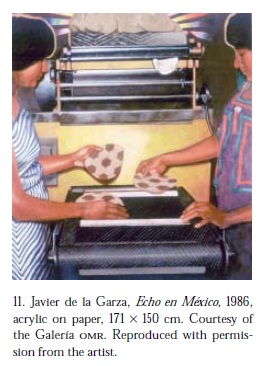
De la Garza painted a series of Chac Mool figures in 1992 to protest the commercialization of culture and the widespread employment of the Chac Mool sculpture(s) as poster boys for the Mexican tourist industry. "They are so exploited," he states. "What more can one say [today] than 'Chac Mool equals Cancún'" (where the artist in actuality resided temporarily while painting the series).26 How are we to read Liebovitz's Chac Mool from the Mexico86 (fig. 10) series? By placing a soccer ball on the sculpture's belly as a sacrificial offering, does Leibovitz match De la Garza's irreverence and affirm that the Chac Mool is a cliché, an overused sign of Mexican identity? And is Leibovitz then serving up this trophy as a new sign of identity and a symbol of progress? Is she literally equating modern day soccer with the pre-Columbian legacy and cultural patrimony? Or does Leibovitz, like De la Garza in his work Eco in México (1986) (fig. 11), in which tortillas are transformed into soccer balls, state the obvious: that soccer, like the Chac Mool figure, has become a contemporary cultural cliché within the popular language of Mexican nationalism propagated by the media? Leibovitz at once achieves a balance of ambiguity and directness with this highly provocative image.
]]>
The athlete presented in another work from the Mexico 86 series (fig. 12) could qualify for Superman's job description: "able to leap over tall buildings in a single bound." Likely it is to this specific image that art historian Luis Carlos Emerich refers when stating that in the Mexico 86 series "Leibovitz characterized the indigenous culture as choreographed by Busby Berkeley."27 (Incidentally, in her essay "Notes on Camp" Susan Sontag mentions this famous choreographer of Warner Brothers movie musicals of the 1930s and 1940s as one of the masters of camp).28 Here the athlete propels himself through space with a gran jeté as the Castillo at Chichén Itzá towers in the distance. Ever so subtly, as if Chac Mool had come to life, the butterfly pectoral, a pre-Columbian symbol that is associated with transformation, sacrifice, movement, and the souls of dead warriors, is emblazoned in white light on the leaping athlete's chest.

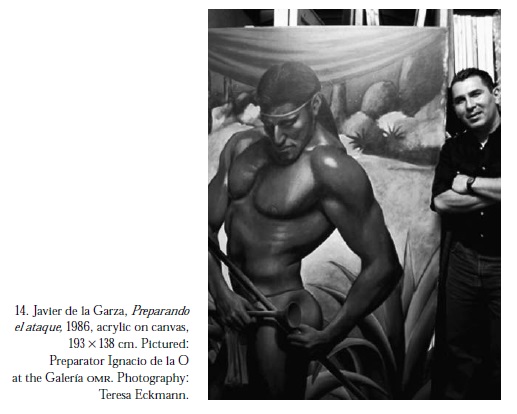
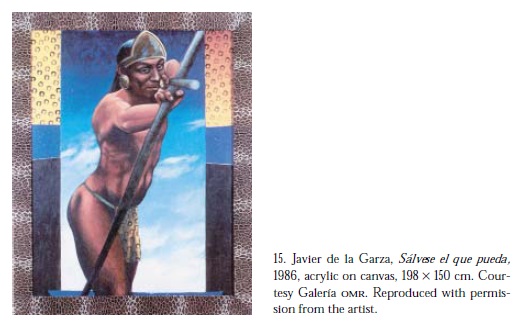
Like Leibovitz, De la Garza combines understatement with dramatic exaggeration. Another source of inspiration for the Inocencia perdida series are photographs of blue-eyed bodybuilders posing on the California beaches that the artist pulled from gay muscle magazines.29 In the flamboyant Al ataque mis valientes (To the Attack My Valiant Ones, fig. 13) for example, an Aztec warrior strikes a typical body-builder pose while riding a hobbyhorse (a toy associated with the Spaniards) and wearing chanclas (plastic sandals) on his feet. Nopales and maguey plants surround him as signs of the national and he sports an outrageous red, white, and green feather headdress. Furthermore, here De la Garza has mimicked the pose of the El valiente (The Valiant) character from the lotería card game. Preparando el ataque (Preparing the Attack, fig. 14) is a companion piece to Al ataque mis valientes that incorporates the same jewel tones, idealized landscape, and overt homo-eroticism. Here red curtains are drawn back to display a buff, tanned warrior who, with utter seriousness and excessive strength, grasps a plunger for a weapon. Sálvese el que pueda (Save Yourself If You Can, fig. 15), like La raza de bronce, confronts the viewer head on. It is a painting about indigenous resistance, as well as isolation and vulnerability. Pinned against the forces of colonialism and modernity, the lone Indian stands as a metaphor for an empty threat. Intentionally undermining the sobriety of the message, De la Garza frames this martyr in leopard skin and jaguar spots, again making the subtext of exoticism clear.

The clever and heavy-handed employment of fake zebra, leopard, and calf skin, as well as black velvet, to frame the paintings exhibited in Inocencia perdida, succeeds in putting them "over the top." The work can easily be labeled as cursi (tacky and vulgar) or what is referred to in Chicano culture as rascuache. As Tomás Ybarra-Frausto explains, "To be rascuache is to posit a bawdy, spunky consciousness, to seek to subvert and turn ruling paradigms upside down. It is a witty, irreverent, and impertinent posture that recodes and moves outside established boundaries."30 With Inocencia perdida De la Garza proves himself to be a connoisseur of rascuachismo. However, his rasquache approach is neither specifically from a working class position or "an underdog perspective," nor about them. In questioning and challenging concepts of identity — his own as a Spanish-descended, middle-class, fair-skinned, non-heterosexual Mexican, as well as stereotypes propagated through mass media — his response is to "invent it [representations of identity] starting from [what is already invented] from the nationalisms in order to say 'It's not what it is, but what one wants to believe it to be.'"31 To underscore the level of hypocrisy and artifice that he sees present in fixed concepts of mexicanidad, De la Garza bitingly concludes, "The middle-class way of feeling that they are different — by rejecting everything that smells like Indian — is very 'Mexican.'"32 It is this level of hypocrisy in the construction of mexicanidad that De la Garza s Inocencia perdida confronts through parody.
Encore
In 1992, for the Quincentennial celebration of the encounter of the two worlds, an exhibition curated by Olivier Debroise and Rina Epelstein opened at the Museo de Monterrey. Audiences expecting a heavy dose of irony from the exhibition, titled Si Colón supiera (If Columbus Only Knew), were not disappointed. Javier de la Garza's installation Eucaristía (Eucharist) consisted of a room filled waist-high with thousands of metallic red balloons in the shape of hearts, disposable paper plates painted with images of the codices covered the walls, and the floor was painted blood red (fig. 16). The centerpiece of the installation was a six-foot wide cake in the form of a Chac Mool that had a red-colored filling. It was the artist's intention that each person attending the reception would, in an orderly fashion, eventually have a slice of cake and take a balloon home with them. "What happened was amazing", De la Garza recounts. "The people went crazy — the old ladies, the children, [businessmen], everybody. Crazed, they burst the balloons, threw chunks of cake — a true free-for-all. Things got out of control. I was yelling to contain the crowd. Frightened, I was screaming 'mexicas'! It was a real orgy."33 Art historian Cuauhtémoc Medina, who was present at the opening reception, witnessed the gruesome incident. Recounting a slightly different version of the finale, he points out that, ironically, what De la Garza was actually yelling at the hysteric crowd was "¡chichimecas!" (barbarians!). Medina laughs, "They wanted to build a pyramid, and what they actually got was the massacre of Cholula."34

The Conquest
We [Mexicans] have been very tolerant towards many things
— towards American culture and towards European culture
and we have survived. Despite everything, we have an identity
.
Alejandro Arango35
Arango affirms that his work is not divorced from the challenging contemporary reality in which he lives. In 1984, he observed that, at that time, art filled a need for Mexicans to "expel our anxieties, frustrations, and insecurities," and that an expressionist style of painting was "the most suitable way of representing the crises of the individual, the country, and the world."36 In Arango's exhibition La conquista, the Conquest serves both as the pretext for creating art, and the means, not of elevating the great Mexican historical myth, but of questioning and undermining it. He explains that a sense of disillusion similar to De la Garza's motivated his series on the Conquest:
]]> While the fresco mural Cortés y la Malinche painted by José Clemente Orozco at the Escuela Nacional Preparatoria in 1926 serves as an obvious reference point for several paintings in La conquista, Arango's intentions, like De la Garza's, are to play off, rather than to replicate the nationalist visual vocabulary of his predecessors. The artist expands on Orozco's non-idealized portrayals of Hernán Cortés and Malinche as they hold the center-stage in La conquista. Arango's depiction of the primordial couple is a surprising one. They are car-toonesque, limp, amorphous beings that have been haphazardly conjoined as if they were the unwitting victims of an irresistible magnetic force.Unconsciously I realize that the history of Mexico is super-invented, manipulated, and has always been part lie and part reality. One cannot help but turn a little, not cynical, but rather, ironic. From the time of childhood they tout [Benito] Juárez as a great man, that Cuauhtémoc was the great Mexican hero, and that the Spaniards were villains. As a child they bombard you with such things to the point that you parrot that "the Spaniards are the bad guys and the Mexicans are the good guys." That is the way they frame it. Then you grow up and you realize that all of this is a total lie. You realize that they manipulated Cuauhtémoc, that they manipulated Cortés, and that [they manipulated] all of it in order to, in my opinion, create a cleaner and more sovereign patria.37
In La mordida de Malinche (Malinche's Bite, fig. 17) Cortés and Malinche are entangled to the point of resembling a single, two-headed individual. Moreover, they even appear to represent the body of the nation as if from far above the viewer were looking down at the topographical patterns and shapes of the Mexican coastline where the ocean meets terrain. Green hues evoking feelings of envy run from Malinche's face through Cortés's body as she literally bites him on the upper arm. A mixture of anger, passion, and lust is expressed in the red blush of Cortés's face as the conquistador swoons. The artist comments, "It is an erotic image. One realizes that the Indian woman has a very special eroticism; she has a spiritual harmony that is independent from the European. Here she is biting the Spaniard — the European in every aspect."38 A mordida (bite) in the Spanish language presents a double entendre in that the word is commonly used in reference to a bribe. While the image engages with humor, La mordida de Malinche nonetheless appears to participate in the malinchista discourse of portraying Malinche as a femme fatale, who bewitches Cortés with her powers of persuasion.

In another painting, Malinche en su lecho de rosas (Malinche in her Bed of Roses, fig. 18), however, Malinche is far from depicted as a seductive figure in any traditional sense; in fact, she appears as a rather unattractive crone. This work, referred to by the artist as an "ofrenda," an offering or petition to the gods generally for the souls of one's dead ancestors (in this case, an offering to Cortés and the Spaniards) provides yet another example of Arango's departure from conventional iconography. Here we have no sign beyond the painting's title that places it within the context of the Conquest. Malinche lies on a bed of flowers, basking in the sun, while a bearded face in profile gazes down at her from above, and two abstracted armored gloves reach out to her. Today this work hangs in the lobby of a bank in Monterrey where, as the artist recounts, by chance he encountered it one day, much to his surprise.39

Arango's subjects appear to be incapacitated or suspended in a state of folly and awkwardness. For example, in the disturbing image La tentación de Cortés (The Temptation of Cortés, fig. 19) the dreamy conquistador, decked out in armor, stands in profile, either fantasizing about, or impervious to, the scene that occurs behind him. The lifeless, nude female figure dangling in the background evokes the horrific images of human hangings so poignantly depicted by Mexican artist Francisco Goitia (1882-1960) during the Mexican Revolution. A snake coils around her midriff while the head of a masked indigenous figure floats by. In reference to another painting, the artist states that the snake does not represent evil, but is, along with the eagle, a sign of the patria, the father/motherland. Nonetheless, the title of the work directs the viewer to associate the nude female with both Malinche, and the biblical Eve, who, in plucking the forbidden fruit, caused her own and Adam's expulsion from the Garden of Eden. Summoned here is an element of the malinchista discourse where Malinche becomes a source of blame for the downfall of the Aztec Empire.40


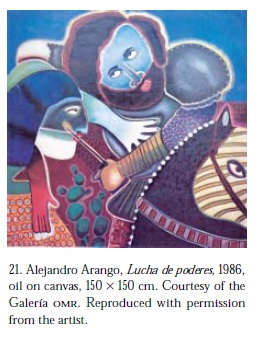
In Lucha de poderes (Power Struggle, fig. 21) Arango has created a composition of large, voluptuous shapes accented by areas of pattern and rhythm. Here, once again, the artist uses as a reference point the relationship between the conquistador and Malinche that was interpreted as one of tension and ambiguity by Orozco in Cortés y la Malinche (1926); Arango echoes the simultaneous attraction and resistance, and the shyness and distrust present between the two lovers. A nopal cactus, another sign of the patria, grows between them.
La batalla (The Battle, fig. 22) is a peculiar mating dance of averted gazes and misguided arrows. The scene describes the resulting chaos from the clashing forces of attraction. "The Spaniard came with the idea of pillaging money or of conquering land. They were given Indian women, a sexual act took place, and mestizaje emerged... Unawares, they created a race," states the artist.41 This sense of blunder and ineptitude pervades La conquista.

]]> Post-Pop Pastiche
If the previous generation of visual artists struggled in opposition
to muralism, it is illogical to once again fall into wanting
at all cost to be Mexican. One shouldn't pigeonhole, or
be commonplace, as in [the act of] painting a nopal, for the
sole reason of including something that is ours on the canvas.
Following international art, without abandoning the
support of one's own culture, is more interesting.
Alejandro Arango42
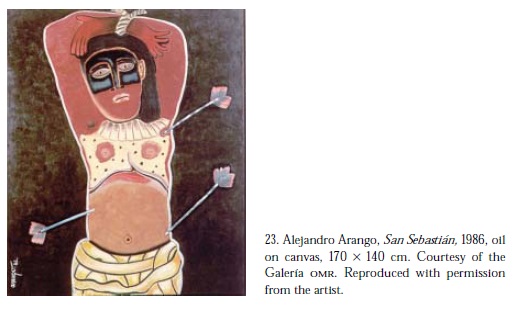
Arango, like De la Garza, turns to several sources and influences for his work while maintaining a stylistically unified look overall. This potpourri of sources includes the pre-Columbian codices, the Mexican fotonovela, comic books, television, cinema, the work of several international and national artists of the twentieth century, and art movements such as Post-Impressionism (i.e., Henri Matisse and Paul Gauguin) and Fauvism. The inclusion among the paintings of conquistadors and Indian women in La conquista of a seemingly out of place, pierced Saint Sebastian wearing an Aztec mask (fig. 23) exemplifies the artist's eclecticism. Furthermore, Arango's compositions emerge as he cuts out shapes from paper and assembles them in creating what he calls a "collage of images" (fig. 24).43 Arango certainly embraces the post-modern tendency of "pastiche," of combining a variety of elements to create a whole.
]]>

Formal qualities that Arango shares in common with several other Mexican artists that worked within the so-called neo-Mexicanist tendency include large scale, representational figuration, deliberate distortion and a lack of modulation. We find in his work the fragmentation, eroticism, and aggression common to neo-Mexicanist painting. And like his peers, he has relied on religious themes (as in his Madonna series of 1990), events and figures from Mexican history, and urban culture, as pretexts or a basis for developing a body of work. Arango nonetheless diverges from the kind of hybrid visual language produced by artists such as Rocío Maldonado and Germán Venegas where forms that refer to different historical epochs and cultures interact freely on the canvas.
This particular series of Arango's (La conquista) is more akin to De la Garza's work as evidenced by their shared interest in blending overt Mexican subject matter with the commercial slickness of a Pop art sensibility to critique what we could call "consumer nationalism" through parody and a kitsch aesthetic. As Cuban art historian Gerardo Mosquera explains:
In contrast to Pop Art, which originated in a mass culture manufactured in series by the specialists of modern industrial society [...] and which used the productive features of advertising and consumerism for their plastic potential, postmodernism seeks to recycle degraded and obsolete forms that have fallen to low status, proscribed by a "good taste" dictated by the avant-garde and rationalistic design [...] It attempts to be "high" and "popular" at one and the same time, like a double, dissociated personality that permits a simultaneous communication with cultural elites and the masses.44
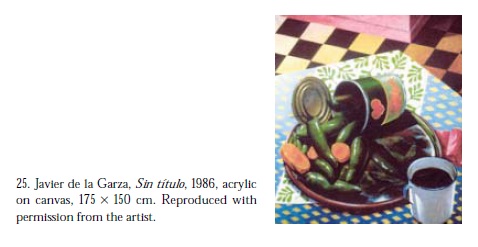
Arango and De la Garza have incorporated the lessons of Pop art into their post-modern works. Arango is visibly attracted to the comics, electric color, and the graffiti-like rhythmic repetition that motivated his contemporary Keith Haring in the United States via such predecessors as Andy Warhol and Roy Lichtenstein. Furthermore, he consistently incorporates an aura-like outlining of his figures in his paintings that is a common device found in the work of Cuban, Pop art-influenced artists, particularly Raúl Martínez. De la Garza at times has drawn more directly from Pop art as in Untitled of 1986 (fig. 25) where he presents a large-scale work that displays, not a Campbell's soup can, but an open can of chili peppers and carrots accompanied by a cup of black coffee served on top of a garish table cloth — an unremarkable, ordinary scene that supposedly could be found in any "typical" Mexican kitchen. In contrast to Pop art, De la Garza's work is not about the object, but about its cultural context. Again, De la Garza satirically selects a stereotypical sign of mexicanidad, the chili pepper (canned by Del Monte food company no less), as the focal point of this work.
]]>
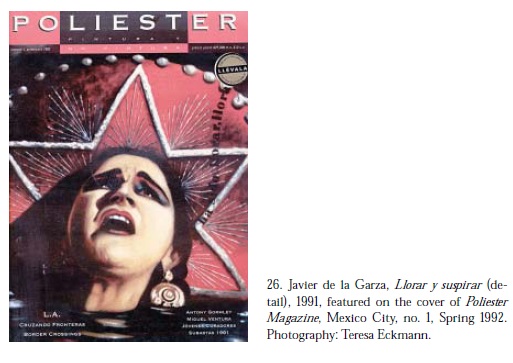
De la Garza has also both painted on canvas, and sculpted the image of contemporary performance artist Astrid Hadad, an icon of excessive mexicanidad in her own right. Known as the "walking museum of popular cultures," Hadad has interpreted on stage, with the most outlandish props and costumes, every conceivable cultural cliché within the spectrum of signs of Mexican identity.45 De la Garza's Llorar y suspirar (Cry and Sigh) of 1991, which portrays Hadad as the archetype of the damsel in distress drowning in an ocean of tears, was featured on the front cover of the art magazine Poliéster (fig. 26). De la Garza takes his version of post-modern Pop to the limits of nostalgia in excess.
Arango's work throughout his career has been eclectic; the Mexicanist theme of the Conquest is more of an exception to the rule, than a measure of the artist's trajectory. He explains, "When I examine the Conquest I don't have to fill myself with the Conquest. When I was working on La conquista I was studying the Russian Revolution [...] and I was listening to Wagner or Impressionist music. This saves me from not constantly copying myself."46
Consistently painting in series, Arango's thematic choices reach beyond what is considered specifically Mexican to include his interest in the Orient and in world music as expressed in the bodies of work Los sueños japoneses (Japanese Dreams), Vietnam, and Algo de jazz (Something of Jazz) created between the late 1980s to mid-1990s. Furthermore, he places equal importance on an international and a national artistic inheritance. He states, "as an artist my inheritance is [Paul] Gauguin, my inheritance is [Henri] Matisse and it is [Pablo] Piccasso — they have all left a heritage."47 Arango also acknowledges the influence of Mexican artists María Izquierdo, Diego Rivera, and José Clemente Orozco in his work. And yet, as Arango points out, his palette reflects "the color that is here in Mexico: the magentas, intense yellows, and cobalt blues."48 He makes no mention of artesanía as a source of inspiration, but rather underscores an attraction to Pop art, film, fotonovela comics, and caricature that are indeed visible in his artwork. Nonetheless, more traditional media such as masks, lacquers, and the textiles of Guerrero and Nayarit have been noted as likely influences in the artist's work; Arango agrees with the former observation, but extends that influence into the international realm by pointing to the religious objects of Bali and Singapore as equally significant to him.49
Like De la Garza, Arango explores gender stereotypes and machismo. He imbues Moctezuma and Cortés, not with bravery and valor, but with apathy. Additionally, he places the multi-racial aspect of mexicanidad at the foreground of his work. Unlike De la Garza, he does not parody the seemingly contradictory aspect of mexicanidad expressed in the naco or malinchista aspiration to whiteness, but rather paints the concept of mestizaje, as seen in the irreverent and unexpected manner in which he applies color to his figures.50
Placing these two artists' work and exhibitions side by side provides one more example of the stylistic diversity encountered within the neo-Mexicanist current. De la Garza is an excellent draftsman. The sensual contours of his Aztec warriors are painted with determined precision. He convincingly portrays the human anatomy with the rigorous exactitude of an academy-trained artist. On a two-dimensional surface he can give life to a stone sculpture or make a man's body appear to be carved of stone. Arango, on the other hand, is an expressionist painter whose figures defy idealism. His visual language, like that of Ruptura artist José Luis Cuevas (b. 1934), is one of distortion rather than delineation. Uninterested in chiaroscuro, Arango values caricature over an academic realism. He achieves a deliberate anti-classicism in his work. He relies on outline, texture, and pattern as key aspects of his stylistic vocabulary. De la Garza's figures of flesh and bone emerge from the scrutinized play of light and shadow, on skin and surface.
Arango's work serves as fertile ground for considering some of the problematics and paradoxes of neo-Mexicanism. Is it simply folklore, or are there deeper levels of meaning and analysis that can be drawn from this work? Arango's painting, like what has been called neo-Mexicanist art on the whole, risks being easily dismissed or categorized as decorative, fashionable, and commercial. While it may well be considered all of the latter by some artists and art critics alike, nonetheless, on closer examination we find layers of irony, satire, perversion, and ambiguity, as argued in this analysis, that allows us to also view Arango's work, and neo-Mexicanist art in general, as subversive.
]]> Entrance
The 80s become more conceptual, and more fat, and more
saturated, and contrived, and rich.
Annie Leibovitz51
Arango explains that between the Ruptura era of the 1960s and 1970s, and his generation of artists of the 1980s, an opening occurred that allowed new expressions in the visual arts:
We were allowed to make these criticisms — which aren't strong criticisms. It wasn't an aggressive, exhausting criticism. It was something very light that had more of an ironic charge than one of criticism. If I had done that in the 1960s or 1970s, there could have been a backlash from the government, the Instituto Nacional de Bellas Artes (INBA), or from many other institutions.52
He adds that the Ruptura artists such as Cuevas, Vicente Rojo, Alberto Gironella, and Fernando García Ponce were really students of the European schools of painting, especially Paris. It had been a simple matter of their transferring Parisian culture to Mexico. "When the generation of 1950s-born artists emerged, we had a need to speak in Spanish, not in French. In the 1980s Mexican art became more agile and flexible. There was a need to remove all of these binds from Paris and the United States," he remarks.53 Nonetheless, as previously stated, Arango's work in terms of the design element, vibrancy, and love of rhythm and pattern, while not as schematic, is stylistically reminiscent of North American artist Keith Haring's work. Commenting on this apparent paradox Arango reiterates: "We painted in Spanish independently of whether we were influenced, or not, by other countries — which is a valid [observation] because we are not isolated. Even if we don't want to be, we are also Western."54
Arango and De la Garza consider themselves to be predominantly self-taught artists. De la Garza did enter la Academia de San Carlos in 1976, and Arango studied at La Esmeralda in 1972. Both artists were marginally associated with Los grupos in the late 1970s. De la Garza kept company with artists such as Olivero Hinojosa and Ricardo Rocha of the Grupo Suma, while Arango participated in, and exhibited with Adolfo Patiño's Peyote y la compañía. They both traveled outside of Mexico: De la Garza resided in Paris from 1981 to 1986, and Arango lived in Europe in 1975, and in New York in 1978. During the 1980s they gained the patronage of the Televisa Corporation through then-Director of the Museo Rufino Tamayo Robert Littman, and they were among the select group of artists represented by the Galería OMR.
In the early 1980s, Arango established a professional relationship with Alberto Raurell, who preceded Littman for a brief time as the director of the Museo Rufino Tamayo. Raurell had close ties to New York art dealers Leo Castelli and Harry Solomon, as well as to William Lieberman, Director of the Department of Art of the Twentieth Century at New York City's Metropolitan Museum of Art. Raurell facilitated Arango's participation in an exchange program that North American artist Julian Schnabel instigated at Project Studio One (PS1) in New York City where Arango exhibited alongside photographer Cindy Sherman in 1983.55 When Raurell brought the exhibition Homage to Henri Matisse from the New York Metropolitan Museum to the Museo Rufino Tamayo in 1983, Arango was simultaneously featured with an installation in the museum's lobby where, in fact, his work initially caught the attention of Patricia Ortiz Monasterio. When Raurell was mysteriously gunned down in El Sanborncito, a Mexico City café in the Polanco district, Televisa magnate Emilio Azcárraga hired Littman, then-Director of the Grey Art Gallery at New York University to take Raurell's place at the Museo Rufino Tamayo. Littman continued to support Arango by acquiring his work for the Fundación Cultural Televisa collection and including it in exhibitions such as Pintura narrativa (1984) and 17 Artistas de hoy en México (1985) alongside emerging neo-Mexicanist work by De la Garza, Rocío Maldonado, Gerardo Suter, Germán Venegas, and others. Additionally, for his homes in Hollywood, California and Mexico City, Azcárraga purchased several of Arango's works from La conquista, Cóctel, and Sueños japoneses series through the Galería OMR.56
]]> In contrast with their 1986 exhibitions on the Conquest, the work by Arango and De la Garza included in 17 Artistas de hoy en México lacks any specifically "Mexicanist" content. Four large-scale portraits by De la Garza were exhibited (fig. 27), of which Littman purchased at least one of the paintings, Autorretrato con sombrero (Self-Portrait with Hat).57 Another four paintings by Arango included in the exhibition were of a universal expressionist content (fig. 28). For example, Arango's Ver, oír, callar (See, Hear, Silence, 1985) treated the sightings of Halley's Comet during that year, while La niña que sacó a pasear su ángel (The Girl Who Took Her Angel Out for a Walk, 1984), a painting acquired the previous year by Raurell for the Fundación Cultural Televisa collection, is a psychological work about the perils of childhood.

While 17 Artistas de hoy en México was likely the first collective exhibition that brought together artists working within the emerging neo-Mexicanist current (preceding by nine months the Galería omr's exhibition Raíces populares del arte actual), Arango's La conquista was the first individual painting exhibition at the OMR to present a body of work that would later be called neo-Mexicanist. Subsequently, De la Garza's Inocencia perdida and several other individual exhibitions of a specifically neo-Mexicanist painting style by other OMR-represented artists were presented at the gallery throughout the mid-to-late 1980s.
A Wounded National Pride
Arango and De la Garza's exhibitions on the theme of the Conquest reached beyond the strictly personal, to represent the general tone of an era. The disenchantment expressed by these two artists was echoed loudly by the Mexican public when, at the opening celebrations of the World Cup soccer tournament on May 31, 1986, an event that was televised around the globe, President Miguel de la Madrid was greeted by the audience with an unprecedented chorus of boos.58 The artists were certainly not exempt from experiencing the moral and economic crises that the nation struggled with at the time. In a letter dated December 2, 1985 from Patricia Ortiz Monasterio sent to De la Garza in Paris, the gallery owner explains to the artist the difficulty with the devaluation of the peso of maintaining the prices of his paintings in U.S. dollars. She states that the $1000 price that they had previously agreed upon for his paintings, which had been the equivalent of $250000.00 pesos at that time, now equaled $540000 pesos — in other words, the value of the peso had fallen more that fifty percent. She then asked him if he would agree, for the time being, that his paintings be raised to the price of $350,000.00 pesos — a nonetheless nearly thirty percent cut in price for his work. Ortiz Monasterio ends her letter with the plea, "Consider that Mexico is a country in crisis, that it is your country, that I believe you are interested in having a presence here [through your work] and that the people here earn pesos [not U.S. dollars] and moreover, not so many [pesos]."59
Arango posits that neo-Mexicanist art unconsciously grew out of his generation of artists' collective need for change during this era of crisis. "An interior revolution took place. It wasn't a declared revolution, but a revolution in that new values were taking shape and the culture was being scrambled in the political and social arena. Maybe this motivated us to create that kind of work."60
]]> By the early 1990s, interestingly, Arango claims that he fell out of favor with the OMR precisely because his work was not "folkloric" enough for the gallery's needs. Arango relates that in 1990, when OMR toured the United States with the Parallel Project, he was expected to participate with paintings of "nopales, Indians, and little landscapes."61 De la Garza's experience with the Parallel Project was equally distressing in that, ironically, his work was used as advertising for then-President Carlos Salinas de Gortari's contemporaneous public relations project in the U.S.62
Notas
1. "Uno es mexicano porque es mexicano, no porque está pintando sarapes". Recorded interview with Javier de la Garza in Mexico City, July 22, 1998.
2. Carlos Monsiváis, "Perspectives on the Arts of Mexico", Latin American Art (Fall 1990): 27. [ Links ]
3. Susan Sontag, "Notes on Camp", Against Interpretation and Other Essays (New York: Noonday Press, 1961), p. 283. [ Links ]
4. "Me propuse, con toda conciencia, sumergirme literalmente en los símbolos patrios, en la idea del machismo y los héroes, pero en ningún momento intenté participar en el mexicanismo." Recorded interview, De la Garza, July 22, 1998.
5. Noah Webster, Webster's New Twentieth Century Dictionary (Cleveland: Simon and Schuster, 1983). [ Links ]
6. See the exhibition catalogue La Patria Portátil: 100 Years of Mexican Chromo Art Calendars (Mexico City: Asociación Carso, 1999). [ Links ]
7. Gerardo Mosquera, "Bad Taste in Good Form," Social Text (Fall, 1986): 58. [ Links ]
8. "Quería trabajar sobre el tema de los héroes nacionales para parodiarlos, y regresé a mis recuerdos infantiles. Fui al Zócalo en busca de esas láminas que uno compra de niño para aprender acerca de los héroes y la bandera; tienen una ilustración en el frente y una descripción histórica detrás. Lo más chistoso es lo que allí dice —el retrato "oficial" para la enseñanza escolar en la primaria— que es básico, manipulado y entretenido. Compré todas las laminillas que encontré y regresé a París. Cuauhtémoc fue mi primer cuadro." Recorded interview, De la Garza, July 22, 1998.
9. "Vivía en París cuando me vino la idea de retomar la idea de indigenismo-mexicanidad, pero de una manera 'moderna' o actualizada. Ellos [los guerreros aztecas] obviamente tenían que estar bien alimentados y ser atractivos, con un erotismo tangible." Email correspondence with De la Garza, August 28, 2002.
10. The quote "Toma tu puñal, ábreme las venas, déjame sangrar, hasta que me muera... etc. [no quiero la vida, si he de verte ajena, que sin tu cariño, no vale la pena]," lyrics from a popular song are written in the artist's own hand on the back of the canvas.
11. "¡...haría volver la cabeza incluso al más macho!" Recorded interview, De la Garza, July 22, 1998.
12. Susan Sontag, "Notes on Camp," pp. 275-292. [ Links ]
13. Idem.
14. Oral communication between Jean Charlot and Jorge Enciso on November 1, 1945. Cited with permission from John P. Charlot.
15. "Estoy interesado en la imagen, el icono y el mensaje. En eso se basa mi trabajo; la manipulación, el desplazamiento en la crítica, el lugar común y la distribución de imágenes gastadas". Recorded interview, De la Garza, July 22, 1998.
16. [Efectivamente, lo que mencionas de Leibovitz, esos cuadros fueron hechos al tiempo que] esas imágenes aparecían por todos lados. Email correspondence with Javier de la Garza, August 28, 2002. In a conversation with the author on September 4, 2004, Gerardo Suter mentioned that the Mexico86 series were essentially still-shots of the television commercials.
17. 17 Artistas de hoy en México (Mexico City: Museo Rufino Tamayo, 1985). [ Links ]
18. Conversation with Gerardo Suter on September 4, 2004, Cuernavaca, Morelos.
19. "Lo cual me sirvió como plataforma (entre otras cosas) para hablar de la idealización-ficción de las imágenes inspiradas en estereotipos de belleza extranjeros". Email correspondence with De la Garza, August 28, 2002.
20. "Vasconcelos concluye su historia de México diciendo que lo mejor que nos pudo haber pasado fue que [los españoles] nos conquistaran. Yo dije '¿What?' Esto significa que cada persona puede hacer historia para convertirla en lo que quiere que sea". Recorded interview, De la Garza, July 22, 1998.
]]> 21. "El nacionalismo es totalmente una forma de manipular masas. ¿Por qué los indios? ¿Por qué esa representación tan frontal y tan directa? Eso viene de la publicidad, como, por ejemplo, de esas imágenes de Calvin Klein de Estados Unidos que tienen una influencia muy fuerte. Viene del arte totalitario, de la propaganda. Empiezas a analizar esto y te das cuenta de que lo que te gusta es manipular también de la forma más directa. El homoerotismo es tan fuerte en la obra italiana, la virilidad es también a la vez negada y perseguida. El sexo es una de las cosas más efectivas para manipular, para dirigir, para distraer, es propaganda. Mi trabajo de ahí viene." Idem.22. Carlos Monsiváis, "Perspectives on the Arts of Mexico," p. 27. [ Links ]
23. For more on desmodernismo see Roger Bartra, The Cage of Melancholy: Identity and Metamorphosis in the Mexican Character (New Brunswick: Rutgers University Press, 1987), p. 9, no. 19, [ Links ] and Claudio Lomnitz, Deep Mexico Silent Mexico: An Anthropology on Nationalism (Minneapolis: University of Minnesota Press, 2001), p. 110. [ Links ]
24. "Con mis indígenas hablo de un país inventado, el país que hemos aprendido a través de la falsa historia que nos enseñaron en la escuela: la idealización de algo que podría haber sido y no fue... [M]e metí a la onda indígena y a esa historia totalmente ficticia que sabemos de ellos. Nada más hay que ponernos a ver cómo están siendo utilizados como imagen turística y han cambiado sus costumbres para poder vivir frente al personaje extranjero." Angélica Abelleyra, "Lejos de México comprendí la vida indígena: De la Garza," La Jornada (March 2, 1987), p. 37. [ Links ]
25. "Todos sabíamos que era falso lo que decía Salinas. Como mucha gente creíamos, aunque en el fondo sabíamos lo que todo el mundo sabía, que era falso. Un día amanecimos con el "primer mundo". Tú salías y comprabas. Llegaron todas las firmas de todos lados: Calvin Klein, Armani. Ya no tenían que salir los mexicanos a Houston a comprar. De repente te enfrentas con la realidad. Mi obra habla de eso, de esa ficción, de ese ambiente." Recorded interview, De la Garza, July 22, 1998.
26. "Son tan explotadas. [Por eso pinté todos los chacmoles, con esta idea de pintar la imagen] ¿Qué más se puede decir que 'Chacmoles=Cancún'?" Idem.
]]>27. Luis Carlos Emerich, Figuros y desfiguros de los ochenta: pintura mexicana joven (Mexico City: Diana, 1989), p. 76. [ Links ] It was this brief comment by Emerich, for which I am grateful, that led me to research the Leibovitz Mexico86 series. (Leibovitz, que, en los afiches del Mundial de futbol celebrado en México, caracterizó la cultura indígena como coreografiada por Busby Berkeley).
28. Sontag, "Notes on Camp," p. 282.
29. Recorded interview, De la Garza, July 22, 1998.
30. Tomás Ybarra-Frausto, "Rasquachismo: A Chicano Sensibility" in CARA: Chicano Art: Resistance and Affirmation 1965-1995, Richard Griswold de Castillo, Teresa Mckenna and Yvonne Yarbro-Bejerano (Los Angeles: Wight Art Gallery, University of California, 1991), p. 155. [ Links ]
31. "Inventarse desde los nacionalismos, como para decir, 'no es lo que es, sino lo que se quiera creer que es' ". Email correspondence with De la Garza, August 28, 2002.
32. "Muy mexicana también es la actitud de esa clase media de sentirse diferente, por rechazar todo lo que huele a indio". Recorded interview, De la Garza, July 22, 1998.
33. "La gente se volvió loca, las viejitas, los niños, todos, enloquecidos, reventaban los globos, arrancaban pedazos de pastel —una verdadera refriega. Las cosas se salieron de control. Yo trataba de contener a la multitud. Asustado, gritaba: '¡mexicas!' Fue una verdadera orgía." Email correspondence with De la Garza, August 8, 2004.
34. Conversation with Cuauhtémoc Medina in Albuquerque, New Mexico, August 11, 2004.
]]> 35. "Los mexicanos hemos sido muy tolerantes hacia muchas cosas —hacia la cultura estadounidense y hacia la cultura europea—; sin embargo, hemos sobrevivido. A pesar de todo, tenemos una identidad." Recorded interview with Alejandro Arango in his studio in Mexico City, January 15, 1998.36. María Antonieta Barragán, "Pinta Alejandro Arango las situaciones cotidianas, con personajes grotescos, y refleja sus conflictos", Unomásuno (July 8, 1984), p. 18. [ Links ]
37. "Inconscientemente me doy cuenta de que la historia de México está súper inventada, manipulada, y siempre ha sido en parte mentira y en parte realidad. Uno no puede evitar volverse un poquito... no cínico, sino más bien irónico. Desde la infancia ellos te ofrecen a Juárez como un gran hombre; te dicen que Cuauhtémoc fue el gran héroe mexicano y que los españoles fueron unos villanos. Cuando eres niño te bombardean con tales cosas hasta el punto de que repites como loro que los españoles son los malos y los mexicanos los buenos: ésta es la manera en que los encasillan. Cuando creces te das cuenta de que todo esto es una mentira total. Te das cuenta de que manipularon a Cuauhtémoc, que manipularon a Cortés, todo ello con el fin de, en mi opinión, inventar una patria más limpia y soberana." Recorded interview, Alejandro Arango, January 15, 1998.
38. "Es una imagen erótica. Se da cuenta uno de que la mujer indígena tiene un erotismo muy especial. Una indígena posee una armonía espiritual muy independiente del europeo. Aquí le está dando la mordida al español, al europeo en todos los aspectos." Idem.
39. Recorded interview with Arango in his studio in Mexico City, October 25, 2001.
40. See for example "Sons of La Malinche" in Octavio Paz's Labyrinth of Solitude (New York: Grove, 1985), pp. 65-88. [ Links ]
41. "El español vino con la idea de obtener dinero o conquistar tierras. Sin embargo, cuando le dieron mujeres indígenas se realizó un acto sexual y emergió el mestizaje. Sin darse cuenta, crearon una raza." Recorded interview, Arango, January 15, 1998.
42. "Si la generación pasada de artistas plásticos luchó contra el muralismo, no es lógico volver a caer en querer ser mexicano a ultranza: no se debe uno encajonar y caer en lugares comunes como pintar un nopal por el solo hecho de incluir algo nuestro en una tela. Es más interesante seguir el arte internacional sin dejar de apoyarse en la cultura propia." Adriana Moncada, "El artista expone en la galería omr: Pintar madonnas me remite al amor maternal: Alejandro Arango," Unomásuno (octubre 21, 1990): 23.
]]> 43. "[Hacía yo] un collage de imágenes." Recorded interview, Arango, October 25, 2001.44. Gerardo Mosquera, "Bad Taste in Good Form," 56. [ Links ]
45. See www.worldmusicportal.com/Artists/Mexican/astrid_hadad.htm [ Links ]
46. "Cuando examino la conquista, no me tengo que llenar de la conquista [...] Cuando estaba trabajando sobre la serie de La conquista estaba estudiando la Revolución Rusa [...] y estaba oyendo a Wagner, o música impresionista. Eso me salvó de no copiarme constantemente." Recorded interview, Arango, January 15, 1998.
47. "Como pintor, mi herencia es Gauguin, mi herencia es Matisse, es Picasso. Todos ellos han dejado una herencia." Recorded interview, Arango, October 25, 2001.
48. Como él mismo señala, su paleta refleja: "el color que está aquí en México: los magentas, los amarillos intensos, y los azules cobalto". Recorded interview, Arango, January 15, 1998.
49. Guillermo Santamarina, "Alejandro Arango" in Nuevos momentos del arte mexicano. New Moments in Mexican Art, Patricia Ortiz Monasterio and Jaime Riestra (Madrid: Turner, 1990), pp. 99-103 and recorded interview, [ Links ] Arango, January 15, 1998.
50. The term "naco," allegedly a contraction of Totonaco, which was used up until the mid-1970s as a slur against Indians who stood for provincial backwardness, in more recent refers to a kitsch aesthetic of impurity and hybridity that emerges from a failed aspiration to modernity. See Claudio Lomnitz-Adler's discussion of the term naco in Deep Mexico, Silent Mexico, pp. 111-114. De la Garza states that he turned to the images of blue-eyed, blonde California body builders depicted in gay magazines as a source for his work specifically to address this contradiction within the discourse of mexicanidad of upholding foreign models of beauty as the national standard. Recorded interview, De la Garza, July 22, 1998.
]]>51. Melvyn Bragg, Annie Leibovitz: Celebrity Photographer, video (Chicago: Home Vision Arts, 1997). [ Links ]
52. "Se nos permitió hacer esas críticas, que no son críticas fuertes. No era una crítica agresiva, exhaustiva. Era algo muy ligero, que llevaba una carga irónica más que una crítica. Si yo lo hubiera hecho en los años sesenta o setenta, hubiera habido una retroacción por parte del gobierno, del Instituto de Bellas Artes, o de muchas otras instituciones." Recorded interview, Arango, January 15, 1998.
53. "Cuando emergió la generación de los artistas nacidos en los años cincuenta, teníamos necesidad de hablar en español, no en francés. En los ochenta se volvió más ágil y flexible el arte en México. Había la necesidad de quitar todas esas ataduras de París y Estados Unidos." Idem.
54. "Pintamos en español —independientemente de si tenemos influencias o no de otros países— lo que es válido, porque no estamos aislados. Y aunque no lo queramos, somos occidentales también." Idem.
55. Recorded interview, Arango, October 25, 2001.
56. Idem.
57. Letter from Patricia Ortiz Monasterio dated December 2, 1985 sent to Javier de la Garza in Paris. Available in the artist's file folder in the Galería OMR archives.
58. See Andrea Dabrowski and Harry Kelly "Dead Men Don't Pay Up," in Time (June 23, 1986), p. 47. [ Links ]
]]> 59. "Considera que México es un país en crisis, que es tu país y creo te interesa tener una presencia aquí, y que la gente aquí gana pesos, y además no tantos." Letter from Patricia Ortiz Monasterio to Javier de la Garza, December 2, 1985.60. "Hubo una revolución interior. No fue una revolución declarada, sino una revolución de nuevos valores que estaban tomando forma, y la cultura estaba siendo mezclada en la arena política y social. Quizás eso nos motivó a crear ese tipo de obra." Recorded interview, Arango, January 15, 1998.
61. [Sí, por ejemplo cuando yo estuve en Nueva York y presenté mi trabajo a una galería (OMR/Parallel Project), se esperaba que yo participara] con nopales, indios y paisajitos. Ibid.
62. See the special advertising section of the October 15, 1990 issue of Time Magazine where De la Garza's painting Enemigos I (substituted with the title "Mexican Delights") is used to promote Mexican tourism and culture in conjunction with a photograph of, and statement by, President Salinas de Gortari.
]]>