<?xml version="1.0" encoding="ISO-8859-1"?><article xmlns:mml="http://www.w3.org/1998/Math/MathML" xmlns:xlink="http://www.w3.org/1999/xlink" xmlns:xsi="http://www.w3.org/2001/XMLSchema-instance">
<front>
<journal-meta>
<journal-id>0065-1737</journal-id>
<journal-title><![CDATA[Acta zoológica mexicana]]></journal-title>
<abbrev-journal-title><![CDATA[Acta Zool. Mex]]></abbrev-journal-title>
<issn>0065-1737</issn>
<publisher>
<publisher-name><![CDATA[Instituto de Ecología A.C.]]></publisher-name>
</publisher>
</journal-meta>
<article-meta>
<article-id>S0065-17372012000200008</article-id>
<title-group>
<article-title xml:lang="en"><![CDATA[The life cycle of a desert spider inferred from observed size frequency distribution]]></article-title>
<article-title xml:lang="es"><![CDATA[El ciclo de vida de una araña desértica deducido a partir de la distribución de frecuencia de tallas]]></article-title>
</title-group>
<contrib-group>
<contrib contrib-type="author">
<name>
<surname><![CDATA[NIETO-CASTAÑEDA]]></surname>
<given-names><![CDATA[Irma Gisela]]></given-names>
</name>
<xref ref-type="aff" rid="A01"/>
</contrib>
<contrib contrib-type="author">
<name>
<surname><![CDATA[SALGADO-UGARTE]]></surname>
<given-names><![CDATA[Isaías Hazarmabeth]]></given-names>
</name>
<xref ref-type="aff" rid="A02"/>
</contrib>
<contrib contrib-type="author">
<name>
<surname><![CDATA[JIMÉNEZ-JIMÉNEZ]]></surname>
<given-names><![CDATA[María Luisa]]></given-names>
</name>
<xref ref-type="aff" rid="A03"/>
</contrib>
</contrib-group>
<aff id="A01">
<institution><![CDATA[,Universidad del Mar Campus Puerto Escondido ]]></institution>
<addr-line><![CDATA[Juquila Oax]]></addr-line>
<country>México</country>
</aff>
<aff id="A02">
<institution><![CDATA[,Universidad Nacional Autónoma de México Facultad de Estudios Superiores Zaragoza Laboratorio de Biometría]]></institution>
<addr-line><![CDATA[México D.F.]]></addr-line>
<country>México</country>
</aff>
<aff id="A03">
<institution><![CDATA[,Centro de Investigaciones Biológicas del Noroeste Mar Bermejo  ]]></institution>
<addr-line><![CDATA[La Paz B.C.S.]]></addr-line>
<country>México</country>
</aff>
<pub-date pub-type="pub">
<day>00</day>
<month>08</month>
<year>2012</year>
</pub-date>
<pub-date pub-type="epub">
<day>00</day>
<month>08</month>
<year>2012</year>
</pub-date>
<volume>28</volume>
<numero>2</numero>
<fpage>353</fpage>
<lpage>364</lpage>
<copyright-statement/>
<copyright-year/>
<self-uri xlink:href="http://www.scielo.org.mx/scielo.php?script=sci_arttext&amp;pid=S0065-17372012000200008&amp;lng=en&amp;nrm=iso"></self-uri><self-uri xlink:href="http://www.scielo.org.mx/scielo.php?script=sci_abstract&amp;pid=S0065-17372012000200008&amp;lng=en&amp;nrm=iso"></self-uri><self-uri xlink:href="http://www.scielo.org.mx/scielo.php?script=sci_pdf&amp;pid=S0065-17372012000200008&amp;lng=en&amp;nrm=iso"></self-uri><abstract abstract-type="short" xml:lang="en"><p><![CDATA[We studied the life cycle of the spider Syspira tigrina (Araneae: Miturgidae) by indirect methods. This species is endemic to the North American deserts and locally abundant; nevertheless, information on its biology is scarce. We did monthly collections for over a year at La Paz, Baja California Sur, Mexico. We found that adult spiders were more abundant between August and November 2005 and had low abundance or were absent the remainder of the year while juveniles were present all year. To estimate changing body size structure of the population we analyzed juvenile tibia I length distribution (TIL) (as indicator of the body size) of each monthly sample by means of Kernel Density Estimators (KDEs). We found 35 TIL juveniles size groups (Gaussian components). The smallest juveniles were more abundant between October 2005 and January 2006 and the biggest were more abundant twice during the hottest months. We hypothesize that mating period is between August and October 2005 and the main recruitment period from November 2005 and January 2006. However we found evidence of continuous recruitment through the year, suggesting that although there is a peak of reproduction in November, the females oviposit almost all year. Also there is evidence of juveniles' growth pattern from January to July 2006. The use of KDEs with histograms is a very good statistical tool to delimit size groups with mixed frequency distributions that otherwise might be difficult. This tool should be useful to test any hypothesis related with the body size structure of a population or community.]]></p></abstract>
<abstract abstract-type="short" xml:lang="es"><p><![CDATA[Se estudió el ciclo de vida de la especie Syspira tigrina (Miturgidae), por métodos indirectos. Esta especie es endémica de los desiertos de Norte América y es localmente muy abundante; sin embargo, su biología es prácticamente desconocida. Se realizaron recolectas mensuales durante un ciclo anual de la especie en La Paz, Baja California Sur, México. Al analizar los patrones de abundancia de adultos, se encontró que son más abundantes entre los meses de agosto y noviembre del 2005 y poco abundantes o ausentes el resto del año. Lo que apunta a que el periodo reproductivo debe ocurrir durante esta lapso. Paralelamente se analizó la distribución de la longitud tibial I (LTI) de los juveniles (como indicador de talla corporal), mediante el método de estimadores de densidad por kernel (EDKA's). Se delimitaron 35 grupos de talla (componentes Gaussianos) estadísticamente significativos para juveniles durante los 12 meses de muestreo. Los grupos de LTI más pequeños fueron más abundantes entre octubre del 2005 y enero del 2006, sugiriendo que es cuando ocurre el periodo de reclutamiento, mientras que los grupos de talla mayor dominaron dos veces durante los meses más cálidos. Por su parte, el periodo debe ocurrir entre noviembre 2005 y enero 2006 También existe un claro patrón de crecimiento de los juveniles de enero a julio del 2006. El empleo de los EDKA's en conjunto con los histogramas de frecuencia, son una herramienta estadística viable para delimitar distribución de grupos de tallas con frecuencias mezcladas, que sería difícil hacerlo por los métodos tradicionales. Su aplicación podría ser útil para probar cualquier hipótesis relacionada a la talla de los organismos de una población o comunidad.]]></p></abstract>
<kwd-group>
<kwd lng="en"><![CDATA[spider life histories]]></kwd>
<kwd lng="en"><![CDATA[size frequency]]></kwd>
<kwd lng="en"><![CDATA[kernel density estimators]]></kwd>
<kwd lng="en"><![CDATA[size classes]]></kwd>
<kwd lng="es"><![CDATA[historias de vida de arañas]]></kwd>
<kwd lng="es"><![CDATA[frecuencia de tallas]]></kwd>
<kwd lng="es"><![CDATA[estimadores de densidad por kernel]]></kwd>
<kwd lng="es"><![CDATA[clases de tallas]]></kwd>
</kwd-group>
</article-meta>
</front><body><![CDATA[  	    <p align="justify"><font face="verdana" size="4">Art&iacute;culos originales</font></p>      <p align="justify"><font face="verdana" size="2">&nbsp;</font></p>  	    <p align="center"><font face="verdana" size="4"><b>The life cycle of a desert spider inferred from observed size frequency distribution</b></font></p> 	    <p align="center"><font face="verdana" size="2">&nbsp;</font></p> 	    <p align="center"><font face="verdana" size="3"><b>El ciclo de vida de una ara&ntilde;a des&eacute;rtica deducido a partir de la distribuci&oacute;n de frecuencia de tallas</b></font></p>      <p align="center"><font face="verdana" size="2">&nbsp;</font></p>     <p align="center"><font face="verdana" size="2"><b>Irma Gisela NIETO&#45;CASTA&Ntilde;EDA,<sup>1</sup> Isa&iacute;as Hazarmabeth SALGADO&#45;UGARTE<sup>2</sup> &amp; Mar&iacute;a Luisa JIM&Eacute;NEZ&#45;JIM&Eacute;NEZ<sup>3</sup></b></font></p>  	    <p align="justify"><font face="verdana" size="2">&nbsp;</font></p> 	    <p align="justify"><font face="verdana" size="2"><sup><i>1 </i></sup><i>Universidad del Mar, Campus Puerto Escondido (UMAR), Ciudad Universitaria, Carretera V&iacute;a Sola de Vega, Puerto Escondido, San Pedro Mixtepec, Juquila, Oax., M&eacute;xico C.P. 71980 M&eacute;xico; Tel: +(52) (954) 954 58 249 90.</i> &lt;<a href="mailto:irmanieto@zicatela.umar.mx">irmanieto@zicatela.umar.mx</a>&gt; </font></p> 	    ]]></body>
<body><![CDATA[<p align="justify"><font face="verdana" size="2"><sup><i>2 </i></sup><i>Laboratorio de Biometr&iacute;a. Facultad de Estudios Superiores Zaragoza, Universidad Nacional Aut&oacute;noma de M&eacute;xico (FESZ, UNAM), Batalla 5 de mayo S/N esq. Fuerte de Loreto, Ej&eacute;rcito de Oriente, Iztapalapa 09230, M&eacute;xico, D.F., M&eacute;xico.</i> &lt;<a href="mailto:isalgado@servidor.unam.mx">isalgado@servidor.unam.mx</a>&gt; </font></p> 	    <p align="justify"><font face="verdana" size="2"><sup><i>3 </i></sup><i>Centro de Investigaciones Biol&oacute;gicas del Noroeste Mar Bermejo 195, Col. Playa Palo de Sta. Rita La Paz, B.C.S., 23090 M&eacute;xico Tels: (612) 12 3 8481.</i> &lt;<a href="mailto:ljimenez04@cibnor.mx">ljimenez04@cibnor.mx</a>&gt;</font></p> 	    <p align="justify"><font face="verdana" size="2">&nbsp;</font></p> 	    <p align="justify"><font face="verdana" size="2">Recibido: 19/08/2011;     <br>     aceptado: 21/03/2012.</font></p>      <p align="justify"><font face="verdana" size="2">&nbsp;</font></p>     <p align="justify"><font face="verdana" size="2"><b>ABSTRACT</b></font></p>     <p align="justify"><font face="verdana" size="2"> We studied the life cycle of the spider <i>Syspira tigrina</i> (Araneae: Miturgidae) by indirect methods. This species is endemic to the North American deserts and locally abundant; nevertheless, information on its biology is scarce. We did monthly collections for over a year at La Paz, Baja California Sur, Mexico. We found that adult spiders were more abundant between August and November 2005 and had low abundance or were absent the remainder of the year while juveniles were present all year. To estimate changing body size structure of the population we analyzed juvenile tibia I length distribution (TIL) (as indicator of the body size) of each monthly sample by means of Kernel Density Estimators (KDEs). We found 35 TIL juveniles size groups (Gaussian components). The smallest juveniles were more abundant between October 2005 and January 2006 and the biggest were more abundant twice during the hottest months. We hypothesize that mating period is between August and October 2005 and the main recruitment period from November 2005 and January 2006. However we found evidence of continuous recruitment through the year, suggesting that although there is a peak of reproduction in November, the females oviposit almost all year. Also there is evidence of juveniles' growth pattern from January to July 2006. The use of KDEs with histograms is a very good statistical tool to delimit size groups with mixed frequency distributions that otherwise might be difficult. This tool should be useful to test any hypothesis related with the body size structure of a population or community. </font></p>     <p align="justify"><font face="verdana" size="2"><b>Key words:</b> spider life histories, size frequency, kernel density estimators, size classes.</font></p>     <p align="justify"><font face="verdana" size="2">&nbsp;</font></p>     ]]></body>
<body><![CDATA[<p align="justify"><font face="verdana" size="2"><b>RESUMEN</b></font></p>     <p align="justify"><font face="verdana" size="2"> Se estudi&oacute; el ciclo de vida de la especie <i>Syspira tigrina</i> (Miturgidae), por m&eacute;todos indirectos. Esta especie es end&eacute;mica de los desiertos de Norte Am&eacute;rica y es localmente muy abundante; sin embargo, su biolog&iacute;a es pr&aacute;cticamente desconocida. Se realizaron recolectas mensuales durante un ciclo anual de la especie en La Paz, Baja California Sur, M&eacute;xico. Al analizar los patrones de abundancia de adultos, se encontr&oacute; que son m&aacute;s abundantes entre los meses de agosto y noviembre del 2005 y poco abundantes o ausentes el resto del a&ntilde;o. Lo que apunta a que el periodo reproductivo debe ocurrir durante esta lapso. Paralelamente se analiz&oacute; la distribuci&oacute;n de la longitud tibial I (LTI) de los juveniles (como indicador de talla corporal), mediante el m&eacute;todo de estimadores de densidad por kernel (EDKA's). Se delimitaron 35 grupos de talla (componentes Gaussianos) estad&iacute;sticamente significativos para juveniles durante los 12 meses de muestreo. Los grupos de LTI m&aacute;s peque&ntilde;os fueron m&aacute;s abundantes entre octubre del 2005 y enero del 2006, sugiriendo que es cuando ocurre el periodo de reclutamiento, mientras que los grupos de talla mayor dominaron dos veces durante los meses m&aacute;s c&aacute;lidos. Por su parte, el periodo debe ocurrir entre noviembre 2005 y enero 2006 Tambi&eacute;n existe un claro patr&oacute;n de crecimiento de los juveniles de enero a julio del 2006. El empleo de los EDKA's en conjunto con los histogramas de frecuencia, son una herramienta estad&iacute;stica viable para delimitar distribuci&oacute;n de grupos de tallas con frecuencias mezcladas, que ser&iacute;a dif&iacute;cil hacerlo por los m&eacute;todos tradicionales. Su aplicaci&oacute;n podr&iacute;a ser &uacute;til para probar cualquier hip&oacute;tesis relacionada a la talla de los organismos de una poblaci&oacute;n o comunidad. </font></p>     <p align="justify"><font face="verdana" size="2"><b>Palabras clave:</b> historias de vida de ara&ntilde;as, frecuencia de tallas, estimadores de densidad por kernel, clases de tallas.</font></p>      <p align="justify"><font face="verdana" size="2">&nbsp;</font></p>     <p align="justify"><font face="verdana" size="2"><b>INTRODUCTION</b></font></p>      <p align="justify"><font face="verdana" size="2">The life history of any species is related to the species distribution, habitat use and energetic requirements, the biological relationships with other species and the structure and dynamics of communities (Polis <i>et al.</i> 1996; Begon <i>et al.</i> 2006). There are many studies of post&#45;embryonic development and the identification of spiders instars by direct observation of captive specimens (Aguilar &amp; M&eacute;ndez 1971; Jackson 1978; Bartos 2005; Punzo &amp; Farmer 2006), but this takes a lot of time and effort (Toft 1976). An alternative method is to deduce the life cycle of a species based on the analysis of different body size measurements of organisms systematically collected during one or two years (Toft 1976; Aitchinson 1984; Aiken &amp; Coyle 2000; Wright &amp; Coyle 2000; Crews <i>et al.</i> 2008). Most of these studies identified spider size classes by using frequency histograms, assuming that most conspicuous modes represent size groups while recognizing that the boundaries among them are arbitrary (Toft 1976; Davis &amp; Coyle 2001). However these histograms present several problems, including dependence of grid origin and the interval width, discontinuity and the use of fixed width intervals. These problems have motivated statisticians to find alternative, more efficient methods. Kernel Density Estimators (KDEs) do not depend on the origin position and are continuous distribution estimators (Silverman 1986). Besides, there are several methods for choosing the interval width (H&aacute;rdle 1991; Scott 1992). Most of these methods have been employed to describe fish size classes and growth (Sanvicente&#45;A&ntilde;orve <i>et al.</i> 2003); however they have not been used to describe spider size classes. Here we present the use of KDEs as a modern tool to examine body size&#45;frequency distributions of spiders, using <i>Syspira tigrina</i> Simon, 1885 as an example.</font></p>     <p align="justify"><font face="verdana" size="2">The species <i>Syspira tigrina</i> Simon, 1885 (Araneae: Miturgidae) is very abundant in xeric areas from North America. This species is one of the most conspicuous spiders in Baja California Sur, representing up 40% of all wandering spiders (Nieto&#45;Casta&ntilde;eda &amp; Jim&eacute;nez&#45;Jim&eacute;nez 2009; Jim&eacute;nez &amp; Navarrete 2010). This miturgid is a fast&#45;moving ground&#45;hunting spider and its body size range from 5 to 18 mm; males are same or bigger size than females (Ubick &amp; Richman 2005; Nieto&#45;Casta&ntilde;eda &amp; Jim&eacute;nez&#45;Jim&eacute;nez 2009). In turn, this species is an important prey diet component for some rodents (&Aacute;lvarez&#45;Casta&ntilde;eda <i>et al.</i> 2006), and possibly be preyed upon by other vertebrates and invertebrates due to its high abundance. Nevertheless, information on its biology is scarce.</font></p>     <p align="justify"><font face="verdana" size="2">&nbsp;</font></p>     <p align="justify"><font face="verdana" size="2"><b>METHODS</b></font></p>      <p align="justify"><font face="verdana" size="2"><b>Study area.</b> We worked in El Comit&aacute;n, a federal biological preserve station located near Bah&iacute;a de La Paz (24&deg;7'N, 110&deg;25'W, 20 m a.s.l.), west of La Paz city in Baja California Sur, M&eacute;xico. The region is a subtropical desert with hot summers, a sporadic rainy season between July and October, and warm winters with little or no rain between November and February. The vegetation is a subtropical desert shrub (Le&oacute;n de la Luz <i>&eacute;t al.</i> 1996).</font></p>  	    ]]></body>
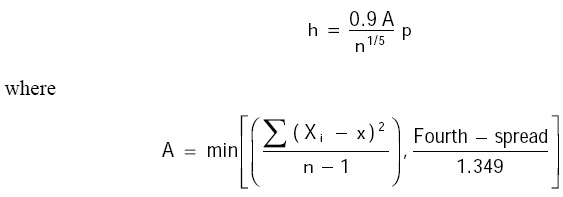
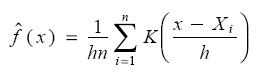
<body><![CDATA[<p align="justify"><font face="verdana" size="2"><b>Field work.</b> We collected spiders every month from July 2005 to July 2006 by establishing two 150 m line transects, each one with 15 pitfall traps at approximately 10 m intervals (Muma 1981). A wire covering on each trap excluded dead leaves and other debris but not spiders. The samples were preserved in 70% ethanol and transferred to the laboratory for cleaning and taxonomic identification.</font></p>  	    <p align="justify"><font face="verdana" size="2"><b>Species identification and measurements.</b> We grouped the spiders as juveniles, penultimate adults (males and females) and adults (males and females). Then we measured the tibia I length (TIL) (distance along the dorsal surface from proximal joint to distal joint with the leg on the horizontal plane) as an estimator of body size (Toft 1976), using a graduated lens under the stereoscopic microscope with each specimen submerged in 70% ethanol and anchored in a bed of fine white sand on the bottom of a culture dish. Voucher specimens were deposited in the Arachnological and Entomological Collection of the Centro de Investigaciones Biol&oacute;gicas del Noroeste (CAECIB).</font></p>  	    <p align="justify"><font face="verdana" size="2"><b>Data analysis.</b> We analyzed the TIL distribution of each monthly sample by means of Kernel Density Estimators (KDEs), using weighted averaging of rounded points (WARP) (H&aacute;rdle &amp; Scott 1992; Salgado&#45;Ugarte <i>et al.</i> 1995a). KDEs are defined as:</font></p>  	    <p align="center"><font face="verdana" size="2"><img src="/img/revistas/azm/v28n2/a8e1.jpg"></font></p>     <p align="justify"><font face="verdana" size="2">Where,</font></p>  	    <p align="justify"><font face="verdana" size="2"><i><img src="/img/revistas/azm/v28n2/a8s1.jpg"> =</i> density estimation of the variable x </font></p> 	    <p align="justify"><font face="verdana" size="2"><i>n</i> = number of observations</font></p> 	    <p align="justify"><font face="verdana" size="2"><i>h</i> = bandwidth</font></p>      <p align="justify"><font face="verdana" size="2"><i>X<sub>i</sub></i> = tibia length of the i&#45;th spider specimen</font></p>  	    <p align="justify"><font face="verdana" size="2"><i>K (&bull;)</i>= a smooth, symmetric kernel function integrating to one.</font></p>  	    ]]></body>
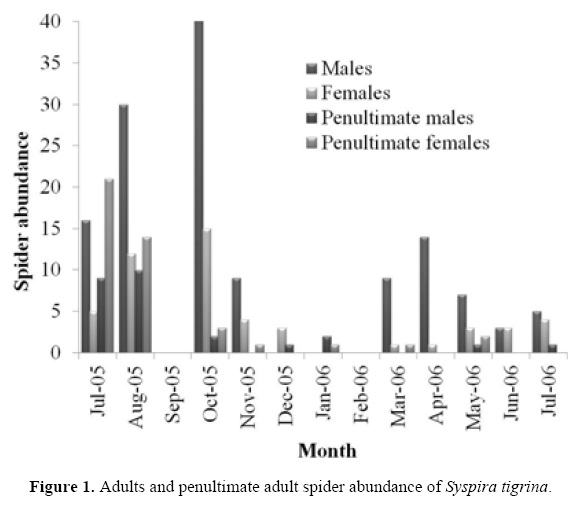
<body><![CDATA[<p align="justify"><font face="verdana" size="2">In this case, we use the Gaussian kernel function, i.e.:</font></p>  	    <p align="center"><font face="verdana" size="2"><img src="/img/revistas/azm/v28n2/a8e2.jpg"></font></p>     <p align="justify"><font face="verdana" size="2">The bandwidth <i>h</i> was chosen based on Silverman's rule (1986) (Salgado&#45;Ugarte <i>et al.</i> 1995b):</font></p>  	    <p align="center"><font face="verdana" size="2"><img src="/img/revistas/azm/v28n2/a8e3.jpg"></font></p>     <p align="justify"><font face="verdana" size="2"><i>A</i> is the smaller of two estimates of the standard deviation: the usual estimate <i>S</i> or F&#45;pseudosigma, a robust alternative for <i>S</i> (Hoaglin 1983). The Fourth&#45;spread is a resistant dispersion measure approximately equivalent to the interquartile range (Tukey 1977). The Silverman optimal bandwidth is designed for Gaussian distributed data. This value is too large when applied with skewed or multimodal distributions. Nevertheless, in these cases the optimal bandwidth may serve as a starting point which allows the dominant modes to be recovered.</font></p>  	    <p align="justify"><font face="verdana" size="2">The optimal bandwidth chosen for each TIL size group reflects reference values calculated with several practical rules for oversmoothed and optimal widths (Salgado&#45;Ugarte <i>et al.</i> 1995b) and the values determined by the smoothed Bootstrap multimodality test of Silverman (1986) (Salgado&#45;Ugarte <i>et al.</i> 1997). The resulting density distributions were scaled to a smoothed frequency and decomposed into their Gaussian components with a computerized version of the method proposed by Bhat&#45;tacharya (1967) (Salgado&#45;Ugarte <i>et al.</i> 1994). Since the slope of a Gaussian curve is positive to the left of the mode, zero at the mode and negative to the right of the mode, the logarithmic derivative decreases linearly. Therefore, each Gaussian component can be determined by identifying negative sloped intervals in the graph of logarithmic frequency differences against length midpoints (Salgado&#45;Ugarte <i>et al.</i> 1994). Then each Gaussian component represents a TIL size group. We analyze the TIL groups within samples by plotting monthly TIL frequency histograms with over imposed monthly KDEs for all TIL groups. The KDEs result in figures smoother than histograms, allowing easy recognition of characteristics such as outliers, skewness, and multimodality (Salgado&#45;Ugarte <i>et al.</i> 1993, 1995b). All statistical procedures were performed in Stata v. 9.1 (StataCorp 2001).</font></p>     <p align="justify"><font face="verdana" size="2">&nbsp;</font></p>     <p align="justify"><font face="verdana" size="2"><b>RESULTS</b></font></p>      <p align="justify"><font face="verdana" size="2">We collected 914 spiders, 660 were juveniles, 69 penultimate adults and 185 adults of <i>S. tigrina.</i> We found that adult spiders were more abundant between August and November 2005 and penultimate adults were more abundant between July and August 2005; both had low abundance or were absent the remainder of the year (<a href="#f1">Fig. 1</a>) while juveniles were present all year.</font></p>     <p align="center"><font face="verdana" size="2"><a name="f1"></a></font></p>     ]]></body>

<body><![CDATA[<p align="center"><font face="verdana" size="2"><img src="/img/revistas/azm/v28n2/a8f1.jpg"></font></p>     <p align="justify"><font face="verdana" size="2">Because use KDEs analysis is to delimit size groups continuously we only analyzed juvenile TIL distribution (<a href="/img/revistas/azm/v28n2/a8f2.jpg" target="_blank">Fig. 2</a>), and excluded the other spiders because we already identified them as penultimate adults and adults.</font></p>  	    <p align="justify"><font face="verdana" size="2">The TIL&#45;frequency distributions of juveniles indicate that most part of the year small sizes (TIL mean &lt; 1 mm) had high frequency. TIL mean varied from 0.9752 to 1.0518 mm. Optimal TIL bandwidths used to construct KDEs varied between 0.053 to 0.3425 mm depending on the number of observations and their variation. In most cases we observe a dominant mode with several minor modes. Assuming Gaussian distribution, we estimated the statistics: mean, standard deviation and size (<a href="/img/revistas/azm/v28n2/a8t1.jpg" target="_blank">Table 1</a>) corresponding to each main mode by the Bhattacharya's method (<a href="/img/revistas/azm/v28n2/a8f3.jpg" target="_blank">Fig. 3</a>). Dominant TIL modes indicate spider groups.</font></p>  	    <p align="justify"><font face="verdana" size="2">We found 35 spider groups (Gaussian components) with TIL frequency distributions during the 12 month collection period (<a href="/img/revistas/azm/v28n2/a8t1.jpg" target="_blank">Table 1</a>). The smallest TIL groups were more abundant between October 2005 and January 2006 (N = 284, TIL mean &lt; 0.65 mm) and the biggest were more abundant twice, one from May to July 2006 (N = 196, TIL mean &gt; 0.75 and &lt; 1.92) and from July to August 2005 (N = 101, TIL mean &gt; 0.75 and &lt; 1.63).</font></p>  	    <p align="justify"><font face="verdana" size="2">&nbsp;</font></p> 	    <p align="justify"><font face="verdana" size="2"><b>DISCUSSION</b></font></p>      <p align="justify"><font face="verdana" size="2">The abundance patterns of adult spiders of <i>S. tigrina</i> indicate that the mating period might occur between August and October 2005 because it is when most adults were present. The high abundance of penultimate males and females previous to August 2005 confirms this outcome. This period takes place just after the main rainy season and when temperature starts to drop (<a href="/img/revistas/azm/v28n2/a8f4.jpg" target="_blank">Fig. 4</a>). This it is compatible with the breeding season of most desert animals (Keast &amp; Marshall 1954; Barrientos <i>et al.</i> 2007).</font></p>  	    <p align="justify"><font face="verdana" size="2">Also the juvenile TIL groups also indicate that the principal recruitment period might occur during November and December and, to a lesser extent, on January when the smallest juveniles (TIL mean &lt; = 0.7 mm) were more abundant, and also when larger specimens (TIL mean &lt; = 0.7 mm) were scarcer in the study period. This recruitment occurs after the main rainy season and when the temperature starts to decrease (<a href="/img/revistas/azm/v28n2/a8f4.jpg" target="_blank">Fig. 4</a>).</font></p>  	    <p align="justify"><font face="verdana" size="2">The pattern described above suggests that there should be a continuous recruitment through the year (the highest values occurs between November and December 2005), implying that the females oviposit almost throughout the year, starting in November and gradually less frequently afterwards. There is evidence of juvenile growth from January to February, when the dominant group classes were &gt; 0.7 mm of TIL mean, but growth continued until May&#45; July. This suggests that the maturation and mating periods are close to each other. The patterns we found through this analysis are similar to those observed earlier for the desert spider <i>Diguetia mojavea,</i> where reproduction and oviposition occurs during July and October, and no juveniles are found during August to December (Boulton &amp; Polis 1999). The continuous oviposition periods of the females could be a consequence of the characteristic desert harsh conditions (Polis &amp; Yamashita 1991), as reported for the desert spider <i>Clubiona robusta,</i> which oviposits several times in at least six months in one year (the recruitment period of the species cannot be determined because their juveniles are impossible to identify from other clubionids) (Austin 1984). Unfortunately there are few comparable life history studies of other desert spiders. The lower abundance of the larger juveniles (TIL mean &gt; 0.7 mm) during most part of the year suggests that they must be dying. For this or any other reason they cannot be caught by the pitfall traps.</font></p>     <p align="justify"><font face="verdana" size="2">In general, there are few studies about the life histories of ground dwelling spiders around the world. This might be due to the difficulty of differentiating juveniles among related species, and discriminating size classes in mixed length frequency distributions (Toft 1976). However, it is interesting that in Holarctic regions some spider species from several families (Araneidae, Clubionidae, Linyphidae, Theridiidae, Lycosidae, mainly), mate and ovipositate during May and October (Toft 1976; Aiken &amp; Coyle 2000; Wright &amp; Coyle 2000; Davis &amp; Coyle 2001); these species have well defined life histories where the mature adults occur once or twice in a year, however in all cases the limits of size classes are unambiguous.</font></p>     ]]></body>
<body><![CDATA[<p align="justify"><font face="verdana" size="2">The use of KDEs is a powerful statistical tool to delimitate size groups with mixed frequency distributions which otherwise would be difficult to determine, not only for life cycle studies. Animal group size is one of the most important characteristics that structures populations and communities, then it must be necessary to test any biological hypothesis based on size groups.</font></p>  	    <p align="justify"><font face="verdana" size="2">&nbsp;</font></p>     <p align="justify"><font face="verdana" size="2"><b>ACKNOWLDGEMENTS</b></font></p>     <p align="justify"><font face="verdana" size="2">We thank F. A. Coyle for his suggestions; M. M. Correa&#45;Ram&iacute;rez assisted during field collections and L. Higgins for her comments and valuable editorial improvements and two anonymous reviewers for the time and concern spent on the review of this manuscript. This project was supported by Consejo Nacional de Ciencia y Tecnolog&iacute;a of Mexico (SEMARNAT&#45;CONACYT C01&#45;0052). Additional support was provided by UNAM (PAPIME PE205407). Collection, study, and preservation of specimens comply with Mexican law, including a permit from SEMARNAT.</font></p>     <p align="justify"><font face="verdana" size="2">&nbsp;</font></p>     <p align="justify"><font face="verdana" size="2"><b>LITERATURE CITED</b></font></p>      <!-- ref --><p align="justify"><font face="verdana" size="2"><b>Aguilar, P. G. F. &amp; M A. M&eacute;ndez G.</b> 1971. La "ara&ntilde;a chata del nido de arena" <i>Sicarius peruensis</i> (Keyserling, 1880). III. Desarrollo post&#45;embrionario. Primer Congreso Latinoamericano de Entomolog&iacute;a. Cusco&#45;Per&uacute;. <i>Revista Peruana de Entomolog&iacute;a,</i> 14: 213&#45;220.    &nbsp;&nbsp;&nbsp;&nbsp;&nbsp;&nbsp;&nbsp;&nbsp;[&#160;<a href="javascript:void(0);" onclick="javascript: window.open('/scielo.php?script=sci_nlinks&ref=393242&pid=S0065-1737201200020000800001&lng=','','width=640,height=500,resizable=yes,scrollbars=1,menubar=yes,');">Links</a>&#160;]<!-- end-ref --></font></p>  	    <!-- ref --><p align="justify"><font face="verdana" size="2"><b>Aiken, M. &amp; F. A. Coyle.</b> 2000. Habitat distribution, life history and behavior of <i>Tetragnatha</i> spider species in the Great Smoky Mountains National Park. <i>Journal of Arachnology,</i> 28: 97&#45;106.    &nbsp;&nbsp;&nbsp;&nbsp;&nbsp;&nbsp;&nbsp;&nbsp;[&#160;<a href="javascript:void(0);" onclick="javascript: window.open('/scielo.php?script=sci_nlinks&ref=393244&pid=S0065-1737201200020000800002&lng=','','width=640,height=500,resizable=yes,scrollbars=1,menubar=yes,');">Links</a>&#160;]<!-- end-ref --></font></p>  	    ]]></body>
<body><![CDATA[<!-- ref --><p align="justify"><font face="verdana" size="2"><b>&Aacute;lvarez&#45;Casta&ntilde;eda, S. T., M. M. Correa&#45;Ram&iacute;rez &amp; A. L. Trujano&#45;&Aacute;lvarez.</b> 2006. Notes on <i>Notio&#45;sorex crawfordi</i> (Coues) from two oases in the Baja California peninsula, Mexico. <i>Journal of Arid Environments,</i> 66: 773&#45;777.    &nbsp;&nbsp;&nbsp;&nbsp;&nbsp;&nbsp;&nbsp;&nbsp;[&#160;<a href="javascript:void(0);" onclick="javascript: window.open('/scielo.php?script=sci_nlinks&ref=393246&pid=S0065-1737201200020000800003&lng=','','width=640,height=500,resizable=yes,scrollbars=1,menubar=yes,');">Links</a>&#160;]<!-- end-ref --></font></p>  	    <!-- ref --><p align="justify"><font face="verdana" size="2"><b>Atchison, C. W.</b> 1984. The phenology of winter&#45;active spiders. <i>Journal of Arachnology,</i> 12: 249&#45;271.    &nbsp;&nbsp;&nbsp;&nbsp;&nbsp;&nbsp;&nbsp;&nbsp;[&#160;<a href="javascript:void(0);" onclick="javascript: window.open('/scielo.php?script=sci_nlinks&ref=393248&pid=S0065-1737201200020000800004&lng=','','width=640,height=500,resizable=yes,scrollbars=1,menubar=yes,');">Links</a>&#160;]<!-- end-ref --></font></p>  	    <!-- ref --><p align="justify"><font face="verdana" size="2"><b>Austin, A. D.</b> 1984. Life history of <i>Clubiona robusta</i> L. Kock and related species (Araneae: Clubioni&#45;dae) in South Australia. <i>Journal of Arachnology,</i> 12: 87&#45;104.    &nbsp;&nbsp;&nbsp;&nbsp;&nbsp;&nbsp;&nbsp;&nbsp;[&#160;<a href="javascript:void(0);" onclick="javascript: window.open('/scielo.php?script=sci_nlinks&ref=393250&pid=S0065-1737201200020000800005&lng=','','width=640,height=500,resizable=yes,scrollbars=1,menubar=yes,');">Links</a>&#160;]<!-- end-ref --></font></p>  	    <!-- ref --><p align="justify"><font face="verdana" size="2"><b>Barrientos, R., A. Barbosa, F. Valera &amp; E. Moreno.</b> 2007. Temperature but not rainfall influences timing of breeding in a desert bird, the trumpeter finch <i>(Bucanetes githagineus). Journal of Ornithology,</i> 148: 411&#45;416.    &nbsp;&nbsp;&nbsp;&nbsp;&nbsp;&nbsp;&nbsp;&nbsp;[&#160;<a href="javascript:void(0);" onclick="javascript: window.open('/scielo.php?script=sci_nlinks&ref=393252&pid=S0065-1737201200020000800006&lng=','','width=640,height=500,resizable=yes,scrollbars=1,menubar=yes,');">Links</a>&#160;]<!-- end-ref --></font></p>  	    <!-- ref --><p align="justify"><font face="verdana" size="2"><b>Bartos, M.</b> 2005. The life history of <i>Yllenus arenarius</i> (Araneae, Salticidae) evidence for sympatric populations isolated by the year of maturation. <i>Journal of Arachnology,</i> 33: 214&#45;221.    &nbsp;&nbsp;&nbsp;&nbsp;&nbsp;&nbsp;&nbsp;&nbsp;[&#160;<a href="javascript:void(0);" onclick="javascript: window.open('/scielo.php?script=sci_nlinks&ref=393254&pid=S0065-1737201200020000800007&lng=','','width=640,height=500,resizable=yes,scrollbars=1,menubar=yes,');">Links</a>&#160;]<!-- end-ref --> </font></p>     ]]></body>
<body><![CDATA[<!-- ref --><p align="justify"><font face="verdana" size="2"><b>Begon, M., C. R. Townsend &amp; J. L. Harper.</b> 2006. <i>Ecology: From individuals to ecosystems.</i> Blackwell Publishing. 4<sup>th</sup> E.U.A. 738pp.    &nbsp;&nbsp;&nbsp;&nbsp;&nbsp;&nbsp;&nbsp;&nbsp;[&#160;<a href="javascript:void(0);" onclick="javascript: window.open('/scielo.php?script=sci_nlinks&ref=393256&pid=S0065-1737201200020000800008&lng=','','width=640,height=500,resizable=yes,scrollbars=1,menubar=yes,');">Links</a>&#160;]<!-- end-ref --></font></p>     <!-- ref --><p align="justify"><font face="verdana" size="2"><b>Bhattacharya, C. G.</b> 1967. A simple method of resolution of a distribution into Gaussian components. <i>Biometrics,</i> 23: 115&#45;135.    &nbsp;&nbsp;&nbsp;&nbsp;&nbsp;&nbsp;&nbsp;&nbsp;[&#160;<a href="javascript:void(0);" onclick="javascript: window.open('/scielo.php?script=sci_nlinks&ref=393258&pid=S0065-1737201200020000800009&lng=','','width=640,height=500,resizable=yes,scrollbars=1,menubar=yes,');">Links</a>&#160;]<!-- end-ref --></font></p>  	    <!-- ref --><p align="justify"><font face="verdana" size="2"><b>Boulton, M. &amp; G. A. Polis.</b> 1999. Phenology and Life History of the Desert Spider, <i>Diguetia mojavea </i>(Araneae, Diguetidae). <i>Journal of Arachnology,</i> 27: 513&#45;521.    &nbsp;&nbsp;&nbsp;&nbsp;&nbsp;&nbsp;&nbsp;&nbsp;[&#160;<a href="javascript:void(0);" onclick="javascript: window.open('/scielo.php?script=sci_nlinks&ref=393260&pid=S0065-1737201200020000800010&lng=','','width=640,height=500,resizable=yes,scrollbars=1,menubar=yes,');">Links</a>&#160;]<!-- end-ref --> </font></p>     <!-- ref --><p align="justify"><font face="verdana" size="2"><b>Crews, S. C., E. Wienskoskib &amp; R. G. Gillespie.</b> 2008. Life history of the spider <i>Selenops occultus </i>Mello&#45;Leitao (Araneae, Selenopidae) from Brazil with notes on the natural history of the genus. <i>Journal of Natural History,</i> 42: 2747&#45;2761.    &nbsp;&nbsp;&nbsp;&nbsp;&nbsp;&nbsp;&nbsp;&nbsp;[&#160;<a href="javascript:void(0);" onclick="javascript: window.open('/scielo.php?script=sci_nlinks&ref=393262&pid=S0065-1737201200020000800011&lng=','','width=640,height=500,resizable=yes,scrollbars=1,menubar=yes,');">Links</a>&#160;]<!-- end-ref --> </font></p>     <!-- ref --><p align="justify"><font face="verdana" size="2"><b>Davis, M. J. &amp; F. A. Coyle.</b> 2001. Habitat distribution and life history of <i>Araneus</i> spider species in the Great Smoky Mountains National Park. <i>Bulletin of the British Arachnological Society,</i> 12: 49&#45;57.    &nbsp;&nbsp;&nbsp;&nbsp;&nbsp;&nbsp;&nbsp;&nbsp;[&#160;<a href="javascript:void(0);" onclick="javascript: window.open('/scielo.php?script=sci_nlinks&ref=393264&pid=S0065-1737201200020000800012&lng=','','width=640,height=500,resizable=yes,scrollbars=1,menubar=yes,');">Links</a>&#160;]<!-- end-ref --> </font></p>     ]]></body>
<body><![CDATA[<!-- ref --><p align="justify"><font face="verdana" size="2"><b>H&auml;rdle, W. K.</b> 1991. Smoothing techniques: with implementation in S. Springer Verlag, New York. 261 pp.    &nbsp;&nbsp;&nbsp;&nbsp;&nbsp;&nbsp;&nbsp;&nbsp;[&#160;<a href="javascript:void(0);" onclick="javascript: window.open('/scielo.php?script=sci_nlinks&ref=393266&pid=S0065-1737201200020000800013&lng=','','width=640,height=500,resizable=yes,scrollbars=1,menubar=yes,');">Links</a>&#160;]<!-- end-ref --></font></p>     <!-- ref --><p align="justify"><font face="verdana" size="2"><b>H&auml;rdle, W. K. &amp; D. W. Scott.</b> 1992. Smoothing by weighted averaging of rounded points. <i>Computational Statistics,</i> 7: 97&#45;128.    &nbsp;&nbsp;&nbsp;&nbsp;&nbsp;&nbsp;&nbsp;&nbsp;[&#160;<a href="javascript:void(0);" onclick="javascript: window.open('/scielo.php?script=sci_nlinks&ref=393268&pid=S0065-1737201200020000800014&lng=','','width=640,height=500,resizable=yes,scrollbars=1,menubar=yes,');">Links</a>&#160;]<!-- end-ref --></font></p>  	    <!-- ref --><p align="justify"><font face="verdana" size="2"><b>Hoaglin, D. C.</b> 1983. Letter values: a set of selected order statistics, pp. 33&#45;57. <i>In:</i> D.C. Hoaglin, F.Mosteller andJ.W. Tukey (Eds.), Understanding robust and exploratory data analysis. John Wiley &amp; Sons, New York.    &nbsp;&nbsp;&nbsp;&nbsp;&nbsp;&nbsp;&nbsp;&nbsp;[&#160;<a href="javascript:void(0);" onclick="javascript: window.open('/scielo.php?script=sci_nlinks&ref=393270&pid=S0065-1737201200020000800015&lng=','','width=640,height=500,resizable=yes,scrollbars=1,menubar=yes,');">Links</a>&#160;]<!-- end-ref --></font></p>  	    <!-- ref --><p align="justify"><font face="verdana" size="2"><b>Jackson, R. R.</b> 1978. The life history of <i>Phidippus johnsoni</i> (Araneae: Salticidae). <i>Journal of Arachnology,</i> 6: 1&#45;29.    &nbsp;&nbsp;&nbsp;&nbsp;&nbsp;&nbsp;&nbsp;&nbsp;[&#160;<a href="javascript:void(0);" onclick="javascript: window.open('/scielo.php?script=sci_nlinks&ref=393272&pid=S0065-1737201200020000800016&lng=','','width=640,height=500,resizable=yes,scrollbars=1,menubar=yes,');">Links</a>&#160;]<!-- end-ref --></font></p>     <!-- ref --><p align="justify"><font face="verdana" size="2"><b>Jim&eacute;nez, M. L. &amp; J. G. Navarrete.</b> 2010. Fauna de ara&ntilde;as del suelo de una comunidad &aacute;rida&#45;tropical en Baja California Sur, M&eacute;xico. <i>Revista Mexicana de Biodiversidad,</i> 81: 417&#45;426.    &nbsp;&nbsp;&nbsp;&nbsp;&nbsp;&nbsp;&nbsp;&nbsp;[&#160;<a href="javascript:void(0);" onclick="javascript: window.open('/scielo.php?script=sci_nlinks&ref=393274&pid=S0065-1737201200020000800017&lng=','','width=640,height=500,resizable=yes,scrollbars=1,menubar=yes,');">Links</a>&#160;]<!-- end-ref --></font></p>     ]]></body>
<body><![CDATA[<!-- ref --><p align="justify"><font face="verdana" size="2"><b>Keast, A. &amp;. A. J. Marshall.</b> 1954. The influence of drought and rainfall on reproduction in Australian desert birds. <i>Proceedings of the Zoological Society of London,</i> 124: 493&#45;499.    &nbsp;&nbsp;&nbsp;&nbsp;&nbsp;&nbsp;&nbsp;&nbsp;[&#160;<a href="javascript:void(0);" onclick="javascript: window.open('/scielo.php?script=sci_nlinks&ref=393276&pid=S0065-1737201200020000800018&lng=','','width=640,height=500,resizable=yes,scrollbars=1,menubar=yes,');">Links</a>&#160;]<!-- end-ref --> </font></p>     <!-- ref --><p align="justify"><font face="verdana" size="2"><b>Le&oacute;n de la Luz, J. L., R. B. Coria &amp; M. E. Cruz.</b> 1996. Fenolog&iacute;a reproductiva de una flora &aacute;rido&#45;tropical de Baja California Sur, M&eacute;xico. <i>Acta Bot&aacute;nica Mexicana,</i> 35: 45&#45;64.    &nbsp;&nbsp;&nbsp;&nbsp;&nbsp;&nbsp;&nbsp;&nbsp;[&#160;<a href="javascript:void(0);" onclick="javascript: window.open('/scielo.php?script=sci_nlinks&ref=393278&pid=S0065-1737201200020000800019&lng=','','width=640,height=500,resizable=yes,scrollbars=1,menubar=yes,');">Links</a>&#160;]<!-- end-ref --> </font></p>     <!-- ref --><p align="justify"><font face="verdana" size="2"><b>Muma, M. H.</b> 1981. Adult activity of ground surface spider populations in pinion&#45;juniper and arid&#45;grass land association in Southwestern New Mexico. <i>Florida Entomologist,</i> 64: 276&#45;283.    &nbsp;&nbsp;&nbsp;&nbsp;&nbsp;&nbsp;&nbsp;&nbsp;[&#160;<a href="javascript:void(0);" onclick="javascript: window.open('/scielo.php?script=sci_nlinks&ref=393280&pid=S0065-1737201200020000800020&lng=','','width=640,height=500,resizable=yes,scrollbars=1,menubar=yes,');">Links</a>&#160;]<!-- end-ref --> </font></p>     <!-- ref --><p align="justify"><font face="verdana" size="2"><b>Nieto&#45;Casta&ntilde;eda, I. G. &amp; M. L. Jim&eacute;nez&#45;Jim&eacute;nez.</b> 2009. Possible niche differentiation of two desert wandering spiders of the genus <i>Syspira</i> (Araneae: Miturgidae). <i>Journal of Arachnology,</i> 37: 299&#45;305.    &nbsp;&nbsp;&nbsp;&nbsp;&nbsp;&nbsp;&nbsp;&nbsp;[&#160;<a href="javascript:void(0);" onclick="javascript: window.open('/scielo.php?script=sci_nlinks&ref=393282&pid=S0065-1737201200020000800021&lng=','','width=640,height=500,resizable=yes,scrollbars=1,menubar=yes,');">Links</a>&#160;]<!-- end-ref --></font></p>      <!-- ref --><p align="justify"><font face="verdana" size="2"><b>Polis, G. A. &amp; T. Yamashita.</b> 1991. The ecology and importance of predaceous arthropods in desert communities, pp. 180&#45;215. <i>In:</i> Polis, G (Ed.). <i>Ecology of desert communities.</i> The University of Arizona Press Tucson.    &nbsp;&nbsp;&nbsp;&nbsp;&nbsp;&nbsp;&nbsp;&nbsp;[&#160;<a href="javascript:void(0);" onclick="javascript: window.open('/scielo.php?script=sci_nlinks&ref=393284&pid=S0065-1737201200020000800022&lng=','','width=640,height=500,resizable=yes,scrollbars=1,menubar=yes,');">Links</a>&#160;]<!-- end-ref --></font></p>  	    ]]></body>
<body><![CDATA[<!-- ref --><p align="justify"><font face="verdana" size="2"><b>Polis, G. A., R. D. Holt, B. A. Menge, &amp; K. O. Winemiller.</b> 1996. Time, space, and life history: influences on food webs, pp. 435&#45;461. In: G. A. Polis &amp; K. O. Winemiller (Eds.). <i>Food Webs: Integration of Patterns and Dynamics.</i> Chapman &amp; Hall.    &nbsp;&nbsp;&nbsp;&nbsp;&nbsp;&nbsp;&nbsp;&nbsp;[&#160;<a href="javascript:void(0);" onclick="javascript: window.open('/scielo.php?script=sci_nlinks&ref=393286&pid=S0065-1737201200020000800023&lng=','','width=640,height=500,resizable=yes,scrollbars=1,menubar=yes,');">Links</a>&#160;]<!-- end-ref --> </font></p> 	    <!-- ref --><p align="justify"><font face="verdana" size="2"><b>Punzo, F. &amp; C. Farmer.</b> 2006. Life history and ecology of the wolf spider <i>Pardosa sierra</i> Banks (Araneae: Lycosidae) in southeastern Arizona. <i>The Southwestern Naturalist,</i> 51: 310&#45;319.    &nbsp;&nbsp;&nbsp;&nbsp;&nbsp;&nbsp;&nbsp;&nbsp;[&#160;<a href="javascript:void(0);" onclick="javascript: window.open('/scielo.php?script=sci_nlinks&ref=393288&pid=S0065-1737201200020000800024&lng=','','width=640,height=500,resizable=yes,scrollbars=1,menubar=yes,');">Links</a>&#160;]<!-- end-ref --> </font></p>     <!-- ref --><p align="justify"><font face="verdana" size="2"><b>Salgado&#45;Ugarte, I. H., M. Shimizu &amp; T. Taniuchi.</b> 1993. Exploring the shape of univariate data using kernel density estimators. <i>Stata Technical Bulletin,</i> 16: 8&#45;19.    &nbsp;&nbsp;&nbsp;&nbsp;&nbsp;&nbsp;&nbsp;&nbsp;[&#160;<a href="javascript:void(0);" onclick="javascript: window.open('/scielo.php?script=sci_nlinks&ref=393290&pid=S0065-1737201200020000800025&lng=','','width=640,height=500,resizable=yes,scrollbars=1,menubar=yes,');">Links</a>&#160;]<!-- end-ref --> </font></p>     <!-- ref --><p align="justify"><font face="verdana" size="2"><b>Salgado&#45;Ugarte, I. H., M. Shimizu &amp; T. Taniuchi.</b> 1994. Semi&#45;graphical determination of Gaussian components in mixed distributions. <i>Stata Technical Bulletin,</i> 18: 15&#45;27.    &nbsp;&nbsp;&nbsp;&nbsp;&nbsp;&nbsp;&nbsp;&nbsp;[&#160;<a href="javascript:void(0);" onclick="javascript: window.open('/scielo.php?script=sci_nlinks&ref=393292&pid=S0065-1737201200020000800026&lng=','','width=640,height=500,resizable=yes,scrollbars=1,menubar=yes,');">Links</a>&#160;]<!-- end-ref --> </font></p>     <!-- ref --><p align="justify"><font face="verdana" size="2"><b>Salgado&#45;Ugarte, I. H., M. Shimizu &amp; T. Taniuchi.</b> 1995a. ASH, WARPing, and kernel density estimation for univariate data. <i>Stata Technical Bulletin,</i> 26: 23&#45;31.    &nbsp;&nbsp;&nbsp;&nbsp;&nbsp;&nbsp;&nbsp;&nbsp;[&#160;<a href="javascript:void(0);" onclick="javascript: window.open('/scielo.php?script=sci_nlinks&ref=393294&pid=S0065-1737201200020000800027&lng=','','width=640,height=500,resizable=yes,scrollbars=1,menubar=yes,');">Links</a>&#160;]<!-- end-ref --> </font></p>     ]]></body>
<body><![CDATA[<!-- ref --><p align="justify"><font face="verdana" size="2"><b>Salgado&#45;Ugarte, I. H., M. Shimizu &amp; T. Taniuchi.</b> 1995b. Practical rules for bandwidth selection in univariate density estimation. <i>Stata Technical Bulletin,</i> 27: 5&#45;19.    &nbsp;&nbsp;&nbsp;&nbsp;&nbsp;&nbsp;&nbsp;&nbsp;[&#160;<a href="javascript:void(0);" onclick="javascript: window.open('/scielo.php?script=sci_nlinks&ref=393296&pid=S0065-1737201200020000800028&lng=','','width=640,height=500,resizable=yes,scrollbars=1,menubar=yes,');">Links</a>&#160;]<!-- end-ref --> </font></p>     <!-- ref --><p align="justify"><font face="verdana" size="2"><b>Salgado&#45;Ugarte, I. H., M. Shimizu &amp; T. Taniuchi.</b> 1997. Nonparametric assessment of multimodality for univariate data. <i>Stata Technical Bulletin,</i> 38: 27&#45;35.    &nbsp;&nbsp;&nbsp;&nbsp;&nbsp;&nbsp;&nbsp;&nbsp;[&#160;<a href="javascript:void(0);" onclick="javascript: window.open('/scielo.php?script=sci_nlinks&ref=393298&pid=S0065-1737201200020000800029&lng=','','width=640,height=500,resizable=yes,scrollbars=1,menubar=yes,');">Links</a>&#160;]<!-- end-ref --> </font></p>     <!-- ref --><p align="justify"><font face="verdana" size="2"><b>Sanvicente&#45;A&ntilde;orve, L., I. H. Salgado&#45;Ugarte &amp; M. Castillo&#45;Rivera.</b> 2003. The use of kernel density estimators to analyze length&#45;frequency distributions of fish larvae, 419&#45;430 pp. <i>In:</i> H. I. Browman &amp; A. B. Skiftesvik (Eds.). <i>The Big fish Bang.</i> Proceedings of the 26th Annual Larval Fish Conference.    &nbsp;&nbsp;&nbsp;&nbsp;&nbsp;&nbsp;&nbsp;&nbsp;[&#160;<a href="javascript:void(0);" onclick="javascript: window.open('/scielo.php?script=sci_nlinks&ref=393300&pid=S0065-1737201200020000800030&lng=','','width=640,height=500,resizable=yes,scrollbars=1,menubar=yes,');">Links</a>&#160;]<!-- end-ref --></font></p>      <!-- ref --><p align="justify"><font face="verdana" size="2"><b>Scott, D. W.</b> 1992. <i>Multivariate density estimation: theory, practice and visualization.</i> John Wiley &amp; Sons, New York. 317 pp.    &nbsp;&nbsp;&nbsp;&nbsp;&nbsp;&nbsp;&nbsp;&nbsp;[&#160;<a href="javascript:void(0);" onclick="javascript: window.open('/scielo.php?script=sci_nlinks&ref=393302&pid=S0065-1737201200020000800031&lng=','','width=640,height=500,resizable=yes,scrollbars=1,menubar=yes,');">Links</a>&#160;]<!-- end-ref --></font></p>  	    <!-- ref --><p align="justify"><font face="verdana" size="2"><b>Silverman, B. W.</b> 1986. <i>Density estimation for statistics and data analysis.</i> Chapman and Hall, London. 175 pp.    &nbsp;&nbsp;&nbsp;&nbsp;&nbsp;&nbsp;&nbsp;&nbsp;[&#160;<a href="javascript:void(0);" onclick="javascript: window.open('/scielo.php?script=sci_nlinks&ref=393304&pid=S0065-1737201200020000800032&lng=','','width=640,height=500,resizable=yes,scrollbars=1,menubar=yes,');">Links</a>&#160;]<!-- end-ref --></font></p>  	    ]]></body>
<body><![CDATA[<!-- ref --><p align="justify"><font face="verdana" size="2"><b>StataCorp.</b> 2001. <i>Stata Statistical Software:</i> Release 7.0. College Station, TX. Stata Corporation.    &nbsp;&nbsp;&nbsp;&nbsp;&nbsp;&nbsp;&nbsp;&nbsp;[&#160;<a href="javascript:void(0);" onclick="javascript: window.open('/scielo.php?script=sci_nlinks&ref=393306&pid=S0065-1737201200020000800033&lng=','','width=640,height=500,resizable=yes,scrollbars=1,menubar=yes,');">Links</a>&#160;]<!-- end-ref --> </font></p> 	    <!-- ref --><p align="justify"><font face="verdana" size="2"><b>Toft, S.</b> 1976. Life histories of spiders in a Danish beech wood. <i>Natura Jutlandica,</i> 19: 5&#45;40.    &nbsp;&nbsp;&nbsp;&nbsp;&nbsp;&nbsp;&nbsp;&nbsp;[&#160;<a href="javascript:void(0);" onclick="javascript: window.open('/scielo.php?script=sci_nlinks&ref=393308&pid=S0065-1737201200020000800034&lng=','','width=640,height=500,resizable=yes,scrollbars=1,menubar=yes,');">Links</a>&#160;]<!-- end-ref --> </font></p>     <!-- ref --><p align="justify"><font face="verdana" size="2"><b>Tukey, J. W.</b> 1977. <i>Exploratory data analysis.</i> Addison&#45;Wesley, Reading, Massachusetts. Addison&#45;Wesley Publishing Co. 668 pp.    &nbsp;&nbsp;&nbsp;&nbsp;&nbsp;&nbsp;&nbsp;&nbsp;[&#160;<a href="javascript:void(0);" onclick="javascript: window.open('/scielo.php?script=sci_nlinks&ref=393310&pid=S0065-1737201200020000800035&lng=','','width=640,height=500,resizable=yes,scrollbars=1,menubar=yes,');">Links</a>&#160;]<!-- end-ref --> </font></p>     <!-- ref --><p align="justify"><font face="verdana" size="2"><b>Ubick, D. P. &amp; D. B. Richman.</b> 2005. Miturgidae. p. 173 In: D. Ubick, P. Paquin, P. E. Cushing &amp; V. Roth (Eds.) <i>Spiders of North America: an identification manual.</i> American Arachnological Society.    &nbsp;&nbsp;&nbsp;&nbsp;&nbsp;&nbsp;&nbsp;&nbsp;[&#160;<a href="javascript:void(0);" onclick="javascript: window.open('/scielo.php?script=sci_nlinks&ref=393312&pid=S0065-1737201200020000800036&lng=','','width=640,height=500,resizable=yes,scrollbars=1,menubar=yes,');">Links</a>&#160;]<!-- end-ref --></font></p>      <!-- ref --><p align="justify"><font face="verdana" size="2"><b>Wright, R. L &amp; F. A. Coyle.</b> 2000. Habitat distribution, life history and behaviour of <i>Neriene</i> species in the Great Smoky Mountains National Park (Araneae, Linyphiidae). <i>Bulletin of the British Arachnological Society,</i> 11: 293&#45;304.    &nbsp;&nbsp;&nbsp;&nbsp;&nbsp;&nbsp;&nbsp;&nbsp;[&#160;<a href="javascript:void(0);" onclick="javascript: window.open('/scielo.php?script=sci_nlinks&ref=393314&pid=S0065-1737201200020000800037&lng=','','width=640,height=500,resizable=yes,scrollbars=1,menubar=yes,');">Links</a>&#160;]<!-- end-ref --></font></p>     ]]></body>
<body><![CDATA[ ]]></body><back>
<ref-list>
<ref id="B1">
<nlm-citation citation-type="journal">
<person-group person-group-type="author">
<name>
<surname><![CDATA[Aguilar]]></surname>
<given-names><![CDATA[P. G. F.]]></given-names>
</name>
<name>
<surname><![CDATA[Méndez G]]></surname>
<given-names><![CDATA[M A.]]></given-names>
</name>
</person-group>
<article-title xml:lang="es"><![CDATA[La "araña chata del nido de arena" Sicarius peruensis (Keyserling, 1880). III. Desarrollo post-embrionario. Primer Congreso Latinoamericano de Entomología. Cusco-Perú]]></article-title>
<source><![CDATA[Revista Peruana de Entomología]]></source>
<year>1971</year>
<volume>14</volume>
<page-range>213-220</page-range></nlm-citation>
</ref>
<ref id="B2">
<nlm-citation citation-type="journal">
<person-group person-group-type="author">
<name>
<surname><![CDATA[Aiken]]></surname>
<given-names><![CDATA[M.]]></given-names>
</name>
<name>
<surname><![CDATA[Coyle]]></surname>
<given-names><![CDATA[F. A.]]></given-names>
</name>
</person-group>
<article-title xml:lang="en"><![CDATA[Habitat distribution, life history and behavior of Tetragnatha spider species in the Great Smoky Mountains National Park]]></article-title>
<source><![CDATA[Journal of Arachnology]]></source>
<year>2000</year>
<volume>28</volume>
<page-range>97-106</page-range></nlm-citation>
</ref>
<ref id="B3">
<nlm-citation citation-type="journal">
<person-group person-group-type="author">
<name>
<surname><![CDATA[Álvarez-Castañeda]]></surname>
<given-names><![CDATA[S. T.]]></given-names>
</name>
<name>
<surname><![CDATA[Correa-Ramírez]]></surname>
<given-names><![CDATA[M. M.]]></given-names>
</name>
<name>
<surname><![CDATA[Trujano-Álvarez]]></surname>
<given-names><![CDATA[A. L.]]></given-names>
</name>
</person-group>
<article-title xml:lang="en"><![CDATA[Notes on Notio-sorex crawfordi (Coues) from two oases in the Baja California peninsula, Mexico]]></article-title>
<source><![CDATA[Journal of Arid Environments]]></source>
<year>2006</year>
<volume>66</volume>
<page-range>773-777</page-range></nlm-citation>
</ref>
<ref id="B4">
<nlm-citation citation-type="journal">
<person-group person-group-type="author">
<name>
<surname><![CDATA[Atchison]]></surname>
<given-names><![CDATA[C. W]]></given-names>
</name>
</person-group>
<article-title xml:lang="en"><![CDATA[The phenology of winter-active spiders]]></article-title>
<source><![CDATA[Journal of Arachnology]]></source>
<year>1984</year>
<volume>12</volume>
<page-range>249-271</page-range></nlm-citation>
</ref>
<ref id="B5">
<nlm-citation citation-type="journal">
<person-group person-group-type="author">
<name>
<surname><![CDATA[Austin]]></surname>
<given-names><![CDATA[A. D]]></given-names>
</name>
</person-group>
<article-title xml:lang="en"><![CDATA[Life history of Clubiona robusta L. Kock and related species (Araneae: Clubioni-dae) in South Australia]]></article-title>
<source><![CDATA[Journal of Arachnology]]></source>
<year>1984</year>
<volume>12</volume>
<page-range>87-104</page-range></nlm-citation>
</ref>
<ref id="B6">
<nlm-citation citation-type="journal">
<person-group person-group-type="author">
<name>
<surname><![CDATA[Barrientos]]></surname>
<given-names><![CDATA[R.]]></given-names>
</name>
<name>
<surname><![CDATA[Barbosa]]></surname>
<given-names><![CDATA[A.]]></given-names>
</name>
<name>
<surname><![CDATA[Valera]]></surname>
<given-names><![CDATA[F.]]></given-names>
</name>
<name>
<surname><![CDATA[Moreno]]></surname>
<given-names><![CDATA[E.]]></given-names>
</name>
</person-group>
<article-title xml:lang="en"><![CDATA[Temperature but not rainfall influences timing of breeding in a desert bird, the trumpeter finch (Bucanetes githagineus)]]></article-title>
<source><![CDATA[Journal of Ornithology]]></source>
<year>2007</year>
<volume>148</volume>
<page-range>411-416</page-range></nlm-citation>
</ref>
<ref id="B7">
<nlm-citation citation-type="journal">
<person-group person-group-type="author">
<name>
<surname><![CDATA[Bartos]]></surname>
<given-names><![CDATA[M]]></given-names>
</name>
</person-group>
<article-title xml:lang="en"><![CDATA[The life history of Yllenus arenarius (Araneae, Salticidae) evidence for sympatric populations isolated by the year of maturation]]></article-title>
<source><![CDATA[Journal of Arachnology]]></source>
<year>2005</year>
<volume>33</volume>
<page-range>214-221</page-range></nlm-citation>
</ref>
<ref id="B8">
<nlm-citation citation-type="book">
<person-group person-group-type="author">
<name>
<surname><![CDATA[Begon]]></surname>
<given-names><![CDATA[M.]]></given-names>
</name>
<name>
<surname><![CDATA[Townsend]]></surname>
<given-names><![CDATA[C. R.]]></given-names>
</name>
<name>
<surname><![CDATA[Harper]]></surname>
<given-names><![CDATA[J. L.]]></given-names>
</name>
</person-group>
<source><![CDATA[Ecology: From individuals to ecosystems]]></source>
<year>2006</year>
<edition>4</edition>
<page-range>738</page-range><publisher-name><![CDATA[Blackwell Publishing]]></publisher-name>
</nlm-citation>
</ref>
<ref id="B9">
<nlm-citation citation-type="journal">
<person-group person-group-type="author">
<name>
<surname><![CDATA[Bhattacharya]]></surname>
<given-names><![CDATA[C. G]]></given-names>
</name>
</person-group>
<article-title xml:lang="en"><![CDATA[A simple method of resolution of a distribution into Gaussian components]]></article-title>
<source><![CDATA[Biometrics]]></source>
<year>1967</year>
<volume>23</volume>
<page-range>115-135</page-range></nlm-citation>
</ref>
<ref id="B10">
<nlm-citation citation-type="journal">
<person-group person-group-type="author">
<name>
<surname><![CDATA[Boulton]]></surname>
<given-names><![CDATA[M.]]></given-names>
</name>
<name>
<surname><![CDATA[Polis]]></surname>
<given-names><![CDATA[G. A.]]></given-names>
</name>
</person-group>
<article-title xml:lang="en"><![CDATA[Phenology and Life History of the Desert Spider, Diguetia mojavea (Araneae, Diguetidae)]]></article-title>
<source><![CDATA[Journal of Arachnology]]></source>
<year>1999</year>
<volume>27</volume>
<page-range>513-521</page-range></nlm-citation>
</ref>
<ref id="B11">
<nlm-citation citation-type="journal">
<person-group person-group-type="author">
<name>
<surname><![CDATA[Crews]]></surname>
<given-names><![CDATA[S. C.]]></given-names>
</name>
<name>
<surname><![CDATA[Wienskoskib]]></surname>
<given-names><![CDATA[E.]]></given-names>
</name>
<name>
<surname><![CDATA[Gillespie]]></surname>
<given-names><![CDATA[R. G.]]></given-names>
</name>
</person-group>
<article-title xml:lang="en"><![CDATA[Life history of the spider Selenops occultus Mello-Leitao (Araneae, Selenopidae) from Brazil with notes on the natural history of the genus]]></article-title>
<source><![CDATA[Journal of Natural History]]></source>
<year>2008</year>
<volume>42</volume>
<page-range>2747-2761</page-range></nlm-citation>
</ref>
<ref id="B12">
<nlm-citation citation-type="journal">
<person-group person-group-type="author">
<name>
<surname><![CDATA[Davis]]></surname>
<given-names><![CDATA[M. J.]]></given-names>
</name>
<name>
<surname><![CDATA[Coyle]]></surname>
<given-names><![CDATA[F. A.]]></given-names>
</name>
</person-group>
<article-title xml:lang="en"><![CDATA[Habitat distribution and life history of Araneus spider species in the Great Smoky Mountains National Park]]></article-title>
<source><![CDATA[Bulletin of the British Arachnological Society]]></source>
<year>2001</year>
<volume>12</volume>
<page-range>49-57</page-range></nlm-citation>
</ref>
<ref id="B13">
<nlm-citation citation-type="book">
<person-group person-group-type="author">
<name>
<surname><![CDATA[Härdle]]></surname>
<given-names><![CDATA[W. K]]></given-names>
</name>
</person-group>
<source><![CDATA[Smoothing techniques: with implementation in S]]></source>
<year>1991</year>
<page-range>261</page-range><publisher-loc><![CDATA[New York ]]></publisher-loc>
<publisher-name><![CDATA[Springer Verlag]]></publisher-name>
</nlm-citation>
</ref>
<ref id="B14">
<nlm-citation citation-type="journal">
<person-group person-group-type="author">
<name>
<surname><![CDATA[Härdle]]></surname>
<given-names><![CDATA[W. K.]]></given-names>
</name>
<name>
<surname><![CDATA[Scott]]></surname>
<given-names><![CDATA[D. W.]]></given-names>
</name>
</person-group>
<article-title xml:lang="en"><![CDATA[Smoothing by weighted averaging of rounded points]]></article-title>
<source><![CDATA[Computational Statistics]]></source>
<year>1992</year>
<volume>7</volume>
<page-range>97-128</page-range></nlm-citation>
</ref>
<ref id="B15">
<nlm-citation citation-type="book">
<person-group person-group-type="author">
<name>
<surname><![CDATA[Hoaglin]]></surname>
<given-names><![CDATA[D. C]]></given-names>
</name>
</person-group>
<article-title xml:lang="es"><![CDATA[Letter values: a set of selected order statistics]]></article-title>
<person-group person-group-type="editor">
<name>
<surname><![CDATA[Hoaglin]]></surname>
<given-names><![CDATA[D.C.]]></given-names>
</name>
<name>
<surname><![CDATA[Mosteller]]></surname>
<given-names><![CDATA[F]]></given-names>
</name>
<name>
<surname><![CDATA[Tukey]]></surname>
<given-names><![CDATA[J.W.]]></given-names>
</name>
</person-group>
<source><![CDATA[Understanding robust and exploratory data analysis]]></source>
<year>1983</year>
<page-range>33-57</page-range><publisher-loc><![CDATA[New York ]]></publisher-loc>
<publisher-name><![CDATA[John Wiley & Sons]]></publisher-name>
</nlm-citation>
</ref>
<ref id="B16">
<nlm-citation citation-type="journal">
<person-group person-group-type="author">
<name>
<surname><![CDATA[Jackson]]></surname>
<given-names><![CDATA[R. R]]></given-names>
</name>
</person-group>
<article-title xml:lang="en"><![CDATA[The life history of Phidippus johnsoni (Araneae: Salticidae)]]></article-title>
<source><![CDATA[Journal of Arachnology]]></source>
<year>1978</year>
<volume>6</volume>
<page-range>1-29</page-range></nlm-citation>
</ref>
<ref id="B17">
<nlm-citation citation-type="journal">
<person-group person-group-type="author">
<name>
<surname><![CDATA[Jiménez]]></surname>
<given-names><![CDATA[M. L.]]></given-names>
</name>
<name>
<surname><![CDATA[Navarrete]]></surname>
<given-names><![CDATA[J. G.]]></given-names>
</name>
</person-group>
<article-title xml:lang="es"><![CDATA[Fauna de arañas del suelo de una comunidad árida-tropical en Baja California Sur, México]]></article-title>
<source><![CDATA[Revista Mexicana de Biodiversidad]]></source>
<year>2010</year>
<volume>81</volume>
<page-range>417-426</page-range></nlm-citation>
</ref>
<ref id="B18">
<nlm-citation citation-type="journal">
<person-group person-group-type="author">
<name>
<surname><![CDATA[Keast]]></surname>
<given-names><![CDATA[A.]]></given-names>
</name>
<name>
<surname><![CDATA[Marshall]]></surname>
<given-names><![CDATA[A. J.]]></given-names>
</name>
</person-group>
<article-title xml:lang="en"><![CDATA[The influence of drought and rainfall on reproduction in Australian desert birds]]></article-title>
<source><![CDATA[Proceedings of the Zoological Society of London]]></source>
<year>1954</year>
<volume>124</volume>
<page-range>493-499</page-range></nlm-citation>
</ref>
<ref id="B19">
<nlm-citation citation-type="journal">
<person-group person-group-type="author">
<name>
<surname><![CDATA[León de la Luz]]></surname>
<given-names><![CDATA[J. L.]]></given-names>
</name>
<name>
<surname><![CDATA[Coria]]></surname>
<given-names><![CDATA[R. B.]]></given-names>
</name>
<name>
<surname><![CDATA[Cruz]]></surname>
<given-names><![CDATA[M. E.]]></given-names>
</name>
</person-group>
<article-title xml:lang="es"><![CDATA[Fenología reproductiva de una flora árido-tropical de Baja California Sur, México]]></article-title>
<source><![CDATA[Acta Botánica Mexicana]]></source>
<year>1996</year>
<volume>35</volume>
<page-range>45-64</page-range></nlm-citation>
</ref>
<ref id="B20">
<nlm-citation citation-type="journal">
<person-group person-group-type="author">
<name>
<surname><![CDATA[Muma]]></surname>
<given-names><![CDATA[M. H]]></given-names>
</name>
</person-group>
<article-title xml:lang="en"><![CDATA[Adult activity of ground surface spider populations in pinion-juniper and arid-grass land association in Southwestern New Mexico]]></article-title>
<source><![CDATA[Florida Entomologist]]></source>
<year>1981</year>
<volume>64</volume>
<page-range>276-283</page-range></nlm-citation>
</ref>
<ref id="B21">
<nlm-citation citation-type="journal">
<person-group person-group-type="author">
<name>
<surname><![CDATA[Nieto-Castañeda]]></surname>
<given-names><![CDATA[I. G.]]></given-names>
</name>
<name>
<surname><![CDATA[Jiménez-Jiménez]]></surname>
<given-names><![CDATA[M. L.]]></given-names>
</name>
</person-group>
<article-title xml:lang="en"><![CDATA[Possible niche differentiation of two desert wandering spiders of the genus Syspira (Araneae: Miturgidae)]]></article-title>
<source><![CDATA[Journal of Arachnology]]></source>
<year>2009</year>
<volume>37</volume>
<page-range>299-305</page-range></nlm-citation>
</ref>
<ref id="B22">
<nlm-citation citation-type="book">
<person-group person-group-type="author">
<name>
<surname><![CDATA[Polis]]></surname>
<given-names><![CDATA[G. A.]]></given-names>
</name>
<name>
<surname><![CDATA[Yamashita]]></surname>
<given-names><![CDATA[T.]]></given-names>
</name>
</person-group>
<article-title xml:lang="en"><![CDATA[The ecology and importance of predaceous arthropods in desert communities]]></article-title>
<person-group person-group-type="editor">
<name>
<surname><![CDATA[Polis]]></surname>
<given-names><![CDATA[G]]></given-names>
</name>
</person-group>
<source><![CDATA[Ecology of desert communities]]></source>
<year>1991</year>
<page-range>180-215</page-range><publisher-loc><![CDATA[^eTucson Tucson]]></publisher-loc>
<publisher-name><![CDATA[University of Arizona Press]]></publisher-name>
</nlm-citation>
</ref>
<ref id="B23">
<nlm-citation citation-type="book">
<person-group person-group-type="author">
<name>
<surname><![CDATA[Polis]]></surname>
<given-names><![CDATA[G. A.]]></given-names>
</name>
<name>
<surname><![CDATA[Holt]]></surname>
<given-names><![CDATA[R. D.]]></given-names>
</name>
<name>
<surname><![CDATA[Menge]]></surname>
<given-names><![CDATA[B. A.]]></given-names>
</name>
<name>
<surname><![CDATA[Winemiller]]></surname>
<given-names><![CDATA[K. O.]]></given-names>
</name>
</person-group>
<article-title xml:lang="es"><![CDATA[Time, space, and life history: influences on food webs]]></article-title>
<person-group person-group-type="editor">
<name>
<surname><![CDATA[Polis]]></surname>
<given-names><![CDATA[G. A.]]></given-names>
</name>
<name>
<surname><![CDATA[Winemiller]]></surname>
<given-names><![CDATA[K. O.]]></given-names>
</name>
</person-group>
<source><![CDATA[Food Webs: Integration of Patterns and Dynamics]]></source>
<year>1996</year>
<page-range>435-461</page-range><publisher-name><![CDATA[Chapman & Hall]]></publisher-name>
</nlm-citation>
</ref>
<ref id="B24">
<nlm-citation citation-type="journal">
<person-group person-group-type="author">
<name>
<surname><![CDATA[Punzo]]></surname>
<given-names><![CDATA[F.]]></given-names>
</name>
<name>
<surname><![CDATA[Farmer]]></surname>
<given-names><![CDATA[C.]]></given-names>
</name>
</person-group>
<article-title xml:lang="en"><![CDATA[Life history and ecology of the wolf spider Pardosa sierra Banks (Araneae: Lycosidae) in southeastern Arizona]]></article-title>
<source><![CDATA[The Southwestern Naturalist]]></source>
<year>2006</year>
<volume>51</volume>
<page-range>310-319</page-range></nlm-citation>
</ref>
<ref id="B25">
<nlm-citation citation-type="journal">
<person-group person-group-type="author">
<name>
<surname><![CDATA[Salgado-Ugarte]]></surname>
<given-names><![CDATA[I. H.]]></given-names>
</name>
<name>
<surname><![CDATA[Shimizu]]></surname>
<given-names><![CDATA[M.]]></given-names>
</name>
<name>
<surname><![CDATA[Taniuchi]]></surname>
<given-names><![CDATA[T.]]></given-names>
</name>
</person-group>
<article-title xml:lang="en"><![CDATA[Exploring the shape of univariate data using kernel density estimators]]></article-title>
<source><![CDATA[Stata Technical Bulletin]]></source>
<year>1993</year>
<volume>16</volume>
<page-range>8-19</page-range></nlm-citation>
</ref>
<ref id="B26">
<nlm-citation citation-type="journal">
<person-group person-group-type="author">
<name>
<surname><![CDATA[Salgado-Ugarte]]></surname>
<given-names><![CDATA[I. H.]]></given-names>
</name>
<name>
<surname><![CDATA[Shimizu]]></surname>
<given-names><![CDATA[M.]]></given-names>
</name>
<name>
<surname><![CDATA[Taniuchi]]></surname>
<given-names><![CDATA[T.]]></given-names>
</name>
</person-group>
<article-title xml:lang="en"><![CDATA[Semi-graphical determination of Gaussian components in mixed distributions]]></article-title>
<source><![CDATA[Stata Technical Bulletin]]></source>
<year>1994</year>
<volume>18</volume>
<page-range>15-27</page-range></nlm-citation>
</ref>
<ref id="B27">
<nlm-citation citation-type="journal">
<person-group person-group-type="author">
<name>
<surname><![CDATA[Salgado-Ugarte]]></surname>
<given-names><![CDATA[I. H.]]></given-names>
</name>
<name>
<surname><![CDATA[Shimizu]]></surname>
<given-names><![CDATA[M.]]></given-names>
</name>
<name>
<surname><![CDATA[Taniuchi]]></surname>
<given-names><![CDATA[T.]]></given-names>
</name>
</person-group>
<article-title xml:lang="en"><![CDATA[ASH, WARPing, and kernel density estimation for univariate data]]></article-title>
<source><![CDATA[Stata Technical Bulletin]]></source>
<year>1995</year>
<volume>26</volume>
<page-range>23-31</page-range></nlm-citation>
</ref>
<ref id="B28">
<nlm-citation citation-type="journal">
<person-group person-group-type="author">
<name>
<surname><![CDATA[Salgado-Ugarte]]></surname>
<given-names><![CDATA[I. H.]]></given-names>
</name>
<name>
<surname><![CDATA[Shimizu]]></surname>
<given-names><![CDATA[M.]]></given-names>
</name>
<name>
<surname><![CDATA[Taniuchi]]></surname>
<given-names><![CDATA[T.]]></given-names>
</name>
</person-group>
<article-title xml:lang="en"><![CDATA[Practical rules for bandwidth selection in univariate density estimation]]></article-title>
<source><![CDATA[Stata Technical Bulletin]]></source>
<year>1995</year>
<volume>27</volume>
<page-range>5-19</page-range></nlm-citation>
</ref>
<ref id="B29">
<nlm-citation citation-type="journal">
<person-group person-group-type="author">
<name>
<surname><![CDATA[Salgado-Ugarte]]></surname>
<given-names><![CDATA[I. H.]]></given-names>
</name>
<name>
<surname><![CDATA[Shimizu]]></surname>
<given-names><![CDATA[M.]]></given-names>
</name>
<name>
<surname><![CDATA[Taniuchi]]></surname>
<given-names><![CDATA[T.]]></given-names>
</name>
</person-group>
<article-title xml:lang="en"><![CDATA[Nonparametric assessment of multimodality for univariate data]]></article-title>
<source><![CDATA[Stata Technical Bulletin]]></source>
<year>1997</year>
<volume>38</volume>
<page-range>27-35</page-range></nlm-citation>
</ref>
<ref id="B30">
<nlm-citation citation-type="">
<person-group person-group-type="author">
<name>
<surname><![CDATA[Sanvicente-Añorve]]></surname>
<given-names><![CDATA[L]]></given-names>
</name>
<name>
<surname><![CDATA[Salgado-Ugarte]]></surname>
<given-names><![CDATA[I. H.]]></given-names>
</name>
<name>
<surname><![CDATA[Castillo-Rivera]]></surname>
<given-names><![CDATA[M]]></given-names>
</name>
</person-group>
<article-title xml:lang="en"><![CDATA[The use of kernel density estimators to analyze length-frequency distributions of fish larvae]]></article-title>
<person-group person-group-type="editor">
<name>
<surname><![CDATA[Browman]]></surname>
<given-names><![CDATA[H. I.]]></given-names>
</name>
<name>
<surname><![CDATA[Skiftesvik]]></surname>
<given-names><![CDATA[A. B.]]></given-names>
</name>
</person-group>
<source><![CDATA[The Big fish Bang. Proceedings of the 26th Annual Larval Fish Conference]]></source>
<year>2003</year>
<page-range>419-430</page-range></nlm-citation>
</ref>
<ref id="B31">
<nlm-citation citation-type="book">
<person-group person-group-type="author">
<name>
<surname><![CDATA[Scott]]></surname>
<given-names><![CDATA[D. W]]></given-names>
</name>
</person-group>
<source><![CDATA[Multivariate density estimation: theory, practice and visualization]]></source>
<year>1992</year>
<page-range>317</page-range><publisher-loc><![CDATA[New York ]]></publisher-loc>
<publisher-name><![CDATA[John Wiley & Sons]]></publisher-name>
</nlm-citation>
</ref>
<ref id="B32">
<nlm-citation citation-type="book">
<person-group person-group-type="author">
<name>
<surname><![CDATA[Silverman]]></surname>
<given-names><![CDATA[B. W]]></given-names>
</name>
</person-group>
<source><![CDATA[Density estimation for statistics and data analysis]]></source>
<year>1986</year>
<page-range>175</page-range><publisher-loc><![CDATA[London ]]></publisher-loc>
<publisher-name><![CDATA[Chapman and Hall]]></publisher-name>
</nlm-citation>
</ref>
<ref id="B33">
<nlm-citation citation-type="book">
<collab>StataCorp</collab>
<source><![CDATA[Stata Statistical Software: Release 7.0]]></source>
<year>2001</year>
<publisher-loc><![CDATA[^eTX TX]]></publisher-loc>
<publisher-name><![CDATA[College Station]]></publisher-name>
</nlm-citation>
</ref>
<ref id="B34">
<nlm-citation citation-type="journal">
<person-group person-group-type="author">
<name>
<surname><![CDATA[Toft]]></surname>
<given-names><![CDATA[S]]></given-names>
</name>
</person-group>
<article-title xml:lang="en"><![CDATA[Life histories of spiders in a Danish beech wood]]></article-title>
<source><![CDATA[Natura Jutlandica]]></source>
<year>1976</year>
<volume>19</volume>
<page-range>5-40</page-range></nlm-citation>
</ref>
<ref id="B35">
<nlm-citation citation-type="book">
<person-group person-group-type="author">
<name>
<surname><![CDATA[Tukey]]></surname>
<given-names><![CDATA[J. W]]></given-names>
</name>
</person-group>
<source><![CDATA[Exploratory data analysis]]></source>
<year>1977</year>
<page-range>668</page-range><publisher-loc><![CDATA[^eMassachusetts Massachusetts]]></publisher-loc>
<publisher-name><![CDATA[Addison-Wesley, ReadingAddison-Wesley Publishing]]></publisher-name>
</nlm-citation>
</ref>
<ref id="B36">
<nlm-citation citation-type="book">
<person-group person-group-type="author">
<name>
<surname><![CDATA[Ubick]]></surname>
<given-names><![CDATA[D. P.]]></given-names>
</name>
<name>
<surname><![CDATA[Richman]]></surname>
<given-names><![CDATA[D. B.]]></given-names>
</name>
</person-group>
<article-title xml:lang="en"><![CDATA[Miturgidae]]></article-title>
<person-group person-group-type="editor">
<name>
<surname><![CDATA[Ubick]]></surname>
<given-names><![CDATA[D]]></given-names>
</name>
<name>
<surname><![CDATA[Paquin]]></surname>
<given-names><![CDATA[P]]></given-names>
</name>
<name>
<surname><![CDATA[Cushing]]></surname>
<given-names><![CDATA[P. E.]]></given-names>
</name>
<name>
<surname><![CDATA[Roth]]></surname>
<given-names><![CDATA[V]]></given-names>
</name>
</person-group>
<source><![CDATA[Spiders of North America: an identification manual]]></source>
<year>2005</year>
<page-range>173</page-range><publisher-name><![CDATA[American Arachnological Society]]></publisher-name>
</nlm-citation>
</ref>
<ref id="B37">
<nlm-citation citation-type="journal">
<person-group person-group-type="author">
<name>
<surname><![CDATA[Wright]]></surname>
<given-names><![CDATA[R. L]]></given-names>
</name>
<name>
<surname><![CDATA[Coyle]]></surname>
<given-names><![CDATA[F. A.]]></given-names>
</name>
</person-group>
<article-title xml:lang="en"><![CDATA[Habitat distribution, life history and behaviour of Neriene species in the Great Smoky Mountains National Park (Araneae, Linyphiidae)]]></article-title>
<source><![CDATA[Bulletin of the British Arachnological Society]]></source>
<year>2000</year>
<volume>11</volume>
<page-range>293-304</page-range></nlm-citation>
</ref>
</ref-list>
</back>
</article>