<?xml version="1.0" encoding="ISO-8859-1"?><article xmlns:mml="http://www.w3.org/1998/Math/MathML" xmlns:xlink="http://www.w3.org/1999/xlink" xmlns:xsi="http://www.w3.org/2001/XMLSchema-instance">
<front>
<journal-meta>
<journal-id>0065-1737</journal-id>
<journal-title><![CDATA[Acta zoológica mexicana]]></journal-title>
<abbrev-journal-title><![CDATA[Acta Zool. Mex]]></abbrev-journal-title>
<issn>0065-1737</issn>
<publisher>
<publisher-name><![CDATA[Instituto de Ecología A.C.]]></publisher-name>
</publisher>
</journal-meta>
<article-meta>
<article-id>S0065-17372005000200009</article-id>
<title-group>
<article-title xml:lang="en"><![CDATA[Ogyges and Veturius (Coleoptera: Passalidae) in Central America: synonymies, range extensions and new species]]></article-title>
</title-group>
<contrib-group>
<contrib contrib-type="author">
<name>
<surname><![CDATA[Schuster]]></surname>
<given-names><![CDATA[Jack C.]]></given-names>
</name>
<xref ref-type="aff" rid="A01"/>
</contrib>
<contrib contrib-type="author">
<name>
<surname><![CDATA[Cano]]></surname>
<given-names><![CDATA[Enio B.]]></given-names>
</name>
<xref ref-type="aff" rid="A01"/>
</contrib>
<contrib contrib-type="author">
<name>
<surname><![CDATA[Boucher]]></surname>
<given-names><![CDATA[Stéphane]]></given-names>
</name>
<xref ref-type="aff" rid="A02"/>
</contrib>
</contrib-group>
<aff id="A01">
<institution><![CDATA[,Universidad del Valle de Guatemala  ]]></institution>
<addr-line><![CDATA[Ciudad de Guatemala ]]></addr-line>
<country>Guatemala</country>
</aff>
<aff id="A02">
<institution><![CDATA[,Museum National d'Histoire Naturelle  ]]></institution>
<addr-line><![CDATA[París ]]></addr-line>
<country>Francia</country>
</aff>
<pub-date pub-type="pub">
<day>00</day>
<month>00</month>
<year>2005</year>
</pub-date>
<pub-date pub-type="epub">
<day>00</day>
<month>00</month>
<year>2005</year>
</pub-date>
<volume>21</volume>
<numero>2</numero>
<fpage>115</fpage>
<lpage>132</lpage>
<copyright-statement/>
<copyright-year/>
<self-uri xlink:href="http://www.scielo.org.mx/scielo.php?script=sci_arttext&amp;pid=S0065-17372005000200009&amp;lng=en&amp;nrm=iso"></self-uri><self-uri xlink:href="http://www.scielo.org.mx/scielo.php?script=sci_abstract&amp;pid=S0065-17372005000200009&amp;lng=en&amp;nrm=iso"></self-uri><self-uri xlink:href="http://www.scielo.org.mx/scielo.php?script=sci_pdf&amp;pid=S0065-17372005000200009&amp;lng=en&amp;nrm=iso"></self-uri><abstract abstract-type="short" xml:lang="en"><p><![CDATA[The following nomenclatural changes in passalid taxonomy are made: Veturius laevior (Kaup 1868) n.stat., bona sp.; V. lineatosulcatus Luederwaldt 1941, n. syn. of V. laevior; Ogyges championi (Bates 1886) n. stat., bona sp.; and O. laevior (Kaup 1868) sensu auct., n. syn.of O. championi. New distribution records are given for V. sinuatocollis Kuwert 1890 (Honduras), O. crassulus(Casey) (Guatemala, Honduras), O. championi, O. cakchiqueli Schuster & Reyes-Castillo 1990, O. tzutuhili Schuster & Reyes-Castillo 1990, O. hondurensis Schuster & Reyes-Castillo 1990, O. quichensis Schuster & Reyes-Castillo 1990 and O. politus (Hincks 1953) (Guatemala). O. crassulus is redescribed and O. coxchicopi n. sp., O. monzoni n. sp., O. aluxi n. sp. and O. nahuali n. sp. are described, all species from cloud forests between 900 and 2064m altitude in Guatemala and Honduras. A key to the species of Ogyges is given.]]></p></abstract>
<abstract abstract-type="short" xml:lang="es"><p><![CDATA[Se realizaron los siguientes cambios nomenclatoriales en la taxonomía de Passalidae: Veturius laevior (Kaup 1868) n.stat., bona sp.; V. lineatosulcatus Luederwaldt 1941, n. syn. de V. laevior; Ogyges championi (Bates 1886) n. stat., bona sp.; y O. laevior (Kaup 1868) sensu auct., n. syn.de O. championi. Se presentan nuevos registros de distribución de V. sinuatocollis Kuwert 1890 (Honduras), O. crassulus (Casey) (Guatemala, Honduras), O. championi, O. cakchiqueli Schuster & Reyes-Castillo 1990, O. tzutuhili Schuster & Reyes-Castillo 1990, O. hondurensis Schuster & Reyes-Castillo 1990, O. quichensis Schuster & Reyes-Castillo 1990 y O. politus (Hincks 1953) (Guatemala). Se redescribe O. crassulus y se describen O. coxchicopi n. sp., O. monzoni n. sp., O. aluxi n .sp. y O. nahuali n. sp., todas especies de bosques nubosos o mesófilos de montaña, entre 900 y 2064msnm de Guatemala y Honduras. Se presenta una clave para las especies de Ogyges.]]></p></abstract>
<kwd-group>
<kwd lng="en"><![CDATA[Passalidae]]></kwd>
<kwd lng="en"><![CDATA[Ogyges]]></kwd>
<kwd lng="en"><![CDATA[Veturius]]></kwd>
<kwd lng="en"><![CDATA[Central America]]></kwd>
<kwd lng="en"><![CDATA[Key]]></kwd>
<kwd lng="es"><![CDATA[Passalidae]]></kwd>
<kwd lng="es"><![CDATA[Ogyges]]></kwd>
<kwd lng="es"><![CDATA[Veturius]]></kwd>
<kwd lng="es"><![CDATA[América Central]]></kwd>
<kwd lng="es"><![CDATA[Clave]]></kwd>
</kwd-group>
</article-meta>
</front><body><![CDATA[  	    <p align="center"><font face="verdana" size="4"><b><i>Ogyges</i> and <i>Veturius</i> (Coleoptera: Passalidae) in Central America: synonymies, range extensions and new species</b></font></p>      <p align="center"><font face="verdana" size="2">&nbsp;</font></p>  	    <p align="center"><font face="verdana" size="2"><b>Jack C. Schuster<sup>1</sup>, Enio B. Cano<sup>1</sup> and St&eacute;phane Boucher<sup>2</sup></b></font></p>  	    <p align="justify"><font face="verdana" size="2">&nbsp;</font></p>  	    <p align="justify"><font face="verdana" size="2"><sup><i>1</i></sup> <i>Universidad del Valle de Guatemala Apartado Postal 82, 01901 Guatemala, C.A. GUATEMALA.</i></font></p>  	    <p align="justify"><font face="verdana" size="2"><i><sup>2</sup> Laboratoire d'Entomologie Museum National d'Histoire Naturelle Laboratoire d'Entomologie 45 rue Buffon, 75005 Paris, FRANCE.</i></font></p>  	    <p align="justify"><font face="verdana" size="2">&nbsp;</font></p>  	    <p align="justify"><font face="verdana" size="2">Recibido: 15 de marzo 2004    <br> 	Aceptado: 2 de marzo 2005</font></p>  	    ]]></body>
<body><![CDATA[<p align="justify"><font face="verdana" size="2">&nbsp;</font></p>  	    <p align="justify"><font face="verdana" size="2"><b>ABSTRACT</b></font></p>  	    <p align="justify"><font face="verdana" size="2">The following nomenclatural changes in passalid taxonomy are made: <i>Veturius laevior</i> (Kaup 1868) n.stat., bona sp.; <i>V. lineatosulcatus</i> Luederwaldt 1941, n. syn. of <i>V. laevior; Ogyges championi</i> (Bates 1886) n. stat., bona sp.; and <i>O. laevior</i> (Kaup 1868) sensu auct., n. syn.of <i>O. championi.</i> New distribution records are given for <i>V. sinuatocollis</i> Kuwert 1890 (Honduras), <i>O. crassulus</i>(Casey) (Guatemala, Honduras), <i>O. championi, O. cakchiqueli</i> Schuster &#38; Reyes&#45;Castillo 1990, <i>O. tzutuhili</i> Schuster &#38; Reyes&#45;Castillo 1990, <i>O. hondurensis</i> Schuster &#38; Reyes&#45;Castillo 1990, <i>O. quichensis</i> Schuster &#38; Reyes&#45;Castillo 1990 and <i>O. politus</i> (Hincks 1953) (Guatemala). <i>O. crassulus</i> is redescribed and <i>O. coxchicopi</i> n. sp., <i>O. monzoni</i> n. sp., <i>O. aluxi</i> n. sp. and <i>O. nahuali</i> n. sp. are described, all species from cloud forests between 900 and 2064m altitude in Guatemala and Honduras. A key to the species of <i>Ogyges</i> is given.</font></p>  	    <p align="justify"><font face="verdana" size="2"><b>Key words:</b> Passalidae, <i>Ogyges, Veturius,</i> Central America, Key.</font></p>  	    <p align="justify"><font face="verdana" size="2">&nbsp;</font></p>  	    <p align="justify"><font face="verdana" size="2"><b>RESUMEN</b></font></p>  	    <p align="justify"><font face="verdana" size="2">Se realizaron los siguientes cambios nomenclatoriales en la taxonom&iacute;a de Passalidae: <i>Veturius laevior</i> (Kaup 1868) n.stat., bona sp.; <i>V. lineatosulcatus</i> Luederwaldt 1941, n. syn. de <i>V. laevior; Ogyges championi</i> (Bates 1886) n. stat., bona sp.; y <i>O. laevior</i> (Kaup 1868) sensu auct., n. syn.de <i>O. championi.</i> Se presentan nuevos registros de distribuci&oacute;n de <i>V. sinuatocollis</i> Kuwert 1890 (Honduras), <i>O. crassulus</i> (Casey) (Guatemala, Honduras), <i>O. championi, O. cakchiqueli</i> Schuster &#38; Reyes&#45;Castillo 1990, <i>O. tzutuhili</i> Schuster &#38; Reyes&#45;Castillo 1990, <i>O. hondurensis</i> Schuster &#38; Reyes&#45;Castillo 1990, <i>O. quichensis</i> Schuster &#38; Reyes&#45;Castillo 1990 y <i>O. politus</i> (Hincks 1953) (Guatemala). Se redescribe <i>O. crassulus</i> y se describen <i>O. coxchicopi</i> n. sp., <i>O. monzoni</i> n. sp., <i>O. aluxi</i> n .sp. y <i>O. nahuali</i> n. sp., todas especies de bosques nubosos o mes&oacute;filos de monta&ntilde;a, entre 900 y 2064msnm de Guatemala y Honduras. Se presenta una clave para las especies de <i>Ogyges.</i></font></p>  	    <p align="justify"><font face="verdana" size="2"><b>Palabras clave:</b> Passalidae, <i>Ogyges, Veturius,</i> Am&eacute;rica Central, Clave.</font></p>  	    <p align="justify"><font face="verdana" size="2">&nbsp;</font></p>  	    <p align="justify"><font face="verdana" size="2"><b>INTRODUCTION</b></font></p>  	    ]]></body>
<body><![CDATA[<p align="justify"><font face="verdana" size="2"><i>Ogyges</i> was revised by Schuster &#38; Reyes&#45;Castillo (1990). They listed 12 species from Chiapas to northern Nicaragua. Since then, additional collections have produced range extensions and new species, and require nomenclatural changes and species descriptions. A total of 16 species are now known from Mesoamerica, including 12 from Guatemala, 5 from Honduras, 3 from Chiapas and 1 from El Salvador. Guatemala has 7 endemic species, Honduras 3, Chiapas, 1 and none for El Salvador. <i>Veturius</i> is primarily a South American genus with a disjunct distribution between Nicaragua and M&eacute;xico (Chiapas and Veracruz). Here we report range extension into northern Central America and nomenclatural changes.</font></p>  	    <p align="justify"><font face="verdana" size="2">&nbsp;</font></p>  	    <p align="justify"><font face="verdana" size="2"><b>MATERIALS AND METHODS</b></font></p>  	    <p align="justify"><font face="verdana" size="2">Locations of the specimens newly&#45;designated and specimens of the new species as follows: Arthropod Collection of Universidad del Valle de Guatemala, Guatemala (UVGC), Zoologische Staatssammlung, Munich, Germany (ZSSM), United States National Museum, Smithsonian Institution (USNM), Colecci&oacute;n Entomol&oacute;gica, Instituto de Ecolog&iacute;a, Xalapa, Veracruz, M&eacute;xico (IEXA), Instituto Nacional de Pesquisas da Amazonia, Manaus, Brazil (INPA); Museum National d'Histoire Naturelle, Paris, France (MNHN); The Natural History Museum, London, United Kingdom (BMNH) and Florida State Collection of Arthropods, USA (FSCA).</font></p>  	    <p align="justify"><font face="verdana" size="2">Most of the specimens were collected by us or our students. Concerning the material examined for each species, we indicate in parentheses the number of individuals and the abbreviation for the collection to which it belongs, except for those from UVGC.</font></p>  	    <p align="justify"><font face="verdana" size="2">Measurements were taken with a vernier. The total length was measured from the tip of mandibles to the tip of elytra.</font></p>  	    <p align="justify"><font face="verdana" size="2">&nbsp;</font></p>  	    <p align="justify"><font face="verdana" size="2"><b>RESULTS AND DISCUSSION</b></font></p>  	    <p align="justify"><font face="verdana" size="2"><i>Veturius laevior</i> (Kaup) n. stat., bona sp. and <i>Ogyges championi</i> (Bates) n.stat., bona sp.</font></p>  	    <p align="justify"><font face="verdana" size="2">While examining passalids in the Bavarian State Collection in Munich (ZSSM), one of us (Schuster) encountered a unique specimen labeled: "Guatemala Proc. laevior Kaup". The label is 16mm on each side, with a green border. A small label reads: M. Wagner. It is a species of <i>Veturius,</i> identical to a species known from Volc&aacute;n Cacao in Guanacaste, Costa Rica (<a href="/img/revistas/azm/v21n2/a9f1.jpg" target="_blank">Fig. 1</a>). Boucher, who is revising <i>Veturius,</i> determined the specimens from Volc&aacute;n Cacao (at UVGC and MNHN) to be <i>V. lineatosulcatus</i> Luederwaldt 1941. This is the only <i>Veturius</i> known from that area and is apparently endemic to Costa Rica.</font></p>  	    ]]></body>
<body><![CDATA[<p align="justify"><font face="verdana" size="2">After Kaup (1868, 1871), Schuster &#38; Reyes&#45;Castillo (1990) mention that the holotype of <i>Ogyges laevior</i> (Kaup) was collected by Moritz Wagner and was deposited in Munich. The museum has no specimen labeled "holotype" for this species. According to one of us (Boucher), the handwriting on the label corresponds to that of Kaup. Moritz Wagner collected in Costa Rica, on Volc&aacute;n Miravalles, some 40 km S.E. of Volc&aacute;n Cacao, and in Guatemala (Wagner &#38; Scherzer 1974). We suspect that there was a confusion of locality data and the type specimen was incorrectly labeled, especially since the genus <i>Veturius</i> is not known from Guatemala. In the original description, Kaup (1868) cites only Central America as collecting site. Later, in a brief redescription under the genus <i>Ogyges</i> (Kaup 1871), he cites it from "Guatemala or Colombia".</font></p>  	    <p align="justify"><font face="verdana" size="2">The species presently called <i>O. laevior</i> was originally described by Bates (1886) as <i>Proculejus championi</i> from material from Purulh&aacute;, Baja Verapaz, Guatemala (<a href="/img/revistas/azm/v21n2/a9f1.jpg" target="_blank">Fig. 1</a>). If we compare this species and Wagner's specimen with Kaup's original description, we find that Kaup's description is so vague that it almost fits either species. Kaup (1871) gives the following dimensions for the type specimen: length 30 mm, prothorax length 7 mm, width 10 mm, and elytra length 16 mm. This is very close to what we measured on the Munich specimen: 30, 7, 9 and 17 mm respectively. Measurements of other individuals of this species give the following ranges: 29&#45;33, 8&#45;9, 10&#45;11, 15&#45;17 mm, respectively. Because Kaup (1868) described this species based on one specimen, we conclude, according to article 73.1.2 of the ICZN (1999), that the Munich specimen is the only type of <i>Veturius laevior</i> (Kaup) new status and we have placed a Holotype label on it.</font></p>  	    <p align="justify"><font face="verdana" size="2">The correct name for the species <i>Ogyges laevior</i> should be <i>Ogyges championi</i> (Bates) new status. Due to priority, then, <i>V. lineatosulcatus</i> Luederwaldt is a new synonym of <i>V. laevior</i> (Kaup).</font></p>  	    <p align="justify"><font face="verdana" size="2">The collection of Bates in the MNHN, Paris, includes four specimens identified by him. Also, we saw three specimens in the BMNH, London. All examined specimens bear the type locality label of "Purula, Vera Paz, Champion", and the standard BCA (Biologia Centrali&#45;Americana) label. Although in London one specimen has a red&#45;bordered "type" label, according to the curator, this label only indicates that the specimen is from the type series. In consequence, the three specimens would be syntypes. We assume that the seven specimens are syntypes because Bates (1886) states, "several examples found in dense humid forest". We designated one specimen identified by Bates from the Paris Museum as lectotype and the other six as paralectotypes. The purpose of lectotype designation in this case is to assure the correct and consistent application of names in the future.</font></p>     <p align="justify"><font face="verdana" size="2">In conclusion, the following nomenclatural changes are made:</font></p>  	    <blockquote> 	      <p align="justify"><font face="verdana" size="2"><i>Proculejus laevior</i> Kaup, 1868.</font></p> 	      <p align="justify"><font face="verdana" size="2"><i>Veturius laevior</i> (Kaup 1868) n.stat., bona sp.</font></p> 	      <p align="justify"><font face="verdana" size="2"><i>Veturius lineatosulcatus</i> Luederwaldt, 1941, n.syn.</font></p> 	      <p align="justify"><font face="verdana" size="2"><i>Proculejus championi</i> Bates 1886</font></p> 	      ]]></body>
<body><![CDATA[<p align="justify"><font face="verdana" size="2"> <i>Ogyges championi</i> (Bates 1886), n.stat., bona sp.</font></p> 	      <p align="justify"><font face="verdana" size="2"><i>Ogyges laevior,</i> sensu auct., n.syn.</font></p> </blockquote>     <p align="justify"><font face="verdana" size="2"><b><i>Veturius sinuatocollis</i></b> Kuwert, 1890: Range extension</font></p>     <p align="justify"><font face="verdana" size="2">The genus <i>Veturius</i> is presently known from Veracruz and Chiapas, Mexico and from Nicaragua south through South America (Boucher 1988). We report here a specimen of <i>V. sinuatocollis</i> from La Muralla National Park, Olancho, Honduras (<a href="/img/revistas/azm/v21n2/a9f1.jpg" target="_blank">Fig. 1</a>) collected by R. Turnbow on May 24, 1995 (UVGC). Since this species is also known from Chiapas, Nicaragua, Costa Rica and Panama (Boucher 1988), one would suspect that it also occurs in Guatemala; however, in over 29 years of collecting in Guatemala we have yet to find a specimen. If indeed it is present, we would expect to find it in the northern foothills in Izabal, Alta Verapaz, Quiche and/or Huehuetenango Departments, areas not well explored.</font></p>  	    <p align="justify"><font face="verdana" size="2"><b><i>Ogyges</i></b> spp.: Range extensions</font></p>     <p align="justify"><font face="verdana" size="2">New range extensions for various Guatemalan species of <i>Ogyges</i> are noted (for <i>O. crassulus</i> see following redescription).</font></p>  	    <p align="justify"><font face="verdana" size="2"><b><i>Ogyges championi</i></b> (Bates 1886). Cano collected the species north of Bulej and south of, and above, Yalambojoch, and Chiblac, Barillas, Huehuetenango in the cloud forests of the north slopes of the Cuchumatan Mountains between 1200&#45;1800 m elevation. Schuster collected it east of Santa Eulalia, Huehuetenango, at 2375 m, a new altitude record. In general, this species inhabits cloud forests between 1200 and 2380 m from north&#45;east of Comitan, Chiapas to the Sierra de las Minas in Guatemala.</font></p>  	    <p align="justify"><font face="verdana" size="2"><b><i>Ogyges cackchiqueli</i></b> Schuster &#38; Reyes&#45;Castillo 1990. In higher altitude cloud forests in the Cuchumatan Mountains, <i>O. championi</i> is replaced by <i>O. cakchiqueli.</i> Schuster &#38; Reyes&#45;Castillo (1990) give 2575&#45;2920 as the altitudinal range of this species. Schuster recently found a specimen at 2490 m east of Santa Eulalia. Cano, while exploring an isolated mountain massif (Cuilco), south of the Cuchumatan Mountains, found this species at 2100 m altitude. When we explored both the southeast and north slopes of Cuilco, we found no sign of <i>O. championi.</i> This may be due to the higher cloud base (slightly less than 2000m) on Cuilco compared to that of the Cuchumatan Mountains (about 1200 m) (Elias 1984). This would affect the lower limit of cloud forests attributed to the "mountain mass altitude effect" ("Massenerhebung" effect) (see Flenley 1995). In summary, this species seems to be confined to higher cloud forest types on the Cuilco massif and the Cuchumatan Mountains.</font></p>  	    <p align="justify"><font face="verdana" size="2"><b><i>O. tzutuhili</i></b> Schuster &#38; Reyes&#45;Castillo 1990. The species is known only from cloud forests in the mountain range north of Rio Polochic and west of the Santa Cruz Mountains at 2200&#45;2300 m (Schuster &#38; Reyes&#45;Castillo 1990). Cano found specimens in the Sierra de las Minas above San Lorenzo, Zacapa Dept., in cloud forest (Cano 1993) at 2260&#45;2350 m, above where <i>O. championi</i> disappears at 2140 m. <i>O. tzutuhili</i> was collected at Sierra de Los Cuchumatanes in Laj Chimel, Uspant&aacute;n, Quich&eacute;, at 2000 m in cloud forest, sympatric with <i>O. championi. O. tzutuhili</i> is closely related to <i>O. cakchiqueli</i> and appears to be its ecological analogue in the Sierra de las Minas and western region of Sierra de los Cuchumatanes.</font></p>  	    <p align="justify"><font face="verdana" size="2"><b><i>Ogyges hondurensis</i></b> Schuster &#38; Reyes&#45;Castillo 1990. The species is known only from mountains in southeast Honduras and northern El Salvador (Schuster &#38; Reyes&#45;Castillo 1990). Schuster recently found specimens of this species in the small cloud forest at 1500 m elevation above La Uni&oacute;n, Zacapa Dept., Guatemala near the border with Honduras in a small isolated mountain southwest of the Sierra del Merend&oacute;n. The presence of this species here strengthens the suggestion by Schuster (1992), based on the similar distribution of <i>Xylopassaloides chortii</i> Schuster, that the fauna of the La Uni&oacute;n forest is related to that of southwestern Honduras and not the same as the rest of the Sierra del Merend&oacute;n. Interestingly, finding <i>O. hondurensis</i> here completes the pattern that, in every place a species of <i>Xylopassaloides</i> exists, at least one species of <i>Ogyges</i> is found as well (Schuster 1993). In each genus, the individuals are flightless and have restricted distributional ranges. Would the phylogenies of each genus plotted on a map give the same patterns&#63; Also, we recently collected <i>O. hondurensis</i> near Pueblo Nuevo Vi&ntilde;as, Santa Rosa Dept. in an isolated cloud forest on Miramundo Mountain, a peak associated with Tecuamburro Volcano on the south coast of Guatemala. This implies a close faunal relationship of the eastern volcanoes to Honduras and El Salvador (Schuster <i>et al.</i> 2000) instead of the western volcanoes (Schuster 1992).</font></p>  	    ]]></body>
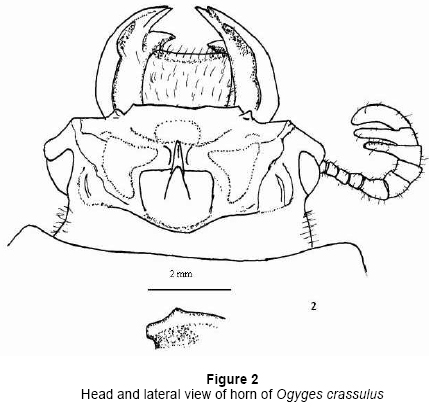
<body><![CDATA[<p align="justify"><font face="verdana" size="2"><b><i>Ogyges quichensis</i></b> Schuster &#38; Reyes&#45;Castillo 1990. The species was collected in the western region of Sierra de los Cuchumatanes, Laj Chimel, Uspant&aacute;n, Quich&eacute;, 2000 m. It was sympatric with <i>O. tzutuhili</i> and <i>O. championi.</i></font></p>  	    <p align="justify"><font face="verdana" size="2"><b><i>Ogyges politus</i></b> (Hincks 1953). This species was recently encountered at the Guatemalan portion of the Cerro Montecristo, near the Guatemalan&#45;Salvadoran&#45;Honduran border, at 1600&#45;1900 m in cloud forest.</font></p>  	    <p align="justify"><font face="verdana" size="2"><b><i>Ogyges crassulus</i> (Casey)</b></font></p> 	    <p align="justify"><font face="verdana" size="2"><i>Proculejoides crassulus</i> Casey, 1897: 642&#45;643. Hincks &#38; Dibb 1935:34.</font></p>         <p align="justify"><font face="verdana" size="2"><i>Proculejoides crassula:</i> Blackwelder 1944:191.</font></p>         <p align="justify"><font face="verdana" size="2"><i>Ogyges crassulus:</i> Reyes&#45;Castillo 1970:176.</font></p>     <p align="center"><font face="verdana" size="2"><a href="#f2">Figures 2</a>&#45;<a href="#f3">3</a></font></p>     <p align="center"><font face="verdana" size="2"><img src="/img/revistas/azm/v21n2/a9f2.jpg"><a name="f2"></a></font></p>      <p align="center">&nbsp;</p>  	    <p align="center"><font face="verdana" size="2"><a name="f3"></a></font></p>  	    ]]></body>
<body><![CDATA[<p align="center"><font face="verdana" size="2"><img src="/img/revistas/azm/v21n2/a9f3.jpg"></font></p>  	    <p align="justify">&nbsp;</p>     <p align="justify"><font face="verdana" size="2"><b>Redescription.</b> Head: anterior border of labrum slightly concave. Clypeus inclined (&#62;90&#176;); anterior border straight, with a small central invagination, without suture separating it from the frons; external tubercles rounded and defined. Frontal area smooth, without inner tubercles and frontal ridges. Frontal fossae wide, glabrous and slightly rugose. Median frontal structure of "marginatus" type (see Reyes&#45;Castillo 1970, p. 15), center horn short, narrow, with apex barely free or not free, without median longitudinal groove posteriorly; lateral ridges somewhat elongate, not separated from the central horn by a groove. A wide, bare, smooth fossa present in front of the median frontal structure. Occipital area with shallow fossa. Supraorbital ridge with equal anterior tubercles; posterior 1/2 bifurcate, external ridge well marked. Canthus with apex straight or slightly swollen. Eyes reduced. Eye width &#61; 0.41 mm. Head width &#61; 7.23 mm; ratio both eye widths/head width &#61; 0.11.</font></p>  	    <p align="justify"><font face="verdana" size="2">Ligula slightly protuberant basally, with small central tooth, setaceous punctations medially. Lateral lobes and medial basal mentum with abundant setose punctations. Hypostomal process elongate, without lateral depression, wide medially and narrow in apical third. Infraocular ridge present, short and smooth, surrounded by striate, setose punctations.</font></p>  	    <p align="justify"><font face="verdana" size="2">Mandible with two apical teeth. Internal teeth bifid. Dorsal tooth occupies 1/2 length of mandible.</font></p>  	    <p align="justify"><font face="verdana" size="2">Antepenultimate segment of antennal club short, less wide than the penultimate (<a href="#f2">Fig. 2</a>), measures 1.69 mm wide and 0.31 mm long.</font></p>  	    <p align="justify"><font face="verdana" size="2">Thorax: Lateral fossae of pronotum without punctations. Pronotum with marginal groove narrow and smooth; anterior angles rounded; disk smooth. Mesosternum glabrous; lateral depressions elongate and rugose (shagreened). Mesepisternum with oval, elongate, shagreened area. Metasternum anterior angles glabrous; disk delimited by 15&#45;42 well marked punctations (some striate) on each side; marginal fossa glabrous, narrow and smooth, posteriorly two times wider than medially.</font></p>  	    <p align="justify"><font face="verdana" size="2">Elytra: Slightly opaque. Striations marked and with defined punctations, slightly deeper and wider between striae 5&#45;10. Junctions of striations 1 and 10 with some extra punctations.</font></p>  	    <p align="justify"><font face="verdana" size="2">Wings: Reduced.</font></p>  	    <p align="justify"><font face="verdana" size="2">Legs: Femur I with anterior&#45;ventral groove marked. Tibia II with one (n&#61; 24) or more rarely two (n&#61; 3) spines.</font></p>  	    ]]></body>
<body><![CDATA[<p align="justify"><font face="verdana" size="2">Abdomen: Marginal groove incomplete, occupies 3/5 of last sternite.</font></p>  	    <p align="justify"><font face="verdana" size="2">Aedeagus: Lateral lobes and basal piece fused (<a href="#f3">Fig. 3</a>).</font></p>  	    <p align="justify"><font face="verdana" size="2">Dimensions (mm) (n&#61; 21): Total length 24.30&#45;30.1, (<img src="/img/revistas/azm/v21n2/a9i1.jpg">&#61; 28.14); elytral length 12.7&#45;16, (<img src="/img/revistas/azm/v21n2/a9i1.jpg"> &#61; 14.99); pronotal length 6.45&#45;8.40, (<img src="/img/revistas/azm/v21n2/a9i1.jpg"> &#61; 7.71); pronotal width 8.35&#45;11, (<img src="/img/revistas/azm/v21n2/a9i1.jpg"> &#61; 9.91); humeral width 7.65&#45;10.2, (<img src="/img/revistas/azm/v21n2/a9i1.jpg"> &#61; 9.26).</font></p>  	    <p align="justify"><font face="verdana" size="2"><b>Material examined.</b> 72 whole specimens.</font></p>  	    <p align="justify"><font face="verdana" size="2"><b>Type material.</b> Holotype (sex unknown) from "HONDURAS", deposited at U.S. National Museum, Smithsonian Institution. Data: Type, USNM catalogue No. 49202. Casey det. Cropulus crassulus Cas. (handwritten). Dimensions: (Casey measurements in parentheses): Total length 25 mm (24 mm); elytral length 13 mm (12.3 mm); pronotal length 7.1 mm (6.5 mm); pronotal width 8.8 mm (9); humeral width 7.5 mm. The bluish opaqueness of the elytra of the slight brown holotype is not easy to see. Other specimens from: HONDURAS: Esnacifor 8 X 1980, Bolivar Dom&iacute;nguez. (1) (IEXA). Cort&eacute;s, 18 km O. San Pedro Sula, cra El Merend&oacute;n, 1600 m, VI 1995 T. Porion &#38; G. Lachaume (1) (MNHN); same data except 1400 m, VII 1995, T. Porion &#38; A. Grange (1) (MNHN); Santa B&aacute;rbara, cra El Rodeo &#45; San Luis, La Alianza, 1750 m, VII 1995, A. Grange &#38; T. Porion (1) (MNHN).</font></p>  	    <p align="justify"><font face="verdana" size="2"><b>New country record:</b> GUATEMALA: Izabal, Morales, Sierra de Caral, Aldea Negro Norte, finca La Firmeza, 23&#45;27 VI 1991, J.Monz&oacute;n (9); same data except 1200 m, IV 1997 (6); same data except 1150 m, 30 VIII 1997 (18); same data except 1150 m, 27 VII 1998, E. Cano &#38; J. Monz&oacute;n (5); same data except 1000 m, 25 III 1997, J. Monz&oacute;n &#38; A.C. Bailey (4); same data except 900 m, 1&#45;2 IV 1992, C. Guirola (1). GUATEMALA: Izabal, Los Amates, Cerro Nylon, above San Antonio, 1120 m, 8&#45;11 IV 1990, J.C. Schuster, collector, &#35; WI (6); same data except 1100 m (1); same data except 1250 m (2); same data except 1230 m (1); same data except 1240 m (1); same data except 1270 m (1); same data except 1295 m (1); same data except 1290 m (1); same data except 1150 m (2); same data except 4&#45;7 VIII 1990, C. Guirola &#38; E. Smith (8).</font></p>  	    <p align="justify"><font face="verdana" size="2"><b>Etymology.</b> From the Latin <i>"crassus",</i> "coarse" or "gross".</font></p>  	    <p align="justify"><font face="verdana" size="2"><b>Distribution.</b> This species was described from "Honduras". It is now known from Sierra de Caral, Izabal Dept., and Cerro Nylon in Guatemala, near the Guatemalan&#45;Honduran border (<a href="/img/revistas/azm/v21n2/a9f1.jpg" target="_blank">Fig. 1</a>) in lowland cloud forest (1100&#45;1295 m) grading into rain forest at lowest elevations.</font></p>  	    <p align="justify"><font face="verdana" size="2"><b>Affinities.</b> <i>Ogyges crassulus</i> is related to <i>O. monzoni</i> n.sp. and <i>O. aluxi</i> n.sp., forming a different lineage, not considered in Schuster &#38; Reyes&#45;Castillo (1990).</font></p>  	    <p align="justify"><font face="verdana" size="2"><b>Description.</b> Head: anterior border of labrum straight, dorsal surface granular. Clypeus vertical, anterior border straight. Frons delimited by a keel; external tubercles rounded. Frontal area slightly microtuberculate, more or less smooth to somewhat roughened; inner tubercles and frontal ridges strongly marked and united to the median frontal structure; inner tubercles small. Frontal fossae glabrous, smooth, somewhat roughened and with microtubercles. Median frontal structure of "marginatus" type, center horn short with apex not free, with median longitudinal (mostly deep) groove posteriorly in basal half; lateral ridges elongate, rounded, directed forward, separated from the center horn by a small groove. Supraorbital ridge with mostly unequal or almost equal anterior tubercles; posterior 1/2 bifurcate, external ridge well marked. Canthus with apex swollen, apex forming a right angle. Eyes reduced, width &#61; 0.62 mm (each eye). Head width &#61; 7.54 mm. Ratio both eyes/head &#61; 0.16.</font></p>  	    ]]></body>
<body><![CDATA[<p align="justify"><font face="verdana" size="2">Ligula slightly protuberant basally, with central tooth small (absent in mature specimens), setose punctations present medially. Lateral lobes of mentum with abundant setose punctations. Medial basal mentum bare or with scarse setae. Hypostomal process long, narrow, without lateral depression. Infraocular ridge present, external and basal area punctate or punctate&#45;pubescent.</font></p>  	    <p align="justify"><font face="verdana" size="2">Mandible with two apical teeth. Internal teeth wide and short. Dorsal tooth occupies 1/2 length of the mandible; internal face granular.</font></p>  	    <p align="justify"><font face="verdana" size="2">Antennal club (<a href="#f4">Fig. 4</a>) with last two segments wider than the antepenultimate, this slightly more than twice as wide as long.</font></p>  	    <p align="center"><font face="verdana" size="2"><a name="f4"></a></font></p>  	    <p align="center"><font face="verdana" size="2"><img src="/img/revistas/azm/v21n2/a9f4.jpg"></font></p>  	    <p align="justify"><font face="verdana" size="2">Thorax: Lateral fossae of pronotum without heavy punctations. Pronotum with marginal groove narrow and smooth; anterior angles rounded. Pronotum strongly punctate anteriorly and posteriorly near the marginal groove; punctations small and shallow, moderately visible at low magnification; disk with sparse micropunctations. Mesosternum bare, lateral depressions elongate, rugose (shagreened). Mesepisternum with large rugose area (shagreened). Metasternum with anterior angles bare; disk not delimited by punctations; marginal fossa bare and narrow, posterior part 1.5&#45;2 times wider than the median part.</font></p>  	    <p align="justify"><font face="verdana" size="2">Elytra: Striations marked and without defined punctations; interstriae 1&#45;7 with scarce micropunctations, more abundant and visible at lower magnification on interstriae 8&#45;10.</font></p>  	    <p align="justify"><font face="verdana" size="2">Wings: Reduced.</font></p>  	    <p align="justify"><font face="verdana" size="2">Legs: Femur I with anterior&#45;ventral groove marked. Tibia II with two (rarely three) spines.</font></p>  	    <p align="justify"><font face="verdana" size="2">Abdomen: Marginal groove incomplete, occupies 3/5 of last sternite.</font></p>  	    ]]></body>
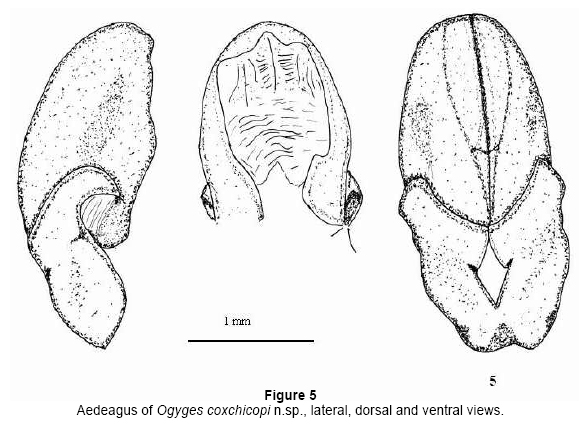
<body><![CDATA[<p align="justify"><font face="verdana" size="2">Aedeagus (ventrally): Tegmen with lateral lobes fused to basal piece (<a href="#f5">Fig. 5</a>).</font></p>  	    <p align="center"><font face="verdana" size="2"><a name="f5"></a></font></p>  	    <p align="center"><font face="verdana" size="2"><img src="/img/revistas/azm/v21n2/a9f5.jpg"></font></p>  	    <p align="justify"><font face="verdana" size="2">Dimensions (mm) (n&#61; 15): Total length 28.5&#45;32.25, (<img src="/img/revistas/azm/v21n2/a9i1.jpg">&#61; 30.49); elytral length 15.75&#45;17, (<img src="/img/revistas/azm/v21n2/a9i1.jpg"> &#61; 16.29); pronotal length 7.6&#45;8.75, (<img src="/img/revistas/azm/v21n2/a9i1.jpg"> &#61; 8.16); pronotal width 10.3&#45;11, (<img src="/img/revistas/azm/v21n2/a9i1.jpg"> &#61; 10.6); humeral width 9.9&#45;10.9, (<img src="/img/revistas/azm/v21n2/a9i1.jpg"> &#61;10.35).</font></p>  	    <p align="justify"><font face="verdana" size="2">Larva. Tergal setal pattern of <i>"Vindex"</i> type (see Schuster &#38; Reyes&#45;Castillo 1981). Anal ring with 16 setae.</font></p>  	    <p align="justify"><font face="verdana" size="2"><b>Material examined.</b> 20 whole specimens.</font></p>  	    <p align="justify"><font face="verdana" size="2"><b>Type material.</b> Holotype male: GUATEMALA: Izabal Dept., near Rio Zarco Grande, north slope of Sierra de las Minas, altitude 1500 m., 24 V 1993, E. Cano collector.</font></p>  	    <p align="justify"><font face="verdana" size="2">Paratypes: GUATEMALA: same data as holotype (14); Zacapa Dept., rd. to Jones, finca Monte de Mor&aacute;n, 8 IV 1983. S. Ubico, 1600 m. &#35; PNO&#45;3,4,5,6 (5 specimens).</font></p>  	    <p align="justify"><font face="verdana" size="2">Holotype deposited in UVGC. Paratypes will be deposited in IEXA, MNHN, FSCA and INPA.</font></p>  	    <p align="justify"><font face="verdana" size="2"><b>Etymology.</b> According to a Q'ich&eacute; Mayan from the region of Uspant&aacute;n, cox'chicop means passalids.</font></p>  	    ]]></body>
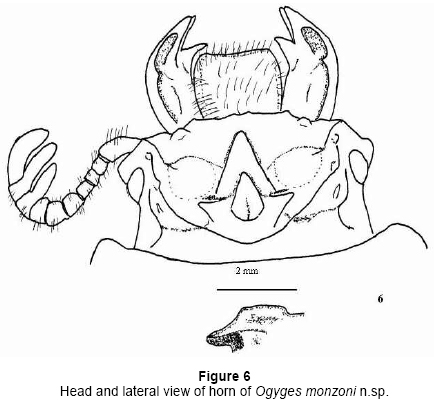
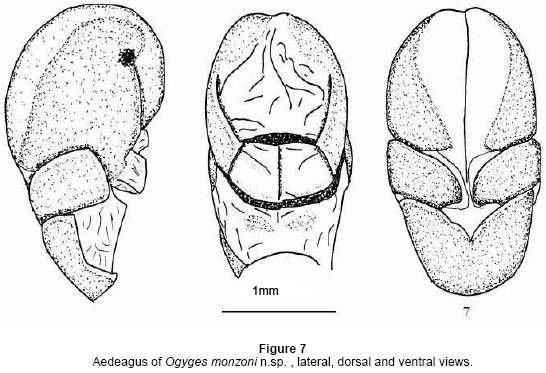
<body><![CDATA[<p align="justify"><font face="verdana" size="2"><b>Distribution and ecology.</b> Known only from middle altitudes and lowland cloud forests on Polochic and Motagua valley slopes in the Sierra de las Minas between 1500 and 1600 m altitude (<a href="/img/revistas/azm/v21n2/a9f1.jpg" target="_blank">Fig. 1</a>). Other species found at these sites includes: <i>Proculus opacipennis</i> (Thompson), <i>Ogyges championi</i> (Bates) <i>Chondrocephalus granulum</i> Kuwert, <i>Chondrocephalus gemmae</i> Castillo &#38; Reyes&#45;Castillo, <i>Xylopassaloides moxi</i> Schuster, <i>Vindex sculptilis</i> Bates, <i>Popilius haagi</i> (Kaup), <i>Passalus caelatus</i> Erichson, <i>Passalus punctatostriatus</i> Percheron and <i>Passalus (Pertinax)</i> n.sp.</font></p>  	    <p align="justify"><font face="verdana" size="2"><b>Affinities.</b> <i>O. coxchicopi</i> is most related to <i>O. championi</i> and <i>O. kekchii.</i> These especies are in the "laevior" lineage of Schuster &#38; Reyes Castillo (1990).</font></p>  	    <p align="justify"><font face="verdana" size="2">&nbsp;</font></p>  	    <p align="center"><font face="verdana" size="2"><b><i>Ogyges monzoni</i> n.sp.</b></font></p> 	    <p align="center"><font face="verdana" size="2"><a href="#f6">Figures 6</a>&#45;<a href="#f7">7</a></font></p>      <p align="center"><font face="verdana" size="2"><a name="f6"></a></font></p>  	    <p align="center"><font face="verdana" size="2"><img src="/img/revistas/azm/v21n2/a9f6.jpg"></font></p>  	    <p align="center"><font face="verdana" size="2"><a name="f7"></a></font></p>  	    <p align="center"><font face="verdana" size="2"><img src="/img/revistas/azm/v21n2/a9f7.jpg"></font></p>  	    <p align="justify"><font face="verdana" size="2"><b>Description.</b> Head: anterior border of labrum slightly concave. Clypeus inclined (&#62;90 degrees); anterior border almost straight, with a small central invagination; without suture separating it from the frons; external tubercles rounded and defined. Frontal area smooth; without inner tubercles and frontal ridges. Frontal fossae glabrous and slightly rugose. Median frontal structure of "marginatus" type, center horn basally wide, long, with apex largely free, with a dorsal protrusion like an small horn with apex not free (<a href="#f6">Fig. 6</a>), and a median longitudinal groove (marked to indistinct) in posterior half; lateral ridges somewhat elongate, directed slightly posteriorly, not separated from the central horn by a groove. A wide, bare, smooth fossa present in front of the median frontal structure. Occipital area with shallow fossa. Supraorbital ridge with equal anterior tubercles; posterior half bifurcate, external ridge well marked. Canthus with apex straight or slightly swollen. Eyes reduced. Eye width &#61; 0.46 mm. Head width &#61; 6.84 mm; ratio both eye widths/head width &#61; 0.13.</font></p>  	    ]]></body>
<body><![CDATA[<p align="justify"><font face="verdana" size="2">Ligula almost flat basally, with small central tooth, setaceous punctations medially. Lateral lobes and medial basal mentum with 5&#45;12 setose punctations. Hypostomal process elongate, without lateral depression, wide medially and narrow in apical third. Infraocular ridge present, short and smooth, surrounded by striate, setose punctations.</font></p>  	    <p align="justify"><font face="verdana" size="2">Mandible with two apical teeth. Internal teeth bifid. Dorsal tooth occupies 1/2 length of mandible.</font></p>  	    <p align="justify"><font face="verdana" size="2">Antepenultimate segment of antennal club less wide than penultimate (<a href="#f6">Fig. 6</a>), measures 1.48 mm wide and 0.35 mm long.</font></p>  	    <p align="justify"><font face="verdana" size="2">Thorax: Lateral fossae of pronotum without punctations; lateral fossae and lateral borders with numerous micropuntations of rugose aspect, visible with great magnification. Pronotum with marginal groove narrow and smooth; anterior angles rounded; disk smooth. Mesosternum glabrous; lateral depressions wide, elongate and rugose (shagreened). Mesepisternum with oval, elongate, shagreened area. Metasternum anterior angles glabrous; disk delimited by 17&#45;48 well marked punctations on each side; marginal fossa glabrous, very narrow and smooth, posteriorly two times wider than medially.</font></p>  	    <p align="justify"><font face="verdana" size="2">Elytra: Slightly opaque. Striations marked and with defined punctations, slightly deeper and wider between striae 5&#45;10. Junctions of striae 1 and 10 with some extra punctations.</font></p>  	    <p align="justify"><font face="verdana" size="2">Wings: Reduced.</font></p>  	    <p align="justify"><font face="verdana" size="2">Legs: Femur I with anterior&#45;ventral groove marked. Tibia II with one (n&#61; 11) or more rarely two (n&#61; 3) spines.</font></p>  	    <p align="justify"><font face="verdana" size="2">Abdomen: Marginal groove incomplete, occupies 3/5 of last sternite.</font></p>  	    <p align="justify"><font face="verdana" size="2">Aedeagus: Lateral lobes separated from basal piece (<a href="#f7">Fig. 7</a>).</font></p>  	    <p align="justify"><font face="verdana" size="2">Dimensions (mm) (n&#61; 14): Total length 25&#45;28.25, (<img src="/img/revistas/azm/v21n2/a9i1.jpg"> &#61; 26.55); elytral length 13.7&#45;15.45, ( <img src="/img/revistas/azm/v21n2/a9i1.jpg">&#61; 14.44); pronotal length 6.85&#45;7.85, (<img src="/img/revistas/azm/v21n2/a9i1.jpg"> &#61; 7.36); pronotal width 9.05&#45;10, ( <img src="/img/revistas/azm/v21n2/a9i1.jpg">&#61; 9.63); humeral width 8.6&#45;9.5, (<img src="/img/revistas/azm/v21n2/a9i1.jpg"> &#61; 9.07).</font></p>  	    ]]></body>
<body><![CDATA[<p align="justify"><font face="verdana" size="2"><b>Material examined.</b> 14 whole specimens.</font></p>  	    <p align="justify"><font face="verdana" size="2"><b>Type material.</b> Holotype male. GUATEMALA, Izabal, Morales, Cerro Nylon, above San Antonio, 4&#45;7 VIII 1990. C. Guirola &#38; E. Smith.</font></p>  	    <p align="justify"><font face="verdana" size="2">Paratypes: Same data as holotype (10, one specimen deposited in MNHN). GUATEMALA, Izabal, Los Amates, Cerro Nylon, above San Antonio, 8&#45;11 IV 1990. J.C. Schuster, &#35;WI, 1290 m (3); same data except 1250 m (1).</font></p>  	    <p align="justify"><font face="verdana" size="2">Holotype deposited in UVGC. Paratypes will be deposited in IEXA, MNHN, FSCA and INPA.</font></p>  	    <p align="justify"><font face="verdana" size="2"><b>Etymology.</b> The name of this species is in honor of our friend and collector Jos&eacute; Monz&oacute;n, who has loaned us various passalids new to science.</font></p>  	    <p align="justify"><font face="verdana" size="2"><b>Distribution.</b> Only known from Cerro Nylon, Izabal Dept., Guatemala, near the Guatemalan&#45;Honduran border (<a href="/img/revistas/azm/v21n2/a9f1.jpg" target="_blank">Fig. 1</a>) in lowland cloud forest (1200&#45;1300 m).</font></p>  	    <p align="justify"><font face="verdana" size="2"><b>Affinities.</b> <i>Ogyges monzoni</i> is closelly related to <i>O. aluxi</i> and <i>O. crassulus.</i> These species compose a different lineage not considered in Schuster &#38; Reyes&#45;Castillo (1990).</font></p>  	    <p align="justify"><font face="verdana" size="2">&nbsp;</font></p>  	    <p align="center"><font face="verdana" size="2"><b><i>Ogyges aluxi</i> n.sp.</b></font></p> 	    <p align="center"><font face="verdana" size="2"><a href="#f8">Figures 8</a>&#45;<a href="#f9">9</a></font></p>      ]]></body>
<body><![CDATA[<p align="center"><font face="verdana" size="2"><a name="f8"></a></font></p>  	    <p align="center"><font face="verdana" size="2"><img src="/img/revistas/azm/v21n2/a9f8.jpg"></font></p>  	    <p align="center"><font face="verdana" size="2"><a name="f9"></a></font></p>  	    <p align="center"><font face="verdana" size="2"><img src="/img/revistas/azm/v21n2/a9f9.jpg"></font></p>  	    <p align="justify"><font face="verdana" size="2">This new species was erroneously cited as <i>Ogyges crassulus</i> (Casey) by Schuster &#38; Reyes&#45;Castillo (1990:8, 12&#45;15, 41, 42) and by Schuster &#38; Schuster (1997: 263, 265).</font></p>  	    <p align="justify"><font face="verdana" size="2"><b>Description.</b> Head: anterior border of labrum concave or slightly concave. Clypeus inclined, anterior border straight, with a small central invagination, without (n&#61; 17) or with (n&#61; 10) groove separating it from the frons; external tubercles rounded and well defined. Frontal area smooth, without inner tubercles and frontal ridges. Frontal fossae glabrous and slightly rugose. Median frontal structure of "marginatus" type, center horn long and free, with apex directed forward, without median longitudinal groove posteriorly; lateral ridges elongate, rounded, directed laterally or slightly posteriorly, not separated from center horn by a groove. A wide, smooth, bare fossa present in front of median frontal structure. Occipital area with deep fossa. Supraorbital ridge with equal anterior tubercles; posterior 1/2 bifurcate, external ridge well marked. Canthus with apex slightly swollen. Eyes reduced. Eye width &#61; 0.58 mm. Head width &#61; 8.46 mm; ratio width both eyes/head width &#61; 0.14.</font></p>  	    <p align="justify"><font face="verdana" size="2">Ligula slightly protuberant basally, with small central tooth (absent in mature specimens), setose punctations medially. Lateral lobes of mentum with abundant setose punctations; medial basal mentum glabrous and smooth. Hypostomal process elongate, without lateral depression, wide medially and narrow in apical third. Infraocular ridge present, short and smooth, surrounded by striate setose punctations.</font></p>  	    <p align="justify"><font face="verdana" size="2">Mandible with two apical teeth. Internal teeth bifid. Dorsal tooth occupies 1/2 length of mandible. Antepenultimate segment of antennal club narrower than penultimate (<a href="#f8">Fig. 8</a>), measures 1.92 mm wide and 0.38 mm long.</font></p>  	    <p align="justify"><font face="verdana" size="2">Thorax: Lateral fossae of pronotum without punctations; striate micropunctations present on fossae only anterolaterally. Pronotum with marginal groove narrow and smooth; anterior angles rounded; disk smooth. Mesosternum glabrous; lateral depressions elongate and rugose (shagreened). Mesepisternum with rugose area (shagreened), ovate and elongate posteriorly.</font></p>  	    <p align="justify"><font face="verdana" size="2">Metasternum anterior angles glabrous; disk delimited by 4&#45;39 well marked punctations (some striated) on each side; marginal fossae glabrous, narrow and smooth, posteriorly twice as wide as medially.</font></p>  	    ]]></body>
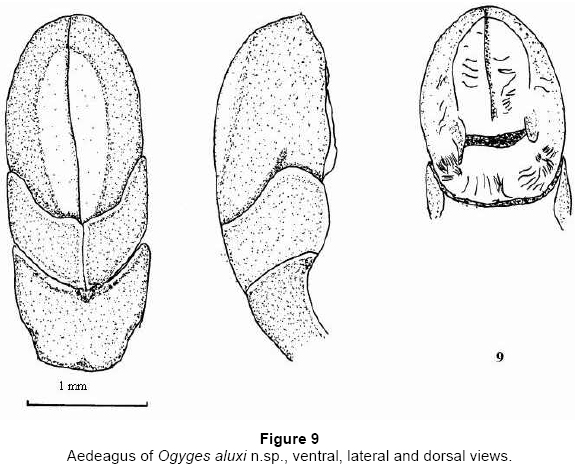
<body><![CDATA[<p align="justify"><font face="verdana" size="2">Elytra: Slightly opaque and bluish. Striations marked and with defined punctations, slightly deeper and wider between striae 5&#45;10 such that interstriae 6&#45;10 are narrower than interstriae 1&#45;5. Junctions of striations 1 and 10 with extra punctations forming a double line. Humeri markedly expanded laterally.</font></p>  	    <p align="justify"><font face="verdana" size="2">Wings: Reduced.</font></p>  	    <p align="justify"><font face="verdana" size="2">Legs: Femur I with anterior&#45;ventral groove marked. Tibia II with only one strong spine (n&#61; 16), or with one (n&#61; 8) or two (n&#61; 3) small spine(s).</font></p>  	    <p align="justify"><font face="verdana" size="2">Abdomen: Marginal groove incomplete, occupies 3/5 of last sternite.</font></p> 	    <p align="justify"><font face="verdana" size="2">Aedeagus: Lateral lobes and basal piece separated (<a href="#f9">Fig. 9</a>).</font></p>      <p align="justify"><font face="verdana" size="2">Dimensions (mm) (n&#61; 15): Total length 32.1&#45;36.45, (<img src="/img/revistas/azm/v21n2/a9i1.jpg"> &#61; 33.86); elytral length 17.45&#45;19, (<img src="/img/revistas/azm/v21n2/a9i1.jpg" height="10"> &#61; 18.07); pronotal length 8.6&#45;10.05, (<img src="/img/revistas/azm/v21n2/a9i1.jpg"> &#61; 9.21); pronotal width 11.4&#45;12.75, (<img src="/img/revistas/azm/v21n2/a9i1.jpg"> &#61; 12.02); humeral width 10.65&#45;12.75, (<img src="/img/revistas/azm/v21n2/a9i1.jpg"> &#61; 11.65).</font></p>  	    <p align="justify"><font face="verdana" size="2"><b>Etymology.</b> "Alux" is a Mayan term meaning "spirit". The specific name honors the Guatemalan rock band Alux Nahual. While on tour in Honduras with the band, Schuster found various passalids, some new to science.</font></p>  	    <p align="justify"><font face="verdana" size="2"><b>Material examined.</b> 34 whole specimens and one specimen in pieces.</font></p>  	    <p align="justify"><font face="verdana" size="2"><b>Type material.</b> Holotype male. HONDURAS, Cort&eacute;z, 30 km N. of San Pedro Sula, 1550 m, 20&#45;21 III 1987, &#35;VI, J.C. Schuster, cloud forest.</font></p>  	    <p align="justify"><font face="verdana" size="2">Paratypes: Same data as holotype (15, one female deposited at MNHN). HONDURAS: Cort&eacute;z, N. de Cofrad&iacute;a, Cusuco, 1420&#45;1440 m, 26III1991, &#35;WK, J.C. Schuster (9, one female deposited at MNHN). HONDURAS: Cort&eacute;z, 18 km of San Pedro Sula, Cra. El Merend&oacute;n, 1650 m, T. Porion &#38; A. Grange (3 females deposited at MNHN). HONDURAS: San Pedro Sula, Norte de Cofrad&iacute;a, P.N. El Cusuco, Orion, 1400 m, junio 1999. J. Monz&oacute;n &#38; A.C. Bailey (5). Honduras: Yoro, 10 km N.O. de Moraz&aacute;n, 780 m, 24 III 1991, J.C. Schuster, &#35;WJ (2).</font></p>  	    ]]></body>
<body><![CDATA[<p align="justify"><font face="verdana" size="2">Holotype deposited in UVGC. Paratypes will be deposited in IEXA, MNHN, FSCA and INPA.</font></p>  	    <p align="justify"><font face="verdana" size="2"><b>Distribution.</b> This species seems to occur widely in the cloud forests of northeastern Honduras (<a href="/img/revistas/azm/v21n2/a9f1.jpg" target="_blank">Fig. 1</a>).</font></p>  	    <p align="justify"><font face="verdana" size="2"><b>Affinities.</b> <i>Ogyges aluxi</i> is related to <i>O. monzoni</i> and <i>O. crassulus.</i> These species compose a different lineage not considered in Schuster &#38; Reyes&#45;Castillo (1990).</font></p>  	    <p align="justify"><font face="verdana" size="2">&nbsp;</font></p>  	    <p align="center"><font face="verdana" size="2"><b><i>Ogyges nahuali</i> n.sp.</b>    <br> 	<a href="#f10">Figures 10</a>&#45;<a href="#f11">11</a></font></p>  	    <p align="center"><font face="verdana" size="2"><a name="f10"></a></font></p>  	    <p align="center"><font face="verdana" size="2"><img src="/img/revistas/azm/v21n2/a9f10.jpg"></font></p>  	    <p align="center"><font face="verdana" size="2"><a name="f11"></a></font></p>  	    <p align="center"><font face="verdana" size="2"><img src="/img/revistas/azm/v21n2/a9f11.jpg"></font></p>  	    ]]></body>
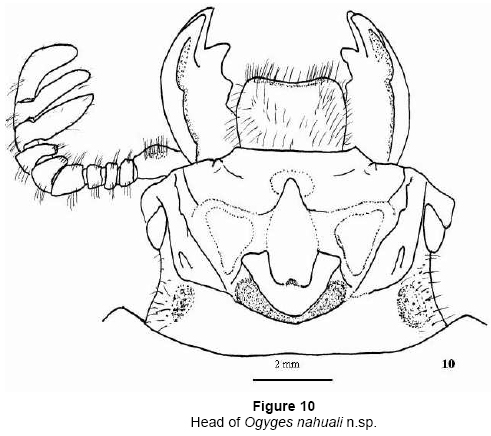
<body><![CDATA[<p align="justify"><font face="verdana" size="2"><b>Description.</b> Head: anterior border of labrum concave. Clypeus inclined, anterior border straight, with a weak suture separating it from the frons; external tubercles small and rounded. Frontal area smooth, without inner tubercles and frontal ridges. Frontal fossae glabrous and smooth. Median frontal structure of "marginatus" type, center horn long, with apex free, without median longitudinal groove posteriorly; lateral ridges short, rounded, curved forward, separated from center horn by a small groove. A small, bare, smooth fossa present in front of the median frontal structure. Occipital region forming a smooth fossa, posteriorly shallow and laterally deep (<a href="#f10">fig. 10</a>); lateral extremities 8 times longer than median area. Supraorbital ridge with equal anterior tubercles; posterior 1/2 bifurcate, external ridge well marked. Canthus with apex slightly swollen. Eyes reduced. Eye width &#61; 0.49 mm. Head width &#61; 8.17 mm. Ratio width of both eyes/head &#61; 0.12.</font></p>  	    <p align="justify"><font face="verdana" size="2">Ligula slightly protuberant basally, with central tooth small, setose punctations on the median area. Lateral lobes of mentum with abundant setose punctations. Medial basal mentum glabrous. Hypostomal process elongate, without lateral depression, wide medially and narrow in the apical third. Infraocular ridge present, short and smooth, surrounded by setose punctations.</font></p>  	    <p align="justify"><font face="verdana" size="2">Mandible with two apical teeth. Internal teeth bifid. Dorsal tooth occupies 1/2 length of mandible.</font></p>  	    <p align="justify"><font face="verdana" size="2">Antennal club (<a href="#f10">Fig. 10</a>) with all three segments very wide and subequal; antepenultimate segment slightly longer, wider than the penultimate (6/5).</font></p>  	    <p align="justify"><font face="verdana" size="2">Thorax: Lateral fossa of pronotum without punctations. Pronotum with marginal groove narrow and smooth; anterior angles rounded; disk smooth. Mesosternum with two lines of setaceous punctations apically; lateral depressions elongate and rugose (shagreened). Mesepisternum with elongate rugose area (shagreened). Metasternum anterior angles glabrous; disk delimited by 33&#45;49 well marked punctations on each side; marginal fossae glabrous, narrow and rugose, posteriorly two times wider than medially.</font></p>  	    <p align="justify"><font face="verdana" size="2">Elytra: Striations marked; with small, defined, superficial punctations, deeper and wider between striae 6&#45;10 and clearly visible in all striae on the distal third of the elytra. Junctions of striations 1 and 10 with extra punctations forming a double line.</font></p>  	    <p align="justify"><font face="verdana" size="2">Wings: Reduced.</font></p>  	    <p align="justify"><font face="verdana" size="2">Legs: Femur I with anterior&#45;ventral groove marked. Tibia II with one spine.</font></p>  	    <p align="justify"><font face="verdana" size="2">Abdomen: Marginal groove incomplete, occupies 3/5 of last sternite.</font></p>  	    <p align="justify"><font face="verdana" size="2">Aedeagus: Lateral lobes and basal piece separated (<a href="#f11">Fig. 11</a>).</font></p>  	    ]]></body>
<body><![CDATA[<p align="justify"><font face="verdana" size="2">Dimensions (mm) (n&#61; 4): Total length 31.2&#45;34 (<img src="/img/revistas/azm/v21n2/a9i1.jpg"> &#61; 33.11); elytral length &#61; 16.25&#45;18.25 (<img src="/img/revistas/azm/v21n2/a9i1.jpg"> &#61; 17.6); pronotal length &#61; 8.85&#45;9.55 (<img src="/img/revistas/azm/v21n2/a9i1.jpg"> &#61; 9.12); pronotal width &#61; 10.8&#45;12.1 (<img src="/img/revistas/azm/v21n2/a9i1.jpg"> &#61; 11.69); humeral width &#61; 10.2511.50 (<img src="/img/revistas/azm/v21n2/a9i1.jpg"> &#61; 10.96).</font></p>  	    <p align="justify"><font face="verdana" size="2"><b>Material examined.</b> 4 whole specimens.</font></p>  	    <p align="justify"><font face="verdana" size="2"><b>Type material.</b> Holotype male: HONDURAS: Olancho, route La Uni&oacute;n &#45; El Dictamo, 16 km La Muralla, 1550 m, VII 1995, T. Porion &#38; A. Grange.</font></p>  	    <p align="justify"><font face="verdana" size="2">Paratypes: HONDURAS: Olancho, Parque Nacional La Muralla, 17 IX 1995, R. Lehman (1 female). HONDURAS: Olancho, Parque Nacional la Muralla, Sendero Pizote, 10 VI 2003, R. Turnbow (2).</font></p> 	    <p align="justify"><font face="verdana" size="2">Holotype deposited in the MNHN and paratypes in the UVGC and IEXA.</font></p>      <p align="justify"><font face="verdana" size="2"><b>Etymology.</b> "Nahual" is a Mayan term for a spirit that each person has within himself (the <i>alter ego),</i> usually in the form of an animal, a "duende" in Spanish. This name was chosen to honor the Guatemalan rock band Alux Nahual. During concert tours, Schuster was able to collect passalids in Honduras and other Central American countries and to examine collections of passalids.</font></p>  	    <p align="justify"><font face="verdana" size="2"><b>Distribution.</b> The species is known only from cloud forests between El Dictamo (1550 m) and the protected cloud forest of La Muralla (1880&#45;2064 m) (<a href="/img/revistas/azm/v21n2/a9f1.jpg" target="_blank">Fig. 1</a>) (Cruz 1993).</font></p>  	    <p align="justify"><font face="verdana" size="2">AFFINITIES. <i>Ogyges nahuali</i> n.sp. is most related to <i>O. adamsi</i> Schuster &#38; Reyes&#45;Castillo. These species are in the "quichensis" lineage of Schuster &#38; Reyes&#45;Castillo (1990).</font></p>  	    <p align="justify"><font face="verdana" size="2">&nbsp;</font></p>  	    <p align="justify"><font face="verdana" size="2"><b>KEY TO THE SPECIES OF THE GENUS <i>OGYGES</i> KAUP</b></font></p> 	         ]]></body>
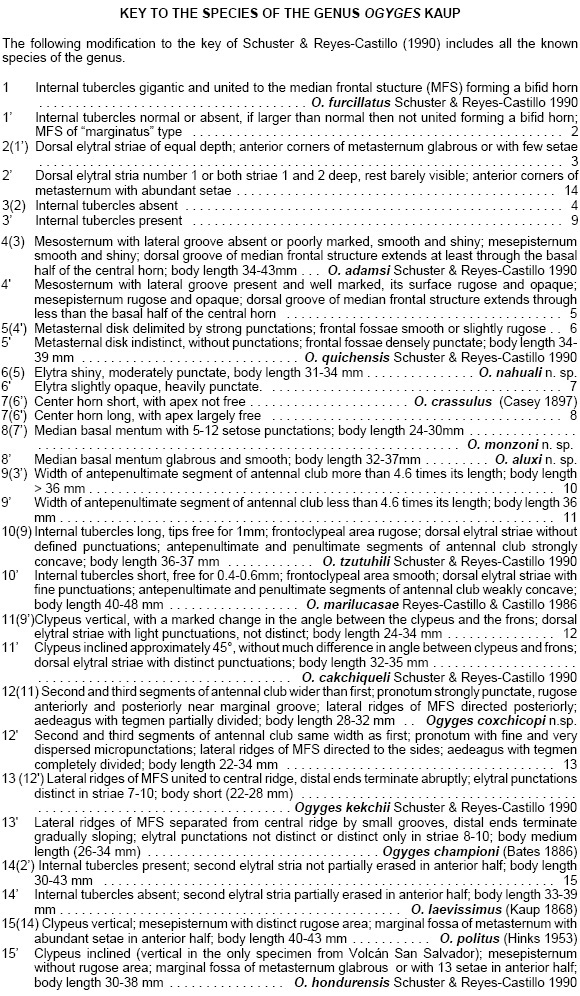
<body><![CDATA[<p align="justify"><font face="verdana" size="2">The following modification to the key of Schuster &amp; Reyes-Castillo (1990) includes all the known species of the genus.</font></p>         <p align="center"><img src="/img/revistas/azm/v21n2/a9t1.jpg"></p>         <p align="justify">&nbsp;</p>     <p align="justify"><font face="verdana" size="2"><b>ACKNOWLEDGEMENTS</b></font></p>      <p align="justify"><font face="verdana" size="2">We thank Jos&eacute; Monz&oacute;n, Eric Smith, Cristina Bailey, Manuel Acevedo, Sonia Ubico, Karla Villatoro and Fundaci&oacute;n Rigoberta Mench&uacute; Tum for specimens collected. Financial support was partially provided by Consejo Nacional de Ciencia y Tecnolog&iacute;a de Guatemala (CONCYT). We thank the Consejo Nacional de Areas Protegidas (CONAP) for collecting permits and Universidad del Valle de Guatemala for support. Also, we thank R. Lehman, T. Porion and R. Turnbow for the specimens of <i>O. nahuali,</i> Edith DuBose for logistical help in visiting European collections, Martin Baehr of the Bavarian State Collection in Munich for loaning the specimen of <i>V. laevior,</i> Angel Solis (INBio) for information about Moritz Wagner in Costa Rica, Michael W. Dix for assistance in examining the holotype of <i>O. crassulus</i> and Martin Brendel and Malcolm Kerley for data on labels and help when examining the type series of <i>Ogyges championi</i> at The Natural History Museum, London. We thank Alfonso Garc&iacute;a Aldrete and Alan Gilloglly for valuable comments that allowed us to improve the manuscript.</font></p>  	    <p align="justify"><font face="verdana" size="2">&nbsp;</font></p>  	    <p align="justify"><font face="verdana" size="2"><b>LITERATURE CITED</b></font></p>  	    <!-- ref --><p align="justify"><font face="verdana" size="2">Bates, H. W. 1886. <i>Biologia Centrali&#45;Americana.</i> Vol. 2, part 2. Coleoptera Pectinicornia and Lamellicornia. Godman &#38; Salvin, London. 1&#45;24.    &nbsp;&nbsp;&nbsp;&nbsp;&nbsp;&nbsp;&nbsp;&nbsp;[&#160;<a href="javascript:void(0);" onclick="javascript: window.open('/scielo.php?script=sci_nlinks&ref=328057&pid=S0065-1737200500020000900001&lng=','','width=640,height=500,resizable=yes,scrollbars=1,menubar=yes,');">Links</a>&#160;]<!-- end-ref --></font></p>  	    <!-- ref --><p align="justify"><font face="verdana" size="2">Blackwelder, R. E. 1944. Checklist of the coleopterous insects of Mexico, Central America, the West Indies, and South America. Part. 2, <i>Bull. U.S. Nal. Mus.</i> 185: 189&#45;341.    &nbsp;&nbsp;&nbsp;&nbsp;&nbsp;&nbsp;&nbsp;&nbsp;[&#160;<a href="javascript:void(0);" onclick="javascript: window.open('/scielo.php?script=sci_nlinks&ref=328059&pid=S0065-1737200500020000900002&lng=','','width=640,height=500,resizable=yes,scrollbars=1,menubar=yes,');">Links</a>&#160;]<!-- end-ref --></font></p>  	    <!-- ref --><p align="justify"><font face="verdana" size="2">Boucher, S. 1988. Revision des especies mexicaines du genre <i>Veturius</i> Kaup (Coleoptera: Passalidae). <i>Ann. Soc. ent. Fr. (N.S.)</i> 24(3):295&#45;305.    &nbsp;&nbsp;&nbsp;&nbsp;&nbsp;&nbsp;&nbsp;&nbsp;[&#160;<a href="javascript:void(0);" onclick="javascript: window.open('/scielo.php?script=sci_nlinks&ref=328061&pid=S0065-1737200500020000900003&lng=','','width=640,height=500,resizable=yes,scrollbars=1,menubar=yes,');">Links</a>&#160;]<!-- end-ref --></font></p>  	    <!-- ref --><p align="justify"><font face="verdana" size="2">Cano, E. 1993. Pas&aacute;lidos. <i>In: Evaluaci&oacute;n Ecol&oacute;gica R&aacute;pida de la Reserva de la Biosfera "Sierra de las</i> <i>Minas".</i> Centro de Datos para la Conservaci&oacute;n, Guatemala. 36&#45;39.    &nbsp;&nbsp;&nbsp;&nbsp;&nbsp;&nbsp;&nbsp;&nbsp;[&#160;<a href="javascript:void(0);" onclick="javascript: window.open('/scielo.php?script=sci_nlinks&ref=328063&pid=S0065-1737200500020000900004&lng=','','width=640,height=500,resizable=yes,scrollbars=1,menubar=yes,');">Links</a>&#160;]<!-- end-ref --></font></p>  	    <!-- ref --><p align="justify"><font face="verdana" size="2">Casey, T. L. 1897. Coleopterological notices VII. Passalinae. <i>Anns. New York Acad. Sci.</i> 9(6&#45;12):640&#45;649.    &nbsp;&nbsp;&nbsp;&nbsp;&nbsp;&nbsp;&nbsp;&nbsp;[&#160;<a href="javascript:void(0);" onclick="javascript: window.open('/scielo.php?script=sci_nlinks&ref=328065&pid=S0065-1737200500020000900005&lng=','','width=640,height=500,resizable=yes,scrollbars=1,menubar=yes,');">Links</a>&#160;]<!-- end-ref --></font></p>  	    <!-- ref --><p align="justify"><font face="verdana" size="2">Cruz, G. 1993. <i>El decreto 87&#45;87, Ley de los Bosques Nublados: Base legal para la conservaci&oacute;n de</i> <i>los bosques nublados de Honduras.</i> CODEFOR&#45;ODA&#45;ESNACIFOR, Honduras. 75 pp.    &nbsp;&nbsp;&nbsp;&nbsp;&nbsp;&nbsp;&nbsp;&nbsp;[&#160;<a href="javascript:void(0);" onclick="javascript: window.open('/scielo.php?script=sci_nlinks&ref=328067&pid=S0065-1737200500020000900006&lng=','','width=640,height=500,resizable=yes,scrollbars=1,menubar=yes,');">Links</a>&#160;]<!-- end-ref --></font></p>  	    <!-- ref --><p align="justify"><font face="verdana" size="2">Elias, P. 1984. Salamanders of the northwestern highlands of Guatemala. <i>Contrib. Sci., Nat. Hist. Mus.</i> <i>Los Angeles Coun.</i> 348:1&#45;20.    &nbsp;&nbsp;&nbsp;&nbsp;&nbsp;&nbsp;&nbsp;&nbsp;[&#160;<a href="javascript:void(0);" onclick="javascript: window.open('/scielo.php?script=sci_nlinks&ref=328069&pid=S0065-1737200500020000900007&lng=','','width=640,height=500,resizable=yes,scrollbars=1,menubar=yes,');">Links</a>&#160;]<!-- end-ref --></font></p>  	    <!-- ref --><p align="justify"><font face="verdana" size="2">Flenley, J. R. 1995. Cloud forest, the Massenerhebung effect, and ultraviolet insolation. Pp. 150&#45;155. <i>In:</i> L.S. Hamilton, J.O. Juvik, and F.N. Scatena (Eds.). <i>Tropical Montane Cloud Forests.</i> Springer&#45;Verlag, New York.    &nbsp;&nbsp;&nbsp;&nbsp;&nbsp;&nbsp;&nbsp;&nbsp;[&#160;<a href="javascript:void(0);" onclick="javascript: window.open('/scielo.php?script=sci_nlinks&ref=328071&pid=S0065-1737200500020000900008&lng=','','width=640,height=500,resizable=yes,scrollbars=1,menubar=yes,');">Links</a>&#160;]<!-- end-ref --></font></p>  	    <!-- ref --><p align="justify"><font face="verdana" size="2">Hincks, W. D. &#38; J. R. Dibb. 1935. <i>Coleopterorum Catalogus, Pars 142: Passalidae.</i> W. Junk's&#45;Gravenhage. 118 p.    &nbsp;&nbsp;&nbsp;&nbsp;&nbsp;&nbsp;&nbsp;&nbsp;[&#160;<a href="javascript:void(0);" onclick="javascript: window.open('/scielo.php?script=sci_nlinks&ref=328073&pid=S0065-1737200500020000900009&lng=','','width=640,height=500,resizable=yes,scrollbars=1,menubar=yes,');">Links</a>&#160;]<!-- end-ref --></font></p>  	    <!-- ref --><p align="justify"><font face="verdana" size="2">ICZN (International Commission on Zoological Nomenclature). 1999. <i>International Code of Zoological Nomenclature.</i> 4<sup>th</sup> ed. International Trust for Zoological Nomenclature, London, xxix&#43;306pp.    &nbsp;&nbsp;&nbsp;&nbsp;&nbsp;&nbsp;&nbsp;&nbsp;[&#160;<a href="javascript:void(0);" onclick="javascript: window.open('/scielo.php?script=sci_nlinks&ref=328075&pid=S0065-1737200500020000900010&lng=','','width=640,height=500,resizable=yes,scrollbars=1,menubar=yes,');">Links</a>&#160;]<!-- end-ref --></font></p>  	    <!-- ref --><p align="justify"><font face="verdana" size="2">Kaup, J. J. 1868. Prodromus zu einer Monographie der Passaliden. <i>Coleopt. Hefte, M&uuml;nchen</i> 4(1):1&#45;31.    &nbsp;&nbsp;&nbsp;&nbsp;&nbsp;&nbsp;&nbsp;&nbsp;[&#160;<a href="javascript:void(0);" onclick="javascript: window.open('/scielo.php?script=sci_nlinks&ref=328077&pid=S0065-1737200500020000900011&lng=','','width=640,height=500,resizable=yes,scrollbars=1,menubar=yes,');">Links</a>&#160;]<!-- end-ref --></font></p>  	    <!-- ref --><p align="justify"><font face="verdana" size="2">&#45;&#45;&#45;&#45;&#45;&#45;&#45;&#45;&#45;&#45;, 1871. Monographie der Passaliden. <i>Berliner Entomol. Z.</i> 15:1&#45;126. 5 pl.    &nbsp;&nbsp;&nbsp;&nbsp;&nbsp;&nbsp;&nbsp;&nbsp;[&#160;<a href="javascript:void(0);" onclick="javascript: window.open('/scielo.php?script=sci_nlinks&ref=328079&pid=S0065-1737200500020000900012&lng=','','width=640,height=500,resizable=yes,scrollbars=1,menubar=yes,');">Links</a>&#160;]<!-- end-ref --></font></p>  	    <!-- ref --><p align="justify"><font face="verdana" size="2">Reyes&#45;Castillo, P. 1970. Coleoptera, Passalidae: morfolog&iacute;a y divisi&oacute;n en grandes grupos; g&eacute;neros americanos. <i>Folia Entomol. Mex.</i> 20&#45;22:1&#45;240.    &nbsp;&nbsp;&nbsp;&nbsp;&nbsp;&nbsp;&nbsp;&nbsp;[&#160;<a href="javascript:void(0);" onclick="javascript: window.open('/scielo.php?script=sci_nlinks&ref=328081&pid=S0065-1737200500020000900013&lng=','','width=640,height=500,resizable=yes,scrollbars=1,menubar=yes,');">Links</a>&#160;]<!-- end-ref --></font></p>  	    <!-- ref --><p align="justify"><font face="verdana" size="2">Schuster, J. C. 1992. Biotic areas and the distribution of passalid beetles (Coleoptera) in northern Central America: Post&#45;Pleistocene montane refuges. Pp. 285&#45;293. <i>In: Biogeography of</i> <i>Mesoamerica.</i> Tulane Studies in Zoology and Botany, Supplementary Publ. no. 1, New Orleans.    &nbsp;&nbsp;&nbsp;&nbsp;&nbsp;&nbsp;&nbsp;&nbsp;[&#160;<a href="javascript:void(0);" onclick="javascript: window.open('/scielo.php?script=sci_nlinks&ref=328083&pid=S0065-1737200500020000900014&lng=','','width=640,height=500,resizable=yes,scrollbars=1,menubar=yes,');">Links</a>&#160;]<!-- end-ref --></font></p>  	    <!-- ref --><p align="justify"><font face="verdana" size="2">&#45;&#45;&#45;&#45;&#45;&#45;&#45;&#45;&#45;&#45;, 1993. <i>Xylopassaloides</i> (Coleoptera: Passalidae) in Mesoamerica: relations, distribution and new species. <i>Flo. Entomol.</i> 76(1): 114&#45;119.    &nbsp;&nbsp;&nbsp;&nbsp;&nbsp;&nbsp;&nbsp;&nbsp;[&#160;<a href="javascript:void(0);" onclick="javascript: window.open('/scielo.php?script=sci_nlinks&ref=328085&pid=S0065-1737200500020000900015&lng=','','width=640,height=500,resizable=yes,scrollbars=1,menubar=yes,');">Links</a>&#160;]<!-- end-ref --></font></p>  	    <!-- ref --><p align="justify"><font face="verdana" size="2">Schuster, J. C., E. B. Cano &#38; C. Cardona. 2000. Un m&eacute;todo sencillo para priorizar la conservaci&oacute;n de los bosques nubosos de Guatemala, usando Passalidae (Coleoptera) como organismos indicadores. <i>Acta Zool. Mex. (n.s.)</i> 80:197&#45;209.    &nbsp;&nbsp;&nbsp;&nbsp;&nbsp;&nbsp;&nbsp;&nbsp;[&#160;<a href="javascript:void(0);" onclick="javascript: window.open('/scielo.php?script=sci_nlinks&ref=328087&pid=S0065-1737200500020000900016&lng=','','width=640,height=500,resizable=yes,scrollbars=1,menubar=yes,');">Links</a>&#160;]<!-- end-ref --></font></p>  	    <!-- ref --><p align="justify"><font face="verdana" size="2">Schuster, J. C. &#38; P. Reyes&#45;Castillo. 1981. New World Genera of Passalidae (Coleoptera): A revision of larvae. <i>An. Esc. Nal. Cien. Biol., M&eacute;x.</i> 25:79&#45;116.    &nbsp;&nbsp;&nbsp;&nbsp;&nbsp;&nbsp;&nbsp;&nbsp;[&#160;<a href="javascript:void(0);" onclick="javascript: window.open('/scielo.php?script=sci_nlinks&ref=328089&pid=S0065-1737200500020000900017&lng=','','width=640,height=500,resizable=yes,scrollbars=1,menubar=yes,');">Links</a>&#160;]<!-- end-ref --></font></p>  	    <!-- ref --><p align="justify"><font face="verdana" size="2">&#45;&#45;&#45;&#45;&#45;&#45;&#45;&#45;&#45;&#45;, 1990. Coleoptera, Passalidae: <i>Ogyges</i> Kaup, revisi&oacute;n de un g&eacute;nero mesoamericano de monta&ntilde;a. <i>Acta Zool. Mex. (n.s.)</i> 40:1&#45;49.    &nbsp;&nbsp;&nbsp;&nbsp;&nbsp;&nbsp;&nbsp;&nbsp;[&#160;<a href="javascript:void(0);" onclick="javascript: window.open('/scielo.php?script=sci_nlinks&ref=328091&pid=S0065-1737200500020000900018&lng=','','width=640,height=500,resizable=yes,scrollbars=1,menubar=yes,');">Links</a>&#160;]<!-- end-ref --></font></p>  	    <!-- ref --><p align="justify"><font face="verdana" size="2">Schuster, J. C. &#38; L. B. Schuster. 1997. The evolution of social behavior in Passalidae (Coleoptera). Pp. 260&#45;269. <i>In:</i> J.C. Choe and B.J. Crespi (eds.). <i>The evolution of social behavior in insects and</i> <i>arachnids</i> Cambridge University Press, Cambridge, United Kingdom.    &nbsp;&nbsp;&nbsp;&nbsp;&nbsp;&nbsp;&nbsp;&nbsp;[&#160;<a href="javascript:void(0);" onclick="javascript: window.open('/scielo.php?script=sci_nlinks&ref=328093&pid=S0065-1737200500020000900019&lng=','','width=640,height=500,resizable=yes,scrollbars=1,menubar=yes,');">Links</a>&#160;]<!-- end-ref --></font></p>  	    <!-- ref --><p align="justify"><font face="verdana" size="2">Wagner, M. &#38; C. Scherzer. 1974. <i>La Rep&uacute;blica</i></font><font face="verdana" size="2"><i> de Costa Rica en Centro America.</i> Vol. I. Ministerio de Cultura, Juventud y Deportes, San Jos&eacute;. 339 p.    &nbsp;&nbsp;&nbsp;&nbsp;&nbsp;&nbsp;&nbsp;&nbsp;[&#160;<a href="javascript:void(0);" onclick="javascript: window.open('/scielo.php?script=sci_nlinks&ref=328095&pid=S0065-1737200500020000900020&lng=','','width=640,height=500,resizable=yes,scrollbars=1,menubar=yes,');">Links</a>&#160;]<!-- end-ref --></font></p>      ]]></body><back>
<ref-list>
<ref id="B1">
<nlm-citation citation-type="book">
<person-group person-group-type="author">
<name>
<surname><![CDATA[Bates]]></surname>
<given-names><![CDATA[H. W.]]></given-names>
</name>
</person-group>
<source><![CDATA[Biologia Centrali-Americana]]></source>
<year>1886</year>
<volume>2</volume>
<page-range>1-24</page-range><publisher-loc><![CDATA[London ]]></publisher-loc>
<publisher-name><![CDATA[Godman & Salvin]]></publisher-name>
</nlm-citation>
</ref>
<ref id="B2">
<nlm-citation citation-type="journal">
<person-group person-group-type="author">
<name>
<surname><![CDATA[Blackwelder]]></surname>
<given-names><![CDATA[R. E.]]></given-names>
</name>
</person-group>
<article-title xml:lang="en"><![CDATA[Checklist of the coleopterous insects of Mexico, Central America, the West Indies, and South America. Part. 2,]]></article-title>
<source><![CDATA[Bull. U.S. Nal. Mus.]]></source>
<year>1944</year>
<volume>185</volume>
<page-range>189-341</page-range></nlm-citation>
</ref>
<ref id="B3">
<nlm-citation citation-type="journal">
<person-group person-group-type="author">
<name>
<surname><![CDATA[Boucher]]></surname>
<given-names><![CDATA[S.]]></given-names>
</name>
</person-group>
<article-title xml:lang="es"><![CDATA[Revision des especies mexicaines du genre Veturius Kaup (Coleoptera: Passalidae)]]></article-title>
<source><![CDATA[Ann. Soc. ent. Fr.]]></source>
<year>1988</year>
<volume>24</volume>
<numero>3</numero>
<issue>3</issue>
<page-range>295-305</page-range></nlm-citation>
</ref>
<ref id="B4">
<nlm-citation citation-type="book">
<person-group person-group-type="author">
<name>
<surname><![CDATA[Cano]]></surname>
<given-names><![CDATA[E.]]></given-names>
</name>
</person-group>
<article-title xml:lang="es"><![CDATA[Pasálidos]]></article-title>
<source><![CDATA[Evaluación Ecológica Rápida de la Reserva de la Biosfera "Sierra de las Minas"]]></source>
<year>1993</year>
<page-range>36-39</page-range><publisher-name><![CDATA[Centro de Datos para la Conservación]]></publisher-name>
</nlm-citation>
</ref>
<ref id="B5">
<nlm-citation citation-type="journal">
<person-group person-group-type="author">
<name>
<surname><![CDATA[Casey]]></surname>
<given-names><![CDATA[T. L.]]></given-names>
</name>
</person-group>
<article-title xml:lang="en"><![CDATA[Coleopterological notices VII. Passalinae]]></article-title>
<source><![CDATA[Anns. New York Acad. Sci.]]></source>
<year>1897</year>
<volume>9</volume>
<numero>6</numero><numero>12</numero>
<issue>6</issue><issue>12</issue>
<page-range>640-649</page-range></nlm-citation>
</ref>
<ref id="B6">
<nlm-citation citation-type="book">
<person-group person-group-type="author">
<name>
<surname><![CDATA[Cruz]]></surname>
<given-names><![CDATA[G.]]></given-names>
</name>
</person-group>
<source><![CDATA[El decreto 87-87, Ley de los Bosques Nublados: Base legal para la conservación de los bosques nublados de Honduras]]></source>
<year>1993</year>
<page-range>75</page-range><publisher-name><![CDATA[CODEFORODAESNACIFOR]]></publisher-name>
</nlm-citation>
</ref>
<ref id="B7">
<nlm-citation citation-type="journal">
<person-group person-group-type="author">
<name>
<surname><![CDATA[Elias]]></surname>
<given-names><![CDATA[P.]]></given-names>
</name>
</person-group>
<article-title xml:lang="en"><![CDATA[Salamanders of the northwestern highlands of Guatemala]]></article-title>
<source><![CDATA[Contrib. Sci., Nat. Hist. Mus. Los Angeles Coun.]]></source>
<year>1984</year>
<volume>348</volume>
<page-range>1-20</page-range></nlm-citation>
</ref>
<ref id="B8">
<nlm-citation citation-type="book">
<person-group person-group-type="author">
<name>
<surname><![CDATA[Flenley]]></surname>
<given-names><![CDATA[J. R.]]></given-names>
</name>
</person-group>
<article-title xml:lang="en"><![CDATA[Cloud forest, the Massenerhebung effect, and ultraviolet insolation]]></article-title>
<person-group person-group-type="editor">
<name>
<surname><![CDATA[Hamilton]]></surname>
<given-names><![CDATA[L.S.]]></given-names>
</name>
<name>
<surname><![CDATA[Juvik]]></surname>
<given-names><![CDATA[J.O.]]></given-names>
</name>
<name>
<surname><![CDATA[Scatena]]></surname>
<given-names><![CDATA[F.N.]]></given-names>
</name>
</person-group>
<source><![CDATA[Tropical Montane Cloud Forests]]></source>
<year>1995</year>
<page-range>150-155</page-range><publisher-loc><![CDATA[New York ]]></publisher-loc>
<publisher-name><![CDATA[Springer-Verlag]]></publisher-name>
</nlm-citation>
</ref>
<ref id="B9">
<nlm-citation citation-type="book">
<person-group person-group-type="author">
<name>
<surname><![CDATA[Hincks]]></surname>
<given-names><![CDATA[W. D.]]></given-names>
</name>
<name>
<surname><![CDATA[Dibb]]></surname>
<given-names><![CDATA[J. R.]]></given-names>
</name>
</person-group>
<source><![CDATA[Coleopterorum Catalogus, Pars 142: Passalidae]]></source>
<year>1935</year>
<page-range>118</page-range><publisher-name><![CDATA[W. Junk's-Gravenhage]]></publisher-name>
</nlm-citation>
</ref>
<ref id="B10">
<nlm-citation citation-type="book">
<collab>International Commission on Zoological Nomenclature</collab>
<source><![CDATA[International Code of Zoological Nomenclature]]></source>
<year>1999</year>
<edition>4</edition>
<page-range>306</page-range><publisher-loc><![CDATA[London ]]></publisher-loc>
<publisher-name><![CDATA[International Trust for Zoological Nomenclature]]></publisher-name>
</nlm-citation>
</ref>
<ref id="B11">
<nlm-citation citation-type="journal">
<person-group person-group-type="author">
<name>
<surname><![CDATA[Kaup]]></surname>
<given-names><![CDATA[J. J.]]></given-names>
</name>
</person-group>
<article-title xml:lang="de"><![CDATA[Prodromus zu einer Monographie der Passaliden]]></article-title>
<source><![CDATA[Coleopt. Hefte]]></source>
<year>1868</year>
<volume>4</volume>
<numero>1</numero>
<issue>1</issue>
<page-range>1-31</page-range><publisher-loc><![CDATA[München ]]></publisher-loc>
</nlm-citation>
</ref>
<ref id="B12">
<nlm-citation citation-type="journal">
<person-group person-group-type="author">
<name>
<surname><![CDATA[Kaup]]></surname>
<given-names><![CDATA[J. J.]]></given-names>
</name>
</person-group>
<article-title xml:lang="de"><![CDATA[Monographie der Passaliden]]></article-title>
<source><![CDATA[Berliner Entomol. Z.]]></source>
<year>1871</year>
<volume>15</volume>
<page-range>1-126</page-range></nlm-citation>
</ref>
<ref id="B13">
<nlm-citation citation-type="journal">
<person-group person-group-type="author">
<name>
<surname><![CDATA[Reyes-Castillo]]></surname>
<given-names><![CDATA[P.]]></given-names>
</name>
</person-group>
<article-title xml:lang="es"><![CDATA[Coleoptera, Passalidae: morfología y división en grandes grupos; géneros americanos]]></article-title>
<source><![CDATA[Folia Entomol. Mex.]]></source>
<year>1970</year>
<volume>20</volume><volume>22</volume>
<page-range>1-240</page-range></nlm-citation>
</ref>
<ref id="B14">
<nlm-citation citation-type="">
<person-group person-group-type="author">
<name>
<surname><![CDATA[Schuster]]></surname>
<given-names><![CDATA[J. C.]]></given-names>
</name>
</person-group>
<article-title xml:lang="en"><![CDATA[Biotic areas and the distribution of passalid beetles (Coleoptera) in northern Central America: Post-Pleistocene montane refuges]]></article-title>
<source><![CDATA[of Mesoamerica. Tulane Studies in Zoology and Botany]]></source>
<year>1992</year>
<page-range>285-293</page-range><publisher-loc><![CDATA[New Orleans ]]></publisher-loc>
</nlm-citation>
</ref>
<ref id="B15">
<nlm-citation citation-type="journal">
<person-group person-group-type="author">
<name>
<surname><![CDATA[Schuster]]></surname>
<given-names><![CDATA[J. C.]]></given-names>
</name>
</person-group>
<article-title xml:lang="en"><![CDATA[Xylopassaloides (Coleoptera: Passalidae) in Mesoamerica: relations, distribution and new species]]></article-title>
<source><![CDATA[Flo. Entomol.]]></source>
<year>1993</year>
<volume>76</volume>
<numero>1</numero>
<issue>1</issue>
<page-range>114-119</page-range></nlm-citation>
</ref>
<ref id="B16">
<nlm-citation citation-type="journal">
<person-group person-group-type="author">
<name>
<surname><![CDATA[Schuster]]></surname>
<given-names><![CDATA[J. C.]]></given-names>
</name>
<name>
<surname><![CDATA[Cano]]></surname>
<given-names><![CDATA[E. B.]]></given-names>
</name>
<name>
<surname><![CDATA[Cardona]]></surname>
<given-names><![CDATA[C.]]></given-names>
</name>
</person-group>
<article-title xml:lang="es"><![CDATA[Un método sencillo para priorizar la conservación de los bosques nubosos de Guatemala, usando Passalidae (Coleoptera) como organismos indicadores]]></article-title>
<source><![CDATA[Acta Zool. Mex.]]></source>
<year>2000</year>
<volume>80</volume>
<page-range>197-209</page-range></nlm-citation>
</ref>
<ref id="B17">
<nlm-citation citation-type="journal">
<person-group person-group-type="author">
<name>
<surname><![CDATA[Schuster]]></surname>
<given-names><![CDATA[J. C.]]></given-names>
</name>
<name>
<surname><![CDATA[Reyes-Castillo]]></surname>
<given-names><![CDATA[P.]]></given-names>
</name>
</person-group>
<article-title xml:lang="en"><![CDATA[New World Genera of Passalidae (Coleoptera): A revision of larvae]]></article-title>
<source><![CDATA[An. Esc. Nal. Cien. Biol., Méx.]]></source>
<year>1981</year>
<volume>25</volume>
<page-range>79-116</page-range></nlm-citation>
</ref>
<ref id="B18">
<nlm-citation citation-type="journal">
<person-group person-group-type="author">
<name>
<surname><![CDATA[Schuster]]></surname>
<given-names><![CDATA[J. C.]]></given-names>
</name>
</person-group>
<article-title xml:lang="en"><![CDATA[Coleoptera, Passalidae: Ogyges Kaup, revisión de un género mesoamericano de montaña]]></article-title>
<source><![CDATA[Acta Zool. Mex.]]></source>
<year>1990</year>
<volume>40</volume>
<page-range>1-49</page-range></nlm-citation>
</ref>
<ref id="B19">
<nlm-citation citation-type="book">
<person-group person-group-type="author">
<name>
<surname><![CDATA[Schuster]]></surname>
<given-names><![CDATA[J. C.]]></given-names>
</name>
<name>
<surname><![CDATA[Schuster]]></surname>
<given-names><![CDATA[L. B.]]></given-names>
</name>
</person-group>
<article-title xml:lang="en"><![CDATA[The evolution of social behavior in Passalidae (Coleoptera)]]></article-title>
<person-group person-group-type="editor">
<name>
<surname><![CDATA[Choe]]></surname>
<given-names><![CDATA[J.C.]]></given-names>
</name>
<name>
<surname><![CDATA[Crespi]]></surname>
<given-names><![CDATA[B.J.]]></given-names>
</name>
</person-group>
<source><![CDATA[The evolution of social behavior in insects and arachnids]]></source>
<year>1997</year>
<page-range>260-269</page-range><publisher-loc><![CDATA[Cambridge ]]></publisher-loc>
<publisher-name><![CDATA[Cambridge University Press]]></publisher-name>
</nlm-citation>
</ref>
<ref id="B20">
<nlm-citation citation-type="book">
<person-group person-group-type="author">
<name>
<surname><![CDATA[Wagner]]></surname>
<given-names><![CDATA[M.]]></given-names>
</name>
<name>
<surname><![CDATA[Scherzer]]></surname>
<given-names><![CDATA[C.]]></given-names>
</name>
</person-group>
<source><![CDATA[La República de Costa Rica en Centro America]]></source>
<year>1974</year>
<volume>I</volume>
<page-range>339</page-range><publisher-loc><![CDATA[San José ]]></publisher-loc>
<publisher-name><![CDATA[Ministerio de Cultura, Juventud y Deportes]]></publisher-name>
</nlm-citation>
</ref>
</ref-list>
</back>
</article>