<?xml version="1.0" encoding="ISO-8859-1"?><article xmlns:mml="http://www.w3.org/1998/Math/MathML" xmlns:xlink="http://www.w3.org/1999/xlink" xmlns:xsi="http://www.w3.org/2001/XMLSchema-instance">
<front>
<journal-meta>
<journal-id>0065-1737</journal-id>
<journal-title><![CDATA[Acta zoológica mexicana]]></journal-title>
<abbrev-journal-title><![CDATA[Acta Zool. Mex]]></abbrev-journal-title>
<issn>0065-1737</issn>
<publisher>
<publisher-name><![CDATA[Instituto de Ecología A.C.]]></publisher-name>
</publisher>
</journal-meta>
<article-meta>
<article-id>S0065-17372000000200013</article-id>
<title-group>
<article-title xml:lang="en"><![CDATA[Duration and frequency of chorus howling of the mexican wolf (Canis lupus baileyi)]]></article-title>
</title-group>
<contrib-group>
<contrib contrib-type="author">
<name>
<surname><![CDATA[Servín]]></surname>
<given-names><![CDATA[Jorge]]></given-names>
</name>
<xref ref-type="aff" rid="A01"/>
</contrib>
</contrib-group>
<aff id="A01">
<institution><![CDATA[,Instituto de Ecología, A.C. Centro Regional Durango Departamento de Fauna Silvestre]]></institution>
<addr-line><![CDATA[Durango ]]></addr-line>
<country>México</country>
</aff>
<pub-date pub-type="pub">
<day>00</day>
<month>00</month>
<year>2000</year>
</pub-date>
<pub-date pub-type="epub">
<day>00</day>
<month>00</month>
<year>2000</year>
</pub-date>
<numero>80</numero>
<fpage>223</fpage>
<lpage>231</lpage>
<copyright-statement/>
<copyright-year/>
<self-uri xlink:href="http://www.scielo.org.mx/scielo.php?script=sci_arttext&amp;pid=S0065-17372000000200013&amp;lng=en&amp;nrm=iso"></self-uri><self-uri xlink:href="http://www.scielo.org.mx/scielo.php?script=sci_abstract&amp;pid=S0065-17372000000200013&amp;lng=en&amp;nrm=iso"></self-uri><self-uri xlink:href="http://www.scielo.org.mx/scielo.php?script=sci_pdf&amp;pid=S0065-17372000000200013&amp;lng=en&amp;nrm=iso"></self-uri><abstract abstract-type="short" xml:lang="es"><p><![CDATA[El lobo mexicano (Canis lupus baileyi) es una especie amenazada de extinción y su biología básica ha sido poco estudiada. En este artículo se aporta información sobre la duración en tiempo y la frecuencia diaria de los aullidos en grupo del lobo mexicano a lo largo de un año. Los datos fueron obtenidos de una manada de cinco individuos adultos (tres machos y dos hembras), mantenidos en cautiverio en la Reserva de la Biosfera "La Michilía", en la Sierra Madre Occidental en el Estado de Durango, México. Doscientos ochenta y seis aullidos fueron registrados para la manada durante un año. Los aullidos en grupo fueron más comunes durante el período de apareamiento (Enero/Febrero) y tendieron a escucharse en el amanecer y anochecer, como en las poblaciones norteñas. La frecuencia diarias de aullidos en grupo, presentó una variación significativa a lo largo del año (p<0.005); durante la temporada de apareamiento, se encontró un promedio de 2.3 aullidos por día y con una duración de 59.2 ± 6.6 seg; mientras que en Agosto sólo se registraron 0.9 aullidos al día y con menor duración (26.7 ± 3.5 seg). La duración promedio del coro de aullidos de este grupo fue de 41 ± 9 seg, tiempo más reducido con respecto a lo encontrado para las manadas de lobos en E.U.A. y Canadá.]]></p></abstract>
<abstract abstract-type="short" xml:lang="en"><p><![CDATA[The Mexican wolf (Canis lupus baileyi) is an endangered species but remains poorly studied. I report the Mexican wolf chorus howling frequency through the year, from a pack with five adults (three males and two females) in captivity in "La Michilía" Biosphere Reserve at the Western Sierra Madre in Durango, Mexico. These is the first quantitative howling data reported for the Mexican wolf. Two hundred and eighty six chorus howls were recorded between January and December. Chorus howling was most common during the breeding season (January/February), and trends to listen at the dusk and sunrise, likely in wolves from northern populations. Daily howling chorus varied significantly in frequency between months (p<0.005); in February, chorus occurred 2.3 per day and duration of 59.2 ± 6.6 sec, whereas in August 0.9 chorus per day and duration of 26.7 ± 3.5 sec was recorded. The mean duration of chorus were 41 ± 9 sec for this wolf pack, were shorter than those reported from wolves packs of the northern United States and Canada.]]></p></abstract>
<kwd-group>
<kwd lng="es"><![CDATA[Aullidos]]></kwd>
<kwd lng="es"><![CDATA[Canis lupus baileyi]]></kwd>
<kwd lng="es"><![CDATA[duración]]></kwd>
<kwd lng="es"><![CDATA[frecuencia]]></kwd>
<kwd lng="es"><![CDATA[grupo]]></kwd>
<kwd lng="es"><![CDATA[lobo mexicano]]></kwd>
<kwd lng="en"><![CDATA[Canis lupus baileyi]]></kwd>
<kwd lng="en"><![CDATA[duration]]></kwd>
<kwd lng="en"><![CDATA[fequency]]></kwd>
<kwd lng="en"><![CDATA[howling]]></kwd>
<kwd lng="en"><![CDATA[Mexican wolf]]></kwd>
</kwd-group>
</article-meta>
</front><body><![CDATA[ <p align="justify"><font face="Verdana" size="4">Article</font></p>     <p align="justify"><font face="Verdana" size="2">&nbsp;</font></p>     <p align="center"><font face="verdana" size="4"><b>Duration and frequency of chorus howling of the mexican wolf (<i>Canis lupus baileyi</i>)</b></font></p>     <p align="justify"><font face="Verdana" size="2">&nbsp;</font></p>     <p align="center"><font face="verdana" size="2"><b>Jorge Serv&iacute;n</b></font></p>     <p align="justify"><font face="Verdana" size="2">&nbsp;</font></p>     <p align="justify"><font face="verdana" size="2"><i>Instituto de Ecolog&iacute;a, A. C., Centro Regional Durango, Departamento de Fauna Silvestre, Apdo. Postal 632, C.P. 34100, Durango, Dgo., M&eacute;xico.</i> e&#45;mail: <a href="mailto:loboservin@omanet.com.mx">loboservin@omanet.com.mx</a></font></p>     <p align="justify"><font face="Verdana" size="2">&nbsp;</font></p>     <p align="justify"><font face="verdana" size="2">Recibido: 9 de febrero 1999    <br>Aceptado: 28 de marzo 2000</font></p>     ]]></body>
<body><![CDATA[<p align="justify"><font face="Verdana" size="2">&nbsp;</font></p>     <p align="justify"><font face="verdana" size="2"><b>Resumen</b></font></p>     <p align="justify"><font face="verdana" size="2">El lobo mexicano (<i>Canis lupus baileyi)</i> es una especie amenazada de extinci&oacute;n y su biolog&iacute;a b&aacute;sica ha sido poco estudiada. En este art&iacute;culo se aporta informaci&oacute;n sobre la duraci&oacute;n en tiempo y la frecuencia diaria de los aullidos en grupo del lobo mexicano a lo largo de un a&ntilde;o. Los datos fueron obtenidos de una manada de cinco individuos adultos (tres machos y dos hembras), mantenidos en cautiverio en la Reserva de la Biosfera "La Michil&iacute;a", en la Sierra Madre Occidental en el Estado de Durango, M&eacute;xico. Doscientos ochenta y seis aullidos fueron registrados para la manada durante un a&ntilde;o. Los aullidos en grupo fueron m&aacute;s comunes durante el per&iacute;odo de apareamiento (Enero/Febrero) y tendieron a escucharse en el amanecer y anochecer, como en las poblaciones norte&ntilde;as. La frecuencia diarias de aullidos en grupo, present&oacute; una variaci&oacute;n significativa a lo largo del a&ntilde;o (p&lt;0.005); durante la temporada de apareamiento, se encontr&oacute; un promedio de 2.3 aullidos por d&iacute;a y con una duraci&oacute;n de 59.2 &plusmn; 6.6 seg; mientras que en Agosto s&oacute;lo se registraron 0.9 aullidos al d&iacute;a y con menor duraci&oacute;n (26.7 &plusmn; 3.5 seg). La duraci&oacute;n promedio del coro de aullidos de este grupo fue de 41 &plusmn; 9 seg, tiempo m&aacute;s reducido con respecto a lo encontrado para las manadas de lobos en E.U.A. y Canad&aacute;.</font></p>     <p align="justify"><font face="verdana" size="2"><b>Palabras clave</b>: Aullidos, <i>Canis lupus baileyi</i>, duraci&oacute;n, frecuencia, grupo, lobo mexicano.</font></p>     <p align="justify"><font face="Verdana" size="2">&nbsp;</font></p>     <p align="justify"><font face="verdana" size="2"><b>Abstract</b></font></p>     <p align="justify"><font face="verdana" size="2">The Mexican wolf (<i>Canis lupus baileyi</i>) is an endangered species but remains poorly studied. I report the Mexican wolf chorus howling frequency through the year, from a pack with five adults (three males and two females) in captivity in "La Michil&iacute;a" Biosphere Reserve at the Western Sierra Madre in Durango, Mexico. These is the first quantitative howling data reported for the Mexican wolf. Two hundred and eighty six chorus howls were recorded between January and December. Chorus howling was most common during the breeding season (January/February), and trends to listen at the dusk and sunrise, likely in wolves from northern populations. Daily howling chorus varied significantly in frequency between months (p&lt;0.005); in February, chorus occurred 2.3 per day and duration of 59.2 &plusmn; 6.6 sec, whereas in August 0.9 chorus per day and duration of 26.7 &plusmn; 3.5 sec was recorded. The mean duration of chorus were 41 &plusmn; 9 sec for this wolf pack, were shorter than those reported from wolves packs of the northern United States and Canada.</font></p>     <p align="justify"><font face="verdana" size="2"><b>Key words</b>: <i>Canis lupus baileyi</i>, duration, fequency, howling, Mexican wolf.</font></p>     <p align="justify"><font face="Verdana" size="2">&nbsp;</font></p>     <p align="justify"><font face="verdana" size="2"><b>Introduction</b></font></p>     ]]></body>
<body><![CDATA[<p align="justify"><font face="verdana" size="2">The Mexican wolf (<i>Canis lupus baileyi</i>) has been described as the smallest in size of the 24 American subespecies of <i>Canis lupus</i> (Young and Goldman 1944). Two of which <i>C.l. monstrabilis</i> and <i>C.l. baileyi</i> were recognized for Mexico (Hall 1981). Although now restricted to the West Sierra Madre and adjoining tableland region of Western Mexico (McBride 1980, Serv&iacute;n 1986, 1996), <i>C. l. baileyi</i> formerly inhabited portions of southeastern Arizona, southern New Mexico, and western Texas, as well as reaching into the southern Valley of M&eacute;xico (Young and Goldman 1944). Currently its population is fragmented into small areas in the States of Durango and probably Chihuahua and Sonora (Serv&iacute;n 1996). This endagered subspecies is protected by Mexican law throughout its historic range (Mech, 1982). Biological knowledge of this species in Mexico is scarce, although conservation and restoration plans have been started (Aldama&#45;Garisonain 1996, Garc&iacute;a&#45;Moreno <i>et al.</i> 1996, Parson 1998, Siminski 1998). Its social behavior has been studied (Serv&iacute;n 1991), and growth rates (Serv&iacute;n 1997) and count of the remaining wild populations were undertaking in Durango State (Serv&iacute;n 1986, 1996).</font></p>     <p align="justify"><font face="verdana" size="2">The wolf is a strict carnivore with a complex spatial and social organization that is mediated by visual, olfactory and acoustic communication (Mech, 1970). Wolf howling has crucial social roles both within the pack as well as among packs (Mech 1970, Harrington and Mech 1979). Within a pack, howling helps to bring together its members and coordinate social activities and movements. Among packs, howling conveys information about the locations of neighbors, thereby helping to lower aggressive encounters (Joslin 1967, Harrington and Mech 1979, 1983, Mech 1970). All data previously reported on howling has come from North American wolf populations (Harrington and Mech 1983, Joslin 1976, Mech 1970). On the other hand, no data on howls have been obtained on the Mexican wolf.</font></p>     <p align="justify"><font face="verdana" size="2">Little is known of the natural history of the Mexican wolves. Some data obtained from old trappers in the mountains, suggested that wolves were rare, that packs were uncommon, and that individual wolves are more likely to hunt their small prey alone rather than in groups. Recently, it has been suggested that social behavior and groups sizes have evolved differently in southern, as compared to northern ecosystems (Bernardz 1988, Serv&iacute;n 1991). Thus, it is possible that sound communication in southern wolves has different qualities, such as duration and frequency howling, compared to those in northern wolves. <i>C. l. baileyi</i> has special scientific interest, because as a group, they are the most genetically distinct population of North American gray wolf, and our finding would support hypothesis of subtle adaptation to the ecological conditions at the extreme southern limits of the species'range. If this is the case, then it could be expected that howling could be different in the Mexican wolf. This study describes chorus howling, including mean daily frequencies and average duration, throughout a year. Despite the limitations inherent in a captive study, this information can be used in the field to look for wild mexican wolves in remote areas. It is important to know, when and how often Mexican wolves howl, to be able to use howling as a censusing tool.</font></p>     <p align="justify"><font face="Verdana" size="2">&nbsp;</font></p>     <p align="justify"><font face="verdana" size="2"><b>Materials and methods</b></font></p>     <p align="justify"><font face="verdana" size="2">Howling data were obtained from a pack of five adult wolves (three males and two females) housed in a 1.5 ha. enclosure at the Biosphere Reserve (BR) "La Michilia", Durango; 80 km south of Durango city and 55 km west of Vicente Guerrero, in "La Sierra de Michis", at an altitude of 2450 meters. Annual precipitation is 65&#45;80 cm, 70% of which falls from July to September; the dry season is from January to May. Annual average temperature is 11&ordm;C (range &#45;14&ordm;C until 38&ordm;C). The dominant vegetation is oak&#45;pine forest (<i>Quercus</i> spp. and <i>Pinus</i> spp.). The enclosure is situated within the original historic range of the Mexican wolf. Social structure in the pack was stable during this study, with a dominant pair, a subordinate pair, a low ranking male, and without pups (Serv&iacute;n 1991).</font></p>     <p align="justify"><font face="verdana" size="2">All instances of chorus howling were recorded around the enclosure (&lt;1000 m of distance), usually from the Biological Station "Piedra Herrada" located 500 m from the wolves enclosure, thus allowing almost continuous monitoring of wolf howls. All howling records were spontaneous; wolves were not stimulated by any mechanism like sirens that could have provided stimulation for their howling.</font></p>     <p align="justify"><font face="verdana" size="2">I considered a chorus howl, as on event during which two or more members of the pack howled at the same time. A single howl by one wolf (solo howl) was omitted from the chorus howl count. Duration of howls, was the length of time that the chorus howls lasted and was measured in seconds; daily frequency of howls was the number of howls in one sample day. Monthly averages were obtained from these data.</font></p>     <p align="justify"><font face="verdana" size="2">Howling was sampled during 20 days every month, from 06:00 to 10:00 in the morning and 18:00 to 24:00 h at night, for a total of 10 h of howling data collection each day, 200 h each month and 2400 h per year. Monthly data based on the frequency and duration of howlings were analyzed using descriptive statistics. Monthly frequencies and duration of howling were compared with "goodnes of fit" X<sup>2</sup> test, under the null hypotesis of no monthly variations. Monthly mean variation in howling duration was analyzed by one way analysis of variance (ANOVA) (Sokal &amp; Rohlf 1981).</font></p>     <p align="justify"><font face="Verdana" size="2">&nbsp;</font></p>     ]]></body>
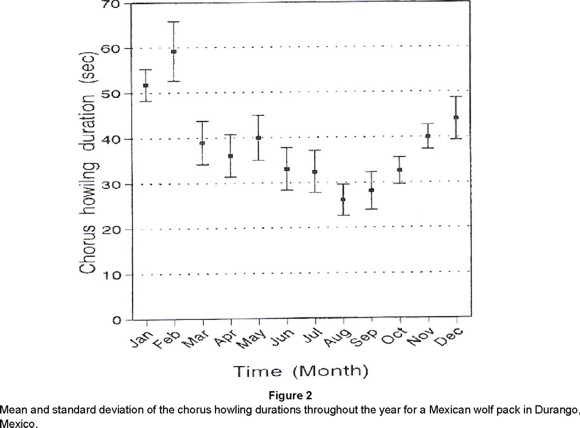
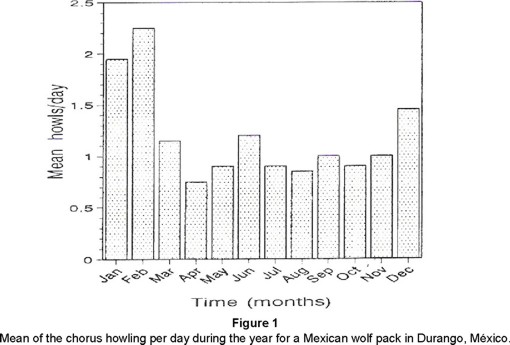
<body><![CDATA[<p align="justify"><font face="verdana" size="2"><b>Results</b></font></p>     <p align="justify"><font face="verdana" size="2">A total of two hundred and eighty six chorus howls were recorded for the wolf pack at "La Michilia" BR between January and December 1986. Data suggest that chorous howling tends to occur more frequently at dusk and sunrise. A representative sample for a statistical analysis was not obtained for comparing nigthtime and daytime data, since samples were unequal and insufficient. However some trends were observed in howling schedule.</font></p>     <p align="justify"><font face="verdana" size="2"><b>Daily frequency of chorus howls</b></font></p>     <p align="justify"><font face="verdana" size="2">Daily frequency of chorus howling showed significant differences during different times of the year (x<sup>2</sup>=40.29; df=11; p&lt;0.005). During February, when wolves had their breeding season, they displayed the highest daily mean frequency of howls (<img src="/img/revistas/azm/n80/a13e1.jpg">=2.3 howls/day); after the breeding season, the mean frequency of howls dropped, so that in March there was a mean of 1.2 howls each day, and the frequency remained low until November (<img src="/img/revistas/azm/n80/a13e1.jpg">&#8804; 1.2 howls/day). Finally, in December the mean increased again (<img src="/img/revistas/azm/n80/a13e1.jpg">=1.5 howls/day) (<a href="#f1">Fig. 1</a>).</font></p>     <p align="center"><font face="verdana" size="2"><a name="f1"></a></font></p>     <p align="center"><font face="verdana" size="2"><img src="/img/revistas/azm/n80/a13f1.jpg"></font></p>     <p align="justify"><font face="verdana" size="2"><b>Duration of chorus howling</b></font></p>     <p align="justify"><font face="verdana" size="2">Mean duration of chorus howling of "La Michilia" pack was 41 &plusmn; 9 sec (range 20 to 79 sec). Mean monthly duration of chorus howling varied significantly throughout the year (F=124; df=11; p&lt;0.001) (<a href="#f2">Figure 2</a>). During February, the pack had the highest mean duration of chorous howling (59.2 &plusmn; 6.6 sec); the mean duration of howls abruptly decreased in March (39.8 &plusmn; 4.7 sec), and remained low until December (<img src="/img/revistas/azm/n80/a13e1.jpg">&#8804;49 sec). In January the mean increased again (51.7 &plusmn; 3.5 sec) (<a href="#f2">Fig. 2</a>).</font></p>     <p align="center"><font face="verdana" size="2"><a name="f2"></a></font></p>     <p align="center"><font face="verdana" size="2"><img src="/img/revistas/azm/n80/a13f2.jpg"></font></p>     ]]></body>
<body><![CDATA[<p align="justify"><font face="verdana" size="2"><b>A comparison of Chorus Howling</b></font></p>     <p align="justify"><font face="verdana" size="2">An important datum obtained in this research, is the seasonal change in the chorus duration of Mexican wolves and its increase during breeding season.</font></p>     <p align="justify"><font face="verdana" size="2">The duration of chorus howling emitted by the Mexican wolf (41 &plusmn; 9 sec) is shorter than that reported from wolves in the northern United States, for which the mean was 60 sec (range 30 to 130 sec) (Harrington 1989); for Canadian wolves the mean was 85 sec, but the range was not reported (Joslin 1967). Hence, the mean duration of chorus howling varies among wolves from Canada, the U.S.A. and Mexico (<a href="#f3">Fig. 3</a>).</font></p>     <p align="center"><font face="verdana" size="2"><a name="f3"></a></font></p>     <p align="center"><font face="verdana" size="2"><img src="/img/revistas/azm/n80/a13f3.jpg"></font></p>     <p align="justify"><font face="Verdana" size="2">&nbsp;</font></p>     <p align="justify"><font face="verdana" size="2"><b>Discussion</b></font></p>     <p align="justify"><font face="verdana" size="2">Zimen (1982) reported an increase of howls/day and its duration during the breeding season; also a preference for howling between 20:00&#45;08:00 h is also reported by Joslin (1967) and Harrington and Mech (1978). The following characteristics were present in "La Michilia" wolves: howling occurred between sunset and sunrise, seasonal variation in the duration of chorus howling, and an increase during breeding season. Chorus howling usually occurs when wolves are resting, or in rally, a behavior called "greeting ceremony" by some authors (Mech 1970, Zimen 1982).</font></p>     <p align="justify"><font face="verdana" size="2"><b>Daily frequency of chorus howls</b></font></p>     <p align="justify"><font face="verdana" size="2">Howling increased before the breeding season (December) and reached its peak in the last two weeks of February, when the reproductive season and successful mating occurred (Serv&iacute;n 1991,1997). These data suggest a close association between high daily frequency of howling and the breeding season, and the social behaviors (aggressive, sexual and friendly behaviors) related to both (Klinghammer 1978, Serv&iacute;n 1991, Zimen 1982). These recorded howls had similar seasonality to those reported from northern wolves in Canada (Joslin 1967) and elsewhere in the United States (Harrington and Mech 1979, Klinghammer 1978) and Europe (Zimen 1982).</font></p>     ]]></body>
<body><![CDATA[<p align="justify"><font face="verdana" size="2">Some authors believe that the low frequency of daily howls was due to the reluctance of adults to howl when their pups were small. These authors reported that adults would not howl until the pups were 6 to 9 weeks old; this lack of vocalization would help to protect the vulnerable pups from possible predators (Joslin 1967, Harrington and Mech 1978, Rabb <i>et al.</i> 1967, Zimen 1982). In "La Michilia" pack, pups were born at the end of April (Serv&iacute;n 1997), and the adults stopped their howls until late July, more than 10 weeks later.</font></p>     <p align="justify"><font face="verdana" size="2"><b>Duration of chorus</b></font></p>     <p align="justify"><font face="verdana" size="2">It is interesting that there were significant differences in the duration of chorus howling throughout the year, particulary in the breeding season. These finding strengthen the hypothesis that howling in wolves has crucial social roles, both within the pack and among packs (Mech and Harrington 1978).</font></p>     <p align="justify"><font face="verdana" size="2">These data suggest that howls could be an interesting parameter to be studied in order to understand communications among packs throughout a latitudinal gradient. Since in temperate areas the duration of howling is shorter than in the Artic zone. Harrington (1989) reported that chorus in very small packs (i.e., just two adults) had shorter duration than those from larger packs.</font></p>     <p align="justify"><font face="verdana" size="2"><b>Regional comparison of Chorus Howling</b></font></p>     <p align="justify"><font face="verdana" size="2">The average of the chorous howling in "La Milchilia" pack is shorter than those reported from wolves of the northern United States (Harrington 1989), and Canadian wolves (Joslin 1967). Hence, the howling range in group varies among wolves from Canada, U.S.A. and Mexico (<a href="#f3">Fig. 3</a>).</font></p>     <p align="justify"><font face="verdana" size="2">These data support the hypothesized relationship between latitude and average pack size, with small group size expected from the southern regions in Mexico (Serv&iacute;n 1991). Data from Canada reported the duration of individual wolf howls as lasting from five to eleven seconds; hence, packs with ten or more wolves will howl in chorus for more than one minute. Considering this Northern howling pattern, in Mexico the howling chorus would be shorter than one minute, as I found and report in this paper. However, Harrington (1989) has reported that the relationship between pack size and duration of chorous howling was not a linear one. Packs of two or three adults were different, but there were not noticeable differences in packs of five or six adults. However does not take into consideration the significant variation during the year.</font></p>     <p align="justify"><font face="Verdana" size="2">&nbsp;</font></p>     <p align="justify"><font face="verdana" size="2"><b>Aknowledgements</b></font></p>     <p align="justify"><font face="verdana" size="2">This paper is dedicated to Jaime Gonzalez (&dagger;) for his important field work developed in surveys wolves in the mountains of Mexico. The draft was kindly revised by F.H. Harrington, L.D. Mech, P. Joslin, J. Packard, S. Lindaker, Z. Tang&#45;Mart&iacute;nez, I. A. Rosen and two anonymous referees. Thanks are due to Pedro Reyes&#45;Castillo, Gonz&aacute;lo Halffter, Alberto Gonz&aacute;lez and Sonia Gallina, for their encouragement for the Mexican Wolf Project; to Martha Vences, Macamen Huxley, Elias Chac&oacute;n, Federico Alvarado, Jose Medina and Jos&eacute; Angel Moreno for their field work assistance. This project was funded by Departmento de Fauna Silvestre (902&#45;06) and is a contribution to the MAB&#45;UNESCO Conservation Program.</font></p>     ]]></body>
<body><![CDATA[<p align="justify"><font face="Verdana" size="2">&nbsp;</font></p>     <p align="justify"><font face="verdana" size="2"><b>Literature cited</b></font></p>     <!-- ref --><p align="justify"><font face="verdana" size="2"><b>Aldama&#45;Garisonain, A</b>. 1996. Proyecto de conservaci&oacute;n y recuperaci&oacute;n del lobo gris mexicano (<i>Canis lupus baileyi</i>). Informe T&eacute;cnico. SEMARNAP&#45;INE, 30 pp.    &nbsp;&nbsp;&nbsp;&nbsp;&nbsp;&nbsp;&nbsp;&nbsp;[&#160;<a href="javascript:void(0);" onclick="javascript: window.open('/scielo.php?script=sci_nlinks&ref=286222&pid=S0065-1737200000020001300001&lng=','','width=640,height=500,resizable=yes,scrollbars=1,menubar=yes,');">Links</a>&#160;]<!-- end-ref --></font></p>     <!-- ref --><p align="justify"><font face="verdana" size="2"><b>Bernardz, J.A</b>. 1988. <i>The Mexican wolf: biology, history, and prospects for reestablishment in</i> <i>New Mexico</i>. U. S. Fish &amp; Wildlife Service, Albuquerque, New Mexico, Endangered Species Report 18.    &nbsp;&nbsp;&nbsp;&nbsp;&nbsp;&nbsp;&nbsp;&nbsp;[&#160;<a href="javascript:void(0);" onclick="javascript: window.open('/scielo.php?script=sci_nlinks&ref=286224&pid=S0065-1737200000020001300002&lng=','','width=640,height=500,resizable=yes,scrollbars=1,menubar=yes,');">Links</a>&#160;]<!-- end-ref --></font></p>     <!-- ref --><p align="justify"><font face="verdana" size="2"><b>Garc&iacute;a&#45;Moreno, J., M.D. Matocq, M.S. Roy, E. Geffen &amp; R.K. Wayne</b>. 1996. Relationships and genetic purity of the endagered Mexican wolf based on analysis of microsatellite loci. <i>Conserv. Biol</i>. 10:376&#45;387.    &nbsp;&nbsp;&nbsp;&nbsp;&nbsp;&nbsp;&nbsp;&nbsp;[&#160;<a href="javascript:void(0);" onclick="javascript: window.open('/scielo.php?script=sci_nlinks&ref=286226&pid=S0065-1737200000020001300003&lng=','','width=640,height=500,resizable=yes,scrollbars=1,menubar=yes,');">Links</a>&#160;]<!-- end-ref --></font></p>     <!-- ref --><p align="justify"><font face="verdana" size="2"><b>Hall, E.R</b>. 1981. <i>The mammals of North America</i>. 2nd. Ed: Wiley &amp; Sons. 1181 pp.    &nbsp;&nbsp;&nbsp;&nbsp;&nbsp;&nbsp;&nbsp;&nbsp;[&#160;<a href="javascript:void(0);" onclick="javascript: window.open('/scielo.php?script=sci_nlinks&ref=286228&pid=S0065-1737200000020001300004&lng=','','width=640,height=500,resizable=yes,scrollbars=1,menubar=yes,');">Links</a>&#160;]<!-- end-ref --></font></p>     ]]></body>
<body><![CDATA[<!-- ref --><p align="justify"><font face="verdana" size="2"><b>Harrington, F.H</b>. 1989. Chorus howling by wolves: Acoustic structure, pack size and the beau geste effect. <i>Bioacoust.</i> 2:117&#45;136.    &nbsp;&nbsp;&nbsp;&nbsp;&nbsp;&nbsp;&nbsp;&nbsp;[&#160;<a href="javascript:void(0);" onclick="javascript: window.open('/scielo.php?script=sci_nlinks&ref=286230&pid=S0065-1737200000020001300005&lng=','','width=640,height=500,resizable=yes,scrollbars=1,menubar=yes,');">Links</a>&#160;]<!-- end-ref --></font></p>     <!-- ref --><p align="justify"><font face="verdana" size="2"><b>Harrington, F.H. &amp; L.D. Mech</b>. 1978. Howling at two Minnesota wolf pack summer homesites. <i>Can. J. Zool.</i> 56:2024&#45;2028.    &nbsp;&nbsp;&nbsp;&nbsp;&nbsp;&nbsp;&nbsp;&nbsp;[&#160;<a href="javascript:void(0);" onclick="javascript: window.open('/scielo.php?script=sci_nlinks&ref=286232&pid=S0065-1737200000020001300006&lng=','','width=640,height=500,resizable=yes,scrollbars=1,menubar=yes,');">Links</a>&#160;]<!-- end-ref --></font></p>     <!-- ref --><p align="justify"><font face="verdana" size="2"><b>&#150;&#150;&#150;&#150;&#150;&#150;&#150;&#150;&#150;&#150;</b>. 1979. Wolf howling and its role in a territory maintenence. <i>Behav</i>. 58:207&#45; 249.    &nbsp;&nbsp;&nbsp;&nbsp;&nbsp;&nbsp;&nbsp;&nbsp;[&#160;<a href="javascript:void(0);" onclick="javascript: window.open('/scielo.php?script=sci_nlinks&ref=286234&pid=S0065-1737200000020001300007&lng=','','width=640,height=500,resizable=yes,scrollbars=1,menubar=yes,');">Links</a>&#160;]<!-- end-ref --></font></p>     <!-- ref --><p align="justify"><font face="verdana" size="2"><b>&#150;&#150;&#150;&#150;&#150;&#150;&#150;&#150;&#150;&#150;</b>. 1983. Wolf pack spacing: howling as a territory&#45;independent spacing mechanism in a territorial population. <i>Behav. Ecol. &amp; Sociobiol.</i> 12:161&#45;168.    &nbsp;&nbsp;&nbsp;&nbsp;&nbsp;&nbsp;&nbsp;&nbsp;[&#160;<a href="javascript:void(0);" onclick="javascript: window.open('/scielo.php?script=sci_nlinks&ref=286236&pid=S0065-1737200000020001300008&lng=','','width=640,height=500,resizable=yes,scrollbars=1,menubar=yes,');">Links</a>&#160;]<!-- end-ref --></font></p>     <!-- ref --><p align="justify"><font face="verdana" size="2"><b>Joslin, P</b>. 1967. Movements and homesites of timber wolves in Algonquin Park. <i>Amer. Zool</i>. 7:279&#45;288.    &nbsp;&nbsp;&nbsp;&nbsp;&nbsp;&nbsp;&nbsp;&nbsp;[&#160;<a href="javascript:void(0);" onclick="javascript: window.open('/scielo.php?script=sci_nlinks&ref=286238&pid=S0065-1737200000020001300009&lng=','','width=640,height=500,resizable=yes,scrollbars=1,menubar=yes,');">Links</a>&#160;]<!-- end-ref --></font></p>     ]]></body>
<body><![CDATA[<!-- ref --><p align="justify"><font face="verdana" size="2"><b>Klinghammer, E</b>. 1978. Analysis of 14 months of daily howl records in a captive wolf pack. Pp. 153&#45;181 <i>In:</i> E. Klinghammer (Ed). <i>Proceedings of Symposium On the Behavior and ecology of wolves.</i> Garland Press, U.S.A.    &nbsp;&nbsp;&nbsp;&nbsp;&nbsp;&nbsp;&nbsp;&nbsp;[&#160;<a href="javascript:void(0);" onclick="javascript: window.open('/scielo.php?script=sci_nlinks&ref=286240&pid=S0065-1737200000020001300010&lng=','','width=640,height=500,resizable=yes,scrollbars=1,menubar=yes,');">Links</a>&#160;]<!-- end-ref --></font></p>     <!-- ref --><p align="justify"><font face="verdana" size="2"><b>McBride, R.T</b>. 1980. The Mexican wolf (<i>Canis lupus baileyi</i>): a historical review and observations on its status and distribution. U.S. Fish and Wildlife Service, Albuquerque, New Mexico, Endangered Species Report 8.    &nbsp;&nbsp;&nbsp;&nbsp;&nbsp;&nbsp;&nbsp;&nbsp;[&#160;<a href="javascript:void(0);" onclick="javascript: window.open('/scielo.php?script=sci_nlinks&ref=286242&pid=S0065-1737200000020001300011&lng=','','width=640,height=500,resizable=yes,scrollbars=1,menubar=yes,');">Links</a>&#160;]<!-- end-ref --></font></p>     <!-- ref --><p align="justify"><font face="verdana" size="2"><b>Mech, L.D</b>. 1970. <i>The wolf: the ecology and behavior of an endagered species</i>. Doubleday, N. Y.    &nbsp;&nbsp;&nbsp;&nbsp;&nbsp;&nbsp;&nbsp;&nbsp;[&#160;<a href="javascript:void(0);" onclick="javascript: window.open('/scielo.php?script=sci_nlinks&ref=286244&pid=S0065-1737200000020001300012&lng=','','width=640,height=500,resizable=yes,scrollbars=1,menubar=yes,');">Links</a>&#160;]<!-- end-ref --></font></p>     <!-- ref --><p align="justify"><font face="verdana" size="2"><b>&#150;&#150;&#150;&#150;&#150;&#150;&#150;&#150;&#150;&#150;</b>. 1982. The IUCN&#45;SSC wolf specialist group. Pp. 327&#45;333. <i>In:</i> F.H. Harrington &amp; P.C. Paquet (Eds). <i>Wolves of the World.</i> Noyes Publications, Park Ridge, New Jersey.    &nbsp;&nbsp;&nbsp;&nbsp;&nbsp;&nbsp;&nbsp;&nbsp;[&#160;<a href="javascript:void(0);" onclick="javascript: window.open('/scielo.php?script=sci_nlinks&ref=286246&pid=S0065-1737200000020001300013&lng=','','width=640,height=500,resizable=yes,scrollbars=1,menubar=yes,');">Links</a>&#160;]<!-- end-ref --></font></p>     <!-- ref --><p align="justify"><font face="verdana" size="2"><b>Parson, D.R</b>. 1998. "Green fire" returns to the Southwest: reintroduction of the Mexican wolf. <i>Wildl. Soc. Bull.</i> 26:799&#45;807.    &nbsp;&nbsp;&nbsp;&nbsp;&nbsp;&nbsp;&nbsp;&nbsp;[&#160;<a href="javascript:void(0);" onclick="javascript: window.open('/scielo.php?script=sci_nlinks&ref=286248&pid=S0065-1737200000020001300014&lng=','','width=640,height=500,resizable=yes,scrollbars=1,menubar=yes,');">Links</a>&#160;]<!-- end-ref --></font></p>     ]]></body>
<body><![CDATA[<!-- ref --><p align="justify"><font face="verdana" size="2"><b>Rabb, G.L., J.H. Woolpy &amp; B.E. Ginsburg</b>. 1967. Social relations in a group of captive wolves. <i>Amer. Zool.</i> 7:305&#45;311.    &nbsp;&nbsp;&nbsp;&nbsp;&nbsp;&nbsp;&nbsp;&nbsp;[&#160;<a href="javascript:void(0);" onclick="javascript: window.open('/scielo.php?script=sci_nlinks&ref=286250&pid=S0065-1737200000020001300015&lng=','','width=640,height=500,resizable=yes,scrollbars=1,menubar=yes,');">Links</a>&#160;]<!-- end-ref --></font></p>     <!-- ref --><p align="justify"><font face="verdana" size="2"><b>Serv&iacute;n, J</b>. 1986. Estudio para la recuperaci&oacute;n del lobo mexicano (<i>Canis lupus baileyi</i>) en el Estado de Durango, II Etapa. Informe T&eacute;cnico, Instituto de Ecolog&iacute;a&#45;SEDUE, M&eacute;xico, 66 pp.    &nbsp;&nbsp;&nbsp;&nbsp;&nbsp;&nbsp;&nbsp;&nbsp;[&#160;<a href="javascript:void(0);" onclick="javascript: window.open('/scielo.php?script=sci_nlinks&ref=286252&pid=S0065-1737200000020001300016&lng=','','width=640,height=500,resizable=yes,scrollbars=1,menubar=yes,');">Links</a>&#160;]<!-- end-ref --></font></p>     <!-- ref --><p align="justify"><font face="verdana" size="2"><b>&#150;&#150;&#150;&#150;&#150;&#150;&#150;&#150;&#150;&#150;</b>. 1991. Algunos aspectos de la conducta social del lobo mexicano (<i>Canis lupus baileyi</i>) en cautiverio. <i>Acta Zool. Mex.</i> (n.s.), 45:1&#45;41.    &nbsp;&nbsp;&nbsp;&nbsp;&nbsp;&nbsp;&nbsp;&nbsp;[&#160;<a href="javascript:void(0);" onclick="javascript: window.open('/scielo.php?script=sci_nlinks&ref=286254&pid=S0065-1737200000020001300017&lng=','','width=640,height=500,resizable=yes,scrollbars=1,menubar=yes,');">Links</a>&#160;]<!-- end-ref --></font></p>     <!-- ref --><p align="justify"><font face="verdana" size="2"><b>&#150;&#150;&#150;&#150;&#150;&#150;&#150;&#150;&#150;&#150;</b>. 1996. Prospecci&oacute;n y b&uacute;squeda del lobo mexicano (<i>Canis lupus baileyi</i>) en el estado de Durango, M&eacute;xico. Informe T&eacute;cnico. Instituto de Ecolog&iacute;a&#45;CONABIO, M&eacute;xico, 31 pp.    &nbsp;&nbsp;&nbsp;&nbsp;&nbsp;&nbsp;&nbsp;&nbsp;[&#160;<a href="javascript:void(0);" onclick="javascript: window.open('/scielo.php?script=sci_nlinks&ref=286256&pid=S0065-1737200000020001300018&lng=','','width=640,height=500,resizable=yes,scrollbars=1,menubar=yes,');">Links</a>&#160;]<!-- end-ref --></font></p>     <!-- ref --><p align="justify"><font face="verdana" size="2"><b>&#150;&#150;&#150;&#150;&#150;&#150;&#150;&#150;&#150;&#150;</b>. 1997. El per&iacute;odo de apareamiento, nacimiento y crecimiento del lobo mexicano (<i>Canis lupus baileyi</i>). <i>Acta Zool. Mex., (n.s.)</i>, 71:45&#45;56.    &nbsp;&nbsp;&nbsp;&nbsp;&nbsp;&nbsp;&nbsp;&nbsp;[&#160;<a href="javascript:void(0);" onclick="javascript: window.open('/scielo.php?script=sci_nlinks&ref=286258&pid=S0065-1737200000020001300019&lng=','','width=640,height=500,resizable=yes,scrollbars=1,menubar=yes,');">Links</a>&#160;]<!-- end-ref --></font></p>     ]]></body>
<body><![CDATA[<!-- ref --><p align="justify"><font face="verdana" size="2"><b>Siminski, P</b>. 1998. <i>Mexican gray wolf international studbook.</i> Arizona&#45;Sonora Desert Museum. Tucson, Arizona, 104 pp.    &nbsp;&nbsp;&nbsp;&nbsp;&nbsp;&nbsp;&nbsp;&nbsp;[&#160;<a href="javascript:void(0);" onclick="javascript: window.open('/scielo.php?script=sci_nlinks&ref=286260&pid=S0065-1737200000020001300020&lng=','','width=640,height=500,resizable=yes,scrollbars=1,menubar=yes,');">Links</a>&#160;]<!-- end-ref --></font></p>     <!-- ref --><p align="justify"><font face="verdana" size="2"><b>Sokal, R.R. &amp; F.J. Rohlf</b>. 1981. <i>Biometry.</i> W. H. Freeman and Co., San Francisco, Calif.    &nbsp;&nbsp;&nbsp;&nbsp;&nbsp;&nbsp;&nbsp;&nbsp;[&#160;<a href="javascript:void(0);" onclick="javascript: window.open('/scielo.php?script=sci_nlinks&ref=286262&pid=S0065-1737200000020001300021&lng=','','width=640,height=500,resizable=yes,scrollbars=1,menubar=yes,');">Links</a>&#160;]<!-- end-ref --></font></p>     <!-- ref --><p align="justify"><font face="verdana" size="2"><b>Young, S.P. &amp; E.A. Goldman</b>. 1944. <i>The wolves of North America. Part II, Classification of wolves</i>. The American Wildlife Institute, Washington, D.C.    &nbsp;&nbsp;&nbsp;&nbsp;&nbsp;&nbsp;&nbsp;&nbsp;[&#160;<a href="javascript:void(0);" onclick="javascript: window.open('/scielo.php?script=sci_nlinks&ref=286264&pid=S0065-1737200000020001300022&lng=','','width=640,height=500,resizable=yes,scrollbars=1,menubar=yes,');">Links</a>&#160;]<!-- end-ref --></font></p>     <!-- ref --><p align="justify"><font face="verdana" size="2"><b>Zimen, E</b>. 1982. A wolf pack sociogram. Pp. 282&#45;322. <i>In:</i> F.H. Harrington and P. Paquet (Eds). <i>Wolves of the World. Prespectives of behavior, ecology and management.</i> Noyes Publications Park Ridge, New Jersey.    &nbsp;&nbsp;&nbsp;&nbsp;&nbsp;&nbsp;&nbsp;&nbsp;[&#160;<a href="javascript:void(0);" onclick="javascript: window.open('/scielo.php?script=sci_nlinks&ref=286266&pid=S0065-1737200000020001300023&lng=','','width=640,height=500,resizable=yes,scrollbars=1,menubar=yes,');">Links</a>&#160;]<!-- end-ref --></font></p>      ]]></body><back>
<ref-list>
<ref id="B1">
<nlm-citation citation-type="book">
<person-group person-group-type="author">
<name>
<surname><![CDATA[Aldama-Garisonain]]></surname>
<given-names><![CDATA[A.]]></given-names>
</name>
</person-group>
<source><![CDATA[Proyecto de conservación y recuperación del lobo gris mexicano (Canis lupus baileyi)]]></source>
<year>1996</year>
<page-range>30</page-range><publisher-name><![CDATA[SEMARNAP-INE]]></publisher-name>
</nlm-citation>
</ref>
<ref id="B2">
<nlm-citation citation-type="book">
<person-group person-group-type="author">
<name>
<surname><![CDATA[Bernardz]]></surname>
<given-names><![CDATA[J.A.]]></given-names>
</name>
</person-group>
<source><![CDATA[The Mexican wolf: biology, history, and prospects for reestablishment in New Mexico]]></source>
<year>1988</year>
<publisher-loc><![CDATA[Albuquerque^eNew Mexico New Mexico]]></publisher-loc>
<publisher-name><![CDATA[U. S. Fish & Wildlife Service]]></publisher-name>
</nlm-citation>
</ref>
<ref id="B3">
<nlm-citation citation-type="journal">
<person-group person-group-type="author">
<name>
<surname><![CDATA[García-Moreno]]></surname>
<given-names><![CDATA[J.]]></given-names>
</name>
<name>
<surname><![CDATA[Matocq]]></surname>
<given-names><![CDATA[M.D.]]></given-names>
</name>
<name>
<surname><![CDATA[Roy]]></surname>
<given-names><![CDATA[M.S.]]></given-names>
</name>
<name>
<surname><![CDATA[Geffen]]></surname>
<given-names><![CDATA[E.]]></given-names>
</name>
<name>
<surname><![CDATA[Wayne]]></surname>
<given-names><![CDATA[R.K.]]></given-names>
</name>
</person-group>
<article-title xml:lang="en"><![CDATA[Relationships and genetic purity of the endagered Mexican wolf based on analysis of microsatellite loci]]></article-title>
<source><![CDATA[Conserv. Biol.]]></source>
<year>1996</year>
<volume>10</volume>
<page-range>376-387</page-range></nlm-citation>
</ref>
<ref id="B4">
<nlm-citation citation-type="book">
<person-group person-group-type="author">
<name>
<surname><![CDATA[Hall]]></surname>
<given-names><![CDATA[E.R.]]></given-names>
</name>
</person-group>
<source><![CDATA[The mammals of North America]]></source>
<year>1981</year>
<edition>2</edition>
<page-range>1181</page-range><publisher-name><![CDATA[Wiley & Sons]]></publisher-name>
</nlm-citation>
</ref>
<ref id="B5">
<nlm-citation citation-type="journal">
<person-group person-group-type="author">
<name>
<surname><![CDATA[Harrington]]></surname>
<given-names><![CDATA[F.H.]]></given-names>
</name>
</person-group>
<article-title xml:lang="en"><![CDATA[Chorus howling by wolves: Acoustic structure, pack size and the beau geste effect]]></article-title>
<source><![CDATA[Bioacoust.]]></source>
<year>1989</year>
<volume>2</volume>
<page-range>117-136</page-range></nlm-citation>
</ref>
<ref id="B6">
<nlm-citation citation-type="journal">
<person-group person-group-type="author">
<name>
<surname><![CDATA[Harrington]]></surname>
<given-names><![CDATA[F.H.]]></given-names>
</name>
<name>
<surname><![CDATA[Mech]]></surname>
<given-names><![CDATA[L.D.]]></given-names>
</name>
</person-group>
<article-title xml:lang="en"><![CDATA[Howling at two Minnesota wolf pack summer homesites]]></article-title>
<source><![CDATA[Can. J. Zool.]]></source>
<year>1978</year>
<volume>56</volume>
<page-range>2024-2028</page-range></nlm-citation>
</ref>
<ref id="B7">
<nlm-citation citation-type="journal">
<person-group person-group-type="author">
<name>
<surname><![CDATA[Harrington]]></surname>
<given-names><![CDATA[F.H.]]></given-names>
</name>
</person-group>
<article-title xml:lang="en"><![CDATA[Wolf howling and its role in a territory maintenence]]></article-title>
<source><![CDATA[Behav.]]></source>
<year>1979</year>
<volume>58</volume>
<page-range>207- 249</page-range></nlm-citation>
</ref>
<ref id="B8">
<nlm-citation citation-type="journal">
<person-group person-group-type="author">
<name>
<surname><![CDATA[Harrington]]></surname>
<given-names><![CDATA[F.H.]]></given-names>
</name>
</person-group>
<article-title xml:lang="en"><![CDATA[Wolf pack spacing: howling as a territory-independent spacing mechanism in a territorial population]]></article-title>
<source><![CDATA[Behav. Ecol. & Sociobiol.]]></source>
<year>1983</year>
<volume>12</volume>
<page-range>161-168</page-range></nlm-citation>
</ref>
<ref id="B9">
<nlm-citation citation-type="journal">
<person-group person-group-type="author">
<name>
<surname><![CDATA[Joslin]]></surname>
<given-names><![CDATA[P.]]></given-names>
</name>
</person-group>
<article-title xml:lang="en"><![CDATA[Movements and homesites of timber wolves in Algonquin Park]]></article-title>
<source><![CDATA[Amer. Zool.]]></source>
<year>1967</year>
<volume>7</volume>
<page-range>279-288</page-range></nlm-citation>
</ref>
<ref id="B10">
<nlm-citation citation-type="book">
<person-group person-group-type="author">
<name>
<surname><![CDATA[Klinghammer]]></surname>
<given-names><![CDATA[E.]]></given-names>
</name>
</person-group>
<article-title xml:lang="en"><![CDATA[Analysis of 14 months of daily howl records in a captive wolf pack]]></article-title>
<person-group person-group-type="editor">
<name>
<surname><![CDATA[Klinghammer]]></surname>
<given-names><![CDATA[E.]]></given-names>
</name>
</person-group>
<source><![CDATA[Proceedings of Symposium On the Behavior and ecology of wolves]]></source>
<year>1978</year>
<page-range>153-181</page-range><publisher-name><![CDATA[Garland Press]]></publisher-name>
</nlm-citation>
</ref>
<ref id="B11">
<nlm-citation citation-type="book">
<person-group person-group-type="author">
<name>
<surname><![CDATA[McBride]]></surname>
<given-names><![CDATA[R.T.]]></given-names>
</name>
</person-group>
<source><![CDATA[The Mexican wolf (Canis lupus baileyi): a historical review and observations on its status and distribution]]></source>
<year>1980</year>
<publisher-loc><![CDATA[Albuquerque^eNew Mexico New Mexico]]></publisher-loc>
<publisher-name><![CDATA[U.S. Fish and Wildlife Service]]></publisher-name>
</nlm-citation>
</ref>
<ref id="B12">
<nlm-citation citation-type="book">
<person-group person-group-type="author">
<name>
<surname><![CDATA[Mech]]></surname>
<given-names><![CDATA[L.D.]]></given-names>
</name>
</person-group>
<source><![CDATA[The wolf: the ecology and behavior of an endagered species]]></source>
<year>1970</year>
<publisher-loc><![CDATA[N. Y. ]]></publisher-loc>
<publisher-name><![CDATA[Doubleday]]></publisher-name>
</nlm-citation>
</ref>
<ref id="B13">
<nlm-citation citation-type="book">
<person-group person-group-type="author">
<name>
<surname><![CDATA[Mech]]></surname>
<given-names><![CDATA[L.D.]]></given-names>
</name>
</person-group>
<article-title xml:lang="en"><![CDATA[The IUCN-SSC wolf specialist group]]></article-title>
<person-group person-group-type="editor">
<name>
<surname><![CDATA[Harrington]]></surname>
<given-names><![CDATA[F.H.]]></given-names>
</name>
<name>
<surname><![CDATA[Paquet]]></surname>
<given-names><![CDATA[P.C.]]></given-names>
</name>
</person-group>
<source><![CDATA[Wolves of the World]]></source>
<year>1982</year>
<page-range>327-333</page-range><publisher-loc><![CDATA[Park Ridge^eNew Jersey New Jersey]]></publisher-loc>
<publisher-name><![CDATA[Noyes Publications]]></publisher-name>
</nlm-citation>
</ref>
<ref id="B14">
<nlm-citation citation-type="journal">
<person-group person-group-type="author">
<name>
<surname><![CDATA[Parson]]></surname>
<given-names><![CDATA[D.R.]]></given-names>
</name>
</person-group>
<article-title xml:lang="en"><![CDATA["Green fire" returns to the Southwest: reintroduction of the Mexican wolf]]></article-title>
<source><![CDATA[Wildl. Soc. Bull.]]></source>
<year>1998</year>
<volume>26</volume>
<page-range>799-807</page-range></nlm-citation>
</ref>
<ref id="B15">
<nlm-citation citation-type="journal">
<person-group person-group-type="author">
<name>
<surname><![CDATA[Rabb]]></surname>
<given-names><![CDATA[G.L.]]></given-names>
</name>
<name>
<surname><![CDATA[Woolpy]]></surname>
<given-names><![CDATA[J.H.]]></given-names>
</name>
<name>
<surname><![CDATA[Ginsburg]]></surname>
<given-names><![CDATA[B.E.]]></given-names>
</name>
</person-group>
<article-title xml:lang="en"><![CDATA[Social relations in a group of captive wolves]]></article-title>
<source><![CDATA[Amer. Zool.]]></source>
<year>1967</year>
<volume>7</volume>
<page-range>305-311</page-range></nlm-citation>
</ref>
<ref id="B16">
<nlm-citation citation-type="book">
<person-group person-group-type="author">
<name>
<surname><![CDATA[Servín]]></surname>
<given-names><![CDATA[J.]]></given-names>
</name>
</person-group>
<source><![CDATA[Estudio para la recuperación del lobo mexicano (Canis lupus baileyi) en el Estado de Durango, II Etapa]]></source>
<year>1986</year>
<page-range>66</page-range><publisher-loc><![CDATA[México ]]></publisher-loc>
<publisher-name><![CDATA[Instituto de Ecología-SEDUE]]></publisher-name>
</nlm-citation>
</ref>
<ref id="B17">
<nlm-citation citation-type="journal">
<person-group person-group-type="author">
<name>
<surname><![CDATA[Servín]]></surname>
<given-names><![CDATA[J.]]></given-names>
</name>
</person-group>
<article-title xml:lang="es"><![CDATA[Algunos aspectos de la conducta social del lobo mexicano (Canis lupus baileyi) en cautiverio]]></article-title>
<source><![CDATA[Acta Zool. Mex.]]></source>
<year>1991</year>
<numero>45</numero>
<issue>45</issue>
<page-range>1-41</page-range></nlm-citation>
</ref>
<ref id="B18">
<nlm-citation citation-type="book">
<person-group person-group-type="author">
<name>
<surname><![CDATA[Servín]]></surname>
<given-names><![CDATA[J.]]></given-names>
</name>
</person-group>
<person-group person-group-type="editor">
<name>
</name>
</person-group>
<source><![CDATA[Prospección y búsqueda del lobo mexicano (Canis lupus baileyi) en el estado de Durango, México]]></source>
<year>1996</year>
<page-range>31</page-range><publisher-loc><![CDATA[México ]]></publisher-loc>
<publisher-name><![CDATA[Instituto de EcologíaCONABIO]]></publisher-name>
</nlm-citation>
</ref>
<ref id="B19">
<nlm-citation citation-type="journal">
<person-group person-group-type="author">
<name>
<surname><![CDATA[Servín]]></surname>
<given-names><![CDATA[J.]]></given-names>
</name>
</person-group>
<article-title xml:lang="es"><![CDATA[El período de apareamiento, nacimiento y crecimiento del lobo mexicano (Canis lupus baileyi)]]></article-title>
<source><![CDATA[Acta Zool. Mex.]]></source>
<year>1997</year>
<numero>71</numero>
<issue>71</issue>
<page-range>45-56</page-range></nlm-citation>
</ref>
<ref id="B20">
<nlm-citation citation-type="book">
<person-group person-group-type="author">
<name>
<surname><![CDATA[Siminski]]></surname>
<given-names><![CDATA[P.]]></given-names>
</name>
</person-group>
<source><![CDATA[Mexican gray wolf international studbook]]></source>
<year>1998</year>
<page-range>104</page-range><publisher-loc><![CDATA[Tucson^eArizona Arizona]]></publisher-loc>
<publisher-name><![CDATA[Arizona-Sonora Desert Museum]]></publisher-name>
</nlm-citation>
</ref>
<ref id="B21">
<nlm-citation citation-type="book">
<person-group person-group-type="author">
<name>
<surname><![CDATA[Sokal]]></surname>
<given-names><![CDATA[R.R.]]></given-names>
</name>
<name>
<surname><![CDATA[Rohlf]]></surname>
<given-names><![CDATA[F.J.]]></given-names>
</name>
</person-group>
<source><![CDATA[Biometry]]></source>
<year>1981</year>
<publisher-loc><![CDATA[San Francisco^eCalif Calif]]></publisher-loc>
<publisher-name><![CDATA[W. H. Freeman and Co.]]></publisher-name>
</nlm-citation>
</ref>
<ref id="B22">
<nlm-citation citation-type="book">
<person-group person-group-type="author">
<name>
<surname><![CDATA[Young]]></surname>
<given-names><![CDATA[S.P.]]></given-names>
</name>
<name>
<surname><![CDATA[Goldman]]></surname>
<given-names><![CDATA[E.A.]]></given-names>
</name>
</person-group>
<source><![CDATA[The wolves of North America. Part II, Classification of wolves]]></source>
<year>1944</year>
<publisher-loc><![CDATA[Washington^eD.C. D.C.]]></publisher-loc>
<publisher-name><![CDATA[The American Wildlife Institute]]></publisher-name>
</nlm-citation>
</ref>
<ref id="B23">
<nlm-citation citation-type="book">
<person-group person-group-type="author">
<name>
<surname><![CDATA[Zimen]]></surname>
<given-names><![CDATA[E.]]></given-names>
</name>
</person-group>
<article-title xml:lang="en"><![CDATA[A wolf pack sociogram]]></article-title>
<person-group person-group-type="editor">
<name>
<surname><![CDATA[Harrington]]></surname>
<given-names><![CDATA[F.H.]]></given-names>
</name>
<name>
<surname><![CDATA[Paquet]]></surname>
<given-names><![CDATA[P.]]></given-names>
</name>
</person-group>
<source><![CDATA[Wolves of the World. Prespectives of behavior, ecology and management]]></source>
<year>1982</year>
<page-range>282-322</page-range><publisher-loc><![CDATA[Park Ridge^eNew Jersey New Jersey]]></publisher-loc>
<publisher-name><![CDATA[Noyes Publications]]></publisher-name>
</nlm-citation>
</ref>
</ref-list>
</back>
</article>