<?xml version="1.0" encoding="ISO-8859-1"?><article xmlns:mml="http://www.w3.org/1998/Math/MathML" xmlns:xlink="http://www.w3.org/1999/xlink" xmlns:xsi="http://www.w3.org/2001/XMLSchema-instance">
<front>
<journal-meta>
<journal-id>0034-8376</journal-id>
<journal-title><![CDATA[Revista de investigación clínica]]></journal-title>
<abbrev-journal-title><![CDATA[Rev. invest. clín.]]></abbrev-journal-title>
<issn>0034-8376</issn>
<publisher>
<publisher-name><![CDATA[Instituto Nacional de Ciencias Médicas y Nutrición Salvador Zubirán]]></publisher-name>
</publisher>
</journal-meta>
<article-meta>
<article-id>S0034-83762005000400010</article-id>
<title-group>
<article-title xml:lang="en"><![CDATA[Activated protein C resistance and lupus anticoagulant activity induced by plasma and purified monospecific human IgG anti-&beta;2-glycoprotein-I antibodies]]></article-title>
<article-title xml:lang="es"><![CDATA[Resistencia a la proteína C activada y actividad de anticoagulante lúpico inducidas por plasma y por anticuerpos purificados humanos del IgG anti &beta;2-glicoproteína I]]></article-title>
</title-group>
<contrib-group>
<contrib contrib-type="author">
<name>
<surname><![CDATA[Viveros]]></surname>
<given-names><![CDATA[Martha E.]]></given-names>
</name>
<xref ref-type="aff" rid="A02"/>
</contrib>
<contrib contrib-type="author">
<name>
<surname><![CDATA[Cabiedes]]></surname>
<given-names><![CDATA[Javier]]></given-names>
</name>
<xref ref-type="aff" rid="A01"/>
</contrib>
<contrib contrib-type="author">
<name>
<surname><![CDATA[Reyes]]></surname>
<given-names><![CDATA[Elba]]></given-names>
</name>
<xref ref-type="aff" rid="A02"/>
</contrib>
<contrib contrib-type="author">
<name>
<surname><![CDATA[Cabral]]></surname>
<given-names><![CDATA[Antonio R.]]></given-names>
</name>
<xref ref-type="aff" rid="A01"/>
</contrib>
</contrib-group>
<aff id="A02">
<institution><![CDATA[,Instituto Politécnico Nacional Escuela Nacional de Ciencias Biológicas Morphology Department]]></institution>
<addr-line><![CDATA[ ]]></addr-line>
</aff>
<aff id="A01">
<institution><![CDATA[,Instituto Nacional de Ciencias Médicas y Nutrición Salvador Zubirán Department of Immunology and Rheumatology ]]></institution>
<addr-line><![CDATA[D.F. ]]></addr-line>
<country>México</country>
</aff>
<pub-date pub-type="pub">
<day>00</day>
<month>08</month>
<year>2005</year>
</pub-date>
<pub-date pub-type="epub">
<day>00</day>
<month>08</month>
<year>2005</year>
</pub-date>
<volume>57</volume>
<numero>4</numero>
<fpage>563</fpage>
<lpage>571</lpage>
<copyright-statement/>
<copyright-year/>
<self-uri xlink:href="http://www.scielo.org.mx/scielo.php?script=sci_arttext&amp;pid=S0034-83762005000400010&amp;lng=en&amp;nrm=iso"></self-uri><self-uri xlink:href="http://www.scielo.org.mx/scielo.php?script=sci_abstract&amp;pid=S0034-83762005000400010&amp;lng=en&amp;nrm=iso"></self-uri><self-uri xlink:href="http://www.scielo.org.mx/scielo.php?script=sci_pdf&amp;pid=S0034-83762005000400010&amp;lng=en&amp;nrm=iso"></self-uri><abstract abstract-type="short" xml:lang="en"><p><![CDATA[ABSTRACT Introduction. We investigated the activated protein C resistance (APCR) phenotype and the lupus anticoagulant (LA), activity induced by anti-&beta;2-glycoprotein-I (anti-&beta;2GP-I) antibodies. Patients and methods. We studied plasma and sera samples from 29 patients with persistently positive anti-&beta;2GP-I: 22 with thrombosis (12 with primary APS, 10 with APS secondary to SLE) and seven without thrombosis (all with SLE); 25 healthy subjects were studied as controls. We detected anticardiolipin antibodies (ACA); IgG (and its subclasses) and IgM anti-&beta;2GP-I, on irradiated and non-irradiated plates by ELISA. APCR was assessed by the activated partial thromboplastin time (APTT)-based assay and by the modified test. The FV Leiden mutation was studied by PCR. LA determination included screening and confirmatory dRVVT. Serum anti-&beta;2GP-I were affinity purified on sepharose columns and their isotype, subclass, and reactivity against various antigens were studied by ELISA. Results. We found that titers of IgG anti-&beta;2GP-I on irradiated plates were higher than on non-irradiated plates (p = 0.002), IgG2 was the predominant subclass. Fifteen patients (13 with thrombosis) had LA and 15 (also 13 with thrombosis) induced the APCR phenotype. Eleven (all with thrombosis) had both. Two patients were heterozygous for the Leiden mutation. Two purified antibodies, monospecific for &beta;2GP-I, induced an in vitro APCR phenotype and LA activity. Conclusions. Our results seem to indicate that the inhibition of the APC anticoagulant function by IgG2 anti-&beta;2GP-I with LA activity may be one of the responsible mechanisms of thrombophilia in patients with APS.]]></p></abstract>
<abstract abstract-type="short" xml:lang="es"><p><![CDATA[Introducción. Investigamos la resistencia a la proteína C activada (RPCA) y la actividad de anticoagulante lápico (AL), inducidas por anticuerpos anti-&beta;2-glicoproteína-I (anti-&beta;2GP-I). Pacientes y métodos. Estudiamos los plasmas y sueros persistentemente positivos para anti-&beta;2GP-I de 29 pacientes: 22 tuvieron trombosis (12 con síndrome de antifosfolípidos (SAF) primario y 10 con SAF secundario a lupus erítematoso generalizado (LEG)) y siete sin trombosis (todos con LEG). Como controles estudiamos 25 sueros de personas clínicamente sanas. Detectamos anticuerpos anticardiolipina, anti-&beta;2GP-I IgG (y sus subclases) e IgM por ELISA en placas irradiadas y no irradiadas. Evaluamos la RPCA por medio del tiempo parcial de tromboplastina activada y por la prueba modificada. Estudiamos la mutación FV de Leiden por PCR y el anticoagulante lápico con el método de dRVVT screening y confirmatorio. Después de purificar los anti-&beta;2GP-I séricos con una columna de antígeno unido a sefarosa, analizamos por ELISA sus isotipos, subclases y reactividad contra &beta;2GP-I y algunos fosfolípidos. Resultados. Los títulos de anti-&beta;2GP-I IgG fueron más altos en placas irradiadas que en no irradiadas (p = 0.002), predominó la subclase IgG2. Quince plasmas (13 de pacientes con trombosis) tuvieron AL y 15 (13 también de pacientes con trombosis) indujeron el fenotipo de RPCA. Once plasmas (todos de pacientes con trombosis) indujeron ambas actividades. Dos pacientes fueron heterocigotos para la mutación de Leiden. Dos anticuerpos purificados monoespecíficos para &beta;2GP-I indujeron el fenotipo de la RPCA y la actividad de AL in vitro. Conclusiones. Nuestros resultados sugieren que la RPCA, inducida por los anti-&beta;2GP-I que concomitantemente tienen actividad de AL, puede tener implicaciones patogénicas en la trombofílía del SAF.]]></p></abstract>
<kwd-group>
<kwd lng="en"><![CDATA[Antiphospholipid antibodies]]></kwd>
<kwd lng="en"><![CDATA[Activated protein C resistance]]></kwd>
<kwd lng="en"><![CDATA[Anti-&beta;2-glycoprotein-I antibodies]]></kwd>
<kwd lng="en"><![CDATA[Thrombosis]]></kwd>
<kwd lng="es"><![CDATA[Anticuerpos antifosfolípidos]]></kwd>
<kwd lng="es"><![CDATA[Resistencia a la proteína C activada]]></kwd>
<kwd lng="es"><![CDATA[Anticuerpos anti-&beta;2-glicoproteína-I]]></kwd>
<kwd lng="es"><![CDATA[Trombosis]]></kwd>
</kwd-group>
</article-meta>
</front><body><![CDATA[ <p align="justify"><font face="verdana" size="4">Art&iacute;culo original</font></p>     <p align="justify"><font face="verdana" size="2">&nbsp;</font></p>     <p align="center"><font face="verdana" size="4"><b>Activated protein C resistance and lupus anticoagulant activity induced by plasma and purified monospecific human IgG anti&#150;&#946;<sub>2</sub>&#150;glycoprotein&#150;I antibodies</b></font></p>     <p align="justify"><font face="verdana" size="2">&nbsp;</font></p>     <p align="center"><font face="verdana" size="3"><b>Resistencia a la prote&iacute;na C activada y actividad de anticoagulante l&uacute;pico inducidas por plasma y por anticuerpos purificados humanos del IgG anti &#946;<sub>2</sub>&#150;glicoprote&iacute;na I</b></font></p>     <p align="justify"><font face="verdana" size="2">&nbsp;</font></p>     <p align="center"><font face="verdana" size="2"><b>Martha E. Viveros,** Javier Cabiedes,* Elba Reyes,** Antonio R. Cabral*</b></font></p>     <p align="justify"><font face="verdana" size="2">&nbsp;</font></p>     <p align="justify"><font face="verdana" size="2"><i>* Department of Immunology and Rheumatology. Instituto Nacional de Ciencias M&eacute;dicas y Nutrici&oacute;n Salvador Zubir&aacute;n.</i></font></p>     <p align="justify"><font face="verdana" size="2"><i>** Morphology Department, Escuela Nacional de Ciencias Biol&oacute;gicas, Instituto Polit&eacute;cnico Nacional.</i></font></p>     ]]></body>
<body><![CDATA[<p align="justify"><font face="verdana" size="2">&nbsp;</font></p>     <p align="justify"><font face="verdana" size="2"><b>Correspondence and reprint request:</b><i>    <br>   </i><em>Antonio R. Cabral, MD<b>    <br>   </b>Department of Immunology and Rheumatology,    <br>   Instituto Nacional de Ciencias M&eacute;dicas y Nutrici&oacute;n Salvador Zubir&aacute;n.    <br>   Vasco de Quiroga 15,    <br>   14000, M&eacute;xico, D.F.    <br>   Fax (525) 5573&#150;2096.</em>    <br> E&#150;mail: <a href="mailto:acabral@quetzal.innsz.mx">acabral@quetzal.innsz.mx</a></font></p>     <p align="justify"><font face="verdana" size="2">&nbsp;</font></p>     ]]></body>
<body><![CDATA[<p align="justify"><font face="verdana" size="2">Recibido el 8 de marzo de 2005.     <br>   Aceptado el 16 de mayo de 2005.</font></p>     <p align="justify"><font face="verdana" size="2">&nbsp;</font></p>     <p align="justify"><font face="verdana" size="2"><b>ABSTRACT</b></font></p>     <p align="justify"><font face="verdana" size="2"><i><b>Introduction.</b> </i>We investigated the activated protein C resistance (APCR) phenotype and the lupus anticoagulant (LA), activity induced by anti&#150;&#946;<sub>2</sub>&#150;glycoprotein&#150;I (anti&#150;&#946;<sub>2</sub>GP&#150;I) antibodies. </font></p>     <p align="justify"><font face="verdana" size="2"><i><b>Patients and methods.</b> </i>We studied plasma and sera samples from 29 patients with persistently positive anti&#150;&#946;<sub>2</sub>GP&#150;I: 22 with thrombosis (12 with primary APS, 10 with APS secondary to SLE) and seven without thrombosis (all with SLE); 25 healthy subjects were studied as controls. We detected anticardiolipin antibodies (ACA); IgG (and its subclasses) and IgM anti&#150;&#946;<sub>2</sub>GP&#150;I, on irradiated and non&#150;irradiated plates by ELISA. APCR was assessed by the activated partial thromboplastin time (APTT)&#150;based assay and by the modified test. The FV Leiden mutation was studied by PCR. LA determination included screening and confirmatory dRVVT. Serum anti&#150;&#946;<sub>2</sub>GP&#150;I were affinity purified on sepharose columns and their isotype, subclass, and reactivity against various antigens were studied by ELISA. </font></p>     <p align="justify"><font face="verdana" size="2"><i><b>Results.</b> </i>We found that titers of IgG anti&#150;&#946;<sub>2</sub>GP&#150;I on irradiated plates were higher than on non&#150;irradiated plates (p = 0.002), IgG2 was the predominant subclass. Fifteen patients (13 with thrombosis) had LA and 15 (also 13 with thrombosis) induced the APCR phenotype. Eleven (all with thrombosis) had both. Two patients were heterozygous for the Leiden mutation. Two purified antibodies, monospecific for &#946;<sub>2</sub>GP&#150;I, induced an in vitro APCR phenotype and LA activity. </font></p>     <p align="justify"><font face="verdana" size="2"><i><b>Conclusions.</b> </i>Our results seem to indicate that the inhibition of the APC anticoagulant function by IgG2 anti&#150;&#946;<sub>2</sub>GP&#150;I with LA activity may be one of the responsible mechanisms of thrombophilia in patients with APS.</font></p>     <p align="justify"><font face="verdana" size="2"><b>Key words. </b>Antiphospholipid antibodies. Activated protein C resistance. Anti&#150;&#946;<sub>2</sub>&#150;glycoprotein&#150;I antibodies. Thrombosis.</font></p>     <p align="justify"><font face="verdana" size="2">&nbsp;</font></p>     ]]></body>
<body><![CDATA[<p align="justify"><font face="verdana" size="2"><b><i>RESUMEN</i></b></font></p>     <p align="justify"><font face="verdana" size="2"><i><b>Introducci&oacute;n.</b> Investigamos la resistencia a la prote&iacute;na C activada (RPCA) y la actividad de anticoagulante l&aacute;pico (AL), inducidas por anticuerpos anti&#150;&#946;<sub>2</sub>&#150;glicoprote&iacute;na&#150;I (anti&#150;&#946;<sub>2</sub>GP&#150;I). </i></font></p>     <p align="justify"><font face="verdana" size="2"><i><b>Pacientes y m&eacute;todos.</b> Estudiamos los plasmas y sueros persistentemente positivos para anti&#150;&#946;<sub>2</sub>GP&#150;I de 29 pacientes: 22 tuvieron trombosis (12 con s&iacute;ndrome de antifosfol&iacute;pidos (SAF) primario y 10 con SAF secundario a lupus er&iacute;tematoso generalizado (LEG)) y siete sin trombosis (todos con LEG). Como controles estudiamos 25 sueros de personas cl&iacute;nicamente sanas. Detectamos anticuerpos anticardiolipina, anti&#150;&#946;<sub>2</sub>GP&#150;I IgG (y sus subclases) e IgM por ELISA en placas irradiadas y no irradiadas. Evaluamos la RPCA por medio del tiempo parcial de tromboplastina activada y por la prueba modificada. Estudiamos la mutaci&oacute;n FV de Leiden por PCR y el anticoagulante l&aacute;pico con el m&eacute;todo de dRVVT screening y confirmatorio. Despu&eacute;s de purificar los anti&#150;&#946;<sub>2</sub>GP&#150;I s&eacute;ricos con una columna de ant&iacute;geno unido a sefarosa, analizamos por ELISA sus isotipos, subclases y reactividad contra &#946;<sub>2</sub>GP&#150;I y algunos fosfol&iacute;pidos. </i></font></p>     <p align="justify"><font face="verdana" size="2"><i><b>Resultados.</b> Los t&iacute;tulos de anti&#150;&#946;<sub>2</sub>GP&#150;I IgG fueron m&aacute;s altos en placas irradiadas que en no irradiadas (p </i>= <i>0.002), predomin&oacute; la subclase IgG2. Quince plasmas (13 de pacientes con trombosis) tuvieron AL y 15 (13 tambi&eacute;n de pacientes con trombosis) indujeron el fenotipo de RPCA. Once plasmas (todos de pacientes con trombosis) indujeron ambas actividades. Dos pacientes fueron heterocigotos para la mutaci&oacute;n de Leiden. Dos anticuerpos purificados monoespec&iacute;ficos para &#946;<sub>2</sub>GP&#150;I indujeron el fenotipo de la RPCA y la actividad de AL in vitro. </i></font></p>     <p align="justify"><font face="verdana" size="2"><i><b>Conclusiones.</b> Nuestros resultados sugieren que la RPCA, inducida por los anti&#150;&#946;<sub>2</sub>GP&#150;I que concomitantemente tienen actividad de AL, puede tener implicaciones patog&eacute;nicas en la trombof&iacute;l&iacute;a del SAF.</i></font></p>     <p align="justify"><font face="verdana" size="2"><b><i>Palabras clave. </i></b><i>Anticuerpos antifosfol&iacute;pidos. Resistencia a la prote&iacute;na C activada. Anticuerpos anti&#150;&#946;<sub>2</sub>&#150;glicoprote&iacute;na&#150;I Trombosis.</i></font></p>     <p align="justify"><font face="verdana" size="2">&nbsp;</font></p>     <p align="justify"><font face="verdana" size="2"><b>INTRODUCTION</b></font></p>     <p align="justify"><font face="verdana" size="2">The antiphospholipid syndrome (APS), defined as the presence of antiphospholipid antibodies (aPL), venous and arterial thrombosis, recurrent abortions, thrombocytopenia and hemolytic anemia,<sup>1</sup> can be found in patients without an underlying disease (primary APS)<sup>2&#150;</sup><sup>4</sup> or associated with other autoimmune disease, mainly systemic lupus erythematosus (SLE) (secondary APS).<sup>15</sup> Recently, it has become apparent that aPL is heterogeneous populations of autoantibodies, some of which react against various phospholipid&#150;binding proteins. These include &#946;<sub>2</sub>&#150;glycoprotein&#150;I (&#946;<sub>2</sub>GP&#150;I),<sup>6&#150;</sup><sup>8</sup> prothrombin,<sup>9</sup> high molecular weight kininogen,<sup>10</sup> coagulation protein C<sup>11</sup> and annexing V.<sup>12 </sup>Among these, &#946;<sub>2</sub>&#150;glycoprotein&#150;I, a natural anticoagulant that inhibits the intrinsic blood coagulation pathway<sup>13</sup> and the prothrombinase activity of human platelets,<sup>14</sup> has been identified as the main antigenic target. This has led to the hypothesis that antibodies to &#946;<sub>2</sub>GP&#150;I (anti&#150;&#946;<sub>2</sub>GP&#150;I) interfere with the natural anticoagulant homeostatic properties of &#946;<sub>2</sub>GP&#150;I, resulting in a thrombophilic state.<sup>15&#150;17</sup></font></p>     <p align="justify"><font face="verdana" size="2">The prothrombotic mechanisms of anti&#150;&#946;<sub>2</sub>GP&#150;I are not well understood, but available evidence suggests that anti&#150;&#946;<sub>2</sub>GP&#150;I inhibit phospholipid&#150;dependent reactions<sup>17</sup> and that this activity depends upon the presence of &#946;<sub>2</sub>GP&#150;I.<sup>18</sup> It has also recently been described that anti&#150;&#946;<sub>2</sub>GP&#150;I interfere with the protein C pathway and induce an acquired resistance to activated protein C (APC phenotype), that is, anti&#150;&#946;<sub>2</sub>GP&#150;I inhibit the inactivation of activated Factor V (FVa) by APC on a phospholipid surface.<sup>19</sup> Although this finding seems to be independent of the presence of the FV Leiden mutation (APC genotype),<sup>19</sup> the prevalence of the Factor V Leiden mutation (APC resistance genotype) has not been widely studied in patients with anti&#150;&#946;<sub>2</sub>GP&#150;I antibodies.</font></p>     ]]></body>
<body><![CDATA[<p align="justify"><font face="verdana" size="2">Antibodies to &#946;<sub>2</sub>GP&#150;I from APS patients induce lupus anticoagulant activity (LA).<sup>20</sup> Together, LA and high levels of anti&#150;&#946;<sub>2</sub></sub>GP&#150;I antibodies have been proposed as thrombotic risk markers.<sup>21&#150;22</sup> Still, the strength of the association of anti&#150;&#946;<sub>2</sub>GP&#150;I that induce both LA and APCR activities with thrombosis remains to be established.</font></p>     <p align="justify"><font face="verdana" size="2">There is still controversy as to the exact nature of the epitope to which antibodies to &#946;<sub>2</sub>GP&#150;I (anti&#150;&#946;<sub>2</sub>GP&#150;I) bind. Available evidence suggests that antiphospholipid (aPL) antibodies bind to &#946;<sub>2</sub>GP&#150;I immobilized on anionic phospholipids<sup>6</sup> (or certain oxygen modified synthetic surfaces as irradiated ELISA plates,<sup>23 </sup>although the existence of antibodies to phospholipid&#150;free &#946;<sub>2</sub>GP&#150;I in the serum of patients with APS has </font><font face="verdana" size="2">also been demonstrated.<sup>24</sup> IgG isotype of anti&#150;&#946;<sub>2</sub>GP&#150;I is associated with a higher risk of thrombosis,<sup>25</sup> but little is known as to whether any of the IgG subclasses predominates or has any correlation with the clinical behavior of the disease.</font></p>     <p align="justify"><font face="verdana" size="2">To contribute to these issues, we analyzed the anti&#150;&#946;<sub>2</sub>GP&#150;I isotypes and IgG subclasses on two different plastic surfaces, we studied its coexistance with lupus anticoagulant (LA), acquired APC resistance, and FV Leiden mutation. We also purified anti&#150;&#946;<sub>2</sub>GP&#150;I antibodies from patients' sera by affinity column and studied their ability to induce APC resistance and LA activity <i>in vitro.</i></font></p>     <p align="justify"><font face="verdana" size="2">&nbsp;</font></p>     <p align="justify"><font face="verdana" size="2"><b>MATERIALS AND METHODS</b></font></p>     <p align="justify"><font face="verdana" size="2"><b>Patients</b></font></p>     <p align="justify"><font face="verdana" size="2">We studied 29 patients (25 women) with a median age of 35 years (range 20&#150; 66) and persistently positive IgG anti&#150;&#946;<sub>2</sub>GP&#150;I antibodies. Twenty&#150;two patients had a history of thrombosis, 12 of them had primary APS<sup>2</sup> and 10 had APS secondary<sup>1</sup> to SLE.<sup>26</sup> Seven of 29 patients had SLE without thrombosis. Twenty&#150;five clinically healthy subjects were studied as controls.</font></p>     <p align="justify"><font face="verdana" size="2">&nbsp;</font></p>     <p align="justify"><font face="verdana" size="2"><b>Standard aCL ELISA</b></font></p>     <p align="justify"><font face="verdana" size="2">Antibodies to cardiolipin (Sigma Chemicals, St Louis, MO, USA) were detected by ELISA as described.<sup>27&#150;28</sup></font></p>     ]]></body>
<body><![CDATA[<p align="justify"><font face="verdana" size="2">&nbsp;</font></p>     <p align="justify"><font face="verdana" size="2"><b>Purification of &#946;<sub>2</sub>GP&#150;I</b></font></p>     <p align="justify"><font face="verdana" size="2">&#946;<sub>2</sub>GP&#150;I was isolated from normal human plasma by a published method<sup>29</sup> with some modifications of our own.<sup>24</sup> Protein concentration was determined by the method of Bradford<sup>30</sup> and its purity was assessed by immunoelectrophoresis in sodium dodecyl sulfate polyacrylamide gel electrophoresis (SDS&#150;PAGE).<sup>31</sup></font></p>     <p align="justify"><font face="verdana" size="2">&nbsp;</font></p>     <p align="justify"><font face="verdana" size="2"><b>Detection of anti&#150;&#946;<sub>2</sub>GP&#150;I</b></font></p>     <p align="justify"><font face="verdana" size="2">Antibodies to highly purified human phospholipid&#150;free &#946;<sub>2</sub>GP&#150;I were detected by ELISA as described.<sup>15 </sup>Briefly, &#946;<sub>2</sub>GP&#150;I was coated on to irradiated and non&#150;irradiated plates (Costar, Cambridge, MA USA). After three washes with 0.05% tween&#150;20 (Bio&#150;Rad, Richmond, CA, USA) in PBS pH 7.2, wells were blocked with PBS containing 1.5% bovine serum albumin (Sigma, BSA). After washing, samples (1:100 in PBS/BSA) were incubated one hour at room tem</font><font face="verdana" size="2">perature, washed and incubated with an alkaline phosphatase conjugated with goat anti&#150;human IgG (anti&#150;y&#150;chain specific), anti&#150;human IgM (anti&#150;p&#150;chain specific) or anti&#150;human IgA (anti&#150;a&#150;chain specific, all from Sigma) for isotype determination; for IgG subclasses determination, we used anti &gamma;l, &gamma;2, &gamma;3, and &gamma;4&#150;chain specific (ICN laboratories). After 3 additional washings, color was developed by the addition of p&#150;nitrophenyl phosphate (Sigma) in diethanolamine buffer, pH 9.8. The absorbance was read at 405 nm in a Labsystems Multiskan MS. The ODs of wells containing no antigen were subtracted from all samples. As a positive control, a 1:800 dilution of a rabbit anti&#150;P<sub>2</sub>GP&#150;I was included while a 1:100 dilution of a pool of 30 normal sera was included as internal negative control. Positive values were considered as &gt; 2 SD of the mean value obtained from 30 normal sample sera.</font></p>     <p align="justify"><font face="verdana" size="2">&nbsp;</font></p>     <p align="justify"><font face="verdana" size="2"><b>Purification of anti&#150;&#946;<sub>2</sub>GP&#150;I</b></font></p>     <p align="justify"><font face="verdana" size="2">Patient's sera containing high titers of IgG anti&#150;&#946;<sub>2</sub>GP&#150;I were dialyzed against ethanolamine buffer pH 8.3 for 12 hours. Dialyzed sera were affinity purified on &#946;<sub>2</sub>GP&#150;I&#150;N&#150;hydroxysuccinimide&#150;activated Se&#150;pharose (HiTrap NHS activated; Amersham Pharmacia Biotech Europe). The coupling of P<sub>2</sub>GP&#150;I was performed according to the manufacturer's instructions using an automated chromatographer (&auml;kta Prime, Amersham Pharmacia Biotech). The protein/ gel ratio was 5 mg of &#946;<sub>2</sub>GP&#150;I per mL of gel; the coupling efficiency was measured by the method of Lowry<sup>32</sup> which was approximately 90%. Anti&#150;&#946;<sub>2</sub>GP&#150;I were recovered by acid elution with sodium acetate 0.1M, NaC1 0.5M pH 4.0. Fractions collected were quantified by the method of Lowry and their purity assessed on 10% polyacrylamide on a 7.5% stacking gel, under denaturing conditions to identify light and heavy immunoglobulin chains. Isotype and subclass were determined by ELISA assay as described above. Purified antibodies were also analyzed for antibody activity by ELISA using &#946;<sub>2</sub>GP&#150;I, prothrombin, cardiolipin, phosphatidylcholine or phosphatidylserine as antigens.</font></p>     <p align="justify"><font face="verdana" size="2">&nbsp;</font></p>     ]]></body>
<body><![CDATA[<p align="justify"><font face="verdana" size="2"><b>APC resistance phenotype (functional APC resistance)</b></font></p>     <p align="justify"><font face="verdana" size="2">Resistance to APC was determined in all plasma samples by measuring the prolongation of aPTT in response to activated PC, using Coatest&reg; (Chromogenix, Sweden). Test was considered positive when the ratio of aPTT clotting time of the sample in the presence of APC, by the time obtained using the same plasma in absence of APC, was less than 2.0.<sup>33 </sup>To overcome the interference of LA, APC resistance was confirmed using the modified aPC&#150;resistance test that includes predilution of patient plasma with factor V depleted plasma<sup>34</sup> (Coatest APC Resistance V; Chromogenix, Sweden). Results are reported as APC ratios.</font></p>     <p align="justify"><font face="verdana" size="2">&nbsp;</font></p>     <p align="justify"><font face="verdana" size="2"><b>APC resistance assay with affinity&#150;purified anti&#150;&#946;<sub>2</sub>GP&#150;I</b></font></p>     <p align="justify"><font face="verdana" size="2">The effect of affinity purified anti&#150;&#946;<sub>2</sub>GP&#150;I antibodies over the inhibitory activity of APC was measured by mixing the purified anti&#150;&#946;<sub>2</sub>GP&#150;I with normal pooled plasma (Chromogenix, Sweden) to a final concentration of 0.1 and 0.5 mg/mL, following this, the functional APC resistance assay was determined as described above.</font></p>     <p align="justify"><font face="verdana" size="2">&nbsp;</font></p>     <p align="justify"><font face="verdana" size="2"><b>APC resistance genotype (factor V Leiden mutation)</b></font></p>     <p align="justify"><font face="verdana" size="2">A RFLP analysis for the factor V R506Q gene mutation was performed according to Zoller and Dall&#150;back.<sup>35</sup> Briefly, genomic DNA was purified from citrated blood by standard procedures. Mutant Factor V was detected by amplification of the Factor V gene by polymerase chain reaction (PCR). A region of the factor V gene comprising the codon 506 was amplified by PCR, the amplified fragment (241&#150;bp) was subjected to digestion with restriction endonuclease Hind III, generating fragments of 209&#150;bp and 32&#150;bp. The restricted products were separated by elecrophoresis through a 1.2% agarose gel stained with ethidium bromide and directly visualized and photographed under UV light.<sup>36</sup></font></p>     <p align="justify"><font face="verdana" size="2">&nbsp;</font></p>     <p align="justify"><font face="verdana" size="2"><b>Lupus anticoagulants (LA)</b></font></p>     ]]></body>
<body><![CDATA[<p align="justify"><font face="verdana" size="2">LA were assessed according to the general criteria of the scientific subcommittee for lupus anticoagulants using two&#150;LA tests.<sup>37</sup> The simplified dilute Russell's viper venom time test (DVV&#150;test&reg;, American Diagnostica Inc, Greenwich, USA) was first employed. Then, LA were confirmed with the phospholipid confirmatory reagent for Lupus anticoagulant (DVV confirm&reg;). Results were expressed as the ratio of the clotting time result of the DVV test in seconds by the clotting time result of the DVV confirm, &gt; 2SD was considered positive for LA. Normal and abnormal controls were also tested with each batch of samples.</font></p>     <p align="justify"><font face="verdana" size="2">&nbsp;</font></p>     <p align="justify"><font face="verdana" size="2"><b>Prothrombin (PT) and activated partial thromboplastin (aPTT) times</b></font></p>     <p align="justify"><font face="verdana" size="2">The PT and aPTT times were determined in all patients at the Coagulation Laboratory of our Institute in an automated analyzer (Behring Coagulation Timer, Behring Diagnostics). Thromborel S&reg; was used for PT, results were reported in seconds and INR was calculated. Pathromtin&reg; was used for aPTT. Results are expressed in seconds.</font></p>     <p align="justify"><font face="verdana" size="2">&nbsp;</font></p>     <p align="justify"><font face="verdana" size="2"><b>Statistical analysis</b></font></p>     <p align="justify"><font face="verdana" size="2">We compared groups by Student's t test or with X<sup>2</sup> when appropriate.</font></p>     <p align="justify"><font face="verdana" size="2">&nbsp;</font></p>     <p align="justify"><font face="verdana" size="2"><b>RESULTS</b></font></p>     <p align="justify"><font face="verdana" size="2">The clinical and demographic characteristics of our patients are shown in <a href="/img/revistas/ric/v57n4/a10t1.jpg" target="_blank">table 1</a>.Twenty two of 29 patients had history of thrombosis, 12 patients (41.4%) had primary APS, 10 (34.4%) had APS secondary to SLE. All seven patients without thrombosis had SLE without APS. Venous thrombosis was more frequent than arterial occlusion (77.2% vs. 13.6% respectively), two patients had both (9%). Thrombocytopenia was present in 10 from 22 patients with thrombosis (34.4%) and in two from those without it (6.9%). Only two patients from the thrombosis group had recurrent abortions.</font></p>     ]]></body>
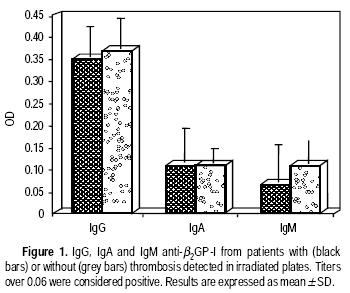
<body><![CDATA[<p align="justify"><font face="verdana" size="2"><a href="/img/revistas/ric/v57n4/a10t2.jpg" target="_blank">Table 2</a> shows the serological data of patients with or without thrombosis. Nineteen patients (13 with thrombosis) had IgG aCL and 15 IgM aCL (12 with thrombosis). Fourteen patients had both isotypes and nine patients had neither (data not shown). Of these, fort have been persistently aCL&#150;negative along disease evolution. <a href="/img/revistas/ric/v57n4/a10t2.jpg" target="_blank">Table 2</a> also shows that 15 patients had lupus anticoagulant (13 with thrombosis) and 15 (13 with thrombosis) had the APCR phenotype; 11 patients had concurrent LA and APCR, all had thrombosis while 10 (7 with thrombosis) were negative for both variables. Only two patients were heterozygous for the Factor V R506Q (FV Leiden) mutation.</font></p>     <p align="justify"><font face="verdana" size="2">&nbsp;</font></p>     <p align="justify"><font face="verdana" size="2"><b>Anti&#150;&#946;<sub>2</sub>GP&#150;I titers and isotypes</b></font></p>     <p align="justify"><font face="verdana" size="2">As per inclusion criteria, all patients had IgG anti&#150;&#946;<sub>2</sub>GP&#150;I detected on non&#150;irradiated plates. <a href="#f1">Figure 1</a> shows the titers of IgG, IgA and IgM anti&#150;&#946;<sub>2</sub>GP&#150;I from patients with or without thrombosis detected in irradiated plates. As seen, IgG anti&#150;&#946;<sub>2</sub>GP&#150;I titers were not significantly different between the two groups. Titers of IgG anti&#150;&#946;<sub>2</sub>GP&#150;I from patients with or without thrombosis detected on irradiated plates were significantly higher than those detected on non&#150;irradiated plates (p = 0.002); but anti&#150;&#946;<sub>2</sub>GP&#150;I titers on non&#150;irradiated plates were always positive (Data not shown). <a href="#f1">Figure 1</a> also shows that nine patients (six with thrombosis and three without it) were positive for IgA anti&#150;&#946;<sub>2</sub>GP&#150;I, 5/9 IgA&#150;positive patients (for with thrombosis) also had IgA anti&#150;&#946;<sub>2</sub>GP&#150;I in non irradiated plates (Data not shown). All patients were negative for IgM anti&#150;&#946;<sub>2</sub>GP&#150;I.</font></p>     <p align="center"><font face="verdana" size="2"><a name="f1"></a></font></p>     <p align="center"><font face="verdana" size="2"><img src="/img/revistas/ric/v57n4/a10f1.jpg"></font></p>     <p align="justify"><font face="verdana" size="2">The results of the detection of IgGl, IgG2, IgG3 and IgG4 anti&#150;&#946;<sub>2</sub>GP&#150;I are shown in <a href="#f2">figure 2</a>. Two patients had IgGl, both had thrombosis. Twenty&#150;eight patients had IgG2 anti&#150;&#946;<sub>2</sub>GP&#150;I, of these 26 were IgA&#150;positive on non&#150;irradiated plates. None of our patients had IgG3 nor IgG4 anti&#150;&#946;<sub>2</sub>GP&#150;I on either kind of plate.</font></p>     <p align="center"><font face="verdana" size="2"><a name="f2"></a></font></p>     <p align="center"><font face="verdana" size="2"><img src="/img/revistas/ric/v57n4/a10f2.jpg"></font></p>     <p align="justify"><font face="verdana" size="2">&nbsp;</font></p>     ]]></body>
<body><![CDATA[<p align="justify"><font face="verdana" size="2"><b>Characteristics of affinity&#150;purified anti&#150;&#946;<sub>2</sub>GP&#150;I antibodies</b></font></p>     <p align="justify"><font face="verdana" size="2">Anti&#150;&#946;<sub>2</sub>GP&#150;I antibodies were isolated by affinity chromatography from the sera of 6 patients (for had thrombosis). One total IgG fraction was isolated from a healthy control sera. We found that purified anti&#150;&#946;<sub>2</sub>GP&#150;I did not react with cardiolipin, phosphatidylcholine, phosphatidylserine or human prothrombin (data not shown). Purified antibodies were mainly of the IgG isotype, but the purified samples also contained IgA, IgM, as well as IgG2 and IgG1 subclasses. Interestingly, one anti&#150;&#946;<sub>2</sub>GP&#150;I reactied with the native &#946;<sub>2</sub>GP&#150;I and with the protein modified by cardiolipina (data not shown).</font></p>     <p align="justify"><font face="verdana" size="2">&nbsp;</font></p>     <p align="justify"><font face="verdana" size="2"><b>APC resistance phenotype assay with affinity purified antibodies</b></font></p>     <p align="justify"><font face="verdana" size="2">The effect of three anti&#150;&#946;<sub>2</sub>GP&#150;I preparations (two from patients with thrombosis and one without it) were tested for their effects on the prolongation of aPTT in response to activated protein C, using both the APTT based assay and the modified assay. At a concentration of 1.0 mg/mL, anti&#150;&#946;<sub>2</sub>GP&#150;I preparations from patients with thrombosis inhibited the factor Va inactivation by APC by both methods, that is, they induced an <i>in vitro </i>APC resistance phenotype. The anti&#150;&#946;<sub>2</sub>GP&#150;I isolated from the patient without thrombosis failed to induce the APC resistance phenotype.</font></p>     <p align="justify"><font face="verdana" size="2">&nbsp;</font></p>     <p align="justify"><font face="verdana" size="2"><b>DISCUSSION</b></font></p>     <p align="justify"><font face="verdana" size="2">While the induction of acquired APCR by serum&#150;containing aPL antibodies has been the topic of several reports,<sup>19,</sup><sup>22,</sup><sup>34,</sup><sup>38,</sup><sup>39</sup> two groups have studied human anti&#150;&#946;<sub>2</sub>GP&#150;I&#150;containing total IgG fractions to address this issue.<sup>19&#150;38</sup> Malia, <i>et al., </i>studied the effect of IgG fractions from 10 plasma samples containing lupus anticoagulant and/or aCL antibodies on the degradation of activated Factor V (FVa) by an activated protein C&#150;protein S complex. Authors found that aPL have an inhibitory effect on the activated protein C/Protein S complex.<sup>38</sup> More recently, Galli, <i>et al, </i>studied the effect of affinity&#150;purified IgG phospholipid&#150;dependent inhibitors of coagulation on the time course of FVa generation and inactivation in normal plasma. They found that IgG preparations with anti&#150;&#946;<sub>2</sub>GP&#150;I activity, but not those with anti&#150;prothrombin activity, hampered the inactivation of FVa by endogenous APC.<sup>19</sup> One group has reported that monoclonal murine and human anti&#150;&#946;<sub>2</sub>GP&#150;I antibodies induce an acquired APCR.<sup>40,41</sup> Here, we studied anti&#150;&#946;<sub>2</sub>GP&#150;I&#150;positive plasmas and found that 15/ 29 induced an in vitro acquired APC resistance (APC phenotype). Ours is the first report that shows that this phenotype is induced by monospecific purified anti&#150;&#946;<sub>2</sub>GP&#150;I antibodies.</font></p>     <p align="justify"><font face="verdana" size="2">Antibodies to &#946;<sub>2</sub>GP&#150;I have also been associated with lupus anticoagulant activity. Galli, <i>et al, </i>reported that different laboratory tests may distinguish different populations of lupus anticoagulants, they found that the kaolin clotting time (KCT) associates with anti&#150;prothrombin antibodies meanwhile the diluted Russell's viper venom time (dRVVT) correlates more with anti&#150;&#946;<sub>2</sub>GP&#150;I.<sup>19</sup> More recently, Takeya, <i>et al, </i>studied murine monoclonal antibodies to &#946;<sub>2</sub>GP&#150;I and found that they inhibit the thrombin generation induced by Russell's viper venom in diluted plasma.<sup>41 </sup>These authors also reported that this phenomenon was abrogated by the presence of an excess amount of phospholipids, resembling the LA activity, and that this LA activity depends on the anti&#150;&#946;<sub>2</sub>GP&#150;I epitope specificity.<sup>41</sup> In our work, 52% of anti&#150;&#946;<sub>2</sub>GP&#150;I&#150;positive plasmas showed LA activity by the dRVVT coagulation profile. This agrees with Galli's, <i>et al, </i>contention that the dRVVT profile does not overlap with the ELISA's results in the detection of anti&#150;&#946;<sub>2</sub>GP&#150;I.<sup>42 </sup>Taken together all these reports and the current one support the notion that &#946;<sub>2</sub>GP&#150;I binds to APC and that anti&#150;&#946;<sub>2</sub>GP&#150;I indirectly inhibits the APC anticoagulant function.<sup>19</sup> Recently, Hwang, <i>et al; </i>proposed another pathogenic mechanism of aPL.<sup>43</sup> These authors showed that an anti&#150;(pro)thrombin&#150;cross&#150;reactive human monoclonal "aCL" antibody directly binds to APC and inhibits its anticoagulant function <i>in vitro.</i><sup>43</sup></font></p>     <p align="justify"><font face="verdana" size="2">Our work also demonstrated the FV Leiden genotype in 2/29 Mexican patients (7%, both with lupus and APS). This is in agreement with previous studies by Ruiz&#150;Arg&uuml;elles et al who found this genetic trait in 1 of 22 Mexican Mestizo patients with primary APS,<sup>44</sup> and with Davies, <i>et al, </i>in British patients with the same disease.<sup>45,46</sup> In Mexico, Ruiz&#150;Arg&uuml;elles, <i>et al, </i>found the APCR phenotype in 40% of patients with primary thrombophilia, while only 10% of them have the FV Leiden mutation.<sup>47</sup> Recently, the same researchers studied other polymorphisms of the FV gene, namely, the HR2 haplotype, Hong Kong, Cambridge and Liverpool mutations in 39 patients with primary thrombophilia.<sup>48</sup> Authors concluded that these mutations do not substantially contribute to cause primary thrombophilia in Mexican Mestizo patients.<sup>48</sup> It remains to be determined If, apart from anti&#150;&#946;<sub>2</sub>GP&#150;I, any of the four FV non&#150;Leiden mutations could be responsible for the APCR phenotype detected in APS patients.</font></p>     ]]></body>
<body><![CDATA[<p align="justify"><font face="verdana" size="2">The prevalence and clinical significance of IgG anti&#150;&#946;<sub>2</sub>GP&#150;I in primary and secondary APS have already been defined.<sup>16,49</sup> In our study, we found a clear IgG2 restriction of anti&#150;&#946;<sub>2</sub>GP&#150;I in patients with APS, both on irradiated and non&#150;irradiated plates. Two published studies have analyzed the subclass of IgG anti&#150;&#946;<sub>2</sub>GP&#150;I. Arvieux, <i>et al, ana </i>Samarkos, <i>et al, </i>found that 87 and 82% of anti&#150;&#946;<sub>2</sub>GP&#150;I from patients with autoimmune disorders and from SLE and primary APS were of the IgG2 subclass, respectively.<sup>50,51</sup> The latter authors also reported that 18 and 9.1% of anti&#150;&#946;<sub>2</sub>GP&#150;I were IgG3 and IgGl. Our results are in good agreement with both studies. Arvieux, <i>et al., ana </i>ourselves, however, found that IgGl and IgG3 were less represented subclasses of anti&#150;&#946;<sub>2</sub>GP&#150;I. The sensitivity of the ELISA assays may account for the discrepancies of these results. Of note is that none of the two aforementioned groups of investigators studied the binding of anti&#150;&#946;<sub>2</sub>GP&#150;I to non&#150;irradiated plates.<sup>50,</sup><sup>51</sup> Here, we found that, although positive when detected in non&#150;irradiated plates, the binding of plasma&#150;derived or affinity purified IgG2 anti&#150;&#946;<sub>2</sub>GP&#150;I from patients with or without thrombosis was higher in irradiated plates. These results agree with the notion that anti&#150;&#946;<sub>2</sub>GP&#150;I react with at least two different epitopes, one present in the native protein and another uncovered by anionic surfaces.<sup>16,52</sup> The IgG2 predominance of anti&#150;&#946;<sub>2</sub>GP&#150;I suggests that the antibody response against &#946;<sub>2</sub>GP&#150;I may be T&#150;cell independent.</font></p>     <p align="justify"><font face="verdana" size="2">It has been suggested that IgA anti&#150;&#946;<sub>2</sub>GP&#150;I could be good markers for thrombosis.<sup>53</sup> Here, we found that 6/22 (27%) patients with thrombosis (3 of them with very high titers) and 3/7 (42%) patients without thrombosis had positive IgA anti&#150;&#946;<sub>2</sub>GP&#150;I. The difference is not statistically significant, but a larger number of patients is needed to settle this issue. As in previous works from our group,<sup>15&#150;</sup><sup>24</sup> in the current study we found no IgM anti&#150;&#946;<sub>2</sub>GP&#150;I in the sera of patients with primary or secondary APS.</font></p>     <p align="justify"><font face="verdana" size="2">More relevant than their isotype, antibodies to &#946;<sub>2</sub>GP&#150;I with LA activity that concomitantly induce the APCR phenotype may be better markers for thrombophilia. For instance, Potzsch <i>et al. </i>found that 13/14 patients with recurrent thrombotic episodes and 10/19 patients with a single event (altogether 73%), all with LA, had APCR in samples prediluted with factor V deficient plasma.<sup>54</sup> In our study, we found that all patients positive for both LA activity and the APCR phenotype had thrombosis. In contrast, all patients without thrombosis were negative for both tests. This finding suggests that the inhibition of the APC anticoagulant function by anti&#150;&#946;<sub>2</sub>GP&#150;I <i>with </i>LA activity may be one of the responsible mechanisms of the recurrent thrombophilia characteristic of APS patients. More studies are needed to confirm this hypothesis.</font></p>     <p align="justify"><font face="verdana" size="2">&nbsp;</font></p>     <p align="justify"><font face="verdana" size="2"><b>ACKNOWLEDGMENTS</b></font></p>     <p align="justify"><font face="verdana" size="2">This study was supported by a grant from the Consejo Nacional de Ciencia y Tecnolog&iacute;a, Mexico.</font></p>     <p align="justify"><font face="verdana" size="2">MSc Viveros' work was supported by scholarships from CONACYT (91197) and from PIFI of the Instituto Polit&eacute;cnico Nacional, Mexico. During the conduction of this study Dr. Cabral was recipient of the Beatriz V&aacute;zquez S&aacute;mano Career Investigator Award for research on Antiphospholipid/cofactor syndromes. We dedicate this work to our friend and colleague Dr. Donato Alarc&oacute;n Segovia whose work and dedication in the study of the antiphospholipid syndrome will always be a source of inspiration to us all.</font></p>     <p align="justify"><font face="verdana" size="2">&nbsp;</font></p>     <p align="justify"><font face="verdana" size="2"><b>REFERENCES</b></font></p>     <!-- ref --><p align="justify"><font face="verdana" size="2">1. Alarc&oacute;n&#150;Segovia D,  Delez&eacute; M,  Oria CV,  S&aacute;nchez&#150;Guerrero J, G&oacute;mez&#150;Pacheco L, Cabiedes J, <i>et al. </i>Antiphospholipid antibodies   and   the   antiphospholipid   syndrome   in   systemic   lupus erythematosus.  A prospective  analysis  of 500  consecutive patients. <i>Medicine </i>1989; 68: 353&#150;65.</font>&nbsp;&nbsp;&nbsp;&nbsp;&nbsp;&nbsp;&nbsp;&nbsp;[&#160;<a href="javascript:void(0);" onclick="javascript: window.open('/scielo.php?script=sci_nlinks&ref=6761393&pid=S0034-8376200500040001000001&lng=','','width=640,height=500,resizable=yes,scrollbars=1,menubar=yes,');">Links</a>&#160;]<!-- end-ref --><!-- ref --><p align="justify"><font face="verdana" size="2">2. Alarc&oacute;n&#150;Segovia   D,    S&aacute;nchez&#150;Guerrero   J.    Primary   antiphospholipid syndrome. <i>J Rheumatol </i>1989;   16:  482&#150;8.</font>&nbsp;&nbsp;&nbsp;&nbsp;&nbsp;&nbsp;&nbsp;&nbsp;[&#160;<a href="javascript:void(0);" onclick="javascript: window.open('/scielo.php?script=sci_nlinks&ref=6761394&pid=S0034-8376200500040001000002&lng=','','width=640,height=500,resizable=yes,scrollbars=1,menubar=yes,');">Links</a>&#160;]<!-- end-ref --><!-- ref --><p align="justify"><font face="verdana" size="2">3. Asherson  RA,  Khamashta MA,  Ordi&#150;Ros  J,  Derksen RHWM, Machin S, Barquinero J et al.  The "primary" antiphospholipid syndrome:   major   clinical   and   serological   features. <i>Medicine </i>1989;  68:  366&#150;74.</font>&nbsp;&nbsp;&nbsp;&nbsp;&nbsp;&nbsp;&nbsp;&nbsp;[&#160;<a href="javascript:void(0);" onclick="javascript: window.open('/scielo.php?script=sci_nlinks&ref=6761395&pid=S0034-8376200500040001000003&lng=','','width=640,height=500,resizable=yes,scrollbars=1,menubar=yes,');">Links</a>&#160;]<!-- end-ref --><!-- ref --><p align="justify"><font face="verdana" size="2">4. Mackworth&#150;Young  CG,  Loizou  S,  Walport MJ.   Primary  antiphospholipid  syndrome:  features  of patients  with raised  anticardiolipin  antibodies  and no  other disorder. <i>Ann Rheum Dis </i>1989;  48:  362&#150;7.</font>&nbsp;&nbsp;&nbsp;&nbsp;&nbsp;&nbsp;&nbsp;&nbsp;[&#160;<a href="javascript:void(0);" onclick="javascript: window.open('/scielo.php?script=sci_nlinks&ref=6761396&pid=S0034-8376200500040001000004&lng=','','width=640,height=500,resizable=yes,scrollbars=1,menubar=yes,');">Links</a>&#160;]<!-- end-ref --><!-- ref --><p align="justify"><font face="verdana" size="2">5. Cervera R,  Piette  JC,  Font  J,  Khamashta  MA,   Shoenfeld  Y, Camps MT <i>et al. </i>Antiphospholipid syndrome. Clinical and immunologic manifestations and patterns of disease expression in a cohort of 1,000 patients. <i>Arthritis Rheum </i>2002; 46:  1019&#150;27.</font>&nbsp;&nbsp;&nbsp;&nbsp;&nbsp;&nbsp;&nbsp;&nbsp;[&#160;<a href="javascript:void(0);" onclick="javascript: window.open('/scielo.php?script=sci_nlinks&ref=6761397&pid=S0034-8376200500040001000005&lng=','','width=640,height=500,resizable=yes,scrollbars=1,menubar=yes,');">Links</a>&#160;]<!-- end-ref --><!-- ref --><p align="justify"><font face="verdana" size="2">6. Galli M, Comfurius P, Maassen C, Hemker HC, de Baets MH, Van   Breda&#150;Vriesmen   PJC   et   al.      Anticardiolipin   antibodies (ACA) are directed not to cardiolipin but to a plasma protein cofactor. <i>Lancet  </i>1990;  335:   1544&#150;7.</font>&nbsp;&nbsp;&nbsp;&nbsp;&nbsp;&nbsp;&nbsp;&nbsp;[&#160;<a href="javascript:void(0);" onclick="javascript: window.open('/scielo.php?script=sci_nlinks&ref=6761398&pid=S0034-8376200500040001000006&lng=','','width=640,height=500,resizable=yes,scrollbars=1,menubar=yes,');">Links</a>&#160;]<!-- end-ref --><!-- ref --><p align="justify"><font face="verdana" size="2">7. McNeil  HP,   Simpson  RJ,   Chesterman  CN,   Krilis   SA.   Antiphospholipid antibodies are directed against a complex antigen that   includes   a   lipid&#150;binding   inhibitor   of   coagulation:    &#946;<sub>2</sub>&#150;Glycoprotein I (apolipoprotein H). <i>Proc Nati Acad Sci (USA) </i>1990;  87:  4120&#150;4.</font>&nbsp;&nbsp;&nbsp;&nbsp;&nbsp;&nbsp;&nbsp;&nbsp;[&#160;<a href="javascript:void(0);" onclick="javascript: window.open('/scielo.php?script=sci_nlinks&ref=6761399&pid=S0034-8376200500040001000007&lng=','','width=640,height=500,resizable=yes,scrollbars=1,menubar=yes,');">Links</a>&#160;]<!-- end-ref --><!-- ref --><p align="justify"><font face="verdana" size="2">8. Matsuura  E,  Igarashi  Y,  Fujimoto  M,  Ichikawa T,  Koike  T. Anticardiolipin   cofactor(s)   and   differential   diagnosis   of  autoimmune disease (Letter). <i>Lancet </i>1990; 336:  177&#150;8.</font>&nbsp;&nbsp;&nbsp;&nbsp;&nbsp;&nbsp;&nbsp;&nbsp;[&#160;<a href="javascript:void(0);" onclick="javascript: window.open('/scielo.php?script=sci_nlinks&ref=6761400&pid=S0034-8376200500040001000008&lng=','','width=640,height=500,resizable=yes,scrollbars=1,menubar=yes,');">Links</a>&#160;]<!-- end-ref --><!-- ref --><p align="justify"><font face="verdana" size="2">9. Galli  M.  Non&#150;&#946;5<sub>2</sub>&#150;glycoprotien I  cofactors for antiphospholipid antibodies. <i>Lupus  </i>1996;  5(5):  388&#150;92.</font>&nbsp;&nbsp;&nbsp;&nbsp;&nbsp;&nbsp;&nbsp;&nbsp;[&#160;<a href="javascript:void(0);" onclick="javascript: window.open('/scielo.php?script=sci_nlinks&ref=6761401&pid=S0034-8376200500040001000009&lng=','','width=640,height=500,resizable=yes,scrollbars=1,menubar=yes,');">Links</a>&#160;]<!-- end-ref --><!-- ref --><p align="justify"><font face="verdana" size="2">10. Sugi T, Mcintyre JA.  Autoantibodies to phosphatydilethanolamine (PE) recognize a kininogen&#150;PE complex. <i>Blood </i>1995; 86: 3083&#150;9.</font>&nbsp;&nbsp;&nbsp;&nbsp;&nbsp;&nbsp;&nbsp;&nbsp;[&#160;<a href="javascript:void(0);" onclick="javascript: window.open('/scielo.php?script=sci_nlinks&ref=6761402&pid=S0034-8376200500040001000010&lng=','','width=640,height=500,resizable=yes,scrollbars=1,menubar=yes,');">Links</a>&#160;]<!-- end-ref --><!-- ref --><p align="justify"><font face="verdana" size="2">11. Ru&iacute;z&#150;Arg&uuml;elles  A,  V&aacute;zquez&#150;Prado  J,  Delez&eacute;  M,  P&eacute;rez&#150;Romano B, Drenkard C, Alarc&oacute;n&#150;Segovia D, et al. Presence of serum antibodies to coagulation protein C in patients with systemic lupus erythematosus is not associated with antigenic or functional protein C deficiencies. <i>Am J Hematol </i>1993; 44: 58&#150;9.</font>&nbsp;&nbsp;&nbsp;&nbsp;&nbsp;&nbsp;&nbsp;&nbsp;[&#160;<a href="javascript:void(0);" onclick="javascript: window.open('/scielo.php?script=sci_nlinks&ref=6761403&pid=S0034-8376200500040001000011&lng=','','width=640,height=500,resizable=yes,scrollbars=1,menubar=yes,');">Links</a>&#160;]<!-- end-ref --><!-- ref --><p align="justify"><font face="verdana" size="2">12. Matsuda J, Saitoh N, Gohchi K, Gotoh M, Tsukamoto M. Anti&#150;annexin V  antibody  in systemic  lupus  erythematosus  patients with lupus anticoagulant and/or anticardiolipin antibody. <i>Am J Hematol  </i>1994;  47(1):   56&#150;8.</font>&nbsp;&nbsp;&nbsp;&nbsp;&nbsp;&nbsp;&nbsp;&nbsp;[&#160;<a href="javascript:void(0);" onclick="javascript: window.open('/scielo.php?script=sci_nlinks&ref=6761404&pid=S0034-8376200500040001000012&lng=','','width=640,height=500,resizable=yes,scrollbars=1,menubar=yes,');">Links</a>&#160;]<!-- end-ref --><!-- ref --><p align="justify"><font face="verdana" size="2">13. Schousboe I.  &#946;<sub>2</sub>&#150;Glycoprotein I: a plasma inhibitor of the contact   activation   of  the   intrinsic   blood   coagulation   pathway. <i>Blood  </i>1985;  66:   1086&#150;91.</font>&nbsp;&nbsp;&nbsp;&nbsp;&nbsp;&nbsp;&nbsp;&nbsp;[&#160;<a href="javascript:void(0);" onclick="javascript: window.open('/scielo.php?script=sci_nlinks&ref=6761405&pid=S0034-8376200500040001000013&lng=','','width=640,height=500,resizable=yes,scrollbars=1,menubar=yes,');">Links</a>&#160;]<!-- end-ref --><!-- ref --><p align="justify"><font face="verdana" size="2">14. Nimpf J, Bevers EM, Bomans PHH. Prothrombinase activity of human platelets  is  inhibited by  &#946;2&#150;  Glycoprotein  I. <i>Biochem Biophys Acta  </i>1986;  884:  142&#150;9.</font>&nbsp;&nbsp;&nbsp;&nbsp;&nbsp;&nbsp;&nbsp;&nbsp;[&#160;<a href="javascript:void(0);" onclick="javascript: window.open('/scielo.php?script=sci_nlinks&ref=6761406&pid=S0034-8376200500040001000014&lng=','','width=640,height=500,resizable=yes,scrollbars=1,menubar=yes,');">Links</a>&#160;]<!-- end-ref --><!-- ref --><p align="justify"><font face="verdana" size="2">15. Cabiedes J, Cabral AR, Alarc&oacute;n&#150;Segovia D. Clinical manifestations of the antiphospholipid syndrome in patients with systemic lupus erythematosus associate more strongly with anti&#150;&#946;<sub>2</sub>&#150;glycoprotein&#150;I than with  antiphospholipid  antibodies.  <i>J Rheu</i><i>matol  </i>1995;  22:   1899&#150;906.&nbsp; &nbsp; &nbsp; &nbsp; &nbsp; &nbsp; &nbsp; &nbsp; &nbsp; &nbsp; &nbsp; &nbsp; &nbsp; &nbsp; &nbsp; &nbsp; &nbsp; &nbsp; &nbsp; &nbsp; &nbsp; &nbsp; &nbsp; &nbsp; &nbsp; &nbsp; &nbsp; &nbsp; &nbsp; &nbsp; &nbsp; &nbsp;</font>&nbsp;&nbsp;&nbsp;&nbsp;&nbsp;&nbsp;&nbsp;&nbsp;[&#160;<a href="javascript:void(0);" onclick="javascript: window.open('/scielo.php?script=sci_nlinks&ref=6761407&pid=S0034-8376200500040001000015&lng=','','width=640,height=500,resizable=yes,scrollbars=1,menubar=yes,');">Links</a>&#160;]<!-- end-ref --><!-- ref --><p align="justify"><font face="verdana" size="2">16. Alarc&oacute;n&#150;Segovia D, Cabral AR. The antiphospholipid antibody syndrome: clinical and serological aspects. In: Alarc&oacute;n GS, Catoggio  LJ,  editors.  Balli&eacute;res'  Clinical Rheumatology.  London:          Bailliere Tindall; 2000, p.  139&#150;50.</font>&nbsp;&nbsp;&nbsp;&nbsp;&nbsp;&nbsp;&nbsp;&nbsp;[&#160;<a href="javascript:void(0);" onclick="javascript: window.open('/scielo.php?script=sci_nlinks&ref=6761408&pid=S0034-8376200500040001000016&lng=','','width=640,height=500,resizable=yes,scrollbars=1,menubar=yes,');">Links</a>&#160;]<!-- end-ref --><!-- ref --><p align="justify"><font face="verdana" size="2">17. Brandt JT.  Antibodies to  &#946;52&#150;glycoprotein I  inhibit phospholipid  dependent  coagulation  reactions.   <i>Thromb Haemost   </i>1993;          70:   598&#150;602.</font>&nbsp;&nbsp;&nbsp;&nbsp;&nbsp;&nbsp;&nbsp;&nbsp;[&#160;<a href="javascript:void(0);" onclick="javascript: window.open('/scielo.php?script=sci_nlinks&ref=6761409&pid=S0034-8376200500040001000017&lng=','','width=640,height=500,resizable=yes,scrollbars=1,menubar=yes,');">Links</a>&#160;]<!-- end-ref --><!-- ref --><p align="justify"><font face="verdana" size="2">18. Roubey RAS, Pratt CW, Buyon JP, Winfield JB. Lupus anticoagulant  activity  of autoimmune   antiphospholipid  antibodies   is          dependent   upon   &#946;<sub>2</sub>&#150;glycoprotein   I.   <i>J  Clin  Invest   </i>1992;   90: 1100&#150;04.</font>&nbsp;&nbsp;&nbsp;&nbsp;&nbsp;&nbsp;&nbsp;&nbsp;[&#160;<a href="javascript:void(0);" onclick="javascript: window.open('/scielo.php?script=sci_nlinks&ref=6761410&pid=S0034-8376200500040001000018&lng=','','width=640,height=500,resizable=yes,scrollbars=1,menubar=yes,');">Links</a>&#160;]<!-- end-ref --><!-- ref --><p align="justify"><font face="verdana" size="2">19. Galli M, Ruggeri L, Barbui T.  Differential effects of anti&#150;&#946;2&#150;          glycoprotein I and antiprothrombin antibodies  on the  anticoagulant activity of activated Protein C. <i>Blood </i>1998;  91:   1999&#150;2004.</font>&nbsp;&nbsp;&nbsp;&nbsp;&nbsp;&nbsp;&nbsp;&nbsp;[&#160;<a href="javascript:void(0);" onclick="javascript: window.open('/scielo.php?script=sci_nlinks&ref=6761411&pid=S0034-8376200500040001000019&lng=','','width=640,height=500,resizable=yes,scrollbars=1,menubar=yes,');">Links</a>&#160;]<!-- end-ref --><!-- ref --><p align="justify"><font face="verdana" size="2">20. Roubey   RA.   Autoantibodies   to   phospholipid&#150;binding   plasma proteins:  A new view of lupus  anticoagulant and other "antiphospholipid" autoantibodies. <i>Blood </i>1994;   84:   2854&#150;67.</font>&nbsp;&nbsp;&nbsp;&nbsp;&nbsp;&nbsp;&nbsp;&nbsp;[&#160;<a href="javascript:void(0);" onclick="javascript: window.open('/scielo.php?script=sci_nlinks&ref=6761412&pid=S0034-8376200500040001000020&lng=','','width=640,height=500,resizable=yes,scrollbars=1,menubar=yes,');">Links</a>&#160;]<!-- end-ref --><!-- ref --><p align="justify"><font face="verdana" size="2">21. Carreras  LO,  Forastiero  RR,  Martinuzzo  ME.   Which  are  the          best  biological  markers   of the  antiphospholipid  syndrome? <i>J Autoimmunity </i>2000;   15:   163&#150;72.</font>&nbsp;&nbsp;&nbsp;&nbsp;&nbsp;&nbsp;&nbsp;&nbsp;[&#160;<a href="javascript:void(0);" onclick="javascript: window.open('/scielo.php?script=sci_nlinks&ref=6761413&pid=S0034-8376200500040001000021&lng=','','width=640,height=500,resizable=yes,scrollbars=1,menubar=yes,');">Links</a>&#160;]<!-- end-ref --><!-- ref --><p align="justify"><font face="verdana" size="2">22. Martinuzzo ME, Forastiero R, Adamczuk Y, Cerrato G, Carreras LO. Activated protein C resistance in patients with anti&#150;&#946;<sub>2</sub>          glycoprotein   I   antibodies.   <i>Blood   Coagul   Fibrinol   </i>1996;   7: 702&#150;04.</font>&nbsp;&nbsp;&nbsp;&nbsp;&nbsp;&nbsp;&nbsp;&nbsp;[&#160;<a href="javascript:void(0);" onclick="javascript: window.open('/scielo.php?script=sci_nlinks&ref=6761414&pid=S0034-8376200500040001000022&lng=','','width=640,height=500,resizable=yes,scrollbars=1,menubar=yes,');">Links</a>&#160;]<!-- end-ref --><!-- ref --><p align="justify"><font face="verdana" size="2">23. Matsuura E, Igarashi Y, Yasuda T, Triplett DA, Koike T. Anticardiolipin antibodies recognize  &#946;<sub>2</sub>&#150;glycoprotein I structure altered by interacting with an oxygen modified solid phase surface. <i>J Exp Med </i>1994;  179: 457&#150;62.</font>&nbsp;&nbsp;&nbsp;&nbsp;&nbsp;&nbsp;&nbsp;&nbsp;[&#160;<a href="javascript:void(0);" onclick="javascript: window.open('/scielo.php?script=sci_nlinks&ref=6761415&pid=S0034-8376200500040001000023&lng=','','width=640,height=500,resizable=yes,scrollbars=1,menubar=yes,');">Links</a>&#160;]<!-- end-ref --><!-- ref --><p align="justify"><font face="verdana" size="2">24. Cabral   AR,   Cabiedes   J,   Alarc&oacute;n&#150;Segovia   D.   Antibodies   to phospholipid&#150;free   &#946;<sub>2</sub> glycoprotein&#150;I   in   the   serum   of  patients          with  primary  antiphospholipid  syndrome.  <i>J Rheumatol   </i>1995; 22:   1894&#150;8.</font>&nbsp;&nbsp;&nbsp;&nbsp;&nbsp;&nbsp;&nbsp;&nbsp;[&#160;<a href="javascript:void(0);" onclick="javascript: window.open('/scielo.php?script=sci_nlinks&ref=6761416&pid=S0034-8376200500040001000024&lng=','','width=640,height=500,resizable=yes,scrollbars=1,menubar=yes,');">Links</a>&#160;]<!-- end-ref --><!-- ref --><p align="justify"><font face="verdana" size="2">25. Galli M, Luciani D, Bertolini G, Barbui T. Anti&#150;&#946;2&#150;glycoprotein I, antiprothrombin antibodies, and the risk of thrombosis in the antiphospholipid  syndrome. <i>Blood </i>2003;   102:  2717&#150;23.</font>&nbsp;&nbsp;&nbsp;&nbsp;&nbsp;&nbsp;&nbsp;&nbsp;[&#160;<a href="javascript:void(0);" onclick="javascript: window.open('/scielo.php?script=sci_nlinks&ref=6761417&pid=S0034-8376200500040001000025&lng=','','width=640,height=500,resizable=yes,scrollbars=1,menubar=yes,');">Links</a>&#160;]<!-- end-ref --><!-- ref --><p align="justify"><font face="verdana" size="2">26. Tan EM, Cohen AS, Fries JF, Masi AT, McShane DJ, Rothfield NF et al. The 1982 revised criteria for the classification of systemic lupus erythematosus. <i>Arthritis Rheum </i>1982; 25:  1271&#150;7.</font>&nbsp;&nbsp;&nbsp;&nbsp;&nbsp;&nbsp;&nbsp;&nbsp;[&#160;<a href="javascript:void(0);" onclick="javascript: window.open('/scielo.php?script=sci_nlinks&ref=6761418&pid=S0034-8376200500040001000026&lng=','','width=640,height=500,resizable=yes,scrollbars=1,menubar=yes,');">Links</a>&#160;]<!-- end-ref --><!-- ref --><p align="justify"><font face="verdana" size="2">27. Loizou S, McCrea JD, Rudge AC, Reynolds R, Boyle CC, Harris EN. Measurement of anticardiolipin antibodies by an enzyme&#150;linked immunosorbent assay (ELISA).  Standardization and quantitation of results. <i>Clin Exp Immunol </i>1985; 62: 738&#150;45.</font>&nbsp;&nbsp;&nbsp;&nbsp;&nbsp;&nbsp;&nbsp;&nbsp;[&#160;<a href="javascript:void(0);" onclick="javascript: window.open('/scielo.php?script=sci_nlinks&ref=6761419&pid=S0034-8376200500040001000027&lng=','','width=640,height=500,resizable=yes,scrollbars=1,menubar=yes,');">Links</a>&#160;]<!-- end-ref --><!-- ref --><p align="justify"><font face="verdana" size="2">28. Gharavi AE, Harris EN, Asherson RA, Hughes GRV. Anticardiolipin antibodies:  isotype distribution and phospholipid specificity. <i>Ann Rheum  Dis   </i>1987;   46:   1&#150;6.</font>&nbsp;&nbsp;&nbsp;&nbsp;&nbsp;&nbsp;&nbsp;&nbsp;[&#160;<a href="javascript:void(0);" onclick="javascript: window.open('/scielo.php?script=sci_nlinks&ref=6761420&pid=S0034-8376200500040001000028&lng=','','width=640,height=500,resizable=yes,scrollbars=1,menubar=yes,');">Links</a>&#160;]<!-- end-ref --><!-- ref --><p align="justify"><font face="verdana" size="2">29. Polz E, Wurm H, Kostner GM. Investigations on &#946;2&#150;glycoprotein in the rat: isolation from serum and demonstration in lipoprotein densitiy fractions. <i>J Biochem </i>1980;  11: 265&#150;70.</font>&nbsp;&nbsp;&nbsp;&nbsp;&nbsp;&nbsp;&nbsp;&nbsp;[&#160;<a href="javascript:void(0);" onclick="javascript: window.open('/scielo.php?script=sci_nlinks&ref=6761421&pid=S0034-8376200500040001000029&lng=','','width=640,height=500,resizable=yes,scrollbars=1,menubar=yes,');">Links</a>&#160;]<!-- end-ref --><!-- ref --><p align="justify"><font face="verdana" size="2">30.&nbsp; Bradford MM. A rapid and sensitive method for the quantitation of microgram quantities  of protein utilizing the principle of protein&#150;dye binding. <i>Anal Biochem  </i>1976; 72:  248&#150;54.</font>&nbsp;&nbsp;&nbsp;&nbsp;&nbsp;&nbsp;&nbsp;&nbsp;[&#160;<a href="javascript:void(0);" onclick="javascript: window.open('/scielo.php?script=sci_nlinks&ref=6761422&pid=S0034-8376200500040001000030&lng=','','width=640,height=500,resizable=yes,scrollbars=1,menubar=yes,');">Links</a>&#160;]<!-- end-ref --><!-- ref --><p align="justify"><font face="verdana" size="2">31.&nbsp; Towbin H,  Staehelin T,  Gordon J.  Electrophoretic transfer of protein from SDS  and acid/urea polyacrylamide gels to nitrocellulose sheets: procedure and some applications. <i>PNAS </i>1979; 76:   4350&#150;4.</font>&nbsp;&nbsp;&nbsp;&nbsp;&nbsp;&nbsp;&nbsp;&nbsp;[&#160;<a href="javascript:void(0);" onclick="javascript: window.open('/scielo.php?script=sci_nlinks&ref=6761423&pid=S0034-8376200500040001000031&lng=','','width=640,height=500,resizable=yes,scrollbars=1,menubar=yes,');">Links</a>&#160;]<!-- end-ref --><!-- ref --><p align="justify"><font face="verdana" size="2">32.&nbsp; Lowry OH, Rosebrough NJ, Farr AL, Randall RJ. Protein measurement with the  Folin  phenol  reagent. <i>J Biol Chem   </i>1951; 193:   265&#150;75.</font>&nbsp;&nbsp;&nbsp;&nbsp;&nbsp;&nbsp;&nbsp;&nbsp;[&#160;<a href="javascript:void(0);" onclick="javascript: window.open('/scielo.php?script=sci_nlinks&ref=6761424&pid=S0034-8376200500040001000032&lng=','','width=640,height=500,resizable=yes,scrollbars=1,menubar=yes,');">Links</a>&#160;]<!-- end-ref --><!-- ref --><p align="justify"><font face="verdana" size="2">33. Bertina RM. Laboratory diagnosis of resistance to activated protein C (APC&#150;resistance). <i>Thromb Haemost </i>1997; 78: 478&#150;82.</font>&nbsp;&nbsp;&nbsp;&nbsp;&nbsp;&nbsp;&nbsp;&nbsp;[&#160;<a href="javascript:void(0);" onclick="javascript: window.open('/scielo.php?script=sci_nlinks&ref=6761425&pid=S0034-8376200500040001000033&lng=','','width=640,height=500,resizable=yes,scrollbars=1,menubar=yes,');">Links</a>&#160;]<!-- end-ref --><!-- ref --><p align="justify"><font face="verdana" size="2">34. Benattar N, Schved JF, Biron&#150;Andr&eacute;ani C. A new dilution for the modified APTT&#150;based assay for activated protein C resistance: improvement of the reliability in patients with lupus anticoagulant. <i>Thromb Haemost </i>2000; 83: 967&#150;8.</font>&nbsp;&nbsp;&nbsp;&nbsp;&nbsp;&nbsp;&nbsp;&nbsp;[&#160;<a href="javascript:void(0);" onclick="javascript: window.open('/scielo.php?script=sci_nlinks&ref=6761426&pid=S0034-8376200500040001000034&lng=','','width=640,height=500,resizable=yes,scrollbars=1,menubar=yes,');">Links</a>&#160;]<!-- end-ref --><!-- ref --><p align="justify"><font face="verdana" size="2">35. Z&ouml;ller B, Dallback B. Linkage between inherited resistance to activated protein C and factor V gene mutation in venous thrombosis. <i>Lancet  </i>1994;  343:   1536&#150;8.</font>&nbsp;&nbsp;&nbsp;&nbsp;&nbsp;&nbsp;&nbsp;&nbsp;[&#160;<a href="javascript:void(0);" onclick="javascript: window.open('/scielo.php?script=sci_nlinks&ref=6761427&pid=S0034-8376200500040001000035&lng=','','width=640,height=500,resizable=yes,scrollbars=1,menubar=yes,');">Links</a>&#160;]<!-- end-ref --><!-- ref --><p align="justify"><font face="verdana" size="2">36. Gandrille S, Alhenc&#150;Gelas M, Aiach M. A rapid screening method for the Factor V Leiden Arg 506&#150;Gln mutation. <i>Blood Coag Fibrinol </i>2001; 6: 245&#150;8.</font>&nbsp;&nbsp;&nbsp;&nbsp;&nbsp;&nbsp;&nbsp;&nbsp;[&#160;<a href="javascript:void(0);" onclick="javascript: window.open('/scielo.php?script=sci_nlinks&ref=6761428&pid=S0034-8376200500040001000036&lng=','','width=640,height=500,resizable=yes,scrollbars=1,menubar=yes,');">Links</a>&#160;]<!-- end-ref --><!-- ref --><p align="justify"><font face="verdana" size="2">37. Jacobsen M, Barna&#150;Cler L, Triplett DA, Wisloff F. The evaluation of clotting times in the laboratory detection of lupus anticoagulants. <i>Thromb Res </i>2001; 104: 275&#150;82. </font>&nbsp;&nbsp;&nbsp;&nbsp;&nbsp;&nbsp;&nbsp;&nbsp;[&#160;<a href="javascript:void(0);" onclick="javascript: window.open('/scielo.php?script=sci_nlinks&ref=6761429&pid=S0034-8376200500040001000037&lng=','','width=640,height=500,resizable=yes,scrollbars=1,menubar=yes,');">Links</a>&#160;]<!-- end-ref --><!-- ref --><p align="justify"><font face="verdana" size="2">38. Malia RG, Kitchen S, Greaves M, Preston FE. Inhibition of activated protein C and its cofactor protein S by antiphospholipid antibodies. <i>Br J Hematol </i>1990; 76:  101&#150;7.</font>&nbsp;&nbsp;&nbsp;&nbsp;&nbsp;&nbsp;&nbsp;&nbsp;[&#160;<a href="javascript:void(0);" onclick="javascript: window.open('/scielo.php?script=sci_nlinks&ref=6761430&pid=S0034-8376200500040001000038&lng=','','width=640,height=500,resizable=yes,scrollbars=1,menubar=yes,');">Links</a>&#160;]<!-- end-ref --><!-- ref --><p align="justify"><font face="verdana" size="2">39. Bokarewa MI, Blomback N, Rosen S. A new variant of interaction between phospholipid antibodies and the protein C system. <i>Blood Coag Fibrinol </i>1994; 5: 37.</font>&nbsp;&nbsp;&nbsp;&nbsp;&nbsp;&nbsp;&nbsp;&nbsp;[&#160;<a href="javascript:void(0);" onclick="javascript: window.open('/scielo.php?script=sci_nlinks&ref=6761431&pid=S0034-8376200500040001000039&lng=','','width=640,height=500,resizable=yes,scrollbars=1,menubar=yes,');">Links</a>&#160;]<!-- end-ref --><!-- ref --><p align="justify"><font face="verdana" size="2">40. Ieko M, Ichikawa K, Triplett DA, Matsuura E, Atsumi T, Sawada KI et al. &#946;2&#150;glycoprotein I is necessary to inhibit protein C activity by monoclonal anticardiolipin antibodies. <i>Arthritis Rheum </i>1999; 42:  167&#150;74.</font>&nbsp;&nbsp;&nbsp;&nbsp;&nbsp;&nbsp;&nbsp;&nbsp;[&#160;<a href="javascript:void(0);" onclick="javascript: window.open('/scielo.php?script=sci_nlinks&ref=6761432&pid=S0034-8376200500040001000040&lng=','','width=640,height=500,resizable=yes,scrollbars=1,menubar=yes,');">Links</a>&#160;]<!-- end-ref --><!-- ref --><p align="justify"><font face="verdana" size="2">41. Takeya H, Mori T, Gabazza EC, Kuroda K, Deguchi H, Matsuura E, et al. Anti&#150;&#946;2&#150;glycoprotein I (&#946;2GPI) monoclonal antibodies with lupus anticoagulant&#150;like activity enhance the &#946;2GPI binding to phospholipids. <i>J Clin Invest </i>2003; 99: 2260&#150;8.</font>&nbsp;&nbsp;&nbsp;&nbsp;&nbsp;&nbsp;&nbsp;&nbsp;[&#160;<a href="javascript:void(0);" onclick="javascript: window.open('/scielo.php?script=sci_nlinks&ref=6761433&pid=S0034-8376200500040001000041&lng=','','width=640,height=500,resizable=yes,scrollbars=1,menubar=yes,');">Links</a>&#160;]<!-- end-ref --><!-- ref --><p align="justify"><font face="verdana" size="2">42. Galli M, Finazzi G, Norbis F, Marchioli R, Barbui T. The risk of thrombosis in patients with lupus anticoagulants is predicted by their specific coagulation profile. <i>Thromb Haemost </i>1999; 81(5):    695&#150;700.</font>&nbsp;&nbsp;&nbsp;&nbsp;&nbsp;&nbsp;&nbsp;&nbsp;[&#160;<a href="javascript:void(0);" onclick="javascript: window.open('/scielo.php?script=sci_nlinks&ref=6761434&pid=S0034-8376200500040001000042&lng=','','width=640,height=500,resizable=yes,scrollbars=1,menubar=yes,');">Links</a>&#160;]<!-- end-ref --><!-- ref --><p align="justify"><font face="verdana" size="2">43. Hwang KK, Yang CD, Yan W, Gorssman J, Haln B, Chen PP. A thrombin&#150;cross&#150;reactive anticardiolipin antibody binds to and inhibits the anticoagulant function of activated protein C. <i>Arthritis Rheum </i>2003; 48:   1622&#150;30.</font>&nbsp;&nbsp;&nbsp;&nbsp;&nbsp;&nbsp;&nbsp;&nbsp;[&#160;<a href="javascript:void(0);" onclick="javascript: window.open('/scielo.php?script=sci_nlinks&ref=6761435&pid=S0034-8376200500040001000043&lng=','','width=640,height=500,resizable=yes,scrollbars=1,menubar=yes,');">Links</a>&#160;]<!-- end-ref --><!-- ref --><p align="justify"><font face="verdana" size="2">44. Ru&iacute;z&#150;Arg&uuml;elles GJ, Garc&eacute;s&#150;Eisele J, Alarc&oacute;n&#150;Segovia D. Activated protein C resistance phenotype and genotype in patients with primary antiphospholipid syndrome. <i>Blood Coag Fibrinol </i>1996; 7: 344&#150;8.</font>&nbsp;&nbsp;&nbsp;&nbsp;&nbsp;&nbsp;&nbsp;&nbsp;[&#160;<a href="javascript:void(0);" onclick="javascript: window.open('/scielo.php?script=sci_nlinks&ref=6761436&pid=S0034-8376200500040001000044&lng=','','width=640,height=500,resizable=yes,scrollbars=1,menubar=yes,');">Links</a>&#160;]<!-- end-ref --><!-- ref --><p align="justify"><font face="verdana" size="2">45. Davies KA, Ireland H, Athanassiou P, Lane D, Walport MJ. Factor V Leiden mutation and venous thrombosis (Letter to the Editor). <i>Lancet </i>1995; 345:  132&#150;3.</font>&nbsp;&nbsp;&nbsp;&nbsp;&nbsp;&nbsp;&nbsp;&nbsp;[&#160;<a href="javascript:void(0);" onclick="javascript: window.open('/scielo.php?script=sci_nlinks&ref=6761437&pid=S0034-8376200500040001000045&lng=','','width=640,height=500,resizable=yes,scrollbars=1,menubar=yes,');">Links</a>&#160;]<!-- end-ref --><!-- ref --><p align="justify"><font face="verdana" size="2">46. Simantov R, Lo S, Salmon JE. Factor V Leiden increases the risk of trombosis in patients with antiphospholipid antibodies. <i>Thromb Res </i>1996; 84: 523&#150;7.</font>&nbsp;&nbsp;&nbsp;&nbsp;&nbsp;&nbsp;&nbsp;&nbsp;[&#160;<a href="javascript:void(0);" onclick="javascript: window.open('/scielo.php?script=sci_nlinks&ref=6761438&pid=S0034-8376200500040001000046&lng=','','width=640,height=500,resizable=yes,scrollbars=1,menubar=yes,');">Links</a>&#160;]<!-- end-ref --><!-- ref --><p align="justify"><font face="verdana" size="2">47. Ruiz&#150;Arg&uuml;elles GJ, Gonz&aacute;lez&#150;Estrada S, Garc&eacute;s&#150;Eisele J, Ruiz&#150;Arg&uuml;elles A. Primary thrombophilia in Mexico II: A prospective study. <i>Am J Hematol </i>1999; 60: 1&#150;5.</font>&nbsp;&nbsp;&nbsp;&nbsp;&nbsp;&nbsp;&nbsp;&nbsp;[&#160;<a href="javascript:void(0);" onclick="javascript: window.open('/scielo.php?script=sci_nlinks&ref=6761439&pid=S0034-8376200500040001000047&lng=','','width=640,height=500,resizable=yes,scrollbars=1,menubar=yes,');">Links</a>&#160;]<!-- end-ref --><!-- ref --><p align="justify"><font face="verdana" size="2">48. Ruiz&#150;Arg&uuml;elles GJ, Poblete&#150;Naredo I, Reyes&#150;N&uacute;&ntilde;ez V, Garc&eacute;s&#150;Eisele J, L&oacute;pez&#150;Mart&iacute;nez B, G&oacute;mez&#150;Rangel J. Primary thrombophilia in Mexico IV: frequency of the Leiden, Cambridge, Hong Kong, Liverpool and HR2 haplotype polymorphisms in the factor V gene of a group of thrombophilic Mexican Mestizo patients. <i>Rev Invest Clin </i>2004; 56: 600&#150;4.</font>&nbsp;&nbsp;&nbsp;&nbsp;&nbsp;&nbsp;&nbsp;&nbsp;[&#160;<a href="javascript:void(0);" onclick="javascript: window.open('/scielo.php?script=sci_nlinks&ref=6761440&pid=S0034-8376200500040001000048&lng=','','width=640,height=500,resizable=yes,scrollbars=1,menubar=yes,');">Links</a>&#160;]<!-- end-ref --><!-- ref --><p align="justify"><font face="verdana" size="2">49. Sebastiani GD, Galeazzi M, Tincani A, Piette JC, Font J, Allegri F et al. Anticardiolipin and anti&#150;&#946;<sub>2</sub>GPI antibodies in a large series of European patients with systemic lupus erythematosus. <i>Scand J Rheumatol </i>1999; 28:  344&#150;51.</font>&nbsp;&nbsp;&nbsp;&nbsp;&nbsp;&nbsp;&nbsp;&nbsp;[&#160;<a href="javascript:void(0);" onclick="javascript: window.open('/scielo.php?script=sci_nlinks&ref=6761441&pid=S0034-8376200500040001000049&lng=','','width=640,height=500,resizable=yes,scrollbars=1,menubar=yes,');">Links</a>&#160;]<!-- end-ref --><!-- ref --><p align="justify"><font face="verdana" size="2">50. Arvieux J, Roussel B, Ponard D, Colomb MG. IgG2 subclass restriction of anti&#150;&#946;2 glycoprotein 1 antibodies in autoimmune patients. <i>Clin Exp Immunol </i>1994; 95: 310&#150;5.</font>&nbsp;&nbsp;&nbsp;&nbsp;&nbsp;&nbsp;&nbsp;&nbsp;[&#160;<a href="javascript:void(0);" onclick="javascript: window.open('/scielo.php?script=sci_nlinks&ref=6761442&pid=S0034-8376200500040001000050&lng=','','width=640,height=500,resizable=yes,scrollbars=1,menubar=yes,');">Links</a>&#160;]<!-- end-ref --><!-- ref --><p align="justify"><font face="verdana" size="2">51. Samarkos M, Davies KA, Gordon C, Walport MJ, Loizou S. IgG subclass distribution of antibodies against &#946;<sub>2</sub>&#150;glycoprotein&#150;1 and cardiolipin in patients with systemic lupus erythematosus and primary antiphospholipid syndrome, and their clinical associations. <i>Rheumatology </i>2001;  40:   1026&#150;32.</font>&nbsp;&nbsp;&nbsp;&nbsp;&nbsp;&nbsp;&nbsp;&nbsp;[&#160;<a href="javascript:void(0);" onclick="javascript: window.open('/scielo.php?script=sci_nlinks&ref=6761443&pid=S0034-8376200500040001000051&lng=','','width=640,height=500,resizable=yes,scrollbars=1,menubar=yes,');">Links</a>&#160;]<!-- end-ref --><!-- ref --><p align="justify"><font face="verdana" size="2">52. Pengo V, Biasiolo A, Fior MG.  Autoimmune antiphospholipid antibodies   are   directed   against   a   cryptic   epitope   expressed when &#946;2&#150;glycoprotein I is bound to a suitable surface. <i>Thromb Haemost </i>1995; 73: 29&#150;34.</font>&nbsp;&nbsp;&nbsp;&nbsp;&nbsp;&nbsp;&nbsp;&nbsp;[&#160;<a href="javascript:void(0);" onclick="javascript: window.open('/scielo.php?script=sci_nlinks&ref=6761444&pid=S0034-8376200500040001000052&lng=','','width=640,height=500,resizable=yes,scrollbars=1,menubar=yes,');">Links</a>&#160;]<!-- end-ref --><!-- ref --><p align="justify"><font face="verdana" size="2">53. Lewis S, Keil LB, Binder WL, De Bari VA. Standard measurement of major immunoglobulin class (IgG, IgA, and IgM) antibodies to  &#946;<sub>2</sub>glycoprotein  I  in patients  with  antiphospholipid syndrome. <i>J Clin Lab Anal </i>1998; 12: 293&#150;7.</font>&nbsp;&nbsp;&nbsp;&nbsp;&nbsp;&nbsp;&nbsp;&nbsp;[&#160;<a href="javascript:void(0);" onclick="javascript: window.open('/scielo.php?script=sci_nlinks&ref=6761445&pid=S0034-8376200500040001000053&lng=','','width=640,height=500,resizable=yes,scrollbars=1,menubar=yes,');">Links</a>&#160;]<!-- end-ref --><!-- ref --><p align="justify"><font face="verdana" size="2">54. Potzsch B, Kawamura H, Preissner KT, Schmidt M, Seeling C, Muller&#150;Berghaus   G.   Acquired  protein  C  dysfunction  but  not decreased activity of thrombomodulin is a possible marker of thrombophilia in patients with lupus anticoagulant. <i>J Lab Clin Med </i>1995;  125:  16&#150;7.</font>&nbsp;&nbsp;&nbsp;&nbsp;&nbsp;&nbsp;&nbsp;&nbsp;[&#160;<a href="javascript:void(0);" onclick="javascript: window.open('/scielo.php?script=sci_nlinks&ref=6761446&pid=S0034-8376200500040001000054&lng=','','width=640,height=500,resizable=yes,scrollbars=1,menubar=yes,');">Links</a>&#160;]<!-- end-ref --> ]]></body><back>
<ref-list>
<ref id="B1">
<label>1</label><nlm-citation citation-type="journal">
<person-group person-group-type="author">
<name>
<surname><![CDATA[Alarcón-Segovia]]></surname>
<given-names><![CDATA[D]]></given-names>
</name>
<name>
<surname><![CDATA[Delezé]]></surname>
<given-names><![CDATA[M]]></given-names>
</name>
<name>
<surname><![CDATA[Oria]]></surname>
<given-names><![CDATA[CV]]></given-names>
</name>
<name>
<surname><![CDATA[Sánchez-Guerrero]]></surname>
<given-names><![CDATA[J]]></given-names>
</name>
<name>
<surname><![CDATA[Gómez-Pacheco]]></surname>
<given-names><![CDATA[L]]></given-names>
</name>
<name>
<surname><![CDATA[Cabiedes]]></surname>
<given-names><![CDATA[J]]></given-names>
</name>
</person-group>
<article-title xml:lang="en"><![CDATA[Antiphospholipid antibodies and the antiphospholipid syndrome in systemic lupus erythematosus: A prospective analysis of 500 consecutive patients]]></article-title>
<source><![CDATA[Medicine]]></source>
<year>1989</year>
<volume>68</volume>
<page-range>353-65</page-range></nlm-citation>
</ref>
<ref id="B2">
<label>2.</label><nlm-citation citation-type="journal">
<person-group person-group-type="author">
<name>
<surname><![CDATA[Alarcón-Segovia]]></surname>
<given-names><![CDATA[D]]></given-names>
</name>
<name>
<surname><![CDATA[Sánchez-Guerrero]]></surname>
<given-names><![CDATA[J]]></given-names>
</name>
</person-group>
<article-title xml:lang="en"><![CDATA[Primary antiphospholipid syndrome]]></article-title>
<source><![CDATA[J Rheumatol]]></source>
<year>1989</year>
<volume>16</volume>
<page-range>482-8</page-range></nlm-citation>
</ref>
<ref id="B3">
<label>3</label><nlm-citation citation-type="journal">
<person-group person-group-type="author">
<name>
<surname><![CDATA[Asherson]]></surname>
<given-names><![CDATA[RA]]></given-names>
</name>
<name>
<surname><![CDATA[Khamashta]]></surname>
<given-names><![CDATA[MA]]></given-names>
</name>
<name>
<surname><![CDATA[Ordi-Ros]]></surname>
<given-names><![CDATA[J]]></given-names>
</name>
<name>
<surname><![CDATA[Derksen]]></surname>
<given-names><![CDATA[RHWM]]></given-names>
</name>
<name>
<surname><![CDATA[Machin]]></surname>
<given-names><![CDATA[S]]></given-names>
</name>
<name>
<surname><![CDATA[Barquinero]]></surname>
<given-names><![CDATA[J]]></given-names>
</name>
</person-group>
<article-title xml:lang="en"><![CDATA[The "primary" antiphospholipid syndrome: major clinical and serological features]]></article-title>
<source><![CDATA[Medicine]]></source>
<year>1989</year>
<volume>68</volume>
<page-range>366-74</page-range></nlm-citation>
</ref>
<ref id="B4">
<label>4</label><nlm-citation citation-type="journal">
<person-group person-group-type="author">
<name>
<surname><![CDATA[Mackworth-Young]]></surname>
<given-names><![CDATA[CG]]></given-names>
</name>
<name>
<surname><![CDATA[Loizou]]></surname>
<given-names><![CDATA[S]]></given-names>
</name>
<name>
<surname><![CDATA[Walport]]></surname>
<given-names><![CDATA[MJ]]></given-names>
</name>
</person-group>
<article-title xml:lang="en"><![CDATA[Primary antiphospholipid syndrome: features of patients with raised anticardiolipin antibodies and no other disorder]]></article-title>
<source><![CDATA[Ann Rheum Dis]]></source>
<year>1989</year>
<volume>48</volume>
<page-range>362-7</page-range></nlm-citation>
</ref>
<ref id="B5">
<label>5</label><nlm-citation citation-type="journal">
<person-group person-group-type="author">
<name>
<surname><![CDATA[Cervera]]></surname>
<given-names><![CDATA[R]]></given-names>
</name>
<name>
<surname><![CDATA[Piette]]></surname>
<given-names><![CDATA[JC]]></given-names>
</name>
<name>
<surname><![CDATA[Font]]></surname>
<given-names><![CDATA[J]]></given-names>
</name>
<name>
<surname><![CDATA[Khamashta]]></surname>
<given-names><![CDATA[MA]]></given-names>
</name>
<name>
<surname><![CDATA[Shoenfeld]]></surname>
<given-names><![CDATA[Y]]></given-names>
</name>
<name>
<surname><![CDATA[Camps]]></surname>
<given-names><![CDATA[MT]]></given-names>
</name>
</person-group>
<article-title xml:lang="en"><![CDATA[Antiphospholipid syndrome. Clinical and immunologic manifestations and patterns of disease expression in a cohort of 1,000 patients]]></article-title>
<source><![CDATA[Arthritis Rheum]]></source>
<year>2002</year>
<volume>46</volume>
<page-range>1019-27</page-range></nlm-citation>
</ref>
<ref id="B6">
<label>6</label><nlm-citation citation-type="journal">
<person-group person-group-type="author">
<name>
<surname><![CDATA[Galli]]></surname>
<given-names><![CDATA[M]]></given-names>
</name>
<name>
<surname><![CDATA[Comfurius]]></surname>
<given-names><![CDATA[P]]></given-names>
</name>
<name>
<surname><![CDATA[Maassen]]></surname>
<given-names><![CDATA[C]]></given-names>
</name>
<name>
<surname><![CDATA[Hemker]]></surname>
<given-names><![CDATA[HC]]></given-names>
</name>
<name>
<surname><![CDATA[de Baets]]></surname>
<given-names><![CDATA[MH]]></given-names>
</name>
<name>
<surname><![CDATA[Van Breda-Vriesmen]]></surname>
<given-names><![CDATA[PJC]]></given-names>
</name>
</person-group>
<article-title xml:lang="en"><![CDATA[Anticardiolipin antibodies (ACA) are directed not to cardiolipin but to a plasma protein cofactor]]></article-title>
<source><![CDATA[Lancet]]></source>
<year>1990</year>
<volume>335</volume>
<page-range>1544-7</page-range></nlm-citation>
</ref>
<ref id="B7">
<label>7</label><nlm-citation citation-type="journal">
<person-group person-group-type="author">
<name>
<surname><![CDATA[McNeil]]></surname>
<given-names><![CDATA[HP]]></given-names>
</name>
<name>
<surname><![CDATA[Simpson]]></surname>
<given-names><![CDATA[RJ]]></given-names>
</name>
<name>
<surname><![CDATA[Chesterman]]></surname>
<given-names><![CDATA[CN]]></given-names>
</name>
<name>
<surname><![CDATA[Krilis]]></surname>
<given-names><![CDATA[SA]]></given-names>
</name>
</person-group>
<article-title xml:lang="en"><![CDATA[Antiphospholipid antibodies are directed against a complex antigen that includes a lipid-binding inhibitor of coagulation: &beta;2-Glycoprotein I (apolipoprotein H)]]></article-title>
<source><![CDATA[Proc Nati Acad Sci]]></source>
<year>1990</year>
<volume>87</volume>
<page-range>4120-4</page-range></nlm-citation>
</ref>
<ref id="B8">
<label>8</label><nlm-citation citation-type="journal">
<person-group person-group-type="author">
<name>
<surname><![CDATA[Matsuura]]></surname>
<given-names><![CDATA[E]]></given-names>
</name>
<name>
<surname><![CDATA[Igarashi]]></surname>
<given-names><![CDATA[Y]]></given-names>
</name>
<name>
<surname><![CDATA[Fujimoto]]></surname>
<given-names><![CDATA[M]]></given-names>
</name>
<name>
<surname><![CDATA[Ichikawa]]></surname>
<given-names><![CDATA[T]]></given-names>
</name>
<name>
<surname><![CDATA[Koike]]></surname>
<given-names><![CDATA[T]]></given-names>
</name>
</person-group>
<article-title xml:lang="en"><![CDATA[Anticardiolipin cofactor(s) and differential diagnosis of autoimmune disease (Letter)]]></article-title>
<source><![CDATA[Lancet]]></source>
<year>1990</year>
<volume>336</volume>
<page-range>177-8</page-range></nlm-citation>
</ref>
<ref id="B9">
<label>9</label><nlm-citation citation-type="journal">
<person-group person-group-type="author">
<name>
<surname><![CDATA[Galli]]></surname>
<given-names><![CDATA[M]]></given-names>
</name>
</person-group>
<article-title xml:lang="en"><![CDATA[Non-|5(2)-glycoprotien I cofactors for antiphospholipid antibodies]]></article-title>
<source><![CDATA[Lupus]]></source>
<year>1996</year>
<volume>5</volume>
<numero>5</numero>
<issue>5</issue>
<page-range>388-92</page-range></nlm-citation>
</ref>
<ref id="B10">
<label>10</label><nlm-citation citation-type="journal">
<person-group person-group-type="author">
<name>
<surname><![CDATA[Sugi]]></surname>
<given-names><![CDATA[T]]></given-names>
</name>
<name>
<surname><![CDATA[Mcintyre]]></surname>
<given-names><![CDATA[JA]]></given-names>
</name>
</person-group>
<article-title xml:lang="en"><![CDATA[Autoantibodies to phosphatydilethanolamine (PE) recognize a kininogen-PE complex]]></article-title>
<source><![CDATA[Blood]]></source>
<year>1995</year>
<volume>86</volume>
<page-range>3083-9</page-range></nlm-citation>
</ref>
<ref id="B11">
<label>11</label><nlm-citation citation-type="journal">
<person-group person-group-type="author">
<name>
<surname><![CDATA[Ruíz-Argüelles]]></surname>
<given-names><![CDATA[A]]></given-names>
</name>
<name>
<surname><![CDATA[Vázquez-Prado]]></surname>
<given-names><![CDATA[J]]></given-names>
</name>
<name>
<surname><![CDATA[Delezé]]></surname>
<given-names><![CDATA[M]]></given-names>
</name>
<name>
<surname><![CDATA[Pérez-Romano]]></surname>
<given-names><![CDATA[B]]></given-names>
</name>
<name>
<surname><![CDATA[Drenkard]]></surname>
<given-names><![CDATA[C]]></given-names>
</name>
<name>
<surname><![CDATA[Alarcón-Segovia]]></surname>
<given-names><![CDATA[D]]></given-names>
</name>
</person-group>
<article-title xml:lang="en"><![CDATA[Presence of serum antibodies to coagulation protein C in patients with systemic lupus erythematosus is not associated with antigenic or functional protein C deficiencies]]></article-title>
<source><![CDATA[Am J Hematol]]></source>
<year>1993</year>
<volume>44</volume>
<page-range>58-9</page-range></nlm-citation>
</ref>
<ref id="B12">
<label>12</label><nlm-citation citation-type="journal">
<person-group person-group-type="author">
<name>
<surname><![CDATA[Matsuda]]></surname>
<given-names><![CDATA[J]]></given-names>
</name>
<name>
<surname><![CDATA[Saitoh]]></surname>
<given-names><![CDATA[N]]></given-names>
</name>
<name>
<surname><![CDATA[Gohchi]]></surname>
<given-names><![CDATA[K]]></given-names>
</name>
<name>
<surname><![CDATA[Gotoh]]></surname>
<given-names><![CDATA[M]]></given-names>
</name>
<name>
<surname><![CDATA[Tsukamoto]]></surname>
<given-names><![CDATA[M]]></given-names>
</name>
</person-group>
<article-title xml:lang="en"><![CDATA[Anti-annexin V antibody in systemic lupus erythematosus patients with lupus anticoagulant and/or anticardiolipin antibody]]></article-title>
<source><![CDATA[Am J Hematol]]></source>
<year>1994</year>
<volume>47</volume>
<numero>1</numero>
<issue>1</issue>
<page-range>56-8</page-range></nlm-citation>
</ref>
<ref id="B13">
<label>13</label><nlm-citation citation-type="journal">
<person-group person-group-type="author">
<name>
<surname><![CDATA[Schousboe]]></surname>
<given-names><![CDATA[I]]></given-names>
</name>
</person-group>
<article-title xml:lang="en"><![CDATA[&beta;2-Glycoprotein I: a plasma inhibitor of the contact activation of the intrinsic blood coagulation pathway]]></article-title>
<source><![CDATA[Blood]]></source>
<year>1985</year>
<volume>66</volume>
<page-range>1086-91</page-range></nlm-citation>
</ref>
<ref id="B14">
<label>14</label><nlm-citation citation-type="journal">
<person-group person-group-type="author">
<name>
<surname><![CDATA[Nimpf]]></surname>
<given-names><![CDATA[J]]></given-names>
</name>
<name>
<surname><![CDATA[Bevers]]></surname>
<given-names><![CDATA[EM]]></given-names>
</name>
<name>
<surname><![CDATA[Bomans]]></surname>
<given-names><![CDATA[PHH]]></given-names>
</name>
</person-group>
<article-title xml:lang="en"><![CDATA[Prothrombinase activity of human platelets is inhibited by &beta;2- Glycoprotein I]]></article-title>
<source><![CDATA[Biochem Biophys Acta]]></source>
<year>1986</year>
<volume>884</volume>
<page-range>142-9</page-range></nlm-citation>
</ref>
<ref id="B15">
<label>15</label><nlm-citation citation-type="journal">
<person-group person-group-type="author">
<name>
<surname><![CDATA[Cabiedes]]></surname>
<given-names><![CDATA[J]]></given-names>
</name>
<name>
<surname><![CDATA[Cabral]]></surname>
<given-names><![CDATA[AR]]></given-names>
</name>
<name>
<surname><![CDATA[Alarcón-Segovia]]></surname>
<given-names><![CDATA[D]]></given-names>
</name>
</person-group>
<article-title xml:lang="en"><![CDATA[Clinical manifestations of the antiphospholipid syndrome in patients with systemic lupus erythematosus associate more strongly with anti-&beta;2-glycoprotein-I than with antiphospholipid antibodies]]></article-title>
<source><![CDATA[J Rheumatol]]></source>
<year>1995</year>
<volume>22</volume>
<page-range>1899-906</page-range></nlm-citation>
</ref>
<ref id="B16">
<label>16</label><nlm-citation citation-type="book">
<person-group person-group-type="author">
<name>
<surname><![CDATA[Alarcón-Segovia]]></surname>
<given-names><![CDATA[D]]></given-names>
</name>
<name>
<surname><![CDATA[Cabral]]></surname>
<given-names><![CDATA[AR]]></given-names>
</name>
</person-group>
<article-title xml:lang="en"><![CDATA[The antiphospholipid antibody syndrome: clinical and serological aspects]]></article-title>
<person-group person-group-type="editor">
<name>
<surname><![CDATA[Alarcón]]></surname>
<given-names><![CDATA[GS]]></given-names>
</name>
<name>
<surname><![CDATA[Catoggio]]></surname>
<given-names><![CDATA[LJ]]></given-names>
</name>
</person-group>
<source><![CDATA[Balliéres' Clinical Rheumatology]]></source>
<year>2000</year>
<page-range>139-50</page-range><publisher-loc><![CDATA[London ]]></publisher-loc>
<publisher-name><![CDATA[Bailliere Tindall]]></publisher-name>
</nlm-citation>
</ref>
<ref id="B17">
<label>17</label><nlm-citation citation-type="journal">
<person-group person-group-type="author">
<name>
<surname><![CDATA[Brandt]]></surname>
<given-names><![CDATA[JT]]></given-names>
</name>
</person-group>
<article-title xml:lang="en"><![CDATA[Antibodies to |52-glycoprotein I inhibit phospholipid dependent coagulation reactions]]></article-title>
<source><![CDATA[Thromb Haemost]]></source>
<year>1993</year>
<volume>70</volume>
<page-range>598-602</page-range></nlm-citation>
</ref>
<ref id="B18">
<label>18</label><nlm-citation citation-type="journal">
<person-group person-group-type="author">
<name>
<surname><![CDATA[Roubey]]></surname>
<given-names><![CDATA[RAS]]></given-names>
</name>
<name>
<surname><![CDATA[Pratt]]></surname>
<given-names><![CDATA[CW]]></given-names>
</name>
<name>
<surname><![CDATA[Buyon]]></surname>
<given-names><![CDATA[JP]]></given-names>
</name>
<name>
<surname><![CDATA[Winfield]]></surname>
<given-names><![CDATA[JB]]></given-names>
</name>
</person-group>
<article-title xml:lang="en"><![CDATA[Lupus anticoagulant activity of autoimmune antiphospholipid antibodies is dependent upon &beta;2-glycoprotein I]]></article-title>
<source><![CDATA[J Clin Invest]]></source>
<year>1992</year>
<volume>90</volume>
<page-range>1100-04</page-range></nlm-citation>
</ref>
<ref id="B19">
<label>19</label><nlm-citation citation-type="journal">
<person-group person-group-type="author">
<name>
<surname><![CDATA[Galli]]></surname>
<given-names><![CDATA[M]]></given-names>
</name>
<name>
<surname><![CDATA[Ruggeri]]></surname>
<given-names><![CDATA[L]]></given-names>
</name>
<name>
<surname><![CDATA[Barbui]]></surname>
<given-names><![CDATA[T]]></given-names>
</name>
</person-group>
<article-title xml:lang="en"><![CDATA[Differential effects of anti-&beta;2- glycoprotein I and antiprothrombin antibodies on the anticoagulant activity of activated Protein C]]></article-title>
<source><![CDATA[Blood]]></source>
<year>1998</year>
<volume>91</volume>
<page-range>1999-2004</page-range></nlm-citation>
</ref>
<ref id="B20">
<label>20</label><nlm-citation citation-type="journal">
<person-group person-group-type="author">
<name>
<surname><![CDATA[Roubey]]></surname>
<given-names><![CDATA[RA]]></given-names>
</name>
</person-group>
<article-title xml:lang="en"><![CDATA[Autoantibodies to phospholipid-binding plasma proteins: A new view of lupus anticoagulant and other "antiphospholipid" autoantibodies]]></article-title>
<source><![CDATA[Blood]]></source>
<year>1994</year>
<volume>84</volume>
<page-range>2854-67</page-range></nlm-citation>
</ref>
<ref id="B21">
<label>21</label><nlm-citation citation-type="journal">
<person-group person-group-type="author">
<name>
<surname><![CDATA[Carreras]]></surname>
<given-names><![CDATA[LO]]></given-names>
</name>
<name>
<surname><![CDATA[Forastiero]]></surname>
<given-names><![CDATA[RR]]></given-names>
</name>
<name>
<surname><![CDATA[Martinuzzo]]></surname>
<given-names><![CDATA[ME]]></given-names>
</name>
</person-group>
<article-title xml:lang="en"><![CDATA[Which are the best biological markers of the antiphospholipid syndrome?]]></article-title>
<source><![CDATA[J Autoimmunity]]></source>
<year>2000</year>
<volume>15</volume>
<page-range>163-72</page-range></nlm-citation>
</ref>
<ref id="B22">
<label>22</label><nlm-citation citation-type="journal">
<person-group person-group-type="author">
<name>
<surname><![CDATA[Martinuzzo]]></surname>
<given-names><![CDATA[ME]]></given-names>
</name>
<name>
<surname><![CDATA[Forastiero]]></surname>
<given-names><![CDATA[R]]></given-names>
</name>
<name>
<surname><![CDATA[Adamczuk]]></surname>
<given-names><![CDATA[Y]]></given-names>
</name>
<name>
<surname><![CDATA[Cerrato]]></surname>
<given-names><![CDATA[G]]></given-names>
</name>
<name>
<surname><![CDATA[Carreras]]></surname>
<given-names><![CDATA[LO]]></given-names>
</name>
</person-group>
<article-title xml:lang="en"><![CDATA[Activated protein C resistance in patients with anti-&beta;2 glycoprotein I antibodies]]></article-title>
<source><![CDATA[Blood Coagul Fibrinol]]></source>
<year>1996</year>
<volume>7</volume>
<page-range>702-04</page-range></nlm-citation>
</ref>
<ref id="B23">
<label>23</label><nlm-citation citation-type="journal">
<person-group person-group-type="author">
<name>
<surname><![CDATA[Matsuura]]></surname>
<given-names><![CDATA[E]]></given-names>
</name>
<name>
<surname><![CDATA[Igarashi]]></surname>
<given-names><![CDATA[Y]]></given-names>
</name>
<name>
<surname><![CDATA[Yasuda]]></surname>
<given-names><![CDATA[T]]></given-names>
</name>
<name>
<surname><![CDATA[Triplett]]></surname>
<given-names><![CDATA[DA]]></given-names>
</name>
<name>
<surname><![CDATA[Koike]]></surname>
</name>
</person-group>
<article-title xml:lang="en"><![CDATA[Anticardiolipin antibodies recognize &beta;2-glycoprotein I structure altered by interacting with an oxygen modified solid phase surface]]></article-title>
<source><![CDATA[J Exp Med]]></source>
<year>1994</year>
<volume>179</volume>
<page-range>457-62</page-range></nlm-citation>
</ref>
<ref id="B24">
<label>24</label><nlm-citation citation-type="journal">
<person-group person-group-type="author">
<name>
<surname><![CDATA[Cabral]]></surname>
<given-names><![CDATA[AR]]></given-names>
</name>
<name>
<surname><![CDATA[Cabiedes]]></surname>
<given-names><![CDATA[J]]></given-names>
</name>
<name>
<surname><![CDATA[Alarcón-Segovia]]></surname>
<given-names><![CDATA[D]]></given-names>
</name>
</person-group>
<article-title xml:lang="en"><![CDATA[Antibodies to phospholipid-free &beta;2 glycoprotein-I in the serum of patients with primary antiphospholipid syndrome]]></article-title>
<source><![CDATA[J Rheumatol]]></source>
<year>1995</year>
<volume>22</volume>
<page-range>1894-8</page-range></nlm-citation>
</ref>
<ref id="B25">
<label>25</label><nlm-citation citation-type="journal">
<person-group person-group-type="author">
<name>
<surname><![CDATA[Galli]]></surname>
<given-names><![CDATA[M]]></given-names>
</name>
<name>
<surname><![CDATA[Luciani]]></surname>
<given-names><![CDATA[D]]></given-names>
</name>
<name>
<surname><![CDATA[Bertolini]]></surname>
<given-names><![CDATA[G]]></given-names>
</name>
<name>
<surname><![CDATA[Barbui]]></surname>
<given-names><![CDATA[T]]></given-names>
</name>
</person-group>
<article-title xml:lang="en"><![CDATA[Anti-&beta;2-glycoprotein I, antiprothrombin antibodies, and the risk of thrombosis in the antiphospholipid syndrome]]></article-title>
<source><![CDATA[Blood]]></source>
<year>2003</year>
<volume>102</volume>
<page-range>2717-23</page-range></nlm-citation>
</ref>
<ref id="B26">
<label>26</label><nlm-citation citation-type="journal">
<person-group person-group-type="author">
<name>
<surname><![CDATA[Tan]]></surname>
<given-names><![CDATA[EM]]></given-names>
</name>
<name>
<surname><![CDATA[Cohen]]></surname>
<given-names><![CDATA[AS]]></given-names>
</name>
<name>
<surname><![CDATA[Fries]]></surname>
<given-names><![CDATA[JF]]></given-names>
</name>
<name>
<surname><![CDATA[Masi]]></surname>
<given-names><![CDATA[AT]]></given-names>
</name>
<name>
<surname><![CDATA[McShane]]></surname>
<given-names><![CDATA[DJ]]></given-names>
</name>
<name>
<surname><![CDATA[Rothfield]]></surname>
<given-names><![CDATA[NF]]></given-names>
</name>
</person-group>
<article-title xml:lang="en"><![CDATA[The 1982 revised criteria for the classification of systemic lupus erythematosus]]></article-title>
<source><![CDATA[Arthritis Rheum]]></source>
<year>1982</year>
<volume>25</volume>
<page-range>1271-7</page-range></nlm-citation>
</ref>
<ref id="B27">
<label>27</label><nlm-citation citation-type="journal">
<person-group person-group-type="author">
<name>
<surname><![CDATA[Loizou]]></surname>
<given-names><![CDATA[S]]></given-names>
</name>
<name>
<surname><![CDATA[McCrea]]></surname>
<given-names><![CDATA[JD]]></given-names>
</name>
<name>
<surname><![CDATA[Rudge]]></surname>
<given-names><![CDATA[AC]]></given-names>
</name>
<name>
<surname><![CDATA[Reynolds]]></surname>
<given-names><![CDATA[R]]></given-names>
</name>
<name>
<surname><![CDATA[Boyle]]></surname>
<given-names><![CDATA[CC]]></given-names>
</name>
<name>
<surname><![CDATA[Harris]]></surname>
<given-names><![CDATA[EN]]></given-names>
</name>
</person-group>
<article-title xml:lang="en"><![CDATA[Measurement of anticardiolipin antibodies by an enzyme-linked immunosorbent assay (ELISA): Standardization and quantitation of results]]></article-title>
<source><![CDATA[Clin Exp Immunol]]></source>
<year>1985</year>
<volume>62</volume>
<page-range>738-45</page-range></nlm-citation>
</ref>
<ref id="B28">
<label>28</label><nlm-citation citation-type="journal">
<person-group person-group-type="author">
<name>
<surname><![CDATA[Gharavi]]></surname>
<given-names><![CDATA[AE]]></given-names>
</name>
<name>
<surname><![CDATA[Harris]]></surname>
<given-names><![CDATA[EN]]></given-names>
</name>
<name>
<surname><![CDATA[Asherson]]></surname>
<given-names><![CDATA[RA]]></given-names>
</name>
<name>
<surname><![CDATA[Hughes]]></surname>
<given-names><![CDATA[GRV]]></given-names>
</name>
</person-group>
<article-title xml:lang="en"><![CDATA[Anticardiolipin antibodies: isotype distribution and phospholipid specificity]]></article-title>
<source><![CDATA[Ann Rheum Dis]]></source>
<year>1987</year>
<volume>46</volume>
<page-range>1-6</page-range></nlm-citation>
</ref>
<ref id="B29">
<label>29</label><nlm-citation citation-type="journal">
<person-group person-group-type="author">
<name>
<surname><![CDATA[Polz]]></surname>
<given-names><![CDATA[E]]></given-names>
</name>
<name>
<surname><![CDATA[Wurm]]></surname>
<given-names><![CDATA[H]]></given-names>
</name>
<name>
<surname><![CDATA[Kostner]]></surname>
<given-names><![CDATA[GM]]></given-names>
</name>
</person-group>
<article-title xml:lang="en"><![CDATA[Investigations on &beta;2-glycoprotein in the rat: isolation from serum and demonstration in lipoprotein densitiy fractions]]></article-title>
<source><![CDATA[J Biochem]]></source>
<year>1980</year>
<volume>11</volume>
<page-range>265-70</page-range></nlm-citation>
</ref>
<ref id="B30">
<label>30</label><nlm-citation citation-type="journal">
<person-group person-group-type="author">
<name>
<surname><![CDATA[Bradford]]></surname>
<given-names><![CDATA[MM]]></given-names>
</name>
</person-group>
<article-title xml:lang="en"><![CDATA[A rapid and sensitive method for the quantitation of microgram quantities of protein utilizing the principle of protein-dye binding]]></article-title>
<source><![CDATA[Anal Biochem]]></source>
<year>1976</year>
<volume>72</volume>
<page-range>248-54</page-range></nlm-citation>
</ref>
<ref id="B31">
<label>31</label><nlm-citation citation-type="journal">
<person-group person-group-type="author">
<name>
<surname><![CDATA[Towbin]]></surname>
<given-names><![CDATA[H]]></given-names>
</name>
<name>
<surname><![CDATA[Staehelin]]></surname>
<given-names><![CDATA[T]]></given-names>
</name>
<name>
<surname><![CDATA[Gordon]]></surname>
<given-names><![CDATA[J]]></given-names>
</name>
</person-group>
<article-title xml:lang="en"><![CDATA[Electrophoretic transfer of protein from SDS and acid/urea polyacrylamide gels to nitrocellulose sheets: procedure and some applications]]></article-title>
<source><![CDATA[PNAS]]></source>
<year>1979</year>
<volume>76</volume>
<page-range>4350-4</page-range></nlm-citation>
</ref>
<ref id="B32">
<label>32</label><nlm-citation citation-type="journal">
<person-group person-group-type="author">
<name>
<surname><![CDATA[Lowry]]></surname>
<given-names><![CDATA[OH]]></given-names>
</name>
<name>
<surname><![CDATA[Rosebrough]]></surname>
<given-names><![CDATA[NJ]]></given-names>
</name>
<name>
<surname><![CDATA[Farr]]></surname>
<given-names><![CDATA[AL]]></given-names>
</name>
<name>
<surname><![CDATA[Randall]]></surname>
<given-names><![CDATA[RJ]]></given-names>
</name>
</person-group>
<article-title xml:lang="en"><![CDATA[Protein measurement with the Folin phenol reagent]]></article-title>
<source><![CDATA[J Biol Chem]]></source>
<year>1951</year>
<volume>193</volume>
<page-range>265-75</page-range></nlm-citation>
</ref>
<ref id="B33">
<label>33</label><nlm-citation citation-type="journal">
<person-group person-group-type="author">
<name>
<surname><![CDATA[Bertina]]></surname>
<given-names><![CDATA[RM]]></given-names>
</name>
</person-group>
<article-title xml:lang="en"><![CDATA[Laboratory diagnosis of resistance to activated protein C (APC-resistance)]]></article-title>
<source><![CDATA[Thromb Haemost]]></source>
<year>1997</year>
<volume>78</volume>
<page-range>478-82</page-range></nlm-citation>
</ref>
<ref id="B34">
<label>34</label><nlm-citation citation-type="journal">
<person-group person-group-type="author">
<name>
<surname><![CDATA[Benattar]]></surname>
<given-names><![CDATA[N]]></given-names>
</name>
<name>
<surname><![CDATA[Schved]]></surname>
<given-names><![CDATA[JF]]></given-names>
</name>
<name>
<surname><![CDATA[Biron-Andréani]]></surname>
<given-names><![CDATA[C]]></given-names>
</name>
</person-group>
<article-title xml:lang="en"><![CDATA[A new dilution for the modified APTT-based assay for activated protein C resistance: improvement of the reliability in patients with lupus anticoagulant]]></article-title>
<source><![CDATA[Thromb Haemost]]></source>
<year>2000</year>
<volume>83</volume>
<page-range>967-8</page-range></nlm-citation>
</ref>
<ref id="B35">
<label>35</label><nlm-citation citation-type="journal">
<person-group person-group-type="author">
<name>
<surname><![CDATA[Zöller]]></surname>
<given-names><![CDATA[B]]></given-names>
</name>
<name>
<surname><![CDATA[Dallback]]></surname>
<given-names><![CDATA[B]]></given-names>
</name>
</person-group>
<article-title xml:lang="en"><![CDATA[Linkage between inherited resistance to activated protein C and factor V gene mutation in venous thrombosis]]></article-title>
<source><![CDATA[Lancet]]></source>
<year>1994</year>
<volume>343</volume>
<page-range>1536-8</page-range></nlm-citation>
</ref>
<ref id="B36">
<label>36</label><nlm-citation citation-type="journal">
<person-group person-group-type="author">
<name>
<surname><![CDATA[Gandrille]]></surname>
<given-names><![CDATA[S]]></given-names>
</name>
<name>
<surname><![CDATA[Alhenc-Gelas]]></surname>
<given-names><![CDATA[M]]></given-names>
</name>
<name>
<surname><![CDATA[Aiach]]></surname>
<given-names><![CDATA[M]]></given-names>
</name>
</person-group>
<article-title xml:lang="en"><![CDATA[A rapid screening method for the Factor V Leiden Arg 506-Gln mutation]]></article-title>
<source><![CDATA[Blood Coag Fibrinol]]></source>
<year>2001</year>
<volume>6</volume>
<page-range>245-8</page-range></nlm-citation>
</ref>
<ref id="B37">
<label>37</label><nlm-citation citation-type="journal">
<person-group person-group-type="author">
<name>
<surname><![CDATA[Jacobsen]]></surname>
<given-names><![CDATA[M]]></given-names>
</name>
<name>
<surname><![CDATA[Barna-Cler]]></surname>
<given-names><![CDATA[L]]></given-names>
</name>
<name>
<surname><![CDATA[Triplett]]></surname>
<given-names><![CDATA[DA]]></given-names>
</name>
<name>
<surname><![CDATA[Wisloff]]></surname>
<given-names><![CDATA[F]]></given-names>
</name>
</person-group>
<article-title xml:lang="en"><![CDATA[The evaluation of clotting times in the laboratory detection of lupus anticoagulants]]></article-title>
<source><![CDATA[Thromb Res]]></source>
<year>2001</year>
<volume>104</volume>
<page-range>275-82</page-range></nlm-citation>
</ref>
<ref id="B38">
<label>38</label><nlm-citation citation-type="journal">
<person-group person-group-type="author">
<name>
<surname><![CDATA[Malia]]></surname>
<given-names><![CDATA[RG]]></given-names>
</name>
<name>
<surname><![CDATA[Kitchen]]></surname>
<given-names><![CDATA[S]]></given-names>
</name>
<name>
<surname><![CDATA[Greaves]]></surname>
<given-names><![CDATA[M]]></given-names>
</name>
<name>
<surname><![CDATA[Preston]]></surname>
<given-names><![CDATA[FE]]></given-names>
</name>
</person-group>
<article-title xml:lang="en"><![CDATA[Inhibition of activated protein C and its cofactor protein S by antiphospholipid antibodies]]></article-title>
<source><![CDATA[Br J Hematol]]></source>
<year>1990</year>
<volume>76</volume>
<page-range>101-7</page-range></nlm-citation>
</ref>
<ref id="B39">
<label>39</label><nlm-citation citation-type="journal">
<person-group person-group-type="author">
<name>
<surname><![CDATA[Bokarewa]]></surname>
<given-names><![CDATA[MI]]></given-names>
</name>
<name>
<surname><![CDATA[Blomback]]></surname>
<given-names><![CDATA[N]]></given-names>
</name>
<name>
<surname><![CDATA[Rosen]]></surname>
<given-names><![CDATA[S]]></given-names>
</name>
</person-group>
<article-title xml:lang="en"><![CDATA[A new variant of interaction between phospholipid antibodies and the protein C system]]></article-title>
<source><![CDATA[Blood Coag Fibrinol]]></source>
<year>1994</year>
<volume>5</volume>
<page-range>37</page-range></nlm-citation>
</ref>
<ref id="B40">
<label>40</label><nlm-citation citation-type="journal">
<person-group person-group-type="author">
<name>
<surname><![CDATA[Ieko]]></surname>
<given-names><![CDATA[M]]></given-names>
</name>
<name>
<surname><![CDATA[Ichikawa]]></surname>
<given-names><![CDATA[K]]></given-names>
</name>
<name>
<surname><![CDATA[Triplett]]></surname>
<given-names><![CDATA[DA]]></given-names>
</name>
<name>
<surname><![CDATA[Matsuura]]></surname>
<given-names><![CDATA[E]]></given-names>
</name>
<name>
<surname><![CDATA[Atsumi]]></surname>
<given-names><![CDATA[T]]></given-names>
</name>
<name>
<surname><![CDATA[Sawada]]></surname>
<given-names><![CDATA[KI]]></given-names>
</name>
</person-group>
<article-title xml:lang="en"><![CDATA[&beta;2-glycoprotein I is necessary to inhibit protein C activity by monoclonal anticardiolipin antibodies]]></article-title>
<source><![CDATA[Arthritis Rheum]]></source>
<year>1999</year>
<volume>42</volume>
<page-range>167-74</page-range></nlm-citation>
</ref>
<ref id="B41">
<label>41</label><nlm-citation citation-type="journal">
<person-group person-group-type="author">
<name>
<surname><![CDATA[Takeya]]></surname>
<given-names><![CDATA[H]]></given-names>
</name>
<name>
<surname><![CDATA[Mori]]></surname>
<given-names><![CDATA[T]]></given-names>
</name>
<name>
<surname><![CDATA[Gabazza]]></surname>
<given-names><![CDATA[EC]]></given-names>
</name>
<name>
<surname><![CDATA[Kuroda]]></surname>
<given-names><![CDATA[K]]></given-names>
</name>
<name>
<surname><![CDATA[Deguchi]]></surname>
<given-names><![CDATA[H]]></given-names>
</name>
<name>
<surname><![CDATA[Matsuura]]></surname>
<given-names><![CDATA[E]]></given-names>
</name>
</person-group>
<article-title xml:lang="en"><![CDATA[Anti-&beta;2-glycoprotein I (&beta;2GPI) monoclonal antibodies with lupus anticoagulant-like activity enhance the &beta;2GPI binding to phospholipids]]></article-title>
<source><![CDATA[J Clin Invest]]></source>
<year>2003</year>
<volume>99</volume>
<page-range>2260-8</page-range></nlm-citation>
</ref>
<ref id="B42">
<label>42</label><nlm-citation citation-type="journal">
<person-group person-group-type="author">
<name>
<surname><![CDATA[Galli]]></surname>
<given-names><![CDATA[M]]></given-names>
</name>
<name>
<surname><![CDATA[Finazzi]]></surname>
<given-names><![CDATA[G]]></given-names>
</name>
<name>
<surname><![CDATA[Norbis]]></surname>
<given-names><![CDATA[F]]></given-names>
</name>
<name>
<surname><![CDATA[Marchioli]]></surname>
<given-names><![CDATA[R]]></given-names>
</name>
<name>
<surname><![CDATA[Barbui]]></surname>
<given-names><![CDATA[T]]></given-names>
</name>
</person-group>
<article-title xml:lang="en"><![CDATA[The risk of thrombosis in patients with lupus anticoagulants is predicted by their specific coagulation profile]]></article-title>
<source><![CDATA[Thromb Haemost]]></source>
<year>1999</year>
<volume>81</volume>
<numero>5</numero>
<issue>5</issue>
<page-range>695-700</page-range></nlm-citation>
</ref>
<ref id="B43">
<label>43</label><nlm-citation citation-type="journal">
<person-group person-group-type="author">
<name>
<surname><![CDATA[Hwang]]></surname>
<given-names><![CDATA[KK]]></given-names>
</name>
<name>
<surname><![CDATA[Yang]]></surname>
<given-names><![CDATA[CD]]></given-names>
</name>
<name>
<surname><![CDATA[Yan]]></surname>
<given-names><![CDATA[W]]></given-names>
</name>
<name>
<surname><![CDATA[Gorssman]]></surname>
<given-names><![CDATA[J]]></given-names>
</name>
<name>
<surname><![CDATA[Haln]]></surname>
<given-names><![CDATA[B]]></given-names>
</name>
<name>
<surname><![CDATA[Chen]]></surname>
<given-names><![CDATA[PP]]></given-names>
</name>
</person-group>
<article-title xml:lang="en"><![CDATA[A thrombin-cross-reactive anticardiolipin antibody binds to and inhibits the anticoagulant function of activated protein C]]></article-title>
<source><![CDATA[Arthritis Rheum]]></source>
<year>2003</year>
<volume>48</volume>
<page-range>1622-30</page-range></nlm-citation>
</ref>
<ref id="B44">
<label>44</label><nlm-citation citation-type="journal">
<person-group person-group-type="author">
<name>
<surname><![CDATA[Ruíz-Argüelles]]></surname>
<given-names><![CDATA[GJ]]></given-names>
</name>
<name>
<surname><![CDATA[Garcés-Eisele]]></surname>
<given-names><![CDATA[J]]></given-names>
</name>
<name>
<surname><![CDATA[Alarcón-Segovia]]></surname>
<given-names><![CDATA[D]]></given-names>
</name>
</person-group>
<article-title xml:lang="en"><![CDATA[Activated protein C resistance phenotype and genotype in patients with primary antiphospholipid syndrome]]></article-title>
<source><![CDATA[Blood Coag Fibrinol]]></source>
<year>1996</year>
<volume>7</volume>
<page-range>344-8</page-range></nlm-citation>
</ref>
<ref id="B45">
<label>45</label><nlm-citation citation-type="journal">
<person-group person-group-type="author">
<name>
<surname><![CDATA[Davies]]></surname>
<given-names><![CDATA[KA]]></given-names>
</name>
<name>
<surname><![CDATA[Ireland]]></surname>
<given-names><![CDATA[H]]></given-names>
</name>
<name>
<surname><![CDATA[Athanassiou]]></surname>
<given-names><![CDATA[P]]></given-names>
</name>
<name>
<surname><![CDATA[Lane]]></surname>
<given-names><![CDATA[D]]></given-names>
</name>
<name>
<surname><![CDATA[Walport]]></surname>
<given-names><![CDATA[MJ]]></given-names>
</name>
</person-group>
<article-title xml:lang="en"><![CDATA[Factor V Leiden mutation and venous thrombosis (Letter to the Editor)]]></article-title>
<source><![CDATA[Lancet]]></source>
<year>1995</year>
<volume>345</volume>
<page-range>132-3</page-range></nlm-citation>
</ref>
<ref id="B46">
<label>46</label><nlm-citation citation-type="journal">
<person-group person-group-type="author">
<name>
<surname><![CDATA[Simantov]]></surname>
<given-names><![CDATA[R]]></given-names>
</name>
<name>
<surname><![CDATA[Lo]]></surname>
<given-names><![CDATA[S]]></given-names>
</name>
<name>
<surname><![CDATA[Salmon]]></surname>
<given-names><![CDATA[JE]]></given-names>
</name>
</person-group>
<article-title xml:lang="en"><![CDATA[Factor V Leiden increases the risk of trombosis in patients with antiphospholipid antibodies]]></article-title>
<source><![CDATA[Thromb Res]]></source>
<year>1996</year>
<volume>84</volume>
<page-range>523-7</page-range></nlm-citation>
</ref>
<ref id="B47">
<label>47</label><nlm-citation citation-type="journal">
<person-group person-group-type="author">
<name>
<surname><![CDATA[Ruiz-Argüelles]]></surname>
<given-names><![CDATA[GJ]]></given-names>
</name>
<name>
<surname><![CDATA[González-Estrada]]></surname>
<given-names><![CDATA[S]]></given-names>
</name>
<name>
<surname><![CDATA[Garcés-Eisele]]></surname>
<given-names><![CDATA[J]]></given-names>
</name>
<name>
<surname><![CDATA[Ruiz-Argüelles]]></surname>
<given-names><![CDATA[A]]></given-names>
</name>
</person-group>
<article-title xml:lang="en"><![CDATA[Primary thrombophilia in Mexico II: A prospective study]]></article-title>
<source><![CDATA[Am J Hematol]]></source>
<year>1999</year>
<volume>60</volume>
<page-range>1-5</page-range></nlm-citation>
</ref>
<ref id="B48">
<label>48</label><nlm-citation citation-type="journal">
<person-group person-group-type="author">
<name>
<surname><![CDATA[Ruiz-Argüelles]]></surname>
<given-names><![CDATA[GJ]]></given-names>
</name>
<name>
<surname><![CDATA[Poblete-Naredo]]></surname>
<given-names><![CDATA[I]]></given-names>
</name>
<name>
<surname><![CDATA[Reyes-Núñez]]></surname>
<given-names><![CDATA[V]]></given-names>
</name>
<name>
<surname><![CDATA[Garcés-Eisele]]></surname>
<given-names><![CDATA[J]]></given-names>
</name>
<name>
<surname><![CDATA[López-Martínez]]></surname>
<given-names><![CDATA[B]]></given-names>
</name>
<name>
<surname><![CDATA[Gómez-Rangel]]></surname>
<given-names><![CDATA[J]]></given-names>
</name>
</person-group>
<article-title xml:lang="en"><![CDATA[Primary thrombophilia in Mexico IV: frequency of the Leiden, Cambridge, Hong Kong, Liverpool and HR2 haplotype polymorphisms in the factor V gene of a group of thrombophilic Mexican Mestizo patients]]></article-title>
<source><![CDATA[Rev Invest Clin]]></source>
<year>2004</year>
<volume>56</volume>
<page-range>600-4</page-range></nlm-citation>
</ref>
<ref id="B49">
<label>49</label><nlm-citation citation-type="journal">
<person-group person-group-type="author">
<name>
<surname><![CDATA[Sebastiani]]></surname>
<given-names><![CDATA[GD]]></given-names>
</name>
<name>
<surname><![CDATA[Galeazzi]]></surname>
<given-names><![CDATA[M]]></given-names>
</name>
<name>
<surname><![CDATA[Tincani]]></surname>
<given-names><![CDATA[A]]></given-names>
</name>
<name>
<surname><![CDATA[Piette]]></surname>
<given-names><![CDATA[JC]]></given-names>
</name>
<name>
<surname><![CDATA[Font]]></surname>
<given-names><![CDATA[J]]></given-names>
</name>
<name>
<surname><![CDATA[Allegri]]></surname>
<given-names><![CDATA[F]]></given-names>
</name>
</person-group>
<article-title xml:lang="en"><![CDATA[Anticardiolipin and anti-&beta;2GPI antibodies in a large series of European patients with systemic lupus erythematosus]]></article-title>
<source><![CDATA[Scand J Rheumatol]]></source>
<year>1999</year>
<volume>28</volume>
<page-range>344-51</page-range></nlm-citation>
</ref>
<ref id="B50">
<label>50</label><nlm-citation citation-type="journal">
<person-group person-group-type="author">
<name>
<surname><![CDATA[Arvieux]]></surname>
<given-names><![CDATA[J]]></given-names>
</name>
<name>
<surname><![CDATA[Roussel]]></surname>
<given-names><![CDATA[B]]></given-names>
</name>
<name>
<surname><![CDATA[Ponard]]></surname>
<given-names><![CDATA[D]]></given-names>
</name>
<name>
<surname><![CDATA[Colomb]]></surname>
<given-names><![CDATA[MG]]></given-names>
</name>
</person-group>
<article-title xml:lang="en"><![CDATA[IgG2 subclass restriction of anti-&beta;2 glycoprotein 1 antibodies in autoimmune patients]]></article-title>
<source><![CDATA[Clin Exp Immunol]]></source>
<year>1994</year>
<volume>95</volume>
<page-range>310-5</page-range></nlm-citation>
</ref>
<ref id="B51">
<label>51</label><nlm-citation citation-type="journal">
<person-group person-group-type="author">
<name>
<surname><![CDATA[Samarkos]]></surname>
<given-names><![CDATA[M]]></given-names>
</name>
<name>
<surname><![CDATA[Davies]]></surname>
<given-names><![CDATA[KA]]></given-names>
</name>
<name>
<surname><![CDATA[Gordon]]></surname>
<given-names><![CDATA[C]]></given-names>
</name>
<name>
<surname><![CDATA[Walport]]></surname>
<given-names><![CDATA[MJ]]></given-names>
</name>
<name>
<surname><![CDATA[Loizou]]></surname>
<given-names><![CDATA[S]]></given-names>
</name>
</person-group>
<article-title xml:lang="en"><![CDATA[IgG subclass distribution of antibodies against &beta;2-glycoprotein-1 and cardiolipin in patients with systemic lupus erythematosus and primary antiphospholipid syndrome, and their clinical associations]]></article-title>
<source><![CDATA[Rheumatology]]></source>
<year>2001</year>
<volume>40</volume>
<page-range>1026-32</page-range></nlm-citation>
</ref>
<ref id="B52">
<label>52</label><nlm-citation citation-type="journal">
<person-group person-group-type="author">
<name>
<surname><![CDATA[Pengo]]></surname>
<given-names><![CDATA[V]]></given-names>
</name>
<name>
<surname><![CDATA[Biasiolo]]></surname>
<given-names><![CDATA[A]]></given-names>
</name>
<name>
<surname><![CDATA[Fior]]></surname>
<given-names><![CDATA[MG]]></given-names>
</name>
</person-group>
<article-title xml:lang="en"><![CDATA[Autoimmune antiphospholipid antibodies are directed against a cryptic epitope expressed when &beta;2-glycoprotein I is bound to a suitable surface]]></article-title>
<source><![CDATA[Thromb Haemost]]></source>
<year>1995</year>
<volume>73</volume>
<page-range>29-34</page-range></nlm-citation>
</ref>
<ref id="B53">
<label>53</label><nlm-citation citation-type="journal">
<person-group person-group-type="author">
<name>
<surname><![CDATA[Lewis]]></surname>
<given-names><![CDATA[S]]></given-names>
</name>
<name>
<surname><![CDATA[Keil]]></surname>
<given-names><![CDATA[LB]]></given-names>
</name>
<name>
<surname><![CDATA[Binder]]></surname>
<given-names><![CDATA[WL]]></given-names>
</name>
<name>
<surname><![CDATA[De Bari]]></surname>
<given-names><![CDATA[VA]]></given-names>
</name>
</person-group>
<article-title xml:lang="en"><![CDATA[Standard measurement of major immunoglobulin class (IgG, IgA, and IgM) antibodies to &beta;2glycoprotein I in patients with antiphospholipid syndrome]]></article-title>
<source><![CDATA[J Clin Lab Anal]]></source>
<year>1998</year>
<volume>12</volume>
<page-range>293-7</page-range></nlm-citation>
</ref>
<ref id="B54">
<label>54</label><nlm-citation citation-type="journal">
<person-group person-group-type="author">
<name>
<surname><![CDATA[Potzsch]]></surname>
<given-names><![CDATA[B]]></given-names>
</name>
<name>
<surname><![CDATA[Kawamura]]></surname>
<given-names><![CDATA[H]]></given-names>
</name>
<name>
<surname><![CDATA[Preissner]]></surname>
<given-names><![CDATA[KT]]></given-names>
</name>
<name>
<surname><![CDATA[Schmidt]]></surname>
<given-names><![CDATA[M]]></given-names>
</name>
<name>
<surname><![CDATA[Seeling]]></surname>
<given-names><![CDATA[C]]></given-names>
</name>
<name>
<surname><![CDATA[Muller-Berghaus]]></surname>
<given-names><![CDATA[G]]></given-names>
</name>
</person-group>
<article-title xml:lang="en"><![CDATA[Acquired protein C dysfunction but not decreased activity of thrombomodulin is a possible marker of thrombophilia in patients with lupus anticoagulant]]></article-title>
<source><![CDATA[J Lab Clin Med]]></source>
<year>1995</year>
<volume>125</volume>
<page-range>16-7</page-range></nlm-citation>
</ref>
</ref-list>
</back>
</article>
