<?xml version="1.0" encoding="ISO-8859-1"?><article xmlns:mml="http://www.w3.org/1998/Math/MathML" xmlns:xlink="http://www.w3.org/1999/xlink" xmlns:xsi="http://www.w3.org/2001/XMLSchema-instance">
<front>
<journal-meta>
<journal-id>0016-7169</journal-id>
<journal-title><![CDATA[Geofísica internacional]]></journal-title>
<abbrev-journal-title><![CDATA[Geofís. Intl]]></abbrev-journal-title>
<issn>0016-7169</issn>
<publisher>
<publisher-name><![CDATA[Universidad Nacional Autónoma de México, Instituto de Geofísica]]></publisher-name>
</publisher>
</journal-meta>
<article-meta>
<article-id>S0016-71692009000400003</article-id>
<title-group>
<article-title xml:lang="en"><![CDATA[Paleomagnetic and rock-magnetic survey of Brunhes lava flows from Tancitaro volcano, Mexico]]></article-title>
</title-group>
<contrib-group>
<contrib contrib-type="author">
<name>
<surname><![CDATA[Maciel Peña]]></surname>
<given-names><![CDATA[R.]]></given-names>
</name>
<xref ref-type="aff" rid="A01"/>
</contrib>
<contrib contrib-type="author">
<name>
<surname><![CDATA[Goguitchaichvili]]></surname>
<given-names><![CDATA[A.]]></given-names>
</name>
<xref ref-type="aff" rid="A01"/>
</contrib>
<contrib contrib-type="author">
<name>
<surname><![CDATA[Garduño Monroy]]></surname>
<given-names><![CDATA[V. H.]]></given-names>
</name>
<xref ref-type="aff" rid="A02"/>
</contrib>
<contrib contrib-type="author">
<name>
<surname><![CDATA[Ruiz Martinez]]></surname>
<given-names><![CDATA[V. C.]]></given-names>
</name>
<xref ref-type="aff" rid="A03"/>
</contrib>
<contrib contrib-type="author">
<name>
<surname><![CDATA[Aguilar Reyes]]></surname>
<given-names><![CDATA[B.]]></given-names>
</name>
<xref ref-type="aff" rid="A01"/>
</contrib>
<contrib contrib-type="author">
<name>
<surname><![CDATA[Morales]]></surname>
<given-names><![CDATA[J.]]></given-names>
</name>
<xref ref-type="aff" rid="A01"/>
</contrib>
<contrib contrib-type="author">
<name>
<surname><![CDATA[Alva-Valdivia]]></surname>
<given-names><![CDATA[L.]]></given-names>
</name>
<xref ref-type="aff" rid="A04"/>
</contrib>
<contrib contrib-type="author">
<name>
<surname><![CDATA[Caballero Miranda]]></surname>
<given-names><![CDATA[C.]]></given-names>
</name>
<xref ref-type="aff" rid="A04"/>
</contrib>
<contrib contrib-type="author">
<name>
<surname><![CDATA[Urrutia-Fucugauchi]]></surname>
<given-names><![CDATA[J.]]></given-names>
</name>
<xref ref-type="aff" rid="A04"/>
</contrib>
</contrib-group>
<aff id="A01">
<institution><![CDATA[,Universidad Nacional Autónoma de México Instituto de Geofísica Laboratorio Interinstitucional de Magnetismo Natural]]></institution>
<addr-line><![CDATA[ Michoacán]]></addr-line>
<country>Mexico</country>
</aff>
<aff id="A02">
<institution><![CDATA[,Universidad Michoacana, San Nicolás de Hidalgo Instituto de Investigaciones Metalúrgicas Departamento de Geología y Mineralogía]]></institution>
<addr-line><![CDATA[Morelia Michoacán]]></addr-line>
<country>Mexico</country>
</aff>
<aff id="A03">
<institution><![CDATA[,Universidad Complutense de Madrid Departamento de Física de la Tierra, Astronomía y Astrofísica I ]]></institution>
<addr-line><![CDATA[Madrid ]]></addr-line>
<country>Spain</country>
</aff>
<aff id="A04">
<institution><![CDATA[,Universidad Nacional Autónoma de México Instituto de Geofísica Laboratorio de Paleomagnétismo y Geofísica Nuclear]]></institution>
<addr-line><![CDATA[México City ]]></addr-line>
<country>Mexico</country>
</aff>
<pub-date pub-type="pub">
<day>00</day>
<month>12</month>
<year>2009</year>
</pub-date>
<pub-date pub-type="epub">
<day>00</day>
<month>12</month>
<year>2009</year>
</pub-date>
<volume>48</volume>
<numero>4</numero>
<fpage>375</fpage>
<lpage>384</lpage>
<copyright-statement/>
<copyright-year/>
<self-uri xlink:href="http://www.scielo.org.mx/scielo.php?script=sci_arttext&amp;pid=S0016-71692009000400003&amp;lng=en&amp;nrm=iso"></self-uri><self-uri xlink:href="http://www.scielo.org.mx/scielo.php?script=sci_abstract&amp;pid=S0016-71692009000400003&amp;lng=en&amp;nrm=iso"></self-uri><self-uri xlink:href="http://www.scielo.org.mx/scielo.php?script=sci_pdf&amp;pid=S0016-71692009000400003&amp;lng=en&amp;nrm=iso"></self-uri><abstract abstract-type="short" xml:lang="es"><p><![CDATA[Este estudio presenta los resultados paleomagnéticos del Volcán Tancitaro, (perteneciente al Campo Volcánico Michoacán Guanajuato), en el oeste de México, como una contribución a la base de datos de promediados en el tiempo del campo global. Se realizó el estudio paleomagnético y de magnetismo de roca en once flujos de lava. Se colectaron 120 núcleos orientados en el volcán Tancitaro y sus áreas aledañas. Todos los sitios fueron previamente fechados por 40Ar -39Ar (Ownby et al., 2007,) y van desde 793 ka hasta el presente. Se realizaron experimentos de magnetismo de roca, curvas de susceptibilidad e histéresis magnética y en la mayoría de los casos la remanencia magnética fue por la presencia de titanomagnetita pobre en Titanio con estructura magnética de pseudodominio simple. Ocho de los once flujos de lava dieron polaridad normal, mientras que los tres restantes produjeron paleodirecciones inconsistentes y no se tomaron en cuenta para el análisis y se debió probablemente por efectos de rayos. La paleodirección principal obtenida de los ocho flujos es Inc=39.5°, Dec= 356.4°, k=29, &#945;c95=9.1° lo cual corresponde a la posición del polo con Plat=84.4°, Plong=219.9°, K=33 y &#945;c95=8.5° Esta dirección es prácticamente consistente con la paleodirección esperada del Plio Cuaternario, derivada del polo de referencia para el Craton Norteamericano. La variación paleosecular coincide con otros estudios de la misma latitud y con modelos estadísticos recientes. La inclinación media cae dentro de la incertidumbre del Eje Dipolar Geomagnético más 5% de contribuciones cuadrupolares.]]></p></abstract>
<abstract abstract-type="short" xml:lang="en"><p><![CDATA[This study presents paleomagnetic results from Tancitaro volcanism in the Michoacan Guanajuato Volcanic Field, western Mexico, as a contribution to the time averaged field global database. Detailed paleomagnetic and rock-magnetic studies were carried out on eleven independent lava flows; 120 oriented, standard paleomagnetic cores were collected from Tancitaro volcano and surrounding areas. All sites were dated by means of 40Ar-39Ar (Ownby et al., 2007) as originating from 793 ka to present. Rock-magnetic experiments included continuous susceptibility and hysteresis measurements. Remanence is carried mostly by Ti-poor titanomagnetite of pseudo-single-domain magnetic structure. Eight out of eleven flows yield normal magnetic polarities while three sites yielded inconsistent paleodirections most probably due to lightning. Mean paleodirection from eight flows is Inc=39.5°, Dec=356.4°, k=29, &#945;c95=9.1° which corresponds to a pole position with Plat=84.4°, Plong=219.9°, K=33 and A95=8.5°, practically undistinguishable from expected Plio-Quaternary paleodirections, for the North American Craton. Paleosecular variation is compatible with other studies at the same latitude bands and with recent statistical models. The mean inclination falls within the uncertainties of the Geomagnetic Axial Dipole plus 5% quadrupolar contributions.]]></p></abstract>
<kwd-group>
<kwd lng="es"><![CDATA[Paleomagnetismo]]></kwd>
<kwd lng="es"><![CDATA[variación paleosecular]]></kwd>
<kwd lng="es"><![CDATA[promedio de tiempo de campo]]></kwd>
<kwd lng="es"><![CDATA[epoca Brunhes]]></kwd>
<kwd lng="es"><![CDATA[Cinturón Volcánico Trans-Mexicano]]></kwd>
<kwd lng="en"><![CDATA[Paleosecular variation]]></kwd>
<kwd lng="en"><![CDATA[time averaged field]]></kwd>
<kwd lng="en"><![CDATA[Brunhes chron]]></kwd>
<kwd lng="en"><![CDATA[Trans-Mexican Volcanic Belt]]></kwd>
</kwd-group>
</article-meta>
</front><body><![CDATA[ <p align="justify"><font face="verdana" size="4">Articles</font></p>     <p align="justify"><font face="verdana" size="4">&nbsp;</font></p>     <p align="center"><font face="verdana" size="4"><b>Paleomagnetic and rock&#150;magnetic survey of Brunhes lava flows from Tancitaro volcano, Mexico</b></font></p>     <p align="center"><font face="verdana" size="2">&nbsp;</font></p>     <p align="center"><font face="verdana" size="2"><b>R. Maciel Pe&ntilde;a<sup>1</sup>*, A. Goguitchaichvili<sup>1</sup>, V. H. Gardu&ntilde;o Monroy<sup>2</sup>, V. C. Ruiz Martinez<sup>3</sup>, B. Aguilar Reyes<sup>1</sup>, J. Morales<sup>1</sup> L. Alva&#150;Valdivia<sup>4</sup>, C. Caballero Miranda<sup>4</sup> and J. Urrutia&#150;Fucugauchi<sup>4</sup></b></font></p>     <p align="justify"><font face="verdana" size="2">&nbsp;</font></p>     <p align="justify"><font face="verdana" size="2"><i><sup>1</sup> Laboratorio Interinstitucional de Magnetismo Natural, </i><i>Instituto de Geof&iacute;sica, Sede Michoac&aacute;n, Universidad</i><i> Nacional Aut&oacute;noma de M&eacute;xico, Campus Morelia, </i><i>Mexico. <i>*Corresponding author: <a href="mailto:rafaelmacielmx@yahoo.com.mx">rafaelmacielmx@yahoo.com.</a></i><a href="mailto:rafaelmacielmx@yahoo.com.mx"><i>mx</i></a>.</i></font></p>     <p align="justify"><font face="verdana" size="2"><i><sup>2</sup> Departamento de Geolog&iacute;a y Mineralog&iacute;a, Instituto </i><i>de Investigaciones Metal&uacute;rgicas, Universidad </i><i>Michoacana, San Nicol&aacute;s de Hidalgo, Morelia, </i><i>Michoac&aacute;n, Mexico.</i></font></p>     <p align="justify"><font face="verdana" size="2"><i><sup>3</sup> Departamento de F&iacute;sica de la Tierra, Astronom&iacute;a y </i><i>Astrof&iacute;sica I, Universidad Complutense de Madrid, </i><i>28040, Madrid, Spain.</i></font></p>     <p align="justify"><font face="verdana" size="2"><i><sup>4</sup> Laboratorio de Paleomagn&eacute;tismo y Geof&iacute;sica Nuclear, </i><i>Instituto de Geof&iacute;sica, Universidad Nacional Aut&oacute;noma </i><i>de M&eacute;xico, Ciudad Universitaria, Del Coyoac&aacute;n 04510 </i><i>M&eacute;xico City, Mexico.</i></font></p>     ]]></body>
<body><![CDATA[<p align="justify"><font face="verdana" size="2">&nbsp;</font></p>     <p align="justify"><font face="verdana" size="2">Received: March 31, 2009    <br> Accepted: May 13, 2009</font></p>     <p align="justify"><font face="verdana" size="2">&nbsp;</font></p>     <p align="justify"><font face="verdana" size="2"><b>Resumen</b></font></p>     <p align="justify"><font face="verdana" size="2">Este estudio presenta los resultados paleomagn&eacute;ticos del Volc&aacute;n Tancitaro, (perteneciente al Campo Volc&aacute;nico Michoac&aacute;n Guanajuato), en el oeste de M&eacute;xico, como una contribuci&oacute;n a la base de datos de promediados en el tiempo del campo global. Se realiz&oacute; el estudio paleomagn&eacute;tico y de magnetismo de roca en once flujos de lava. Se colectaron 120 n&uacute;cleos orientados en el volc&aacute;n Tancitaro y sus &aacute;reas aleda&ntilde;as. Todos los sitios fueron previamente fechados por <sup>40</sup>Ar &#150;<sup>39</sup>Ar (Ownby <i>et al., </i>2007,) y van desde 793 ka hasta el presente. Se realizaron experimentos de magnetismo de roca, curvas de susceptibilidad e hist&eacute;resis magn&eacute;tica y en la mayor&iacute;a de los casos la remanencia magn&eacute;tica fue por la presencia de titanomagnetita pobre en Titanio con estructura magn&eacute;tica de pseudodominio simple. Ocho de los once flujos de lava dieron polaridad normal, mientras que los tres restantes produjeron paleodirecciones inconsistentes y no se tomaron en cuenta para el an&aacute;lisis y se debi&oacute; probablemente por efectos de rayos. La paleodirecci&oacute;n principal obtenida de los ocho flujos es Inc=39.5&deg;, Dec= 356.4&deg;, k=29, &alpha;c<sub>95</sub>=9.1&deg; lo cual corresponde a la posici&oacute;n del polo con Plat=84.4&deg;, Plong=219.9&deg;, K=33 y &alpha;c<sub>95</sub>=8.5&deg; Esta direcci&oacute;n es pr&aacute;cticamente consistente con la paleodirecci&oacute;n esperada del Plio Cuaternario, derivada del polo de referencia para el Craton Norteamericano. La variaci&oacute;n paleosecular coincide con otros estudios de la misma latitud y con modelos estad&iacute;sticos recientes. La inclinaci&oacute;n media cae dentro de la incertidumbre del Eje Dipolar Geomagn&eacute;tico m&aacute;s 5% de contribuciones cuadrupolares.</font></p>     <p align="justify"><font face="verdana" size="2"><b>Palabras clave: </b>Paleomagnetismo, variaci&oacute;n paleosecular, promedio de tiempo de campo, epoca Brunhes, Cintur&oacute;n Volc&aacute;nico Trans&#150;Mexicano.</font></p>     <p align="justify"><font face="verdana" size="2">&nbsp;</font></p>     <p align="justify"><font face="verdana" size="2"><b>Abstract</b></font></p>     <p align="justify"><font face="verdana" size="2">This study presents paleomagnetic results from Tancitaro volcanism in the Michoacan Guanajuato Volcanic Field, western Mexico, as a contribution to the time averaged field global database. Detailed paleomagnetic and rock&#150;magnetic studies were carried out on eleven independent lava flows; 120 oriented, standard paleomagnetic cores were collected from Tancitaro volcano and surrounding areas. All sites were dated by means of <sup>40</sup>Ar&#150;<sup>39</sup>Ar (Ownby <i>et al., </i>2007) as originating from 793 ka to present. Rock&#150;magnetic experiments included continuous susceptibility and hysteresis measurements. Remanence is carried mostly by Ti&#150;poor titanomagnetite of pseudo&#150;single&#150;domain magnetic structure. Eight out of eleven flows yield normal magnetic polarities while three sites yielded inconsistent paleodirections most probably due to lightning. Mean paleodirection from eight flows is Inc=39.5&deg;, Dec=356.4&deg;, k=29, &alpha;c<sub>95</sub>=9.1&deg; which corresponds to a pole position with Plat=84.4&deg;, Plong=219.9&deg;, K=33 and A<sub>95</sub>=8.5&deg;, practically undistinguishable from expected Plio&#150;Quaternary paleodirections, for the North American Craton. Paleosecular variation is compatible with other studies at the same latitude bands and with recent statistical models. The mean inclination falls within the uncertainties of the Geomagnetic Axial Dipole plus 5% quadrupolar contributions.</font></p>     ]]></body>
<body><![CDATA[<p align="justify"><font face="verdana" size="2"><b>Key words:</b> Paleosecular variation, time averaged field, Brunhes chron, Trans&#150;Mexican Volcanic Belt.</font></p>     <p align="justify"><font face="verdana" size="2">&nbsp;</font></p>     <p align="justify"><font face="verdana" size="2"><b>Introduction</b></font></p>     <p align="justify"><font face="verdana" size="2">Fluctuations of the geomagnetic field with time are essential for understanding the geodynamo, and conditions in the Earth's liquid core and at the core&#150;mantle boundary. Paleosecular variation may indicate modulation of geodynamo action in the core by the convective state of the lower mantle. Thus, determinations of these variations are decisive for understanding the processes in the core that give rise to the geomagnetic field and how and why the Earth's magnetic field reverses polarity.</font></p>     <p align="justify"><font face="verdana" size="2">The fundamental factors in the variability of the Earth Magnetic Field are the Time Averaged Field (TAF) and paleosecular variation (PSV). The TAF initiative has begun to update the database of geomagnetic observations over the last five million years (Mejia <i>et al.</i>, 2005; Tauxe <i>et al., </i>2004, Lawrence <i>et al., </i>2006; Lawrence <i>et al., </i>2009). A simple method to estimate the PSV consists in observing of the angular standard deviation (ASD) of virtual geomagnetic poles (VGPs) for a given locality. Several combinations of dipole and non&#150;dipole components predict the ASD characteristic of PSV with latitude (McFadden <i>et al., </i>1988, 1991; Lawrence <i>et al., </i>2006; Johnson <i>et al. </i>2008)).</font></p>     <p align="justify"><font face="verdana" size="2">Johnson <i>et al. </i>(2008) reported a detailed synthesis of a new generation of paleomagnetic data compilations. The latitudinal dependence of VGP (virtual geomagnetic poles) scatter for these data appears much less important. The data at low latitudes seems to be more scattered than those at high latitude. This issue depends critically on a set of data of latitude 20&deg;N. Published directional data from Trans Mexican Volcanic Belt (TMVB) meeting some very basic selection criteria (Herrero&#150;Bervera <i>et al., </i>1986; Ruiz&#150;Martinez <i>et al., </i>2000; Osete <i>et al., </i>2000, Morales <i>et al., </i>2001, Alva&#150;Valdivia <i>et al., </i>2001; Mejia <i>et al., </i>2005; Petronille <i>et al., </i>2005, Rodriguez&#150;Ceja <i>et al., </i>2006) show an unusually high degree of scatter, which might be due to genuine geomagnetic field behavior.</font></p>     <p align="justify"><font face="verdana" size="2">The present study reports time averaged field global database and paleosecular investigations at low latitudes, based on a detailed rock&#150;magnetic and paleomagnetic study of eleven lava flows associated to Tancitaro Volcano in the Michoacan Guanajuato Volcanic Field (MGVF). All sites were recently dated by means of Ar<sup>40</sup>&#150;Ar<sup>39</sup> sy stematics (Ownby <i>et al., </i>2007). The available ages range from 793 Ka to present.</font></p>     <p align="justify"><font face="verdana" size="2">&nbsp;</font></p>     <p align="justify"><font face="verdana" size="2"><b>Available age and sampling</b></font></p>     <p align="justify"><font face="verdana" size="2">The Trans&#150;Mexican Volcanic Belt contains stratovolcanoes, cinder cone fields and silicic caldera complexes.  Volcanism in this region dates from late Miocene related to the subduction of Cocos and Rivera plates at the Middle America trench. The western TMVB is associated with subduction of &#126; 9 Ma Rivera plate, whereas the 12&#150;18 Ma Cocos plate subducts under North America to the east (Klitgord and Mammerickx, 1982).</font></p>     ]]></body>
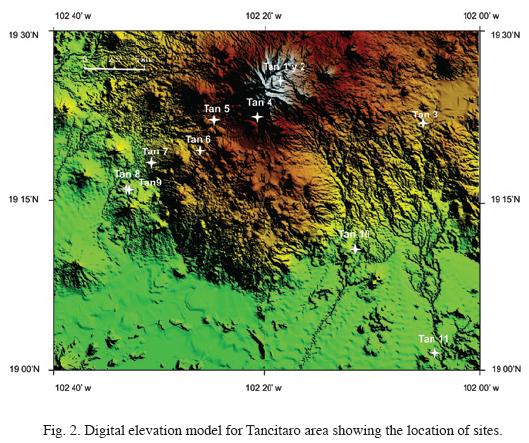
<body><![CDATA[<p align="justify"><font face="verdana" size="2">The Michoacan&#150;Guanajuato volcanic field is located in the west&#150;central part of TMVB (<a href="/img/revistas/geoint/v48n4/a3f1.jpg" target="_blank">Fig. 1</a>), east of Chapala Lake. The geographic boundaries of the MGVF are 18&deg;45' N to 20&deg; 15' N and 100&deg;25' W to 100&deg;45' W, with an area of 40,000 km<sup>2</sup>, It contains over 2,000 small monogenetic volcanoes including cinder cones (90%), maars, tuff rings, lava domes and lava flows with hidden vents all are predominant calc&#150;alkaline but some alkaline and transitional rocks are also found Silica content varies from 47% to 70% for olivine basalt and basalt&#150;andesite rocks (Hasenaka, 1994; Hasenaka <i>et al., </i>1994).</font></p>     <p align="justify"><font face="verdana" size="2">Volc&aacute;n Tanc&iacute;taro (VT) is a large andesitic, composite volcano in the Michoac&aacute;n&#150;Guanajuato Volcanic Field in west&#150;central Mexico. With a height of 3840 m (Ownby <i>et al., </i>2007), VT is the dominant feature in the MGVF. Twenty&#150;six new Ar<sup>40</sup>&#150;Ar<sup>39</sup> ages indicate that Tanc&iacute;taro became active <u>&gt;</u>793+22 ka and that the most recent effusive activity occurred at 237&plusmn; 4 ka. Two catastrophic sector&#150;collapse events are identified and dated; the first one on the west flank between 694 and 571 ka, and the second on the east flank between 261 and 238 ka (Ownby <i>et al., </i>2007).</font></p>     <p align="justify"><font face="verdana" size="2">Our sampling strategy was largely conditioned by Ownby <i>et al. </i>(2007) who gave 26 new Ar&#150;Ar incremental heating ages for Tancitaro and adjacent sorounding areas. We sampled only sites with available radiometric dating information (<a href="/img/revistas/geoint/v48n4/a3t1.jpg" target="_blank">Table 1</a> and <a href="#f2">Fig. 2</a> trough 4), of easy access and yielding fresh, apparently unanltered outcrops. In total, 120 oriented samples belonging to 11 individual lava flows were collected. The samples were distributed throughout each flow both horizontally and vertically. All lava flows sampled were horizontal (dip less than 4&deg;). In general, samples were obtained at the bottom of flows with the hope of collecting samples with the finest grained material. Cores were sampled with a gasoline&#150;powered portable drill, and oriented in most cases with both magnetic and sun compasses.</font></p>     <p align="center"><font face="verdana" size="2"><a name="f2"></a></font></p>     <p align="center"><font face="verdana" size="2"><img src="/img/revistas/geoint/v48n4/a3f2.jpg"></font></p>     <p align="justify"><font face="verdana" size="2">&nbsp;</font></p>     <p align="justify"><font face="verdana" size="2"><b>Summary of magnetic experiments</b></font></p>     <p align="justify"><font face="verdana" size="2">In order to obtain the directions of characteristic remanent magnetization and to identify the principal magnetic carriers, following experiments were carried out: a) Thermal and alternating field demagnetizations, b) measurements of continuous thermomagnetic curves (low field susceptibility versus temperature), and c) hysteresis experiments.</font></p>     <p align="justify"><font face="verdana" size="2">(<a href="/img/revistas/geoint/v48n4/a3f3.jpg" target="_blank">See Fig. 3</a>)</font></p>     <p align="justify"><font face="verdana" size="2"><i>Remanence Properties</i></font></p>     ]]></body>
<body><![CDATA[<p align="justify"><font face="verdana" size="2">The remanent magnetizations of seven to nine samples from each lava flow (<a href="/img/revistas/geoint/v48n4/a3t1.jpg" target="_blank">Table 1</a>) were measured with a JR&#150;6 (<i>AGICO LtD</i>) spinner magnetometer (nominal sensitivity &#126; 10<sup>&#150;9</sup> Am<sup>2</sup>) at the Laboratorio Interinstitucional de Magnetismo Natural (LIMNA) in Morelia (Mexico). Both alternating field (AF) demagnetization (using a <i>molspin </i>AF&#150;demagnetizer) and stepwise thermal demagnetization up to 560 &deg;C (using a <i>ASC TD&#150;48 </i>furnace) were carried out. During thermal demagnetization, the low&#150;field susceptibility at room temperature was measured after each step with a Bartington susceptibility meter.</font></p>     <p align="justify"><font face="verdana" size="2">Two&#150;component magnetizations were systematically recognized for most of studied units (<a href="/img/revistas/geoint/v48n4/a3f4.jpg" target="_blank">Fig. 4</a>). The secondary components are sometimes much stronger than primary ones (samples 08T012A, 08T012B and 08T093A). The characteristic magnetizations components are isolated after applying 40 mT peak alternating field. It should be noted that AF treatments proved to be more efficient than thermal demagnetization. This is illustrated at <a href="/img/revistas/geoint/v48n4/a3f4.jpg" target="_blank">Fig. 4.</a> Samples 08T012B and 08T012A belong to the same core. While thermal treatment is unable to isolate primary remanence, the alternating fields could reveal the primary, characteristic magnetization at last steps of demagnetization procedure. We believe that the origin of this strong secondary overprint is due to the lightning effect. This is in agreement with the fact that the NRM (natural remanent magnetization) directions show huge dispersion on the equal&#150;area projection. We note that no ChRM directions were obtained from sites TAN1, TAN4 and TAN5.</font></p>     <p align="justify"><font face="verdana" size="2">For remaining sites, relatively small, secondary components, probably of viscous origin were detected and were easily removed applying 10 mT (<a href="/img/revistas/geoint/v48n4/a3f4.jpg" target="_blank">Fig. 4</a>, sample 08T107A). The greater part of remanent magnetization, in most cases was removed at temperatures between 520 and 560&deg;C, which indicate to low&#150;Ti titanomagnetites as responsible for magnetization. The median destructive fields (MDF) range mostly from 20 to 40 mT, suggesting pseudo&#150;single domain grains as remanent magnetization carriers (Dunlop and &Ouml;zdemir, 1997).</font></p>     <p align="justify"><font face="verdana" size="2">A characteristic magnetization direction was determined by the least squares method (Kirschvink, 1980), 4 to 10 points being taken in the principal component analysis for this determination. The obtained directions were averaged by unit and the statistical parameters calculated assuming a Fisherian distribution.</font></p>     <p align="justify"><font face="verdana" size="2"><i>Susceptibility vs. Temperature</i></font></p>     <p align="justify"><font face="verdana" size="2">Low&#150;field susceptibility measurements (k&#150;T curves) under air were carried out using <i>Agico&#150;Kapabrdige </i>susceptibility meter equipped with furnace in Saint Maur (France) IPGP laboratory. One sample from each site were heated up to about 630&deg;C at a heating rate 20&deg;C/ min and then cooled at the same rate. Curie temperature was determined by the Pr&eacute;vot <i>et al's </i>(1983) method. Alternatively, low&#150;temperature (from about &#150;185&deg;C to room temperature) susceptibility was recorded using the same apparatus.</font></p>     <p align="justify"><font face="verdana" size="2">Low&#150;T susceptibility experiments (<a href="/img/revistas/geoint/v48n4/a3f5.jpg" target="_blank">Fig. 5</a>) show a rather monotonic increase from about &#150;185&deg;C to room temperature with no indication of Verwey transition. Some titanium&#150;poor titanomagnetite may be responsible for remanent magnetization. As showed by &Ouml;zdemir <i>et al. </i>(1993), the Verwey transition may be largely suppressed for the titanomagnetites with variable titanium content. Alternatively, similar behavior may also belong to non&#150;stoichiometric (partially oxidized) magnetite. Corresponding high&#150;T susceptibility experiments (<a href="/img/revistas/geoint/v48n4/a3f6.jpg" target="_blank">Fig. 6</a>) also indicate the presence of Ti&#150;poor titanomagnetites. However, the cooling and heating curves are not perfectly reversible, probably because of low initial value of magnetic susceptibility. This may also be due to some moderate mineralogical alteration at high temperatures. Both Ti&#150;rich and Ti&#150;poor titanomagnetites seem to co&#150;exist in few lava flows (samples 08T107 and 08T004A). These curve yields apparently two different thermomagnetic phases during heating. The lower Curie point ranges between 300&#150;400&deg;C, while the highest one is about 570&deg;C.</font></p>     <p align="justify"><font face="verdana" size="2"><i>Hysteresis</i></font></p>     <p align="justify"><font face="verdana" size="2">Magnetic hysteresis measurements were performed at room temperature on a specimen from all sampled sites at IPGP (Saint Maur) laboratory apparatus in fields up to 0.8 Tesla. The histeresis parameters were calculated after correction for the paramagnetic contribution. The coercivity of remanence (H<sub>cr</sub>) was determined by applying progressively increasing backfield after saturation. Typical hysteresis plot are reported in <a href="/img/revistas/geoint/v48n4/a3f7.jpg" target="_blank">Fig. 7a</a>. The representative curve is simple, symmetrical and reflects very restricted ranges of the coercivities (Tauxe <i>et al., </i>1996). Judging from the ratios of hysteresis parameters (<a href="/img/revistas/geoint/v48n4/a3f7.jpg" target="_blank">Fig. 7b</a>), it seems that all samples fall in the pseudo&#150;single domain (PSD) grain size region (Day <i>et al.</i>, 1977). This may also indicate a mixture of multidomain (MD) and a significant amount of single domain (SD) grains (Dunlop and &Ouml;zdemir, 1997; Dunlop, 2002).</font></p>     <p align="justify"><font face="verdana" size="2">&nbsp;</font></p>     ]]></body>
<body><![CDATA[<p align="justify"><font face="verdana" size="2"><b>Results and discussion</b></font></p>     <p align="justify"><font face="verdana" size="2">Beside strong lightning effect, the average unit directions are rather precisely determined for 8 independent lava flows out of 11 collected (<a href="/img/revistas/geoint/v48n4/a3t1.jpg" target="_blank">Table 1</a>, <a href="/img/revistas/geoint/v48n4/a3f8.jpg" target="_blank">Fig. 8a</a>). All &alpha;<sub>95</sub> are less than 10&deg;. All flows yielded normal polarity magnetization as may be expected for the Bruhnes age rocks. We consider the paleodirections determined in this study to be of primary origin. Thermomagnetic curves show that the remanence is carried in most cases by Ti&#150;poor titanomagnetite, resulting of oxy&#150;exsolution of original titanomagnetite during the initial flow cooling, which indicates that the primary magnetization is a TRM (thermoremanent magnetization). Moreover, unblocking temperature spectra and relatively high coercivities point to pseudo&#150;single domain magnetic structure grains as responsible for remanent magnetization. The mean paleodirection obtained from eight flows is Inc=39.5&deg;, Dec=356.4&deg;, k=29, &alpha;<sub>95</sub>=9. 1<sup>&deg;</sup> which corresponds to the pole position Plat=84.4&deg;, Plong=219.9&deg;, K=33 and A<sub>95</sub>=8.5&deg;. These directions are practically undistinguishable (<a href="/img/revistas/geoint/v48n4/a3f8.jpg" target="_blank">Fig. 8a</a> and <a href="/img/revistas/geoint/v48n4/a3f8.jpg" target="_blank">b</a>) from both the spin axis and the expected Plio&#150;Quaternary paleodirections, as derived from reference poles for the North American craton (Besse and Courtillot, 2002). This may indicates that no major regional tectonic rotation occurred in the area since about 1 My. The mean inclination overlaps within the uncertainties to those derived from the GAD (Geomagnetic Axial Dipole) and GAD plus a 5% quadrupolar contributions.</font></p>     <p align="justify"><font face="verdana" size="2">The formula <img src="/img/revistas/geoint/v48n4/a3s1.jpg">was used for estimating paleosecular variation in this study where, <i>S<sub>T</sub> </i>is the total angular dispersion <img src="/img/revistas/geoint/v48n4/a3s2.jpg">&#91;<i>Cox, </i>1969&#93;, N the number of sites used in the calculation, <i>&delta;<sub>i</sub> </i>the angular distance of the ith virtual geomagnetic pole (VGP) from the axial dipole, <i>S<sub>W</sub> </i>the within site dispersion (following McEllhinny and McFadden, 1997) and, <i>n </i>the average number of sample per site. All new VGPs obtained on this study yield lesser colatitudes (maximum value is 28.3&deg;) than generally adopted 45&deg; cut&#150;off angle (Johnson <i>et al., </i>2008). We obtained <i>S<sub>F</sub>=16.0 </i>with S<i><sub>U</sub></i>=25.5 and S<i><sub>L</sub></i>=8.1 (upper and lower limits respectively) which reasonably agree to the model G of McFadden <i>et al. </i>(1988, 1991) fit to the McElhinny and McFadden (1997) and Johnson <i>et al. </i>(2008) databases for the last 5 Myr (<a href="/img/revistas/geoint/v48n4/a3f8.jpg" target="_blank">Fig. 8b</a> and <a href="/img/revistas/geoint/v48n4/a3f9.jpg" target="_blank">9</a>).</font></p>     <p align="justify"><font face="verdana" size="2">The combination of our data with previously published results from Central and Western Mexico (Conte, 2004) yields that the amplitude of the secular variation is consistent with values obtained from other worldwide scattered sites. Thus, the hypothesis of the Pacific dipole window (Doell and Cox, 1971) may be rejected. This supports the findings of McElhinny <i>et al. </i>(1996) and Ruiz&#150;Mart&iacute;nez, (2004).Withintheuncertainties,the. Within the uncertainties, the results obtained in this study agree with the PSV values for Hawaii (+20&deg; latitude) and Reunion (&#150;20&deg; latitude). However, the amplitude of dispersion found is much higher in Mexico with respect to other places at the same latitude bands in agreement with findings of Lawrence <i>et al., </i>2006. More high quality studies and reevaluation of old sites are needed in order to estimate whether this is a genuine characteristic of geomagnetic field.</font></p>     <p align="justify"><font face="verdana" size="2">&nbsp;</font></p>     <p align="justify"><font face="verdana" size="2"><b>Acknowledgements</b></font></p>     <p align="justify"><font face="verdana" size="2">This study was supported by UNAM&#150;DGAPA grant n&deg; 102007 CONACYT grant n&deg; 54957. We thank Bernard Henry and Maxim le Goff for help during rock&#150;magnetic measurements in Saint Maur. VCRM is grateful to the financial support given by MEC (Spain) "Jos&eacute; Castillejo Program" ref. JC2007&#150;00314.</font></p>     <p align="justify"><font face="verdana" size="2">&nbsp;</font></p>     <p align="justify"><font face="verdana" size="2"><b>Bibliography</b></font></p>     <!-- ref --><p align="justify"><font face="verdana" size="2">Alva&#150;Valdivia L. M, A. Goguitchaichvili and J. Urrutia&#150;Fucugauchi, 2001. Further Constraints for the Plio&#150;Pleistocene Geomagnetic Field Strength: new results from Los Tuxtlas volcanic field (Mexico). <i>Earth, Planets and Space 53, 9, </i>873&#150;881.</font>&nbsp;&nbsp;&nbsp;&nbsp;&nbsp;&nbsp;&nbsp;&nbsp;[&#160;<a href="javascript:void(0);" onclick="javascript: window.open('/scielo.php?script=sci_nlinks&ref=3907312&pid=S0016-7169200900040000300001&lng=','','width=640,height=500,resizable=yes,scrollbars=1,menubar=yes,');">Links</a>&#160;]<!-- end-ref --><!-- ref --><p align="justify"><font face="verdana" size="2">Besse, J. and V. Courtillot, 2002. Apparent and true polar wander and the geometry of the geomagnetic field over the last 200 Myr. <i>J. Geophys. Res., 107, </i>B11, 1029/2000JB000050.</font>&nbsp;&nbsp;&nbsp;&nbsp;&nbsp;&nbsp;&nbsp;&nbsp;[&#160;<a href="javascript:void(0);" onclick="javascript: window.open('/scielo.php?script=sci_nlinks&ref=3907313&pid=S0016-7169200900040000300002&lng=','','width=640,height=500,resizable=yes,scrollbars=1,menubar=yes,');">Links</a>&#160;]<!-- end-ref --><!-- ref --><p align="justify"><font face="verdana" size="2">Conte, G., 2004. Estudio integrado de rocas volc&aacute;nicas Plio&#150;Cuaternarias de M&eacute;xico y Italia, PhD Thesis, National University of M&eacute;xico, 154pp.</font>&nbsp;&nbsp;&nbsp;&nbsp;&nbsp;&nbsp;&nbsp;&nbsp;[&#160;<a href="javascript:void(0);" onclick="javascript: window.open('/scielo.php?script=sci_nlinks&ref=3907314&pid=S0016-7169200900040000300003&lng=','','width=640,height=500,resizable=yes,scrollbars=1,menubar=yes,');">Links</a>&#160;]<!-- end-ref --><!-- ref --><p align="justify"><font face="verdana" size="2">Cox, A., 1969. Confidence limits for the precision parameter k. <i>Geophys. J. R. astr. Soc. 18, </i>545&#150;549.</font>&nbsp;&nbsp;&nbsp;&nbsp;&nbsp;&nbsp;&nbsp;&nbsp;[&#160;<a href="javascript:void(0);" onclick="javascript: window.open('/scielo.php?script=sci_nlinks&ref=3907315&pid=S0016-7169200900040000300004&lng=','','width=640,height=500,resizable=yes,scrollbars=1,menubar=yes,');">Links</a>&#160;]<!-- end-ref --><!-- ref --><p align="justify"><font face="verdana" size="2">Day, R., M. Fuller and V. A. Schmidt, 1977. Hysteresis properties of titanomagnetites: grain size and compositional dependence. <i>Phys. Earth Planet. Int., 13, </i>260&#150;267.</font>&nbsp;&nbsp;&nbsp;&nbsp;&nbsp;&nbsp;&nbsp;&nbsp;[&#160;<a href="javascript:void(0);" onclick="javascript: window.open('/scielo.php?script=sci_nlinks&ref=3907316&pid=S0016-7169200900040000300005&lng=','','width=640,height=500,resizable=yes,scrollbars=1,menubar=yes,');">Links</a>&#160;]<!-- end-ref --><!-- ref --><p align="justify"><font face="verdana" size="2">Delgado&#150;Granados, H., 1993. Late Cenozoic tectonics offshore western Mexico and its relation to the structure and volcanic activity in the western Trans&#150;Mexican volcanic belt. <i>Geof&iacute;sica Internacional 32, </i>543&#150;559.</font>&nbsp;&nbsp;&nbsp;&nbsp;&nbsp;&nbsp;&nbsp;&nbsp;[&#160;<a href="javascript:void(0);" onclick="javascript: window.open('/scielo.php?script=sci_nlinks&ref=3907317&pid=S0016-7169200900040000300006&lng=','','width=640,height=500,resizable=yes,scrollbars=1,menubar=yes,');">Links</a>&#160;]<!-- end-ref --><!-- ref --><p align="justify"><font face="verdana" size="2">Doell, R. and A. Cox, 1971. Pacific geomagnetic secular variation. <i>Science, 71, </i>248&#150;254.</font>&nbsp;&nbsp;&nbsp;&nbsp;&nbsp;&nbsp;&nbsp;&nbsp;[&#160;<a href="javascript:void(0);" onclick="javascript: window.open('/scielo.php?script=sci_nlinks&ref=3907318&pid=S0016-7169200900040000300007&lng=','','width=640,height=500,resizable=yes,scrollbars=1,menubar=yes,');">Links</a>&#160;]<!-- end-ref --><!-- ref --><p align="justify"><font face="verdana" size="2">Dunlop, D. and &Ouml;. &Ouml;zdemir, 1997. Rock magnetism: fundamentals and frontiers, Cambridge University Press, 573 pp.</font>&nbsp;&nbsp;&nbsp;&nbsp;&nbsp;&nbsp;&nbsp;&nbsp;[&#160;<a href="javascript:void(0);" onclick="javascript: window.open('/scielo.php?script=sci_nlinks&ref=3907319&pid=S0016-7169200900040000300008&lng=','','width=640,height=500,resizable=yes,scrollbars=1,menubar=yes,');">Links</a>&#160;]<!-- end-ref --><!-- ref --><p align="justify"><font face="verdana" size="2">Dunlop, D., 2002. Theory and application of the Day plot (M<sub>rs</sub>/M<sub>s</sub> versus H<sub>cr</sub>/H<sub>c</sub>) 1. Theoretical curves and tests using titanomagnetite data. <i>J. Geophys. Res., 107, </i>10.1029/2001JB000486.</font>&nbsp;&nbsp;&nbsp;&nbsp;&nbsp;&nbsp;&nbsp;&nbsp;[&#160;<a href="javascript:void(0);" onclick="javascript: window.open('/scielo.php?script=sci_nlinks&ref=3907320&pid=S0016-7169200900040000300009&lng=','','width=640,height=500,resizable=yes,scrollbars=1,menubar=yes,');">Links</a>&#160;]<!-- end-ref --><!-- ref --><p align="justify"><font face="verdana" size="2">Johnson, C. L., C. G. Constable, L. Tauxe, R. W. Barendregt, L. L. Brown, R. S. Coe, P. Layer, V. Mejia, N. D. Opdyke, B. S. Singer, H. Staudigel, and D. Stone,2008. Recent investigations of the 0&#150;5 ma geomagnetic field recorded in lava flows. Geochemistry, Geophysics, Geosystems, 9:Q04032, doi:10.1029/2007GC001696.</font>&nbsp;&nbsp;&nbsp;&nbsp;&nbsp;&nbsp;&nbsp;&nbsp;[&#160;<a href="javascript:void(0);" onclick="javascript: window.open('/scielo.php?script=sci_nlinks&ref=3907321&pid=S0016-7169200900040000300010&lng=','','width=640,height=500,resizable=yes,scrollbars=1,menubar=yes,');">Links</a>&#160;]<!-- end-ref --><!-- ref --><p align="justify"><font face="verdana" size="2">Hasenaka, T., 1994. Size, distribution, and magma output rate for shield volcanoes of the Michoac&aacute;n&#150;Guanajuato volcanic field, Central Mexico. <i>Journal of Volcanology and Geothermal Research, 63, </i>13&#150;31.</font>&nbsp;&nbsp;&nbsp;&nbsp;&nbsp;&nbsp;&nbsp;&nbsp;[&#160;<a href="javascript:void(0);" onclick="javascript: window.open('/scielo.php?script=sci_nlinks&ref=3907322&pid=S0016-7169200900040000300011&lng=','','width=640,height=500,resizable=yes,scrollbars=1,menubar=yes,');">Links</a>&#160;]<!-- end-ref --><!-- ref --><p align="justify"><font face="verdana" size="2">Hasenaka, T., M. Ban and H. Delgado&#150;Granados, 1994. Contrasting volcanism in the Michoac&aacute;n&#150;Guanajuato Volcanic Field, central Mexico: Shield volcanoes vs. cinder cones. <i>Geof&iacute;sica Internacional, 33, 1, </i>125&#150;138.</font>&nbsp;&nbsp;&nbsp;&nbsp;&nbsp;&nbsp;&nbsp;&nbsp;[&#160;<a href="javascript:void(0);" onclick="javascript: window.open('/scielo.php?script=sci_nlinks&ref=3907323&pid=S0016-7169200900040000300012&lng=','','width=640,height=500,resizable=yes,scrollbars=1,menubar=yes,');">Links</a>&#160;]<!-- end-ref --><!-- ref --><p align="justify"><font face="verdana" size="2">Herrero&#150;Bervera E., J. Urrutia&#150;Fucugauchi, A. Martin del Pozzo, H. Bohnel and J. Guerrero, 1986. Normal amplitude Brunhes paleosecular variation at low&#150;latitudes: A paleomagnetic record from the Trans&#150;Mexican Volcani Belt. Geophysical Research Letters, 13, 1442&#150;1445.</font>&nbsp;&nbsp;&nbsp;&nbsp;&nbsp;&nbsp;&nbsp;&nbsp;[&#160;<a href="javascript:void(0);" onclick="javascript: window.open('/scielo.php?script=sci_nlinks&ref=3907324&pid=S0016-7169200900040000300013&lng=','','width=640,height=500,resizable=yes,scrollbars=1,menubar=yes,');">Links</a>&#160;]<!-- end-ref --><!-- ref --><p align="justify"><font face="verdana" size="2">Kirschvink, J. L. 1980. The least&#150;square line and plane and analysis of palaeomagnetic data. <i>Geophys. J. R. Astron. Soc., 62, </i>699&#150;718.</font>&nbsp;&nbsp;&nbsp;&nbsp;&nbsp;&nbsp;&nbsp;&nbsp;[&#160;<a href="javascript:void(0);" onclick="javascript: window.open('/scielo.php?script=sci_nlinks&ref=3907325&pid=S0016-7169200900040000300014&lng=','','width=640,height=500,resizable=yes,scrollbars=1,menubar=yes,');">Links</a>&#160;]<!-- end-ref --><!-- ref --><p align="justify"><font face="verdana" size="2">Klitgord, K. D. and J. Mammerickx, (1982). Northern East Pacific Rise&#150;Magnetic anomaly and bathymetric framework. <i>J. Geophys. Res., 87, </i>6725&#150;6783.</font>&nbsp;&nbsp;&nbsp;&nbsp;&nbsp;&nbsp;&nbsp;&nbsp;[&#160;<a href="javascript:void(0);" onclick="javascript: window.open('/scielo.php?script=sci_nlinks&ref=3907326&pid=S0016-7169200900040000300015&lng=','','width=640,height=500,resizable=yes,scrollbars=1,menubar=yes,');">Links</a>&#160;]<!-- end-ref --><!-- ref --><p align="justify"><font face="verdana" size="2">Lawrence, K. P., C. G. Constable, C. L. Johnson, 2006. Paleosecular variation and the average geomagnetic field at &plusmn;20&deg; latitude. Geochem. Geophys. Geosyst., doi:10.1029/2004GC000871.</font>&nbsp;&nbsp;&nbsp;&nbsp;&nbsp;&nbsp;&nbsp;&nbsp;[&#160;<a href="javascript:void(0);" onclick="javascript: window.open('/scielo.php?script=sci_nlinks&ref=3907327&pid=S0016-7169200900040000300016&lng=','','width=640,height=500,resizable=yes,scrollbars=1,menubar=yes,');">Links</a>&#160;]<!-- end-ref --><!-- ref --><p align="justify"><font face="verdana" size="2">Lawrence, K. P., L. Tauxe, H. Staudigel, C. G. Constable, A. Koppers, W. McIntosh and C. L. Johnson, 2009. Paleomagnetic field properties near the southern hemisphere tangent cylinder. <i>Geochem. Geophys. Geosys., 10, </i>Q01005, doi: 10.1029/2008GC002072.</font>&nbsp;&nbsp;&nbsp;&nbsp;&nbsp;&nbsp;&nbsp;&nbsp;[&#160;<a href="javascript:void(0);" onclick="javascript: window.open('/scielo.php?script=sci_nlinks&ref=3907328&pid=S0016-7169200900040000300017&lng=','','width=640,height=500,resizable=yes,scrollbars=1,menubar=yes,');">Links</a>&#160;]<!-- end-ref --><!-- ref --><p align="justify"><font face="verdana" size="2">McEllhinny, M. W., P. L. McFadden and R. Merrill, 1996, The myth of the Pacific dipole window. <i>Earth Planet Sci. Lett., 143,13&#150;22.</i></font>&nbsp;&nbsp;&nbsp;&nbsp;&nbsp;&nbsp;&nbsp;&nbsp;[&#160;<a href="javascript:void(0);" onclick="javascript: window.open('/scielo.php?script=sci_nlinks&ref=3907329&pid=S0016-7169200900040000300018&lng=','','width=640,height=500,resizable=yes,scrollbars=1,menubar=yes,');">Links</a>&#160;]<!-- end-ref --><!-- ref --><p align="justify"><font face="verdana" size="2">McElhinny, M. W. and P. L. McFadden, 1997. Palaeosecular variation over the past 5 Myr based on a new generalized database. <i>Geophys. J. Int., 131, </i>240&#150;252.</font>&nbsp;&nbsp;&nbsp;&nbsp;&nbsp;&nbsp;&nbsp;&nbsp;[&#160;<a href="javascript:void(0);" onclick="javascript: window.open('/scielo.php?script=sci_nlinks&ref=3907330&pid=S0016-7169200900040000300019&lng=','','width=640,height=500,resizable=yes,scrollbars=1,menubar=yes,');">Links</a>&#160;]<!-- end-ref --><!-- ref --><p align="justify"><font face="verdana" size="2">McFadden, P., T. Merrill and W. McElhinny, 1988, Dipole/Quadrupole Family Modeling of Paleosecular Variation.   <i>Journal  of Geophysical  Research,   93, </i>11,583&#150;11,588.</font>&nbsp;&nbsp;&nbsp;&nbsp;&nbsp;&nbsp;&nbsp;&nbsp;[&#160;<a href="javascript:void(0);" onclick="javascript: window.open('/scielo.php?script=sci_nlinks&ref=3907331&pid=S0016-7169200900040000300020&lng=','','width=640,height=500,resizable=yes,scrollbars=1,menubar=yes,');">Links</a>&#160;]<!-- end-ref --><!-- ref --><p align="justify"><font face="verdana" size="2">McFadden, P. L., R. Merrill, M. W. McEllhinny and S. Lee, 1991. Reversals of the Earth's magnetic field and temporal variations of the dynamo families. <i>J. </i><i>Geophys. Res., 96, </i>3923&#150;3933.</font>&nbsp;&nbsp;&nbsp;&nbsp;&nbsp;&nbsp;&nbsp;&nbsp;[&#160;<a href="javascript:void(0);" onclick="javascript: window.open('/scielo.php?script=sci_nlinks&ref=3907332&pid=S0016-7169200900040000300021&lng=','','width=640,height=500,resizable=yes,scrollbars=1,menubar=yes,');">Links</a>&#160;]<!-- end-ref --><!-- ref --><p align="justify"><font face="verdana" size="2">Mejia, V., H. Bohnel, M. A. Ortega&#150;Rivera, J. Lee and J. Aranda&#150;Gomez, 2005. Paleosecular variation and time&#150;averaged field recorded in Late Pliocene&#150;Holocene lava flows from Mexico. <i>Geochem. Geophys. Geosyst., 6, </i>doi : 10.1029/2004GC000871.</font>&nbsp;&nbsp;&nbsp;&nbsp;&nbsp;&nbsp;&nbsp;&nbsp;[&#160;<a href="javascript:void(0);" onclick="javascript: window.open('/scielo.php?script=sci_nlinks&ref=3907333&pid=S0016-7169200900040000300022&lng=','','width=640,height=500,resizable=yes,scrollbars=1,menubar=yes,');">Links</a>&#160;]<!-- end-ref --><!-- ref --><p align="justify"><font face="verdana" size="2">Morales, J., A. Goguitchaichvili and J. Urrutia&#150;Fucugauchi, 2001. A rock&#150;magnetic and paleointensity study of some Mexican volcanic lava flows during the Latest Pleistocene to the Holocene. <i>Earth Planets Space, 53, </i>839&#150;902.</font>&nbsp;&nbsp;&nbsp;&nbsp;&nbsp;&nbsp;&nbsp;&nbsp;[&#160;<a href="javascript:void(0);" onclick="javascript: window.open('/scielo.php?script=sci_nlinks&ref=3907334&pid=S0016-7169200900040000300023&lng=','','width=640,height=500,resizable=yes,scrollbars=1,menubar=yes,');">Links</a>&#160;]<!-- end-ref --><!-- ref --><p align="justify"><font face="verdana" size="2">Osete, M. L., V. C. Ruiz&#150;Martinez, C. Caballero, C. Galindo, J. Urrutia&#150;Fucugauchi and D. Tarling, 2000, Southward migration of continental volcanic activity in the Sierra de Las Cruces, Mexico: Palaeomagnetic and radiometric evidence. <i>Tectonophysics, 318, </i>201&#150;215.</font>&nbsp;&nbsp;&nbsp;&nbsp;&nbsp;&nbsp;&nbsp;&nbsp;[&#160;<a href="javascript:void(0);" onclick="javascript: window.open('/scielo.php?script=sci_nlinks&ref=3907335&pid=S0016-7169200900040000300024&lng=','','width=640,height=500,resizable=yes,scrollbars=1,menubar=yes,');">Links</a>&#160;]<!-- end-ref --><!-- ref --><p align="justify"><font face="verdana" size="2">Ozdemir, O., D. Dunlop and B. M. Moskowitz, 1993. The effect of oxidation on the Verwey transition in magnetite. <i>Geophys. Res. Lett., 20, </i>1671&#150;1674.</font>&nbsp;&nbsp;&nbsp;&nbsp;&nbsp;&nbsp;&nbsp;&nbsp;[&#160;<a href="javascript:void(0);" onclick="javascript: window.open('/scielo.php?script=sci_nlinks&ref=3907336&pid=S0016-7169200900040000300025&lng=','','width=640,height=500,resizable=yes,scrollbars=1,menubar=yes,');">Links</a>&#160;]<!-- end-ref --><!-- ref --><p align="justify"><font face="verdana" size="2">Ownby, S. E., H. Delgado&#150;Granados, R. A. Lange and C. M. Hall, 2007. Volcan Tancitaro, Michoacan, Mexico, 40ar/39ar constraints on its history of sector collapse. J. <i>Volcanology and Geothermal Res., 161, </i>1&#150;14.</font>&nbsp;&nbsp;&nbsp;&nbsp;&nbsp;&nbsp;&nbsp;&nbsp;[&#160;<a href="javascript:void(0);" onclick="javascript: window.open('/scielo.php?script=sci_nlinks&ref=3907337&pid=S0016-7169200900040000300026&lng=','','width=640,height=500,resizable=yes,scrollbars=1,menubar=yes,');">Links</a>&#160;]<!-- end-ref --><!-- ref --><p align="justify"><font face="verdana" size="2">Petronille, M., A. Goguitchaichvili, B. Henry, L. Alva&#150;Valdivia, J. Rosas&#150;Elguera, M. Rodr&iacute;guez Ceja and M. Calvo&#150;Rathert, 2005. Paleomagnetism of Ar&#150;Ar dated lava flows from the Ceboruco&#150;San Pedro volcanic field (western Mexico): Evidence for the Matuyama&#150;Brunhes transition precursor and a fully reversed geomagnetic event in the Brunhes chron. <i>J. of Geophys. Res., 110, </i>b08101, doi:10.1029/2004jb003321.</font>&nbsp;&nbsp;&nbsp;&nbsp;&nbsp;&nbsp;&nbsp;&nbsp;[&#160;<a href="javascript:void(0);" onclick="javascript: window.open('/scielo.php?script=sci_nlinks&ref=3907338&pid=S0016-7169200900040000300027&lng=','','width=640,height=500,resizable=yes,scrollbars=1,menubar=yes,');">Links</a>&#160;]<!-- end-ref --><!-- ref --><p align="justify"><font face="verdana" size="2">Pr&eacute;vot, M., E. A. Mankinen, S. Gromm&eacute; and A. Lecaille, 1983. High paleointensities of the geomagnetic field from thermomagnetic study on rift valley pillow basalts from the mid&#150;Atlantic ridge. <i>J. Geophys. Res., </i>88,2316&#150;2326.</font>&nbsp;&nbsp;&nbsp;&nbsp;&nbsp;&nbsp;&nbsp;&nbsp;[&#160;<a href="javascript:void(0);" onclick="javascript: window.open('/scielo.php?script=sci_nlinks&ref=3907339&pid=S0016-7169200900040000300028&lng=','','width=640,height=500,resizable=yes,scrollbars=1,menubar=yes,');">Links</a>&#160;]<!-- end-ref --><!-- ref --><p align="justify"><font face="verdana" size="2">Rodriguez&#150;Ceja, M., A. Goguitchaichvili, M. Calvo&#150;Rathert, J. Morales&#150;Contreras, L. Alva&#150;Valdivia, J. R. Elguera, J. U. Fucugauchi and H. D. Granados, (2006). Paleomagnetism of Tequila Volcanic Field: Western Mexico. <i>Earth Planets Space, 58,10, </i>1349&#150;1358.</font>&nbsp;&nbsp;&nbsp;&nbsp;&nbsp;&nbsp;&nbsp;&nbsp;[&#160;<a href="javascript:void(0);" onclick="javascript: window.open('/scielo.php?script=sci_nlinks&ref=3907340&pid=S0016-7169200900040000300029&lng=','','width=640,height=500,resizable=yes,scrollbars=1,menubar=yes,');">Links</a>&#160;]<!-- end-ref --><!-- ref --><p align="justify"><font face="verdana" size="2">Ruiz&#150;Martinez, V. C., M. L. Osete, R. Vegas, J. I. Nunez&#150; Aguilar, J. Urrutia&#150;Fucugauchi and D. H. Tarling, 2000. Palaeomagnetism of Late Miocene to Quaternary volcanics from the eastern segment of the Trans&#150;Mexican Volcanic Belt. <i>Tectonophysics, 318, </i>217&#150;233.</font>&nbsp;&nbsp;&nbsp;&nbsp;&nbsp;&nbsp;&nbsp;&nbsp;[&#160;<a href="javascript:void(0);" onclick="javascript: window.open('/scielo.php?script=sci_nlinks&ref=3907341&pid=S0016-7169200900040000300030&lng=','','width=640,height=500,resizable=yes,scrollbars=1,menubar=yes,');">Links</a>&#160;]<!-- end-ref --><!-- ref --><p align="justify"><font face="verdana" size="2">Ruiz&#150;Mart&iacute;nez, V. C., 2004. Estudio paleomagn&eacute;tico del cintur&oacute;n volc&aacute;nico transmexicano: implicaciones tect&oacute;nicas, PhD thesis, Universidad Complutense de Madrid, ISBN 84&#150;669&#150;1761&#150;6, 288 pp., Madrid.</font>&nbsp;&nbsp;&nbsp;&nbsp;&nbsp;&nbsp;&nbsp;&nbsp;[&#160;<a href="javascript:void(0);" onclick="javascript: window.open('/scielo.php?script=sci_nlinks&ref=3907342&pid=S0016-7169200900040000300031&lng=','','width=640,height=500,resizable=yes,scrollbars=1,menubar=yes,');">Links</a>&#160;]<!-- end-ref --><!-- ref --><p align="justify"><font face="verdana" size="2">Tauxe, L., T. A. T. Mullender and T. Pick, 1996. Pot&#150;bellies, wasp&#150;waists and superparamagnetism in magnetic hysteresis. <i>J. Geophys. Res., 95, </i>12337&#150;12350.</font>&nbsp;&nbsp;&nbsp;&nbsp;&nbsp;&nbsp;&nbsp;&nbsp;[&#160;<a href="javascript:void(0);" onclick="javascript: window.open('/scielo.php?script=sci_nlinks&ref=3907343&pid=S0016-7169200900040000300032&lng=','','width=640,height=500,resizable=yes,scrollbars=1,menubar=yes,');">Links</a>&#160;]<!-- end-ref --><!-- ref --><p align="justify"><font face="verdana" size="2">Tauxe, L., C. Luskin, P. Selkin, P. Gans and A. Calvert, 2004. Paleomagnetic results from the Snake River Plain: Contribution to the time&#150;averaged field global database. <i>Geochem. Geophys. Geosyst., 5, </i>Q08H13, doi:10.1029/2003GC000661.</font>&nbsp;&nbsp;&nbsp;&nbsp;&nbsp;&nbsp;&nbsp;&nbsp;[&#160;<a href="javascript:void(0);" onclick="javascript: window.open('/scielo.php?script=sci_nlinks&ref=3907344&pid=S0016-7169200900040000300033&lng=','','width=640,height=500,resizable=yes,scrollbars=1,menubar=yes,');">Links</a>&#160;]<!-- end-ref --> ]]></body><back>
<ref-list>
<ref id="B1">
<nlm-citation citation-type="journal">
<person-group person-group-type="author">
<name>
<surname><![CDATA[Alva-Valdivia]]></surname>
<given-names><![CDATA[L. M]]></given-names>
</name>
<name>
<surname><![CDATA[Goguitchaichvili]]></surname>
<given-names><![CDATA[A.]]></given-names>
</name>
<name>
<surname><![CDATA[Urrutia-Fucugauchi]]></surname>
<given-names><![CDATA[J.]]></given-names>
</name>
</person-group>
<article-title xml:lang="en"><![CDATA[Further Constraints for the Plio-Pleistocene Geomagnetic Field Strength: new results from Los Tuxtlas volcanic field (Mexico)]]></article-title>
<source><![CDATA[Earth, Planets and Space]]></source>
<year>2001</year>
<volume>53</volume>
<numero>9</numero>
<issue>9</issue>
<page-range>873-881</page-range></nlm-citation>
</ref>
<ref id="B2">
<nlm-citation citation-type="journal">
<person-group person-group-type="author">
<name>
<surname><![CDATA[Besse]]></surname>
<given-names><![CDATA[J.]]></given-names>
</name>
<name>
<surname><![CDATA[Courtillot]]></surname>
<given-names><![CDATA[V.]]></given-names>
</name>
</person-group>
<article-title xml:lang="en"><![CDATA[Apparent and true polar wander and the geometry of the geomagnetic field over the last 200 Myr]]></article-title>
<source><![CDATA[J. Geophys. Res.]]></source>
<year>2002</year>
<volume>107</volume>
<numero>B11</numero>
<issue>B11</issue>
</nlm-citation>
</ref>
<ref id="B3">
<nlm-citation citation-type="">
<person-group person-group-type="author">
<name>
<surname><![CDATA[Conte]]></surname>
<given-names><![CDATA[G.]]></given-names>
</name>
</person-group>
<source><![CDATA[Estudio integrado de rocas volcánicas Plio-Cuaternarias de México y Italia]]></source>
<year>2004</year>
<page-range>154</page-range></nlm-citation>
</ref>
<ref id="B4">
<nlm-citation citation-type="journal">
<person-group person-group-type="author">
<name>
<surname><![CDATA[Cox]]></surname>
<given-names><![CDATA[A.]]></given-names>
</name>
</person-group>
<article-title xml:lang="en"><![CDATA[Confidence limits for the precision parameter k]]></article-title>
<source><![CDATA[Geophys. J. R. astr. Soc.]]></source>
<year>1969</year>
<volume>18</volume>
<page-range>545-549</page-range></nlm-citation>
</ref>
<ref id="B5">
<nlm-citation citation-type="journal">
<person-group person-group-type="author">
<name>
<surname><![CDATA[Day]]></surname>
<given-names><![CDATA[R.]]></given-names>
</name>
<name>
<surname><![CDATA[Fuller]]></surname>
<given-names><![CDATA[M.]]></given-names>
</name>
<name>
<surname><![CDATA[Schmidt]]></surname>
<given-names><![CDATA[V. A.]]></given-names>
</name>
</person-group>
<article-title xml:lang="en"><![CDATA[Hysteresis properties of titanomagnetites: grain size and compositional dependence]]></article-title>
<source><![CDATA[Phys. Earth Planet. Int.]]></source>
<year>1977</year>
<volume>13</volume>
<page-range>260-267</page-range></nlm-citation>
</ref>
<ref id="B6">
<nlm-citation citation-type="journal">
<person-group person-group-type="author">
<name>
<surname><![CDATA[Delgado-Granados]]></surname>
<given-names><![CDATA[H.]]></given-names>
</name>
</person-group>
<article-title xml:lang="en"><![CDATA[Late Cenozoic tectonics offshore western Mexico and its relation to the structure and volcanic activity in the western Trans-Mexican volcanic belt]]></article-title>
<source><![CDATA[Geofísica Internacional]]></source>
<year>1993</year>
<volume>32</volume>
<page-range>543-559</page-range></nlm-citation>
</ref>
<ref id="B7">
<nlm-citation citation-type="journal">
<person-group person-group-type="author">
<name>
<surname><![CDATA[Doell]]></surname>
<given-names><![CDATA[R.]]></given-names>
</name>
<name>
<surname><![CDATA[Cox]]></surname>
<given-names><![CDATA[A.]]></given-names>
</name>
</person-group>
<article-title xml:lang="en"><![CDATA[Pacific geomagnetic secular variation]]></article-title>
<source><![CDATA[Science]]></source>
<year>1971</year>
<volume>71</volume>
<page-range>248-254</page-range></nlm-citation>
</ref>
<ref id="B8">
<nlm-citation citation-type="book">
<person-group person-group-type="author">
<name>
<surname><![CDATA[Dunlop]]></surname>
<given-names><![CDATA[D.]]></given-names>
</name>
<name>
<surname><![CDATA[Özdemir]]></surname>
<given-names><![CDATA[Ö.]]></given-names>
</name>
</person-group>
<source><![CDATA[Rock magnetism: fundamentals and frontiers]]></source>
<year>1997</year>
<page-range>573</page-range><publisher-name><![CDATA[Cambridge University Press]]></publisher-name>
</nlm-citation>
</ref>
<ref id="B9">
<nlm-citation citation-type="journal">
<person-group person-group-type="author">
<name>
<surname><![CDATA[Dunlop]]></surname>
<given-names><![CDATA[D.]]></given-names>
</name>
</person-group>
<article-title xml:lang="en"><![CDATA[Theory and application of the Day plot (Mrs/Ms versus Hcr/Hc) 1: Theoretical curves and tests using titanomagnetite data]]></article-title>
<source><![CDATA[J. Geophys. Res.]]></source>
<year>2002</year>
<volume>107</volume>
</nlm-citation>
</ref>
<ref id="B10">
<nlm-citation citation-type="journal">
<person-group person-group-type="author">
<name>
<surname><![CDATA[Johnson]]></surname>
<given-names><![CDATA[C. L.]]></given-names>
</name>
<name>
<surname><![CDATA[Constable]]></surname>
<given-names><![CDATA[C. G.]]></given-names>
</name>
<name>
<surname><![CDATA[Tauxe]]></surname>
<given-names><![CDATA[L.]]></given-names>
</name>
<name>
<surname><![CDATA[Barendregt]]></surname>
<given-names><![CDATA[R. W.]]></given-names>
</name>
<name>
<surname><![CDATA[Brown]]></surname>
<given-names><![CDATA[L. L.]]></given-names>
</name>
<name>
<surname><![CDATA[Coe]]></surname>
<given-names><![CDATA[R. S.]]></given-names>
</name>
<name>
<surname><![CDATA[Layer]]></surname>
<given-names><![CDATA[P.]]></given-names>
</name>
<name>
<surname><![CDATA[Mejia]]></surname>
<given-names><![CDATA[V.]]></given-names>
</name>
<name>
<surname><![CDATA[Opdyke]]></surname>
<given-names><![CDATA[N. D.]]></given-names>
</name>
<name>
<surname><![CDATA[Singer]]></surname>
<given-names><![CDATA[B. S.]]></given-names>
</name>
<name>
<surname><![CDATA[Staudigel]]></surname>
<given-names><![CDATA[H.]]></given-names>
</name>
<name>
<surname><![CDATA[Stone]]></surname>
<given-names><![CDATA[D.]]></given-names>
</name>
</person-group>
<article-title xml:lang="en"><![CDATA[Recent investigations of the 0-5 ma geomagnetic field recorded in lava flows]]></article-title>
<source><![CDATA[Geochemistry, Geophysics, Geosystems]]></source>
<year>2008</year>
</nlm-citation>
</ref>
<ref id="B11">
<nlm-citation citation-type="journal">
<person-group person-group-type="author">
<name>
<surname><![CDATA[Hasenaka]]></surname>
<given-names><![CDATA[T.]]></given-names>
</name>
</person-group>
<article-title xml:lang="en"><![CDATA[Size, distribution, and magma output rate for shield volcanoes of the Michoacán-Guanajuato volcanic field, Central Mexico]]></article-title>
<source><![CDATA[Journal of Volcanology and Geothermal Research]]></source>
<year>1994</year>
<volume>63</volume>
<page-range>13-31</page-range></nlm-citation>
</ref>
<ref id="B12">
<nlm-citation citation-type="journal">
<person-group person-group-type="author">
<name>
<surname><![CDATA[Hasenaka]]></surname>
<given-names><![CDATA[T.]]></given-names>
</name>
<name>
<surname><![CDATA[Ban]]></surname>
<given-names><![CDATA[M.]]></given-names>
</name>
<name>
<surname><![CDATA[Delgado-Granados]]></surname>
<given-names><![CDATA[H.]]></given-names>
</name>
</person-group>
<article-title xml:lang="en"><![CDATA[Contrasting volcanism in the Michoacán-Guanajuato Volcanic Field, central Mexico: Shield volcanoes vs. cinder cones]]></article-title>
<source><![CDATA[Geofísica Internacional]]></source>
<year>1994</year>
<volume>33</volume>
<numero>1</numero>
<issue>1</issue>
<page-range>125-138</page-range></nlm-citation>
</ref>
<ref id="B13">
<nlm-citation citation-type="journal">
<person-group person-group-type="author">
<name>
<surname><![CDATA[Herrero-Bervera]]></surname>
<given-names><![CDATA[E.]]></given-names>
</name>
<name>
<surname><![CDATA[Urrutia-Fucugauchi]]></surname>
<given-names><![CDATA[J.]]></given-names>
</name>
<name>
<surname><![CDATA[Martin del Pozzo]]></surname>
<given-names><![CDATA[A.]]></given-names>
</name>
<name>
<surname><![CDATA[Bohnel]]></surname>
<given-names><![CDATA[H.]]></given-names>
</name>
<name>
<surname><![CDATA[Guerrero]]></surname>
<given-names><![CDATA[J.]]></given-names>
</name>
</person-group>
<article-title xml:lang="en"><![CDATA[Normal amplitude Brunhes paleosecular variation at low-latitudes: A paleomagnetic record from the Trans-Mexican Volcani Belt]]></article-title>
<source><![CDATA[Geophysical Research Letters]]></source>
<year>1986</year>
<volume>13</volume>
<page-range>1442-1445</page-range></nlm-citation>
</ref>
<ref id="B14">
<nlm-citation citation-type="journal">
<person-group person-group-type="author">
<name>
<surname><![CDATA[Kirschvink]]></surname>
<given-names><![CDATA[J. L.]]></given-names>
</name>
</person-group>
<article-title xml:lang="en"><![CDATA[The least-square line and plane and analysis of palaeomagnetic data]]></article-title>
<source><![CDATA[Geophys. J. R. Astron. Soc.]]></source>
<year>1980</year>
<volume>62</volume>
<page-range>699-718</page-range></nlm-citation>
</ref>
<ref id="B15">
<nlm-citation citation-type="journal">
<person-group person-group-type="author">
<name>
<surname><![CDATA[Klitgord]]></surname>
<given-names><![CDATA[K. D.]]></given-names>
</name>
<name>
<surname><![CDATA[Mammerickx]]></surname>
<given-names><![CDATA[J.]]></given-names>
</name>
</person-group>
<article-title xml:lang="en"><![CDATA[Northern East Pacific Rise-Magnetic anomaly and bathymetric framework]]></article-title>
<source><![CDATA[J. Geophys. Res.]]></source>
<year>1982</year>
<volume>87</volume>
<page-range>6725-6783</page-range></nlm-citation>
</ref>
<ref id="B16">
<nlm-citation citation-type="journal">
<person-group person-group-type="author">
<name>
<surname><![CDATA[Lawrence]]></surname>
<given-names><![CDATA[K. P.]]></given-names>
</name>
<name>
<surname><![CDATA[Constable]]></surname>
<given-names><![CDATA[C. G.]]></given-names>
</name>
<name>
<surname><![CDATA[Johnson]]></surname>
<given-names><![CDATA[C. L.]]></given-names>
</name>
</person-group>
<article-title xml:lang="en"><![CDATA[Paleosecular variation and the average geomagnetic field at ±20° latitude]]></article-title>
<source><![CDATA[Geochem. Geophys. Geosyst.]]></source>
<year>2006</year>
</nlm-citation>
</ref>
<ref id="B17">
<nlm-citation citation-type="journal">
<person-group person-group-type="author">
<name>
<surname><![CDATA[Lawrence]]></surname>
<given-names><![CDATA[K. P.]]></given-names>
</name>
<name>
<surname><![CDATA[Tauxe]]></surname>
<given-names><![CDATA[L.]]></given-names>
</name>
<name>
<surname><![CDATA[Staudigel]]></surname>
<given-names><![CDATA[H.]]></given-names>
</name>
<name>
<surname><![CDATA[Constable]]></surname>
<given-names><![CDATA[C. G.]]></given-names>
</name>
<name>
<surname><![CDATA[Koppers]]></surname>
<given-names><![CDATA[A.]]></given-names>
</name>
<name>
<surname><![CDATA[McIntosh]]></surname>
<given-names><![CDATA[W.]]></given-names>
</name>
<name>
<surname><![CDATA[Johnson]]></surname>
<given-names><![CDATA[C. L.]]></given-names>
</name>
</person-group>
<article-title xml:lang="en"><![CDATA[Paleomagnetic field properties near the southern hemisphere tangent cylinder]]></article-title>
<source><![CDATA[Geochem. Geophys. Geosys.]]></source>
<year>2009</year>
<volume>10</volume>
</nlm-citation>
</ref>
<ref id="B18">
<nlm-citation citation-type="journal">
<person-group person-group-type="author">
<name>
<surname><![CDATA[McEllhinny]]></surname>
<given-names><![CDATA[M. W.]]></given-names>
</name>
<name>
<surname><![CDATA[McFadden]]></surname>
<given-names><![CDATA[P. L.]]></given-names>
</name>
<name>
<surname><![CDATA[Merrill]]></surname>
<given-names><![CDATA[R.]]></given-names>
</name>
</person-group>
<article-title xml:lang="en"><![CDATA[The myth of the Pacific dipole window]]></article-title>
<source><![CDATA[Earth Planet Sci. Lett.]]></source>
<year>1996</year>
<volume>143</volume>
<page-range>13-22</page-range></nlm-citation>
</ref>
<ref id="B19">
<nlm-citation citation-type="journal">
<person-group person-group-type="author">
<name>
<surname><![CDATA[McElhinny]]></surname>
<given-names><![CDATA[M. W.]]></given-names>
</name>
<name>
<surname><![CDATA[McFadden]]></surname>
<given-names><![CDATA[P. L.]]></given-names>
</name>
</person-group>
<article-title xml:lang="en"><![CDATA[Palaeosecular variation over the past 5 Myr based on a new generalized database]]></article-title>
<source><![CDATA[Geophys. J. Int.]]></source>
<year>1997</year>
<volume>131</volume>
<page-range>240-252</page-range></nlm-citation>
</ref>
<ref id="B20">
<nlm-citation citation-type="journal">
<person-group person-group-type="author">
<name>
<surname><![CDATA[McFadden]]></surname>
<given-names><![CDATA[P.]]></given-names>
</name>
<name>
<surname><![CDATA[Merrill]]></surname>
<given-names><![CDATA[T.]]></given-names>
</name>
<name>
<surname><![CDATA[McElhinny]]></surname>
<given-names><![CDATA[W.]]></given-names>
</name>
</person-group>
<article-title xml:lang="en"><![CDATA[Dipole/Quadrupole Family Modeling of Paleosecular Variation]]></article-title>
<source><![CDATA[Journal of Geophysical Research]]></source>
<year>1988</year>
<volume>93</volume>
<numero>11</numero>
<issue>11</issue>
<page-range>583-11,588</page-range></nlm-citation>
</ref>
<ref id="B21">
<nlm-citation citation-type="journal">
<person-group person-group-type="author">
<name>
<surname><![CDATA[McFadden]]></surname>
<given-names><![CDATA[P. L.]]></given-names>
</name>
<name>
<surname><![CDATA[Merrill]]></surname>
<given-names><![CDATA[R.]]></given-names>
</name>
<name>
<surname><![CDATA[McEllhinny]]></surname>
<given-names><![CDATA[M. W.]]></given-names>
</name>
<name>
<surname><![CDATA[Lee]]></surname>
<given-names><![CDATA[S.]]></given-names>
</name>
</person-group>
<article-title xml:lang="en"><![CDATA[Reversals of the Earth's magnetic field and temporal variations of the dynamo families]]></article-title>
<source><![CDATA[J. Geophys. Res.]]></source>
<year>1991</year>
<volume>96</volume>
<page-range>3923-3933</page-range></nlm-citation>
</ref>
<ref id="B22">
<nlm-citation citation-type="journal">
<person-group person-group-type="author">
<name>
<surname><![CDATA[Mejia]]></surname>
<given-names><![CDATA[V.]]></given-names>
</name>
<name>
<surname><![CDATA[Bohnel]]></surname>
<given-names><![CDATA[H.]]></given-names>
</name>
<name>
<surname><![CDATA[Ortega-Rivera]]></surname>
<given-names><![CDATA[M. A.]]></given-names>
</name>
<name>
<surname><![CDATA[Lee]]></surname>
<given-names><![CDATA[J.]]></given-names>
</name>
<name>
<surname><![CDATA[Aranda-Gomez]]></surname>
<given-names><![CDATA[J.]]></given-names>
</name>
</person-group>
<article-title xml:lang="en"><![CDATA[Paleosecular variation and time-averaged field recorded in Late Pliocene-Holocene lava flows from Mexico]]></article-title>
<source><![CDATA[Geochem. Geophys. Geosyst.]]></source>
<year>2005</year>
<volume>6</volume>
</nlm-citation>
</ref>
<ref id="B23">
<nlm-citation citation-type="journal">
<person-group person-group-type="author">
<name>
<surname><![CDATA[Morales]]></surname>
<given-names><![CDATA[J.]]></given-names>
</name>
<name>
<surname><![CDATA[Goguitchaichvili]]></surname>
<given-names><![CDATA[A.]]></given-names>
</name>
<name>
<surname><![CDATA[Urrutia-Fucugauchi]]></surname>
<given-names><![CDATA[J.]]></given-names>
</name>
</person-group>
<article-title xml:lang="en"><![CDATA[A rock-magnetic and paleointensity study of some Mexican volcanic lava flows during the Latest Pleistocene to the Holocene]]></article-title>
<source><![CDATA[Earth Planets Space]]></source>
<year>2001</year>
<volume>53</volume>
<page-range>839-902</page-range></nlm-citation>
</ref>
<ref id="B24">
<nlm-citation citation-type="journal">
<person-group person-group-type="author">
<name>
<surname><![CDATA[Osete]]></surname>
<given-names><![CDATA[M. L.]]></given-names>
</name>
<name>
<surname><![CDATA[Ruiz-Martinez]]></surname>
<given-names><![CDATA[V. C.]]></given-names>
</name>
<name>
<surname><![CDATA[Caballero]]></surname>
<given-names><![CDATA[C.]]></given-names>
</name>
<name>
<surname><![CDATA[Galindo]]></surname>
<given-names><![CDATA[C.]]></given-names>
</name>
<name>
<surname><![CDATA[Urrutia-Fucugauchi]]></surname>
<given-names><![CDATA[J.]]></given-names>
</name>
<name>
<surname><![CDATA[Tarling]]></surname>
<given-names><![CDATA[D.]]></given-names>
</name>
</person-group>
<article-title xml:lang="en"><![CDATA[Southward migration of continental volcanic activity in the Sierra de Las Cruces, Mexico: Palaeomagnetic and radiometric evidence]]></article-title>
<source><![CDATA[Tectonophysics]]></source>
<year>2000</year>
<volume>318</volume>
<page-range>201-215</page-range></nlm-citation>
</ref>
<ref id="B25">
<nlm-citation citation-type="journal">
<person-group person-group-type="author">
<name>
<surname><![CDATA[Ozdemir]]></surname>
<given-names><![CDATA[O.]]></given-names>
</name>
<name>
<surname><![CDATA[Dunlop]]></surname>
<given-names><![CDATA[D.]]></given-names>
</name>
<name>
<surname><![CDATA[Moskowitz]]></surname>
<given-names><![CDATA[B. M.]]></given-names>
</name>
</person-group>
<article-title xml:lang="en"><![CDATA[The effect of oxidation on the Verwey transition in magnetite]]></article-title>
<source><![CDATA[Geophys. Res. Lett.]]></source>
<year>1993</year>
<volume>20</volume>
<page-range>1671-1674</page-range></nlm-citation>
</ref>
<ref id="B26">
<nlm-citation citation-type="journal">
<person-group person-group-type="author">
<name>
<surname><![CDATA[Ownby]]></surname>
<given-names><![CDATA[S. E.]]></given-names>
</name>
<name>
<surname><![CDATA[Delgado-Granados]]></surname>
<given-names><![CDATA[H.]]></given-names>
</name>
<name>
<surname><![CDATA[Lange]]></surname>
<given-names><![CDATA[R. A.]]></given-names>
</name>
<name>
<surname><![CDATA[Hall]]></surname>
<given-names><![CDATA[C. M.]]></given-names>
</name>
</person-group>
<article-title xml:lang="en"><![CDATA[Volcan Tancitaro, Michoacan, Mexico, 40ar/39ar constraints on its history of sector collapse]]></article-title>
<source><![CDATA[J. Volcanology and Geothermal Res.]]></source>
<year>2007</year>
<volume>161</volume>
<page-range>1-14</page-range></nlm-citation>
</ref>
<ref id="B27">
<nlm-citation citation-type="journal">
<person-group person-group-type="author">
<name>
<surname><![CDATA[Petronille]]></surname>
<given-names><![CDATA[M.]]></given-names>
</name>
<name>
<surname><![CDATA[Goguitchaichvili]]></surname>
<given-names><![CDATA[A.]]></given-names>
</name>
<name>
<surname><![CDATA[Henry]]></surname>
<given-names><![CDATA[B.]]></given-names>
</name>
<name>
<surname><![CDATA[Alva-Valdivia]]></surname>
<given-names><![CDATA[L.]]></given-names>
</name>
<name>
<surname><![CDATA[Rosas-Elguera]]></surname>
<given-names><![CDATA[J.]]></given-names>
</name>
<name>
<surname><![CDATA[Rodríguez Ceja]]></surname>
<given-names><![CDATA[M.]]></given-names>
</name>
<name>
<surname><![CDATA[Calvo-Rathert]]></surname>
<given-names><![CDATA[M.]]></given-names>
</name>
</person-group>
<article-title xml:lang="en"><![CDATA[Paleomagnetism of Ar-Ar dated lava flows from the Ceboruco-San Pedro volcanic field (western Mexico): Evidence for the Matuyama-Brunhes transition precursor and a fully reversed geomagnetic event in the Brunhes chron]]></article-title>
<source><![CDATA[J. of Geophys. Res.]]></source>
<year>2005</year>
<volume>110</volume>
</nlm-citation>
</ref>
<ref id="B28">
<nlm-citation citation-type="journal">
<person-group person-group-type="author">
<name>
<surname><![CDATA[Prévot]]></surname>
<given-names><![CDATA[M.]]></given-names>
</name>
<name>
<surname><![CDATA[Mankinen]]></surname>
<given-names><![CDATA[E. A.]]></given-names>
</name>
<name>
<surname><![CDATA[Grommé]]></surname>
<given-names><![CDATA[S.]]></given-names>
</name>
<name>
<surname><![CDATA[Lecaille]]></surname>
<given-names><![CDATA[A.]]></given-names>
</name>
</person-group>
<article-title xml:lang="en"><![CDATA[High paleointensities of the geomagnetic field from thermomagnetic study on rift valley pillow basalts from the mid-Atlantic ridge]]></article-title>
<source><![CDATA[J. Geophys. Res.]]></source>
<year>1983</year>
<volume>88</volume>
<page-range>2316-2326</page-range></nlm-citation>
</ref>
<ref id="B29">
<nlm-citation citation-type="journal">
<person-group person-group-type="author">
<name>
<surname><![CDATA[Rodriguez-Ceja]]></surname>
<given-names><![CDATA[M.]]></given-names>
</name>
<name>
<surname><![CDATA[Goguitchaichvili]]></surname>
<given-names><![CDATA[A.]]></given-names>
</name>
<name>
<surname><![CDATA[Calvo-Rathert]]></surname>
<given-names><![CDATA[M.]]></given-names>
</name>
<name>
<surname><![CDATA[Morales-Contreras]]></surname>
<given-names><![CDATA[J.]]></given-names>
</name>
<name>
<surname><![CDATA[Alva-Valdivia]]></surname>
<given-names><![CDATA[L.]]></given-names>
</name>
<name>
<surname><![CDATA[Elguera]]></surname>
<given-names><![CDATA[J. R.]]></given-names>
</name>
<name>
<surname><![CDATA[Fucugauchi]]></surname>
<given-names><![CDATA[J. U.]]></given-names>
</name>
<name>
<surname><![CDATA[Granados]]></surname>
<given-names><![CDATA[H. D.]]></given-names>
</name>
</person-group>
<article-title xml:lang="en"><![CDATA[Paleomagnetism of Tequila Volcanic Field: Western Mexico]]></article-title>
<source><![CDATA[Earth Planets Space]]></source>
<year>2006</year>
<volume>58</volume>
<numero>10</numero>
<issue>10</issue>
<page-range>1349-1358</page-range></nlm-citation>
</ref>
<ref id="B30">
<nlm-citation citation-type="journal">
<person-group person-group-type="author">
<name>
<surname><![CDATA[Ruiz-Martinez]]></surname>
<given-names><![CDATA[V. C.]]></given-names>
</name>
<name>
<surname><![CDATA[Osete]]></surname>
<given-names><![CDATA[M. L.]]></given-names>
</name>
<name>
<surname><![CDATA[Vegas]]></surname>
<given-names><![CDATA[R.]]></given-names>
</name>
<name>
<surname><![CDATA[Nunez- Aguilar]]></surname>
<given-names><![CDATA[J. I.]]></given-names>
</name>
<name>
<surname><![CDATA[Urrutia-Fucugauchi]]></surname>
<given-names><![CDATA[J.]]></given-names>
</name>
<name>
<surname><![CDATA[Tarling]]></surname>
<given-names><![CDATA[D. H.]]></given-names>
</name>
</person-group>
<article-title xml:lang="en"><![CDATA[Palaeomagnetism of Late Miocene to Quaternary volcanics from the eastern segment of the Trans-Mexican Volcanic Belt]]></article-title>
<source><![CDATA[Tectonophysics]]></source>
<year>2000</year>
<volume>318</volume>
<page-range>217-233</page-range></nlm-citation>
</ref>
<ref id="B31">
<nlm-citation citation-type="">
<person-group person-group-type="author">
<name>
<surname><![CDATA[Ruiz-Martínez]]></surname>
<given-names><![CDATA[V. C.]]></given-names>
</name>
</person-group>
<source><![CDATA[Estudio paleomagnético del cinturón volcánico transmexicano: implicaciones tectónicas]]></source>
<year>2004</year>
<page-range>288</page-range><publisher-loc><![CDATA[Madrid ]]></publisher-loc>
</nlm-citation>
</ref>
<ref id="B32">
<nlm-citation citation-type="journal">
<person-group person-group-type="author">
<name>
<surname><![CDATA[Tauxe]]></surname>
<given-names><![CDATA[L.]]></given-names>
</name>
<name>
<surname><![CDATA[Mullender]]></surname>
<given-names><![CDATA[T. A. T.]]></given-names>
</name>
<name>
<surname><![CDATA[Pick]]></surname>
<given-names><![CDATA[T.]]></given-names>
</name>
</person-group>
<article-title xml:lang="en"><![CDATA[Pot-bellies, wasp-waists and superparamagnetism in magnetic hysteresis]]></article-title>
<source><![CDATA[J. Geophys. Res.]]></source>
<year>1996</year>
<volume>95</volume>
<page-range>12337-12350</page-range></nlm-citation>
</ref>
<ref id="B33">
<nlm-citation citation-type="journal">
<person-group person-group-type="author">
<name>
<surname><![CDATA[Tauxe]]></surname>
<given-names><![CDATA[L.]]></given-names>
</name>
<name>
<surname><![CDATA[Luskin]]></surname>
<given-names><![CDATA[C.]]></given-names>
</name>
<name>
<surname><![CDATA[Selkin]]></surname>
<given-names><![CDATA[P.]]></given-names>
</name>
<name>
<surname><![CDATA[Gans]]></surname>
<given-names><![CDATA[P.]]></given-names>
</name>
<name>
<surname><![CDATA[Calvert]]></surname>
<given-names><![CDATA[A.]]></given-names>
</name>
</person-group>
<article-title xml:lang="en"><![CDATA[Paleomagnetic results from the Snake River Plain: Contribution to the time-averaged field global database]]></article-title>
<source><![CDATA[Geochem. Geophys. Geosyst.]]></source>
<year>2004</year>
<volume>5</volume>
</nlm-citation>
</ref>
</ref-list>
</back>
</article>
