<?xml version="1.0" encoding="ISO-8859-1"?><article xmlns:mml="http://www.w3.org/1998/Math/MathML" xmlns:xlink="http://www.w3.org/1999/xlink" xmlns:xsi="http://www.w3.org/2001/XMLSchema-instance">
<front>
<journal-meta>
<journal-id>0016-7169</journal-id>
<journal-title><![CDATA[Geofísica internacional]]></journal-title>
<abbrev-journal-title><![CDATA[Geofís. Intl]]></abbrev-journal-title>
<issn>0016-7169</issn>
<publisher>
<publisher-name><![CDATA[Universidad Nacional Autónoma de México, Instituto de Geofísica]]></publisher-name>
</publisher>
</journal-meta>
<article-meta>
<article-id>S0016-71692009000400001</article-id>
<title-group>
<article-title xml:lang="en"><![CDATA[Possible dependence between the total solar irradiance and dimethylsulphide]]></article-title>
</title-group>
<contrib-group>
<contrib contrib-type="author">
<name>
<surname><![CDATA[Mendoza]]></surname>
<given-names><![CDATA[B.]]></given-names>
</name>
<xref ref-type="aff" rid="A01"/>
</contrib>
<contrib contrib-type="author">
<name>
<surname><![CDATA[Flores-Márquez]]></surname>
<given-names><![CDATA[E. L.]]></given-names>
</name>
<xref ref-type="aff" rid="A01"/>
</contrib>
<contrib contrib-type="author">
<name>
<surname><![CDATA[Ramírez-Rojas]]></surname>
<given-names><![CDATA[A.]]></given-names>
</name>
<xref ref-type="aff" rid="A02"/>
</contrib>
<contrib contrib-type="author">
<name>
<surname><![CDATA[Martínez-Arroyo]]></surname>
<given-names><![CDATA[A.]]></given-names>
</name>
<xref ref-type="aff" rid="A03"/>
</contrib>
</contrib-group>
<aff id="A01">
<institution><![CDATA[,Universidad Nacional Autónoma de México Instituto de Geofísica ]]></institution>
<addr-line><![CDATA[Mexico City ]]></addr-line>
<country>Mexico</country>
</aff>
<aff id="A02">
<institution><![CDATA[,Universidad Autónoma Metropolitana Azcapotzalco Área de Física de Procesos Irreversibles ]]></institution>
<addr-line><![CDATA[Mexico City ]]></addr-line>
<country>Mexico</country>
</aff>
<aff id="A03">
<institution><![CDATA[,Universidad Nacional Autónoma de México Centro de Ciencias de la Atmósfera ]]></institution>
<addr-line><![CDATA[Mexico City ]]></addr-line>
<country>Mexico</country>
</aff>
<pub-date pub-type="pub">
<day>00</day>
<month>12</month>
<year>2009</year>
</pub-date>
<pub-date pub-type="epub">
<day>00</day>
<month>12</month>
<year>2009</year>
</pub-date>
<volume>48</volume>
<numero>4</numero>
<fpage>351</fpage>
<lpage>360</lpage>
<copyright-statement/>
<copyright-year/>
<self-uri xlink:href="http://www.scielo.org.mx/scielo.php?script=sci_arttext&amp;pid=S0016-71692009000400001&amp;lng=en&amp;nrm=iso"></self-uri><self-uri xlink:href="http://www.scielo.org.mx/scielo.php?script=sci_abstract&amp;pid=S0016-71692009000400001&amp;lng=en&amp;nrm=iso"></self-uri><self-uri xlink:href="http://www.scielo.org.mx/scielo.php?script=sci_pdf&amp;pid=S0016-71692009000400001&amp;lng=en&amp;nrm=iso"></self-uri><abstract abstract-type="short" xml:lang="es"><p><![CDATA[La variabilidad solar es una de las principales influencias naturales del clima terrestre, y que afecta profundamente a los procesos biológicos. Se ha propuesto que algunos de estos procesos biológicos alteran el albedo y por tanto tienen un impacto en el clima. En este trabajo investigamos la relación entre la irradiancia total solar (ITS) y la concentración de Dime til sulfuro (DMS), que es producido por algas marinas. El DMS se ha mencionado frecuentemente como un forzamiento climático a través de su efecto en las nubes y por tanto en el albedo. En el presente trabajo encontramos que las series temporales de la IST y el DMS muestran una correlación. Para ello utilizamos un esquema probabilístico, la Función de Información Mutua (FIM), que es una medida de la dependencia entre los parámetros de interés. La FIM presenta una dependencia con el ciclo solar: valores mayores aparecen durante épocas de baja actividad solar (épocas de menor IST), mientras que los valores menores se presentan durante tiempos de alta actividad solar (mayor IST). En otras palabras, la dependencia entre IST y DMS es más fuerte durante épocas de actividad solar menor que durante actividad solar mayor.]]></p></abstract>
<abstract abstract-type="short" xml:lang="en"><p><![CDATA[Solar variability is one of the main natural influences on the Earth's climate. Biological processes are profoundly affected by the solar irradiance. Some of these processes have been proposed to change the cloud albedo and therefore impact the climate. Here we investigate the relation between the total solar irradiance (TSI) and the global concentration of Dimethylsulphide (DMS), produced by plancktonic algae in seawater. DMS has been frequently mentioned as a forcing of climate through its effect on clouds and therefore on albedo. In the present work we attempt to find the relation between TSI and DMS. We found that the TSI and the DMS production data series display a correlation. A probabilistic scheme is introduced, the Mutual Information Function (MIF) which is a measure of the dependence between the parameters of interest. The MIF seems to present solar cycle dependence: larger values during lower solar activity times (lower TSI times) than during higher solar activity epochs (higher TSI epochs). Or in other words, the dependence between TSI and DMS is stronger during lower solar activity times than during higher solar activity epochs.]]></p></abstract>
<kwd-group>
<kwd lng="es"><![CDATA[Función de información mutua]]></kwd>
<kwd lng="es"><![CDATA[dimetilsulfuro]]></kwd>
<kwd lng="es"><![CDATA[irradiancia solar total]]></kwd>
<kwd lng="es"><![CDATA[actividad solar]]></kwd>
<kwd lng="es"><![CDATA[relaciones Sol-Tierra]]></kwd>
<kwd lng="en"><![CDATA[Mutual information function]]></kwd>
<kwd lng="en"><![CDATA[dimethylsulphide]]></kwd>
<kwd lng="en"><![CDATA[total solar irradiance]]></kwd>
<kwd lng="en"><![CDATA[solar activity]]></kwd>
<kwd lng="en"><![CDATA[Sun-Earth relations]]></kwd>
</kwd-group>
</article-meta>
</front><body><![CDATA[ <p align="justify"><font face="verdana" size="4">Articles</font></p>     <p align="justify">&nbsp;</p>     <p align="center"><font face="verdana" size="4"><b>Possible dependence between the total solar irradiance and dimethylsulphide</b></font></p>     <p align="center"><font face="verdana" size="2">&nbsp;</font></p>     <p align="center"><font face="verdana" size="2"><b>B. Mendoza<sup>1</sup>*, E. L. Flores&#150;M&aacute;rquez<sup>1</sup>, A. Ram&iacute;rez&#150;Rojas<sup>2</sup> and A. Mart&iacute;nez&#150;Arroyo<sup>3</sup></b></font></p>     <p align="justify"><font face="verdana" size="2">&nbsp;</font></p>     <p align="justify"><font face="verdana" size="2"><i><sup>1</sup>&nbsp;Instituto de Geof&iacute;sica, Universidad Nacional Aut&oacute;noma </i><i>de M&eacute;xico, Ciudad Universitaria, Del. Coyoac&aacute;n </i><i>04510, Mexico City, Mexico. <i>*Corresponding author: <a href="mailto:blanca@geofisica.unam.mx">blanca@geofisica.unam.mx</a>.</i></i></font></p>     <p align="justify"><font face="verdana" size="2"><i><sup>2</sup>&nbsp;&Aacute;rea de F&iacute;sica de Procesos Irreversibles, Universidad </i><i>Aut&oacute;noma Metropolitana Azcapotzalco, Avenida San </i><i>Pablo 180 Col. Reynosa, Azcapotzalco 02200, Mexico </i><i>City, Mexico.</i></font></p>     <p align="justify"><font face="verdana" size="2"><i><sup>3</sup>&nbsp;Centro de Ciencias de la Atm&oacute;sfera, Universidad </i><i>Nacional Aut&oacute;noma de M&eacute;xico, Ciudad Universitaria, </i><i>Del. Coyoac&aacute;n 04510, Mexico City, Mexico. </i></font></p>     <p align="justify"><font face="verdana" size="2">&nbsp;</font></p>     ]]></body>
<body><![CDATA[<p align="justify"><font face="verdana" size="2">Received: June 18, 2008    <br>   Accepted: May 12, 2009</font></p>     <p align="justify"><font face="verdana" size="2">&nbsp;</font></p>     <p align="justify"><font face="verdana" size="2"><b>Resumen</b></font></p>     <p align="justify"><font face="verdana" size="2">La variabilidad solar es una de las principales influencias naturales del clima terrestre, y que afecta profundamente a los procesos biol&oacute;gicos. Se ha propuesto que algunos de estos procesos biol&oacute;gicos alteran el albedo y por tanto tienen un impacto en el clima. En este trabajo investigamos la relaci&oacute;n entre la irradiancia total solar (ITS) y la concentraci&oacute;n de Dime til sulfuro (DMS), que es producido por algas marinas. El DMS se ha mencionado frecuentemente como un forzamiento clim&aacute;tico a trav&eacute;s de su efecto en las nubes y por tanto en el albedo. En el presente trabajo encontramos que las series temporales de la IST y el DMS muestran una correlaci&oacute;n. Para ello utilizamos un esquema probabil&iacute;stico, la Funci&oacute;n de Informaci&oacute;n Mutua (FIM), que es una medida de la dependencia entre los par&aacute;metros de inter&eacute;s. La FIM presenta una dependencia con el ciclo solar: valores mayores aparecen durante &eacute;pocas de baja actividad solar (&eacute;pocas de menor IST), mientras que los valores menores se presentan durante tiempos de alta actividad solar (mayor IST). En otras palabras, la dependencia entre IST y DMS es m&aacute;s fuerte durante &eacute;pocas de actividad solar menor que durante actividad solar mayor.</font></p>     <p align="justify"><font face="verdana" size="2"><b>Palabras clave:</b> Funci&oacute;n de informaci&oacute;n mutua, dimetilsulfuro, irradiancia solar total, actividad solar, relaciones Sol&#150;Tierra.</font></p>     <p align="justify"><font face="verdana" size="2">&nbsp;</font></p>     <p align="justify"><font face="verdana" size="2"><b>Abstract</b></font></p>     <p align="justify"><font face="verdana" size="2">Solar variability is one of the main natural influences on the Earth's climate. Biological processes are profoundly affected by the solar irradiance. Some of these processes have been proposed to change the cloud albedo and therefore impact the climate. Here we investigate the relation between the total solar irradiance (TSI) and the global concentration of Dimethylsulphide (DMS), produced by plancktonic algae in seawater. DMS has been frequently mentioned as a forcing of climate through its effect on clouds and therefore on albedo. In the present work we attempt to find the relation between TSI and DMS. We found that the TSI and the DMS production data series display a correlation. A probabilistic scheme is introduced, the Mutual Information Function (MIF) which is a measure of the dependence between the parameters of interest. The MIF seems to present solar cycle dependence: larger values during lower solar activity times (lower TSI times) than during higher solar activity epochs (higher TSI epochs). Or in other words, the dependence between TSI and DMS is stronger during lower solar activity times than during higher solar activity epochs.</font></p>     <p align="justify"><font face="verdana" size="2"><b>Key words:</b> Mutual information function, dimethylsulphide, total solar irradiance, solar activity, Sun&#150;Earth relations.</font></p>     ]]></body>
<body><![CDATA[<p align="justify"><font face="verdana" size="2">&nbsp;</font></p>     <p align="justify"><font face="verdana" size="2"><b>Introduction</b></font></p>     <p align="justify"><font face="verdana" size="2">The solar radiation is the fundamental source of energy that drives the Earth's climate and sustains life. Several attempts have been made to estimate the impact of the Total Solar Irradiance (TSI) on climate (Lean <i>et al., </i>1995; Cubasch and Voss, 2000; Shindell <i>et al., </i>2006; Lockwood and Fr&ouml;hlich, 2007). However, in the last few decades, the changes measured in TSI are considered too small to explain the observed climate changes (Stott <i>et al., </i>2003). Therefore, other mechanisms linking Sun and climate have been proposed: the ultraviolet (UV) radiation changes that could alter the tropospheric Hadley circulation affecting the equator&#150;to&#150;pole energy transport (Haigh, 1999; Shindell <i>et al., </i>1999), the solar wind modulation of the global electric circuit (Tinsley, 2000) or the galactic cosmic rays that affect the electrofreezing processes (Tinsley and Deen, 1991) or the Earth's radiation budget (Pudovkin and Veretenko, 1995; Marsh and Svensmark, 2000; Pall&eacute;&#150;Bag&oacute; and Butler, 2000; Usoskin <i>et al., </i>2004; Svensmark, 2007).</font></p>     <p align="justify"><font face="verdana" size="2">Clouds have a major impact on the heat and radiation budget of the atmosphere as they modify the Earth's albedo. However to form a cloud, water vapour requires a condensation nucleus on which to condensate. It has been proposed that Dimethylsulphide (DMS) produced by planktonic algae in seawater (Charlson <i>et al., </i>1987) could change the Earth's radiation budget, by producing cloud condensation nuclei (CCN).</font></p>     <p align="justify"><font face="verdana" size="2">According to several authors the major source of CCN over the oceans is Dimethylsulphide (DMS) (e.g. Andreae and Crutzen, 1997): dimethylsulfoniopropionate in phytoplankton cells is released into the water column where it is transformed into DMS. DMS diffuses through the sea surface to the atmosphere where it is oxidized to form SO<sub>2</sub>; this compound can be oxidized to H<sub>2</sub>SO<sub>4</sub> that forms sulphate particles which act as CCN.</font></p>     <p align="justify"><font face="verdana" size="2">The DMS concentration is controlled by the phytoplankton biomass and by a web of ecological and biogeochemical processes driven by the geophysical context (Sim&oacute;, 2001). Solar radiation is a primary forcing of the geophysical context, and responsible for the growth of the phytoplankton communities.</font></p>     <p align="justify"><font face="verdana" size="2">The DMS, solar radiation and cloud albedo are hypothesized to have a feedback interaction (Charlson <i>et al., </i>1987; Shaw <i>et al., </i>1998; Gunson <i>et al., </i>2006). This feedback can be either negative or positive, a negative feedback process requires a correlation between solar irradiance and DMS: increases in solar irradiance reaching the sea surface increase DMS augmenting the CCN and the albedo, an overall increased albedo produces a decrease of the irradiance reaching the sea surface and a cooling. A positive feedback requires an anti&#150;correlation between solar irradiance and DMS: increases in solar irradiance produce a decrease of DMS, of CCN and albedo, a net reduced albedo allows more radiation to be absorbed producing a heating. Then a basic step of this feedback process is the type of relation between TSI and DMS.</font></p>     <p align="justify"><font face="verdana" size="2">At seasonal time scales, a first attempt to find a relations between a global database of DMS concentration and several geophysical parameters such as wind speed and sea surface temperature (SST) was carried out by Kettle <i>et al. </i>(1999) along 1972&#150;1997. The authors sought linear correlations unsuccessfully. More recent quantitative studies (Sim&oacute; and Dachs, 2002; Sim&oacute; and Vallina, 2007; Vallina <i>et al., </i>2007) concluded that at seasonal time scales, the DMS/TSI relation favours a climate negative feedback. Another study (Larsen, 2005) based on a conceptual model, proposed a positive feedback.</font></p>     <p align="justify"><font face="verdana" size="2">Moreover, several studies performed along few days and using samples from very localized regions, show that the seasonal and regional production of DMS is significantly influenced by UV radiation (Toole <i>et al., </i>2006). Some of them report increases of DMS with exposure to UV (Sunda <i>et al., </i>2002; Slezak and Herndl, 2003; Toole and Siegel, 2004). In contrast other studies found a decrease of DMS with increased UV (Hefu and Kirst, 1997; Sakka <i>et al., </i>1997; Kniventon <i>et al., </i>2003).</font></p>     <p align="justify"><font face="verdana" size="2">In this context a basic question is then to find the type of relationship between TSI and DMS.</font></p>     ]]></body>
<body><![CDATA[<p align="justify"><font face="verdana" size="2">The quantitative aspects of the previous studies relating DMS and TSI mentioned above, focused on finding linear regression coefficients between the involved time series. However, given the complexity of the systems, linear correlations between DMS and TSI are not necessarily expected. Under these circumstances a standard statistical treatment of the data is not very appropriate.</font></p>     <p align="justify"><font face="verdana" size="2">In the present work we attempt to find the relation between TSI and DMS taking an alternative approach that consists in obtaining a measure of the global dependence between two parameters of interest (Dionisio <i>et al., </i>2004). The mutual information function (MIF) (Matsuda, 1999) is particularly suitable for this purpose.</font></p>     <p align="justify"><font face="verdana" size="2">Also, the quantification of the relation between DMS and TSI could be the bases of another mechanism linking solar activity and climate.</font></p>     <p align="justify"><font face="verdana" size="2">The paper is organized as follows: in section 2 a description of the time series is given. Section 3 presents the statistical analysis, including a spectral analysis. Section 4 explains the MIF method. Section 5 describes the MIF calculation, in Section 6 we discuss the results and finally in section 7 we present our conclusions.</font></p>     <p align="justify"><font face="verdana" size="2">&nbsp;</font></p>     <p align="justify"><font face="verdana" size="2"><b>TSI and DMS data series</b></font></p>     <p align="justify"><font face="verdana" size="2">The TSI data time series were obtained from the National Geophysical Data Center (NGDC; <a href="http://www.ngdc.noaa.gov/" target="_blank">http://www.ngdc.noaa.gov/</a>). This data base has been compiled from many satellites since 1978 (<a href="http://www.ngdc.noaa.gov/stp/SOLAR/ftpsolarirradiance.html" target="_blank">http://www.ngdc.noaa.gov/stp/SOLAR/ftpsolarirradiance.html</a>). In particular we used the data provided by the Active Cavity Radiometer Irradiance Monitor (ACRIM) on board of the Solar Maximum Mission satellite; the data set is displayed as the daily&#150;recorded variability of the TSI, starting from 1980 to 1997 (<a href="/img/revistas/geoint/v48n4/a1f1.jpg" target="_blank">Fig. 1a</a>)<sup><a href="#notas">1</a></sup>. The DMS data set was obtained from the site <a href="http://www.dss.ucar.edu/datasets/" target="_blank">http://www.dss.ucar.edu/datasets</a>. The original data series in this web site contains the DMS measurements collected in the global oceans during 1972&#150;1998 and are given as raw data samples (<a href="/img/revistas/geoint/v48n4/a1f1.jpg" target="_blank">Fig. 1b</a>). The sequence of data presents important data gaps in space and time, more details are given in Kettle <i>et al. </i>(1999).</font></p>     <p align="justify"><font face="verdana" size="2">&nbsp;</font></p>     <p align="justify"><font face="verdana" size="2"><b>TSI and DMS statistical analysis</b></font></p>     <p align="justify"><font face="verdana" size="2">For the DMS series, we use the average daily data. As there are data gaps we performed a previous treatment to the DMS original data series (see <a href="/img/revistas/geoint/v48n4/a1f2.jpg" target="_blank">Figs. 2a and b</a>) by applying a moving average criterion to short periods with data gaps. However, for longer periods with data gaps this procedure is not applicable, this is the case for the DMS series where we detected seven gaps (see <a href="/img/revistas/geoint/v48n4/a1f6.jpg" target="_blank">Fig.6</a>): <sup>(1) </sup>11/7/80 &#150; 5/4/81; <sup>(2)</sup> 10/31/81 &#150; 5/8/82;<sup> (3)</sup> 7/31/82 &#150; 1/4/83; <sup>(4)</sup> 5/22/83 &#150; 11/6/83; <sup>(5)</sup> 9/13/86 &#150; 3/23/87; <sup>(6)</sup> 12/13/92 &#150;1/20/94; <sup>(7)</sup> 11/6/96 &#150; 12/3/97. As we are mainly limited by the DMS data, we worked with the period containing the most numerous DMS observations: 1980&#150;1997 (see <a href="/img/revistas/geoint/v48n4/a1f1.jpg" target="_blank">Fig. 1b</a>).</font></p>     ]]></body>
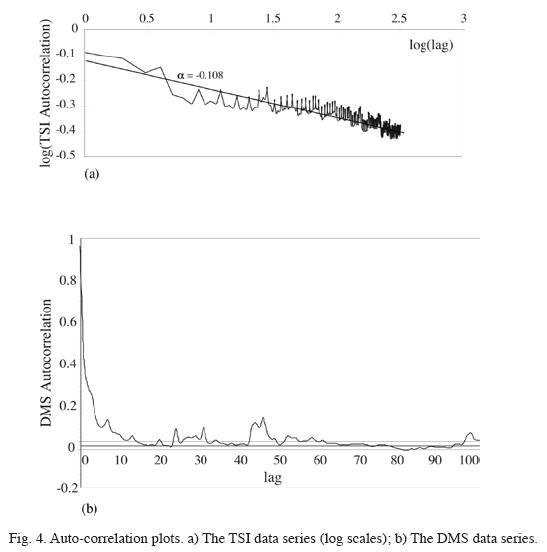
<body><![CDATA[<p align="justify"><font face="verdana" size="2">In order to verify the confidence of the selected period, from 1980 to 1997, a spectral analysis was performed on the TSI (<a href="/img/revistas/geoint/v48n4/a1f3.jpg" target="_blank">Fig. 3</a>). This ensures that no relevant information of the TSI series was lost when taking a shorter time span. Five important peaks appear with periodicities of: 9.6, 5.9, 3.9, 2.5, and 1.06 years respectively. These periodicities reproduce the most conspicuous ones observed in the solar activity (e.g. Polygiannakis <i>et al., </i>2003).</font></p>     <p align="justify"><font face="verdana" size="2">We applied a linear autocorrelation analysis to the TSI and DMS series independently, and subsequently a standard cross&#150;correlation was calculated between them. The TSI and DMS autocorrelations are depicted in <a href="#f4">Fig. 4</a>. The autocorrelation of TSI time series (<a href="#f4">Fig. 4a</a>) displays a long&#150;range power law&#150;like autocorrelation behavior <img src="/img/revistas/geoint/v48n4/a1s1.jpg">. Typically this behavior indicates a fractal structure in the time series and consequently nonlinear properties.</font></p>     <p align="center"><font face="verdana" size="2"><a name="f4"></a></font></p>     <p align="center"><font face="verdana" size="2"><img src="/img/revistas/geoint/v48n4/a1f4.jpg"></font></p>     <p align="justify"><font face="verdana" size="2">Due to the fact that the DMS data were monitored unevenly in different sea world sites, the autocorrelation was computed for different segments and for the complete series, observing the same kind of behavior in all of them; each one shows a short&#150;range correlation, with a fast&#150;decaying time delay of approximately 20 days (see <a href="#f4">Fig. 4b</a>); for a longer time delay an uncorrelated behavior is found.</font></p>     <p align="justify"><font face="verdana" size="2">A standard calculation of the cross correlation between DMS and TSI is shown in <a href="/img/revistas/geoint/v48n4/a1f5.jpg" target="_blank">Fig. 5a</a>. In this case a complex relation is observed; firstly a quasi&#150;periodic behavior is depicted however a linear cross&#150;correlation cannot be distinguished. Moreover, the scatter plot, showed in <a href="/img/revistas/geoint/v48n4/a1f5.jpg" target="_blank">Fig. 5b</a>, indicates a poor linear cross&#150;correlation coefficient of r= &#150;0.0067. We would like to point out that we obtain these results using an annual global data base, correlations or anticorrelations between DMS and TSI are not ruled out when using regional data or seasonal time scales. We already know that the TSI and DMS show dependence (<a href="/img/revistas/geoint/v48n4/a1f5.jpg" target="_blank">Fig. 5a</a>) and that their relation is non&#150;linear (<a href="/img/revistas/geoint/v48n4/a1f5.jpg" target="_blank">Fig. 5b</a>). However, we would like to have more information and the MIF is a suitable alternative to achieve this.</font></p>     <p align="justify"><font face="verdana" size="2">&nbsp;</font></p>     <p align="justify"><font face="verdana" size="2"><b>Mutual information function</b></font></p>     <p align="justify"><font face="verdana" size="2">The MIF quantifies a global dependence between two variables. Some other interpretations are given in the literature, for instance the MIF represents the amount of information stored between two variables, another one considers the MIF as a measurement of the predictability of one variable by knowing the other one (Grosse <i>et al., </i>2000). Clearly, these interpretations are related directly with the notion of dependence or correlation (Li, 1990). Although the concept is the same, an important difference between the MIF and the correlation function deserves to be considered. While the MIF is able to give information for both numerical and symbolic sequences, the correlation function can be applied only to analyze numerical sequences evenly monitored. Moreover, the theoretical basis of the MIF in terms of the joint entropy (Shannon, 1948), allows to characterize the level of correlation. Finally, another advantage of the MIF is the possibility to perform the analysis even if the time series have data gaps in a given time span because the MIF is a punctual analysis in the window time.</font></p>     <p align="justify"><font face="verdana" size="2">The mutual information function I(A,B) is defined as follows: Consider two physical systems A and B with a finite number of accessible states {a} and {b} respectively. Let p(a) to be the probability of finding the system A in the state a, q(b) denote the probability of finding the system B in state b, and p(a,b) denote the joint probability of finding the compound system (A,B) in the joint state (a,b).</font></p>     ]]></body>
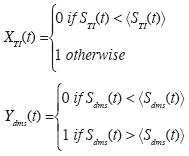
<body><![CDATA[<p align="justify"><font face="verdana" size="2">For each system, the corresponding entropies are defined in terms of the probabilities by:</font></p>     <p align="center"><font face="verdana" size="2"><img src="/img/revistas/geoint/v48n4/a1s2.jpg"></font></p>     <p align="justify"><font face="verdana" size="2">or explicitly in terms of the joint probability:</font></p>     <p align="center"><font face="verdana" size="2"><img src="/img/revistas/geoint/v48n4/a1s3.jpg"></font></p>     <p align="justify"><font face="verdana" size="2">Or explicitly in terms of the joint probability, can be written as:</font></p>     <p align="justify"><font face="verdana" size="2">When A and B are statistically independent, the mutual information between them is zero, that is, <i>I</i>(<i>A,B</i>)<i> = </i>0. When there is dependence, the MIF between them is positive and, the MIF must satisfy the condition 0 <u>&lt;</u> (<i>A,B</i>) min {<i>H</i>&#91;<i>A</i>&#93;<i>, H</i>&#91;<i>B</i>&#93;} (Matsuda, 1999), in this sense the MIF characterize the degree of correlation between both systems</font></p>     <p align="justify"><font face="verdana" size="2">Another advantages of the MIF in comparison with the classical correlation function, are: (i) The correlation function only measures linear correlations, MIF is able to characterize a global dependence (Matsuda, 1999); (ii) MIF remains invariant for transformation of a, b; (iii) the correlation function relies on an assignment of numerical values but MIF can be calculated directly from a set of symbols associated with the accessible states of the systems. When a signal is symbolized some dynamical features can be lost, however we are interested to find long&#150;range information instead of the dynamical behavior of the signals.</font></p>     <p align="justify"><font face="verdana" size="2">&nbsp;</font></p>     <p align="justify"><font face="verdana" size="2"><b>The MIF between TSI and DMS</b></font></p>     <p align="justify"><font face="verdana" size="2">We define the time series for DMS {<i>S<sub>dms</sub>   </i>(<i>t</i>)}<i>, </i>and for TSI {<i>S<sub>TI</sub></i>(<i>t</i>)}<i>. </i>The variables are symbolized as follow: X<sub>TI </sub>is the variable associated to TSI and Y<sub>dms</sub>     is the variable associated to DMS production. We defined two states for each series as follows:</font></p>     ]]></body>
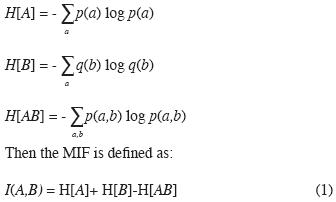
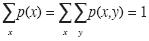
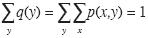
<body><![CDATA[<p align="center"><font face="verdana" size="2"><img src="/img/revistas/geoint/v48n4/a1s4.jpg"></font></p>     <p align="justify"><font face="verdana" size="2">Where (s) represents the mean value over the complete time series.</font></p>     <p align="justify"><font face="verdana" size="2">One&#150;month (30 days) windowing was considered, and for each window the probabilities <i>p</i>(<i>x) </i>and <i>q</i>(<i>y</i>) were calculated, here {<i>x,y</i>} represent the accessible states of the variables <i>X<sub>TI</sub> </i>and <i>Y<sub>dms</sub> </i>respectively. To compute the MIF, <i>I</i>(<i>X<sub>TI </sub>, Y<sub>dms</sub></i>) from Eq. (2), the joint probability <i>p</i>(<i>x,y</i>)<i>, </i>was calculated following the algorithm proposed in Druzdzel (1994). In fact, the joint probability should represent the internal interactions between all components of the systems. In terms of our variables the Eq. (2) is rewritten as:</font></p>     <p align="center"><font face="verdana" size="2"><img src="/img/revistas/geoint/v48n4/a1s5.jpg"> </font></p>     <p align="justify"><font face="verdana" size="2">The normalization condition must be satisfied:</font></p>     <p align="center"><font face="verdana" size="2"><img src="/img/revistas/geoint/v48n4/a1s6.jpg"></font></p>     <p align="justify"><font face="verdana" size="2">and</font></p>     <p align="center"><font face="verdana" size="2"><img src="/img/revistas/geoint/v48n4/a1s7.jpg"></font></p>     <p align="justify"><font face="verdana" size="2">&nbsp;</font></p>     <p align="justify"><font face="verdana" size="2"><b>MIF results and discussion</b></font></p>     ]]></body>
<body><![CDATA[<p align="justify"><font face="verdana" size="2">From Eq. (2), the MIF between TSI and DMS is calculated and presented in <a href="/img/revistas/geoint/v48n4/a1f6.jpg" target="_blank">Fig. 6a</a>. We also produced a surrogate (Schreiber and Smith, 2000) of both series (see <a href="/img/revistas/geoint/v48n4/a1f6.jpg" target="_blank">Fig. 6b</a>) as the resulting MIF shows a different structure from the previous one, this indicates that the analysis is statistically significant.</font></p>     <p align="justify"><font face="verdana" size="2">A global dependence between the DMS production and the TSI is observed in the sense that we always have MIF values larger than zero (see <a href="/img/revistas/geoint/v48n4/a1f6.jpg" target="_blank">Fig. 6</a>), however, we already found that the relation between DMS and TSI is non&#150;linear (see <a href="/img/revistas/geoint/v48n4/a1f5.jpg" target="_blank">Fig. 5</a>). According to <a href="/img/revistas/geoint/v48n4/a1f6.jpg" target="_blank">Fig. 6</a>, from 1984 to 1988 and from 1992 to 1996, the MIF reaches its maximum values, indicating a strong relation of the series. The periods of low and highly variable relation are those between 1980 and before 1984, and after 1988 to before 1992. The time spans of 1984&#150;1988 and 1992&#150;1996 correspond to lower solar activity times compared with the time spans of 1980&#150;1984 and 1988&#150;1992. Then a dependence of MIF behavior with the sunspot cycle is suggested: the MIF values seem to be larger in times of lower solar activity, and decrease during times of higher solar activity. Or in other words, during lower solar activity times the dependence between DMS and TSI is stronger than in higher solar activity epochs. Moreover, it is well known the strong positive correlation between TSI and solar activity (Lean, 2000) therefore lower solar activity times are times of lower TSI and higher MIF values and viceversa.</font></p>     <p align="justify"><font face="verdana" size="2">Although a relation between DMA and TSI has been sought in previous works, an explicit association between DMS/TSI and the solar activity cycle has not been discussed. In this sense the present is the first work to do so, because we search for long term (not seasonal) global relations as the data time span goes from 1980 to 1997.</font></p>     <p align="justify"><font face="verdana" size="2">&nbsp;</font></p>     <p align="justify"><font face="verdana" size="2"><b>Conclusions</b></font></p>     <p align="justify"><font face="verdana" size="2">In order to quantify the global long&#150;term dependence of the DMS production as function of TSI, alinear correlation was firstly sought. We found that the series show a very weak linear correlation coefficient. Then, a probabilistic scheme was introduced, the Mutual Information Function (MIF) formalism, in order to characterize the global correlation between the DMS production and the TSI.</font></p>     <p align="justify"><font face="verdana" size="2">An association betweenDMS/TSI and the solar activity cycle is suggested, the MIF seems to present a solar cycle dependence: maximum values are found between 1984 and 1988 and also from 1992 to 1996, which would imply that the MIF is stronger during lower solar activity times than during higher solar activity epochs. Then when TSI is lower the correlation with the global DMS attaints higher values and viceversa, but the relation between them is non&#150;linear.</font></p>     <p align="justify"><font face="verdana" size="2">As mentioned in the Introduction, a basic step of the feedback process between DMS, cloud albedo and solar radiation, is to know if the relation between TSI and DMS is a correlation or an anti&#150;correlation. The MIF between TSI and DMS does not provide information on the type of relation between these variables, it only indicates that the dependence between the variables (than can be a positive or negative relation) is higher during lower TSI times. Then we cannot yet answer if the feedback is either positive or negative, however we have given a step forward by showing that in fact there is a dependence between TSI and DMS and that this dependence in nonlinear.</font></p>     <p align="justify"><font face="verdana" size="2">&nbsp;</font></p>     <p align="justify"><font face="verdana" size="2"><b>Bibliography</b></font></p>     ]]></body>
<body><![CDATA[<!-- ref --><p align="justify"><font face="verdana" size="2">Andreae, M. O. and P. J. Crutzen, 1997. Atmospheric aerosols: biogeochemical sources and role in atmospheric chemistry, <i>Science 276, </i>1052&#150;1058.</font>&nbsp;&nbsp;&nbsp;&nbsp;&nbsp;&nbsp;&nbsp;&nbsp;[&#160;<a href="javascript:void(0);" onclick="javascript: window.open('/scielo.php?script=sci_nlinks&ref=3906994&pid=S0016-7169200900040000100001&lng=','','width=640,height=500,resizable=yes,scrollbars=1,menubar=yes,');">Links</a>&#160;]<!-- end-ref --><!-- ref --><p align="justify"><font face="verdana" size="2">Charlson, R. J., J. E. Lovelock, M. O. Andreae and S. G.Warren, 1987. Oceanic phytoplankton, atmospheric sulfur, cloud albedo and climate: a geophysiological feedback, <i>Nature 326, </i>655&#150;661.</font>&nbsp;&nbsp;&nbsp;&nbsp;&nbsp;&nbsp;&nbsp;&nbsp;[&#160;<a href="javascript:void(0);" onclick="javascript: window.open('/scielo.php?script=sci_nlinks&ref=3906995&pid=S0016-7169200900040000100002&lng=','','width=640,height=500,resizable=yes,scrollbars=1,menubar=yes,');">Links</a>&#160;]<!-- end-ref --><!-- ref --><p align="justify"><font face="verdana" size="2">Cubasch, U. and R. Voss, 2000. The influence of total solar irradiance on climate, <i>Space Sci. Rev. 94, </i>185&#150;198.</font>&nbsp;&nbsp;&nbsp;&nbsp;&nbsp;&nbsp;&nbsp;&nbsp;[&#160;<a href="javascript:void(0);" onclick="javascript: window.open('/scielo.php?script=sci_nlinks&ref=3906996&pid=S0016-7169200900040000100003&lng=','','width=640,height=500,resizable=yes,scrollbars=1,menubar=yes,');">Links</a>&#160;]<!-- end-ref --><!-- ref --><p align="justify"><font face="verdana" size="2">Dionisio, A., R. Menezes and D. A. Mendes, 2004. Mutual Information: A measure of dependency for nonlinear time series, <i>Physica A 344, </i>326&#150;329.</font>&nbsp;&nbsp;&nbsp;&nbsp;&nbsp;&nbsp;&nbsp;&nbsp;[&#160;<a href="javascript:void(0);" onclick="javascript: window.open('/scielo.php?script=sci_nlinks&ref=3906997&pid=S0016-7169200900040000100004&lng=','','width=640,height=500,resizable=yes,scrollbars=1,menubar=yes,');">Links</a>&#160;]<!-- end-ref --><!-- ref --><p align="justify"><font face="verdana" size="2">Druzdzel, M. J., 1994. Some properties of joint probabilities distribution, in Proceedings of the 10<sup>th</sup> annual conference on uncertainty and artificial intelligence (UAI&#150;94), (Morgan Kaufmann Publishers Inc. CA, E.U.A, 1994) 187&#150;194.</font>&nbsp;&nbsp;&nbsp;&nbsp;&nbsp;&nbsp;&nbsp;&nbsp;[&#160;<a href="javascript:void(0);" onclick="javascript: window.open('/scielo.php?script=sci_nlinks&ref=3906998&pid=S0016-7169200900040000100005&lng=','','width=640,height=500,resizable=yes,scrollbars=1,menubar=yes,');">Links</a>&#160;]<!-- end-ref --><!-- ref --><p align="justify"><font face="verdana" size="2">Grosse I., H. Hertzel, V. Buldyrev and H. E. Stanly, 2000. Species independence of mutual information in coding and non coding DNA, <i>Phys. Rev. A 61, </i>5624&#150;5629.</font>&nbsp;&nbsp;&nbsp;&nbsp;&nbsp;&nbsp;&nbsp;&nbsp;[&#160;<a href="javascript:void(0);" onclick="javascript: window.open('/scielo.php?script=sci_nlinks&ref=3906999&pid=S0016-7169200900040000100006&lng=','','width=640,height=500,resizable=yes,scrollbars=1,menubar=yes,');">Links</a>&#160;]<!-- end-ref --><!-- ref --><p align="justify"><font face="verdana" size="2">Gunson, J. R., S. A Spall, T. R. Anderson, A. Jones, I. J. Totterdell and M. J. Woodage, 2006. Climate sensitivity to ocean dimethylsulphide emissions, <i>Geophys Res. Lett. 33, </i>IDL07701, 10.1029/2005GL024982.</font>&nbsp;&nbsp;&nbsp;&nbsp;&nbsp;&nbsp;&nbsp;&nbsp;[&#160;<a href="javascript:void(0);" onclick="javascript: window.open('/scielo.php?script=sci_nlinks&ref=3907000&pid=S0016-7169200900040000100007&lng=','','width=640,height=500,resizable=yes,scrollbars=1,menubar=yes,');">Links</a>&#160;]<!-- end-ref --><!-- ref --><p align="justify"><font face="verdana" size="2">Haigh, J. D., 1999. A GCM study of climate change in response to the 11&#150;year solar cycle, Q. J. R. <i>Meteorol. Soc. 125, </i>871&#150;892.</font>&nbsp;&nbsp;&nbsp;&nbsp;&nbsp;&nbsp;&nbsp;&nbsp;[&#160;<a href="javascript:void(0);" onclick="javascript: window.open('/scielo.php?script=sci_nlinks&ref=3907001&pid=S0016-7169200900040000100008&lng=','','width=640,height=500,resizable=yes,scrollbars=1,menubar=yes,');">Links</a>&#160;]<!-- end-ref --><!-- ref --><p align="justify"><font face="verdana" size="2">Hefu, Y. and G. O. Kirst, 1997. Effects of UV radiation on DMS content and DMS formation of Phaeocystis Antartica, <i>Polar Biol. 18, </i>402&#150;409.</font>&nbsp;&nbsp;&nbsp;&nbsp;&nbsp;&nbsp;&nbsp;&nbsp;[&#160;<a href="javascript:void(0);" onclick="javascript: window.open('/scielo.php?script=sci_nlinks&ref=3907002&pid=S0016-7169200900040000100009&lng=','','width=640,height=500,resizable=yes,scrollbars=1,menubar=yes,');">Links</a>&#160;]<!-- end-ref --><!-- ref --><p align="justify"><font face="verdana" size="2">Kettle, A. J., M. O. Andreae, D. Amouroux, <i>et al., </i>1999. A global data base of sea surface Dimethylsulfide (DMS) measurements and a procedure to predict sea surface DMS as a function of latitude, longitude and month, Global Biogeochem. <i>Cycles 13, </i>399&#150;444.</font>&nbsp;&nbsp;&nbsp;&nbsp;&nbsp;&nbsp;&nbsp;&nbsp;[&#160;<a href="javascript:void(0);" onclick="javascript: window.open('/scielo.php?script=sci_nlinks&ref=3907003&pid=S0016-7169200900040000100010&lng=','','width=640,height=500,resizable=yes,scrollbars=1,menubar=yes,');">Links</a>&#160;]<!-- end-ref --><!-- ref --><p align="justify"><font face="verdana" size="2">Kniventon, D. R., M. C. Todd, J. Sciare and N. Mihalopoulos, 2003. Variability of atmospheric dimethyl sulphide over the southern Indian Ocean due to changes in ultraviolet radiation, <i>Global Biogeochem. Cycles 17, </i>1096, doi: 10.1029/2003GB002033.</font>&nbsp;&nbsp;&nbsp;&nbsp;&nbsp;&nbsp;&nbsp;&nbsp;[&#160;<a href="javascript:void(0);" onclick="javascript: window.open('/scielo.php?script=sci_nlinks&ref=3907004&pid=S0016-7169200900040000100011&lng=','','width=640,height=500,resizable=yes,scrollbars=1,menubar=yes,');">Links</a>&#160;]<!-- end-ref --><!-- ref --><p align="justify"><font face="verdana" size="2">Larsen, S. H., 2005. Solar variability, dimethyl sulphide, clouds, and climate, <i>Global Biogeochem. Cycles 19, </i>GB1014.</font>&nbsp;&nbsp;&nbsp;&nbsp;&nbsp;&nbsp;&nbsp;&nbsp;[&#160;<a href="javascript:void(0);" onclick="javascript: window.open('/scielo.php?script=sci_nlinks&ref=3907005&pid=S0016-7169200900040000100012&lng=','','width=640,height=500,resizable=yes,scrollbars=1,menubar=yes,');">Links</a>&#160;]<!-- end-ref --><!-- ref --><p align="justify"><font face="verdana" size="2">Li, W., 1990. Mutual information function versus correlation functions, <i>Journal of Statistical Physics 60, </i>823&#150;837.</font>&nbsp;&nbsp;&nbsp;&nbsp;&nbsp;&nbsp;&nbsp;&nbsp;[&#160;<a href="javascript:void(0);" onclick="javascript: window.open('/scielo.php?script=sci_nlinks&ref=3907006&pid=S0016-7169200900040000100013&lng=','','width=640,height=500,resizable=yes,scrollbars=1,menubar=yes,');">Links</a>&#160;]<!-- end-ref --><!-- ref --><p align="justify"><font face="verdana" size="2">Lean, J. L., J. Beer and R. Bradley, 1995. Reconstruction of solar irradiance since 1610: implications for climate change, <i>Geophys. Res. Lett. 22, </i>3195&#150;3198.</font>&nbsp;&nbsp;&nbsp;&nbsp;&nbsp;&nbsp;&nbsp;&nbsp;[&#160;<a href="javascript:void(0);" onclick="javascript: window.open('/scielo.php?script=sci_nlinks&ref=3907007&pid=S0016-7169200900040000100014&lng=','','width=640,height=500,resizable=yes,scrollbars=1,menubar=yes,');">Links</a>&#160;]<!-- end-ref --><!-- ref --><p align="justify"><font face="verdana" size="2">Lean, J. L., 2000. Short term direct indices of solar variability, <i>Space Sci. Rev. 94, </i>39&#150;51.</font>&nbsp;&nbsp;&nbsp;&nbsp;&nbsp;&nbsp;&nbsp;&nbsp;[&#160;<a href="javascript:void(0);" onclick="javascript: window.open('/scielo.php?script=sci_nlinks&ref=3907008&pid=S0016-7169200900040000100015&lng=','','width=640,height=500,resizable=yes,scrollbars=1,menubar=yes,');">Links</a>&#160;]<!-- end-ref --><!-- ref --><p align="justify"><font face="verdana" size="2">Lockwood, M. and C. Fr&ouml;hlich, 2007. Recent oppositely directed trends in solar climate forcings and the global mean surface air temperature, <i>Proc. R. Soc. A, </i>doi:10.1098/rspa.2007.1880.</font>&nbsp;&nbsp;&nbsp;&nbsp;&nbsp;&nbsp;&nbsp;&nbsp;[&#160;<a href="javascript:void(0);" onclick="javascript: window.open('/scielo.php?script=sci_nlinks&ref=3907009&pid=S0016-7169200900040000100016&lng=','','width=640,height=500,resizable=yes,scrollbars=1,menubar=yes,');">Links</a>&#160;]<!-- end-ref --><!-- ref --><p align="justify"><font face="verdana" size="2">Marsh, N. D. and H. H. Svensmark, 2000. Low cloud properties influenced by Cosmic Ray, <i>Phys. Rev. Letts. 85, </i>5004&#150;5007.</font>&nbsp;&nbsp;&nbsp;&nbsp;&nbsp;&nbsp;&nbsp;&nbsp;[&#160;<a href="javascript:void(0);" onclick="javascript: window.open('/scielo.php?script=sci_nlinks&ref=3907010&pid=S0016-7169200900040000100017&lng=','','width=640,height=500,resizable=yes,scrollbars=1,menubar=yes,');">Links</a>&#160;]<!-- end-ref --><!-- ref --><p align="justify"><font face="verdana" size="2">Matsuda, H., 1999. Physical nature of higher&#150;order mutual information:   intrinsic  correlations  and frustration, <i>Physical Review E 62&#150;3, </i>3096&#150;3102.</font>&nbsp;&nbsp;&nbsp;&nbsp;&nbsp;&nbsp;&nbsp;&nbsp;[&#160;<a href="javascript:void(0);" onclick="javascript: window.open('/scielo.php?script=sci_nlinks&ref=3907011&pid=S0016-7169200900040000100018&lng=','','width=640,height=500,resizable=yes,scrollbars=1,menubar=yes,');">Links</a>&#160;]<!-- end-ref --><!-- ref --><p align="justify"><font face="verdana" size="2">Pall&eacute;&#150;Bag&oacute;, E. and C. J. Butler, 2000. The influence of cosmic rays on terrestrial clouds and global warming, <i>Astron. Geophys. 41, </i>418&#150;422.</font>&nbsp;&nbsp;&nbsp;&nbsp;&nbsp;&nbsp;&nbsp;&nbsp;[&#160;<a href="javascript:void(0);" onclick="javascript: window.open('/scielo.php?script=sci_nlinks&ref=3907012&pid=S0016-7169200900040000100019&lng=','','width=640,height=500,resizable=yes,scrollbars=1,menubar=yes,');">Links</a>&#160;]<!-- end-ref --><!-- ref --><p align="justify"><font face="verdana" size="2">Pudovkin, M. I. and S. V. Veretenenko, 1995. Cloudiness decreases associated with Forbush decreases of galactic cosmic rays, <i>J. Atm. Solar&#150;Terr. Phys. 57, </i>1349&#150;1355.</font>&nbsp;&nbsp;&nbsp;&nbsp;&nbsp;&nbsp;&nbsp;&nbsp;[&#160;<a href="javascript:void(0);" onclick="javascript: window.open('/scielo.php?script=sci_nlinks&ref=3907013&pid=S0016-7169200900040000100020&lng=','','width=640,height=500,resizable=yes,scrollbars=1,menubar=yes,');">Links</a>&#160;]<!-- end-ref --><!-- ref --><p align="justify"><font face="verdana" size="2">Polygiannakis, J., P. Preka&#150;Papadema and X. Moussas, 2003. On signal&#150;noise decomposition of time&#150;series using the continuous wavelet transform: application to sunspot index, Mon. Not. R. <i>Astron. Soc. 343, </i>725&#150;734.</font>&nbsp;&nbsp;&nbsp;&nbsp;&nbsp;&nbsp;&nbsp;&nbsp;[&#160;<a href="javascript:void(0);" onclick="javascript: window.open('/scielo.php?script=sci_nlinks&ref=3907014&pid=S0016-7169200900040000100021&lng=','','width=640,height=500,resizable=yes,scrollbars=1,menubar=yes,');">Links</a>&#160;]<!-- end-ref --><!-- ref --><p align="justify"><font face="verdana" size="2">Sakka, A., M. Gosselin, M. Levasseur, P. Monfort and S. Demers, 1997. Effects of reduced ultraviolet radiation on aqueous concentrations of dimethylsulfoniopropionate during a microcosm study in the Lower St. Lawrence Estuary, <i>Mar. Ecol. Prog. Ser. 149, </i>227&#150;238.</font>&nbsp;&nbsp;&nbsp;&nbsp;&nbsp;&nbsp;&nbsp;&nbsp;[&#160;<a href="javascript:void(0);" onclick="javascript: window.open('/scielo.php?script=sci_nlinks&ref=3907015&pid=S0016-7169200900040000100022&lng=','','width=640,height=500,resizable=yes,scrollbars=1,menubar=yes,');">Links</a>&#160;]<!-- end-ref --><!-- ref --><p align="justify"><font face="verdana" size="2">Schreiber, T. and A. Smith, 2000. Surrogate time series, <i>Physica D 142, </i>346&#150;382.</font>&nbsp;&nbsp;&nbsp;&nbsp;&nbsp;&nbsp;&nbsp;&nbsp;[&#160;<a href="javascript:void(0);" onclick="javascript: window.open('/scielo.php?script=sci_nlinks&ref=3907016&pid=S0016-7169200900040000100023&lng=','','width=640,height=500,resizable=yes,scrollbars=1,menubar=yes,');">Links</a>&#160;]<!-- end-ref --><!-- ref --><p align="justify"><font face="verdana" size="2">Shannon, C. E., 1948. Bell. <i>Syst. Tech. J. </i>379.</font>&nbsp;&nbsp;&nbsp;&nbsp;&nbsp;&nbsp;&nbsp;&nbsp;[&#160;<a href="javascript:void(0);" onclick="javascript: window.open('/scielo.php?script=sci_nlinks&ref=3907017&pid=S0016-7169200900040000100024&lng=','','width=640,height=500,resizable=yes,scrollbars=1,menubar=yes,');">Links</a>&#160;]<!-- end-ref --><!-- ref --><p align="justify"><font face="verdana" size="2">Shaw, G. E., R. L. Benner, W. Cantrell and D. Veazey, 1998. The regulation of climate: A sulfate particle feedback loop involving deep convection&#150;An editorial essay, <i>Clim. Change 39, </i>23&#150;33.</font>&nbsp;&nbsp;&nbsp;&nbsp;&nbsp;&nbsp;&nbsp;&nbsp;[&#160;<a href="javascript:void(0);" onclick="javascript: window.open('/scielo.php?script=sci_nlinks&ref=3907018&pid=S0016-7169200900040000100025&lng=','','width=640,height=500,resizable=yes,scrollbars=1,menubar=yes,');">Links</a>&#160;]<!-- end-ref --><!-- ref --><p align="justify"><font face="verdana" size="2">Shindell, D. T., D. Rind, N. Balachandran, J. Lean, and P. Lonergan, 1999. Solar cycle variability, ozone and climate. <i>Science 284, </i>305&#150;308.</font>&nbsp;&nbsp;&nbsp;&nbsp;&nbsp;&nbsp;&nbsp;&nbsp;[&#160;<a href="javascript:void(0);" onclick="javascript: window.open('/scielo.php?script=sci_nlinks&ref=3907019&pid=S0016-7169200900040000100026&lng=','','width=640,height=500,resizable=yes,scrollbars=1,menubar=yes,');">Links</a>&#160;]<!-- end-ref --><!-- ref --><p align="justify"><font face="verdana" size="2">Shindell, D. T., G. Faluvegi, R. L. Miller, G. A. Schmidt and J. E. Hansen, 2006. Solar and anthropogenic forcing of tropical hydrology, <i>Gephys. Res. Lett. 33, </i>L24706, 10.1029/2006GL027468.</font>&nbsp;&nbsp;&nbsp;&nbsp;&nbsp;&nbsp;&nbsp;&nbsp;[&#160;<a href="javascript:void(0);" onclick="javascript: window.open('/scielo.php?script=sci_nlinks&ref=3907020&pid=S0016-7169200900040000100027&lng=','','width=640,height=500,resizable=yes,scrollbars=1,menubar=yes,');">Links</a>&#160;]<!-- end-ref --><!-- ref --><p align="justify"><font face="verdana" size="2">Sim&oacute;, R., 2001. Production of atmpospheric sulfur by oceanic plankton: Biogeochemical, ecological and evolutionary links, <i>Trends Ecol. Evol. 16, </i>287&#150;294.</font>&nbsp;&nbsp;&nbsp;&nbsp;&nbsp;&nbsp;&nbsp;&nbsp;[&#160;<a href="javascript:void(0);" onclick="javascript: window.open('/scielo.php?script=sci_nlinks&ref=3907021&pid=S0016-7169200900040000100028&lng=','','width=640,height=500,resizable=yes,scrollbars=1,menubar=yes,');">Links</a>&#160;]<!-- end-ref --><!-- ref --><p align="justify"><font face="verdana" size="2">Sim&oacute;, R. and J. J. Dachs, 2002. Global ocean emission of dymethylsulfide predicted from biogeophysical data, <i>Global Biogeochem. Cycles, </i>doi: 10.1029/2001GB001829.</font>&nbsp;&nbsp;&nbsp;&nbsp;&nbsp;&nbsp;&nbsp;&nbsp;[&#160;<a href="javascript:void(0);" onclick="javascript: window.open('/scielo.php?script=sci_nlinks&ref=3907022&pid=S0016-7169200900040000100029&lng=','','width=640,height=500,resizable=yes,scrollbars=1,menubar=yes,');">Links</a>&#160;]<!-- end-ref --><!-- ref --><p align="justify"><font face="verdana" size="2">Sim&oacute;, R. and S. M. Vallina, 2007. Strong relationship between DMS and the solar radiation dose over the global surface ocean, <i>Science 315, </i>506&#150;508.</font>&nbsp;&nbsp;&nbsp;&nbsp;&nbsp;&nbsp;&nbsp;&nbsp;[&#160;<a href="javascript:void(0);" onclick="javascript: window.open('/scielo.php?script=sci_nlinks&ref=3907023&pid=S0016-7169200900040000100030&lng=','','width=640,height=500,resizable=yes,scrollbars=1,menubar=yes,');">Links</a>&#160;]<!-- end-ref --><!-- ref --><p align="justify"><font face="verdana" size="2">Slezak, D. and G. J. Herndl, 2003. Effects of ultraviolet and visible radiation on the cellular concentration of dimethylsulfoniopropionate (DMSP) in Emiliania huxleyi (strain L), <i>Mar. Ecol. Prog. Ser. 246, </i>61&#150;71.</font>&nbsp;&nbsp;&nbsp;&nbsp;&nbsp;&nbsp;&nbsp;&nbsp;[&#160;<a href="javascript:void(0);" onclick="javascript: window.open('/scielo.php?script=sci_nlinks&ref=3907024&pid=S0016-7169200900040000100031&lng=','','width=640,height=500,resizable=yes,scrollbars=1,menubar=yes,');">Links</a>&#160;]<!-- end-ref --><!-- ref --><p align="justify"><font face="verdana" size="2">Stott, P. A., G. S. Jones and J. F. B. Mitchell, 2003. Do models underestimate the solar contribution to recent climate changes? J. <i>Clim. 16, 4079&#150;4093.</i></font>&nbsp;&nbsp;&nbsp;&nbsp;&nbsp;&nbsp;&nbsp;&nbsp;[&#160;<a href="javascript:void(0);" onclick="javascript: window.open('/scielo.php?script=sci_nlinks&ref=3907025&pid=S0016-7169200900040000100032&lng=','','width=640,height=500,resizable=yes,scrollbars=1,menubar=yes,');">Links</a>&#160;]<!-- end-ref --><!-- ref --><p align="justify"><font face="verdana" size="2">Sunda, W., D. J. Kieber, R. P. Kiene and S. Huntsman, 2002. An antioxidant function for DMSP and DMS in marine algae, <i>Nature 418, </i>317&#150;320.</font>&nbsp;&nbsp;&nbsp;&nbsp;&nbsp;&nbsp;&nbsp;&nbsp;[&#160;<a href="javascript:void(0);" onclick="javascript: window.open('/scielo.php?script=sci_nlinks&ref=3907026&pid=S0016-7169200900040000100033&lng=','','width=640,height=500,resizable=yes,scrollbars=1,menubar=yes,');">Links</a>&#160;]<!-- end-ref --><!-- ref --><p align="justify"><font face="verdana" size="2">Svensmark, H., 2007. Cosmoclimatology: a new theory emerges, <i>Astron. and Geophys. 48, </i>18&#150;24.</font>&nbsp;&nbsp;&nbsp;&nbsp;&nbsp;&nbsp;&nbsp;&nbsp;[&#160;<a href="javascript:void(0);" onclick="javascript: window.open('/scielo.php?script=sci_nlinks&ref=3907027&pid=S0016-7169200900040000100034&lng=','','width=640,height=500,resizable=yes,scrollbars=1,menubar=yes,');">Links</a>&#160;]<!-- end-ref --><!-- ref --><p align="justify"><font face="verdana" size="2">Tinsley, B. A. and G. W. Deen, 1991. Apparent tropospheric response to MeV&#150;GeV particle flux variations: A connection via electrofreezing of supercooled water in high level clouds? <i>J. Geophys. Res. 96, </i>22283&#150;22296.</font>&nbsp;&nbsp;&nbsp;&nbsp;&nbsp;&nbsp;&nbsp;&nbsp;[&#160;<a href="javascript:void(0);" onclick="javascript: window.open('/scielo.php?script=sci_nlinks&ref=3907028&pid=S0016-7169200900040000100035&lng=','','width=640,height=500,resizable=yes,scrollbars=1,menubar=yes,');">Links</a>&#160;]<!-- end-ref --><!-- ref --><p align="justify"><font face="verdana" size="2">Tinsley, B. A., 2000. Influence of solar wind on the global electric circuit, and inferred effects on cloud microphysics, temperature and dynamics in the troposphere, <i>Space Sci. Rev. 94, </i>231&#150;258.</font>&nbsp;&nbsp;&nbsp;&nbsp;&nbsp;&nbsp;&nbsp;&nbsp;[&#160;<a href="javascript:void(0);" onclick="javascript: window.open('/scielo.php?script=sci_nlinks&ref=3907029&pid=S0016-7169200900040000100036&lng=','','width=640,height=500,resizable=yes,scrollbars=1,menubar=yes,');">Links</a>&#160;]<!-- end-ref --><!-- ref --><p align="justify"><font face="verdana" size="2">Toole, D. A. and D. A., Siegel, 2004. Light&#150;driven Cycling of Dimethylsumde (DMS) in the Sargasso Sea: Closing the Loop, <i>Geophys. Res. Lett., </i>doi: 10.1029/2004GL019581.</font>&nbsp;&nbsp;&nbsp;&nbsp;&nbsp;&nbsp;&nbsp;&nbsp;[&#160;<a href="javascript:void(0);" onclick="javascript: window.open('/scielo.php?script=sci_nlinks&ref=3907030&pid=S0016-7169200900040000100037&lng=','','width=640,height=500,resizable=yes,scrollbars=1,menubar=yes,');">Links</a>&#160;]<!-- end-ref --><!-- ref --><p align="justify"><font face="verdana" size="2">Toole, D. A., D. Slezak, R. P. Kiene, D. J. Kieber and D. A., 2006. Effects of solar radiation on dimethylsumde cycling in the western Atlantic Ocean, <i>Deep&#150;Sea Res. I, 53, </i>136&#150;153.</font>&nbsp;&nbsp;&nbsp;&nbsp;&nbsp;&nbsp;&nbsp;&nbsp;[&#160;<a href="javascript:void(0);" onclick="javascript: window.open('/scielo.php?script=sci_nlinks&ref=3907031&pid=S0016-7169200900040000100038&lng=','','width=640,height=500,resizable=yes,scrollbars=1,menubar=yes,');">Links</a>&#160;]<!-- end-ref --><!-- ref --><p align="justify"><font face="verdana" size="2">Usoskin, I. G., N. Marsh, A. Kovaltsov, K. Mursula and O. G. Gladyssheva, 2004. Latitudinal dependence of low cloud amount on cosmic ray induced ionization, <i>Geophys. Res. Lett. 31, </i>doi: 10.1029/2004GL019507.</font>&nbsp;&nbsp;&nbsp;&nbsp;&nbsp;&nbsp;&nbsp;&nbsp;[&#160;<a href="javascript:void(0);" onclick="javascript: window.open('/scielo.php?script=sci_nlinks&ref=3907032&pid=S0016-7169200900040000100039&lng=','','width=640,height=500,resizable=yes,scrollbars=1,menubar=yes,');">Links</a>&#160;]<!-- end-ref --><!-- ref --><p align="justify"><font face="verdana" size="2">Vallina, S. M., R. Sim&oacute;, S. Gass&oacute;, C. de Boyer&#150;Mont&eacute;gut, E. del R&iacute;o, E. Jurado and J. Dach, 2007. Analysis of a potential "solar radiation dose&#150;dimethylsulfide&#150;cloud condensation nuclei" link from globally mapped seasonal correlations, <i>Global Biogeochem. Cycles 21, </i>GB2004, doi: 10.1029/2006GB002787.</font>&nbsp;&nbsp;&nbsp;&nbsp;&nbsp;&nbsp;&nbsp;&nbsp;[&#160;<a href="javascript:void(0);" onclick="javascript: window.open('/scielo.php?script=sci_nlinks&ref=3907033&pid=S0016-7169200900040000100040&lng=','','width=640,height=500,resizable=yes,scrollbars=1,menubar=yes,');">Links</a>&#160;]<!-- end-ref --><p align="justify"><font face="verdana" size="2">&nbsp;</font></p>     <p align="justify"><font face="verdana" size="2"><b><a name="notas"></a>Nota</b></font></p>     <p align="justify"><font face="verdana" size="2"><sup>1</sup> <a href="http://www.ngdc.noaa.gov/stp/SOLAR/ftpsolarirradiance.html.com" target="_blank">http://www.ngdc.noaa.gov/stp/SOLAR/ftpsolarirradiance.html</a> , <a href="http://www.dss.ucar.edu/datasets/" target="_blank">http://www.dss.ucar.edu/datasets</a></font></p>      ]]></body><back>
<ref-list>
<ref id="B1">
<nlm-citation citation-type="journal">
<person-group person-group-type="author">
<name>
<surname><![CDATA[Andreae]]></surname>
<given-names><![CDATA[M. O.]]></given-names>
</name>
<name>
<surname><![CDATA[Crutzen]]></surname>
<given-names><![CDATA[P. J.]]></given-names>
</name>
</person-group>
<article-title xml:lang="en"><![CDATA[Atmospheric aerosols: biogeochemical sources and role in atmospheric chemistry]]></article-title>
<source><![CDATA[Science]]></source>
<year>1997</year>
<volume>276</volume>
<page-range>1052-1058</page-range></nlm-citation>
</ref>
<ref id="B2">
<nlm-citation citation-type="journal">
<person-group person-group-type="author">
<name>
<surname><![CDATA[Charlson]]></surname>
<given-names><![CDATA[R. J.]]></given-names>
</name>
<name>
<surname><![CDATA[Lovelock]]></surname>
<given-names><![CDATA[J. E.]]></given-names>
</name>
<name>
<surname><![CDATA[Andreae]]></surname>
<given-names><![CDATA[M. O.]]></given-names>
</name>
<name>
<surname><![CDATA[Warren]]></surname>
<given-names><![CDATA[S. G.]]></given-names>
</name>
</person-group>
<article-title xml:lang="en"><![CDATA[Oceanic phytoplankton, atmospheric sulfur, cloud albedo and climate: a geophysiological feedback]]></article-title>
<source><![CDATA[Nature]]></source>
<year>1987</year>
<volume>326</volume>
<page-range>655-661</page-range></nlm-citation>
</ref>
<ref id="B3">
<nlm-citation citation-type="journal">
<person-group person-group-type="author">
<name>
<surname><![CDATA[Cubasch]]></surname>
<given-names><![CDATA[U.]]></given-names>
</name>
<name>
<surname><![CDATA[Voss]]></surname>
<given-names><![CDATA[R.]]></given-names>
</name>
</person-group>
<article-title xml:lang="en"><![CDATA[The influence of total solar irradiance on climate]]></article-title>
<source><![CDATA[Space Sci. Rev.]]></source>
<year>2000</year>
<volume>94</volume>
<page-range>185-198</page-range></nlm-citation>
</ref>
<ref id="B4">
<nlm-citation citation-type="journal">
<person-group person-group-type="author">
<name>
<surname><![CDATA[Dionisio]]></surname>
<given-names><![CDATA[A.]]></given-names>
</name>
<name>
<surname><![CDATA[Menezes]]></surname>
<given-names><![CDATA[R.]]></given-names>
</name>
<name>
<surname><![CDATA[Mendes]]></surname>
<given-names><![CDATA[D. A.]]></given-names>
</name>
</person-group>
<article-title xml:lang="en"><![CDATA[Mutual Information: A measure of dependency for nonlinear time series]]></article-title>
<source><![CDATA[Physica]]></source>
<year>2004</year>
<volume>A 344</volume>
<page-range>326-329</page-range></nlm-citation>
</ref>
<ref id="B5">
<nlm-citation citation-type="confpro">
<person-group person-group-type="author">
<name>
<surname><![CDATA[Druzdzel]]></surname>
<given-names><![CDATA[M. J.]]></given-names>
</name>
</person-group>
<source><![CDATA[Some properties of joint probabilities distribution]]></source>
<year>1994</year>
<month>19</month>
<day>94</day>
<conf-name><![CDATA[10th annual conference on uncertainty and artificial intelligence]]></conf-name>
<conf-loc> </conf-loc>
<publisher-loc><![CDATA[CA ]]></publisher-loc>
<publisher-name><![CDATA[Morgan Kaufmann Publishers Inc.]]></publisher-name>
</nlm-citation>
</ref>
<ref id="B6">
<nlm-citation citation-type="journal">
<person-group person-group-type="author">
<name>
<surname><![CDATA[Grosse I.]]></surname>
<given-names><![CDATA[H. Hertzel]]></given-names>
</name>
<name>
<surname><![CDATA[Buldyrev]]></surname>
<given-names><![CDATA[V.]]></given-names>
</name>
<name>
<surname><![CDATA[Stanly]]></surname>
<given-names><![CDATA[H. E.]]></given-names>
</name>
</person-group>
<article-title xml:lang="en"><![CDATA[Species independence of mutual information in coding and non coding DNA]]></article-title>
<source><![CDATA[Phys. Rev.]]></source>
<year>2000</year>
<volume>A 61</volume>
<page-range>5624-5629</page-range></nlm-citation>
</ref>
<ref id="B7">
<nlm-citation citation-type="journal">
<person-group person-group-type="author">
<name>
<surname><![CDATA[Gunson]]></surname>
<given-names><![CDATA[J. R.]]></given-names>
</name>
<name>
<surname><![CDATA[Spall]]></surname>
<given-names><![CDATA[S. A]]></given-names>
</name>
<name>
<surname><![CDATA[Anderson]]></surname>
<given-names><![CDATA[T. R.]]></given-names>
</name>
<name>
<surname><![CDATA[Jones]]></surname>
<given-names><![CDATA[A.]]></given-names>
</name>
<name>
<surname><![CDATA[Totterdell]]></surname>
<given-names><![CDATA[I. J.]]></given-names>
</name>
<name>
<surname><![CDATA[Woodage]]></surname>
<given-names><![CDATA[M. J.]]></given-names>
</name>
</person-group>
<article-title xml:lang="en"><![CDATA[Climate sensitivity to ocean dimethylsulphide emissions]]></article-title>
<source><![CDATA[Geophys Res. Lett.]]></source>
<year>2006</year>
<volume>33</volume>
</nlm-citation>
</ref>
<ref id="B8">
<nlm-citation citation-type="journal">
<person-group person-group-type="author">
<name>
<surname><![CDATA[Haigh]]></surname>
<given-names><![CDATA[J. D.]]></given-names>
</name>
</person-group>
<article-title xml:lang="en"><![CDATA[A GCM study of climate change in response to the 11-year solar cycle, Q. J. R]]></article-title>
<source><![CDATA[Meteorol. Soc.]]></source>
<year>1999</year>
<volume>125</volume>
<page-range>871-892</page-range></nlm-citation>
</ref>
<ref id="B9">
<nlm-citation citation-type="journal">
<person-group person-group-type="author">
<name>
<surname><![CDATA[Hefu]]></surname>
<given-names><![CDATA[Y.]]></given-names>
</name>
<name>
<surname><![CDATA[Kirst]]></surname>
<given-names><![CDATA[G. O.]]></given-names>
</name>
</person-group>
<article-title xml:lang="en"><![CDATA[Effects of UV radiation on DMS content and DMS formation of Phaeocystis Antartica]]></article-title>
<source><![CDATA[Polar Biol.]]></source>
<year>1997</year>
<volume>18</volume>
<page-range>402-409</page-range></nlm-citation>
</ref>
<ref id="B10">
<nlm-citation citation-type="journal">
<person-group person-group-type="author">
<name>
<surname><![CDATA[Kettle]]></surname>
<given-names><![CDATA[A. J.]]></given-names>
</name>
<name>
<surname><![CDATA[Andreae]]></surname>
<given-names><![CDATA[M. O.]]></given-names>
</name>
<name>
<surname><![CDATA[Amouroux]]></surname>
<given-names><![CDATA[D.]]></given-names>
</name>
</person-group>
<article-title xml:lang="en"><![CDATA[A global data base of sea surface Dimethylsulfide (DMS) measurements and a procedure to predict sea surface DMS as a function of latitude, longitude and month, Global Biogeochem.]]></article-title>
<source><![CDATA[Cycles]]></source>
<year>1999</year>
<volume>13</volume>
<page-range>399-444</page-range></nlm-citation>
</ref>
<ref id="B11">
<nlm-citation citation-type="journal">
<person-group person-group-type="author">
<name>
<surname><![CDATA[Kniventon]]></surname>
<given-names><![CDATA[D. R.]]></given-names>
</name>
<name>
<surname><![CDATA[Todd]]></surname>
<given-names><![CDATA[M. C.]]></given-names>
</name>
<name>
<surname><![CDATA[Sciare]]></surname>
<given-names><![CDATA[J.]]></given-names>
</name>
<name>
<surname><![CDATA[Mihalopoulos]]></surname>
<given-names><![CDATA[N.]]></given-names>
</name>
</person-group>
<article-title xml:lang="en"><![CDATA[Variability of atmospheric dimethyl sulphide over the southern Indian Ocean due to changes in ultraviolet radiation]]></article-title>
<source><![CDATA[Global Biogeochem. Cycles]]></source>
<year>2003</year>
<volume>17</volume>
</nlm-citation>
</ref>
<ref id="B12">
<nlm-citation citation-type="journal">
<person-group person-group-type="author">
<name>
<surname><![CDATA[Larsen]]></surname>
<given-names><![CDATA[S. H.]]></given-names>
</name>
</person-group>
<article-title xml:lang="en"><![CDATA[Solar variability, dimethyl sulphide, clouds, and climate]]></article-title>
<source><![CDATA[Global Biogeochem. Cycles]]></source>
<year>2005</year>
<volume>19</volume>
</nlm-citation>
</ref>
<ref id="B13">
<nlm-citation citation-type="journal">
<person-group person-group-type="author">
<name>
<surname><![CDATA[Li]]></surname>
<given-names><![CDATA[W.]]></given-names>
</name>
</person-group>
<article-title xml:lang="en"><![CDATA[Mutual information function versus correlation functions]]></article-title>
<source><![CDATA[Journal of Statistical Physics]]></source>
<year>1990</year>
<volume>60</volume>
<page-range>823-837</page-range></nlm-citation>
</ref>
<ref id="B14">
<nlm-citation citation-type="journal">
<person-group person-group-type="author">
<name>
<surname><![CDATA[Lean]]></surname>
<given-names><![CDATA[J. L.]]></given-names>
</name>
<name>
<surname><![CDATA[Beer]]></surname>
<given-names><![CDATA[J.]]></given-names>
</name>
<name>
<surname><![CDATA[Bradley]]></surname>
<given-names><![CDATA[R.]]></given-names>
</name>
</person-group>
<article-title xml:lang="en"><![CDATA[Reconstruction of solar irradiance since 1610: implications for climate change]]></article-title>
<source><![CDATA[Geophys. Res. Lett.]]></source>
<year>1995</year>
<volume>22</volume>
<page-range>3195-3198</page-range></nlm-citation>
</ref>
<ref id="B15">
<nlm-citation citation-type="journal">
<person-group person-group-type="author">
<name>
<surname><![CDATA[Lean]]></surname>
<given-names><![CDATA[J. L.]]></given-names>
</name>
</person-group>
<article-title xml:lang="en"><![CDATA[Short term direct indices of solar variability]]></article-title>
<source><![CDATA[Space Sci. Rev.]]></source>
<year>2000</year>
<volume>94</volume>
<page-range>39-51</page-range></nlm-citation>
</ref>
<ref id="B16">
<nlm-citation citation-type="journal">
<person-group person-group-type="author">
<name>
<surname><![CDATA[Lockwood]]></surname>
<given-names><![CDATA[M.]]></given-names>
</name>
<name>
<surname><![CDATA[Fröhlich]]></surname>
<given-names><![CDATA[C.]]></given-names>
</name>
</person-group>
<article-title xml:lang="en"><![CDATA[Recent oppositely directed trends in solar climate forcings and the global mean surface air temperature]]></article-title>
<source><![CDATA[Proc. R. Soc. A]]></source>
<year>2007</year>
</nlm-citation>
</ref>
<ref id="B17">
<nlm-citation citation-type="journal">
<person-group person-group-type="author">
<name>
<surname><![CDATA[Marsh]]></surname>
<given-names><![CDATA[N. D.]]></given-names>
</name>
<name>
<surname><![CDATA[Svensmark]]></surname>
<given-names><![CDATA[H. H.]]></given-names>
</name>
</person-group>
<article-title xml:lang="en"><![CDATA[Low cloud properties influenced by Cosmic Ray]]></article-title>
<source><![CDATA[Phys. Rev. Letts.]]></source>
<year>2000</year>
<volume>85</volume>
<page-range>5004-5007</page-range></nlm-citation>
</ref>
<ref id="B18">
<nlm-citation citation-type="journal">
<person-group person-group-type="author">
<name>
<surname><![CDATA[Matsuda]]></surname>
<given-names><![CDATA[H.]]></given-names>
</name>
</person-group>
<article-title xml:lang="en"><![CDATA[Physical nature of higher-order mutual information: intrinsic correlations and frustration]]></article-title>
<source><![CDATA[Physical Review]]></source>
<year>1999</year>
<volume>E 62-3</volume>
<page-range>3096-3102</page-range></nlm-citation>
</ref>
<ref id="B19">
<nlm-citation citation-type="journal">
<person-group person-group-type="author">
<name>
<surname><![CDATA[Pallé-Bagó]]></surname>
<given-names><![CDATA[E.]]></given-names>
</name>
<name>
<surname><![CDATA[Butler]]></surname>
<given-names><![CDATA[C. J.]]></given-names>
</name>
</person-group>
<article-title xml:lang="en"><![CDATA[The influence of cosmic rays on terrestrial clouds and global warming]]></article-title>
<source><![CDATA[Astron. Geophys.]]></source>
<year>2000</year>
<volume>41</volume>
<page-range>418-422</page-range></nlm-citation>
</ref>
<ref id="B20">
<nlm-citation citation-type="journal">
<person-group person-group-type="author">
<name>
<surname><![CDATA[Pudovkin]]></surname>
<given-names><![CDATA[M. I.]]></given-names>
</name>
<name>
<surname><![CDATA[Veretenenko]]></surname>
<given-names><![CDATA[S. V.]]></given-names>
</name>
</person-group>
<article-title xml:lang="en"><![CDATA[Cloudiness decreases associated with Forbush decreases of galactic cosmic rays]]></article-title>
<source><![CDATA[J. Atm. Solar-Terr. Phys.]]></source>
<year>1995</year>
<volume>57</volume>
<page-range>1349-1355</page-range></nlm-citation>
</ref>
<ref id="B21">
<nlm-citation citation-type="journal">
<person-group person-group-type="author">
<name>
<surname><![CDATA[Polygiannakis]]></surname>
<given-names><![CDATA[J.]]></given-names>
</name>
<name>
<surname><![CDATA[Preka-Papadema]]></surname>
<given-names><![CDATA[P.]]></given-names>
</name>
<name>
<surname><![CDATA[Moussas]]></surname>
<given-names><![CDATA[X.]]></given-names>
</name>
</person-group>
<article-title xml:lang="en"><![CDATA[On signal-noise decomposition of time-series using the continuous wavelet transform: application to sunspot index, Mon. Not. R]]></article-title>
<source><![CDATA[Astron. Soc.]]></source>
<year>2003</year>
<volume>343</volume>
<page-range>725-734</page-range></nlm-citation>
</ref>
<ref id="B22">
<nlm-citation citation-type="journal">
<person-group person-group-type="author">
<name>
<surname><![CDATA[Sakka]]></surname>
<given-names><![CDATA[A.]]></given-names>
</name>
<name>
<surname><![CDATA[Gosselin]]></surname>
<given-names><![CDATA[M.]]></given-names>
</name>
<name>
<surname><![CDATA[Levasseur]]></surname>
<given-names><![CDATA[M.]]></given-names>
</name>
<name>
<surname><![CDATA[Monfort]]></surname>
<given-names><![CDATA[P.]]></given-names>
</name>
<name>
<surname><![CDATA[Demers]]></surname>
<given-names><![CDATA[S.]]></given-names>
</name>
</person-group>
<article-title xml:lang="en"><![CDATA[Effects of reduced ultraviolet radiation on aqueous concentrations of dimethylsulfoniopropionate during a microcosm study in the Lower St. Lawrence Estuary]]></article-title>
<source><![CDATA[Mar. Ecol. Prog. Ser.]]></source>
<year>1997</year>
<volume>149</volume>
<page-range>227-238</page-range></nlm-citation>
</ref>
<ref id="B23">
<nlm-citation citation-type="journal">
<person-group person-group-type="author">
<name>
<surname><![CDATA[Schreiber]]></surname>
<given-names><![CDATA[T.]]></given-names>
</name>
<name>
<surname><![CDATA[Smith]]></surname>
<given-names><![CDATA[A.]]></given-names>
</name>
</person-group>
<article-title xml:lang="en"><![CDATA[Surrogate time series]]></article-title>
<source><![CDATA[Physica]]></source>
<year>2000</year>
<volume>D 142</volume>
<page-range>346-382</page-range></nlm-citation>
</ref>
<ref id="B24">
<nlm-citation citation-type="journal">
<person-group person-group-type="author">
<name>
<surname><![CDATA[Shannon]]></surname>
<given-names><![CDATA[C. E.]]></given-names>
</name>
</person-group>
<article-title xml:lang="en"><![CDATA[Bell]]></article-title>
<source><![CDATA[Syst. Tech. J.]]></source>
<year>1948</year>
<volume>379</volume>
</nlm-citation>
</ref>
<ref id="B25">
<nlm-citation citation-type="journal">
<person-group person-group-type="author">
<name>
<surname><![CDATA[Shaw]]></surname>
<given-names><![CDATA[G. E.]]></given-names>
</name>
<name>
<surname><![CDATA[Benner]]></surname>
<given-names><![CDATA[R. L.]]></given-names>
</name>
<name>
<surname><![CDATA[Cantrell]]></surname>
<given-names><![CDATA[W.]]></given-names>
</name>
<name>
<surname><![CDATA[Veazey]]></surname>
<given-names><![CDATA[D.]]></given-names>
</name>
</person-group>
<article-title xml:lang="en"><![CDATA[The regulation of climate: A sulfate particle feedback loop involving deep convection-An editorial essay]]></article-title>
<source><![CDATA[Clim. Change]]></source>
<year>1998</year>
<volume>39</volume>
<page-range>23-33</page-range></nlm-citation>
</ref>
<ref id="B26">
<nlm-citation citation-type="journal">
<person-group person-group-type="author">
<name>
<surname><![CDATA[Shindell]]></surname>
<given-names><![CDATA[D. T.]]></given-names>
</name>
<name>
<surname><![CDATA[Rind]]></surname>
<given-names><![CDATA[D.]]></given-names>
</name>
<name>
<surname><![CDATA[Balachandran]]></surname>
<given-names><![CDATA[N.]]></given-names>
</name>
<name>
<surname><![CDATA[Lean]]></surname>
<given-names><![CDATA[J.]]></given-names>
</name>
<name>
<surname><![CDATA[Lonergan]]></surname>
<given-names><![CDATA[P.]]></given-names>
</name>
</person-group>
<article-title xml:lang="en"><![CDATA[Solar cycle variability, ozone and climate]]></article-title>
<source><![CDATA[Science]]></source>
<year>1999</year>
<volume>284</volume>
<page-range>305-308</page-range></nlm-citation>
</ref>
<ref id="B27">
<nlm-citation citation-type="journal">
<person-group person-group-type="author">
<name>
<surname><![CDATA[Shindell]]></surname>
<given-names><![CDATA[D. T.]]></given-names>
</name>
<name>
<surname><![CDATA[Faluvegi]]></surname>
<given-names><![CDATA[G.]]></given-names>
</name>
<name>
<surname><![CDATA[Miller]]></surname>
<given-names><![CDATA[R. L.]]></given-names>
</name>
<name>
<surname><![CDATA[Schmidt]]></surname>
<given-names><![CDATA[G. A.]]></given-names>
</name>
<name>
<surname><![CDATA[Hansen]]></surname>
<given-names><![CDATA[J. E.]]></given-names>
</name>
</person-group>
<article-title xml:lang="en"><![CDATA[Solar and anthropogenic forcing of tropical hydrology]]></article-title>
<source><![CDATA[Gephys. Res. Lett.]]></source>
<year>2006</year>
<volume>33</volume>
</nlm-citation>
</ref>
<ref id="B28">
<nlm-citation citation-type="journal">
<person-group person-group-type="author">
<name>
<surname><![CDATA[Simó]]></surname>
<given-names><![CDATA[R.]]></given-names>
</name>
</person-group>
<article-title xml:lang="en"><![CDATA[Production of atmpospheric sulfur by oceanic plankton: Biogeochemical, ecological and evolutionary links]]></article-title>
<source><![CDATA[Trends Ecol. Evol.]]></source>
<year>2001</year>
<volume>16</volume>
<page-range>287-294</page-range></nlm-citation>
</ref>
<ref id="B29">
<nlm-citation citation-type="journal">
<person-group person-group-type="author">
<name>
<surname><![CDATA[Simó]]></surname>
<given-names><![CDATA[R.]]></given-names>
</name>
<name>
<surname><![CDATA[Dachs]]></surname>
<given-names><![CDATA[J. J.]]></given-names>
</name>
</person-group>
<article-title xml:lang="en"><![CDATA[Global ocean emission of dymethylsulfide predicted from biogeophysical data]]></article-title>
<source><![CDATA[Global Biogeochem. Cycles]]></source>
<year>2002</year>
</nlm-citation>
</ref>
<ref id="B30">
<nlm-citation citation-type="journal">
<person-group person-group-type="author">
<name>
<surname><![CDATA[Simó]]></surname>
<given-names><![CDATA[R.]]></given-names>
</name>
<name>
<surname><![CDATA[Vallina]]></surname>
<given-names><![CDATA[S. M.]]></given-names>
</name>
</person-group>
<article-title xml:lang="en"><![CDATA[Strong relationship between DMS and the solar radiation dose over the global surface ocean]]></article-title>
<source><![CDATA[Science]]></source>
<year>2007</year>
<volume>315</volume>
<page-range>506-508</page-range></nlm-citation>
</ref>
<ref id="B31">
<nlm-citation citation-type="journal">
<person-group person-group-type="author">
<name>
<surname><![CDATA[Slezak]]></surname>
<given-names><![CDATA[D.]]></given-names>
</name>
<name>
<surname><![CDATA[Herndl]]></surname>
<given-names><![CDATA[G. J.]]></given-names>
</name>
</person-group>
<article-title xml:lang="en"><![CDATA[Effects of ultraviolet and visible radiation on the cellular concentration of dimethylsulfoniopropionate (DMSP) in Emiliania huxleyi (strain L)]]></article-title>
<source><![CDATA[Mar. Ecol. Prog. Ser.]]></source>
<year>2003</year>
<volume>246</volume>
<page-range>61-71</page-range></nlm-citation>
</ref>
<ref id="B32">
<nlm-citation citation-type="journal">
<person-group person-group-type="author">
<name>
<surname><![CDATA[Stott]]></surname>
<given-names><![CDATA[P. A.]]></given-names>
</name>
<name>
<surname><![CDATA[Jones]]></surname>
<given-names><![CDATA[G. S.]]></given-names>
</name>
<name>
<surname><![CDATA[Mitchell]]></surname>
<given-names><![CDATA[J. F. B.]]></given-names>
</name>
</person-group>
<article-title xml:lang="en"><![CDATA[Do models underestimate the solar contribution to recent climate changes?]]></article-title>
<source><![CDATA[J. Clim.]]></source>
<year>2003</year>
<volume>16</volume>
<page-range>4079-4093</page-range></nlm-citation>
</ref>
<ref id="B33">
<nlm-citation citation-type="journal">
<person-group person-group-type="author">
<name>
<surname><![CDATA[Sunda]]></surname>
<given-names><![CDATA[W.]]></given-names>
</name>
<name>
<surname><![CDATA[Kieber]]></surname>
<given-names><![CDATA[D. J.]]></given-names>
</name>
<name>
<surname><![CDATA[Kiene]]></surname>
<given-names><![CDATA[R. P.]]></given-names>
</name>
<name>
<surname><![CDATA[Huntsman]]></surname>
<given-names><![CDATA[S.]]></given-names>
</name>
</person-group>
<article-title xml:lang="en"><![CDATA[An antioxidant function for DMSP and DMS in marine algae]]></article-title>
<source><![CDATA[Nature]]></source>
<year>2002</year>
<volume>418</volume>
<page-range>317-320</page-range></nlm-citation>
</ref>
<ref id="B34">
<nlm-citation citation-type="journal">
<person-group person-group-type="author">
<name>
<surname><![CDATA[Svensmark]]></surname>
<given-names><![CDATA[H.]]></given-names>
</name>
</person-group>
<article-title xml:lang="en"><![CDATA[Cosmoclimatology: a new theory emerges]]></article-title>
<source><![CDATA[Astron. and Geophys.]]></source>
<year>2007</year>
<volume>48</volume>
<page-range>18-24</page-range></nlm-citation>
</ref>
<ref id="B35">
<nlm-citation citation-type="journal">
<person-group person-group-type="author">
<name>
<surname><![CDATA[Tinsley]]></surname>
<given-names><![CDATA[B. A.]]></given-names>
</name>
<name>
<surname><![CDATA[Deen]]></surname>
<given-names><![CDATA[G. W.]]></given-names>
</name>
</person-group>
<article-title xml:lang="en"><![CDATA[Apparent tropospheric response to MeV-GeV particle flux variations: A connection via electrofreezing of supercooled water in high level clouds?]]></article-title>
<source><![CDATA[J. Geophys. Res.]]></source>
<year>1991</year>
<volume>96</volume>
<page-range>22283-22296</page-range></nlm-citation>
</ref>
<ref id="B36">
<nlm-citation citation-type="journal">
<person-group person-group-type="author">
<name>
<surname><![CDATA[Tinsley]]></surname>
<given-names><![CDATA[B. A.]]></given-names>
</name>
</person-group>
<article-title xml:lang="en"><![CDATA[Influence of solar wind on the global electric circuit, and inferred effects on cloud microphysics, temperature and dynamics in the troposphere]]></article-title>
<source><![CDATA[Space Sci. Rev.]]></source>
<year>2000</year>
<volume>94</volume>
<page-range>231-258</page-range></nlm-citation>
</ref>
<ref id="B37">
<nlm-citation citation-type="journal">
<person-group person-group-type="author">
<name>
<surname><![CDATA[Toole]]></surname>
<given-names><![CDATA[D. A.]]></given-names>
</name>
<name>
<surname><![CDATA[Siegel]]></surname>
<given-names><![CDATA[D. A.]]></given-names>
</name>
</person-group>
<article-title xml:lang="en"><![CDATA[Light-driven Cycling of Dimethylsumde (DMS) in the Sargasso Sea: Closing the Loop]]></article-title>
<source><![CDATA[Geophys. Res. Lett.]]></source>
<year>2004</year>
</nlm-citation>
</ref>
<ref id="B38">
<nlm-citation citation-type="journal">
<person-group person-group-type="author">
<name>
<surname><![CDATA[Toole]]></surname>
<given-names><![CDATA[D. A.]]></given-names>
</name>
<name>
<surname><![CDATA[Slezak]]></surname>
<given-names><![CDATA[D.]]></given-names>
</name>
<name>
<surname><![CDATA[Kiene]]></surname>
<given-names><![CDATA[R. P.]]></given-names>
</name>
<name>
<surname><![CDATA[Kieber]]></surname>
<given-names><![CDATA[D. J.]]></given-names>
</name>
<name>
<surname><![CDATA[D. A.]]></surname>
</name>
</person-group>
<article-title xml:lang="en"><![CDATA[Effects of solar radiation on dimethylsumde cycling in the western Atlantic Ocean]]></article-title>
<source><![CDATA[Deep-Sea Res. I]]></source>
<year>2006</year>
<volume>53</volume>
<page-range>136-153</page-range></nlm-citation>
</ref>
<ref id="B39">
<nlm-citation citation-type="journal">
<person-group person-group-type="author">
<name>
<surname><![CDATA[Usoskin]]></surname>
<given-names><![CDATA[I. G.]]></given-names>
</name>
<name>
<surname><![CDATA[Marsh]]></surname>
<given-names><![CDATA[N.]]></given-names>
</name>
<name>
<surname><![CDATA[Kovaltsov]]></surname>
<given-names><![CDATA[A.]]></given-names>
</name>
<name>
<surname><![CDATA[Mursula]]></surname>
<given-names><![CDATA[K.]]></given-names>
</name>
<name>
<surname><![CDATA[Gladyssheva]]></surname>
<given-names><![CDATA[O. G.]]></given-names>
</name>
</person-group>
<article-title xml:lang="en"><![CDATA[Latitudinal dependence of low cloud amount on cosmic ray induced ionization]]></article-title>
<source><![CDATA[Geophys. Res. Lett.]]></source>
<year>2004</year>
<volume>31</volume>
</nlm-citation>
</ref>
<ref id="B40">
<nlm-citation citation-type="journal">
<person-group person-group-type="author">
<name>
<surname><![CDATA[Vallina]]></surname>
<given-names><![CDATA[S. M.]]></given-names>
</name>
<name>
<surname><![CDATA[Simó]]></surname>
<given-names><![CDATA[R.]]></given-names>
</name>
<name>
<surname><![CDATA[Gassó]]></surname>
<given-names><![CDATA[S.]]></given-names>
</name>
<name>
<surname><![CDATA[de Boyer-Montégut]]></surname>
<given-names><![CDATA[C.]]></given-names>
</name>
<name>
<surname><![CDATA[del Río]]></surname>
<given-names><![CDATA[E.]]></given-names>
</name>
<name>
<surname><![CDATA[Jurado]]></surname>
<given-names><![CDATA[E.]]></given-names>
</name>
<name>
<surname><![CDATA[Dach]]></surname>
<given-names><![CDATA[J.]]></given-names>
</name>
</person-group>
<article-title xml:lang="en"><![CDATA[Analysis of a potential "solar radiation dose-dimethylsulfide-cloud condensation nuclei" link from globally mapped seasonal correlations]]></article-title>
<source><![CDATA[Global Biogeochem. Cycles]]></source>
<year>2007</year>
<volume>21</volume>
</nlm-citation>
</ref>
</ref-list>
</back>
</article>