<?xml version="1.0" encoding="ISO-8859-1"?><article xmlns:mml="http://www.w3.org/1998/Math/MathML" xmlns:xlink="http://www.w3.org/1999/xlink" xmlns:xsi="http://www.w3.org/2001/XMLSchema-instance">
<front>
<journal-meta>
<journal-id>0016-7169</journal-id>
<journal-title><![CDATA[Geofísica internacional]]></journal-title>
<abbrev-journal-title><![CDATA[Geofís. Intl]]></abbrev-journal-title>
<issn>0016-7169</issn>
<publisher>
<publisher-name><![CDATA[Universidad Nacional Autónoma de México, Instituto de Geofísica]]></publisher-name>
</publisher>
</journal-meta>
<article-meta>
<article-id>S0016-71692008000200002</article-id>
<title-group>
<article-title xml:lang="en"><![CDATA[Geological interpretation of Eastern Cuba Laterites from an airborne magnetic and radioactive isotope survey]]></article-title>
</title-group>
<contrib-group>
<contrib contrib-type="author">
<name>
<surname><![CDATA[Batista]]></surname>
<given-names><![CDATA[J. A.]]></given-names>
</name>
<xref ref-type="aff" rid="A01"/>
</contrib>
<contrib contrib-type="author">
<name>
<surname><![CDATA[Blanco]]></surname>
<given-names><![CDATA[J.]]></given-names>
</name>
</contrib>
<contrib contrib-type="author">
<name>
<surname><![CDATA[Pérez-Flores]]></surname>
<given-names><![CDATA[M. A.]]></given-names>
</name>
<xref ref-type="aff" rid="A02"/>
</contrib>
</contrib-group>
<aff id="A01">
<institution><![CDATA[,Instituto Superior Minero Metalúrgico de Moa Departamento de Geología ]]></institution>
<addr-line><![CDATA[Moa Holguín]]></addr-line>
<country>Cuba</country>
</aff>
<aff id="A02">
<institution><![CDATA[,Centro de Investigación Científica y Educación Superior de Ensenada  ]]></institution>
<addr-line><![CDATA[ Baja California]]></addr-line>
<country>México</country>
</aff>
<pub-date pub-type="pub">
<day>00</day>
<month>06</month>
<year>2008</year>
</pub-date>
<pub-date pub-type="epub">
<day>00</day>
<month>06</month>
<year>2008</year>
</pub-date>
<volume>47</volume>
<numero>2</numero>
<fpage>99</fpage>
<lpage>113</lpage>
<copyright-statement/>
<copyright-year/>
<self-uri xlink:href="http://www.scielo.org.mx/scielo.php?script=sci_arttext&amp;pid=S0016-71692008000200002&amp;lng=en&amp;nrm=iso"></self-uri><self-uri xlink:href="http://www.scielo.org.mx/scielo.php?script=sci_abstract&amp;pid=S0016-71692008000200002&amp;lng=en&amp;nrm=iso"></self-uri><self-uri xlink:href="http://www.scielo.org.mx/scielo.php?script=sci_pdf&amp;pid=S0016-71692008000200002&amp;lng=en&amp;nrm=iso"></self-uri><abstract abstract-type="short" xml:lang="es"><p><![CDATA[Se han utilizado varias técnicas geofísicas en la región oriental de Cuba para distinguir las principales características geológicas de las lateritas, que poseen importancia económica para la extracción de hierro, níquel y cobalto. Las mediciones geofísicas incluyen un estudio aeromagnético y mediciones de isótopos de torio (eTh), potasio (K) y uranio (eU). Los resultados de las mediciones espectrométricas establecen diferencias entre los yacimientos de lateritas. De la aplicación del método magnético e isotópico se determinó la distribución y desarrollo de las cortezas lateríticas, así como la ubicación de alteraciones hidrotermales que afectan a las lateritas, lo cual es muy útil durante la exploración y explotación minera. Esas alteraciones indican la presencia de silicatos, que tienen un efecto negativo en el proceso metalúrgico. Se conoce que las cortezas lateríticas tienen altos contenidos de eU y eTh. De los contenidos de eU y eTh se infiere que las lateritas de la región de Moa se formaron antes que las de Mayarí. De estas mediciones fue posible inferir el origen, espesor y edad de las cortezas lateríticas.]]></p></abstract>
<abstract abstract-type="short" xml:lang="en"><p><![CDATA[In eastern Cuba area several geophysical techniques have been applied to distinguish the main geological characteristics of the laterites which are of economical importance for the extraction of iron, nickel and chrome. The geophysical measurements include an aeromagnetic survey and thorium (eTh), potassium (K) and uranium (eU) isotope measurements. The results of gamma spectrometer measurements make a distinction between laterite reservoirs. The application of the magnetic and isotope methods allowed the determination of the distribution and development of the laterite crust, as well as the determination of hydrothermal alterations affecting the laterites, which is very useful for mining exploration and exploitation. Such alterations indicate the presence of silicates, which have negative effects on the metallurgic process. It is known that laterite crust has a high content of eU and eTh. From the content of the isotope abundance (eU and eTh) it was possible to infer that Moa laterites were formed before the Mayari Region. From the measurements it was also possible to infer the origin, thickness and age of the lateritic crust.]]></p></abstract>
<kwd-group>
<kwd lng="es"><![CDATA[Cortezas lateríticas]]></kwd>
<kwd lng="es"><![CDATA[exploración de torio y uranio]]></kwd>
<kwd lng="es"><![CDATA[Cuba]]></kwd>
<kwd lng="en"><![CDATA[Lateritic crust]]></kwd>
<kwd lng="en"><![CDATA[thorium and uranium exploration]]></kwd>
<kwd lng="en"><![CDATA[Cuba]]></kwd>
</kwd-group>
</article-meta>
</front><body><![CDATA[ <p align="justify"><font face="verdana" size="4">Article</font></p>     <p align="justify"><font face="verdana" size="2">&nbsp;</font></p>     <p align="center"><font face="verdana" size="4"><b>Geological interpretation of Eastern Cuba Laterites from an airborne magnetic and radioactive isotope survey</b></font></p>     <p align="center"><font face="verdana" size="2">&nbsp;</font></p>     <p align="center"><font face="verdana" size="2"><b>J. A. Batista<sup>1,</sup><sup>2</sup>*, J. Blanco<sup>1</sup> and M. A. P&eacute;rez&#150;Flores<sup>2</sup></b></font></p>     <p align="justify"><font face="verdana" size="2">&nbsp;</font></p>     <p align="justify"><font face="verdana" size="2"><i><sup>1</sup> Departamento de Geolog&iacute;a. Instituto Superior Minero Metal&uacute;rgico de Moa, Cuba. Las Coloradas, s/n, 83320, Moa, Holgu&iacute;n, Cuba. <sup>*</sup>Corresponding author: <a href="MAILTO:jabatista@ismm.edu.cu">jabatista@ismm.edu.cu</a> E&#150; mail: <a href="MAILTO:jblanco@ismm.edu.cu">jblanco@ismm.edu.cu</a></i></font></p>     <p align="justify"><font face="verdana" size="2"><i><sup>2</sup> Centro de Investigaci&oacute;n Cient&iacute;fica y Educaci&oacute;n Superior de Ensenada, Baja California, M&eacute;xico.  E&#150;mail:  <a href="MAILTO:mperez@cicese.mx">mperez@cicese.mx</a></i></font></p>     <p align="justify"><font face="verdana" size="2">&nbsp;</font></p>     <p align="justify"><font face="verdana" size="2">Received: May 22, 2007    ]]></body>
<body><![CDATA[<br> Accepted: January 31, 2008</font></p>     <p align="justify"><font face="verdana" size="2">&nbsp;</font></p>     <p align="justify"><font face="verdana" size="2"><b>Resumen</b></font></p>     <p align="justify"><font face="verdana" size="2">Se han utilizado varias t&eacute;cnicas geof&iacute;sicas en la regi&oacute;n oriental de Cuba para distinguir las principales caracter&iacute;sticas geol&oacute;gicas de las lateritas, que poseen importancia econ&oacute;mica para la extracci&oacute;n de hierro, n&iacute;quel y cobalto. Las mediciones geof&iacute;sicas incluyen un estudio aeromagn&eacute;tico y mediciones de is&oacute;topos de torio (eTh), potasio (K) y uranio (eU). Los resultados de las mediciones espectrom&eacute;tricas establecen diferencias entre los yacimientos de lateritas. De la aplicaci&oacute;n del m&eacute;todo magn&eacute;tico e isot&oacute;pico se determin&oacute; la distribuci&oacute;n y desarrollo de las cortezas later&iacute;ticas, as&iacute; como la ubicaci&oacute;n de alteraciones hidrotermales que afectan a las lateritas, lo cual es muy &uacute;til durante la exploraci&oacute;n y explotaci&oacute;n minera. Esas alteraciones indican la presencia de silicatos, que tienen un efecto negativo en el proceso metal&uacute;rgico. Se conoce que las cortezas later&iacute;ticas tienen altos contenidos de eU y eTh. De los contenidos de eU y eTh se infiere que las lateritas de la regi&oacute;n de Moa se formaron antes que las de Mayar&iacute;. De estas mediciones fue posible inferir el origen, espesor y edad de las cortezas later&iacute;ticas.</font></p>     <p align="justify"><font face="verdana" size="2"><b>Palabras clave: </b>Cortezas later&iacute;ticas, exploraci&oacute;n de torio y uranio, Cuba.</font></p>     <p align="justify"><font face="verdana" size="2">&nbsp;</font></p>     <p align="justify"><font face="verdana" size="2"><b>Abstract</b></font></p>     <p align="justify"><font face="verdana" size="2">In eastern Cuba area several geophysical techniques have been applied to distinguish the main geological characteristics of the laterites which are of economical importance for the extraction of iron, nickel and chrome. The geophysical measurements include an aeromagnetic survey and thorium (eTh), potassium (K) and uranium (eU) isotope measurements. The results of gamma spectrometer measurements make a distinction between laterite reservoirs. The application of the magnetic and isotope methods allowed the determination of the distribution and development of the laterite crust, as well as the determination of hydrothermal alterations affecting the laterites, which is very useful for mining exploration and exploitation. Such alterations indicate the presence of silicates, which have negative effects on the metallurgic process. It is known that laterite crust has a high content of eU and eTh. From the content of the isotope abundance (eU and eTh) it was possible to infer that Moa laterites were formed before the Mayari Region. From the measurements it was also possible to infer the origin, thickness and age of the lateritic crust.</font></p>     <p align="justify"><font face="verdana" size="2"><b>Key words: </b>Lateritic crust, thorium and uranium exploration, Cuba.</font></p>     <p align="justify"><font face="verdana" size="2">&nbsp;</font></p>     ]]></body>
<body><![CDATA[<p align="justify"><font face="verdana" size="2"><b>Introduction</b></font></p>     <p align="justify"><font face="verdana" size="2">In Cuba, one of the largest reserves of exploitable laterites with high content of iron (Fe), nickel (Ni) and cobalt (Co) is located in the eastern region (<a href="/img/revistas/geoint/v47n2/a2f1.jpg" target="_blank">Fig. 1</a>). The research done in these deposits hase been useful to solve problems such as: horizontal limit determination of the laterite crust, genesis, kind of crust <i>(in situ </i>or redeposit) and differentiation of the lateritic column (complete or incomplete; Lavaut, 1998).</font></p>     <p align="justify"><font face="verdana" size="2">Earlier laterite exploration was not very successful because of the lack of resolution of previous geophysical methods and the instruments used.</font></p>     <p align="justify"><font face="verdana" size="2">The purpose of this work is to show that the present magnetic and radioactive airborne exploration can locate and characterize in Cuba several laterite deposits with high content of Fe, Ni, Co.</font></p>     <p align="justify"><font face="verdana" size="2">&nbsp;</font></p>     <p align="justify"><font face="verdana" size="2"><b>Geological setting</b></font></p>     <p align="justify"><font face="verdana" size="2">In the region, outcrops are mainly ophiolitic rocks (<a href="/img/revistas/geoint/v47n2/a2f1.jpg" target="_blank">Fig. 1</a>) belonging to the Mayari&#150;Baracoa belt (Iturralde&#150;Vinent, 1996). Main outcrops are Mayari&#150;Cristal and Moa&#150;Baracoa massifs (Proenza <i>et al., </i>1999a). These o&#150;phiolites are a mixture of serpentinized ultrabasic rocks, constituted mainly by harzburgites, dunites, lherzolites and pyroxenites, overlain by a thick weathered crust that generates lateritic deposits rich in Fe, Ni and Co. Basic rocks are represented by gabbro&#150;olivines, gabbro&#150;norites, anorthosites and plain gabbros (R&iacute;os and Cobiella, 1984). Volcanic arc sequences from Cretaceous and Paleogene as well as sedimentary rocks are less abundant (Cobiella, 2000; Iturralde&#150;Vinent, 1996; Proenza <i>et al., </i>1999b).</font></p>     <p align="justify"><font face="verdana" size="2">The lithology of the weathered lateritic crust in eastern Cuba is well defined by their vertical zonation. The lithology along a profile over the weathered area is constituted by six lithotypes (<a href="/img/revistas/geoint/v47n2/a2t1.jpg" target="_blank">Table 1</a>): two are non&#150;structural and shallow and four are inner structural that form the central and lower part of the weathered crust. Below these layers is the non&#150;weathered rock (Lavaut, 1998).</font></p>     <p align="justify"><font face="verdana" size="2">&nbsp;</font></p>     <p align="justify"><font face="verdana" size="2"><b>Airborne data</b></font></p>     ]]></body>
<body><![CDATA[<p align="justify"><font face="verdana" size="2">Aerogamma spectrometric and aeromagnetic data were collected by Chang <i>et al. </i>(1991), with N&#150;S flight lines, with 500 m of spacing with an average flight altitude of 70 m over the topographic surface. The aerogamma spectrometric measured total radioactivity intensity (I&gamma;), and narrow window frequencies for K, eU and eTh isotope decay, while the aeromagnetometer measured the rotational invariant amplitude of the zero frequency magnetic field (&Delta;T).</font></p>     <p align="justify"><font face="verdana" size="2">&nbsp;</font></p>     <p align="justify"><font face="verdana" size="2"><b>Method description</b></font></p>     <p align="justify"><font face="verdana" size="2">In earth sciences we deal with many variables or sets of data. Most of the time the geological information contained in a single set of data is redundant and a linear  relation between the data may exist (Alfonso&#150;Roche, 1989). Thanks to multivariable statistics it is possible to transform one set of original data to another set where variables will be independent or orthogonal between them. The new variables will not be redundant and may be reduced from p (original variables) to q (new variables), where q <u>&lt;</u> p. The transformations has the following form:</font></p>     <p align="center"><font face="verdana" size="2"><img src="/img/revistas/geoint/v47n2/a2s1.jpg"></font></p>     <p align="justify"><font face="verdana" size="2">where</font></p>     <p align="justify"><font face="verdana" size="2"><i>Yi: </i>new variables</font></p>     <p align="justify"><font face="verdana" size="2"><img src="/img/revistas/geoint/v47n2/a2s2.jpg">coefficient matrix to get the new variables</font></p>     <p align="justify"><font face="verdana" size="2"><i>x<sub>j</sub>: </i>original data or variables.</font></p>     <p align="justify"><font face="verdana" size="2">Correlation matrices were used in this study in order to measure the linear dependence between the original data sets. It was considered linear when the correlation coefficient was around &alpha;&lt;0.05. The relationships between them and the kind of distribution of the measured parameters, were verified by means of the Kolmogorov&#150;Smirnov test, with a &alpha;&lt;0.01 (Marrison, 1967; Alfonso&#150;Roche, 1989; Bluman, 1992; Hamed, 1995).</font></p>     ]]></body>
<body><![CDATA[<p align="justify"><font face="verdana" size="2">Factor analysis (FA) which comes from multivariate statistics (MS) was also used; its purpose is to find the principal components. The goal is to transform the original data to a new domain where variables are independent. This transformation is done by linear combination of the original (Alfonso&#150;Roche, 1989).</font></p>     <p align="justify"><font face="verdana" size="2">New variables are not correlated but also can be sorted with decreasing variance. This method is used to decrease the number of observed variables without losing information contained in the data. In FA it is assumed that in the original variables only q common factors work. The p&#150;q factors are named non&#150;common or singular and it is assumed that these do not influence the new variables. This can be expressed as:</font></p>     <p align="center"><font face="verdana" size="2"><img src="/img/revistas/geoint/v47n2/a2s3.jpg"></font></p>     <p align="justify"><font face="verdana" size="2">where</font></p>     <p align="justify"><font face="verdana" size="2"><i> <img src="/img/revistas/geoint/v47n2/a2s4.jpg"></i>represents the influence of the q common factors over the new variable.</font></p>     <p align="justify"><font face="verdana" size="2"><i>b<sub>i</sub> e<sub>i</sub></i>: is the random influence of the p&#150;q singular factors over <i>x<sub>i</sub>'. b<sub>i</sub> </i>is constant and <i>e<sub>i</sub> </i>a random variable with zero average and non&#150;correlated with the q common factors.</font></p>     <p align="justify"><font face="verdana" size="2">Such factors can be used to reveal non evident features within the observed data. They are also used to decrease the number of variables and to characterize those that are similar. This is useful for geologic mapping (Marrison, 1967; Alfonso&#150;Roche, 1989; Reimann <i>et al., </i>2002). FA method was used over all the sets of data (I, eU, eTh, K and &Delta;T) and the ratios (eU/K and eTh/K).</font></p>     <p align="justify"><font face="verdana" size="2">The correlation matrix between the original sets of data reveals a high correspondence, indicating that they carry similar information. The factor analysis shows a good applicability because it shows non evident geological features. In this study we refer to K factors as those obtained from the original K data and the ratios (eU/K and eTh/K); the same procedure is true for the other isotopes.</font></p>     <p align="justify"><font face="verdana" size="2">Factors eU and eTh are very sensitive to changes in the clay content of the rocks, considering that those chemical elements are common in clays (Galbraith and Saunders, 1983). Same factors can also be used to limit lateritic crusts and determine their lateral variation thickness (Batista et <i>al., </i>2002a).</font></p>     <p align="justify"><font face="verdana" size="2">Factors eTh and eTh/K are very sensitive to rock weathering (Galbraith and Saunders, 1983; Portnov, 1987; Braun <i>et al., </i>1993) and clay content (Portnov, 1987). Factors K, eU/K and eTh/K are susceptible to hydrothermal alterations (Portnov, 1987).</font></p>     ]]></body>
<body><![CDATA[<p align="justify"><font face="verdana" size="2">&nbsp;</font></p>     <p align="justify"><font face="verdana" size="2"><b>Results</b></font></p>     <p align="justify"><font face="verdana" size="2">The northeast area of the study region is of particular interest because of the development of lateritic crust. Batista and Rodr&iacute;guez&#150;Infante (2000) and Batista <i>et al </i>(2002b) performed a qualitative interpretation of the aeromagnetic data, correlating the anomalies with the presence of serpentinized ultrabasic rocks on surface and making suggestions about their depths. They also suggested some faults and correlated the negative magnetic anomalies with hydrothermal alterations as seen in <a href="/img/revistas/geoint/v47n2/a2f2.jpg" target="_blank">Fig. 2</a> and <a href="/img/revistas/geoint/v47n2/a2f3.jpg" target="_blank">3</a>.</font></p>     <p align="justify"><font face="verdana" size="2">These negative magnetic anomalies are also associated with lateritic deposits, perhaps because of hydro&#150;thermal alteration at the same place. This is of economic importance for the extraction of Ni and Co sulfurs (Rojas and Beyris, 1994). Some negative anomalies can also be associated with the presence of sedimentary rocks or a thinning of the serpentinized ultrabasic bodies (Karlsen and Olesen, 1996).</font></p>     <p align="justify"><font face="verdana" size="2">Batista <i>et al. </i>(2002a) observed that in NE region of Cuba, the mafic and ultramafic rocks with poor development of a lateritic crust are characterized by low radioactivity values (<a href="/img/revistas/geoint/v47n2/a2f4.jpg" target="_blank">Fig. 4</a>, <a href="/img/revistas/geoint/v47n2/a2f5.jpg" target="_blank">5</a> and <a href="/img/revistas/geoint/v47n2/a2f6.jpg" target="_blank">6</a>; <a href="#t2">Table 2</a>). Galbraith and Saunders (1983) have observed a similar behavior in other regions. However, areas with considerable development of lateritic crust (rich in Fe&#150;Ni&#150;Co) register high contents in eU and eTh.</font></p>     <p align="center"><font face="verdana" size="2"><a name="t2"></a></font></p>     <p align="center"><font face="verdana" size="2"><img src="/img/revistas/geoint/v47n2/a2t2.jpg"></font></p>     <p align="justify"><font face="verdana" size="2">The higher contents in eU and eTh are located over the Moa, Punta Gorda and Pinares de Mayar&iacute; laterite deposits. However a considerable difference in eU and eTh is registered between Moa and Mayari. In other regions of the world, Galbraith and Saunders, 1983; K&ouml;gler <i>et al., </i>1987; Portnov, 1987; Braun <i>et al., </i>1993; Casas <i>et al., </i>1998; Vogel <i>et al., </i>1999, gave some idea about the genesis, formation time and the maturity grade of the lateritic crust, according to contents of eU and eTh. A thorough explanation of the high values over those weathered crusts is in Batista et al. (2002a). According to those ideas we indicate that the larger eTh contents in the later&iacute;tic Moa crust suggests that formation time is longer than the later&iacute;tic Mayari crust, because eTh content increases with weathering and rock aging.</font></p>     <p align="justify"><font face="verdana" size="2">We have observed that most of these laterite deposits register values that range from 3 &micro;R/h in total gamma ray (<a href="/img/revistas/geoint/v47n2/a2f4.jpg" target="_blank">Fig. 4</a>), 2 ppm in eU and eTh (<a href="/img/revistas/geoint/v47n2/a2f5.jpg" target="_blank">Fig. 5</a> and <a href="/img/revistas/geoint/v47n2/a2f6.jpg" target="_blank">6</a>), 1x10<sup>-3</sup> in the ratio eTh/K (<a href="/img/revistas/geoint/v47n2/a2f7.jpg" target="_blank">Fig. 7</a>) and 5x10<sup>-4</sup> in eU/K ratio (<a href="/img/revistas/geoint/v47n2/a2f8.jpg" target="_blank">Fig. 8</a>). With these values it was possible to find latente zones not previously reported.</font></p>     <p align="justify"><font face="verdana" size="2">There is a direct correlation between eU and eTh content due to the long decay of uranium and thorium isotopes, suggesting thicker and redeposited laterites (Galbraith and Saunders, 1983; K&ouml;gler <i>et al., </i>1987; Casas <i>et al., </i>1998; Vogel <i>et al., </i>1999). Therefore, we consider that such identified laterites are well developed and have a long formation time. The correlation between eU&#150;eTh and laterites is more evident in serpentinized rocks. In sedimentary formations this correlation indicates the presence of redeposited laterites. Similar correlation has been observed in other world sites (Eliopoulos and Economou&#150;Eliopoulos, 2000).</font></p>     ]]></body>
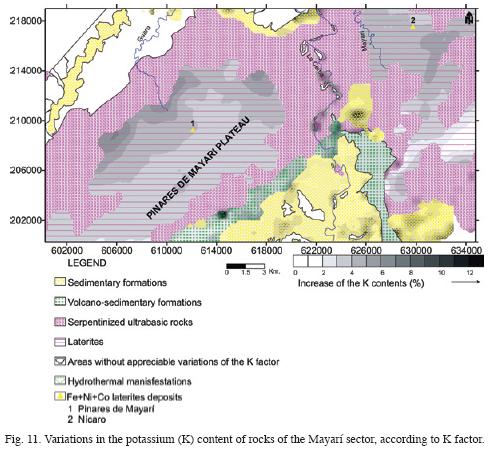
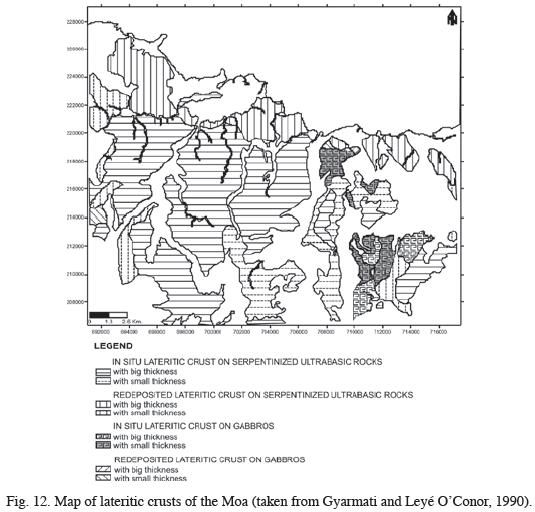
<body><![CDATA[<p align="justify"><font face="verdana" size="2">The inverse correlation between eTh and K in weathered serpentinized ultrabasic rocks, indicate the presence of laterites rich in Fe+Ni. This is because K isotope is lost during the weathering process of the igneous rocks while thorium was accumulated at the ferruginous material (Portnov, 1987).</font></p>     <p align="justify"><font face="verdana" size="2">With the application of the correlation matrices and the factor analysis method it was possible to observe lateral variations of some geological features, as follows. In serpentinized ultrabasic rocks, with the eU and eTh factor it was possible to find several things as; 1) To locate lateritic crust areas with larger thickness and correlated with the location of the most important Fe+Ni+Co laterites deposits in the region (<a href="/img/revistas/geoint/v47n2/a2t3.jpg" target="_blank">Table 3</a> and <a href="/img/revistas/geoint/v47n2/a2f9.jpg" target="_blank">Fig. 9a</a>). 2) To propose new laterite areas not previously mapped (<a href="/img/revistas/geoint/v47n2/a2f9.jpg" target="_blank">Fig. 9a</a>). This was demostrated by the redeposited laterites reported over sedimentary and volcanosedimentary formations in the region, showing a good agreement (Chang <i>et al., </i>1991). 3) To propose a qualitative idea of the thickness variation of laterites crusts (<a href="/img/revistas/geoint/v47n2/a2f9.jpg" target="_blank">Fig. 9a</a> and <a href="/img/revistas/geoint/v47n2/a2f11.jpg" target="_blank">10</a>). On <a href="#f10">Fig. 9b</a> a comparison of the thickness with the eU&#150;eTh factor in the lateritic crust of the Punta Gorda deposit is presented, through two cross sections, traced in <a href="/img/revistas/geoint/v47n2/a2f9.jpg" target="_blank">Fig. 9a</a>. The high correspondence between both parameters justifies the idea of inferring the variations of the thickness of the lateritic crust according to eU and eTh concentrations.</font></p>     <p align="center"><font face="verdana" size="2"><a name="f10"></a></font></p>     <p align="center"><font face="verdana" size="2"><img src="/img/revistas/geoint/v47n2/a2f10.jpg"></font></p>     <p align="justify"><font face="verdana" size="2">The K factor shows the presence of hydrothermal manifestations on serpentinized ultrabasic rocks (<a href="/img/revistas/geoint/v47n2/a2t3.jpg" target="_blank">Table 3</a>, <a href="#f12">Fig. 11</a>) previously reported by Navarrete and Rodr&iacute;guez (1991). These areas are also shown as negative magnetic anomalies (lower than &#150;25 nT) and alignments related with faults.</font></p>     <p align="center"><font face="verdana" size="2"><a name="f12"></a></font></p>     <p align="center"><font face="verdana" size="2"><img src="/img/revistas/geoint/v47n2/a2f12.jpg"></font></p>     <p align="justify"><font face="verdana" size="2">The Gyarmati and Ley&eacute; O'Conor (1990) map was used as reference for the analysis of laterites in situ and redeposited over serpentinized ultrabasic rocks and gabbros of the Moa region (<a href="#f13">Fig. 12</a>). From the statistical data analysis we found that redeposited laterites have higher content of eU and eTh than those in situ. Thicker laterite deposits over serpentinized ultrabasic rocks also have higher eU and eTh content (<a href="#t4">Table 4</a>).</font></p>     <p align="center"><font face="verdana" size="2"><a name="f13"></a></font></p>     <p align="center"><font face="verdana" size="2"><img src="/img/revistas/geoint/v47n2/a2f13.jpg"></font></p>     ]]></body>
<body><![CDATA[<p align="center"><font face="verdana" size="2"><a name="t4"></a></font></p>     <p align="center"><font face="verdana" size="2"><img src="/img/revistas/geoint/v47n2/a2t4.jpg"></font></p>     <p align="justify"><font face="verdana" size="2">The correlation of matrices in different laterites areas shows a significant relation in eU and eTh contents, related to chemical&#150;mineralogical characteristic and their genesis.</font></p>     <p align="justify"><font face="verdana" size="2">High positive correlations between eU and eTh are observed in thicker laterite areas or redeposited (<a href="#t5">Table 5</a>). There is also a positive correlation between eU, eTh and &Delta;T in areas of serpentinized ultrabasic rocks (<a href="#t6">Table 6</a>), suggesting a larger thickness of the lateritic crust over the serpentinized ultrabasic rocks, considering results in other investigations (Batista and Rodr&iacute;guez&#150;Infante, 2000; Zaigham and Mallick, 2000).</font></p>     <p align="center"><font face="verdana" size="2"><a name="t5"></a></font></p>     <p align="center"><font face="verdana" size="2"><img src="/img/revistas/geoint/v47n2/a2t5.jpg"></font></p>     <p align="center"><font face="verdana" size="2"><a name="t6"></a></font></p>     <p align="center"><font face="verdana" size="2"><img src="/img/revistas/geoint/v47n2/a2t6.jpg"></font></p>     <p align="justify"><font face="verdana" size="2">Laterites with variable thickness over serpentinized ultrabasic rocks show a positive correlation between eTh and &Delta;T (<a href="#t7">Table 7</a>). Considering that eTh content increases with weathering and rock aging (Galbraith and Saunders, 1983; Portnov, 1987; Braun <i>et al., </i>1993) and that &Delta;T increases as magnetic rock thickness increases (Karlsen and Olesen, 1996; Batista and Rodr&iacute;guez&#150;Infante, 2000), a relation is suggested between the formation time, crust development and magnetization. Therefore, larger laterites crust and larger thickness show a larger magnetic anomaly. This behavior was also present in larger thickness of serpentinized ultrabasic rocks.</font></p>     <p align="center"><font face="verdana" size="2"><a name="t7"></a></font></p>     ]]></body>
<body><![CDATA[<p align="center"><font face="verdana" size="2"><img src="/img/revistas/geoint/v47n2/a2t7.jpg"></font></p>     <p align="justify"><font face="verdana" size="2">The factor analysis for the Moa laterites shows lateral variations at the eU&#150;eTh factor (<a href="/img/revistas/geoint/v47n2/a2t3.jpg" target="_blank">Table 3</a>, <a href="/img/revistas/geoint/v47n2/a2f14.jpg" target="_blank">Fig. 13</a>), indicating variations in laterite thickness, according to <a href="#t8">Table 8</a> and cross sections of the <a href="#f10">Fig. 9b</a>. These variations are influenced by geomorphology, pH, Eh (oxidation potential), the water table, organic material content and modal per cent of mineral phases with high absortion capacity (ferrihydrite, goethite and amorphous percent; Jubeli <i>et al.</i>, 1998; Luo <i>et al., </i>2000). The production of uranium and thorium absortion by iron oxides and hydroxides in laterites requires a longer period of time and thicker laterite crusts (Jubeli <i>et al., </i>1998; Von Gunten <i>et al., </i>1999; Luo <i>et al., </i>2000).</font></p>     <p align="center"><font face="verdana" size="2"><a name="t8"></a></font></p>     <p align="center"><font face="verdana" size="2"><img src="/img/revistas/geoint/v47n2/a2t8.jpg"></font></p>     <p align="justify"><font face="verdana" size="2">The factor analysis shows lateral variations in K content (<a href="/img/revistas/geoint/v47n2/a2t3.jpg" target="_blank">Table 3</a>, <a href="#f15">Fig. 14</a>). Maximums are located at the central part of the region and at the SW part of the city, correlating some of them with hydrothermal alterations reported by Batista and Ramayo (2000). This could also be related with volcanic rocks or gabbros (sills and dikes) intruding the peridotites.</font></p>     <p align="center"><font face="verdana" size="2"><a name="f15"></a></font></p>     <p align="center"><font face="verdana" size="2"><img src="/img/revistas/geoint/v47n2/a2f15.jpg"></font></p>     <p align="justify"><font face="verdana" size="2">Hydrothermal alteration of Fe&#150;Ni&#150;Co enriched laterite deposits is useful for mining exploration and exploitation, because such alterations indicates the presence of silicates, which have negative effects on the metallurgic process (Rojas and Beyris, 1994). This kind of weathered crust presents gold mineralization associated whit quartz&#150;veins (Batista and Ramayo, 2000), as has been observed in the Caba&ntilde;as sector (SW Moa) with 30 and 52 ppb of gold.</font></p>     <p align="justify"><font face="verdana" size="2">We have also observed that higher eU concentrations are present in laterite areas with topographical depressions, where more organic material is present, as shown in <a href="/img/revistas/geoint/v47n2/a2f5.jpg" target="_blank">Fig. 5</a> at A and cross section I&#150;I, to the SW of Moa. This kind of correlation has been observed in other world sites, where the eU concentration increases during the leaching of the weathered rocks only when appropriate topographical conditions exists (Jubeli <i>et al., </i>1998).</font></p>     <p align="justify"><font face="verdana" size="2">The eTh factor shows lateral variations (<a href="/img/revistas/geoint/v47n2/a2t3.jpg" target="_blank">Table 3</a>, <a href="/img/revistas/geoint/v47n2/a2f16.jpg" target="_blank">Fig. 15</a>) related with formation time, developments and laterite thickness as seen in other world sites (Galbraith and Saunders, 1983; Portnov, 1987; Braun <i>et al., </i>1993). The inverse correlation of this parameter with &Delta;T, suggest a large development of lateritic crust, in serpentinized ultrabasic rocks but with lower thickness, as shown in <a href="/img/revistas/geoint/v47n2/a2f6.jpg" target="_blank">Fig. 6</a> with capital letter B.</font></p>     ]]></body>
<body><![CDATA[<p align="justify"><font face="verdana" size="2">&nbsp;</font></p>     <p align="justify"><font face="verdana" size="2"><b>Conclusions</b></font></p>     <p align="justify"><font face="verdana" size="2">The applications of airborne radioactivity and magnetic data have been useful to find the horizontal boundaries for known laterite crust, to propose new areas and to detect hydrothermal alteration over such laterites. High content in eU and eTh is common in laterites, but redeposited laterites shows even higher content. High values in those elements are also present in thicker, developed or redeposited laterites over serpentinized ultrabasic rocks. From the eU, eTh, K and &Delta;T relations, the laterite formation time, thickness, morphological features and possible hydrothermal alterations can be estimated. We found that Moa laterites have longer formation time and thickness than Mayari. Factors characterized the different kind of laterites, genesis differences and thickness variation. Lateral variation in eU&#150; eTh factor is related with thickness variation in laterites. eTh factor is related with the formation time, development and thickness of laterites. K factor shows the presence of hydrothermal alterations. This last is an important indicator of the presence of silicates that may affect the metallurgical processes and also is an indicator of the possible presence of precious metals on those alterations. Lateral variation of the total magnetic field and eU or eTh or K content is related with the laterite thickness and underlayered rocks.</font></p>     <p align="justify"><font face="verdana" size="2">&nbsp;</font></p>     <p align="justify"><font face="verdana" size="2"><b>Aknowledgements</b></font></p>     <p align="justify"><font face="verdana" size="2">To the Central Office of Mineral Recourses, for airborne data access from eastern Cuba. To the Geophysics Department of the Instituto de Geolog&iacute;a and Paleontolog&iacute;a. Also to professors Jos&eacute; Rodr&iacute;guez, Alina Rodr&iacute;guez, Joaqu&iacute;n Proenza and Antonio Rodr&iacute;guez for their valuable suggestions about this work. To Centro de Investigaci&oacute;n Cient&iacute;fica y Educaci&oacute;n Superior de Ensenada for financial support while this manuscript was in its final stage.</font></p>     <p align="justify"><font face="verdana" size="2">&nbsp;</font></p>     <p align="justify"><font face="verdana" size="2"><b>Bibliography</b></font></p>     <!-- ref --><p align="justify"><font face="verdana" size="2">Albear, J., I. Boyanov, K. Brezsnyanszky, R. Cabrera, V. Chejovich, B. Echevarr&iacute;a, R. Flores, F. Formell, G. Franco, I. Haydutov, M. Iturralde&#150;Vinent, I. Kantchev, I. Kartashov, V. Kostadinov, G. Mill&aacute;n, R. Myczynski, E. Nagy, J. Oro, L. Pe&ntilde;alver, K. Piotrowska, A. Pszczolkowski, J. Radoczj, J. Rudnicki and M. L. Somin, 1988. Geological map of Cuba, Scale 1:250 000, Academia de Ciencias de Cuba e Instituto de Geolog&iacute;a y Paleontolog&iacute;a, Cuba.</font>&nbsp;&nbsp;&nbsp;&nbsp;&nbsp;&nbsp;&nbsp;&nbsp;[&#160;<a href="javascript:void(0);" onclick="javascript: window.open('/scielo.php?script=sci_nlinks&ref=3899001&pid=S0016-7169200800020000200001&lng=','','width=640,height=500,resizable=yes,scrollbars=1,menubar=yes,');">Links</a>&#160;]<!-- end-ref --><!-- ref --><p align="justify"><font face="verdana" size="2">Alfonso&#150;Roche, J. R., 1989. Estad&iacute;stica en las ciencias geol&oacute;gicas. 2 ed. Ciudad Habana: Editorial ENPES, 2 t.</font>&nbsp;&nbsp;&nbsp;&nbsp;&nbsp;&nbsp;&nbsp;&nbsp;[&#160;<a href="javascript:void(0);" onclick="javascript: window.open('/scielo.php?script=sci_nlinks&ref=3899002&pid=S0016-7169200800020000200002&lng=','','width=640,height=500,resizable=yes,scrollbars=1,menubar=yes,');">Links</a>&#160;]<!-- end-ref --><!-- ref --><p align="justify"><font face="verdana" size="2">Batista, J. and A. Rodr&iacute;guez&#150;Infante, 2000. Particularidades geol&oacute;gicas del complejo ofiol&iacute;tico de Moa a partir de los datos aeromagn&eacute;ticos 1:50 000. Miner&iacute;a y Geolog&iacute;a, 17 (1), 17&#150;25.</font>&nbsp;&nbsp;&nbsp;&nbsp;&nbsp;&nbsp;&nbsp;&nbsp;[&#160;<a href="javascript:void(0);" onclick="javascript: window.open('/scielo.php?script=sci_nlinks&ref=3899003&pid=S0016-7169200800020000200003&lng=','','width=640,height=500,resizable=yes,scrollbars=1,menubar=yes,');">Links</a>&#160;]<!-- end-ref --><!-- ref --><p align="justify"><font face="verdana" size="2">Batista, J. and L. Ramayo, 2000. Utilizaci&oacute;n de datos aerogamma espectrom&eacute;tricos para la localizaci&oacute;n de zonas de alteraci&oacute;n hidrotermal en la regi&oacute;n Sagua&#150;Moa, Cuba oriental. Miner&iacute;a y Geolog&iacute;a, 17(3&#150;4), 3&#150;10.</font>&nbsp;&nbsp;&nbsp;&nbsp;&nbsp;&nbsp;&nbsp;&nbsp;[&#160;<a href="javascript:void(0);" onclick="javascript: window.open('/scielo.php?script=sci_nlinks&ref=3899004&pid=S0016-7169200800020000200004&lng=','','width=640,height=500,resizable=yes,scrollbars=1,menubar=yes,');">Links</a>&#160;]<!-- end-ref --><!-- ref --><p align="justify"><font face="verdana" size="2">Batista, J., J. Blanco and A. Vila, 2002a. Caracterizaci&oacute;n geol&oacute;gica de las &aacute;reas de desarrollo de lateritas de la regi&oacute;n Mayar&iacute;&#150;Moa a partir de datos aerogeof&iacute;sicos. II Congreso cubano de Geof&iacute;sica.</font>&nbsp;&nbsp;&nbsp;&nbsp;&nbsp;&nbsp;&nbsp;&nbsp;[&#160;<a href="javascript:void(0);" onclick="javascript: window.open('/scielo.php?script=sci_nlinks&ref=3899005&pid=S0016-7169200800020000200005&lng=','','width=640,height=500,resizable=yes,scrollbars=1,menubar=yes,');">Links</a>&#160;]<!-- end-ref --><!-- ref --><p align="justify"><font face="verdana" size="2">Batista, J., A. Rodr&iacute;guez&#150;Infante, J. Blanco and J. Proenza, 2002b. Estructura del macizo ofiol&iacute;tico de Moa (NE de Cuba) seg&uacute;n la interpretaci&oacute;n del levantamiento aeromagn&eacute;tico 1:50 000. Acta Geol&oacute;gica Hisp&aacute;nica, 37(4), 369&#150;387.</font>&nbsp;&nbsp;&nbsp;&nbsp;&nbsp;&nbsp;&nbsp;&nbsp;[&#160;<a href="javascript:void(0);" onclick="javascript: window.open('/scielo.php?script=sci_nlinks&ref=3899006&pid=S0016-7169200800020000200006&lng=','','width=640,height=500,resizable=yes,scrollbars=1,menubar=yes,');">Links</a>&#160;]<!-- end-ref --><!-- ref --><p align="justify"><font face="verdana" size="2">Bluman, A. G., 1992. Elementary statistic, 2 ed., Wm. C. Brown Communications, EUA, 713 p.</font>&nbsp;&nbsp;&nbsp;&nbsp;&nbsp;&nbsp;&nbsp;&nbsp;[&#160;<a href="javascript:void(0);" onclick="javascript: window.open('/scielo.php?script=sci_nlinks&ref=3899007&pid=S0016-7169200800020000200007&lng=','','width=640,height=500,resizable=yes,scrollbars=1,menubar=yes,');">Links</a>&#160;]<!-- end-ref --><!-- ref --><p align="justify"><font face="verdana" size="2">Braun, J. J., M. Pagel, A. Herbillon and C. Rocin, 1993. Mobilization and redistribution of REEs and thorium in a syenitic lateritic profile: A mass balance study. Geochimica et Cosmochimica Acta, 57, 4419&#150;4434.</font>&nbsp;&nbsp;&nbsp;&nbsp;&nbsp;&nbsp;&nbsp;&nbsp;[&#160;<a href="javascript:void(0);" onclick="javascript: window.open('/scielo.php?script=sci_nlinks&ref=3899008&pid=S0016-7169200800020000200008&lng=','','width=640,height=500,resizable=yes,scrollbars=1,menubar=yes,');">Links</a>&#160;]<!-- end-ref --><!-- ref --><p align="justify"><font face="verdana" size="2">Casas, I., J. Pablo, J. Jim&eacute;nez, M. E. Torrero, J. Bruno, E. Cera, R. J. Finch and R. C. Edwing, 1998. The role of pe, pH, and carbonate on the solubility of UO<sub>2 </sub>and uraninite under nominally reducing conditions. Geochimica Et Cosmochimica Acta, 62(13), 2223&#150;2231.</font>&nbsp;&nbsp;&nbsp;&nbsp;&nbsp;&nbsp;&nbsp;&nbsp;[&#160;<a href="javascript:void(0);" onclick="javascript: window.open('/scielo.php?script=sci_nlinks&ref=3899009&pid=S0016-7169200800020000200009&lng=','','width=640,height=500,resizable=yes,scrollbars=1,menubar=yes,');">Links</a>&#160;]<!-- end-ref --><!-- ref --><p align="justify"><font face="verdana" size="2">Chang, J. L., L. Corbea, F. Prieto, J. Hern&aacute;ndez and G. Brito, 1991. Informe sobre los resultados del levantamiento aerogeof&iacute;sico complejo en el territorio de las provincias Guant&aacute;namo y Holgu&iacute;n (Sector Guant&aacute;namo sur). O. N. R. M. Cuba, 260 p.</font>&nbsp;&nbsp;&nbsp;&nbsp;&nbsp;&nbsp;&nbsp;&nbsp;[&#160;<a href="javascript:void(0);" onclick="javascript: window.open('/scielo.php?script=sci_nlinks&ref=3899010&pid=S0016-7169200800020000200010&lng=','','width=640,height=500,resizable=yes,scrollbars=1,menubar=yes,');">Links</a>&#160;]<!-- end-ref --><!-- ref --><p align="justify"><font face="verdana" size="2">Cobiella, J. L., 2000. Jurassic and Cretaceous geological history of Cuba. International Geology Review, 42, 594&#150;616.</font>&nbsp;&nbsp;&nbsp;&nbsp;&nbsp;&nbsp;&nbsp;&nbsp;[&#160;<a href="javascript:void(0);" onclick="javascript: window.open('/scielo.php?script=sci_nlinks&ref=3899011&pid=S0016-7169200800020000200011&lng=','','width=640,height=500,resizable=yes,scrollbars=1,menubar=yes,');">Links</a>&#160;]<!-- end-ref --><!-- ref --><p align="justify"><font face="verdana" size="2">Eliopoulos, D. G., M. Economou&#150;Eliopoulos, 2000. Geochemical and mineralogical characteristics of Fe&#150;Ni&#150; and bauxitic&#150;laterite deposits of Greece. Ore Geology Review, 16, 41&#150;58.</font>&nbsp;&nbsp;&nbsp;&nbsp;&nbsp;&nbsp;&nbsp;&nbsp;[&#160;<a href="javascript:void(0);" onclick="javascript: window.open('/scielo.php?script=sci_nlinks&ref=3899012&pid=S0016-7169200800020000200012&lng=','','width=640,height=500,resizable=yes,scrollbars=1,menubar=yes,');">Links</a>&#160;]<!-- end-ref --><!-- ref --><p align="justify"><font face="verdana" size="2">Galbraith, J. H., D. F. Saunders, 1983. Rock classification by characteristics of aerial gamma&#150;ray measurements. Journal of Geochemical Exploration 18, 49&#150;73.</font>&nbsp;&nbsp;&nbsp;&nbsp;&nbsp;&nbsp;&nbsp;&nbsp;[&#160;<a href="javascript:void(0);" onclick="javascript: window.open('/scielo.php?script=sci_nlinks&ref=3899013&pid=S0016-7169200800020000200013&lng=','','width=640,height=500,resizable=yes,scrollbars=1,menubar=yes,');">Links</a>&#160;]<!-- end-ref --><!-- ref --><p align="justify"><font face="verdana" size="2">Gyarmati, P., J. Ley&eacute; O'Conor, 1990. Informe final sobre los trabajos de levantamiento geol&oacute;gico en escala 1:50 000 y b&uacute;squeda acompa&ntilde;ante en el pol&iacute;gono CAME V, Guant&aacute;namo. O.N.R.M., Cuba.</font>&nbsp;&nbsp;&nbsp;&nbsp;&nbsp;&nbsp;&nbsp;&nbsp;[&#160;<a href="javascript:void(0);" onclick="javascript: window.open('/scielo.php?script=sci_nlinks&ref=3899014&pid=S0016-7169200800020000200014&lng=','','width=640,height=500,resizable=yes,scrollbars=1,menubar=yes,');">Links</a>&#160;]<!-- end-ref --><!-- ref --><p align="justify"><font face="verdana" size="2">Hamed, S., 1995. Statistical evaluation of airborne gamma ray spectrometric data from the Magal Gabriel area, south eastern desert, Egypt. Journal of Applied Geophysics, 34 (1), 47&#150;54.</font>&nbsp;&nbsp;&nbsp;&nbsp;&nbsp;&nbsp;&nbsp;&nbsp;[&#160;<a href="javascript:void(0);" onclick="javascript: window.open('/scielo.php?script=sci_nlinks&ref=3899015&pid=S0016-7169200800020000200015&lng=','','width=640,height=500,resizable=yes,scrollbars=1,menubar=yes,');">Links</a>&#160;]<!-- end-ref --><!-- ref --><p align="justify"><font face="verdana" size="2">Iturralde&#150;Vinent, M. A., 1996. Geolog&iacute;a de las ofiolitas de Cuba. En: Iturralde&#150;Vinent, M. (ed.). Ofiolitas y arcos volc&aacute;nicos de Cuba. IGCP project 364. Special contribution n. 1, 83&#150;120.</font>&nbsp;&nbsp;&nbsp;&nbsp;&nbsp;&nbsp;&nbsp;&nbsp;[&#160;<a href="javascript:void(0);" onclick="javascript: window.open('/scielo.php?script=sci_nlinks&ref=3899016&pid=S0016-7169200800020000200016&lng=','','width=640,height=500,resizable=yes,scrollbars=1,menubar=yes,');">Links</a>&#160;]<!-- end-ref --><!-- ref --><p align="justify"><font face="verdana" size="2">Jubeli, Y., M. Al&#150;Hillal, G. Rajja and A. Al&#150;Ali, 1998. Radiometric profiles of uranium dispersal pattern adjacent to cretaceous phosphatic sediments in Wadi Qasser Al&#150;Hallabat basin, Central Syria. Explor. Mining Geol., 7 (4), 313&#150;319.</font>&nbsp;&nbsp;&nbsp;&nbsp;&nbsp;&nbsp;&nbsp;&nbsp;[&#160;<a href="javascript:void(0);" onclick="javascript: window.open('/scielo.php?script=sci_nlinks&ref=3899017&pid=S0016-7169200800020000200017&lng=','','width=640,height=500,resizable=yes,scrollbars=1,menubar=yes,');">Links</a>&#160;]<!-- end-ref --><!-- ref --><p align="justify"><font face="verdana" size="2">Karlsen, T. A. and O. Olesen, 1996. Airborne geophysical prospecting for ultramafite associated talc, Altermark, northern Norway. Journal of Applied Geophysics, 35 (4), 215&#150;236.</font>&nbsp;&nbsp;&nbsp;&nbsp;&nbsp;&nbsp;&nbsp;&nbsp;[&#160;<a href="javascript:void(0);" onclick="javascript: window.open('/scielo.php?script=sci_nlinks&ref=3899018&pid=S0016-7169200800020000200018&lng=','','width=640,height=500,resizable=yes,scrollbars=1,menubar=yes,');">Links</a>&#160;]<!-- end-ref --><!-- ref --><p align="justify"><font face="verdana" size="2">K&ouml;gler, K., G. Friedrich, R. Gatzweiler, F. Bianconi and S. Theis, 1987. Alpha&#150;Spectrometric disequilibrium determinations on sandstone&#150;type uranium mineralization in the lateritic environment of Tanzania. Monograph Series on Mineral Deposits 27, Gebr&uuml;der Borntraeger, Berl&iacute;n&#150;Stuttgart, 161&#150;174.</font>&nbsp;&nbsp;&nbsp;&nbsp;&nbsp;&nbsp;&nbsp;&nbsp;[&#160;<a href="javascript:void(0);" onclick="javascript: window.open('/scielo.php?script=sci_nlinks&ref=3899019&pid=S0016-7169200800020000200019&lng=','','width=640,height=500,resizable=yes,scrollbars=1,menubar=yes,');">Links</a>&#160;]<!-- end-ref --><!-- ref --><p align="justify"><font face="verdana" size="2">Lavaut, W., 1998 Tendencias geol&oacute;gicas del intemperismo de las rocas ultram&aacute;ficas en Cuba oriental. Revista Miner&iacute;a y Geolog&iacute;a, XV (1), 9&#150;16.</font>&nbsp;&nbsp;&nbsp;&nbsp;&nbsp;&nbsp;&nbsp;&nbsp;[&#160;<a href="javascript:void(0);" onclick="javascript: window.open('/scielo.php?script=sci_nlinks&ref=3899020&pid=S0016-7169200800020000200020&lng=','','width=640,height=500,resizable=yes,scrollbars=1,menubar=yes,');">Links</a>&#160;]<!-- end-ref --><!-- ref --><p align="justify"><font face="verdana" size="2">Luo, S., T&#150;L. Ku, R. Roback, M. Mureell, T. McLing, 2000. In&#150;situ radionuclide transport and preferential groundwater flows at INEEL (Idaho): decay&#150;series disequilibrium studies. Geochimica Et Cosmochimica Acta, 64 (5), 867&#150;881.</font>&nbsp;&nbsp;&nbsp;&nbsp;&nbsp;&nbsp;&nbsp;&nbsp;[&#160;<a href="javascript:void(0);" onclick="javascript: window.open('/scielo.php?script=sci_nlinks&ref=3899021&pid=S0016-7169200800020000200021&lng=','','width=640,height=500,resizable=yes,scrollbars=1,menubar=yes,');">Links</a>&#160;]<!-- end-ref --><!-- ref --><p align="justify"><font face="verdana" size="2">Marrison, D. F., 1967. Multivariate statistical methods. McGraw&#150;Hill Book Company. 338 p.</font>&nbsp;&nbsp;&nbsp;&nbsp;&nbsp;&nbsp;&nbsp;&nbsp;[&#160;<a href="javascript:void(0);" onclick="javascript: window.open('/scielo.php?script=sci_nlinks&ref=3899022&pid=S0016-7169200800020000200022&lng=','','width=640,height=500,resizable=yes,scrollbars=1,menubar=yes,');">Links</a>&#160;]<!-- end-ref --><!-- ref --><p align="justify"><font face="verdana" size="2">Navarrete, M., R. Rodr&iacute;guez, 1991. Generalizaci&oacute;n petrol&oacute;gica del corte ofiol&iacute;tico de los yacimientos de Pinares de Mayar&iacute;, Canad&aacute; y Luz Norte, Macizo Mayar&iacute;&#150;N&iacute;caro. Miner&iacute;a y Geolog&iacute;a, 8, 3&#150;10.</font>&nbsp;&nbsp;&nbsp;&nbsp;&nbsp;&nbsp;&nbsp;&nbsp;[&#160;<a href="javascript:void(0);" onclick="javascript: window.open('/scielo.php?script=sci_nlinks&ref=3899023&pid=S0016-7169200800020000200023&lng=','','width=640,height=500,resizable=yes,scrollbars=1,menubar=yes,');">Links</a>&#160;]<!-- end-ref --><!-- ref --><p align="justify"><font face="verdana" size="2">Portnov, A. M., 1987. Specialization of rocks toward potassium and thorium in relation to mineralization. International Geology Review, 29, 326&#150;344.</font>&nbsp;&nbsp;&nbsp;&nbsp;&nbsp;&nbsp;&nbsp;&nbsp;[&#160;<a href="javascript:void(0);" onclick="javascript: window.open('/scielo.php?script=sci_nlinks&ref=3899024&pid=S0016-7169200800020000200024&lng=','','width=640,height=500,resizable=yes,scrollbars=1,menubar=yes,');">Links</a>&#160;]<!-- end-ref --><!-- ref --><p align="justify"><font face="verdana" size="2">Proenza, J., F. Gervilla, J. C. Melgarejo, J. L. Bodinier, 1999a. Al&#150; and Cr&#150;rich chromitites from the Mayar&iacute;&#150;Baracoa ophiolitic belt (Eastern Cuba): Consequence of interaction between volatile&#150;rich melts and peridotites in suprasubduction mantle. Economic Geology, 94, 547&#150;566.</font>&nbsp;&nbsp;&nbsp;&nbsp;&nbsp;&nbsp;&nbsp;&nbsp;[&#160;<a href="javascript:void(0);" onclick="javascript: window.open('/scielo.php?script=sci_nlinks&ref=3899025&pid=S0016-7169200800020000200025&lng=','','width=640,height=500,resizable=yes,scrollbars=1,menubar=yes,');">Links</a>&#160;]<!-- end-ref --><!-- ref --><p align="justify"><font face="verdana" size="2">Proenza, J., J. C. Melgarejo, F. Gervilla and J. Sol&eacute;, 1999b. Los niveles de gabros bandeados en el macizo ofiol&iacute;tico Moa&#150;Baracoa (Cuba). Gabros caracter&iacute;sticos de cumulados de ofiolitas de zonas de suprasubducci&oacute;n. Miner&iacute;a y Geolog&iacute;a, 16 (2), 5&#150;12.</font>&nbsp;&nbsp;&nbsp;&nbsp;&nbsp;&nbsp;&nbsp;&nbsp;[&#160;<a href="javascript:void(0);" onclick="javascript: window.open('/scielo.php?script=sci_nlinks&ref=3899026&pid=S0016-7169200800020000200026&lng=','','width=640,height=500,resizable=yes,scrollbars=1,menubar=yes,');">Links</a>&#160;]<!-- end-ref --><!-- ref --><p align="justify"><font face="verdana" size="2">Reimann, C., P. Filzmoser and R. G. Garrett, 2002. Factor analysis applied to regional geochemical data: problems and possibilities. Applied Geochemistry, 17 (3), 85&#150;206.</font>&nbsp;&nbsp;&nbsp;&nbsp;&nbsp;&nbsp;&nbsp;&nbsp;[&#160;<a href="javascript:void(0);" onclick="javascript: window.open('/scielo.php?script=sci_nlinks&ref=3899027&pid=S0016-7169200800020000200027&lng=','','width=640,height=500,resizable=yes,scrollbars=1,menubar=yes,');">Links</a>&#160;]<!-- end-ref --><!-- ref --><p align="justify"><font face="verdana" size="2">R&iacute;os, Y. I. and J. L. Cobiella, 1984. Estudio preliminar del macizo de gabroides Quesigua de las ofiolitas del este de la provincia de Holgu&iacute;n. Miner&iacute;a y Geolog&iacute;a, 2, 109&#150;132.</font>&nbsp;&nbsp;&nbsp;&nbsp;&nbsp;&nbsp;&nbsp;&nbsp;[&#160;<a href="javascript:void(0);" onclick="javascript: window.open('/scielo.php?script=sci_nlinks&ref=3899028&pid=S0016-7169200800020000200028&lng=','','width=640,height=500,resizable=yes,scrollbars=1,menubar=yes,');">Links</a>&#160;]<!-- end-ref --><!-- ref --><p align="justify"><font face="verdana" size="2">Rojas, A. and P. Beyris, 1994. Influencia de la composici&oacute;n mineral&oacute;gica del material limon&iacute;tico de frentes de explotaci&oacute;n de la industria Pedro Soto Alba, Moa. Miner&iacute;a y geolog&iacute;a 11 (1), 13&#150;17.</font>&nbsp;&nbsp;&nbsp;&nbsp;&nbsp;&nbsp;&nbsp;&nbsp;[&#160;<a href="javascript:void(0);" onclick="javascript: window.open('/scielo.php?script=sci_nlinks&ref=3899029&pid=S0016-7169200800020000200029&lng=','','width=640,height=500,resizable=yes,scrollbars=1,menubar=yes,');">Links</a>&#160;]<!-- end-ref --><!-- ref --><p align="justify"><font face="verdana" size="2">Vogel, J. C., A. S. Talma, T. H. E. Heaton and J. Kronfeld, 1999. Evaluation the rate of migration of an uranium deposition front within the Uitenhage Aquifer. Journal of Geochemical Exploration, 66 (1&#150;2), 269&#150;276.</font>&nbsp;&nbsp;&nbsp;&nbsp;&nbsp;&nbsp;&nbsp;&nbsp;[&#160;<a href="javascript:void(0);" onclick="javascript: window.open('/scielo.php?script=sci_nlinks&ref=3899030&pid=S0016-7169200800020000200030&lng=','','width=640,height=500,resizable=yes,scrollbars=1,menubar=yes,');">Links</a>&#160;]<!-- end-ref --><!-- ref --><p align="justify"><font face="verdana" size="2">Von Gunten, H. R., E. Roessler, R. T. Lowson, P. D. Reid, S. A. Short, 1999. Distribution of uranium&#150; and thorium series radionuclides in mineral phases of a weathered lateritic transect of a uranium ore body. Chemical Geology. 160 (3), 225&#150;240.</font>&nbsp;&nbsp;&nbsp;&nbsp;&nbsp;&nbsp;&nbsp;&nbsp;[&#160;<a href="javascript:void(0);" onclick="javascript: window.open('/scielo.php?script=sci_nlinks&ref=3899031&pid=S0016-7169200800020000200031&lng=','','width=640,height=500,resizable=yes,scrollbars=1,menubar=yes,');">Links</a>&#160;]<!-- end-ref --><!-- ref --><p align="justify"><font face="verdana" size="2">Zaigham, N. A., K. A. Mallick, 2000. Bela ophiolite zone of southern Pakistan: Tectonic setting and associated mineral deposits. GSA Bulletin, 112 (3), 478&#150;489.</font>&nbsp;&nbsp;&nbsp;&nbsp;&nbsp;&nbsp;&nbsp;&nbsp;[&#160;<a href="javascript:void(0);" onclick="javascript: window.open('/scielo.php?script=sci_nlinks&ref=3899032&pid=S0016-7169200800020000200032&lng=','','width=640,height=500,resizable=yes,scrollbars=1,menubar=yes,');">Links</a>&#160;]<!-- end-ref --> ]]></body><back>
<ref-list>
<ref id="B1">
<nlm-citation citation-type="book">
<person-group person-group-type="author">
<name>
<surname><![CDATA[Albear]]></surname>
<given-names><![CDATA[J.]]></given-names>
</name>
<name>
<surname><![CDATA[Boyanov]]></surname>
<given-names><![CDATA[I.]]></given-names>
</name>
<name>
<surname><![CDATA[Brezsnyanszky]]></surname>
<given-names><![CDATA[K.]]></given-names>
</name>
<name>
<surname><![CDATA[Cabrera]]></surname>
<given-names><![CDATA[R.]]></given-names>
</name>
<name>
<surname><![CDATA[Chejovich]]></surname>
<given-names><![CDATA[V.]]></given-names>
</name>
<name>
<surname><![CDATA[Echevarría]]></surname>
<given-names><![CDATA[B.]]></given-names>
</name>
<name>
<surname><![CDATA[Flores]]></surname>
<given-names><![CDATA[R.]]></given-names>
</name>
<name>
<surname><![CDATA[Formell]]></surname>
<given-names><![CDATA[F.]]></given-names>
</name>
<name>
<surname><![CDATA[Franco]]></surname>
<given-names><![CDATA[G.]]></given-names>
</name>
<name>
<surname><![CDATA[Haydutov]]></surname>
<given-names><![CDATA[I.]]></given-names>
</name>
<name>
<surname><![CDATA[Iturralde-Vinent]]></surname>
<given-names><![CDATA[M.]]></given-names>
</name>
<name>
<surname><![CDATA[Kantchev]]></surname>
<given-names><![CDATA[I.]]></given-names>
</name>
<name>
<surname><![CDATA[Kartashov]]></surname>
<given-names><![CDATA[I.]]></given-names>
</name>
<name>
<surname><![CDATA[Kostadinov]]></surname>
<given-names><![CDATA[V.]]></given-names>
</name>
<name>
<surname><![CDATA[Millán]]></surname>
<given-names><![CDATA[G.]]></given-names>
</name>
<name>
<surname><![CDATA[Myczynski]]></surname>
<given-names><![CDATA[R.]]></given-names>
</name>
<name>
<surname><![CDATA[Nagy]]></surname>
<given-names><![CDATA[E.]]></given-names>
</name>
<name>
<surname><![CDATA[Oro]]></surname>
<given-names><![CDATA[J.]]></given-names>
</name>
<name>
<surname><![CDATA[Peñalver]]></surname>
<given-names><![CDATA[L.]]></given-names>
</name>
<name>
<surname><![CDATA[Piotrowska]]></surname>
<given-names><![CDATA[K.]]></given-names>
</name>
<name>
<surname><![CDATA[Pszczolkowski]]></surname>
<given-names><![CDATA[A.]]></given-names>
</name>
<name>
<surname><![CDATA[Radoczj]]></surname>
<given-names><![CDATA[J.]]></given-names>
</name>
<name>
<surname><![CDATA[Rudnicki]]></surname>
<given-names><![CDATA[J.]]></given-names>
</name>
<name>
<surname><![CDATA[Somin]]></surname>
<given-names><![CDATA[M. L.]]></given-names>
</name>
</person-group>
<source><![CDATA[Geological map of Cuba, Scale 1:250 000]]></source>
<year>1988</year>
<publisher-name><![CDATA[Academia de Ciencias de Cuba e Instituto de Geología y Paleontología]]></publisher-name>
</nlm-citation>
</ref>
<ref id="B2">
<nlm-citation citation-type="book">
<person-group person-group-type="author">
<name>
<surname><![CDATA[Alfonso-Roche]]></surname>
<given-names><![CDATA[J. R.]]></given-names>
</name>
</person-group>
<source><![CDATA[Estadística en las ciencias geológicas]]></source>
<year>1989</year>
<volume>2</volume>
<edition>2</edition>
<publisher-loc><![CDATA[Ciudad Habana ]]></publisher-loc>
<publisher-name><![CDATA[Editorial ENPES]]></publisher-name>
</nlm-citation>
</ref>
<ref id="B3">
<nlm-citation citation-type="journal">
<person-group person-group-type="author">
<name>
<surname><![CDATA[Batista]]></surname>
<given-names><![CDATA[J.]]></given-names>
</name>
<name>
<surname><![CDATA[Rodríguez-Infante]]></surname>
<given-names><![CDATA[A.]]></given-names>
</name>
</person-group>
<article-title xml:lang="es"><![CDATA[Particularidades geológicas del complejo ofiolítico de Moa a partir de los datos aeromagnéticos 1:50 000]]></article-title>
<source><![CDATA[Minería y Geología]]></source>
<year>2000</year>
<volume>17</volume>
<numero>1</numero>
<issue>1</issue>
<page-range>17-25</page-range></nlm-citation>
</ref>
<ref id="B4">
<nlm-citation citation-type="journal">
<person-group person-group-type="author">
<name>
<surname><![CDATA[Batista]]></surname>
<given-names><![CDATA[J.]]></given-names>
</name>
<name>
<surname><![CDATA[Ramayo]]></surname>
<given-names><![CDATA[L.]]></given-names>
</name>
</person-group>
<article-title xml:lang="es"><![CDATA[Utilización de datos aerogamma espectrométricos para la localización de zonas de alteración hidrotermal en la región Sagua-Moa, Cuba oriental]]></article-title>
<source><![CDATA[Minería y Geología]]></source>
<year>2000</year>
<volume>17</volume>
<numero>3-4</numero>
<issue>3-4</issue>
<page-range>3-10</page-range></nlm-citation>
</ref>
<ref id="B5">
<nlm-citation citation-type="confpro">
<person-group person-group-type="author">
<name>
<surname><![CDATA[Batista]]></surname>
<given-names><![CDATA[J.]]></given-names>
</name>
<name>
<surname><![CDATA[Blanco]]></surname>
<given-names><![CDATA[J.]]></given-names>
</name>
<name>
<surname><![CDATA[Vila]]></surname>
<given-names><![CDATA[A.]]></given-names>
</name>
</person-group>
<article-title xml:lang="es"><![CDATA[Caracterización geológica de las áreas de desarrollo de lateritas de la región Mayarí-Moa a partir de datos aerogeofísicos]]></article-title>
<source><![CDATA[]]></source>
<year>2002</year>
<conf-name><![CDATA[ II Congreso cubano de Geofísica]]></conf-name>
<conf-loc> </conf-loc>
</nlm-citation>
</ref>
<ref id="B6">
<nlm-citation citation-type="journal">
<person-group person-group-type="author">
<name>
<surname><![CDATA[Batista]]></surname>
<given-names><![CDATA[J.]]></given-names>
</name>
<name>
<surname><![CDATA[Rodríguez-Infante]]></surname>
<given-names><![CDATA[A.]]></given-names>
</name>
<name>
<surname><![CDATA[Blanco]]></surname>
<given-names><![CDATA[J.]]></given-names>
</name>
<name>
<surname><![CDATA[Proenza]]></surname>
<given-names><![CDATA[J.]]></given-names>
</name>
</person-group>
<article-title xml:lang="es"><![CDATA[Estructura del macizo ofiolítico de Moa (NE de Cuba) según la interpretación del levantamiento aeromagnético 1:50 000]]></article-title>
<source><![CDATA[Acta Geológica Hispánica]]></source>
<year>2002</year>
<volume>37</volume>
<numero>4</numero>
<issue>4</issue>
<page-range>369-387</page-range></nlm-citation>
</ref>
<ref id="B7">
<nlm-citation citation-type="book">
<person-group person-group-type="author">
<name>
<surname><![CDATA[Bluman]]></surname>
<given-names><![CDATA[A. G.]]></given-names>
</name>
</person-group>
<source><![CDATA[Elementary statistic]]></source>
<year>1992</year>
<edition>2</edition>
<page-range>713</page-range><publisher-name><![CDATA[Wm. C. Brown Communications]]></publisher-name>
</nlm-citation>
</ref>
<ref id="B8">
<nlm-citation citation-type="journal">
<person-group person-group-type="author">
<name>
<surname><![CDATA[Braun]]></surname>
<given-names><![CDATA[J. J.]]></given-names>
</name>
<name>
<surname><![CDATA[Pagel]]></surname>
<given-names><![CDATA[M.]]></given-names>
</name>
<name>
<surname><![CDATA[Herbillon]]></surname>
<given-names><![CDATA[A.]]></given-names>
</name>
<name>
<surname><![CDATA[Rocin]]></surname>
<given-names><![CDATA[C.]]></given-names>
</name>
</person-group>
<article-title xml:lang="en"><![CDATA[Mobilization and redistribution of REEs and thorium in a syenitic lateritic profile: A mass balance study]]></article-title>
<source><![CDATA[Geochimica et Cosmochimica Acta]]></source>
<year>1993</year>
<numero>57</numero>
<issue>57</issue>
<page-range>4419-4434</page-range></nlm-citation>
</ref>
<ref id="B9">
<nlm-citation citation-type="journal">
<person-group person-group-type="author">
<name>
<surname><![CDATA[Casas]]></surname>
<given-names><![CDATA[I.]]></given-names>
</name>
<name>
<surname><![CDATA[Pablo]]></surname>
<given-names><![CDATA[J.]]></given-names>
</name>
<name>
<surname><![CDATA[Jiménez]]></surname>
<given-names><![CDATA[J.]]></given-names>
</name>
<name>
<surname><![CDATA[Torrero]]></surname>
<given-names><![CDATA[M. E.]]></given-names>
</name>
<name>
<surname><![CDATA[Bruno]]></surname>
<given-names><![CDATA[J.]]></given-names>
</name>
<name>
<surname><![CDATA[Cera]]></surname>
<given-names><![CDATA[E.]]></given-names>
</name>
<name>
<surname><![CDATA[Finch]]></surname>
<given-names><![CDATA[R. J.]]></given-names>
</name>
<name>
<surname><![CDATA[Edwing]]></surname>
<given-names><![CDATA[R. C.]]></given-names>
</name>
</person-group>
<article-title xml:lang="en"><![CDATA[The role of pe, pH, and carbonate on the solubility of UO2 and uraninite under nominally reducing conditions]]></article-title>
<source><![CDATA[Geochimica Et Cosmochimica Acta]]></source>
<year>1998</year>
<volume>62</volume>
<numero>13</numero>
<issue>13</issue>
<page-range>2223-2231</page-range></nlm-citation>
</ref>
<ref id="B10">
<nlm-citation citation-type="book">
<person-group person-group-type="author">
<name>
<surname><![CDATA[Chang]]></surname>
<given-names><![CDATA[J. L.]]></given-names>
</name>
<name>
<surname><![CDATA[Corbea]]></surname>
<given-names><![CDATA[L.]]></given-names>
</name>
<name>
<surname><![CDATA[Prieto]]></surname>
<given-names><![CDATA[F.]]></given-names>
</name>
<name>
<surname><![CDATA[Hernández]]></surname>
<given-names><![CDATA[J.]]></given-names>
</name>
<name>
<surname><![CDATA[Brito]]></surname>
<given-names><![CDATA[G.]]></given-names>
</name>
</person-group>
<source><![CDATA[Informe sobre los resultados del levantamiento aerogeofísico complejo en el territorio de las provincias Guantánamo y Holguín (Sector Guantánamo sur)]]></source>
<year>1991</year>
<page-range>260</page-range><publisher-name><![CDATA[O. N. R. M.]]></publisher-name>
</nlm-citation>
</ref>
<ref id="B11">
<nlm-citation citation-type="journal">
<person-group person-group-type="author">
<name>
<surname><![CDATA[Cobiella]]></surname>
<given-names><![CDATA[J. L.]]></given-names>
</name>
</person-group>
<article-title xml:lang="en"><![CDATA[Jurassic and Cretaceous geological history of Cuba]]></article-title>
<source><![CDATA[International Geology Review]]></source>
<year>2000</year>
<numero>42</numero>
<issue>42</issue>
<page-range>594-616</page-range></nlm-citation>
</ref>
<ref id="B12">
<nlm-citation citation-type="journal">
<person-group person-group-type="author">
<name>
<surname><![CDATA[Eliopoulos]]></surname>
<given-names><![CDATA[D. G.]]></given-names>
</name>
<name>
<surname><![CDATA[Economou-Eliopoulos]]></surname>
<given-names><![CDATA[M.]]></given-names>
</name>
</person-group>
<article-title xml:lang="en"><![CDATA[Geochemical and mineralogical characteristics of Fe-Ni- and bauxitic-laterite deposits of Greece]]></article-title>
<source><![CDATA[Ore Geology Review]]></source>
<year>2000</year>
<numero>16</numero>
<issue>16</issue>
<page-range>41-58</page-range></nlm-citation>
</ref>
<ref id="B13">
<nlm-citation citation-type="journal">
<person-group person-group-type="author">
<name>
<surname><![CDATA[Galbraith]]></surname>
<given-names><![CDATA[J. H.]]></given-names>
</name>
<name>
<surname><![CDATA[Saunders]]></surname>
<given-names><![CDATA[D. F.]]></given-names>
</name>
</person-group>
<article-title xml:lang="en"><![CDATA[Rock classification by characteristics of aerial gamma-ray measurements]]></article-title>
<source><![CDATA[Journal of Geochemical Exploration]]></source>
<year>1983</year>
<numero>18</numero>
<issue>18</issue>
<page-range>49-73</page-range></nlm-citation>
</ref>
<ref id="B14">
<nlm-citation citation-type="book">
<person-group person-group-type="author">
<name>
<surname><![CDATA[Gyarmati]]></surname>
<given-names><![CDATA[P.]]></given-names>
</name>
<name>
<surname><![CDATA[Leyé O'Conor]]></surname>
<given-names><![CDATA[J.]]></given-names>
</name>
</person-group>
<source><![CDATA[Informe final sobre los trabajos de levantamiento geológico en escala 1:50 000 y búsqueda acompañante en el polígono CAME V, Guantánamo]]></source>
<year>1990</year>
<publisher-name><![CDATA[O.N.R.M.]]></publisher-name>
</nlm-citation>
</ref>
<ref id="B15">
<nlm-citation citation-type="journal">
<person-group person-group-type="author">
<name>
<surname><![CDATA[Hamed]]></surname>
<given-names><![CDATA[S.]]></given-names>
</name>
</person-group>
<article-title xml:lang="en"><![CDATA[Statistical evaluation of airborne gamma ray spectrometric data from the Magal Gabriel area, south eastern desert, Egypt]]></article-title>
<source><![CDATA[Journal of Applied Geophysics]]></source>
<year>1995</year>
<volume>34</volume>
<numero>1</numero>
<issue>1</issue>
<page-range>47-54</page-range></nlm-citation>
</ref>
<ref id="B16">
<nlm-citation citation-type="">
<person-group person-group-type="author">
<name>
<surname><![CDATA[Iturralde-Vinent]]></surname>
<given-names><![CDATA[M. A.]]></given-names>
</name>
</person-group>
<article-title xml:lang="es"><![CDATA[Geología de las ofiolitas de Cuba]]></article-title>
<person-group person-group-type="editor">
<name>
<surname><![CDATA[Iturralde-Vinent]]></surname>
<given-names><![CDATA[M.]]></given-names>
</name>
</person-group>
<source><![CDATA[Ofiolitas y arcos volcánicos de Cuba]]></source>
<year>1996</year>
<page-range>83-120</page-range></nlm-citation>
</ref>
<ref id="B17">
<nlm-citation citation-type="journal">
<person-group person-group-type="author">
<name>
<surname><![CDATA[Jubeli]]></surname>
<given-names><![CDATA[Y.]]></given-names>
</name>
<name>
<surname><![CDATA[Al-Hillal]]></surname>
<given-names><![CDATA[M.]]></given-names>
</name>
<name>
<surname><![CDATA[Rajja]]></surname>
<given-names><![CDATA[G.]]></given-names>
</name>
<name>
<surname><![CDATA[Al-Ali]]></surname>
<given-names><![CDATA[A.]]></given-names>
</name>
</person-group>
<article-title xml:lang="en"><![CDATA[Radiometric profiles of uranium dispersal pattern adjacent to cretaceous phosphatic sediments in Wadi Qasser Al-Hallabat basin, Central Syria]]></article-title>
<source><![CDATA[Explor. Mining Geol.]]></source>
<year>1998</year>
<volume>7</volume>
<numero>4</numero>
<issue>4</issue>
<page-range>313-319</page-range></nlm-citation>
</ref>
<ref id="B18">
<nlm-citation citation-type="journal">
<person-group person-group-type="author">
<name>
<surname><![CDATA[Karlsen]]></surname>
<given-names><![CDATA[T. A.]]></given-names>
</name>
<name>
<surname><![CDATA[Olesen]]></surname>
<given-names><![CDATA[O.]]></given-names>
</name>
</person-group>
<article-title xml:lang="en"><![CDATA[Airborne geophysical prospecting for ultramafite associated talc, Altermark, northern Norway]]></article-title>
<source><![CDATA[Journal of Applied Geophysics]]></source>
<year>1996</year>
<volume>35</volume>
<numero>4</numero>
<issue>4</issue>
<page-range>215-236</page-range></nlm-citation>
</ref>
<ref id="B19">
<nlm-citation citation-type="journal">
<person-group person-group-type="author">
<name>
<surname><![CDATA[Kögler]]></surname>
<given-names><![CDATA[K.]]></given-names>
</name>
<name>
<surname><![CDATA[Friedrich]]></surname>
<given-names><![CDATA[G.]]></given-names>
</name>
<name>
<surname><![CDATA[Gatzweiler]]></surname>
<given-names><![CDATA[R.]]></given-names>
</name>
<name>
<surname><![CDATA[Bianconi]]></surname>
<given-names><![CDATA[F.]]></given-names>
</name>
<name>
<surname><![CDATA[Theis]]></surname>
<given-names><![CDATA[S.]]></given-names>
</name>
</person-group>
<article-title xml:lang="en"><![CDATA[Alpha-Spectrometric disequilibrium determinations on sandstone-type uranium mineralization in the lateritic environment of Tanzania]]></article-title>
<source><![CDATA[Monograph Series on Mineral Deposits]]></source>
<year>1987</year>
<numero>27</numero>
<issue>27</issue>
<page-range>161-174</page-range><publisher-loc><![CDATA[BerlínStuttgart ]]></publisher-loc>
<publisher-name><![CDATA[Gebrüder Borntraeger]]></publisher-name>
</nlm-citation>
</ref>
<ref id="B20">
<nlm-citation citation-type="journal">
<person-group person-group-type="author">
<name>
<surname><![CDATA[Lavaut]]></surname>
<given-names><![CDATA[W.]]></given-names>
</name>
</person-group>
<article-title xml:lang="es"><![CDATA[Tendencias geológicas del intemperismo de las rocas ultramáficas en Cuba oriental]]></article-title>
<source><![CDATA[Revista Minería y Geología]]></source>
<year>1998</year>
<volume>XV</volume><volume>1</volume>
<page-range>9-16</page-range></nlm-citation>
</ref>
<ref id="B21">
<nlm-citation citation-type="journal">
<person-group person-group-type="author">
<name>
<surname><![CDATA[Luo]]></surname>
<given-names><![CDATA[S.]]></given-names>
</name>
<name>
<surname><![CDATA[Ku]]></surname>
<given-names><![CDATA[T-L.]]></given-names>
</name>
<name>
<surname><![CDATA[Roback]]></surname>
<given-names><![CDATA[R.]]></given-names>
</name>
<name>
<surname><![CDATA[Mureell]]></surname>
<given-names><![CDATA[M.]]></given-names>
</name>
<name>
<surname><![CDATA[McLing]]></surname>
<given-names><![CDATA[T.]]></given-names>
</name>
</person-group>
<article-title xml:lang="en"><![CDATA[In-situ radionuclide transport and preferential groundwater flows at INEEL (Idaho): decay-series disequilibrium studies]]></article-title>
<source><![CDATA[Geochimica Et Cosmochimica Acta]]></source>
<year>2000</year>
<volume>64</volume>
<numero>5</numero>
<issue>5</issue>
<page-range>867-881</page-range></nlm-citation>
</ref>
<ref id="B22">
<nlm-citation citation-type="book">
<person-group person-group-type="author">
<name>
<surname><![CDATA[Marrison]]></surname>
<given-names><![CDATA[D. F.]]></given-names>
</name>
</person-group>
<source><![CDATA[Multivariate statistical methods]]></source>
<year>1967</year>
<page-range>338</page-range><publisher-name><![CDATA[McGraw-Hill Book Company]]></publisher-name>
</nlm-citation>
</ref>
<ref id="B23">
<nlm-citation citation-type="journal">
<person-group person-group-type="author">
<name>
<surname><![CDATA[Navarrete]]></surname>
<given-names><![CDATA[M.]]></given-names>
</name>
<name>
<surname><![CDATA[Rodríguez]]></surname>
<given-names><![CDATA[R.]]></given-names>
</name>
</person-group>
<article-title xml:lang="es"><![CDATA[Generalización petrológica del corte ofiolítico de los yacimientos de Pinares de Mayarí, Canadá y Luz Norte, Macizo Mayarí-Nícaro]]></article-title>
<source><![CDATA[Minería y Geología]]></source>
<year>1991</year>
<numero>8</numero>
<issue>8</issue>
<page-range>3-10</page-range></nlm-citation>
</ref>
<ref id="B24">
<nlm-citation citation-type="journal">
<person-group person-group-type="author">
<name>
<surname><![CDATA[Portnov]]></surname>
<given-names><![CDATA[A. M.]]></given-names>
</name>
</person-group>
<article-title xml:lang="en"><![CDATA[Specialization of rocks toward potassium and thorium in relation to mineralization]]></article-title>
<source><![CDATA[International Geology Review]]></source>
<year>1987</year>
<numero>29</numero>
<issue>29</issue>
<page-range>326-344</page-range></nlm-citation>
</ref>
<ref id="B25">
<nlm-citation citation-type="journal">
<person-group person-group-type="author">
<name>
<surname><![CDATA[Proenza]]></surname>
<given-names><![CDATA[J.]]></given-names>
</name>
<name>
<surname><![CDATA[Gervilla]]></surname>
<given-names><![CDATA[F.]]></given-names>
</name>
<name>
<surname><![CDATA[Melgarejo]]></surname>
<given-names><![CDATA[J. C.]]></given-names>
</name>
<name>
<surname><![CDATA[Bodinier]]></surname>
<given-names><![CDATA[J. L.]]></given-names>
</name>
</person-group>
<article-title xml:lang="en"><![CDATA[Al- and Cr-rich chromitites from the Mayarí-Baracoa ophiolitic belt (Eastern Cuba): Consequence of interaction between volatile-rich melts and peridotites in suprasubduction mantle]]></article-title>
<source><![CDATA[Economic Geology]]></source>
<year>1999</year>
<numero>94</numero>
<issue>94</issue>
<page-range>547-566</page-range></nlm-citation>
</ref>
<ref id="B26">
<nlm-citation citation-type="journal">
<person-group person-group-type="author">
<name>
<surname><![CDATA[Proenza]]></surname>
<given-names><![CDATA[J.]]></given-names>
</name>
<name>
<surname><![CDATA[Melgarejo]]></surname>
<given-names><![CDATA[J. C.]]></given-names>
</name>
<name>
<surname><![CDATA[Gervilla]]></surname>
<given-names><![CDATA[F.]]></given-names>
</name>
<name>
<surname><![CDATA[Solé]]></surname>
<given-names><![CDATA[J.]]></given-names>
</name>
</person-group>
<article-title xml:lang="en"><![CDATA[Los niveles de gabros bandeados en el macizo ofiolítico Moa-Baracoa (Cuba): Gabros característicos de cumulados de ofiolitas de zonas de suprasubducción]]></article-title>
<source><![CDATA[Minería y Geología]]></source>
<year>1999</year>
<volume>16</volume>
<numero>2</numero>
<issue>2</issue>
<page-range>5-12</page-range></nlm-citation>
</ref>
<ref id="B27">
<nlm-citation citation-type="journal">
<person-group person-group-type="author">
<name>
<surname><![CDATA[Reimann]]></surname>
<given-names><![CDATA[C.]]></given-names>
</name>
<name>
<surname><![CDATA[Filzmoser]]></surname>
<given-names><![CDATA[P.]]></given-names>
</name>
<name>
<surname><![CDATA[Garrett]]></surname>
<given-names><![CDATA[R. G.]]></given-names>
</name>
</person-group>
<article-title xml:lang="en"><![CDATA[Factor analysis applied to regional geochemical data: problems and possibilities]]></article-title>
<source><![CDATA[Applied Geochemistry]]></source>
<year>2002</year>
<volume>17</volume>
<numero>3</numero>
<issue>3</issue>
<page-range>85-206</page-range></nlm-citation>
</ref>
<ref id="B28">
<nlm-citation citation-type="journal">
<person-group person-group-type="author">
<name>
<surname><![CDATA[Ríos]]></surname>
<given-names><![CDATA[Y. I.]]></given-names>
</name>
<name>
<surname><![CDATA[Cobiella]]></surname>
<given-names><![CDATA[J. L.]]></given-names>
</name>
</person-group>
<article-title xml:lang="es"><![CDATA[Estudio preliminar del macizo de gabroides Quesigua de las ofiolitas del este de la provincia de Holguín]]></article-title>
<source><![CDATA[Minería y Geología]]></source>
<year>1984</year>
<numero>2</numero>
<issue>2</issue>
<page-range>109-132</page-range></nlm-citation>
</ref>
<ref id="B29">
<nlm-citation citation-type="journal">
<person-group person-group-type="author">
<name>
<surname><![CDATA[Rojas]]></surname>
<given-names><![CDATA[A.]]></given-names>
</name>
<name>
<surname><![CDATA[Beyris]]></surname>
<given-names><![CDATA[P.]]></given-names>
</name>
</person-group>
<article-title xml:lang="es"><![CDATA[Influencia de la composición mineralógica del material limonítico de frentes de explotación de la industria Pedro Soto Alba, Moa]]></article-title>
<source><![CDATA[Minería y geología]]></source>
<year>1994</year>
<volume>11</volume>
<numero>1</numero>
<issue>1</issue>
<page-range>13-17</page-range></nlm-citation>
</ref>
<ref id="B30">
<nlm-citation citation-type="journal">
<person-group person-group-type="author">
<name>
<surname><![CDATA[Vogel]]></surname>
<given-names><![CDATA[J. C.]]></given-names>
</name>
<name>
<surname><![CDATA[Talma]]></surname>
<given-names><![CDATA[A. S.]]></given-names>
</name>
<name>
<surname><![CDATA[Heaton]]></surname>
<given-names><![CDATA[T. H. E.]]></given-names>
</name>
<name>
<surname><![CDATA[Kronfeld]]></surname>
<given-names><![CDATA[J.]]></given-names>
</name>
</person-group>
<article-title xml:lang="en"><![CDATA[Evaluation the rate of migration of an uranium deposition front within the Uitenhage Aquifer]]></article-title>
<source><![CDATA[Journal of Geochemical Exploration]]></source>
<year>1999</year>
<volume>66</volume>
<numero>1-2</numero>
<issue>1-2</issue>
<page-range>269-276</page-range></nlm-citation>
</ref>
<ref id="B31">
<nlm-citation citation-type="journal">
<person-group person-group-type="author">
<name>
<surname><![CDATA[Von Gunten]]></surname>
<given-names><![CDATA[H. R.]]></given-names>
</name>
<name>
<surname><![CDATA[Roessler]]></surname>
<given-names><![CDATA[E.]]></given-names>
</name>
<name>
<surname><![CDATA[Lowson]]></surname>
<given-names><![CDATA[R. T.]]></given-names>
</name>
<name>
<surname><![CDATA[Reid]]></surname>
<given-names><![CDATA[P. D.]]></given-names>
</name>
<name>
<surname><![CDATA[Short]]></surname>
<given-names><![CDATA[S. A.]]></given-names>
</name>
</person-group>
<article-title xml:lang="en"><![CDATA[Distribution of uranium- and thorium series radionuclides in mineral phases of a weathered lateritic transect of a uranium ore body]]></article-title>
<source><![CDATA[Chemical Geology]]></source>
<year>1999</year>
<volume>160</volume>
<numero>3</numero>
<issue>3</issue>
<page-range>225-240</page-range></nlm-citation>
</ref>
<ref id="B32">
<nlm-citation citation-type="journal">
<person-group person-group-type="author">
<name>
<surname><![CDATA[Zaigham]]></surname>
<given-names><![CDATA[N. A.]]></given-names>
</name>
<name>
<surname><![CDATA[Mallick]]></surname>
<given-names><![CDATA[K. A.]]></given-names>
</name>
</person-group>
<article-title xml:lang="en"><![CDATA[Bela ophiolite zone of southern Pakistan: Tectonic setting and associated mineral deposits]]></article-title>
<source><![CDATA[GSA Bulletin]]></source>
<year>2000</year>
<volume>112</volume>
<numero>3</numero>
<issue>3</issue>
<page-range>478-489</page-range></nlm-citation>
</ref>
</ref-list>
</back>
</article>