<?xml version="1.0" encoding="ISO-8859-1"?><article xmlns:mml="http://www.w3.org/1998/Math/MathML" xmlns:xlink="http://www.w3.org/1999/xlink" xmlns:xsi="http://www.w3.org/2001/XMLSchema-instance">
<front>
<journal-meta>
<journal-id>0016-7169</journal-id>
<journal-title><![CDATA[Geofísica internacional]]></journal-title>
<abbrev-journal-title><![CDATA[Geofís. Intl]]></abbrev-journal-title>
<issn>0016-7169</issn>
<publisher>
<publisher-name><![CDATA[Universidad Nacional Autónoma de México, Instituto de Geofísica]]></publisher-name>
</publisher>
</journal-meta>
<article-meta>
<article-id>S0016-71692006000200005</article-id>
<title-group>
<article-title xml:lang="en"><![CDATA[Cooling rate effects on the magnetization of volcanic rocks: Some implications for paleointensity determination]]></article-title>
</title-group>
<contrib-group>
<contrib contrib-type="author">
<name>
<surname><![CDATA[Morales]]></surname>
<given-names><![CDATA[Juan]]></given-names>
</name>
<xref ref-type="aff" rid="A01"/>
</contrib>
<contrib contrib-type="author">
<name>
<surname><![CDATA[Goguitchaichvili]]></surname>
<given-names><![CDATA[Avto]]></given-names>
</name>
<xref ref-type="aff" rid="A01"/>
</contrib>
<contrib contrib-type="author">
<name>
<surname><![CDATA[Urrutia-Fucugauchi]]></surname>
<given-names><![CDATA[Jaime]]></given-names>
</name>
<xref ref-type="aff" rid="A01"/>
</contrib>
</contrib-group>
<aff id="A01">
<institution><![CDATA[,UNAM Instituto de Geofísica ]]></institution>
<addr-line><![CDATA[ ]]></addr-line>
</aff>
<pub-date pub-type="pub">
<day>00</day>
<month>06</month>
<year>2006</year>
</pub-date>
<pub-date pub-type="epub">
<day>00</day>
<month>06</month>
<year>2006</year>
</pub-date>
<volume>45</volume>
<numero>2</numero>
<fpage>141</fpage>
<lpage>146</lpage>
<copyright-statement/>
<copyright-year/>
<self-uri xlink:href="http://www.scielo.org.mx/scielo.php?script=sci_arttext&amp;pid=S0016-71692006000200005&amp;lng=en&amp;nrm=iso"></self-uri><self-uri xlink:href="http://www.scielo.org.mx/scielo.php?script=sci_abstract&amp;pid=S0016-71692006000200005&amp;lng=en&amp;nrm=iso"></self-uri><self-uri xlink:href="http://www.scielo.org.mx/scielo.php?script=sci_pdf&amp;pid=S0016-71692006000200005&amp;lng=en&amp;nrm=iso"></self-uri><abstract abstract-type="short" xml:lang="es"><p><![CDATA[Se analizan los efectos de la variación del ritmo de enfriamiento en la adquisición de la magnetización termoremanente (TRM, por sus siglas en inglés) en un conjunto de rocas volcánicas. Se empleó un procedimiento experimental en tres etapas aplicado a tres temperaturas diferentes de adquisición de TRM. Se aplicó una TRM parcial (pTRM @ 300°C) a una selección de dieciséis muestras, estables térmicamente, de flujos de lava del Cuaternario Tardío, empleando un ritmo de enfriamiento lento. Las intensidades adquiridas se midieron a temperatura ambiente. Una segunda pTRM fue aplicada a los mismos especímenes usando un ritmo de enfriamiento rápido, determinándose las intensidades adquiridas a temperatura ambiente. Finalmente se aplicó una tercera pTRM, como en el primer paso, usando un ritmo de enfriamiento lento. El procedimiento se repitió para crear pTRM's a temperaturas mayores de 450° y 550°C. Se calculó la variación porcentual correspondiente entre la intensidad de las magnetización adquirida a ritmos de enfriamiento lento-rápido y lento-lento para investigar la influencia del ritmo de enfriamiento sobre la intensidad de adquisición de la TRM, así como los cambios en la capacidad de adquisición de la TRM, respectivamente. Se observan variaciones tan altas como 300% en el primer caso (300°C). La intensidad del campo magnético antiguo, obtenida de rocas volcánicas, podría estar sobreestimada al menos 15% debido a la diferencia entre los ritmos de enfriamiento empleados comúnmente en el laboratorio y los ritmos de enfriamiento, más lentos, encontrados en la naturaleza.]]></p></abstract>
<abstract abstract-type="short" xml:lang="en"><p><![CDATA[Effects of variation of cooling rate in the acquisition of thermoremanent magnetization (TRM) are analyzed on a suite of volcanic rocks. We use a three-step cooling rate experimental procedure applied at three distinct temperatures of TRM acquisition. Sixteen selected, thermally stable samples from Late Quaternary lava flows were given a pTRM (300°C) at a slow cooling rate. The acquired intensities were measured at room temperature. A second pTRM was applied to the same specimens using a fast cooling rate, and the acquired intensities were measured at room temperature. Finally a third pTRM was induced as in the first step, using a slow cooling rate. The procedure was repeated to create pTRM's at higher temperatures of 450° and 550°C. Corresponding percent variations between magnetization intensities acquired at slow-fast and at slow-slow cooling rates were calculated to investigate the influence of cooling rate on TRM intensity acquisition, and on TRM acquisition capacity. We observe values as high as 300 % in the former case (300 °C). Intensity of the ancient geomagnetic field obtained from volcanic rocks could be overestimated by at least 15% due to a variation in cooling rate normally employed in the laboratory, as compared to slower rates found in nature.]]></p></abstract>
<kwd-group>
<kwd lng="es"><![CDATA[Ritmo de enfriamiento]]></kwd>
<kwd lng="es"><![CDATA[paleointensidad]]></kwd>
<kwd lng="es"><![CDATA[rocas volcánicas]]></kwd>
<kwd lng="es"><![CDATA[magnetismo de rocas]]></kwd>
<kwd lng="en"><![CDATA[Cooling rate]]></kwd>
<kwd lng="en"><![CDATA[paleointensity]]></kwd>
<kwd lng="en"><![CDATA[volcanic rocks]]></kwd>
<kwd lng="en"><![CDATA[rock magnetism]]></kwd>
</kwd-group>
</article-meta>
</front><body><![CDATA[ <p align="center"><font face="verdana" size="4"><b>Cooling rate effects on the magnetization of volcanic rocks: Some implications for paleointensity determination</b></font></p>     <p align="center"><font face="verdana" size="2">&nbsp;</font></p>     <p align="center"><font face="verdana" size="2"><b>Juan Morales*, Avto Goguitchaichvili and Jaime Urrutia&#150;Fucugauchi</b></font></p>     <p align="justify"><font face="verdana" size="2">&nbsp;</font></p>     <p align="justify"><font face="verdana" size="2"><i>Laboratorio de Paleomagnetismo y Geof&iacute;sica Nuclear, Instituto de Geof&iacute;sica, UNAM, Ciudad Universitaria S/N, 04510 M&eacute;xico, D. F., MEXICO </i></font></p>     <p align="justify"><font face="verdana" size="2">&nbsp;</font></p>     <p align="justify"><font face="verdana" size="2"><sup><b>*</b></sup><b>Corresponding author: </b>    <br>     <i>Dr. Juan Morales,     <br>     Universidad Nacional Aut&oacute;noma de M&eacute;xico (UNAM),     <br>     Instituto de Geof&iacute;sica </i>    ]]></body>
<body><![CDATA[<br> Email:<i> <a href="mailto:jmorales@geofisica.unam.mx">jmorales@geofisica.unam.mx</a></i></font></p>     <p align="justify"><font face="verdana" size="2">&nbsp;</font></p>     <p align="justify"><font face="verdana" size="2">Received: September 14, 2005    <br> Accepted: March 31, 2006</font></p>     <p align="justify"><font face="verdana" size="2">&nbsp;</font></p>     <p align="justify"><font face="verdana" size="2"><b>Resumen</b></font></p>     <p align="justify"><font face="verdana" size="2">Se analizan los efectos de la variaci&oacute;n del ritmo de enfriamiento en la adquisici&oacute;n de la magnetizaci&oacute;n termoremanente (TRM, por sus siglas en ingl&eacute;s) en un conjunto de rocas volc&aacute;nicas. Se emple&oacute; un procedimiento experimental en tres etapas aplicado a tres temperaturas diferentes de adquisici&oacute;n de TRM. Se aplic&oacute; una TRM parcial (pTRM @ 300&deg;C) a una selecci&oacute;n de diecis&eacute;is muestras, estables t&eacute;rmicamente, de flujos de lava del Cuaternario Tard&iacute;o, empleando un ritmo de enfriamiento lento. Las intensidades adquiridas se midieron a temperatura ambiente. Una segunda pTRM fue aplicada a los mismos espec&iacute;menes usando un ritmo de enfriamiento r&aacute;pido, determin&aacute;ndose las intensidades adquiridas a temperatura ambiente. Finalmente se aplic&oacute; una tercera pTRM, como en el primer paso, usando un ritmo de enfriamiento lento. El procedimiento se repiti&oacute; para crear pTRM's a temperaturas mayores de 450&deg; y 550&deg;C. Se calcul&oacute; la variaci&oacute;n porcentual correspondiente entre la intensidad de las magnetizaci&oacute;n adquirida a ritmos de enfriamiento lento&#150;r&aacute;pido y lento&#150;lento para investigar la influencia del ritmo de enfriamiento sobre la intensidad de adquisici&oacute;n de la TRM, as&iacute; como los cambios en la capacidad de adquisici&oacute;n de la TRM, respectivamente. Se observan variaciones tan altas como 300% en el primer caso (300&deg;C). La intensidad del campo magn&eacute;tico antiguo, obtenida de rocas volc&aacute;nicas, podr&iacute;a estar sobreestimada al menos 15% debido a la diferencia entre los ritmos de enfriamiento empleados com&uacute;nmente en el laboratorio y los ritmos de enfriamiento, m&aacute;s lentos, encontrados en la naturaleza.</font></p>     <p align="justify"><font face="verdana" size="2"><b>Palabras clave: </b>Ritmo de enfriamiento, paleointensidad, rocas volc&aacute;nicas, magnetismo de rocas.</font></p>     <p align="justify"><font face="verdana" size="2">&nbsp;</font></p>     <p align="justify"><font face="verdana" size="2"><b>Abstract</b></font></p>     ]]></body>
<body><![CDATA[<p align="justify"><font face="verdana" size="2">Effects of variation of cooling rate in the acquisition of thermoremanent magnetization (TRM) are analyzed on a suite of volcanic rocks. We use a three&#150;step cooling rate experimental procedure applied at three distinct temperatures of TRM acquisition. Sixteen selected, thermally stable samples from Late Quaternary lava flows were given a pTRM (300&deg;C) at a slow cooling rate. The acquired intensities were measured at room temperature. A second pTRM was applied to the same specimens using a fast cooling rate, and the acquired intensities were measured at room temperature. Finally a third pTRM was induced as in the first step, using a slow cooling rate. The procedure was repeated to create pTRM's at higher temperatures of 450&deg; and 550&deg;C. Corresponding percent variations between magnetization intensities acquired at slow&#150;fast and at slow&#150;slow cooling rates were calculated to investigate the influence of cooling rate on TRM intensity acquisition, and on TRM acquisition capacity. We observe values as high as 300 % in the former case (300 &deg;C). Intensity of the ancient geomagnetic field obtained from volcanic rocks could be overestimated by at least 15% due to a variation in cooling rate normally employed in the laboratory, as compared to slower rates found in nature.</font></p>     <p align="justify"><font face="verdana" size="2"><b>Key words </b>Cooling rate, paleointensity, volcanic rocks, rock magnetism.</font></p>     <p align="justify"><font face="verdana" size="2">&nbsp;</font></p>     <p align="justify"><font face="verdana" size="2"><b>INTRODUCTION</b></font></p>     <p align="justify"><font face="verdana" size="2">The effect of cooling rate on thermoremanent magnetization (TRM) was first considered by Neel &#91;1955&#93;, and later by Pullaiah <i>et al., </i>&#91;1975&#93; and York &#91;1978&#93;. Since the early 80's, numerous theoretical and experimental studies have been devoted to investigate the influence of cooling rate upon the intensity of TRM acquisition &#91;e.g., Walton, 1980; Fox and Aitken, 1980; Halgedhal <i>et al., </i>1980; Dodson and McClelland Brown, 1980; McClelland Brown, 1984; Walton and Williams, 1988; Chauvin <i>et al., </i>1991; Biquand, 1994&#93;. Most of these authors provide analytical or numerical solutions of magnetization for assemblies of single&#150;domain grains, whereas experimental studies are mainly devoted to synthetic magnetite and titanomagnetites of varying sizes, or to archaeomagnetic materials. Dodson and McClelland&#150;Brown &#91;1980&#93; predicted a 7% increase in TRM intensity for an order of magnitude decrease in cooling rate. This effect may have important implications for paleointensity determinations, yet few studies take into account the cooling rate effects &#91;e.g., Pick and Tauxe, 1993; Chauvin etal.,2000; Carlut and Kent, 2002; Genevey and Gallet, 2002&#93;.</font></p>     <p align="justify"><font face="verdana" size="2">In this study, we report new experimental data to evaluate the effect of cooling rate on the intensity of TRM and we examine some implications on paleointensity determinations for magnetically and chemically well&#150;characterized and thermally stable volcanic rock samples.</font></p>     <p align="justify"><font face="verdana" size="2">&nbsp;</font></p>     <p align="justify"><font face="verdana" size="2"><b>SAMPLES AND LABORATORY PROCEDURES</b></font></p>     <p align="justify"><font face="verdana" size="2">Samples used in this study come from Late Quaternary lava flows of Chichinautzin volcanic field in Central Mexico. These samples previously provided high technical quality Thellier paleointensity results. The rock&#150;magnetic and paleodirectional properties of these flows have been previously investigated in detail &#91;Morales <i>et al., </i>2001 and 2003&#93;. The remanence is dominated by a stable, single component magnetization as attested by alternating field and thermal cleanings. The main magnetic carriers are low&#150;Ti titanomagnetites as evidenced by reasonably reversible susceptibility versus temperature curves. The ratios of hysteresis parameters indicate that all samples fall in the pseudo&#150;single domain grain size region, probably indicating a mixture of multidomain and a significant amount of single domain grains &#91;Morales <i>et al., </i>2003&#93;. Characteristic concave&#150;up Arai plots for MD samples &#91;Shcherbakova <i>et al., </i>2000&#93; are not observed, suggesting no major influence of MD grains.</font></p>     <p align="justify"><font face="verdana" size="2">Samples were heated to 600&deg;C and maintained at this temperature for 20 minutes in zero magnetic field. After this time they were allowed to cool inside the free field furnace chamber down to 300 &deg;C. A magnetic field intensity of 30 &micro;T was induced at this point by the coil of an MMTD <i>(Magnetic Measurements LtD) </i>oven. Samples were then allowed to cool naturally at a slow cooling rate (<img src="/img/revistas/geoint/v45n2/a4s2.jpg">10 hours) down to room temperature. Intensity of the partial TRM (TRM1) so obtained was measured using a JR5 <i>(Agico LtD) </i>spinner magnetometer. In a similar way, a second pTRM (TRM<sub>2</sub>) was created at a faster cooling rate (for about 30 to 45 min). The intensity of TRM<sub>2</sub> was measured. The last step of this procedure consisted of inducing a third partial TRM ( TRM<sub>3</sub>) in the same conditions as those employed to create TRM<sub>1</sub>, that is, using the same cooling conditions. Acquired TRM intensities obtained in this three&#150;step procedure were plotted in bar graphs as shown in <a href="/img/revistas/geoint/v45n2/a5f1.jpg" target="_blank">Figure 1 (a)</a>.</font></p>     ]]></body>
<body><![CDATA[<p align="justify"><font face="verdana" size="2">The entire procedure was repeated to create pTRM's at two higher temperatures of 450 and 550&deg;C. The corresponding histogram plots are shown in <a href="/img/revistas/geoint/v45n2/a5f1.jpg" target="_blank">Figure 1 (b)</a> and <a href="/img/revistas/geoint/v45n2/a5f1.jpg" target="_blank">(c)</a>, respectively.</font></p>     <p align="justify"><font face="verdana" size="2">The anisotropy of magnetic susceptibility (AMS) was measured on all samples to further investigate any possible mineralogical effects on remanence acquisition. AMS determinations were carried out on each specimen using a <i>Kappabridge </i>KL&#150;2 instrument.</font></p>     <p align="justify"><font face="verdana" size="2">&nbsp;</font></p>     <p align="justify"><font face="verdana" size="2"><b>RESULTS</b></font></p>     <p align="justify"><font face="verdana" size="2">The effect of cooling rate upon TRM intensity was estimated from percent variation between the intensity acquired during a long and a short cooling time (<a href="/img/revistas/geoint/v45n2/a5t1.jpg" target="_blank">Table 1</a>).</font></p>     <p align="justify"><font face="verdana" size="2">Changes in TRM acquisition capacity was estimated by means of the percent variation between the intensity acquired during same inconsecutive cooling time (first and third pTRMs).</font></p>     <p align="justify"><font face="verdana" size="2">Most samples experienced an increase in TRM (300&deg;C) acquisition capacity (slow&#150;slow cooling rates, first and third heatings) of 14 %, on average, occasionally increasing to 30% and up to 100%, in some extreme cases. Samples with a lower variation index show changes due to differences in cooling rates (slow&#150;fast rates, first and second heatings) of 35 %, on average, extending up to 100 and 300 %, in a few cases, <a href="/img/revistas/geoint/v45n2/a5t1.jpg" target="_blank">Table 1</a>.</font></p>     <p align="justify"><font face="verdana" size="2">In the two remaining cases, &#91;TRM (450 &deg;C) and TRM (550 &deg;C)&#93; the variation in TRM acquisition capacity was below 5% in most of the samples, with only two exceptions. In contrast, variations due to differences in cooling rates yield raised values higher than 30%, on average, and above 100% in some cases for TRM (450 &deg;C). Corresponding values for TRM (550 &deg;C) did not exceed 20% in most of the samples, with only two exceptions (25.5 and 37.9 %) (<a href="/img/revistas/geoint/v45n2/a5t1.jpg" target="_blank">Table 1</a>).</font></p>     <p align="justify"><font face="verdana" size="2">A higher intensity of pTRM, gained during quick cooling (central bar) for all the samples, is attested in <a href="/img/revistas/geoint/v45n2/a5f1.jpg" target="_blank">Figure 1 (b)</a>, in accordance to McClelland&#150;Brown's observations &#91;1984&#93; for PSD or MD titanomagnetites. The same effect is observed in half of the samples for a temperature of 300 &deg;C, <a href="/img/revistas/geoint/v45n2/a5f1.jpg" target="_blank">Figure 1 (a)</a>, though it is more evident at a temperature of 450 &deg;C, which is within the Curie temperature range of the titanomagnetite matrix.</font></p>     <p align="justify"><font face="verdana" size="2">No anisotropy correction was needed since AMS was low (less than 1%) in all the samples. Thus, anisotropy effects may be discarded as responsible of the observed TRM behavior.</font></p>     ]]></body>
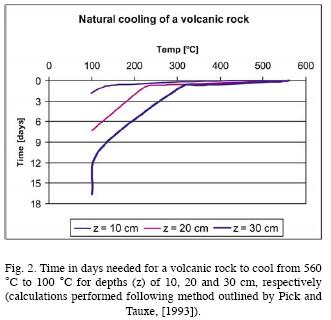
<body><![CDATA[<p align="justify"><font face="verdana" size="2">&nbsp;</font></p>     <p align="justify"><font face="verdana" size="2"><b>DISCUSSION</b></font></p>     <p align="justify"><font face="verdana" size="2">The effect of cooling rate upon acquisition of pTRMs in volcanic rocks appears to be more complex than found in archaeomagnetic investigations. Even samples with near to zero variations in TRM acquisition capacity can show strong dependence on cooling rate (row 6, column 4 of <a href="/img/revistas/geoint/v45n2/a5t1.jpg" target="_blank">Table 1</a>). In the best case (row 14, column 6 of <a href="/img/revistas/geoint/v45n2/a5t1.jpg" target="_blank">Table 1</a>), a difference in cooling rates of just one order of magnitude may produce a difference of more than 10% in magnetization. It should be noted that the effect of cooling rate upon acquisition of pTRMs (TRM<sub>1</sub> vs TRM<sub>2</sub>, Table 1) is generally greater than the variation in TRM acquisition capacity (TRM<sub>1</sub> vs TRM<sub>3</sub>, <a href="/img/revistas/geoint/v45n2/a5t1.jpg" target="_blank">Table 1</a>).</font></p>     <p align="justify"><font face="verdana" size="2">Carlut and Kent &#91;2002&#93; observed a somewhat similar behavior on four glassy and non&#150;glassy sub&#150;samples from submarine basalts. They reported differences of up to 15% between partial remanences acquired using different (one order of magnitude) cooling rates. The cooling in these experiments, however, was performed from relatively low temperatures (340&deg;C maximum), faraway from the higher Curie temperature (T<sub>c</sub>) estimated for these submarine basalts. As suggested by McClelland&#150;Brown, &#91;1984&#93; no intensity changes occur below the Curie temperature of the titanomagnetite matrix. Above T<sub>c</sub>, however, the intensity of the acquired TRM increases drastically.</font></p>     <p align="justify"><font face="verdana" size="2">Paleomagnetic sampling is usually done on artificially exposed outcrops on roads cuts and sampling is distributed horizontally and vertically to minimize block tilting effects. Sampling along several meters of a single lava flow along a profile is also common practice in paleointensity studies. In either case, core samples come from different cooled volumes within the flow.</font></p>     <p align="justify"><font face="verdana" size="2">Calculations made by a simple extension of the model outlined by Pick and Tauxe &#91;1993&#93; led us to estimate the time that it takes for a volcanic rock to cool down from 560&deg; to 100 &deg;C as a function of depth. From <a href="#f2">Figure 2</a>, it takes a lava flow around 2 days to cool between these limits for a depth of 10 cm. This corresponds to a difference of two orders of magnitude in cooling rate with respect to ordinary laboratory cooling times. For a volcanic unit in the same cooling conditions it will take around 7 and 17 days for a thickness of 20 and 30 cm, respectively. Even within a specific outcrop, differences of several orders in cooling rates between nature and laboratory should be expected.</font></p>     <p align="center"><font size="2" face="verdana"><a name="f2"></a></font></p>     <p align="center"><font size="2" face="verdana"><img src="/img/revistas/geoint/v45n2/a5f2.jpg"></font></p>     <p align="justify"><font face="verdana" size="2">An estimate of the cooling rate effect on the intensity of TRM for paleointensity (PI) determinations can be straightforward estimated by means of Koenigsberger's 'single&#150;heating' method &#91;1938&#93;. It is not necessary to use the more reliable stepwise Thellier method &#91;Thellier and Thellier, 1959&#93;, since the remanences are characterized by stable, single components. Intensity of 'ancient' geomagnetic field would be overestimated by at least 15% for cooling rates normally employed in the laboratory, as shown in the second column of <a href="#t2">Table 2.</a> On the contrary, when similar cooling rates are used, the' 'PI' is accurately reproduced within 1% error (column 3, <a href="#t2">Table 2</a>), as reported in earlier studies.</font></p>     <p align="center"><font face="verdana" size="2"><a name="t2"></a></font></p>     ]]></body>
<body><![CDATA[<p align="center"><font face="verdana" size="2"><img src="/img/revistas/geoint/v45n2/a5t2.jpg"></font></p>     <p align="justify"><font face="verdana" size="2">In conclusion, we show that the effect of cooling rate may play an important role in paleointensity determinations. This effect should always be considered when samples are collected at different depths.</font></p>     <p align="justify"><font face="verdana" size="2">&nbsp;</font></p>     <p align="justify"><font face="verdana" size="2"><b>ACKNOWLEDGEMENTS</b></font></p>     <p align="justify"><font face="verdana" size="2">We thank A. Gonz&aacute;lez&#150;Rangel for assistance with the measurements. AG acknowledges the financial support of UNAM&#150;DGAPA IN100403 and CONACyT grant n&deg;42661.</font></p>     <p align="justify"><font face="verdana" size="2">&nbsp;</font></p>     <p align="justify"><font face="verdana" size="2"><b>BIBLIOGRAPHY</b></font></p>     <!-- ref --><p align="justify"><font face="verdana" size="2">BIQUAND, D., 1994. Effet de la vitesse de refroidissement sur l'intesit&eacute; de l'aimantation thermor&eacute;manente: &eacute;tude exp&eacute;rimentale, cons&eacute;quences th&eacute;oriques. <i>Can. J. Earth Sci. 31, </i>1342&#150;1352.</font>&nbsp;&nbsp;&nbsp;&nbsp;&nbsp;&nbsp;&nbsp;&nbsp;[&#160;<a href="javascript:void(0);" onclick="javascript: window.open('/scielo.php?script=sci_nlinks&ref=3893031&pid=S0016-7169200600020000500001&lng=','','width=640,height=500,resizable=yes,scrollbars=1,menubar=yes,');">Links</a>&#160;]<!-- end-ref --><!-- ref --><p align="justify"><font face="verdana" size="2">CARLUT, J. and D. V. KENT, 2002. Grain&#150;size&#150;dependent paleointensity results from very recent mid&#150;oceanic ridge basalts. <i>J. Geophys. Res., 107, B3, </i>10.1029/ 2001JB00439.</font>&nbsp;&nbsp;&nbsp;&nbsp;&nbsp;&nbsp;&nbsp;&nbsp;[&#160;<a href="javascript:void(0);" onclick="javascript: window.open('/scielo.php?script=sci_nlinks&ref=3893032&pid=S0016-7169200600020000500002&lng=','','width=640,height=500,resizable=yes,scrollbars=1,menubar=yes,');">Links</a>&#160;]<!-- end-ref --><!-- ref --><p align="justify"><font face="verdana" size="2">CHAUVIN, A., P. Y. GILLOT and N. BONHOMMET, 1991. Paleointensity of the Earth's Magnetic Field Recorded by Two Late Quaternary Volcanic Sequences at the Island of La R&eacute;union (Indian Ocean). <i>J. Geophys. Res., 96, B2, </i>1981&#150;2006.</font>&nbsp;&nbsp;&nbsp;&nbsp;&nbsp;&nbsp;&nbsp;&nbsp;[&#160;<a href="javascript:void(0);" onclick="javascript: window.open('/scielo.php?script=sci_nlinks&ref=3893033&pid=S0016-7169200600020000500003&lng=','','width=640,height=500,resizable=yes,scrollbars=1,menubar=yes,');">Links</a>&#160;]<!-- end-ref --><!-- ref --><p align="justify"><font face="verdana" size="2">CHAUVIN, A., A. GARC&Iacute;A, PH. LANOS and F. LAUBENHEIMER, 2000. Paleointensity of the geomagnetic field recovered on archaeomagnetic sites from France. <i>Phys. Earth Planet. Int., 120, </i>111&#150;136.</font>&nbsp;&nbsp;&nbsp;&nbsp;&nbsp;&nbsp;&nbsp;&nbsp;[&#160;<a href="javascript:void(0);" onclick="javascript: window.open('/scielo.php?script=sci_nlinks&ref=3893034&pid=S0016-7169200600020000500004&lng=','','width=640,height=500,resizable=yes,scrollbars=1,menubar=yes,');">Links</a>&#160;]<!-- end-ref --><!-- ref --><p align="justify"><font face="verdana" size="2">DODSON, M. H. and E. MCCLELLAND&#150;BROWN, 1980. Magnetic blocking temperature of single&#150;domain grains during slow cooling. <i>J. Geophys. Res., 85, </i>2625&#150;2637.</font>&nbsp;&nbsp;&nbsp;&nbsp;&nbsp;&nbsp;&nbsp;&nbsp;[&#160;<a href="javascript:void(0);" onclick="javascript: window.open('/scielo.php?script=sci_nlinks&ref=3893035&pid=S0016-7169200600020000500005&lng=','','width=640,height=500,resizable=yes,scrollbars=1,menubar=yes,');">Links</a>&#160;]<!-- end-ref --><!-- ref --><p align="justify"><font face="verdana" size="2">FOX, J. M. W. and M. J. AITKEN, 1980. Cooling rate dependence of the thermoremanent magnetization. <i>Nature, 283, </i>462&#150;463.</font>&nbsp;&nbsp;&nbsp;&nbsp;&nbsp;&nbsp;&nbsp;&nbsp;[&#160;<a href="javascript:void(0);" onclick="javascript: window.open('/scielo.php?script=sci_nlinks&ref=3893036&pid=S0016-7169200600020000500006&lng=','','width=640,height=500,resizable=yes,scrollbars=1,menubar=yes,');">Links</a>&#160;]<!-- end-ref --><!-- ref --><p align="justify"><font face="verdana" size="2">GENEVEY, A. and Y. GALLET, 2002. Intensity of the geomagnetic field in western Europe over the past 2000 years: New date from ancient French pottery. <i>J. Geophys. Res., 107, </i>B11, 10.1029/2001JB000701.</font>&nbsp;&nbsp;&nbsp;&nbsp;&nbsp;&nbsp;&nbsp;&nbsp;[&#160;<a href="javascript:void(0);" onclick="javascript: window.open('/scielo.php?script=sci_nlinks&ref=3893037&pid=S0016-7169200600020000500007&lng=','','width=640,height=500,resizable=yes,scrollbars=1,menubar=yes,');">Links</a>&#160;]<!-- end-ref --><!-- ref --><p align="justify"><font face="verdana" size="2">HALGEDAHL, S. L., R. DAY and M. FULLER, 1980. The effect of cooling rate on the intensity of weak field TRM in single domain magnetite. <i>J. Geophys. Res., 85,</i>3690&#150;3698.</font>&nbsp;&nbsp;&nbsp;&nbsp;&nbsp;&nbsp;&nbsp;&nbsp;[&#160;<a href="javascript:void(0);" onclick="javascript: window.open('/scielo.php?script=sci_nlinks&ref=3893038&pid=S0016-7169200600020000500008&lng=','','width=640,height=500,resizable=yes,scrollbars=1,menubar=yes,');">Links</a>&#160;]<!-- end-ref --><!-- ref --><p align="justify"><font face="verdana" size="2">KOENIGSBERGER, J. G., 1938. Natural residual magnetism of eruptive rocks. <i>Terr. Magn. Atmos. Electr., 43, </i>299&#150;320.</font>&nbsp;&nbsp;&nbsp;&nbsp;&nbsp;&nbsp;&nbsp;&nbsp;[&#160;<a href="javascript:void(0);" onclick="javascript: window.open('/scielo.php?script=sci_nlinks&ref=3893039&pid=S0016-7169200600020000500009&lng=','','width=640,height=500,resizable=yes,scrollbars=1,menubar=yes,');">Links</a>&#160;]<!-- end-ref --><!-- ref --><p align="justify"><font face="verdana" size="2">McCLELLAND&#150;BROWN, E., 1984. Experiments on TRM intensity dependence on cooling rate. <i>Geophys. Res. Lett., 11, 3, </i>205&#150;208.</font>&nbsp;&nbsp;&nbsp;&nbsp;&nbsp;&nbsp;&nbsp;&nbsp;[&#160;<a href="javascript:void(0);" onclick="javascript: window.open('/scielo.php?script=sci_nlinks&ref=3893040&pid=S0016-7169200600020000500010&lng=','','width=640,height=500,resizable=yes,scrollbars=1,menubar=yes,');">Links</a>&#160;]<!-- end-ref --><!-- ref --><p align="justify"><font face="verdana" size="2">MORALES J., A. GOGUITCHAICHVILI and J. URRUTIA&#150;FUCUGAUCHI, 2001. A rock&#150;magnetic and paleointensity study of some Mexican volcanic lava flows during the Latest Pleistocene to Holocene. <i>Earth Planets Space, 53, </i>893&#150;902.</font>&nbsp;&nbsp;&nbsp;&nbsp;&nbsp;&nbsp;&nbsp;&nbsp;[&#160;<a href="javascript:void(0);" onclick="javascript: window.open('/scielo.php?script=sci_nlinks&ref=3893041&pid=S0016-7169200600020000500011&lng=','','width=640,height=500,resizable=yes,scrollbars=1,menubar=yes,');">Links</a>&#160;]<!-- end-ref --><!-- ref --><p align="justify"><font face="verdana" size="2">MORALES J., A. GOGUITCHAICHVILI and J. URRUTIA&#150;FUCUGAUCHI, 2003. An experimental evaluation of Shaw's paleointensity method and its modifications using Late Quaternary basalts. <i>Phys. Earth Planet Inter., 138, </i>1&#150;10.</font>&nbsp;&nbsp;&nbsp;&nbsp;&nbsp;&nbsp;&nbsp;&nbsp;[&#160;<a href="javascript:void(0);" onclick="javascript: window.open('/scielo.php?script=sci_nlinks&ref=3893042&pid=S0016-7169200600020000500012&lng=','','width=640,height=500,resizable=yes,scrollbars=1,menubar=yes,');">Links</a>&#160;]<!-- end-ref --><!-- ref --><p align="justify"><font face="verdana" size="2">NEEL, L., 1955. Some theoretical aspects of rock magnetism. <i>Adv. Phys., 4, </i>191&#150;243.</font>&nbsp;&nbsp;&nbsp;&nbsp;&nbsp;&nbsp;&nbsp;&nbsp;[&#160;<a href="javascript:void(0);" onclick="javascript: window.open('/scielo.php?script=sci_nlinks&ref=3893043&pid=S0016-7169200600020000500013&lng=','','width=640,height=500,resizable=yes,scrollbars=1,menubar=yes,');">Links</a>&#160;]<!-- end-ref --><!-- ref --><p align="justify"><font face="verdana" size="2">PICK, T. and L. TAUXE, 1993. Holocene Paleointensities: Thellier Experiments on Submarine Basaltic Glass From the East Pacific Rise. <i>J. Geophys. Res., 98, B10, </i>17949&#150;17964.</font>&nbsp;&nbsp;&nbsp;&nbsp;&nbsp;&nbsp;&nbsp;&nbsp;[&#160;<a href="javascript:void(0);" onclick="javascript: window.open('/scielo.php?script=sci_nlinks&ref=3893044&pid=S0016-7169200600020000500014&lng=','','width=640,height=500,resizable=yes,scrollbars=1,menubar=yes,');">Links</a>&#160;]<!-- end-ref --><!-- ref --><p align="justify"><font face="verdana" size="2">PULLAIAH, G., E. IRVING, K. L. BUCHAN and D. J. DUNLOP, 1975. Magnetization changes caused by burial and uplift. <i>Earth Planet Sci. Lett. 28, </i>133&#150;143.</font>&nbsp;&nbsp;&nbsp;&nbsp;&nbsp;&nbsp;&nbsp;&nbsp;[&#160;<a href="javascript:void(0);" onclick="javascript: window.open('/scielo.php?script=sci_nlinks&ref=3893045&pid=S0016-7169200600020000500015&lng=','','width=640,height=500,resizable=yes,scrollbars=1,menubar=yes,');">Links</a>&#160;]<!-- end-ref --><!-- ref --><p align="justify"><font face="verdana" size="2">SHCHERBAKOVA, V. V., V. P. SHCHERBAKOV and F. HEIDER, 2000. Properties of partial thermoremanent magnetization in PSD and MD magnetite grains. <i>J. </i><i>Geophys. Res. 105, B1. </i>767&#150;782.</font>&nbsp;&nbsp;&nbsp;&nbsp;&nbsp;&nbsp;&nbsp;&nbsp;[&#160;<a href="javascript:void(0);" onclick="javascript: window.open('/scielo.php?script=sci_nlinks&ref=3893046&pid=S0016-7169200600020000500016&lng=','','width=640,height=500,resizable=yes,scrollbars=1,menubar=yes,');">Links</a>&#160;]<!-- end-ref --><!-- ref --><p align="justify"><font face="verdana" size="2">THELLIER, E. and O. THELLIER, 1959. Sur l'intensit&eacute; du champ magn&eacute;tique terrestre dans le pass&eacute; historique et g&eacute;ologique. <i>Ann. G&eacute;ophysique, 15, </i>285&#150;376.</font>&nbsp;&nbsp;&nbsp;&nbsp;&nbsp;&nbsp;&nbsp;&nbsp;[&#160;<a href="javascript:void(0);" onclick="javascript: window.open('/scielo.php?script=sci_nlinks&ref=3893047&pid=S0016-7169200600020000500017&lng=','','width=640,height=500,resizable=yes,scrollbars=1,menubar=yes,');">Links</a>&#160;]<!-- end-ref --><!-- ref --><p align="justify"><font face="verdana" size="2">WALTON, D., 1980, Time&#150;temperature relations in the magnetization of assemblies of single domain grains. <i>Nature, 286, </i>245&#150;247.</font>&nbsp;&nbsp;&nbsp;&nbsp;&nbsp;&nbsp;&nbsp;&nbsp;[&#160;<a href="javascript:void(0);" onclick="javascript: window.open('/scielo.php?script=sci_nlinks&ref=3893048&pid=S0016-7169200600020000500018&lng=','','width=640,height=500,resizable=yes,scrollbars=1,menubar=yes,');">Links</a>&#160;]<!-- end-ref --><!-- ref --><p align="justify"><font face="verdana" size="2">WALTON, D. and W. WILLIAMS, 1988. Cooling Rate Effects in the Magnetization of Single&#150;Domain Grains. <i>J. Geomag. Geoelectr., 40, </i>729&#150;737.</font>&nbsp;&nbsp;&nbsp;&nbsp;&nbsp;&nbsp;&nbsp;&nbsp;[&#160;<a href="javascript:void(0);" onclick="javascript: window.open('/scielo.php?script=sci_nlinks&ref=3893049&pid=S0016-7169200600020000500019&lng=','','width=640,height=500,resizable=yes,scrollbars=1,menubar=yes,');">Links</a>&#160;]<!-- end-ref --><!-- ref --><p align="justify"><font face="verdana" size="2">YORK, D., 1978, A formula describing both magnetic and isotopic blocking temperatures. <i>Earth Planet Sci. Lett. 39, </i>89&#150;93.</font>&nbsp;&nbsp;&nbsp;&nbsp;&nbsp;&nbsp;&nbsp;&nbsp;[&#160;<a href="javascript:void(0);" onclick="javascript: window.open('/scielo.php?script=sci_nlinks&ref=3893050&pid=S0016-7169200600020000500020&lng=','','width=640,height=500,resizable=yes,scrollbars=1,menubar=yes,');">Links</a>&#160;]<!-- end-ref --> ]]></body><back>
<ref-list>
<ref id="B1">
<nlm-citation citation-type="journal">
<person-group person-group-type="author">
<name>
<surname><![CDATA[BIQUAND]]></surname>
<given-names><![CDATA[D]]></given-names>
</name>
</person-group>
<article-title xml:lang="fr"><![CDATA[Effet de la vitesse de refroidissement sur l'intesité de l'aimantation thermorémanente]]></article-title>
<source><![CDATA[Can. J. Earth Sci]]></source>
<year>1994</year>
<numero>31</numero>
<issue>31</issue>
<page-range>1342-1352</page-range></nlm-citation>
</ref>
<ref id="B2">
<nlm-citation citation-type="journal">
<person-group person-group-type="author">
<name>
<surname><![CDATA[CARLUT]]></surname>
<given-names><![CDATA[J]]></given-names>
</name>
<name>
<surname><![CDATA[KENT]]></surname>
<given-names><![CDATA[D. V]]></given-names>
</name>
</person-group>
<article-title xml:lang="en"><![CDATA[Grain-size-dependent paleointensity results from very recent mid-oceanic ridge basalts]]></article-title>
<source><![CDATA[J. Geophys. Res]]></source>
<year>2002</year>
<volume>107</volume>
<numero>B3</numero>
<issue>B3</issue>
</nlm-citation>
</ref>
<ref id="B3">
<nlm-citation citation-type="journal">
<person-group person-group-type="author">
<name>
<surname><![CDATA[CHAUVIN]]></surname>
<given-names><![CDATA[A]]></given-names>
</name>
<name>
<surname><![CDATA[GILLOT]]></surname>
<given-names><![CDATA[P. Y]]></given-names>
</name>
<name>
<surname><![CDATA[BONHOMMET]]></surname>
<given-names><![CDATA[N]]></given-names>
</name>
</person-group>
<article-title xml:lang="en"><![CDATA[Paleointensity of the Earth's Magnetic Field Recorded by Two Late Quaternary Volcanic Sequences at the Island of La Réunion (Indian Ocean)]]></article-title>
<source><![CDATA[J. Geophys. Res]]></source>
<year>1991</year>
<volume>96</volume>
<numero>B2</numero>
<issue>B2</issue>
<page-range>1981-2006</page-range></nlm-citation>
</ref>
<ref id="B4">
<nlm-citation citation-type="journal">
<person-group person-group-type="author">
<name>
<surname><![CDATA[CHAUVIN]]></surname>
<given-names><![CDATA[A]]></given-names>
</name>
<name>
<surname><![CDATA[GARCÍA]]></surname>
<given-names><![CDATA[A]]></given-names>
</name>
<name>
<surname><![CDATA[LANOS]]></surname>
<given-names><![CDATA[PH]]></given-names>
</name>
<name>
<surname><![CDATA[LAUBENHEIMER]]></surname>
<given-names><![CDATA[F]]></given-names>
</name>
</person-group>
<article-title xml:lang="en"><![CDATA[Paleointensity of the geomagnetic field recovered on archaeomagnetic sites from France]]></article-title>
<source><![CDATA[Phys. Earth Planet. Int]]></source>
<year>2000</year>
<numero>120</numero>
<issue>120</issue>
<page-range>111-136</page-range></nlm-citation>
</ref>
<ref id="B5">
<nlm-citation citation-type="journal">
<person-group person-group-type="author">
<name>
<surname><![CDATA[DODSON]]></surname>
<given-names><![CDATA[M. H]]></given-names>
</name>
<name>
<surname><![CDATA[MCCLELLAND-BROWN]]></surname>
<given-names><![CDATA[E]]></given-names>
</name>
</person-group>
<article-title xml:lang="en"><![CDATA[Magnetic blocking temperature of single-domain grains during slow cooling]]></article-title>
<source><![CDATA[J. Geophys. Res]]></source>
<year>1980</year>
<numero>85</numero>
<issue>85</issue>
<page-range>2625-2637</page-range></nlm-citation>
</ref>
<ref id="B6">
<nlm-citation citation-type="journal">
<person-group person-group-type="author">
<name>
<surname><![CDATA[FOX]]></surname>
<given-names><![CDATA[J. M. W]]></given-names>
</name>
<name>
<surname><![CDATA[AITKEN]]></surname>
<given-names><![CDATA[M. J]]></given-names>
</name>
</person-group>
<article-title xml:lang="en"><![CDATA[Cooling rate dependence of the thermoremanent magnetization]]></article-title>
<source><![CDATA[Nature]]></source>
<year>1980</year>
<numero>283</numero>
<issue>283</issue>
<page-range>462-463</page-range></nlm-citation>
</ref>
<ref id="B7">
<nlm-citation citation-type="journal">
<person-group person-group-type="author">
<name>
<surname><![CDATA[GENEVEY]]></surname>
<given-names><![CDATA[A]]></given-names>
</name>
<name>
<surname><![CDATA[GALLET]]></surname>
<given-names><![CDATA[Y]]></given-names>
</name>
</person-group>
<article-title xml:lang="en"><![CDATA[Intensity of the geomagnetic field in western Europe over the past 2000 years: New date from ancient French pottery]]></article-title>
<source><![CDATA[J. Geophys. Res]]></source>
<year>2002</year>
<volume>107</volume>
<numero>B11</numero>
<issue>B11</issue>
</nlm-citation>
</ref>
<ref id="B8">
<nlm-citation citation-type="journal">
<person-group person-group-type="author">
<name>
<surname><![CDATA[HALGEDAHL]]></surname>
<given-names><![CDATA[S. L]]></given-names>
</name>
<name>
<surname><![CDATA[DAY]]></surname>
<given-names><![CDATA[R]]></given-names>
</name>
<name>
<surname><![CDATA[FULLER]]></surname>
<given-names><![CDATA[M]]></given-names>
</name>
</person-group>
<article-title xml:lang="en"><![CDATA[The effect of cooling rate on the intensity of weak field TRM in single domain magnetite]]></article-title>
<source><![CDATA[J. Geophys. Res]]></source>
<year>1980</year>
<numero>85</numero>
<issue>85</issue>
<page-range>3690-3698</page-range></nlm-citation>
</ref>
<ref id="B9">
<nlm-citation citation-type="journal">
<person-group person-group-type="author">
<name>
<surname><![CDATA[KOENIGSBERGER]]></surname>
<given-names><![CDATA[J. G]]></given-names>
</name>
</person-group>
<article-title xml:lang="en"><![CDATA[Natural residual magnetism of eruptive rocks]]></article-title>
<source><![CDATA[Terr. Magn. Atmos. Electr]]></source>
<year>1938</year>
<numero>43</numero>
<issue>43</issue>
<page-range>299-320</page-range></nlm-citation>
</ref>
<ref id="B10">
<nlm-citation citation-type="journal">
<person-group person-group-type="author">
<name>
<surname><![CDATA[McCLELLAND-BROWN]]></surname>
<given-names><![CDATA[E]]></given-names>
</name>
</person-group>
<article-title xml:lang="en"><![CDATA[Experiments on TRM intensity dependence on cooling rate]]></article-title>
<source><![CDATA[Geophys. Res. Lett]]></source>
<year>1984</year>
<volume>11</volume>
<numero>3</numero>
<issue>3</issue>
<page-range>205-208</page-range></nlm-citation>
</ref>
<ref id="B11">
<nlm-citation citation-type="journal">
<person-group person-group-type="author">
<name>
<surname><![CDATA[MORALES]]></surname>
<given-names><![CDATA[J]]></given-names>
</name>
<name>
<surname><![CDATA[GOGUITCHAICHVILI]]></surname>
<given-names><![CDATA[A]]></given-names>
</name>
<name>
<surname><![CDATA[URRUTIA-FUCUGAUCHI]]></surname>
<given-names><![CDATA[J]]></given-names>
</name>
</person-group>
<source><![CDATA[Earth Planets Space]]></source>
<year>2001</year>
<numero>53</numero>
<issue>53</issue>
<page-range>893-902</page-range></nlm-citation>
</ref>
<ref id="B12">
<nlm-citation citation-type="journal">
<person-group person-group-type="author">
<name>
<surname><![CDATA[MORALES]]></surname>
<given-names><![CDATA[J]]></given-names>
</name>
<name>
<surname><![CDATA[GOGUITCHAICHVILI]]></surname>
<given-names><![CDATA[A]]></given-names>
</name>
<name>
<surname><![CDATA[URRUTIA-FUCUGAUCHI]]></surname>
<given-names><![CDATA[J]]></given-names>
</name>
</person-group>
<source><![CDATA[Phys. Earth Planet Inter]]></source>
<year>2003</year>
<numero>138</numero>
<issue>138</issue>
<page-range>1-10</page-range></nlm-citation>
</ref>
<ref id="B13">
<nlm-citation citation-type="journal">
<person-group person-group-type="author">
<name>
<surname><![CDATA[NEEL]]></surname>
<given-names><![CDATA[L]]></given-names>
</name>
</person-group>
<article-title xml:lang="en"><![CDATA[Some theoretical aspects of rock magnetism]]></article-title>
<source><![CDATA[Adv. Phys]]></source>
<year>1955</year>
<numero>4</numero>
<issue>4</issue>
<page-range>191-243</page-range></nlm-citation>
</ref>
<ref id="B14">
<nlm-citation citation-type="journal">
<person-group person-group-type="author">
<name>
<surname><![CDATA[PICK]]></surname>
<given-names><![CDATA[T]]></given-names>
</name>
<name>
<surname><![CDATA[TAUXE]]></surname>
<given-names><![CDATA[L]]></given-names>
</name>
</person-group>
<article-title xml:lang="en"><![CDATA[Holocene Paleointensities: Thellier Experiments on Submarine Basaltic Glass From the East Pacific Rise]]></article-title>
<source><![CDATA[J. Geophys. Res]]></source>
<year>1993</year>
<volume>98</volume>
<numero>B10</numero>
<issue>B10</issue>
</nlm-citation>
</ref>
<ref id="B15">
<nlm-citation citation-type="journal">
<person-group person-group-type="author">
<name>
<surname><![CDATA[PULLAIAH]]></surname>
<given-names><![CDATA[G]]></given-names>
</name>
<name>
<surname><![CDATA[IRVING]]></surname>
<given-names><![CDATA[E]]></given-names>
</name>
<name>
<surname><![CDATA[BUCHAN]]></surname>
<given-names><![CDATA[K. L]]></given-names>
</name>
<name>
<surname><![CDATA[DUNLOP]]></surname>
<given-names><![CDATA[D. J]]></given-names>
</name>
</person-group>
<article-title xml:lang="en"><![CDATA[Magnetization changes caused by burial and uplift]]></article-title>
<source><![CDATA[Earth Planet Sci. Lett]]></source>
<year>1975</year>
<numero>28</numero>
<issue>28</issue>
<page-range>133-143</page-range></nlm-citation>
</ref>
<ref id="B16">
<nlm-citation citation-type="journal">
<person-group person-group-type="author">
<name>
<surname><![CDATA[SHCHERBAKOVA]]></surname>
<given-names><![CDATA[V. V]]></given-names>
</name>
<name>
<surname><![CDATA[SHCHERBAKOV]]></surname>
<given-names><![CDATA[V. P]]></given-names>
</name>
<name>
<surname><![CDATA[HEIDER]]></surname>
<given-names><![CDATA[F]]></given-names>
</name>
</person-group>
<article-title xml:lang="en"><![CDATA[Properties of partial thermoremanent magnetization in PSD and MD magnetite grains]]></article-title>
<source><![CDATA[J. Geophys. Res]]></source>
<year>2000</year>
<volume>105</volume>
<numero>B1</numero>
<issue>B1</issue>
<page-range>767-782</page-range></nlm-citation>
</ref>
<ref id="B17">
<nlm-citation citation-type="journal">
<person-group person-group-type="author">
<name>
<surname><![CDATA[THELLIER]]></surname>
<given-names><![CDATA[E]]></given-names>
</name>
<name>
<surname><![CDATA[THELLIER]]></surname>
<given-names><![CDATA[O]]></given-names>
</name>
</person-group>
<article-title xml:lang="fr"><![CDATA[Sur l'intensité du champ magnétique terrestre dans le passé historique et géologique]]></article-title>
<source><![CDATA[Ann. Géophysique]]></source>
<year>1959</year>
<numero>15</numero>
<issue>15</issue>
<page-range>285-376</page-range></nlm-citation>
</ref>
<ref id="B18">
<nlm-citation citation-type="journal">
<person-group person-group-type="author">
<name>
<surname><![CDATA[WALTON]]></surname>
<given-names><![CDATA[D]]></given-names>
</name>
</person-group>
<article-title xml:lang="en"><![CDATA[Time-temperature relations in the magnetization of assemblies of single domain grains]]></article-title>
<source><![CDATA[Nature]]></source>
<year>1980</year>
<numero>286</numero>
<issue>286</issue>
<page-range>245-247</page-range></nlm-citation>
</ref>
<ref id="B19">
<nlm-citation citation-type="journal">
<person-group person-group-type="author">
<name>
<surname><![CDATA[WALTON]]></surname>
<given-names><![CDATA[D]]></given-names>
</name>
<name>
<surname><![CDATA[WILLIAMS]]></surname>
<given-names><![CDATA[W]]></given-names>
</name>
</person-group>
<article-title xml:lang="en"><![CDATA[Cooling Rate Effects in the Magnetization of Single-Domain Grains]]></article-title>
<source><![CDATA[J. Geomag. Geoelectr]]></source>
<year>1988</year>
<numero>40</numero>
<issue>40</issue>
<page-range>729-737</page-range></nlm-citation>
</ref>
<ref id="B20">
<nlm-citation citation-type="journal">
<person-group person-group-type="author">
<name>
<surname><![CDATA[YORK]]></surname>
<given-names><![CDATA[D]]></given-names>
</name>
</person-group>
<article-title xml:lang="en"><![CDATA[A formula describing both magnetic and isotopic blocking temperatures]]></article-title>
<source><![CDATA[Earth Planet Sci. Lett]]></source>
<year>1978</year>
<numero>39</numero>
<issue>39</issue>
<page-range>89-93</page-range></nlm-citation>
</ref>
</ref-list>
</back>
</article>