




 nueva página del texto (beta)
 Inglés (pdf)
 Artículo en XML
 Referencias del artículo
 Traducción automática
 Enviar artículo por email
 Citado por SciELO
  Similares en
SciELO
Similares en
SciELO 
 Permalink

Business evaluation is the systematic process of analyzing and assessing the performance of an entity, whether it is a company, organization, or project, about specific previously established objectives. This analysis can be performed at any stage of the business life cycle and covers financial, operational, and strategic aspects.
The economic and financial value of the company minimizes uncertainty and provides a firm basis for shareholders in decision-making. This value must be taken as a basis to adequately determine the profitability and goals demanded by shareholders when it is necessary to sell, buy, merge, co-invest, associate, bypass bypass, divest, or spin off an organization. Entrepreneurs and senior executives must always know, with complete certainty, their companies' economic and financial value.
1.The main purposes of the evaluation:
1.1.Determine the viability and financial profitability.
1.2.Measure operational efficiency.
1.3.Analyze strategic alignment against long-term objectives.
1.4.There are several types of business evaluation, among which the following stand out:
a)Financial: Determines the profitability and economic health of the company.
b)Operational: Evaluates the efficiency of internal processes and the use of resources.
c)Strategic: Assesses the sustainability and adequacy of the business model in the long term.
The process begins with data collection through surveys, interviews, observations, and other analytical tools. This data is then analyzed to identify critical success factors and areas for improvement and offer concrete recommendations.
2.Benefits of Business Assessment
2.1.The business assessment provides multiple advantages, such as:
2.2.Determine the viability and financial profitability.
2.3.Determine the viability and financial profitability.
2.4.Accurate business valuation: It helps determine the real value of the company and its assets.
2.5.Identifying opportunities for improvement: Reveals areas where it is possible to optimize processes or strategies.
Facilitation in decision-making: It provides a solid basis for deciding whether to continue, expand, or redirect a business.
3.Specific evaluations
3.1.Financial: Analyzes balance sheets, projections, and economic results.
3.2.Operational: Measures efficiency in production, management, and distribution.
3.3.Marketing: Evaluate the impact of advertising strategies and penetration in target markets.
3.4.Environmental, Social, and Ethical: Examines the company's sustainability, social responsibility, and ethical behavior.
4.Process in Business Evaluation
The business assessment process typically includes the following stages:
4.1.Definition of objectives: Determine which aspects will be evaluated and the criteria for success.
4.2.Selection of methods: Choose analytical techniques such as cost-benefit, market, or capacity analysis.
4.3.Data collection: Use tools such as surveys, interviews, or audits.
4.4.Analysis of results: Interpret the information collected to identify trends, problems, and opportunities.
4.5.Reporting: Present findings in a clear and actionable manner.
4.6.Implementation of recommendations: Ensure that the suggested changes are carried out effectively.
5.Tools for Business Assessment
5.1.Data collection and analysis are essential pillars in business evaluation. Some prominent tools include:
5.2.Surveys: Collect feedback from employees, customers, and other stakeholders.
5.3.Interviews: Provide in-depth perspectives on operations and strategies.
5.4.Focus groups: They analyze collective perceptions about products or services.
5.5.Document Review: Evaluate financial reports, performance reports, and regulations.
5.6.Performance audits: Measure key indicators such as efficiency, quality, and customer satisfaction.
6.Challenges of Business Assessment
Despite its benefits, business assessment presents several challenges:
6.1.Selection of appropriate criteria: Identify relevant and measurable factors.
6.2.Contextual interpretation: Considering the specific environment in which the company operates.
6.3.Time and information constraints: Conducting quick assessments with incomplete data can lead to erroneous conclusions.
Overcoming these challenges requires meticulous planning and robust tools and methodologies.
7.Considerations for Choosing an Evaluation Method
When selecting an evaluation method, several factors must be taken into account:
7.1.Type of business: Non-profit companies may require different approaches than commercial enterprises.
7.2.Purpose of the evaluation: To determine whether to evaluate operational performance, strategic value, or social impact.
7.3.Available resources: More complex methods require more significant investments in time and capital.
7.4.Target audience: Ensure that findings are helpful and understandable to key stakeholders.
8.Theories and Approaches That Underpin the Determination of the Value of Companies
Business assessment is based on various approaches and theories that help determine a company's intrinsic and market value. These theories provide the conceptual and methodological basis for accurate and well-founded assessments. The main theories and approaches are described below:
8.1. Discounted Cash Flow (DCF) Approach. DCF is one of the most widely used methods in business valuation and is based on the following economic theories:
Net Present Value (NPV) Theory. It holds that a company's value is equal to the present value of its discounted future cash flows at a rate that reflects the opportunity cost of capital.
Theory of Time Preference (Fisher, 1930). It establishes that the money available in the present has a more excellent value than the amount available in the future due to its ability to generate returns. The theory, also known as the agio theory of interest or the Austrian theory of interest, explains interest rates in terms of people's preference to spend in the present rather than the future.
This approach assesses the company's ability to generate cash flows in the future and adjusts them to present value by considering risks and the cost of capital. Its importance lies in its ability to synthesize profitability in a single number, simplifying analysis by optimizing financial resource allocation and facilitating organizational decision-making.
8.2.Peer Valuation Approach. Theory of Market Efficiency, (Fama, 1970).
This approach determines the value of a company by comparing it to similar companies operating in the same sector or industry. Key metrics such as:
This methodology assumes that markets are rational and that the valuations of comparable companies reflect fair prices.
8.3.Asset Focus or Substantive Value
This approach is based on the Book Value Theory and evaluates the company by considering the net value of its assets, i.e., the difference between total assets and liabilities. It has two main variants:
Book value: Based on the company's financial statements.
Liquidation value: Considers the value of the assets in the event of the sale or liquidation of the company.
The theory brought from economics is adapted and developed in accounting practice. The authors of this theory can be grouped and organized into different lines of thought that reflect the affinity of the theory of value for its accounting approaches. The authors Mattessich (2002), Buys (2009), and Sánchez and Arias (2012) can be classified as supporters of the theories of use value and exchange value. Toms and Bowman (2008), Bryer (2014), and Sadowska and Lulek (2016) are more in line with the labor theory of value. Finally, the author Dueñas (2007) can be classified as a critic of the subjective theory of value and affirms that this theory is bilateral to accounting practice.
8.4.Market Value Approach
It is based on the Theory of Supply and Demand (Smith, 1776), which states that a firm's value is the price buyers are willing to pay under free market conditions. This approach is commonly used for public companies listed on stock exchanges (Hurtado, 2003).
8.5.Real Options Approach
Based on Financial Options Theory, this approach recognizes that the company has future opportunities that can be seen as "options." These include:
The value of these real options is calculated using methods such as the Black-Scholes model or Monte Carlo simulations. (Black & Scholes, 1973).
Options theory allows the assessment of strategic opportunities. The quantitative analysis of options, together with the qualitative and strategic analysis of company policy, allows correct and rational decisions to be made about the company's future.
8.6.Agency Theory-Based Approach
The Theory of Agency (Jensen, 1986; Jensen & Meckling,1976) analyzes the relationship between owners (shareholders) and managers. According to this theory, valuation decisions should consider how conflicts of interest influence company management and performance.
8.7.Value Creation Approach (EVA and MVA)
Economic Value Added (EVA): Based on the Theory of Economic Surplus (Marx, 1959; 1987; Santarcángelo & Borroni, 2012). It measures the value generated by the company after covering the cost of capital.
Market Value Added (MVA): Assesses the company's ability to increase market value above the capital shareholders invest.
8.8.Risk and Return Approach
Based on Portfolio Theory (Sharpe, 1964) and the Capital Asset Valuation Model (CAPM), Harry Markowitz (1952), William F. Sharpe (1964), John Lintner (1965), and Jan Mossin (1966) developed the CAPM method, this approach considers:
The systematic and non-systematic risk of the company.
The relationship between risk and expected return, adjusting the valuation according to the risk profile.
8.9.Stakeholder Theory Approach
This approach considers that the value of a company is not only determined by its financial performance but also by the impact on its stakeholders (customers, employees, communities, and the environment), proposed by Freeman (1984) and presented in more detail by Fontaine, Haarman, and Schmid (2006). This approach integrates:
Theory of Corporate Social Responsibility.
Business sustainability approaches (Hart & Milstein, 2003; Elkington, 1997)
Economic and financial indicators are valuable tools that benefit organizations by facilitating timely and appropriate decision-making about their corporate and financial strategies.
Next, the evolution of some economic and financial indicators of the Mexican environment is described and shown to facilitate decision-making related to personal and business strategies in an integral manner.
National Consumer Price Index (INPC, Spanish)
The Price and Quotation Index of the Mexican Stock Exchange (IPC, Spanish)
Exchange rate
Equilibrium interbank interest rate (TIIE, Spanish)
CETES rate of return
Investment units (UDIS, Spanish)
1.NATIONAL CONSUMER PRICE INDEX (INPC)
Born in 1995 and reflecting changes in consumer prices, it measures the general price increase in the country. The Bank of Mexico and INEGI calculate it fortnightly (2021). INPC is published in the Official Gazette of the Federation on the 10th and 25th of each month. The reference period is the second half of July 2018.
Table 1 Accumulated inflation in the year (Base: 2nd. half of July 2018=100 with data provided by Banco de México)
| Period | 2013 | 2014 | 2015 | 2016 | 2017 | 2018 | 2019 | 2020 | 2021 | 2022 | 2023 | 2024 |
| January | 0.79 | 0.90 | -0.09 | 0.38 | 1.70 | 0.53 | 0.09 | 0.48 | 0.86 | 0.59 | 0.76 | 0.89 |
| February | 1.46 | 1.15 | 0.09 | 0.82 | 2.29 | 0.91 | 0.06 | 0.90 | 1.50 | 1.43 | 1.24 | 0.99 |
| March | 1.99 | 1.43 | 0.51 | 0.97 | 2.92 | 1.24 | 0.44 | 0.85 | 2.34 | 2.43 | 1.51 | 1.28 |
| April | 1.81 | 1.24 | 0.25 | 0.65 | 3.04 | 0.90 | 0.50 | -0.17 | 2.67 | 2.98 | 1.49 | 1.48 |
| May | 0.95 | 0.91 | -0.26 | 0.20 | 2.92 | 0.73 | 0.21 | 0.22 | 2.88 | 3.17 | 1.27 | 1.29 |
| June | 1.12 | 1.09 | -0.09 | 0.31 | 3.18 | 1.12 | 0.27 | 0.76 | 3.43 | 4.04 | 1.37 | 1.68 |
| July | 1.14 | 1.42 | 0.06 | 0.57 | 3.57 | 1.66 | 0.65 | 1.43 | 4.04 | 4.81 | 1.86 | 2.74 |
| August | 1.31 | 1.73 | 0.27 | 0.86 | 4.08 | 2.26 | 0.63 | 1.82 | 4.24 | 5.54 | 2.42 | 2.75 |
| September | 1.61 | 2.18 | 0.27 | 1.47 | 4.41 | 2.69 | 0.89 | 2.06 | 4.88 | 6.19 | 2.88 | 2.80 |
| October | 2.77 | 2.74 | 1.16 | 2.09 | 5.06 | 3.22 | 1.44 | 2.68 | 5.76 | 6.79 | 3.27 | 3.37 |
| November | 4.57 | 3.57 | 1.71 | 2.89 | 6.15 | 4.10 | 2.26 | 2.76 | 6.97 | 7.41 | 3.93 | 3.06 |
| December | 5.21 | 4.08 | 2.13 | 3.36 | 6.77 | 4.83 | 2.83 | 3.15 | 7.35 | 7.82 | 4.66 |
Source: Own elaboration (INEGI, 2024). Route: Indicadores económicos de coyuntura > Índices de precios > Índice nacional de precios al consumidor. Base segunda quincena de julio de 2018=100 > Mensual > Índice > Índice general
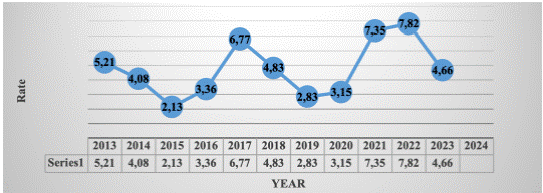
Source: Own elaboration (INEGI, 2024). Route: Indicadores económicos de coyuntura > Índices de precios > Índice nacional de precios al consumidor. Base segunda quincena de julio de 2018=100 > Mensual > Índice > Índice general
Graph 1 Inflation in Mexico (2013-2023 accumulated at the end of the year)
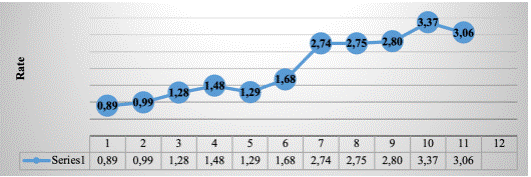
Source: Own elaboration (INEGI, 2024). Route: Indicadores económicos de coyuntura > Índices de precios > Índice nacional de precios al consumidor. Base segunda quincena de julio de 2018=100 > Mensual > Índice > Índice general
Graph 2 Inflation in Mexico (accumulated January-November 2024)
2.THE PRICE AND QUOTATION INDEX OF THE MEXICAN STOCK EXCHANGE (IPC)
Represents the change in the values traded on the Mexican Stock Exchange concerning the previous day to determine the percentage of rising or falling of the most representative shares of the companies listed therein.
Table 2 The Price and Quotation Index of the Mexican Stock Exchange (Base: October 1978, 0.78=100)
| Period | 2013 | 2014 | 2015 | 2016 | 2017 | 2018 | 2019 | 2020 | 2021 | 2022 | 2023 | 2024 |
| January | 45,278 | 40,879 | 40,951 | 43,631 | 47,001 | 50,456 | 43,988 | 44,862 | 42,986 | 51,331 | 54,564 | 57,373 |
| February | 44,121 | 38,783 | 44,190 | 43,715 | 46,857 | 47,438 | 42,824 | 41,324 | 44,593 | 53,401 | 52,758 | 55,414 |
| March | 44,077 | 40,462 | 43,725 | 45,881 | 48,542 | 46,125 | 43,281 | 34,554 | 47,246 | 56,537 | 53,904 | 57,369 |
| April | 42,263 | 40,712 | 44,582 | 45,785 | 49,261 | 48,354 | 44,597 | 36,470 | 48,010 | 51,418 | 55,121 | 56,728 |
| May | 41,588 | 41,363 | 44,704 | 45,459 | 48,788 | 44,663 | 42,749 | 36,122 | 50,886 | 51,753 | 52,736 | 55,179 |
| June | 40,623 | 42,737 | 45,054 | 45,966 | 49,857 | 47,663 | 43,161 | 37,716 | 50,290 | 47,524 | 53,526 | 52,440 |
| July | 40,838 | 43,818 | 44,753 | 46,661 | 51,012 | 49,698 | 40,863 | 37,020 | 50,868 | 48,144 | 54,819 | 53,094 |
| August | 39,492 | 45,628 | 43,722 | 47,541 | 51,210 | 49,548 | 42,623 | 36,841 | 53,305 | 44,919 | 53,021 | 51,986 |
| September | 40,185 | 44,986 | 42,633 | 47,246 | 50,346 | 49,504 | 43,011 | 37,459 | 51,386 | 44,627 | 50,875 | 52,477 |
| October | 41,039 | 45,028 | 44,543 | 48,009 | 48,626 | 43,943 | 43,337 | 36,988 | 51,310 | 49,922 | 49,062 | 50,661 |
| November | 42,499 | 44,190 | 43,419 | 45,286 | 47,092 | 41,733 | 42,820 | 41,779 | 49,699 | 51,685 | 54,060 | 49,813 |
| December | 42,727 | 43,146 | 42,998 | 45,643 | 49,354 | 41,640 | 43,541 | 44,067 | 53,272 | 48,464 | 57,386 |
Source: Own elaboration (BANXICO, 2024). https://www.banxico.org.mx/SieInternet/consultarDirectorioInternetAction.do?sector=7&accion=consultarCuadro&idCuadro=CF57&locale=es
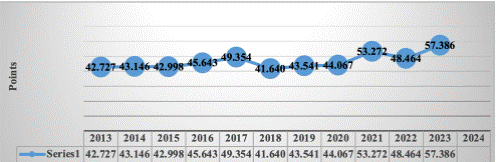
Source: Own elaboration (BANXICO, 2024). https://www.banxico.org.mx/SieInternet/consultarDirectorioInternetAction.do?sector=7&accion=consultarCuadro&idCuadro=CF57&locale=es
Graph 3 The Price and Quotation Index of the Mexican Stock Exchange, 2013 - 2023 (Score at the end of each year)
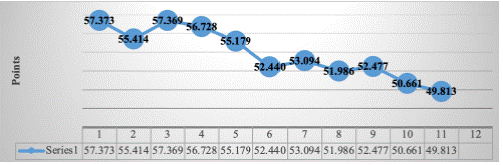
Source: Own elaboration (BANXICO, 2024). https://www.banxico.org.mx/SieInternet/consultarDirectorioInternetAction.do?sector=7&accion=consultarCuadro&idCuadro=CF57&locale=es
Graph 4 The Price and Quotation Index of the Mexican Stock Exchange, January-November 2024 (Score at the end of each month)
3.EXCHANGE RATE
It is the value of the Mexican peso relative to the dollar calculated using the daily average of the five most important banks in the country. It reflects the spot price (cash) negotiated between banks. It is highly related to Inflation, the interest rate, and the Mexican Stock Exchange.
Table 3 Exchange rate (National currency per US dollar, parity at the end of each period)
| Period | 2013 | 2014 | 2015 | 2016 | 2017 | 2018 | 2019 | 2020 | 2021 | 2022 | 2023 | 2024 |
| January | 12.71 | 13.37 | 14.69 | 18.45 | 21.02 | 18.62 | 19.04 | 18.91 | 20.22 | 20.74 | 18.79 | 17.16 |
| February | 12.87 | 13.30 | 14.92 | 18.17 | 19.83 | 18.65 | 19.26 | 19.78 | 20.94 | 20.65 | 18.40 | 17.06 |
| March | 12.36 | 13.08 | 15.15 | 17.40 | 18.81 | 18.33 | 19.38 | 23.48 | 20.44 | 19.99 | 18.11 | 16.53 |
| April | 12.16 | 13.14 | 15.22 | 19.40 | 19.11 | 18.86 | 19.01 | 23.93 | 20.18 | 20.57 | 18.07 | 17.09 |
| May | 12.63 | 12.87 | 15.36 | 18.45 | 18.51 | 19.75 | 19.64 | 22.18 | 19.92 | 19.69 | 17.56 | 17.01 |
| June | 13.19 | 13.03 | 15.57 | 18.91 | 17.90 | 20.06 | 19.21 | 23.09 | 19.91 | 20.13 | 17.07 | 18.24 |
| July | 12.73 | 13.06 | 16.21 | 18.86 | 17.69 | 18.55 | 19.99 | 22.20 | 19.85 | 20.34 | 16.73 | 18.59 |
| August | 13.25 | 13.08 | 16.89 | 18.58 | 17.88 | 19.07 | 20.07 | 21.89 | 20.06 | 20.09 | 16.84 | 19.60 |
| September | 13.01 | 13.45 | 17.01 | 19.50 | 18.13 | 18.90 | 19.68 | 22.14 | 20.56 | 20.09 | 17.62 | 19.64 |
| October | 12.89 | 13.42 | 16.45 | 18.84 | 19.15 | 19.80 | 19.16 | 21.25 | 20.53 | 19.82 | 18.08 | 20.04 |
| November | 13.09 | 13.72 | 16.55 | 20.55 | 18.58 | 20.41 | 19.61 | 20.14 | 21.45 | 19.40 | 17.14 | 20.32 |
| December | 13.08 | 14.72 | 17.21 | 20.73 | 19.79 | 19.68 | 18.87 | 19.91 | 20.47 | 19.47 | 16.89 |
NOTE: Exchange rate FIX by The Banco de México, used for settling obligations denominated in foreign currency. Quote at the end
Source: Own elaboration (BANXICO, 2024). https://www.banxico.org.mx/SieInternet/consultarDirectorioInternetAction.do?sector=6&accion=consultarCuadro&idCuadro=CF102&locale=es
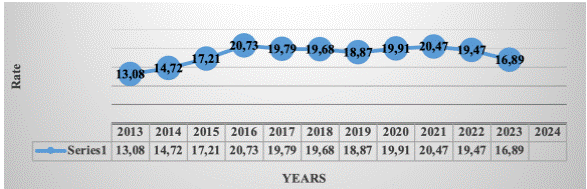
Source: Own elaboration (BANXICO, 2024). https://www.banxico.org.mx/SieInternet/consultarDirectorioInternetAction.do?sector=6&accion=consultarCuadro&idCuadro=CF102&locale=es
Graph 5 Exchange rate (National currency per US dollar, 2013-2024, (FIX parity at the end of each year)
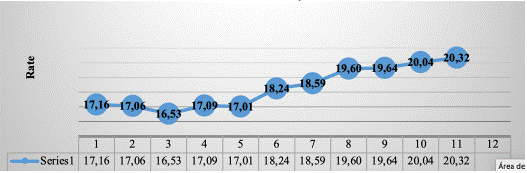
Source: Own elaboration (BANXICO, 2024). https://www.banxico.org.mx/SieInternet/consultarDirectorioInternetAction.do?sector=6&accion=consultarCuadro&idCuadro=CF102&locale=es
Graph 6 Exchange rate (National currency per US dollar, January-November 2024, FIX parity at the end of each month)
4.EQUILIBRIUM INTERBANK INTEREST RATE (TIIE)
On March 23, 1995, the Bank of Mexico, to establish an interbank interest rate that better reflects market conditions, released the Interbank Equilibrium Interest Rate through the Official Gazette of the Federation.
Table 4 Equilibrium interbank interest rate (28-day quote)
| Period | 2013 | 2014 | 2015 | 2016 | 2017 | 2018 | 2019 | 2020 | 2021 | 2022 | 2023 | 2024 |
| January | 4.84 | 3.78 | 3.29 | 3.56 | 6.15 | 7.66 | 8.59 | 7.50 | 4.47 | 5.72 | 10.82 | 11.50 |
| February | 4.80 | 3.79 | 3.29 | 4.05 | 6.61 | 7.83 | 8.54 | 7.29 | 4.36 | 6.02 | 11.27 | 11.50 |
| March | 4.35 | 3.81 | 3.30 | 4.07 | 6.68 | 7.85 | 8.51 | 6.74 | 4.28 | 6.33 | 11.43 | 11.44 |
| April | 4.33 | 3.80 | 3.30 | 4.07 | 6.89 | 7.85 | 8.50 | 6.25 | 4.28 | 6.73 | 11.54 | 11.25 |
| May | 4.30 | 3.79 | 3.30 | 4.10 | 7.15 | 7.86 | 8.51 | 5.74 | 4.29 | 7.01 | 11.51 | 11.24 |
| June | 4.31 | 3.31 | 3.30 | 4.11 | 7.36 | 8.10 | 8.49 | 5.28 | 4.32 | 7.42 | 11.49 | 11.24 |
| July | 4.32 | 3.31 | 3.31 | 4.59 | 7.38 | 8.11 | 8.47 | 5.19 | 4.52 | 8.04 | 11.51 | 11.25 |
| August | 4.30 | 3.30 | 3.33 | 4.60 | 7.38 | 8.10 | 8.26 | 4.76 | 4.65 | 8.50 | 11.51 | 11.08 |
| September | 4.03 | 3.29 | 3.33 | 4.67 | 7.38 | 8.12 | 8.04 | 4.55 | 4.75 | 8.89 | 11.50 | 11.08 |
| October | 3.78 | 3.28 | 3.30 | 5.11 | 7.38 | 8.15 | 7.97 | 4.51 | 4.98 | 9.56 | 11.50 | 10.95 |
| November | 3.80 | 3.31 | 3.32 | 5.57 | 7.39 | 8.34 | 7.78 | 4.48 | 5.13 | 10.00 | 11.50 | 10.74 |
| December | 3.79 | 3.31 | 3.55 | 6.11 | 7.62 | 8.60 | 7.55 | 4.49 | 5.72 | 10.53 | 11.50 |
Source: Own elaboration (BANXICO, 2024). https://www.banxico.org.mx/SieInternet/consultarDirectorioInternetAction.do?sector=18&accion=consultarCuadro&idCuadro=CF101&locale=es
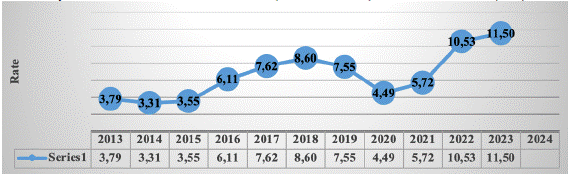
Source: Own elaboration (BANXICO, 2024). https://www.banxico.org.mx/SieInternet/consultarDirectorioInternetAction.do?sector=18&accion=consultarCuadro&idCuadro=CF101&locale=es
Graph 7 Equilibrium interbank interest rate, 2013- 2023 (at the end of each year)
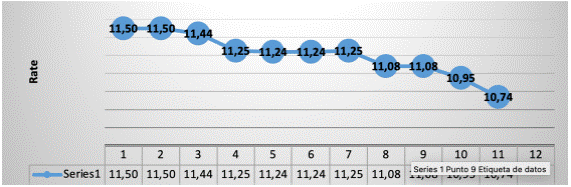
Source: Own elaboration (BANXICO, 2024). https://www.banxico.org.mx/SieInternet/consultarDirectorioInternetAction.do?sector=18&accion=consultarCuadro&idCuadro=CF101&locale=es
Graph 8 Equilibrium interbank interest rate, January-November 2024 (28-day quote)
4. CETES RATE OF RETURN
Table 5 CETES rate of return (28-day)
| Period | 2013 | 2014 | 2015 | 2016 | 2017 | 2018 | 2019 | 2020 | 2021 | 2022 | 2023 | 2024 |
| January | 4.15 | 3.14 | 2.67 | 3.08 | 5.83 | 7.25 | 7.95 | 7.04 | 4.22 | 5.50 | 10.80 | 11.28 |
| February | 4.19 | 3.16 | 2.81 | 3.36 | 6.06 | 7.40 | 7.93 | 6.91 | 4.02 | 5.94 | 11.04 | 11.00 |
| March | 3.98 | 3.17 | 3.04 | 3.80 | 6.32 | 7.47 | 8.02 | 6.59 | 4.08 | 6.52 | 11.34 | 10.90 |
| April | 3.82 | 3.23 | 2.97 | 3.74 | 6.50 | 7.46 | 7.78 | 5.84 | 4.06 | 6.68 | 11.27 | 11.04 |
| May | 3.72 | 3.28 | 2.98 | 3.81 | 6.56 | 7.51 | 8.07 | 5.38 | 4.07 | 6.90 | 11.25 | 11.03 |
| June | 3.78 | 3.02 | 2.96 | 3.81 | 6.82 | 7.64 | 8.18 | 4.85 | 4.03 | 7.56 | 11.02 | 10.88 |
| July | 3.85 | 2.83 | 2.99 | 4.21 | 6.99 | 7.73 | 8.15 | 4.63 | 4.35 | 8.05 | 11.09 | 10.87 |
| August | 3.84 | 2.77 | 3.04 | 4.24 | 6.94 | 7.73 | 7.87 | 4.50 | 4.49 | 8.35 | 11.07 | 10.65 |
| September | 3.64 | 2.83 | 3.10 | 4.28 | 6.99 | 7.69 | 7.61 | 4.25 | 4.69 | 9.25 | 11.05 | 10.35 |
| October | 3.39 | 2.90 | 3.02 | 4.69 | 7.03 | 7.69 | 7.62 | 4.22 | 4.93 | 9.00 | 11.26 | 10.20 |
| November | 3.39 | 2.85 | 3.02 | 5.15 | 7.02 | 7.83 | 7.46 | 4.28 | 5.05 | 9.70 | 11.78 | 9.95 |
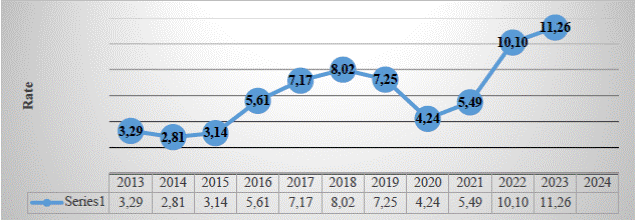
| December | 3.29 | 2.81 | 3.14 | 5.61 | 7.17 | 8.02 | 7.25 | 4.24 | 5.49 | 10.10 | 11.26 |
Source: Own elaboration (BANXICO, 2024). https://www.banxico.org.mx/SieInternet/consultarDirectorioInternetAction.do?sector=22&accion=consultarCuadro&idCuadro=CF107&locale=es
Source: Own elaboration (BANXICO, 2024). https://www.banxico.org.mx/SieInternet/consultarDirectorioInternetAction.do?sector=22&accion=consultarCuadro&idCuadro=CF107&locale=es
Graph 9 CETES rate of return 2013- 2023 (at the end of each year)
Source: Own elaboration (BANXICO, 2024). https://www.banxico.org.mx/SieInternet/consultarDirectorioInternetAction.do?sector=22&accion=consultarCuadro&idCuadro=CF107&locale=es
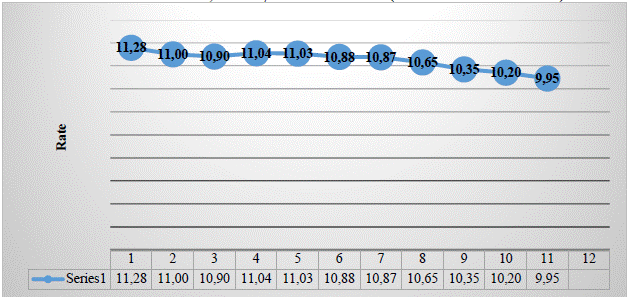
Graph 10 CETES rate of return, January-November 2024 (at the end of each month)
6. INVESTMENT UNITS (UDIS)
The UDI is a unit of account of constant real value to denominate credit titles. It does not apply to checks, commercial contracts, or other acts of commerce.
Table 6 Investment units (value concerning pesos)
| Period | 2013 | 2014 | 2015 | 2016 | 2017 | 2018 | 2019 | 2020 | 2021 | 2022 | 2023 | 2024 |
| January | 4.89 | 5.10 | 5.29 | 5.41 | 5.62 | 5.97 | 6.25 | 6.44 | 6.64 | 7.12 | 7.69 | 8.06 |
| February | 4.92 | 5.13 | 5.29 | 5.43 | 5.69 | 6.00 | 6.25 | 6.46 | 6.70 | 7.18 | 7.74 | 8.11 |
| March | 4.94 | 5.15 | 5.30 | 5.44 | 5.71 | 6.02 | 6.26 | 6.49 | 6.75 | 7.24 | 7.77 | 8.11 |
| April | 4.97 | 5.15 | 5.32 | 5.45 | 5.75 | 6.03 | 6.28 | 6.43 | 6.79 | 7.31 | 7.78 | 8.13 |
| May | 4.96 | 5.13 | 5.29 | 5.42 | 5.75 | 6.01 | 6.27 | 6.42 | 6.81 | 7.33 | 7.78 | 8.15 |
| June | 4.95 | 5.13 | 5.28 | 5.42 | 5.75 | 6.01 | 6.26 | 6.44 | 6.83 | 7.36 | 7.77 | 8.13 |
| July | 4.95 | 5.14 | 5.28 | 5.42 | 5.76 | 6.04 | 6.27 | 6.49 | 6.87 | 7.43 | 7.79 | 8.20 |
| August | 4.95 | 5.16 | 5.29 | 5.44 | 5.79 | 6.07 | 6.29 | 6.52 | 6.90 | 7.47 | 7.83 | 8.25 |
| Sep. | 4.97 | 5.18 | 5.31 | 5.45 | 5.82 | 6.11 | 6.29 | 6.55 | 6.92 | 7.53 | 7.87 | 8.25 |
| Oct. | 4.99 | 5.20 | 5.33 | 5.49 | 5.84 | 6.13 | 6.31 | 6.57 | 6.97 | 7.57 | 7.90 | 8.26 |
| Nov. | 5.02 | 5.23 | 5.36 | 5.53 | 5.89 | 6.17 | 6.35 | 6.60 | 7.04 | 7.62 | 7.94 | 8.32 |
| Dec. | 5.06 | 5.27 | 5.38 | 5.56 | 5.93 | 6.23 | 6.39 | 6.61 | 7.11 | 7.65 | 7.98 |
Source: Own elaboration (BANXICO, 2024). https://www.banxico.org.mx/SieInternet/consultarDirectorioInternetAction.do?accion=consultarCuadro&idCuadro=CP150&locale=es

Source: Own elaboration (BANXICO, 2024). https://www.banxico.org.mx/SieInternet/consultarDirectorioInternetAction.do?accion=consultarCuadro&idCuadro=CP150&locale=es
Graph 11 Investment units 2013-2023 (At the end of the year)
Source: Own elaboration (BANXICO, 2024). https://www.banxico.org.mx/SieInternet/consultarDirectorioInternetAction.do?accion=consultarCuadro&idCuadro=CP150&locale=es
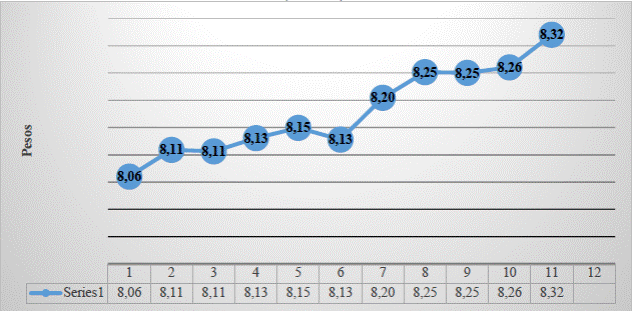
Graph 12 Investment units, January-November 2024
CONCLUSIONS
Business assessment is indispensable for managing any organization's growth, sustainability, and competitiveness. By taking a structured and strategic approach, companies can ensure that their decisions are informed by sound analysis, maximizing their potential for long-term success. Economic, financial, and strategic theories support determining a company's value and allow multidimensional analyses to be carried out. Choosing the right approach depends on factors such as the valuation objective, the type of company, and the economic context. Integrating multiple approaches can provide a more robust and reliable titration.
Financial valuation responds to the company's demand for higher managerial quality by developing creativity, innovation, and executive talent. The dynamics of company financial evaluations result from the changing financial context, which is why the general models must be adapted to the specific circumstances that arise in organizations' future environments.

