




 nueva página del texto (beta)
 Inglés (pdf)
 Artículo en XML
 Referencias del artículo

 Traducción automática
 Enviar artículo por email
 Citado por SciELO
 Similares en
SciELO

 Permalink


Introduction
Boosting rural development is a crucial goal on the global agenda; one of the main objectives of the United Nations (UN) in its 2030 Agenda is to generate the transformations necessary to end poverty, improve food systems, boost jobs and economic growth through sustainable agricultural policies (ONU, 2022). The design of sustainable agricultural policies requires assessing the potential outcomes of policies and their consequences. If this is not done, positive synergies may be omitted given the unintended negative effects when implementing policies (Acosta & Cicowiez, 2021).
Agricultural growth is essential for poverty reduction, and the establishment of policies in support of this sector helps to generate linkages between production and consumption in the economy as a whole (Ravallion & Datt, 2002). Some of the challenges faced by agricultural producers in rural areas are low productivity levels , limited use of inputs due to their high price (e.g., fertilizers), limited access to sources of financing and capital, volatility in food prices, inadequate access to other markets, health risk conditions and, in some cases, vulnerability to organized crime (Louhichi et al., 2020).
Policymakers face the problem of not knowing the effect that an economic policy reform will have on agricultural households. These reforms are intended to correct any weaknesses observed in the markets; but governments should have an overview of the effect of such reform on social welfare, income, production, consumption, or migration. Therefore, it is important to use tools or models of normative economics to quantify these effects on agricultural households; some tools may be econometrics, accounting multiplier models, or applied general equilibrium models (which include the computable general equilibrium model [CGEM]). Agricultural households are families established in marginalized rural areas with an income composed of agricultural production and other exogenous income (Gómez, 2002; López et al., 2013).
Currently in Mexico, the Secretariat of Agriculture and Rural Development (SADER, for its acronym in Spanish) is working on policies and programs aimed at promoting rural activities through actions that contribute to the achievement of food self-sufficiency sustainably, improving income of agricultural households by prioritizing small and medium-sized producers. For the year 2023, five priority programs were active: "Production for Welfare", "Fertilizers for Welfare", "Promotion of Agriculture, Livestock, Fisheries and Aquaculture", "Guaranteed Prices" and "Rural Supply" (SADER, 2023).
Nonetheless, in the current context of Mexican agriculture, several factors affect the rural economy; it is not only the presence or absence of government support that is reflected in agricultural incomes. On the other hand, extortion carried out by organized crime affects the income of agricultural households by acting as taxes on producers.
Berrittella (2018) mentions that organized crime operates in rural areas where the government does not act efficiently and does not make a good distribution of public spending for pure public services such as security, education spending, and other social spending. In her study, she finds that a policy of spending on public goods such as defense and security, in addition, to support for education, has a negative effect on organized crime, that is, it decreases crime in the area. Support for education is beneficial in two ways: because human capital translates into higher productivity and innovation, and because education is likely to impose values of morality and legality that have a positive effect. For this reason, it is interesting to simulate policies that mitigate the negative effects of organized crime on agricultural households.
The objective of this research is to simulate and quantify the effects of the application of agricultural and security policies in Cofradía de San José, municipality of Tuxpan, Michoacán, under general equilibrium models. The materials and methods used in the research are detailed below; afterward, the results and discussion of the policy simulations carried out are presented, ending with the most salient conclusions of the study.
Material and Methods
Study area location, database, and workflow
The simulation and analysis of the application of agricultural and security policies was carried out in the community of Cofradía de San José, municipality of Tuxpan, Michoacán. The community is located 2.2 km from the municipal seat and borders the municipalities of Irimbo to the north, Zitácuaro to the south, Ciudad Hidalgo to the west, and Ocampo to the east (INEGI, 2022). In the community, the lack of diversification of productive activities stands out due to the deficit of local workers, since public programs to promote the countryside are not applied, and due to the abandonment of productive activities as a result of extortion carried out by organized crime, making them less profitable for producers. Therefore, the community is important as an object of study to carry out the simulation and analysis of these policies.
The data correspond to a random sample of 27 surveys applied in Cofradía of San José, with which Toledo et al. (2024) generated the Population Social Accounting Matrix (PSAM) of the locality for the 2022 production cycle. Therefore, this PSAM was used as a database for the calibration of parameters and modeling of general equilibrium equations in the study.
To define, a PSAM is an accounting record that allows the characteristics of a complete economic system to be analyzed, incorporates the added value of the factors of production, and presents how the owners of the factors allocate their income for the acquisition of goods and services, as well as its transfer to production activities. In addition, it provides insight into the diverse economic structures of a village by presenting the links between its components and the relationship of households with other institutions (Yúnez-Naude & Taylor, 1999).
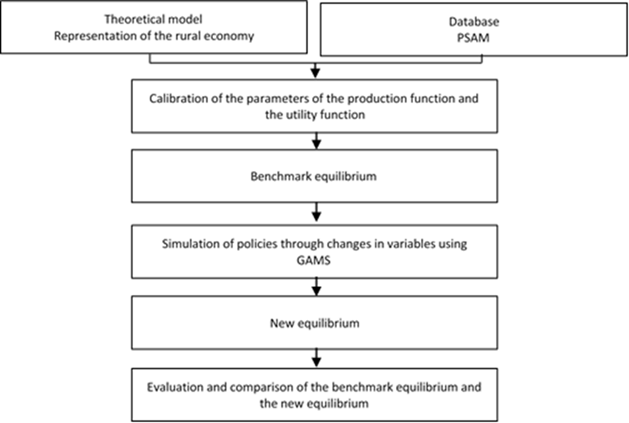
Figure 1 shows the workflow required for the analysis of economic problems using rural Computable General Equilibrium Models (rural CGEM). The starting point is a theoretical model, which is a simplified representation of a rural economy, namely, Cofradía de San José. This model uses the data provided by the PSAM, which functions as a general equilibrium accounting system. Once we have the database, the theoretical model, and the system of equations, we proceed to calibrate the unknown parameters. Calibrating the model parameters means setting a value at which the system of equations reproduces the database (PSAM) as an equilibrium solution of the model. This solution represents the benchmark equilibrium; therefore, the base year (2022) is considered the equilibrium situation of the model. Having the reference equilibrium, the model is used for the simulation of policies through changes in some of the variables of the initial equilibrium, programmed in the software: General Algebraic Modeling System (GAMS) (Gómez, 2002).
Calibration of production function parameters
To calibrate the model parameters, the data contained in the PSAM were used. Following the theoretical calibration model of Cicowiez & Di Gresia (2004), a Cobb-Douglas production function was used:
where Q is the quantity produced, L and K are the factors of labor and capital, respectively,
The cost minimization problem for obtaining the demands of L and K is described as:
where C is the total cost, and
Reordering and assuming that
The scale parameter
Parameter calibration for the utility function
As López et al. (2013) point out, a Cobb-Douglas utility function is easily calibrated and does not require estimates outside the free parameters. The only unknown parameter is the proportion of expenditure on each good consumed in relation to total expenditure; this ratio is the inversion of the demand equation, which is calculated by:
where
Rural Computable General Equilibrium Model
The rural CGEM is composed of five blocks of equations that can be consulted in Taylor et al. (1999) and López et al. (2013). The first block of equations corresponds to agricultural household production, whichuses four factors: family labor, salaried labor, land, and physical capital. The production technology of each sector corresponds to a Cobb-Douglas function. From the point of view of production, agricultural households maximize income through consumption goods and leisure, given market prices or shadow prices of production, factors of production, and intermediate inputs.
In the second block of equations, the income of agricultural households is evaluated. Income is made up of wage income, value-added of capital, land and family labor of productive household activities, and remittances.
The third block of equations corresponds to household expenditures, which include expenditures on goods and services within the community, imported goods and services, leisure, investment in physical and human capital, taxes, and transfers between households.
The fourth block contains a set of general equilibrium closing equations, including the equilibrium conditions of the local market, a savings-investment balance, and a trade balance equation of the locality.
The fifth block consists of price equations; prices may be fixed and determined by markets outside the village in the case of tradable goods, or they may be determined by the interaction of supply and demand in the village in the case of non-tradable goods. The price of land is considered endogenous and is equal to the value of the marginal product of households' productive activities.
Results and Discussion
Theoretical model: Representation of the rural economy
Cofradía de San José is an open rural economy with important links with the outside world. Much of the agricultural production is sold outside the community; in addition, the labor force of the locality has migrated and been hired in labor markets in the United States. As for local production, it is a rural economy with little diversification of productive activities. The main crops produced by agricultural households are avocado, guava, peach, and chayote. Although there is production of animal origin (mainly eggs), there is no animal production, although the production of porcine meat is a tradition in the surrounding area.
The lack of diversification of productive activities is due to two factors: the shortage of labor in local labor markets due to the hiring of labor in external labor markets; on the other hand, the actions of organized crime in the community have led to the abandonment of productive activities since, by demanding fees (extortion) on some productive activities, they cease to be profitable for producers.
Household income in the community is mainly composed of family labor, income from external and internal remittances, income derived from the value added of capital, and to a lesser extent, income from government transfers.
Calibration of production parameters
In the mathematical theoretical model of agricultural households, the aim is to maximize the objective function that depends on the consumption of goods and leisure. Table 1 summarize the productive activities and the factors of production used in these activities. The factors of production in the model are labor and capital. Capital is the sum of physical capital and land, which is assumed to be a fixed factor. The labor factor is the sum of family labor and salaried labor, which is a complement to labor in the units of production. The goods included in the model are obtained from the PSAM of the community, which are: agricultural goods (avocado, guava, peach, chayote, and others), goods of animal origin (eggs), marketed goods, and for the purposes of the model, leisure.
Table 1 Productive activities and factors in Cofradía de San José
| Activities | ||||
|---|---|---|---|---|
| Agriculture | Animal products | Business and services | ||
| Factors | Land | $3,121,200 | - | - |
| Capital | $513,270 | $113,610 | $23,459 | |
| Salaried labor | $599,877 | - | $1,252,348 | |
| Family labor | $8,037,576 | $149,824 | $874,682 | |
Source: Authors' own preparation based on data from the PSAM of Toledo et al. (2024)
Table 2 shows the grouping of goods and productive factors, value added is the sum of the value of capital and land for agricultural goods and production of animal origin. This was used to obtain the parameters of labor and capital according to equations (6) and (7). As can be seen in Table 3, as in several rural communities in Sonora (Méndez-Barrón, 2016) and Chihuahua (López et al., 2013), the labor factor is the largest contributor to the added value of productive activities in a rural economy. The assumption that the functional form of production has constant returns to scale is met since the constraint
Table 2 Grouping of goods and factors
| Goods | ||
|---|---|---|
| Agriculture | Animal products | |
| Labor (L) | $8,637,453 | $149,824 |
| Capital (K) | $3,634,470 | $113,610 |
| Value added | $12,271,923 | $263,434 |
Source: Authors' own preparation based on data from the PSAM of Toledo et al. (2024)
Table 3 Calibrated parameters
| Goods | ||
|---|---|---|
| Agriculture | Animal products | |
| Labor (L) | 0.70 | 0.57 |
| Capital (K) | 0.30 | 0.43 |
Source: Authors' own preparation
Calibration of the scale parameter according to equation (8):
Agricultural goods:
Goods of animal origin:
Calibration of expenditure ratios
The proportion of the expenditure of each good consumed in relation to the total expenditure was obtained with equation (9), the expenditures expressed in Table 4 represent the expenditures of households to carry out productive activities and to acquire goods and services. Family labor is considered an expense since it has been assigned a payment. Table 5 shows the proportions of expenditure, as can be seen and expected, the largest expenditure by households is made by the payment of family labor, followed by expenditure on marketed goods.
Table 4 Classification of expenses made by households
| Total ($) | ||
|---|---|---|
| Activities | Agriculture | 1,535,541 |
| Animal products | 263,434 | |
| Business | 7,562,952 | |
| Family labor | 9,062,081 | |
| Total | 18,424,007 |
Source: Authors' own preparation based on data from the PSAM of (Toledo et al., 2024)
Policy simulation
Policy experiments were conducted for three scenarios: the first is the implementation of the "Fertilizers for Welfare" program, through which fertilizers are delivered to small-scale avocado producers in the community. The second is the implementation of a program run by the State Council of Public Security of Michoacán: the "Peace Strengthening Fund (Fortapaz)" program to support municipalities, which aims to reduce crime rates and thereby reduce extortion of avocado producers in the region. The third is the 7.5 % increase in the price of agricultural goods through complementary policies such as "Promotion of Agriculture" or "Production for Welfare".
These experiments were carried out under two market scenarios: in the first experiment, markets are considered perfect or neoclassical, households participate in formal markets, and prices are freely set outside the locality, through competition. The second scenario assumes that households do not participate in formal markets, this is because their production is used in a greater proportion for self-consumption. This scenario helped to evaluate the behavior of households under the assumption of not participating in agricultural markets (the households of Cofradía of San José are not in this situation, but the evaluation of this scenario is useful for rural economies with agricultural production for self-consumption).
Implementation of the "Fertilizers for Welfare" program
According to the National Service for Agrifood Health, Safety and Quality (SENASICA, 2022), the variable costs of avocado production in Michoacán represent 51 % of the total costs in rainfed systems and 61 % in irrigation systems; within the variable costs, the cost of fertilization and the cost of health protection are the main items.
According to SADER (2022), the so-called "green gold", i.e. avocado, is a fundamental crop for Mexican agriculture, which reaches national and international homes thanks to the care and production of micro, small, and medium-sized producers. This turns avocado into a suitable crop for producers to receive support from the "Fertilizers for Welfare" program; since this is a national attention program applicable to priority crops such as corn, beans, rice, and crops with a high social and economic impact in a region (Diario Oficial de la Federación, [DOF], 2023).
The simulation was carried out by increasing a monetary amount equivalent to the value of fertilizers in the net income (this is due to the reduction in the total cost) of households by the program in question. Since avocado is the main crop in the community, the simulation works well to understand the effects as a percentage of household income in the region.
Table 6 shows the results of the first experiment; here it can be seen that under the assumption of perfect markets, total household income shows an increase of 3.91 %. The products demanded by the market increased in the same proportion as an effect of the increase in income. The marketed surplus of agricultural products and animal products increased the most, with 4.90 % and 6.42 %, respectively. The "Fertilizers for Welfare" program helps producers cope with the volatile fertilizer prices of recent years; by receiving this support, producers reduce their variable costs and it is an opportunity for them to address the problems of lack of capital to invest in their production.
In terms of labor, producers find it more attractive to continue working in their own production unit rather than working for a wage in labor markets within or outside the community. This is similarly reflected in the number of hired workers; since the family workforce does not abandon its activities and does not require a greater amount of days of work, the hired labor decreases.
Under the assumption that households do not participate in the agricultural market, the price of goods is decided in the community and is determined as a shadow price (López et al., 2013). The behavior of income and goods demanded by the market is very similar to the scenario of perfect markets; total household income is slightly higher, with 3.96 %. Naturally, agricultural goods do not increase by the same amount (only by 1.27 %) since in this scenario they are self-consumption goods. For this reason, as agricultural production increases and self-consumption needs are satisfied, the marketed surplus for this type of goods increases (6.49 %). The effect of the percentage decline in labor is explained in the same way as in perfect markets and is slightly larger in this scenario.
Table 6 Percentage change due to the delivery of fertilizers
| Market scenario | ||
|---|---|---|
| A | B | |
| Result variable | Neoclassical perfect markets |
Without household participation in the basic market |
| Household income | 3.91 | 3.96 |
| Consumption demand | ||
| Agriculture | 3.91 | 1.27 |
| Animal products | 3.91 | 3.96 |
| Traded | 3.91 | 3.96 |
| Leisure | 3.91 | 3.96 |
| Marketed surplus | ||
| Agriculture | 4.9 | 6.49 |
| Animal products | 6.42 | 3.96 |
| Family labor supply | -4.22 | -4.26 |
| Hired labor | -4.34 | -4.63 |
Source: Authors' own preparation based on the output of the GAMS software
Security program to reduce extortion
Gaspar (2023) states that at the national level, the crime of extortion was the third most frequent during 2022, behind the crime of fraud and thieving or mugging on the street or public transport. Part of the problem with this crime is the "black number," that is, the total number of crimes that occurred that were not investigated. In the case of extortion, the black figure was the highest in 2022, accounting for 97.4 % of the total crimes not investigated.
Extortion is a problem for avocado and other crop producers in the state of Michoacán, forcing them to abandon their productive activities. The General Coordination of Social Communication (CGCS, 2023) announced the progress of the anti-extortion reform carried out in Michoacán. They highlighted the 221 % increase in the opening of investigation files on the crime of extortion and in the reform they raised the penalty for this crime from 15 to 25 years in prison.
The implementation of this reform, together with the "Fortapaz" Peace Strengthening Fund, through the coordination of the government and the security agencies, could reduce the costs of extortion for producers in the community. This simulation considers the assumption that the implementation of security reforms and programs will reduce extortion costs by 15 %, which is directly reflected in the income of households in the community.
Policies aimed at reducing extortion have positive effects on household income (see Table 7). For the perfect markets scenario, total household income increases by 2.23 %, while in the scenario where households do not participate in the agricultural market, the increase is smaller, by 0.18 %. This is because organized crime primarily affects producers who participate in markets inside and outside the community; with avocado exporting producers being the most affected. However, the consumption demand for of agricultural goods in the non-basic markets increased by 5.00 %, because improving security conditions increases confidence and investment in activities of this type, even in families that produce for self-consumption.
Table 7 Percentage change due to the decrease in extortions
|
Market scenario |
||
|---|---|---|
|
A |
B |
|
|
Result variable |
Neoclassical perfect markets |
Without household participation in the basic market |
|
Household income |
2.23 |
0.18 |
|
Consumption demand |
||
|
Agriculture |
2.23 |
5.00 |
|
Animal products |
2.23 |
0.18 |
|
Traded |
2.23 |
0.18 |
|
Leisure |
2.23 |
0.18 |
|
Marketed surplus |
||
|
Agriculture |
2.79 |
0.30 |
|
Animal products |
3.65 |
0.18 |
|
Family labor supply |
-2.40 |
-0.19 |
|
Hired labor |
-2.47 |
-1.15 |
Source: Authors' own preparation based on the output of the GAMS software
Extortion has a negative impact on the flow of private investment in the regions where this crime is committed and promotes the displacement of labor to foreign labor markets (Mukherjee et al., 2021; Soto & Saramago, 2019). Therefore, and as can be seen in Table 7, the marketed surpluses increase in greater proportion (2.79 %) in perfect markets, being a direct response to the confidence generated in producers by decreasing the crime of extortion. In terms of labor, improving security conditions motivates producers to continue working in their productive activities both in rural economies with perfect markets and in those where production is primarily for self-consumption. In addition, improving security conditions can reduce migration in rural communities.
Increase in the price of agricultural goods
SADER and the Secretariat of Finance and Public Credit (SHCP, for its acronym in Spanish) promote a sectoral program with a focus on innovation, productivity, sustainability, and inclusion for the countryside and the rural sector in Mexico. The sectoral programmatic strategy aims to achieve three objectives: Achieve food self-sufficiency, contribute to the welfare of the rural population, and increase sustainable production practices in the face of agroclimatic risks. This is achieved by increasing production, productivity, and the inclusion of producers by taking advantage of the potential of local territories and markets in agricultural, aquaculture, and fishing activities, with a focus on health and safety (SHCP, 2023).
The simulation was carried out by increasing the prices of agricultural goods by 7.5 %. This increase would depend on the application of the Program to Promote Agriculture, Livestock, Fisheries, and Aquaculture, which aims to increase productivity for food self-sufficiency and the commercialization of surpluses, through the development of regional value chains (DOF, 2022). By improving production, productivity, and marketing systems, implementing sustainable practices, and improving the health and safety conditions of their products, producers can compete with products from international markets and increase the selling prices of their agricultural production.
Table 8 shows the results of the simulation of this policy. In both scenarios, total household income shows a slight increase, in the same proportion (0.13 %). The same is true for labor; in both cases, producers will continue to work in their productive activity, productivity can be improved by the implementation of the policy and it would not be necessary to hire more day laborers.
Table 8 Percentage change due to the increase in the price of agricultural goods
|
Market scenario |
||
|---|---|---|
|
A |
B |
|
|
Result variable |
Neoclassical perfect markets |
Without household participation in the basic market |
|
Household income |
0.13 |
0.13 |
|
Consumption demand |
||
|
Agriculture |
-6.85 |
3.69 |
|
Animal products |
0.13 |
0.13 |
|
Traded |
0.13 |
0.13 |
|
Leisure |
0.13 |
0.13 |
|
Marketed surplus |
||
|
Agriculture |
-13.20 |
0.22 |
|
Animal products |
0.22 |
0.13 |
|
Family labor supply |
-0.14 |
-0.14 |
|
Hired labor |
-0.84 |
-0.84 |
Source: Authors' own preparation based on the output of the GAMS software
In the perfect market scenario, consumption demand for agricultural products decreased (6.85 %) due to rising prices, the same thing happened with the marketed surplus (with a decrease of 13.20 %). This is because the best strategy to compete in this type of market is through price. The price increase that was supposed to benefit the producers caused their sales to decrease. Despite this, these types of policies can have greater advantages compared to a managed pricing policy; when prices are set, quantity is the only variable that can vary in the marketing process and the impacts on the system become fluctuations in quantities, causing shortages or surpluses of production (FAO, 2004). With a program such as the one proposed, improving the conditions for marketing, productivity, and the inclusion of producers in external markets is possible. On the other hand, in the case of the absence of agricultural markets, consumption demand increases by 3.69 %, as does the marketed surplus (0.22 %). In a rural economy with subsistence agriculture (where production is for self-consumption), consumption demand will remain unchanged despite the price of goods and there is an incentive to market surplus production.
Finally, when evaluating the three policy simulations, the results are consistent with those obtained by López et al. (2013) and Echenique (2011), who find that an increase in the selling price of agricultural goods does not represent a substantial improvement in household income. On the other hand, compensatory policies of direct transfer (in cash or in-kind) are more efficient in achieving objectives than compensatory policies of productive development.
Compensatory policies in relation to agriculture are effective in improving labor market conditions in the community, and preventing rural emigration. This result is observable in all three simulations and is mainly effective for family labor. In this regard, Fox & Haight (2010), by conducting an econometric study, find that when the distribution of funds from a program is disaggregated at the community or municipal level and the impact on local labor markets is considered, the programs help to reduce emigration.
Conclusions
The Fertilizers for Welfare program acts as a policy of direct income delivered in kind; it helps producers decrease their variable costs and is efficient in increasing household income, consumption demand, and marketed surplus. In contrast to the Promotion policy, which is treated here as a productivity policy, it is observed that it does not have a significant impact on income and causes distortions in consumption. Therefore, it is concluded that the implementation of direct income policies is more effective than productivity policies. Nevertheless, the positive effect that productivity policies can have should not be discounted, especially when they are aimed at the entire value chain and promote the incursion of producers into local, national, and international markets.
It is important to understand that not all areas of the country depend on the same crop base and producers should not be excluded based on this. It is appropriate to direct policies to support producers of priority crops, but it is necessary to consider crops with high economic and social impact depending on the region since producers face risks such as agroclimatic risks, lack of capital for investment, and organized crime, among others.
Concerning security policies, these are policies that act indirectly but have the potential to help to alleviate the negative effects of organized crime on household income. The simulation showed that a slight decrease in extortion represents a direct increase in total household income, so action must be taken to put an end to these criminal activities to maintain the income and confidence of agricultural households as producers.
Rural CGEM, by allowing non-linearities in functions, offers a wide advantage over other microeconomic models such as accounting multipliers. However, it should be considered that while the theoretical basis of the rural CGEM is robust, the statistical theoretical basis is limited, as it uses the accounting data of a PSAM of a rural economy in a single production cycle (usually one year). An alternative is macroeconometric models based on the statistical theory of the data used, such as vector autoregressive (VAR) models. In addition, the statistical basis of the PSAM is usually presented in very general aggregate concepts, so the robustness of the simulations using the RCGEMs could increase as the accounts are disaggregated.

