




 nueva página del texto (beta)
 Inglés (pdf)
 Artículo en XML
 Referencias del artículo
 Traducción automática
 Enviar artículo por email
 Citado por SciELO
  Similares en
SciELO
Similares en
SciELO 
 Permalink

Introduction
Habanero pepper (Capsicum chinense Jacq.) is characterized by its flavor, aroma and spiciness, holds significant economic importance due to its demand in the national market for both fresh consumption and processing. Additionally, it serves as a source of natural colorants and other compounds such as capsaicinoids (Avilés-Baeza et al., 2021); the latter can be widely used in medicine, cosmetics, paints, tear gas, among others (Chan et al., 2011). Of the total national production, 75% is for fresh consumption, 12% for sauce production, and the remaining 13% for seed production (SIAP, 2022). In 2022, 645 ha were cultivated, yielding a total production of 14,128.81 t of fresh fruit in the states of Campeche, Yucatan, and Quintana Roo, of which 4,737.37 t were produced in Campeche (SIAP, 2022). Typically grown in open fields, the habanero pepper is exposed to various environmental factors that impact the quantity and quality of the product, as well as the profitability of cultivation (Lugo-Jiménez et al., 2010).
This crop is important and representative of the Yucatan Peninsula, prompting efforts to achieve higher yields to meet its high demand. Specifically, for Campeche state, updating the elements comprising technological packages in each production modality, such as fertilization, is preferred. Several factors, including cultural, ideological, geographic, and economic aspects, influence the cultivation of habanero peppers in each region, with a focus on technology personalized for each capacity of producers, including nutritional aspects. Each region has used different preparations for supplying nutritional requirements in habanero peppers, using a widely variable formula of fertilization including nitrogen, phosphorus, and potassium (Ayala-Garay et al., 2018). There are several recommendations on the amounts to apply fertilizers among which we can mention those proposed by Soria-Fregoso et al. (2002), Noh-Medina et al. (2010), Avilés-Baeza et al. (2021), and Javier-López et al. (2022). However, the results of field fertilization are not entirely satisfactory as this depends on the soil type and its characteristics (Borges-Gómez et al., 2014; Ayala-Garay et al., 2018; Meneses & Garruña, 2020).
The objective of this research work was to know the performance of habanero pepper to the application of different levels of nitrogen (N), phosphorus (P), and potassium (K) fertilization, for the increase of fresh fruit yield.
Material and Methods
Study area description
The experiment was established under open-field conditions within the Xamantún experimental field of the Instituto Tecnológico de Chiná, geographically located 19°14' N and 90°28' W, with an average altitude of 44 m.a.s.l. The habanero pepper was planted in September in deep, fine-textured soil of the K'ankab lu'um (KV) according to the Mayan nomenclature (Palma-López & Bautista, 2019), and Ferric Luvisol according to the WRB (IUSS-WRB, 2015). The climate type is characterized as warm sub-humid with summer rainfall and a rainfall range of 1,000 to 1,200 mm (Matos-Pech et al., 2022).
Experimental design
The habanero pepper variety (Capsicum chinense Jacq.) used for this project was "Mayapan", known for its good performance in the conditions of the Yucatán Peninsula and for producing fruits in demand by producers and consumers in the region. The experimental design used was a completely randomized block design with three replications. The treatments consisted of the application of five fertilization formulas (N-P-K) with different levels of nitrogen (N), phosphorus (P), and potassium (K). The experimental unit consisted of four furrows with a distance between them of 1.5 m and a furrow length of 14 m, covering a total area of 84 m2. The useful plot was taken from the central part of each row, resulting in a surface area of 28 m2.
The treatments consisted of the application of fertigation with five doses of fertilization with different NPK levels, which are the result of evaluating various nutritional requirements that have been used in some regions of Tabasco and the Yucatan Peninsula by various researchers and producers of habanero peppers (Soria-Fregoso et al., 2002; Ramírez, 2003; Prado, 2006). Additionally, two proposals with higher quantities of NPK than those commonly used were employed (Borges-Gómez et al., 2010; Meneses & Garruña, 2020), which are described in Table 1. Fertilization management consisted of the application of a base or background fertilization and fertigation, which were provided in a percentage of 30 % nitrogen, 50 % phosphorus, and 40 % potassium for the base fertilization, and 70 % nitrogen, 50 % phosphorus, and 60 % potassium in each of the fertilization formulas evaluated.
Table 1 Nitrogen, phosphorus, and potassium (NPK) fertilization formulas were used as treatment in this study.
| Treatments | Bibliographic reference |
|---|---|
| 150-50-200 (T) | Based on (Soria-Fregoso et al., 2002). |
| 200-100-240 | With reference to the dose used by Ramírez, (2003). |
| 250-150-280 | Requirement adjustment with respect to Prado, (2006). |
| 300-200-320 | |
| 350-250-360 |
T=Test treatment
The study variables were the number of flowers per plant (NFP), number of fruits per plant (NFRP), fruit diameter, fruit length (FL), and fresh fruit yield (FFY). Sampling was carried out based on ten plants taken per treatment and replicate. The selected plants were located in the central furrows of the experimental unit, which also formed a useful plot. Sampling was carried out every 8 days for flowering variables and every 15 days for vegetative development variables, starting 60 days after transplanting and continuing with sampling until the end of the crop.
Harvesting was carried out when the fruit reached commercial characteristics of color and fruit size (intense bright green). A total of six cuts were made, one every 12 days.
Statistical analysis
After analyzing the obtained data for the evaluated variables, the assumptions of normality (Shapiro-Wilks) and homoscedasticity (Levene's test) were checked and confirmed. The data were ordered and subjected to analysis of variance (ANOVA) using the statistical program SAS (Statistical Analysis System, SAS Institute Inc.), through the general linear model procedure for the completely randomized block experimental design. To determine the best treatments from a statistical standpoint, the treatment means were subjected to the Tukey multiple means comparison test (=0.05).
Results and Discussion
Number of flowers and number of fruits per plant
The effect of increasing the fertilization dose on habanero pepper for the number of flowers per plant could not be established through the 13 samplings conducted, given the dynamic process of the change from flower to fruit and the loss of unattached flowers, making precise counting challenging. This was reflected in the results of the mean comparison tests throughout the 13 samples taken. However, the formula 350-250-360 was identified as the treatment that induced the highest number of flowers (Tables 2 and 3).
Table 2 Test for comparison of means by sampling for the variable number of flowers per plant until day 111 after planting, with different NPK treatments.
| Formula | Sample (day) | ||||||
|---|---|---|---|---|---|---|---|
| Fertilization | 69 | 76 | 83 | 90 | 97 | 104 | 111 |
| 150-50-200 | 114.00 ab | 150.00 a | 174.33 c | 221.33 a | 257.67 a | 293.00 a | 329.33 a |
| 200-100-240 | 135.33 ab | 171.33 a | 207.00 abc | 242.67 a | 278.67 a | 314.33 a | 350.67 a |
| 250-150-280 | 166.67 ab | 147.67 a | 183.33 bc | 219.00 a | 255.00 a | 290.67 a | 326.67 a |
| 300-200-320 | 167.67 a | 195.00 a | 222.33 ab | 248.67 a | 277.67 a | 303.33 a | 317.00 a |
| 350-250-360 | 166.67 ab | 194.00 a | 255.33 a | 254.33 a | 285.67 a | 314.67 a | 334.67 a |
| MSD | 55.59 | 51.80 | 40.17 | 47.55 | 48.75 | 48.50 | 40.12 |
MSD= Minimum significant difference (Tukey,=0-05); Treatments with the same letter are statistically equal.
Table 3 Test for comparison of means by sampling for the variable number of flowers per plant from days 118 - 153 after planting, with different NPK treatments.
| Formula | Sample (day) | |||||
|---|---|---|---|---|---|---|
| Fertilization | 118 | 125 | 132 | 139 | 142 | 153 |
| 150-50-200 | 295.33 b | 261.66 b | 228.00 b | 194.67 b | 161.00 a | 127.67 a |
| 200-100-240 | 317.33 ab | 284.33 b | 251.00 ab | 218.00 ab | 185.33 a | 152.00 a |
| 250-150-280 | 297.00 b | 267.00 b | 237.33 b | 207.67 ab | 178.00 a | 148.67 a |
| 300-200-320 | 315.00 ab | 287.66 b | 247.33 b | 211.33 ab | 169.33 a | 126.67 a |
| 350-250-360 | 340.66 a | 325.33 a | 286.00 a | 239.33 a | 189.67 a | 119.67 a |
| MSD | 29.98 | 32.59 | 35.04 | 38.83 | 44.74 | 46.31 |
MSD= Minimum significant difference (Tukey, (=0-05); Treatments with the same letter are statistically equal.
These results indicate an effect of the nutritional regime on flowering in habanero pepper, increasing the number of flowers per plant (López-Gómez et al., 2017). Regarding fruits number, it was possible to observe more precisely an increase due to the effect of the use of the fertilization formula (NPK) 350-250-360, an effect that was maintained throughout all the samplings. This suggests, under the study conditions, an adequate nutritional state of the habanero pepper plants. These findings can be explained by having habanero pepper plants with sufficient nutrition, as these stages of growth and development are crucial for fruit yield. During flowering, a large number of flowers and fruits are usually aborted due to nutritional deficiencies, resulting into losses for producers. The results found are supported by López-Gómez et al. (2017, 2020), who reported that flowering and fruit set are increased by the effect of the amount of nitrogen and phosphorus applied, including the type of soil.
Fruit length and diameter
The increase in fruit length and diameter was attributed to the effect of NPK fertilization, with 350-250-360 being the best fertilization formula across the samples, followed by 300-200-320 (Table 4 and Table 5). As nitrogen, phosphorus, and potassium levels increased, there was a noticeable increase in fruit size, attributed to their combined effects on plant growth, protein component (N), energy production (P) (López-Gómez et al., 2017) and promotion of fruit quality (K) (Berrios et al., 2007). The results found are in agreement with what was referred by (López-Gómez et al., 2017) in the sense that nutrient supply has an impact on plant development, yield, and fruit quality of habanero chili, including the soil and environmental conditions present during crop development.
Table 4 Test for comparison of means by sampling for the fruit length variable in mm.
| Fertilization | Day of sampling | |||||
|---|---|---|---|---|---|---|
| N-P-K | 93 | 105 | 117 | 129 | 142 | 153 |
| 150-50-200 | 50.33ab | 54.30a | 53.46abc | 55.40a | 55.30a | 54.86ab |
| 200-100-240 | 50.33ab | 53.06a | 54.50ab | 55.63a | 55.60a | 55.10ab |
| 250-150-280 | 46.53bc | 48.33b | 49.73bc | 50.87a | 50.83a | 50.33b |
| 300-200-320 | 45.66c | 47.86b | 49.30c | 50.47a | 50.36a | 49.90b |
| 350-250-360 | 51.63a | 53.73a | 55.13a | 39.33a | 55.23a | 55.76a |
| MSD | 3.67 | 4.15 | 4.79 | 35.69 | 5.90 | 5.24 |
MSD = Minimum significant difference; treatments with the same letter are statistically equal (Tukey, p > 0.05).
Table 5 Test for comparison of means by sampling for the fruit diameter variable in mm.
| Fertilization | Day of sampling | |||||
|---|---|---|---|---|---|---|
| N-P-K | 93 | 105 | 117 | 129 | 142 | 153 |
| 150-50-200 | 31.03ab | 32.36ab | 34.86ab | 35.73ab | 35.70ab | 35.13ab |
| 200-100-240 | 33.20a | 35.36a | 36.70a | 37.60a | 37.50a | 36.96a |
| 250-150-280 | 32.50ab | 33.86ab | 35.26ab | 36.10ab | 36.03ab | 35.46ab |
| 300-200-320 | 29.80b | 31.16b | 32.56b | 33.36b | 33.33b | 32.76b |
| 350-250-360 | 31.76ab | 32.50ab | 33.86ab | 34.76ab | 34.70ab | 34.13ab |
| MSD | 2.85 | 3.69 | 3.73 | 3.70 | 3.69 | 3.71 |
MSD = Minimum significant difference; treatments with the same letter are statistically equal (Tukey, p > 0.05).
Under the study conditions the Luvisol soil is a clayey soil considered suitable for vegetable cultivation. However, the study site is frequently intensively used for growing various crops, making a high dose of NPK suitable for habanero pepper cultivation. The type of soil has been shown to have a direct relationship with the growth and development of chili fruits (Borges-Gomez et al., 2010; Medina-Lara et al., 2019). However, it can be argued that when plants are cultivated, the variety of factors that affect growth cannot simply be reduced to the presence or absence of a nutrient or lack of water; soil structure must be taken into account since it is complex and variable.
These results can be explained by considering the role of the evaluated macronutrients, while still considering soil conditions and other parameters, such as climatic factors (Ayala-Garay et al., 2018). Obtained data are interesting since traditionally the fertilization formulas proposed are low ranging in an average order of 150-120-200 (Avilés-Baeza, 2021). Authors such as Borges-Gómez (2014), suggest that the productive potential of habanero pepper under irrigated conditions is mainly determined by soil class and mean annual temperature. I If good production conditions are crucial for achieving high habanero pepper yields, the productive potential of the genotype used is equally important (López-Espinoza et al., 2018). Under protected agriculture conditions several researchers report yields of up to 80 t ha-1 which is mainly attributed to management practices (Meneses & Garruña, 2020).
Fresh fruit yield
It is essential to consider that open-field habanero pepper production depends on genotype, soil type, environmental conditions, and crop management, including fertilization, factors that condition the crop yield potential. For the study conditions, the application of the 350-250-360 formula showed a considerable effect on fruit yield in the field, estimated in the order of 41,250 kg ha-1 (Fig. 1), taking into account the quality of the fruit. Considering the soil quality as good, this yield is higher than what is typically obtained under similar cultivation conditions in the state of Campeche, which is around 20,000 kg-ha-1. Additionally, considering that five harvests are common in open-field conditions, producing habanero pepper fruits with commercial quality, the production is profitable (Castillo-Aguilar et al., 2015).
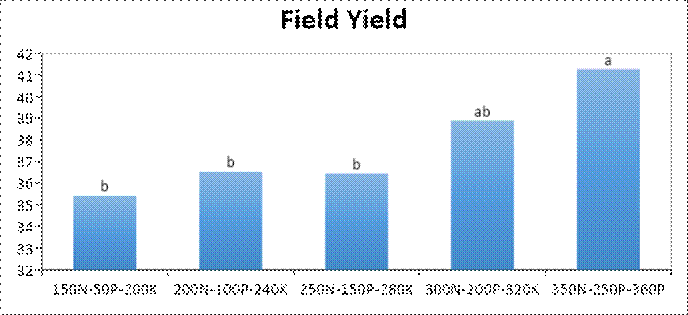
Treatments with the same letter are statistically equal (Tukey, ( =0.05). DMS= 3985.8. Source: Own elaboration based on the data obtained during this research.
Figure 1 Habanero pepper fruit field yield (t ha-1) by fertilization formula.
The average fresh fruit yield obtained is comparable with other research works such as that of Rangel-Campos (2016), who obtained in his evaluations a yield of 42.56 t ha-1. The results reveal a difference of 21,250 kg of fresh habanero pepper fruit, more than double the typically produced amount in open-field conditions. This could potentially translate into greater economic benefits for rural and industrial habanero pepper producers in the state of Campeche.
Conclusions
Higher levels of nitrogen, phosphorus, and potassium (NPK) resulted in a yield increase exceeding 100% compared to conventional methodology suggested for open-field habanero pepper cultivation (Capsicum chinense Jacq.). The fertilization formula that induced the highest habanero bell pepper fruit yield was 350-250-360, (NPK), with an average yield of 41,259 kg ha-1. The application of the 350-250-360 formula is recommended for Luvisol soil conditions; however, results may diverge with changes in soil type, soil fertility, and production techniques. Lastly, it is advisable to direct future research efforts towards assessing the cost-benefit generated by the increased fertilization doses in local and regional production systems.

