

SciELO - Scientific Electronic Library Online

 
vol.11Polinización manual y aplicación de azoxystrobin en el amarre y desarrollo de fruto de guanábana (Annona muricata L.) en árboles con poda en Las Varas, Nayarit.Efecto de bioestimulantes microbianos en plántulas y frutos de chile jalapeño (Capsicum anuum L.) producidos en macrotúnel índice de autoresíndice de materiabúsqueda de artículos
Home Pagelista alfabética de revistas  

Servicios Personalizados

Revista

Articulo

Indicadores

Links relacionados

  • No hay artículos similaresSimilares en SciELO

Compartir


Revista bio ciencias

versión On-line ISSN 2007-3380

Revista bio ciencias vol.11  Tepic  2024  Epub 20-Ene-2025

https://doi.org/10.15741/revbio.11.e1521 

Original articles

Evaluation of the antibacterial activity of skin mucus from the common octopus Octopus bimaculatus against pathogenic bacteria from farm animals.

Evaluación de la actividad antibacteriana de la mucosidad de la piel del pulpo común Octopus bimaculatus contra bacterias patógenas de animales de granja

Macario Savin-Amador1  * 
http://orcid.org/0000-0002-2748-9294

José Saúl Hernández-Rubio1 
http://orcid.org/0000-0001-5852-4008

Miguel Agustin Caballero-Cosío1 

M. Rojas-Contreras1 

Norma Francisca González-Pérez1 

1Universidad Autónoma de Baja California Sur (UABCS) Apartado Postal 19-B. C.P. 23080, La Paz, Baja California Sur, México


ABSTRACT

Studies were conducted to evaluate the antibacterial potential of skin mucus collected from the common octopus Octopus bimaculatus against certain pathogenic strains for crustaceans, mollusks, fish, and bovine; Escherichia coli, Staphylococcus aureus, Vibrio harveyi, Vibrio parahaemolyticus, and Staphylococcus pasteuri. The antibacterial activities were measured in terms of inhibition halos in mm and compared with two antibiotics amikacin and chloramphenicol. The amount of protein in octopus mucus was also estimated in mg mL-1. Inhibition halos produced by three different mucus concentrations were observed for the selected pathogens, except for the V. parahaemolyticus strain, which showed no inhibition at the lowest concentration. Furthermore, at the highest concentration, strain V. parahaemolyticus was the least inhibited, with a diameter of 3.9 ± 0.2 mm. The two antibiotics inhibited all strains, with the E. coli strain being the most inhibited. Therefore, these results have demonstrated that mucus extracted from octopus skin exhibits antibacterial activity and that they contain proteins. These components could be subjected to purification processes for potential use as an alternative to antibiotics in the control of pathogens in both aquaculture and terrestrial facilities.

KEYWORDS: Cephalopods; Protein; Inhibition; Antibacterials

RESUMEN

Se realizaron estudios para evaluar el potencial antibacteriano de la mucosidad de la piel recolectada del pulpo común Octopus bimaculatus contra ciertas cepas patógenas para crustáceos, moluscos, peces y bovinos; Escherichia coli, Staphylococcus aureus, Vibrio harveyi, Vibrio parahaemolyticus y Staphylococcus pasteuri. Las actividades antibacterianas se midieron en términos de halos de inhibición en mm y se compararon con dos antibióticos amikacina y cloranfenicol. También se estimó la cantidad de proteína en la mucosidad del pulpo en mg mL-1. Se observaron halos de inhibición producidos por tres diferentes concentraciones de mucosidad en los patógenos seleccionados, con la excepción de la cepa V. parahaemolyticus, que no mostró inhibición en la concentración mínima. Además, en la concentración más alta, la cepa V. parahaemolyticus fue la menos inhibida, con un diámetro de 3.9 ± 0.2 mm. Los dos antibióticos inhibieron todas las cepas, siendo la cepa E. coli la más inhibida. Por lo tanto, estos resultados han demostrado que la mucosidad extraída de la piel del pulpo exhibe actividad antibacteriana y que contienen proteínas. Estos componentes podrían ser sometidos a procesos de purificación para su potencial utilización como una alternativa a los antibióticos en el control de patógenos tanto en instalaciones acuícolas como terrestres.

PALABRAS CLAVE: Cefalópodos; Proteína; Inhibición; Antibacteriano

Introduction

Marine ecosystems are very complex, and organisms are known to possess bioactive compounds for defense and for the protection of eggs and embryos. Some have chemical mechanisms to synthesize compounds de novo to protect themselves from pathogens (Lauritano & Ianora, 2020).

Currently, about 16,000 natural products have been discovered from marine organisms, for example, in 1949 the first antibacterial product of marine origin, Cephalosporin C, was obtained from a strain of marine fungus Cephalosporium (Pandey, 2019). Among marine organisms, marine invertebrates offer a good source of potential antibacterial drugs (Di Costanzo et al., 2019; Lauritano et al., 2020).

Cephalopods are found in all marine habitats of the world, such as benthic-cryptic; epibenthic, and pelagic in bays and the open sea. However, cephalopods do not have a shell to protect themselves, so they use chemical means, coloration change, and toxins (Monolisha et al., 2013). Cephalopod skin consists of two layers, the epidermis, and the dermis. These layers cover the external surface of the body showing different regional specializations, such as suckers and arms. In addition, the skin is continued with the internal surfaces of the siphon and paleal cavity (Anadon, 2019).

To evaluate the condition of the animals, it is essential to carry out various tests on their organs, including the skin. The characteristics that should be noted on the skin are the presence of desquamation, hematomas, ulcers, and mucosal hypersecretion (FAO, 2011). The skin of most organisms contains mucosal epithelia with important antiparasitic, antifungal, antibacterial, and antiviral properties (Fast et al., 2002). Currently, marine and terrestrial farms present problems arising from diseases transmitted by pathogenic bacteria (OIE, 2019; Prachumwat et al., 2020; Deng et al., 2020; de Lorgeril et al., 2018; Palomares-Reséndiz et al., 2021; Rivera-Benitez et al., 2014; Burniston et al., 2015; Giraldo-Cardona et al., 2019, Pulido-Villamarín et al., 2021). For this reason, this research focuses on the skin of octopuses mainly in the study of mucus (González-Costa et al., 2020; Villanueva et al., 2021).

Recently, there have been many studies on the antibacterial properties of skin mucus from many species of marine organisms against various pathogenic microorganisms for humans and fish (Wei et al., 2010; Bragadeeswaran & Thangaraj, 2011; Vennila et al., 2011; Fuochi et al., 2017; Reverter et al., 2018), of freshwater fishes (Nwabueze, 2014; Pethkar & Lokhande, 2017), marine fishes and catadromous fishes (Fuochi et al., 2017; Pethkar & Lokhande, 2017), elasmobranchs (Coelho et al., 2019; Ritchie et al., 2017), anemones (Subramanian et al., 2011; Stabili et al., 2015), mollusks (Pales Espinosa et al., 2013; Kamiya et al., 2006; Suárez et al., 2021).

The main components of the mucus are glycoproteins and proteoglycans, and to a lesser extent, proteolytic enzymes, lysozymes, immunoglobulins, etc. Unlike other mollusks (Smith, 2002), the chemical nature of mucus in the genus Octopus is limited (Smith & Morin, 2002).

Each species has its own behavior and habitat, lives in different types of aquatic environments, and consumes different types of food, which may influence the amount of mucus secretion and its components within the same species or between different species and may be useful to provide a variety of immune responses. Therefore, the aim of the present study was: To analyze the antibacterial effect of the skin mucus of the common octopus Octopus bimaculatus, against a collection of pathogenic strains for terrestrial and aquatic farm animal collection.

Material and Methods

Specimen Collection

Five octopuses of the genus O. bimaculatus weighing approximately 500 to 700 grams were captured in the community of El Sauzoso, B.C.S. Mexico (24°18'44.5 "N 110°38'26.0 "W) with traps. They were placed in tanks on board of the boat with clean, sterile water. They were washed with a 4% solution of potassium permanganate (KMnO4) before being placed in the tanks and before mucus collection. No chemicals or anesthesia were administered to the octopuses for skin mucus collection. Mucus was collected from five octopuses. Mucus was carefully scraped from the body surface by moving a sterile plastic spatula in an anteroposterior direction, from the head toward the tentacles, and mucus was collected at regular intervals (10 attempts in 3 hrs). Accumulation of mucus from the ventral area was avoided to eliminate intestinal and urogenital contamination (Chong et al., 2005). The mucus samples were brought on ice to the laboratory where they were centrifuged at 13,200 rpm for 10 min at 4°C. The supernatant was placed in a sterile tube and centrifuged again on ice at 11,000 rpm for 30 min. The precipitate was discarded, and the raw mucus extract was stored at -70°C before analysis.

Preparation of raw octopus mucus

Raw octopus mucus was treated with SIGMA® lysozyme enzyme at a final concentration of 10 mg mL-1 in phosphate buffer pH 7.0. The mixture was incubated at optimum pH and temperature for the enzyme to break the peptidoglycan layer of the bacterial cell wall for 2 hrs. The antibacterial activity was performed by a diffusion method in Petri dishes with Müller-Hinton agar using wells (Guerra & Pastrana, 2002).

Reactivation of pathogenic strains

The strains used for the in vitro antibacterial evaluation of the prepared octopus mucus were: Escherichia coli (Amador, 2018), Staphylococcus aureus (Unpublished data), Vibrio harveyi (Parera-Valadez, 2012), Staphylococcus pasteuri (Amador, 2018), Vibrio parahaemolyticus (Amador, 2021) (Table 1). All bacterial strains were obtained from the collection of the Food Science and Technology Laboratory of at Autonomous University of Baja California Sur.

Bacterial strains were cultured according to the protocols and microbiological safety conditions of Eder et al. (2009). Each strain was incubated at 37 °C in nutrient broth (0.5% peptone, 0.5% NaCl, 0.3% meat extract, distilled water, pH 6.8 at 28 °C) for 18-24 h. Subsequently, a viable count of each culture was made and colony-forming units per mL (CFU/mL) were calculated (Barbosa et al., 1995).

Protein estimation

The amount of protein in octopus mucus was determined using the method of Bradford Kruger (2009).

Table 1 Strains from the collection of the Food Science and Technology Laboratory of at Autonomous University of Baja California Sur. 

Isolated Genus Species Place
Oyster Escherichia coli BCS, México.
Bovine Staphylococcus aureus BCS, México.
Shrimp Vibrio harveyi BCS, México.
Oyster Staphylococcus pasteuri BCS, México.
Shrimp Vibrio parahaemolyticus BCS, México.

Petri dish diffusion assay with wells in agar

The antibacterial effect of octopus mucus (OM) extracts on the selected bacterial strains was analyzed by the agar well diffusion method (Valgas et al., 2007). Petri dishes were prepared with 15 mL of Müller-Hinton agar and then the bacterial strains (Table 1) were seeded by surface spreading with 1x10⁷ CFU mL-1. Subsequently, wells with a diameter of 6 mm were aseptically punched with a tip and extracts of the prepared octopus mucus were added (10, 50, and 100 µL mL-1 of mucus extract per well), as positive controls the antibiotics amikacin and chloramphenicol were used at a concentration of 40 µg mL-1 and 20 µg mL-1, respectively, and physiological saline solution (0.85% NaCl) was used as a negative control. The Petri dishes already inoculated and with the extracts were incubated at 37 °C for 24 h. The evaluation of the bactericidal effect was performed by measuring the diameter of the IH formed around the well (Jorgensen & Turnidge, 2015). The diameter of the IH was measured in millimeters (mm) with a vernier, the measurement was made by taking the total diameter of the halo minus the 6 mm of the well. The results of antibacterial activity were compared with positive controls.

Statistical analysis

Results were subjected to Barlett's homoscedasticity test and D'Agostino-Pearson normality test with an α = 0.05 and then a one-way analysis of variance (ANOVA) was performed to compare significant variation in octopus mucus and antibiotics. Determination of factors contributing to significant differences was performed using the LSD multiple comparison test (Sokal & Rohlf, 1980).

Results and Discussion

Octopus mucus may represent a good source of biologically active compounds to be used for different biotechnological purposes. The biological interface between the octopus and its marine environment consists of a mucus layer composed of biochemically diverse secretions of epidermal and epithelial cells (Accogli et al., 2017). It has been suggested that mucus secretion serves an antibacterial purpose, and also helps to collect bacteria from the surrounding waters, and promotes the accumulation of microbial cells, including Vibrio and other marine microorganisms (Troll et al., 2010).

The effects of a new antibacterial peptide (OctoPartenopin), extracted from the suckers of O. vulgaris, against Pseudomonas aeruginosa, Staphylococcus aureus, and Candida albicans were also demonstrated (Maselli et al., 2020). In this research, octopus mucus was used to inhibit the growth of some strains of pathogenic bacteria, where the higher the concentration, the greater the inhibition.

In another study, in vitro and in vivo assays were conducted using octopromycin, a peptide derived from Octopus minor against Acinetobacter baumannii, and revealed that infected fish exhibited a significantly higher relative survival percentage of 37.5 % than infected fish treated with (placebo)PBS 16.6 %, (Rajapaksha et al., 2021).

Soluble proteins

The protein content in the mucus of the selected octopuses varied very little. The general trend of protein content in the epidermal mucus of the species was 3.684 mg mL, while in another research a protein content of 1.0716 mg mL-1 for O. dolfusii and 1.3620 mg mL-1 for O. aegina was found (Monolisha et al.,2013). However, no further information on protein quantification in octopus mucus was found, but in fish, it was shown that raw and partially purified epidermal mucus from Tachysurus dussumieri presented a protein content of 0.48 ± 0.02 mg mL-1 and 0.82 ± 0.05 mg mL-1 (Arulvasu et al., 2012). Similarly, protein was found to be the major component in different skin mucus extracts of Channa micropeltes, Cytusis striatus, Oreochromis niloticus, and Mystus nemurus, which ranged from 4.32 ± 0.28 to 5.79 ± 0.32 mg mL-1 (Rao et al., 2015). Possibly due to the high protein content in the mucus extract of O. bimaculatus had a higher IH against the pathogens selected in this study, as mucus secretion has also been suggested to have an antibacterial purpose (Troll et al., 2010), and in addition to lectins, uncharacterized glycoproteins have also been associated with binding to bacteria in the hemolymph of Octopus vulgaris (Rögener et al., 1987).

Bacterial antagonism assay

The extract of raw octopus mucus and the two antibacterials, chloramphenicol and amikacin, exhibited a strong bactericidal effect against all selected pathogenic strains except for the pathogen V. parahaemolyticus.

In the bioassay, the inhibition of bacterial strains was evaluated using different concentrations of mucus and specific antibiotics. The results showed inhibition halos (IH) (Table 2), where it was observed that at the mucus concentration of 10 µL mL-1, there was a higher IH for the E. coli strain with 19.168 ± 3 mm, the lowest halo for S. aureus with 8.0 ± 0.4 mm and no IH for the V. parahaemolyticus strain. At the concentration of 50 µL mL-1, the highest IH was for E. coli with 20.21 ± 0.4 mm, and the lowest was for V. parahaemolyticus 1.56 ± 0.02. At the concentration of 100 µL mL-1 inhibition was shown in all strains, the highest halo was presented by the S. aureus strain with 14.2 mm ± 0.5 mm and the lowest halo was for V. parahaemolyticus with 3.9 ± 0.2 mm. The antibiotic chloramphenicol 20 lg mL-1 showed the highest inhibition halo for E. coli at 14.6 ± 0.5 mm and the lowest for S. aureus with 2.12 ± 0.1 mm and the antibiotic amikacin 40 lg mL-1 showed the highest IH for S. aureus strain with 8.4 ± 0.6 mm and the lowest for V. parahaemolyticus with 4.0 ± 0.2 mm.

Table 2 Halos of inhibition were shown by selected bacteria exposed to the three different concentrations of octopus mucus and two commercial antibiotics. 

Octopus mucus concentrations HI (mm) HI antibiotics (mm)
10 µL mL-1 50 µL mL-1 100 µL mL-1 Chloramphenicol 20 lg mL-1 Amikacin 40 lg mL-1
Strains
E. coli 19.168 ± 0.3 20.21± 0.4 5.52 ± 0.4 14.6 ± 0.5 5.52 ± 0.4
V. parahaemolyticus 0 3.9 ± 0.2 3.9 ± 0.2 2.4 ± 0.2 4.0 ± 0.2
S. pasteuri 10.32 ± 0.9 10.5 ± 0.45 12.7 ± 0.7 4.4 ± 0.43 5.52 ± 0.4
V. harveyi 8.82 ± 0.3 10.2 ± 0.5 12 ± 0.9 4.4 ± 0.3 6.04 ± 0.5
S. aureus 8.0 ± 0.4 10 ± 0.5 14.2 ± 0.5 2.12 ± 0.1 8.4 ± 0.6

HI= Inhibition halos. Halo Diameter of the inhibition halo minus the diameter of the well with an antibacterial.

The five pathogenic strains presented IH in the presence of the two antibiotics. With chloramphenicol 20 µg mL1, the highest IH was of the following strains: E. coli with 14.6 ± 0.5 mm, V. harveyi with 4.4 ± 0.4 mm, S. pasteuri with 4.4 ± 0.43 mm and the lowest of S. aureus with 2.12 ± 0.1 mm. With amikacin 40 lg mL-1 the highest IH was presented by the S. aureus strain with 8.4 ± 0.6 mm, followed by V. harveyi with 6.04 ± 0.5 mm, E. coli and S. pasteuri with 5.52 ± 0.4 mm and the lowest was V. parahaemolyticus with 4 ± 0.2 mm.

The results of the inhibition halos of the selected bacterial strains due to mucus at a concentration of 10 µL mL-1 showed significant differences (p > 0.05) among all strains, however, E. coli was the most inhibited. At the concentration of 50 µL mL-1 there were no differences between the strains S. pasteuri, V. harveyi, S. aureus, but there were differences against V. parahaemolyticus and E. coli (p > 0.05) with the latter having the highest IH of 20.28 mm. With the 100 µL mL-1 mucus significant differences (p > 0.05) were shown between almost all strains: S. aureus and V. harveyi and the E. coli strain had the highest IH of 21.44 mm, except for S. pasteuri. The antibiotic chloramphenicol 20 lg mL-1 did not cause significant differences between the IH of the strains S. pasteuri and V. harveyi, between V. parahaemolyticus and S. aureus, but it did cause significant differences between these groups and against E. coli, the latter presenting the highest IH of 14.8 mm. The antibiotic amikacin 40 lg mL-1 did not cause significant differences between the IH of E. coli and V. harveyi between S. pasteuri and S. aureus, but these two groups did against V. parahaemolyticus (p > 0.05), here the strain with the highest IH was S. aureus with 8.4 mm. Importantly, the V. parahaemolyticus strain was the least inhibited at all three concentrations and antibiotics.

Other reports have shown the antimicrobial activity of aqueous and ethanolic extracts of mucus from different marine organisms. Antimicrobial activity assays carried out with ethanolic extracts of tissues from Octopus dolfusii and Octopus aegina organisms against V. parahaemolyticus showed IH of 34 and 28 mm on average respectively (Monolisha et al., 2013).

Likewise, in methanolic extracts of O. dollfusi tissue, the highest IH of 17 mm was observed against E. coli, another extract of O. aegina showed an IH of 15 mm against V. parahaemolyticus and another of O. aerolatus against S. aureus presented IH of 13 and 14 mm and the lowest IH of 8 mm was observed against Streptococcus sp. with extracts of O. dollfusi, O. aegina and O. aerolatus (Pasiyappazham et al., 2011). In this study, the surface mucus of O. bimaculatus against different pathogens showed the highest IH against E. coli of 21.44 mm, against S. aureus of 14.2 mm, against S. pasteuri of 12.75 mm and against V. harveyi of 12.36 mm. The lowest IH was 4.6 mm in V. parahaemolyticus (Figure 1), similarly, Monolisha et al. (2013) using ethanolic extracts of O. dolfusii tissue against V. anguillarum, V. alginolyticus, V. sclintis, and V. harveyi reported IH of about 27, 22, 21 and 15 mm respectively, also used extracts of O. aegina extracts against the same pathogens reported IH of 25, 21, 21 and 18 mm respectively, which suggests that the genus Octopus presents antibacterial activity in the superficial mucus and could also be in all the internal mucosa of these organisms. Similar studies with extracts of carp mucus showed that the maximum inhibitory effect of carp mucus Hypophthalmichthys nobilis against E. coli reached an IH of 31.00 ± 0.47 mm, that of Ctenopharyngodon idella against P. aeruginosa was 34.33 ± 0.13 m, significantly higher than amikacin 33.33 ± 0.13 mm and that of O. bimaculatus against S. aureus ranged from 10.32 to 12.75 mm (Kumari et al., 2019). It was also reported that S. aureus was more susceptible than other Gram-negative bacteria to growth inhibition by gastropod extracts (Benkendorff et al., 2001), however, no antibacterial activity against E. coli was detected in Mytilus galloprovincialide hemolymph (Hubert et al., 1999). It has been suggested that the resistance of E. coli to antibacterials was due to the complex structure of the Gram-negative cell wall, particularly the lipopolysaccharides of the outer membrane, which excludes most of the active compounds (Im & Khalid, 2020).
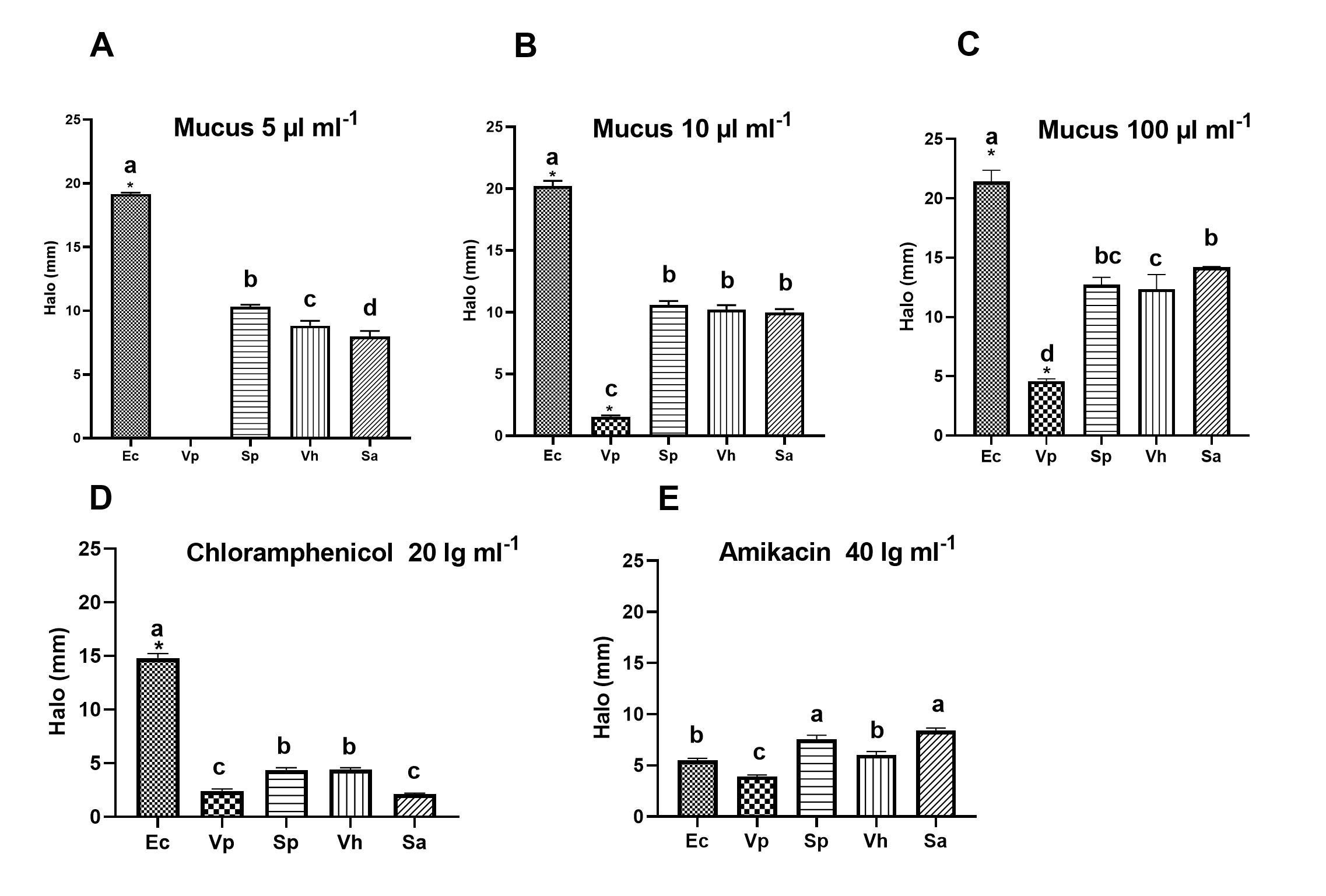
Identical letters denote no significant differences (p > 0.05). In Figure A, there are significant differences between all strains (a) Ec, (b) Sp, (c) Vh, and (d) Sa. Figure B, letter (b) Sp, Vh, Sa there are no differences between them; (a) Ec and (c) Vp means significant differences against a. In figure C, Sp (bc), Sa (b), and Vh (c) there are no differences between them, but there are significant differences (a) Ec and (d) Vp. Figure D no differences between (b) Sp and Vh, (c) Vp and Sa, and significant differences compared to (a) Ec. Figure E, no differences between (a) Sp and Sa, and significant differences in comparison with (c) Vp (p > 0.05) (Tukey HSD).

Figure 1 Halo of inhibition (HI) caused by the octopus mucus extract and two antibiotics on the growth of different selected pathogenic microbial strains. Ec (E. coli), Sa (S. aureus), Vh (V. harveyi), Sp (S. pasteuri), Vp (V. parahaemolyticus).  

Conclusions

In the present study, it has been demonstrated that the skin mucus extract of the cephalopod O. bimaculatus has antimicrobial activity against bacteria pathogenic to fish, crustaceans, mollusks, and bovine, and it has been determined that the extract is rich in protein. This suggests that the mucus extract or subsequently purified antimicrobial compounds can be used as an alternative to antibiotics and could perhaps be used in aquaculture and terrestrial farms for chickens, bovine, etc. Since this extract is a natural product, it would help to reduce the problems of resistance to antibiotics that we currently have.

Acknowledgments

This research was supported by the Internal Research Group: Nature-Based Solutions (SbN), the Academic Department of Animal Science and Habitat Conservation, and the Food Science and Technology Laboratory of at Autonomous University of Baja California Sur.

References

Accogli, G., Scillitani, G., Mentino, D., & Desantis, S. (2017). Characterization of the skin mucus in the common octopus Octopus vulgaris (Cuvier) reared paralarvae. European Journal of Histochemistry: EJH, 61(3).https://doi.org/10.4081/ejh.2017.2815 [ Links ]

Amador, M. S. (2018). Estudio de la interacción de larvas véliger de ostión Crassostrea gigas con una bacteria probiótica y otra patógena a través de ensayos in vivo. (Tesis de maestría, Universidad Autónoma de Baja California Sur). http://rep.uabcs.mx/handle/23080/83Links ]

Amador, M. S. (2021). Análisis transcriptómico de larvas de ostión japonés Crassostrea gigas alimentadas con microalgas locales administradas con un probiótico y retadas con un patógeno regional. (Tesis de doctorado, Universidad Autónoma de Baja California Sur) http://rep.uabcs.mx/handle/23080/385. [ Links ]

Anadón, R. (2019). Functional histology: The tissues of common coleoid cephalopods. In: C. Gestal, S. Pascual, A. Guerra, G. Fiorito, & J. M. Vieites (Eds). (2019). Handbook of pathogens and diseases in European cephalopods (pp. 39-86). Cham, Switzerland: Springer (Open access). https://doi.org/10.1007/978-3-030-11330-8_4. [ Links ]

Arulvasu,C., Selvamathi S., Babu G., & Dhanasekaran, G. (2012). Effect of crude and partially purified epidermal mucus proteins of marine catfish Tachysurus dussumieri on human cancer cell line. Journal of Academia and Industrial Research 1(4), 164-169. http://www.jairjp.com/SEPTEMBER%202012/04%20ARULVASU.pdfLinks ]

Barbosa, H.R., Rodrigues, M.F.A., Campos, C.C., Chaves, M.E., Nunes, I., Juliano & Novo N.F. (1995). Counting of viable cluster-forming and non cluster-forming bacteria: a comparison between the drop and the spread methods. Journal Microbiological Methods, 22, 39-50. https://doi.org/10.1016/0167-7012(94)00062-C [ Links ]

Benkendorff, K., Davis., A. R. & Bremner, J. B. (2001). Chemical defense in the egg masses of benthic invertebrates: an assessment of antibacterial activity in 39 mollusks and 4 polychaetes. Journal Invertebrate Pathology, 78(2), 109-118. https://doi.org/10.1006/jipa.2001.5047 [ Links ]

Bragadeeswaran, S., & Thangaraj, S. (2011). Hemolytic and antibacterial studies on skin mucus of eel fish, Anguilla anguilla Linnaues, 1758. Asian Journal of Biological Sciences, 4(3), 272-276. https://doi.org/10.3923/ajbs.2011.272.276 [ Links ]

Burniston S., Okello A.L., Khamlome B., Inthavong P., Gilbert J., Blacksell S.D., Allen J., & Welburn, S.C. (2015). Cultural drivers and health-seeking behaviours that impact on the transmission of pig-associated zoonoses in Lao People’s Democratic Republic. Infectious Diseases of Poverty, 4, 1-12. https://doi.org/10.1186/2049-9957-4-11 [ Links ]

Chong, K., Ying, T.S, Foou, J., Jin, L.T., & Chong, A. (2005). Characterization of proteins in epidermal mucus of Discus fish (Symphosodon spp.) during parental phase. Aquaculture, 249(1-4), 469-476. https://doi.org/10.1016/j.aquaculture.2005.02.045 [ Links ]

Coelho, G. R., Neto, P. P., Barbosa, F. C., Dos Santos, R. S., Brigatte, P., Spencer, P. J., Coccuzzo Sampaio, S., D’Amelio, F., Carvalho Pimenta, D., & Mozer Sciani, J. (2019). Biochemical and biological characterization of the Hypanus americanus mucus: a perspective on stingray immunity and toxins. Fish Shellfish Immunology, 93, 832-840. https://doi.org/10.1016/j.fsi.2019.08.049 [ Links ]

de Lorgeril, J., Lucasson, A., Petton, B., Toulza, E., Montagnani, C., Clerissi, C., VidalDupiol, J., Chaparro, C., Galinier, R., Escoubas, J.-M., Haffner, P., Dégremont, L., Charriére, G.M., Lafont, M., Delort, A., Vergnes, A., Chiarello, M., Faury, N., Rubio, T., Leroy, M.A., Pérignon, A., Régler, D., Morga, B., Alunno-Bruscia, M., Boudry, P., Le Roux, F., Destoumieux-Garzόn, D., Gueguen., & Mitta,G.(2018). Immune-suppression by OsHV-1 viral infection causes fatal bacteraemia in Pacific oysters. Nature Communications, 9, 4215. https://doi.org/10.1038/s41467-018-06659-3 [ Links ]

Deng, Y., Xu, L., Chen, H., Liu, S., Guo, Z., Cheng, C., Ma, H., & Feng, J. (2020). Prevalence, virulence genes, and antimicrobial resistance of Vibrio species isolated from diseased marine fish in South China, Scientific Reports, 10,14329. https://doi.org/10.1038/s41598-020-71288-0 [ Links ]

Di Costanzo, F., Di Dato, V., Ianora, A., & Romano, G. (2019). Prostaglandins in marine organisms: A review. Marine Drugs, 17(7), 428.https://doi.org/10.3390/md17070428 [ Links ]

Eder, F.A., Kennedy, J.M., Beth, A.D., Notari, P.E., Seate, R., Bachousin, L., Mair, D.G., Swebb, J.S., Wagner, J.S., Doddy, R., & Banjamin, R.J. (2009). Limiting and detecting bacterial contamination of apheresis platelets: inlet line diversion and increased culture volume improve component safety. Tranfusion, 49(8),1554-1563. https://doi.org/10.1111/j.1537-2995.2009.02192.x [ Links ]

FAO (2011). Manual básico de Sanidad Piscicola. Paraguay: FAO. http://www.fao.org/3/a-as830s.pdfLinks ]

Fast, M. D., Sims, D. E., Burka, J. F., Mustafa, A., & Ross, N. W. (2002). Skin morphology and humoral non-specific defence parameters of mucus and plasma in rainbow trout, coho and Atlantic salmon. Comparative Biochemistry and Physiology Part A: Molecular & Integrative Physiology, 132(3), 645-657. https://doi.org/10.1016/S1095-6433(02)00109-5 [ Links ]

Fuochi, V., Li Volti, G., Camiolo, G., Tiralongo, F., Giallongo, C., Distefano, A., Petronio, G.P., Barbagallo,I., Viola, M., Furneri, P.M., Di rosa, M., Avaloa, R., & Tibullo, D. (2017). Antimicrobial and anti-proliferative effects of skin mucus derived from Dasyatis pastinaca (Linnaeus, 1758). Marine Drugs , 15 (11), 342. https://doi.org/10.3390/md15110342 [ Links ]

Giraldo-Cardona, J.P., Gualdrón-Ramírez, D., Chamorro-Tobar, I., Pulido-Villamarín, A., Santamaría-Durán, N., Castañeda-Salazar, R., Zambrano Moreno, C., & Carrascal-Camacho, A.K. (2019). Salmonella spp. prevalence, antimicrobial resistance and risk factor determination in colombian swine farms. Pesquisa Veterinaria Brasileira, 39 (10), 816- 822. https://doi.org/10.1590/1678-5150-PVB-6156 [ Links ]

González‐Costa, A., Fernández‐Gago, R., Carid, S., & Molist, P. (2020). Mucus characterisation in the Octopus vulgaris skin throughout its life cycle. Anatomia, Histologia, Embryologia, 49(4), 502-510.https://doi.org/10.1111/ahe.12554 [ Links ]

Guerra, N. P., & Pastrana, L. (2002). Modelling the influence of pH on the kinetics of both nisin and pediocin production and characterization of their functional properties. Process Biochemistry, 37(9), 1005-1015. https://doi.org/10.1016/S0032-9592(01)00312-0 [ Links ]

Hubert, F., van der Knaap, W., Noël, T., & Roch, P. (1996). Cytotoxic and antibacterial properties of Mytilus galloprovincialis, Ostrea edulis and Crassostrea gigas (bivalve molluscs) hemolymph. Aquat Living Resour, 9(2), 115-124. https://doi.org/10.1051/alr:1996015 [ Links ]

Lauritano, C., & Ianora, A. (2020). Chemical defense in marine organisms.Marine drugs,18(10), 518. https://doi.org/10.3390/md18100518 [ Links ]

Lauritano, C., Martínez, K. A., Battaglia, P., Granata, A., de la Cruz, M., Cautain, B., Martin, J., Reyes, F., Lanora, A., & Guglielmo, L. (2020). First evidence of anticancer and antimicrobial activity in Mediterranean mesopelagic species. Scientific Reports , 10(1), 4929.https://doi.org/10.1038/s41598-020-61515-z [ Links ]

Im., W. & Khalid, S. (2020). Molecular simulations of Gramnegative bacterial membranes come of age. Annual Reviews Physical Chemistry, 71, 171-188. https://doi.org/10.1146/annurev-physchem-103019-033434 [ Links ]

Jorgensen, J., & Turnidge, J. (2015). Susceptibility Test Methods: Dilution and Disk Diffusion Methods. In: Jorgensen, J., Pfaller, M., Carroll, K., Funke, G., Landry, M., Richter, S., Warnock, D. (eds) Manual of clinical microbiology, 11th edn. ASM Press, Washington, DC, pp 1253-1273. https://doi.org/10.1128/9781555817381.ch7.1 [ Links ]

Kamiya H., Sakai R., & Jimbo M. (2006) Bioactive molecules from sea hares. InMolluscs: Progress in Molecular and Subcellular Biology; Cimino, G., Gavagnin, M., Eds. Springer, Berlin/Heidelberg, Germany, 2006; Volume 43, (pp. 215-239). https://doi.org/10.1007/978-3-540-30880-5_10 [ Links ]

Kruger, N. J. (2009). The Bradford method for protein quantitation. The protein protocols handbook; Springer: Berlin/Heidelberg, Germany, pp. 17-24. https://doi.org/10.1007/978-1-59745-198-7_4 [ Links ]

Kumari, S., Tyor, A. K., & Bhatnagar, A. (2019). Evaluation of the antibacterial activity of skin mucus of three carp species. International Aquatic Research, 11(3), 225-239. https://doi.org/10.1007/s40071-019-0231-z [ Links ]

Maselli, V., Galdiero, E., Salzano, A. M., Scaloni, A., Maione, A., Falanga, A., Naviglio, D., Guida, M., Di Cosmo, A., & Galdiero, S. (2020). OctoPartenopin: Identification and preliminary characterization of a novel antimicrobial peptide from the suckers of Octopus vulgaris. Marine drugs , 18(8), 380.https://doi.org/10.3390/md18080380 [ Links ]

Monolisha, S., Mani, A. E., Patterson, J., Edward, J. P. (2013). Molecular characterization and antimicrobial activity of Octopus aegina and Octopus dolfusii in gulf of Mannar coast. International Journal of Pharmaceutical Sciences and Research, 4(9), 3582. http://dx.doi.org/10.13040/IJPSR.0975-8232.4(9).3582-87 [ Links ]

Nwabueze, A. A. (2014). Antimicrobial action of epidermal mucus extract of clarias gariepinus (Burchell, 1822) Juveniles-Fed ginger inclusion in diet. International Journal of Biology, 6(2) 42-48. https://doi.org/10.5539/ijb.v6n2p42 [ Links ]

OIE (Office International des Epizooties), (2019). Acute Hepatopancreatic Necrosis Disease. Manual of Diagnostic Tests for Aquatic Animals, chapter 2.2.1. Retrieved from https://www.oie.int/index.php?id=2439&L=0&htmfile=chapitre_ahpnd.htm Date of access: 11 jul. 2023.Links ]

Pales Espinosa, E., Winnicki, S.M., Allam, B. (2013). Early host-pathogen interactions in marine bivalves: Pallial mucus of Crassostrea virginica modulates the growth and virulence of its pathogen Perkinsus marinus. Diseases of Aquatic Organisms, 104(3), 237-247, https://doi.org/10.3354/dao02599 [ Links ]

Palomares Reséndiz, G., Aguilar Romero, F., Flores Pérez, C., Gómez Núñez, L., Gutiérrez Hernández, J., Herrera López, E., Limón González, M., Morales Álvarez, F., Pastor López c, F., & Díaz Aparicio, E. (2021). Enfermedades infecciosas de relevancia en la producción caprina, historia, retos y perspectivas. Revista mexicana de ciencias pecuarias, 12 (3), 205-223. https://doi.org/10.22319/rmcp.v12s3.5801 [ Links ]

Pandey, A. (2019). Pharmacological Potential of Marine Microbes. In: Arora, D., Sharma, C., Jaglan, S., Lichtfouse, E., editors. Pharmaceuticals from Microbes. Environmental Chemistry for a Sustaintable World. Vol 28. Springer, Cham. https://doi.org/10.1007/978-3-030-04675-0_1 [ Links ]

Parera-Valadez, Y. (2012). identificación y actividad antibacteriana de bacterias (doctoral dissertation, Tesis de Licenciatura. Universidad Autónoma de Baja California Sur, México). https://biblio.uabcs.mx/tesis/tesis/te2826.pdf Links ]

Pasiyappazham, R., Namasivayam, S., Alagiri, S., Vairamani, S., Jayalakshmi, K., & Annaian, S. (2011). In vitro evaluation of antimicrobial activity of methanolic extract from selected species of Cephalopods on clinical isolates. African Journal of Microbiology Research, 5(23), 3884-3889. https://doi.org/10.5897/AJMR11.564 [ Links ]

Pethkar, M. R., and Lokhande, M. V. (2017). Antifungal activity of skin mucus of three cultivable fish species (Catla-catla, cirrhinus mrigala and anguilla anguilla). International Journal of Zoology Studies, 2, 01-03. ISSN: 2455-7269. [ Links ]

Prachumwat, A., Wechprasit, P., Srisala, J., Kriangsaksri, R., Flegel, T. W., Thitamadee, S., & Sritunyalucksana, K. (2020). Shewanella khirikhana sp. nov.-a shrimp pathogen isolated from a cultivation pond exhibiting early mortality syndrome. Microbial biotechnology, 13(3), 781-795. https://doi.org/10.1111/1751-7915.13538 [ Links ]

Pulido-Villamarín, AP, Santamaría-Durán, AN, Castañeda-Salazar, R, Chamorro-Tobar, I, Carrascal Camacho, AK, Aranda-Silva, M, & Zambrano-Moreno, C. (2021). Evaluación de anticuerpos frente a tres bacterias zoonóticas y factores de riesgo asociados en explotaciones porcinas de Colombia. Revue Scientifique Technique, OIE 39(3). https://doi.org/10.20506/rst.39.3.3188 [ Links ]

Rajapaksha, D. C., Jayathilaka, E. T., Edirisinghe, S. L., Nikapitiya, C., Lee, J., Whang, I., & De Zoysa, M. (2021). Octopromycin: Antibacterial and antibiofilm functions of a novel peptide derived from Octopus minor against multidrug-resistant Acinetobacter baumannii. Fish & Shellfish Immunology, 117, 82-94. https://doi.org/10.1016/j.fsi.2021.07.019 [ Links ]

Rao, V., Marimuthu, K., Kupusamy, T., Rathinam, X., Arasu, M.V., Al-Dhabi, N.A., & Arockiaraj, j.(2015). Defense properties in the epidermal mucus of different freshwater fish species. Aquaculture, Aquarium, Conservation & Legislation - International Journal of the Bioflux Society , 8(2),184-194. [ Links ]

Reverter, M., Tapissier-Bontemps, N., Lecchini, D., Banaigs, B., & Sasal, P. (2018). Biological and ecological roles of external fish mucus: a review. Fishes, 3(4), 41. https://doi.org/10.3390/fishes3040041 [ Links ]

Ritchie, K. B., Schwarz, M., Mueller, J., Lapacek, V. A., Merselis, D., Walsh, C. J., & Luer, C.A. (2017). Survey of antibiotic-producing bacteria associated with the epidermal mucus layers of rays and skates. Frontiers Microbiology, 8, 1050. https://doi.org/10.3389/fmicb.2017.01050 [ Links ]

Rivera-Benitez, J.F., Rosas-Estrada, K., Pulido-Camarillo, E., De la Peña Moctezuma, A., Castillo-Juárez, H., Ramírez-Mendoza, H. (2014). Serological survey of veterinarians to assess the zoonotic potential of three emerging swine diseases in Mexico. Zoonoses and Public Health, 61 (2), 131-137. https://doi.org/10.1111/zph.12055 [ Links ]

Rögener, W., Renwrantz, L., & Uhlenbruck, G. (1987). Analysis of Octopus vulgaris hemolymph containing a glycoprotein with blood group A-like properties.Comparative Biochemistry and Physiology Part B: Comparative Biochemistry,86(2), 347-351. https://doi.org/10.1016/0305-0491(87)90304-X [ Links ]

Smith, A. M. (2002). The structure and function of adhesive gels from invertebrates. Integrative and Comparative Biology, 42(6), 1164-1171. https://doi.org/10.1093/icb/42.6.1164 [ Links ]

Smith, A. M., & Morin, M. C. (2002). Biochemical differences between trail mucus and adhesive mucus from marsh periwinkle snails. The Biological Bulletin, 203(3), 338-346. https://doi.org/10.2307/1543576 [ Links ]

Sokal, R. & Rohlf, J. 1980. Introducción a la bioestadística. De Reverte S.A., Barcelon. [ Links ]

Stabili, L., Schirosi, R., Parisi, MG., Piraino, S., & Cammarata, M. (2015) The mucus of Actinia equina (Anthozoa, Cnidaria): an unexplored resource for potential applicative purposes. Marine Drugs , 13(8), 5276-5296. https://doi.org/10.3390/md13085276 [ Links ]

Suárez, L., Pereira, A., Hidalgo, W., & Uribe, N. (2021). Antibacterial, Antibiofilm and Anti-Virulence Activity of Biactive Fractions from Mucus Secretion of Giant African Snail Achatina fulica against Staphylococcus aureus Strains. Antibiotics, 10(12), 1548. https://doi.org/10.3390/antibiotics10121548 [ Links ]

Subramanian, B., Sangappellai, T., Rajak, R.C., & Diraviam, B. (2011). Pharmacological and biomedical properties of sea anemones Paracondactylis indicus, Paracondactylis sinensis, Heteractis magnifica and Stichodactyla haddoni from East coast of India. Asian Pacific Journal of Tropical Medecine, 4(9),722-726. https://doi.org/10.1016/S1995-7645(11)60181-8 [ Links ]

Troll, J. V., Bent, E. H., Pacquette, N., Wier, A. M., Goldman, W. E., Silverman, N., & McFall‐Ngai, M. J. (2010). Taming the symbiont for coexistence: a host PGRP neutralizes a bacterial symbiont toxin. Environmental microbiology, 12(8), 2190-2203. https://doi.org/10.1111/j.1462-2920.2009.02121.x [ Links ]

Valgas, C., De-Souza, S.M., Smania, E.F.A., Smania, Jr.A. (2007). Screening methods to determine antibacterial activity of natural products. Brazilian Journal of Microbiology, 38(2), 369-380. https://doi.org/10.1590/S1517-83822007000200034 [ Links ]

Vennila, R., Kumar, K.R., Kanchana, S., Arumugam, M., Vijayalakshmi, S., Balasubramaniam, T. (2011). Preliminary investigation on antimicrobial and proteolytic property of the epidermal mucus secretion of marine stingrays. Asian Pacific Journal of Tropical Biomedicine, 1(2), S239-S243. https://doi.org/10.1016/S2221-1691(11)60162-7 [ Links ]

Villanueva, R., Coll-Lladó, M., Bonnaud-Ponticelli, L., Carrasco, S. A., Escolar, O., Fernández-Álvarez, F. Á., Gleadall, I.G., Nabhitabhata, J., Ortiz, N., Rosas, C., Sánchez, P., Voight, J.R., & Swoger, J. (2021). Born With Bristles: New Insights on the Kölliker’s Organs of Octopus Skin. Frontiers in Marine Science, 8, 645738. https://doi.org/10.3389/fmars.2021.645738 [ Links ]

Wei, O. Y., Xavier, R., & Marimuthu, K. (2010). Screening of antibacterial activity of mucus extract of snakehead fish, Channa striatus (Bloch). European review for medical and pharmacological sciences, 14(10), 675-681. PMID: 20707287. [ Links ]

Declaration of principles for the ethical use of animals. The authors declare that they have complied with current national and international regulations, which require ethical handling of animals.

Please cite this article as/Como citar este artículo:Savin-Amador, M., Hernández-Rubio, J.S., Caballero-Cosío M.A., Rojas-Contreras, M., González-Pérez, N.F. (2024). Evaluation of the antibacterial activity of the skin mucus of the common octopus Octopus bimaculatus against pathogenic bacteria of farm animals. Revista Bio Ciencias, 11, e1521. https://doi.org/10.15741/revbio.11.e1521

Received: May 23, 2023; Accepted: January 02, 2024; Published: January 19, 2024

*Corresponding Author: Macario Savin Amador. Departamento Académico de Ciencia Animal y Conservación del Hábitat. UABCS. Apartado Postal 19-B. C.P. 23080, La Paz, Baja California Sur, México. Phone: (612) 1238800 Ext. 5140. E-mail: msavin@uabcs.mx

Authors' contribution

Conceptualization of work (MSA, JSHR, MACC). Methodology development (MSA, NFPG, MACC). Software management (MSA, JSHR). Experimental validation (MSA, MRC). Analysis of results (MSA, JSHR, MACC, MRC, NFPG). Data management (MSA, JSHR). Writing and preparation of the manuscript (MSA, MRC). Writing, review, and editing (MSA, JSHR, MRC). Project administrator (MSA). Funding Acquisition (MSA).

Conflicts of Interest

The authors declare no conflict of interest.

Creative Commons License This is an open-access article distributed under the terms of the Creative Commons Attribution License