

SciELO - Scientific Electronic Library Online

 
vol.25 número2Nuevos registros de depredación de especies exóticas por el verdugo americano (Lanius ludovicianus) en MéxicoPrimer registro del Rascón Azteca (Rallus tenuirostris) en Coahuila, México índice de autoresíndice de materiabúsqueda de artículos
Home Pagelista alfabética de revistas  

Servicios Personalizados

Revista

Articulo

Indicadores

Links relacionados

  • No hay artículos similaresSimilares en SciELO

Compartir


Huitzil

versión On-line ISSN 1870-7459

Huitzil vol.25 no.2 Omitlán jul./dic. 2024  Epub 27-Mayo-2025

https://doi.org/10.28947/hrmo.2024.25.2.796 

Nota Científica

Comportamiento de carroñeo en carretera de la urraca copetona (Cyanocorax formosus) en el noroeste de Costa Rica

Roadkill scavenging behavior of White-throated Magpie-Jay (Cyanocorax formosus) in northwestern Costa Rica

Juan de Dios Astorga-Acuña1 
http://orcid.org/0000-0001-7010-8330

José Manuel Mora2  * 
http://orcid.org/0000-0002-1200-1495

1Universidad Técnica Nacional, 7-4013, Atenas, Costa Rica. Sistema Nacional de Áreas de Conservación, Área de Conservación Arenal-Tempisque, 50601, Guanacaste, Costa Rica.

2Carrera de Gestión Ecoturística, Sede Central, Universidad Técnica Nacional, Alajuela, Costa Rica. Department of Biology and Museum of Vertebrate Biology, Portland State University, Portland, Oregon 97207, USA.


Abstract.

Corvids are opportunistic omnivores and facultative scavengers, but there are no direct records of Cyanocorax species scavenging on carrion. We documented opportunistic feeding behavior of the White-throated Magpie-Jay (Cyanocorax formosus) on a road-killed Common Pauraque (Nyctidromus albicollis) in northwestern Costa Rica. On 25 August 2023, we observed three White-throated Magpie-Jays feeding on the carcass of a Common Pauraque, likely killed by collision with a vehicle, along a gravel road near the Taboga Forestry Reserve. This provides de first documented evidence of the White-throated Magpie-Jay scavenging on roadkill, and of carrion consumption by a Central American corvid. Given the White-throated Magpie-Jay's adaptability and its opportunistic nature as an omnivorous predator, this species may exploit roadkill as a readily available food source.

Key words: Carrion; Nyctidromus albicollis; omnivorous; opportunistic feeding; Taboga Forestry Reserve; Tropical Premontane Moist Forest

Resumen.

Los córvidos son omnívoros oportunistas y carroñeros facultativos, pero no existen registros directos de especies de Cyanocorax alimentándose de carroña. Documentamos un comportamiento de alimentación oportunista de la urraca copetona (Cyanocorax formosus) sobre un cuyeo común (Nyctidromus albicollis) atropellado en el noroeste de Costa Rica. El 25 de agosto de 2023, observamos tres individuos de urraca copetona alimentándose del cadáver de un cuyeo común, aparentemente muerto por colisión con un vehículo, a lo largo de un camino de grava cerca de la Reserva Forestal Taboga. Este es el primer registro documentado de la urraca copetona alimentándose de un animal atropellado, así como del consumo de carroña por un córvido centroamericano. Dada la adaptabilidad y naturaleza oportunista de esta especie como depredador omnívoro, es posible que la urraca copetona aproveche los animales atropellados como una fuente de alimento fácilmente disponible.

Palabras clave: alimentación oportunista; bosque muy húmedo premontano; carroña; Nyctidromus albicollis; omnívoro; Reserva Forestal Taboga

Introduction

Many birds obtain a significant portion of their diet through scavenging, with Laridae and Corvidae being notable examples (Smiddy 2023). Scavenging behavior is also observed among specialized predators, including Hawks, Buzzards, and Owls (DeVault et al. 2016). The Common Buzzard (Buteo buteo), and large raptors such as White-tailed Eagle (Haliaeetus albicilla), and Golden Eagle (Aquila chrysaetos), efficiently exploit carrion, particularly from hunter-killed animals (Selva et al. 2019). Additionally, some raptors scavenge roadkill, including Mississippi Kites (Ictinia mississippiensis), feeding on White-winged Dove (Zenaida asiatica) carcasses in Texas (Boal 2023), and Merlins, (Falco columbarius) consuming Snowshoe Hare (Lepus americanus) carcasses in Alaska (McIntyre et al. 2009). Even Peregrine Falcons (Falco peregrinus) occasionally feed on carrion (Varland et al. 2018).

The Corvidae family is a widespread group of passerine birds that are well-known for their adaptability and intelligence (Ehrlich et al. 1988), and are omnivorous, opportunistic feeders (Winkler et al. 2015). Corvids are facultative scavengers and play a vital role in ecological processes by facilitating carcass discovery and contributing to biomass removal (Selva et al. 2019, Bragato et al. 2022). Frequent visitors to carcasses include Jays, Magpies, Crows, and Nutcrackers (Selva et al. 2019). While some species, such as the Carrion Crow (Corvus corone), and Eurasian Magpie (Pica pica) are well-documented scavengers, many corvids consume carrion opportunistically (Gomo et al. 2017, Fielding et al. 2020, Rees et al. 2020).

Most, if not all, species of the genus Corvus scavenge on vertebrate carrion, and roadkill is an important source of carcasses (Sazima 2020). Despite their carrion consumption, corvids lack specialized beaks for tearing flesh, often depending on other predators to open carcasses or scavenging roadkill where meat is more accessible (Marzluff and Neatherlin 2006). However, although corvids are recognized as opportunistic omnivores and facultative scavengers (Moreno-Opo and Margalida 2013, Winkler et al. 2015), there are no direct records of Cyanocorax species scavenging on carrion.

The White-throated Magpie-Jay (Cyanocorax formosus) is a versatile omnivore and opportunistic predator (Langen and Berg 2016, Echeverri et al. 2019, Fielding et al. 2020). Diet of the species includes caterpillars, katydids, roaches, beetle grubs, small amphibians and lizards, fruits, seeds, bird eggs, and nestlings (Stiles and Skutch 1989). The species also consumes crops such as maize and it feeds on nectar from balsa tree blossoms (Stiles and Skutch 1989). Unlike many other corvids, the White-throated Magpie-Jay does not engage in food caching (de Kort and Clayton 2006). This study documents the opportunistic scavenging behavior of the White-throated Magpie-Jay on a bird carcass killed by a vehicle in northwestern Costa Rica, providing new insights into the dietary flexibility of this species.

Methods

We conduct wildlife monitoring and bird surveys at the Taboga Forestry Reserve in San Miguel, Cañas county (Fig. 1), Guanacaste, as well as in its surrounding buffer area. The reserve lies within the tropical premontane moist forest, at the basal transition life zone (Holdridge 1967). Annual rainfall in this zone ranges from 1,200 to 2,200 mm, with mean temperatures between 23ºC and 24ºC (Bolaños et al. 2005). The area experiences a distinct dry season lasting 3.5 to 5 months, from December to May, followed by a rainy season from June to November (Bolaños et al. 2005). Adjacent sites to the reserve are primarily dedicated to agriculture, with sugarcane and rice as the main crops (Astorga and Mora 2022).
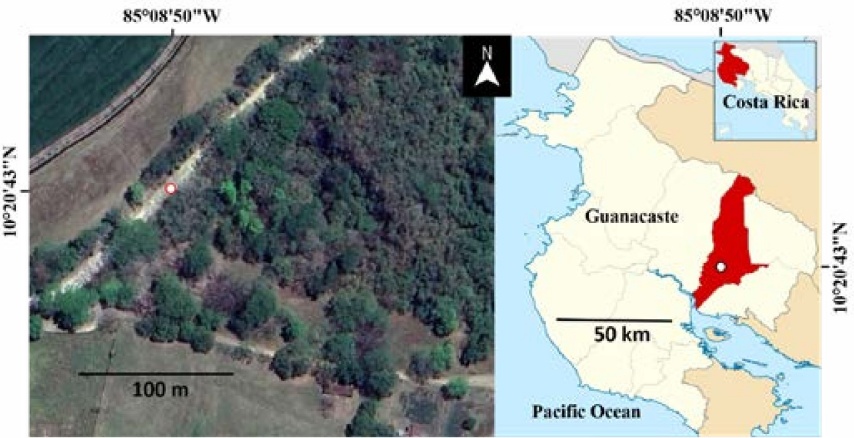
Figure 1 Location (white dot) where a White-throated Magpie-Jay (Cyanocorax formosus) was observed feeding on a road-killed Common Pauraque (Nyctidromus albicollis), in San Miguel, Cañas County (highlighted in red), Guanacaste Province (outlined in white but displayed in red on the map of Costa Rica). Figure prepared by José Manuel Mora using Google Earth (left section) and Wikipedia under the Creative Commons Attribution-ShareAlike 3.0 license (right section). 

Results

On 25 August 2023, at 08:13 h, in the buffer area of the Taboga Forestry Reserve at 15 m elevation, along a gravel road (10°20'42.8"N, 85°08'49.7"W; Fig. 1) with frequent vehicle traffic, we observed a group of three White-throated Magpie-Jays feeding on the ground. The birds were highly active, and upon our approach, two of them flew away while one continued eating. Upon closer inspection, we identified the object of their feeding as the remains of a Common Pauraque (Nyctidromus albicollis), likely struck by a vehicle.

The White-throated Magpie-Jay was easily identified by its notably long, graduated tail, and a lengthy, curled crest (Stiles and Skutch 1989). Also notorious were its upperparts predominantly pale blue, while the underparts were plain white (Stiles and Skutch 1989). This bird exhibited a white throat and sides of the head, contrasting with a long black crest and a variable black neck-stripe that extended to a narrow breast-band (Stiles and Skutch 1989). The Pauraque’s distinctive plumage (Fig. 2) and physical characteristics facilitated its identification, particularly the cryptic pattern of gray, gold, and brown, with cinnamon-colored cheeks and golden edges on the feathers of the back and wings.

The Pauraque carcass appeared relatively fresh, with the flesh exhibiting a normal coloration and no noticeable odor of decay. The remaining Magpie-Jay was observed picking up relatively large pieces of meat from the gravel and occasionally taking chunks that still contained feathers (Fig. 2).
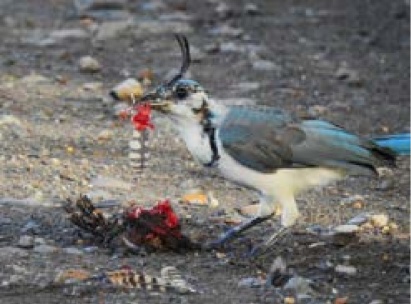
Figure 2 A White-throated Magpie-Jay (Cyanocorax formosus) consuming a road-killed Common Pauraque (Nyctidromus albicollis) in San Miguel de Cañas, Guanacaste, Costa Rica. Photograph by Juan de Dios Astorga-Acuña. 

Discussion

This study provides the first documented evidence of the White-throated Magpie-Jay scavenging on roadkill, specifically the carcass of a Common Pauraque. Although the White-throated Magpie-Jay is known for its versatility as an omnivore, with a diet encompassing fruits, insects, and small vertebrates (Stiles and Skutch 1989), carrion, including roadkill, has not previously been reported in its diet. Notably, no records of carrion consumption exist for Central and South American corvids (Lopes et al. 2005).

Carcasses in natural environments are typically sporadic and difficult to locate. However, roadkill provides a predictable and readily available food source for opportunistic scavengers, potentially influencing their behavior and distribution near roadways (Fielding et al. 2020). During wildlife monitoring in northern Costa Rica, we observed White-throated Magpie-Jays congregating along the main highway (CR1) before sunrise, seemingly to exploit nocturnal roadkill. Over six visits, three to four individuals were recorded at the site between 05:00 and 05:30 on consecutive days. Due to the high traffic volume, we could not confirm the specific roadkill species consumed by the jays. On a quieter road in San Miguel de Cañas, we documented White-throated Magpie-Jays feeding on the intact portion of a Pauraque carcass. Common Pauraques, being nocturnal and frequently found resting along roadsides, are particularly vulnerable to vehicle collisions (Accordi and Barcellos 2006). Their foraging behavior, which involves catching insects in flight, likely increases their exposure to road traffic (Stiles and Skutch 1989).

Despite the ecological importance of the White-throated Magpie-Jay as an insect predator and seed disperser, farmers and urban residents in Guanacaste view the species negatively, surpassed only by the Great-tailed Grackle (Quiscalus mexicanus) in unpopularity (Echeverri et al. 2019). While scavenging on carrion may not constitute a primary feeding strategy for this species, such behavior contributes to essential ecological processes, including nutrient cycling and carcass decomposition (Beasley et al. 2019, Meisuria et al. 2024).

Scavenging among vertebrates is more prevalent than traditionally acknowledged, representing a critical ecological process rather than an anomaly (DeVault et al. 2003). Changes in land use and the expansion of road networks may increase the prevalence of roadkill, influencing populations of opportunistic predators like corvids (Fielding et al. 2020). However, the long-term ecological implications of roadkill as a supplementary food source remain largely unexplored. Further research into the dynamics of roadkill and its role in supporting scavenger populations is crucial for understanding its broader impacts on biodiversity and ecosystem processes.

Acknowledgements

We acknowledge the positive feedback of two anonymous reviewers. JMM acknowledges Emilce Rivera, head of the GEC at UTN, Central Campus, for time and support to write this paper.

Literature cited

Accordi IA, Barcellos A. 2006. Composição da avifauna em oito áreas úmidas da Bacia Hidrográfica do Lago Guaíba, Rio Grande do Sul. Revista Brasileira de Ornitologia 14:101-115. [ Links ]

Astorga J de D, Mora JM. 2022. A defensive attack by a social carnivore (White-nosed Coati) against a constrictor predator (Mesoamerican Boa Constrictor). Jordan Journal of Natural History 9:82-87. [ Links ]

Beasley JC, Olson ZH, Selva N, DeVault TL. 2019. Ecological functions of vertebrate scavenging. Pp. 125-157. In Olea PP, Mateo-Tomas P, Sánchez-Zapata JA (eds), Carrion ecology and management. Wildlife Research Monographs. Springer, Cham, Switzerland. https://doi.org/10.1007/978-3-030-16501-7_6 [ Links ]

Boal CW. 2023. Scavenging of roadkill by Mississippi Kites (Ictinia mississippiensis). Journal of Raptor Research 57:121-122. https://doi.org/10.3356/jrr-22-98 [ Links ]

Bolaños R, Watson V, Tosi J. 2005. Mapa ecológico de Costa Rica (Zonas de Vida), según el sistema de clasificación de zonas de vida del mundo de L. R. Holdridge, Scale 1:750 000. Centro Científico Tropical. San José, Costa Rica. [ Links ]

Bragato PJ, Spencer EE, Dickman CR, Crowther MS, Tulloch A, Newsome TM. 2022. Effects of habitat, season and flood on corvid scavenging dynamics in central Australia. Austral Ecology 47:939-953. https://doi.org/10.1111/aec.13177 [ Links ]

de Kort SR, Clayton NS. 2006. An evolutionary perspective on caching by corvids. Proceedings of the National Academy of Sciences 273:417-423. https://doi.org/10.1098/rspb.2005.3350 [ Links ]

DeVault TL, Rhodes OE, Shivik JA. 2003. Scavenging by vertebrates: behavioral, ecological, and evolutionary perspectives on an important energy transfer pathway in terrestrial ecosystems. Oikos 102:225-234. https://doi.org/10.1034/j.1600-0706.2003.12378.x [ Links ]

DeVault TL, Beasley JC, Olson ZH, Moleón M, Carrete M, Margalida A, Sánchez-Zapata JA. 2016. Ecosystem services provided by avian scavengers. Pp. 235-270. In Şekercioğlu CH, Wenny DG, Whelan CJ (eds.). Why birds matter: avian ecological function and ecosystem services. University of Chicago Press, Chicago, IL, USA. [ Links ]

Echeverri A, Naidoo R, Karp DS, Chan KMA, Zhao J. 2019. Iconic manakins and despicable grackles: comparing bird-related ecosystem services across birdwatchers, farmers, and urbanites in northwestern Costa Rica. Biorxiv 548982. https://doi.org/10.1101/548982 [ Links ]

Ehrlich P, Dobkin DS, Wheye D. 1988. Birder's handbook: a field guide to the natural history of north American birds. Simon & Schuster, New York, USA. [ Links ]

Fielding MW, Buettel JC, Nguyen H, Brook BW. 2020. Ravens exploit wildlife roadkill and agricultural landscapes but do not affect songbird assemblages. Emu-Austral Ornithology 120:11-21. https://doi.org/10.1080/01584197.2019.1629820 [ Links ]

Gomo G, Mattisson J, Hagen BR, Moa PF, Willebrand T. 2017. Scavenging on a pulsed resource: quality matters for corvids but density for mammals. BMC Ecology 17:1-9. https://doi.org/10.1186/s12898-017-0132-1 [ Links ]

Holdridge LR. 1967. Life zone ecology. Centro Científico Tropical, San José, Costa Rica. [ Links ]

Langen TA., Berg EC. 2016. What determines the timing and duration of the nesting season for a tropical dry forest bird, the White-throated Magpie-Jay (Cyanocorax formosus)? The Wilson Journal of Ornithology 128:32-42. https://doi.org/10.1676/wils-128-01-32-42.1 [ Links ]

Lopes LE, Fernandes AM, Marini MÂ. 2005. Predation on vertebrates by Neotropical passerine birds. Lundiana: International Journal of Biodiversity 6:57-66. https://doi.org/10.35699/2675-5327.2005.22028 [ Links ]

Marzluff JM, Neatherlin E. 2006. Corvid response to human settlements and campgrounds: causes, consequences, and challenges for conservation. Biological Conservation 130:301-314. https://doi.org/10.1016/j.biocon.2005.12.026 [ Links ]

McIntyre CL, Withers JM, Gates NJ. 2009. Merlins (Falco columbarius) scavenge road-killed Snowshoe Hares (Lepus americanus) in interior Alaska. Journal of Raptor Research 43:245. https://doi.org/10.3356/jrr-09-07.1 [ Links ]

Meisuria N, Spencer EE, Cairncross RJ, Crowther MS, Newsome TM. 2024. Scavenging and social interaction of an apex avian scavenger is governed by bioregional and seasonal variation. Oikos 2024:e10826. https://doi.org/10.1111/oik.10826 [ Links ]

Moreno-Opo R, Margalida A. 2013. Carcasses provide resources not exclusively to scavengers: patterns of carrion exploitation by passerine birds. Ecosphere 4:105. http://dx.doi.org/10.1890/ES13-00108.1 [ Links ]

Rees JD, Crowther MS, Kingsford RT, Letnic M. 2020. Direct and indirect effects of carrion subsidies in an arid rangeland: carrion has positive effects on facultative scavengers and negative effects on a small songbird. Journal of Arid Environments 179:104174. https://doi.org/10.1016/j.jaridenv.2020.104174 [ Links ]

Sazima I. 2020. Australian Raven (Corvus coronoides) scavenges on all five major vertebrate groups at urban Sydney, southeast Australia. Tropical Natural History 20:89-94. [ Links ]

Selva N, Moleón M, Sebastián-González E, DeVault TL, Quaggiotto MM, Bailey DM, Lambertucci SA, Margalida A. 2019. Vertebrate scavenging communities. Pp. 71-99. In Olea PP, Mateo-Tomas P, Sánchez-Zapata JA (eds). Carrion ecology and management. Wildlife Research Monographs. Springer, Cham, Switzerland. https://doi.org/10.1007/978-3-030-16501-7_6 [ Links ]

Smiddy P. 2023. Bird and mammal scavengers on east Cork and west Waterford roads. The Irish Naturalists' Journal 40:85-88. [ Links ]

Stiles FG, Skutch AF. 1989. Guide to the birds of Costa Rica. Comstock Publishing Associates, Ithaca, New York, U.S.A. [ Links ]

Varland DE, Buchanan, JB, Fleming TL, Kenney MK, Vanier C. 2018. Scavenging as a food-acquisition strategy by Peregrine Falcons. Journal of Raptor Research 52:291-308. https://doi.org/10.3356/jrr-17-38.1 [ Links ]

Winkler DW, Billerman SM, Lovette JJ. 2015. Bird families of the world. Lynx Edicions, Barcelona, Spain. [ Links ]

1Editora Asociada: Patricia Escalante Pliego

2Scavenging behavior of White-throated Magpie-Jay

3Contribución de cada uno de los autores: JDDA found the bird and took the photo, JMM wrote the manuscript. Both authors reviewed the final version of the ms.

Received: April 28, 2024; Accepted: January 15, 2025

*Autor de correspondencia: josemora07@gmail.com

Creative Commons License This is an open-access article distributed under the terms of the Creative Commons Attribution License