




 nueva página del texto (beta)
 Inglés (pdf)
 Artículo en XML
 Referencias del artículo

 Traducción automática
 Enviar artículo por email
 Citado por SciELO
 Similares en
SciELO

 Permalink

Introduction
Parkinson's disease (PD) is a chronic, progressive neurodegenerative condition characterized by motor impairments such as bradykinesia, rigidity, and postural instability, significantly reducing quality of life1. It affects over 10 million individuals worldwide, and its prevalence continues to rise with aging populations2,3. Motor rehabilitation in PD plays a crucial role in preserving functional independence, reducing fall risk, and improving quality of life particularly in stages where pharmacological treatments become less effective against symptoms such as gait disturbances, postural instability, or freezing of gait. Increasing evidence suggests that physical exercise not only alleviates motor symptoms but may also positively influence disease progression through neuroplastic and neuroprotective mechanisms4.
Conventional physical therapy (CPT) is routinely employed to address motor deficits, but outcomes are often suboptimal or short-lived5. Immersive virtual reality therapy (VRT), using interactive and adaptive digital platforms, has emerged as a promising tool to stimulate neuroplasticity and enhance motor function. VRT aligns with modern approaches to personalized rehabilitation by offering multisensory feedback and task-specific training, thereby enhancing both motor learning and therapeutic engagement5,6. Despite this potential, randomized trials yield inconsistent results, and no meta-analytical consensus has been established4. This systematic review and meta-analysis aimed to compare immersive VRT with CPT on balance, mobility, motor function, and fall risk in PD. We hypothesized that VRT would provide superior motor outcomes. Trial sequential analysis (TSA) was employed to assess whether current evidence is sufficient for clinical recommendations.
Materials and methods
Search methods
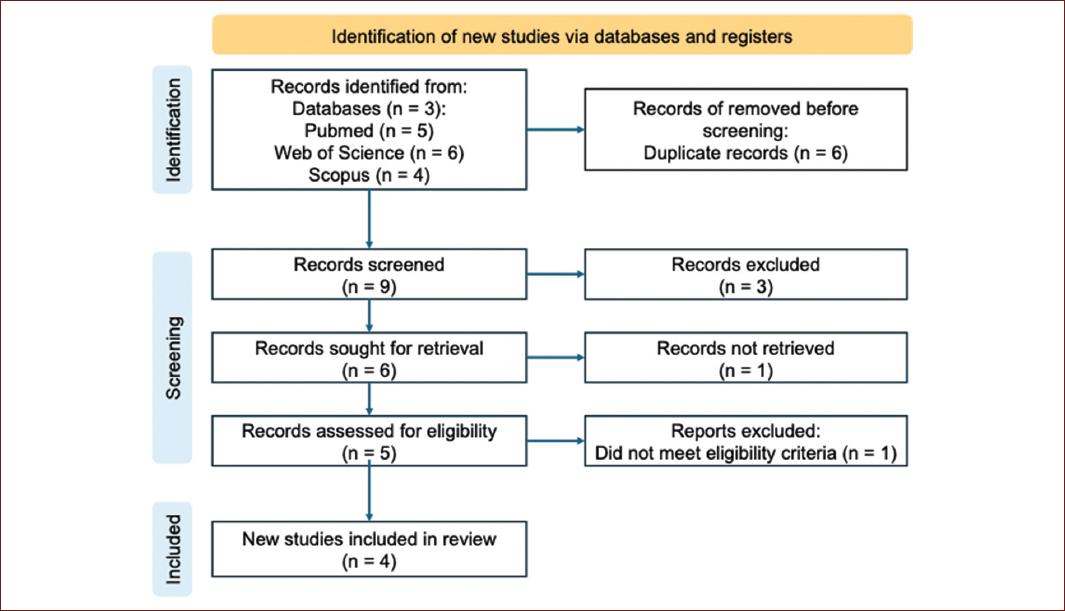
This systematic review adhered to the PRISMA 2020 guidelines. The PRISMA 2020 checklist can be found in Supplementary material 1. A comprehensive search was performed in PubMed, Web of Science, and Scopus databases, with no restrictions on language or publication date. The search strategy utilized the following terms and Boolean operators: ("Parkinson's Disease" AND "Virtual Rehabilitation" OR "Virtual Reality Therapy") AND ("Randomized Controlled Trial"). The complete search process is illustrated in the PRISMA flow diagram (Fig. 1). For additional details on the full search strategy, please refer to Supplementary material 2.
Inclusion and exclusion criteria
Eligible studies were randomized controlled trials (RCTs) comparing immersive VRT with CPT in patients with a clinical diagnosis of PD. Studies had to report at least one of the following outcomes: balance (Berg Balance scale [BBS]), mobility (timed "Up" and "Go" test [TUGT]), motor performance (Unified PD Rating Scale Part III [UPDRS III]), or fall risk (dynamic gait index [DGI]). Observational studies, studies without a control group, or those lacking sufficient data to estimate effect sizes were excluded. In addition, RCTs that included video games such as Wii or Nintendo (non-immersive) were also excluded.
Data extraction information
Two independent reviewers screened titles and abstracts (FLR and BGB), followed by a full-text review to determine study eligibility. Data extraction was performed using a standardized form, collecting information on sample size, participant demographics (Table 1)7-10, study design, intervention characteristics, duration, measured outcomes (Table 2)7-10, and results included in the meta-analysis (Table 3)7-10. Disagreements between reviewers were resolved by consensus with an expert in movement disorders and research. Inter-rater agreement was assessed using Cohen's kappa coefficient to ensure reliability in study selection.
Table 1 Population demographics
| Study | Population (n) | Age mean (IQR) | Male (n) | Female (n) | |||||||
|---|---|---|---|---|---|---|---|---|---|---|---|
| VRT | CPT | Total | VRT | CPT | VRT | CPT | Total | VRT | CPT | Total | |
| Feng et al.7 | 14 | 14 | 28 | 67.47 ± 4.79 | 66.43 ± 4.64 | 8 | 9 | 17 | 7 | 6 | 13 |
| Goffredo et al.9 | 49 | 48 | 97 | 67.8 ± 6.6 | 68.2 ± 5.8 | 27 | 24 | 49 | 22 | 24 | 48 |
| Yang et al.8 | 11 | 12 | 23 | 72.5 ± 8.4 | 75.4 ± 6.3 | 7 | 7 | 14 | 4 | 5 | 9 |
| Pazzaglia et al.10 | 25 | 26 | 51 | 72 ± 7 | 70 ± 10 | 18 | 17 | 35 | 7 | 9 | 16 |
VRT: virtual reality therapy; CTP: conventional physical therapy.
Table 2 Included articles characteristics
| Study | Study design | n | Participants | Intervention | Duration | Measured outcomes |
|---|---|---|---|---|---|---|
| Feng et al.7 | Single-blinded RCT | 28 | Adults with PD based on the UK Parkinson's Disease Society Brain Bank criteria. Hoehn and Yahr score 2.5-4 | Virtual reality therapy Conventional physical therapy Sessions: 45 min, once a day, 5 times a week ON medication phase: intervention 2 h after medication | 12 weeks | Berg Balance Scale, Timed "Up and Go" Test, UPDRS III, functional gait assessment |
| Goffredo et al.9 | Single-blinded, Multicenter RCT | 97 | Adults with PD based on the UK Parkinson's Disease Society Brain Bank criteria. Hoehn and Yahr score ≤ 3 | Virtual reality therapy Conventional physical therapy Sessions: 45 min once a day, 3-5 times a week ON medication phase: Intervention 1 h after medication | 6 to 10 weeks | Timed "Up and Go" Test, UPDRS III, miniBEST test, 6 min walking test |
| Yang et al.8 | Single-blinded RCT | 23 | Adults with PD based on the UK Parkinson's Disease Society Brain Bank criteria. Hoehn and Yahr 2-3 | Virtual reality therapy Conventional Physical Therapy Sessions: 50 min once a day, twice a week ON medication phase: intervention 1 h after medication | 6 weeks | Berg Balance Scale, Timed "Up and Go" test, UPDRS III, dynamic gait index, PDQ-39 |
| Pazzaglia et al.10 | Single-blinded, RCT | 51 | Adults with PD based on the Gelb criteria | Virtual reality therapy Conventional physical therapy Sessions: 40 min once a day, 3 times a week. On the medication phase: Intervention 2 h after medication | 6 weeks | Berg Balance Scale, dynamic gait index, physical composite score (SF-36), mental composite score (SF-36), disabilities of the arm, shoulder, and hand scale |
RCT: randomized controlled trial; PD: Parkinson's disease.
Table 3 Data included in the meta-analysis
| Study | Berg balance scale | Timed "Up and Go" test | UPDRS III | Dynamic gait index | ||||||||||||
|---|---|---|---|---|---|---|---|---|---|---|---|---|---|---|---|---|
| VRT | CTP | VRT | CTP | VRT | CTP | VRT | CTP | |||||||||
| Mean | SD | Mean | SD | Mean | SD | Mean | SD | Mean | SD | Mean | SD | Mean | SD | Mean | SD | |
| Feng et al.7 | 6.07 | 0.35 | 1.93 | 0.7 | 3.29 | 0.94 | 2.71 | 0.97 | 3.64 | 1.25 | 3.36 | 1.93 | NA | NA | NA | NA |
| Goffredo et al.9 | NA | NA | NA | NA | −0.7 | 0.19 | −0.78 | 0.23 | −2.5 | 0.8 | 0.35 | 0.8 | NA | NA | NA | NA |
| Yang et al.8 | 3.36 | 2.38 | 4.17 | 5.01 | −3.34 | 3.67 | −3.07 | 3.15 | 2.55 | 5.96 | −3.17 | 8.73 | 4.09 | 2.98 | 3.17 | 2.86 |
| Pazzaglia et al.10 | 3.6 | 2.38 | 0.8 | 7.41 | NA | NA | NA | NA | NA | NA | NA | NA | 1.6 | 4.47 | −0.2 | 3,51 |
SD: standard deviation; VRT: virtual reality therapy; CTP: conventional physical therapy. NA: not available or not reported in the original publication.
Quality assessment
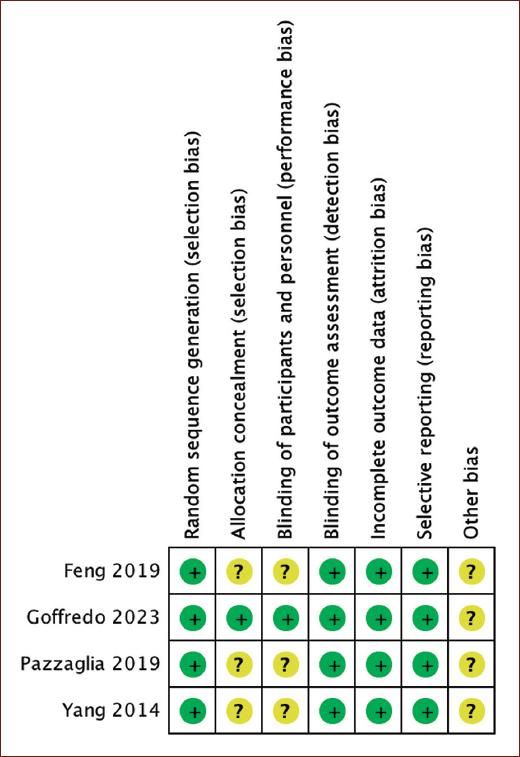
The risk of bias for each included study was assessed using the Cochrane Risk of Bias 2.0 (RoB 2.0) tool (Fig. 2). For additional details on the full risk of bias assessment, please refer to Supplementary Material 2. The certainty of evidence for each outcome was evaluated using the grading of recommendations, assessment, development, and evaluation methodology. Meta-analyses were conducted using Review Manager (RevMan 5.4), applying a random-effects model to calculate mean differences (MD) with 95% confidence intervals (CI) for continuous variables. Heterogeneity was quantified using the I2 statistic. Statistical significance was set at p < 0.05. Random-effects models assume that true effect sizes vary across studies and are approximately normally distributed around an overall mean effect. A sensitivity analysis was planned but not conducted due to the small number of included studies (n = 4), which limited the ability to meaningfully assess robustness. Publication bias was evaluated using funnel plots and Egger's test. To assess whether the cumulative evidence was sufficient, TSA was conducted using TSA software version 0.9.5.10 β, applying a two-sided α of 5%, β of 20%, and the minimal clinically important difference (MCID) as the anticipated effect size.
Results
Search results
A total of four RCTs were included7-10, comprising a total of 102 participants with PD. These studies directly compared the effects of immersive VRT versus CPT on motor outcomes. The selection process followed PRISMA guidelines11 and is detailed in the flow diagram (Fig. 1).
Patient characteristics
Participants across the included studies7-10 had a mean age of 65.4 years. They were primarily classified within stages I to IV of the Hoehn and Yahr scale, indicating mild-to-severe disease severity. The duration of the interventions ranged between 6 and 12 weeks. Baseline demographic and clinical characteristics were generally comparable between intervention and control groups, although small sample sizes limited subgroup analyses.
Statical analysis
In terms of balance, assessed using the BBS, the pooled MD was 2.26 with a 95% CI of −1.04-5.55, which was not statistically significant (p = 0.18). Considerable heterogeneity was observed (I2 = 79%), and TSA confirmed that the required information size (RIS = 464) had not been reached, suggesting insufficient power for conclusive interpretation (Figs. 3 and 4). For functional mobility, evaluated with the TUGT, the pooled MD was 0.09 (0.00, 0.17), achieving statistical significance (p = 0.04) with no heterogeneity (I2 = 0%) (Fig. 5). The TUGT is a widely used clinical measure that assesses the time it takes for an individual to stand up from a chair, walk a short distance, turn, return, and sit down. It reflects functional mobility, which is critical for daily activities and fall prevention. In PD, impaired TUGT performance is strongly associated with higher fall risk and reduced independence, making even modest improvements potentially meaningful in clinical contexts. Regarding motor performance, as measured by the Unified PD Rating Scale Part III (UPDRS III), no significant difference was found between groups (MD = −0.19 [-3.28, 2.90], p = 0.91), with high heterogeneity (I2 = 94%) (Fig. 6). Considerable heterogeneity was observed (I2 = 79%). A subgroup analysis was performed to explore the sources of heterogeneity, suggesting that studies such as Feng 2019 in the BBS analysis and Yang 2014 in UPDRS III contributed substantially due to their extreme effect sizes. This variability likely stems from differences in intervention duration and the inclusion of patients at different stages of PD, which can influence responsiveness to therapy and lead to divergent outcomes. Finally, fall risk, assessed using the DGI, showed a non-significant trend favoring immersive VRT (MD = 1.39 [−0.23, 3.02], p = 0.09) with no observed heterogeneity (I2 = 0%) (Fig. 7). No publication bias was detected upon funnel plot inspection and Egger's test. In general, the results suggest a modest but consistent trend in favor of immersive VRT; however, the current body of evidence is underpowered and limited by statistical and clinical heterogeneity.

Figure 3 Forest plot of studies evaluating the effect of Virtual Reality Therapy (VRT) on balance using the Berg Balance Scale (BBS), compared to conventional physical therapy (CPT). The pooled mean difference was 2.26 [−1.04, 5.55], with no statistical significance (p = 0.18) and high heterogeneity (I² = 79%).
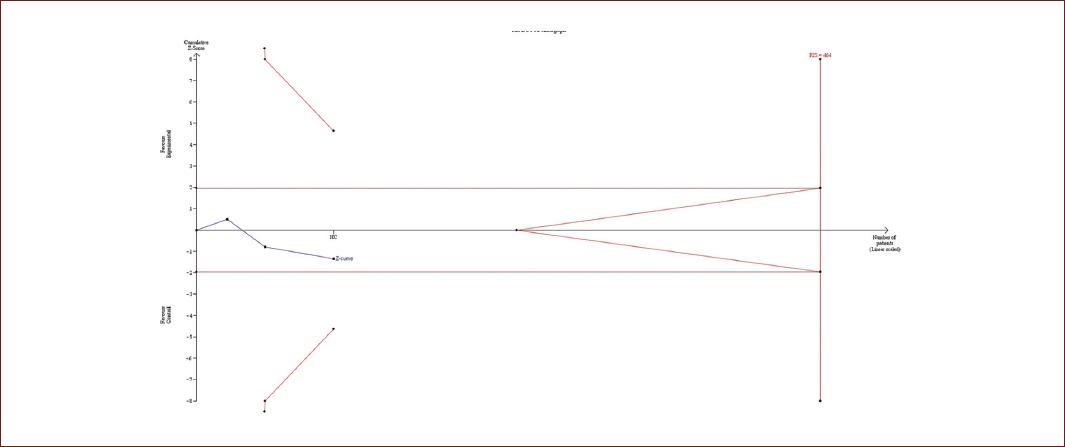
Figure 4 Trial Sequential Analysis (TSA) for the effect of Virtual Reality Therapy (VRT) on balance. The cumulative Z-curve did not cross any monitoring boundaries, and the required information size (RIS = 464 patients) was not reached, indicating that current evidence is insufficient to draw firm conclusions.

Figure 5 Forest plot of studies evaluating the effect of Virtual Reality Therapy (VRT) on functional mobility using the Timed Up and Go (TUG) test, compared to conventional physical therapy (CPT). The pooled mean difference was 0.09 [0.00, 0.17], with marginal statistical significance (p = 0.04) and no heterogeneity (I² = 0%).

Figure 6 Forest plot of studies evaluating the effect of Virtual Reality Therapy (VRT) on motor performance using the Unified Parkinson's Disease Rating Scale Part 3 (UPDRS-III), compared to conventional physical therapy (CPT). The pooled mean difference was −0.19 [−3.28, 2.90], with no statistical significance (p = 0.91) and high heterogeneity (I² = 94%).

Figure 7 Forest plot of studies evaluating the effect of Virtual Reality Therapy (VRT) on fall risk, measured using the Dynamic Gait Index (DGI), compared to conventional physical therapy (CPT). A trend favoring VRT was observed (MD = 1.39 [−0.23, 3.02]), though it did not reach statistical significance (p = 0.09) and showed no heterogeneity (I² = 0%).
Discussion
This meta-analysis assessed the comparative efficacy of immersive VRT and CPT in PD motor rehabilitation. Although trends favored immersive VRT, only mobility (TUGT) reached statistical significance, and even then, the effect was marginal. Balance improved modestly with immersive VRT, but did not surpass the MCID of ~4 points on BBS. High heterogeneity in BBS and UPDRS III suggests protocol and population variability across studies. Mobility improvements were consistent and may reflect the motivational and task-specific nature of immersive VRT. Fall risk and motor scores did not show meaningful changes, possibly due to limited intervention duration or insufficient power. TSA confirmed the current sample size is underpowered, particularly for balance-related outcomes (Fig. 4). By assessing whether the accrued information is sufficient to draw firm conclusions, TSA helps prevent premature claims of benefit or lack of effect based on underpowered data. The finding that the Z-curve did not cross significance boundaries and that the RIS was not reached underscores the need for larger, well-designed trials to determine the true clinical impact of immersive VRT in PD rehabilitation.
Our findings align with previous narrative reviews suggesting the potential of immersive VRT12-24 but insufficient high-quality evidence for routine implementation. Although several published meta-analyses have reported positive outcomes for VRT in PD12,13,15-18,19,21,22, many of these include RCTs that rely on commercial video game systems such as Nintendo Wii (non-immersive). This methodological choice introduces a significant limitation, as these systems are not designed for therapeutic use and lack clinical calibration, reducing the reliability and translatability of the findings to real-world rehabilitation settings25,26.
It is critical to differentiate clinically validated immersive VRT from entertainment-based gaming platforms. Immersive VRT is specifically developed for medical purposes, employing task-specific training, motion tracking, and customizable feedback to target motor deficits under professional supervision26. In contrast, devices such as the WiiTM or NintendoTM consoles offer generic, non-adaptive experiences without therapeutic frameworks, progression protocols, or outcome standardization26. Their use may enhance patient engagement superficially, but it does not fulfill the principles of evidence-based rehabilitation25,26. Therefore, RCTs incorporating such systems were deliberately excluded from the present meta-analysis. Including them would compromise the methodological rigor and distort the clinical relevance of the conclusions, given the fundamental differences in design, intensity, and neurorehabilitative value between commercial gaming and structured immersive VRT.
Immersive VRT should not be viewed as a replacement, but rather as an evolution of traditional rehabilitation paradigms. Its integration into clinical practice holds the potential to deliver structured, adaptive training protocols that respond to individual motor phenotypes, disease stage, and symptom dynamics. Investigating its efficacy through well-designed RCTs is therefore not only an important methodological consideration but also a fundamental step toward precision medicine in PD rehabilitation.
Limitations include the small overall sample size, variability in intervention protocols and duration, and lack of long-term follow-up data. In addition, the included RCTs enrolled participants at different stages of PD (Hoehn and Yahr scores), introducing potential selection bias and heterogeneity in baseline characteristics that could influence treatment response. The risk of type II error also remains due to underpowered analyses in some outcomes. Future research should prioritize multicenter RCTs with standardized immersive VRT protocols, well-defined and robust control groups, and extended follow-up periods to assess the sustainability of effects. Economic evaluations and studies examining adherence and accessibility in diverse settings are also warranted to support implementation in clinical practice.
Conclusion
This meta-analysis demonstrates trends suggesting possible benefits in mobility, though not in balance or overall motor severity. These findings highlight the potential role of immersive VRT as an adjunct in PD rehabilitation, while underscoring the need for larger, well-designed trials to confirm its clinical effectiveness across different motor domains.

