




 nueva página del texto (beta)
 Inglés (pdf)
 Artículo en XML
 Referencias del artículo

 Traducción automática
 Enviar artículo por email
 Citado por SciELO
 Similares en
SciELO

 Permalink

Introduction
Parkinson’s disease (PD) is the second most common neurodegenerative disorder worldwide, with an estimated incidence of 40-50 cases/100,000 inhabitants in Mexico1. Its prevalence increases significantly in individuals over 50 years old, making it a public health priority2. PD is characterized by debilitating motor symptoms such as bradykinesia, resting tremor, and rigidity, alongside a broad range of non-motor symptoms3. These symptoms severely impact patients’ quality of life, place a significant burden on caregivers, and generate substantial costs for healthcare systems4. Despite advancements in pharmacological management, including levodopa and other dopaminergic agents, advanced-stage patients face motor complications such as fluctuations in medication response and treatment-induced dyskinesias5. These limitations underscore the need for complementary and more effective treatments to optimize the comprehensive management of advanced-stage disease.
Deep brain stimulation (DBS) has emerged as an advanced and effective therapy for managing PD. Introduced in 1987, this neurosurgical technique involves implanting electrodes in specific brain areas to modulate affected neural circuits6. DBS provides substantial improvements in motor symptoms, reduces fluctuations and dyskinesias, and decreases medication dependency. Evidence suggests that these benefits can persist for over 15 years in appropriately selected patients, highlighting its potential as a transformative intervention for PD management7.
In Mexico, however, access to DBS remains limited compared to developed countries, highlighting significant implementation gaps. These barriers may be linked to economic constraints, the centralization of specialized centers in major cities, and insufficient knowledge and training among physicians regarding the benefits, referral criteria, and safety profile of DBS. Moreover, delayed or absent referrals for eligible patients remain a recurrent issue, preventing many from receiving this therapy at the optimal time.
Physicians play a pivotal role in DBS implementation as they are responsible for identifying and referring patients who may benefit from this intervention. However, physicians’ perceptions and attitudes toward DBS can significantly influence referral decisions. International studies have identified similar barriers, including lack of awareness of selection criteria, misconceptions about surgical risks, and disagreement on the optimal timing of the intervention8. Addressing these barriers is critical to reducing inequities in DBS access and maximizing its impact on patients’ quality of life.
This study aims to explore the knowledge, attitudes, and perceived barriers toward DBS among physicians in Mexico to identify key areas requiring improvement. By analyzing these perceptions, we aim to provide evidence to inform strategies that promote timely and equitable referrals to this advanced therapy, ultimately optimizing PD management in the country. This work aspires to bridge the gap between scientific evidence and clinical practice, improving clinical outcomes and access to advanced treatments like DBS in Mexico.
Materials and methods
A cross-sectional descriptive qualitative study was conducted using an online survey to explore perceptions, knowledge, and barriers related to DBS among physicians treating PD patients in Mexico. This methodological approach enabled a comprehensive and detailed analysis of attitudes and barriers without requiring variable manipulation or group assignment. Participants provided informed consent, which included details on the survey’s duration, the purpose of the study, and the absence of incentives. Participation was entirely voluntary, and no incentives were offered. The survey’s view rate and participation rate were recorded, and measures were implemented to prevent duplicate entries, ensuring the reliability of the data collected. The study was reviewed and approved by the Institutional Research Ethics Committee of the Tecnológico de Monterrey (code CA-EMCS-2403-02).
The target population included active physicians in Mexico with experience managing PD patients. Specialties considered included neurology, neurosurgery, internal medicine, geriatrics, and other related fields. Inclusion criteria were physicians actively treating PD patients, while exclusion criteria included those who opted not to participate. Participants were selected through non-probability convenience sampling, yielding a final sample of 69 physicians. A 19-question online survey was designed, covering six thematic areas: demographic data, international recommendations for DBS referral, perceived risks associated with the technique, training in DBS or movement disorders, contact with specialized centers, and perceived barriers to DBS access.
The content of the survey was validated by a panel of experts. A pilot test was conducted with 10 physicians from other regions to assess the clarity and relevance of the questions, leading to adjustments before final implementation. The survey was administered through Google Forms. Participants were invited through email and WhatsApp, with reminders sent to non-respondents after 2 weeks. Recruitment was expanded through national conferences to ensure a diverse sample. Data collection spanned 16 weeks. The survey was distributed to 92 professionals in Nuevo León via WhatsApp and extended to attendees of movement disorders, neurology, and geriatrics conferences, reaching a total of 392 invited participants. Measures were taken to minimize potential selection and information biases. Participants were recruited based on predefined criteria, and the survey was anonymous to reduce social desirability bias. Standardization in questionnaire design and administration aimed to mitigate measurement and interpretation biases.
Survey reliability and internal consistency
The survey was designed to assess knowledge, attitudes, and barriers toward DBS among medical specialists. It consisted primarily of dichotomous (yes/no) questions and one open-ended question. The content of the survey was validated by a panel of experts to ensure relevance and clarity. Given the heterogeneous nature of the questionnaire and the fact that the items did not measure a single underlying construct, internal consistency analysis using Cronbach’s alpha was not considered appropriate. Instead, survey validity was ensured through expert panel content validation, clear question wording, and pilot testing to improve reliability.
Statistical analysis
Data analysis was performed using IBM SPSS Statistics version 25. Closed-ended questions were analyzed through frequencies and percentages for categorical variables, while numerical variables, such as age and years of practice, were described using measures of central tendency and dispersion. The open-ended question, which explored perceived barriers to DBS access, underwent thematic analysis to identify and classify responses into key categories, such as cost, infrastructure, and knowledge gaps. This methodological approach ensured robust and in-depth analysis to support the study’s findings.
Results
Demographic characteristics
The general characteristics of the participants are detailed in table 1. The mean age was 42.94 years (standard deviation [SD]: 12.48), with a median of 42 years and a range from 29 to 76 years. Age distribution demonstrated a slight positive skewness (1.085) toward younger physicians and moderate kurtosis (0.257). Regarding gender, 53.6% were male (n = 37) and 46.4% were female (n = 32).
Table 1 Demographic characteristics of surveyed physicians
| Variable | Category | Frequency (n) / Percentage |
|---|---|---|
| Gender | Male | 37 (53.6) |
| Female | 32 (46.4) | |
| Specialty | Neurology | 40 (58.0) |
| Geriatrics | 25 (36.2) | |
| Internal medicine | 1 (1.4) | |
| Neurosurgery | 1 (1.4) | |
| General practitioner | 1 (1.4) | |
| Psychotherapist | 1 (1.4) | |
| Type of institution | Public | 4 (5.8) |
| Private | 28 (40.6) | |
| Both | 37 (53.6) | |
| Nationality | Mexican | 67 (97.1) |
| Other | 2 (2.9) | |
| Geographical practice region in Mexico | Central | 24 (34.8) |
| Northeast | 22 (31.9) | |
| West | 11 (15.9) | |
| Northwest | 6 (8.7) | |
| Southeast | 4 (5.8) | |
| International | 2 (2.9) |
Participants reported a mean of 12.78 years of professional practice (SD: 11.67), with a median of 10 years and a range of 1-44 years, reflecting significant variability. The distribution showed a positive skewness (1.272), indicating a greater representation of less experienced physicians. The predominant specialty was Neurology (58%, n = 40), followed by Geriatrics (36.2%, n = 25). Other specialties included Internal Medicine, Neurosurgery, General Medicine, and Psychotherapy (1.4% each). In terms of employment, 53.6% worked in both public and private sectors, 40.6% exclusively in private institutions, and 5.8% exclusively in public institutions. Geographically, most participants practiced in the Central (34.8%, n = 24) and Northeastern (31.9%, n = 22) regions. The remaining participants were distributed across the Western (15.9%, n = 11), Northwestern (8.7%, n = 6), and Southeastern (5.8%, n = 4) regions. A small proportion (2.9%, n = 2) reported practicing internationally.
International recommendations for DBS referral
The presence of a local center or medical group performing DBS was reported by 62.3% of respondents, whereas 37.7% indicated the absence of such services, reflecting disparities in infrastructure distribution. Most physicians (69.6%) believed that advanced age does not significantly impact the benefits of DBS, while 30.4% disagreed, indicating variability in interpretation of the evidence. Regarding the timing of DBS, 71.0% recommended it 5-10 years after Parkinson’s diagnosis, whereas 24.6% suggested earlier intervention (< 5 years) and 4.3% supported a delay (> 10 years).
For atypical Parkinsonism, 60.9% of respondents considered these patients ineligible for DBS, while 39.1% expressed a broader perception of eligibility. In addition, 76.8% of physicians did not view resistance to pharmacological therapy as an essential referral criterion, compared to 23.2% who did. For patients with a poor or absent response to levodopa, 50.7% deemed them eligible for DBS, whereas 49.3% disagreed.
Given the critical role of patient selection in achieving successful outcomes with DBS, we have summarized the key criteria for referral9,10. These criteria not only guide specialists but also provide educational value for general practitioners and other healthcare professionals involved in the care of patients with PD. The main factors to consider when identifying potential candidates for DBS include a confirmed diagnosis of idiopathic PD, the presence of disabling motor symptoms such as medication-refractory motor fluctuations or dyskinesias, and a good response to levodopa, which is a strong predictor of favorable outcomes with DBS. Patients with severe comorbidities, uncontrolled psychiatric disorders, or dementia are generally excluded. In addition, a multidisciplinary evaluation involving neurology, neurosurgery, neuropsychology, and psychiatry is essential to assess the suitability of candidates and ensure they have realistic expectations regarding the risks and benefits of DBS. Ultimately, proper patient selection and a thorough preoperative assessment are crucial to optimizing outcomes.
Perception of risk associated with DBS
The majority of participants (89.9%) perceived DBS as a safe technique, while 10.1% expressed concerns about significant risks, particularly surgical complications and device programming issues. In addition, 94.2% believed that DBS should not be limited to a last-resort option, emphasizing its value in earlier stages of the disease.
Training and contact with DBS centers
A total of 71.0% of physicians reported no formal training in movement disorders or DBS, whereas 29.0% had completed specialized education, highlighting a notable gap in advanced medical training. Regarding contact with specialized DBS centers, 65.2% had established connections, while 34.8% lacked these relationships, potentially hindering patient referrals and management.
Perceived barriers to DBS access
Open-ended responses identified four main categories of barriers:
– Economic factors: high procedural and device maintenance costs, coupled with insufficient insurance coverage, were reported by 79.7% of respondents
– Infrastructure and resources: a lack of specialized centers and their centralization in major cities was highlighted by 29%, restricting access for patients in remote areas
– Limited knowledge: a lack of dissemination of information about DBS benefits and referral criteria among both physicians and patients was identified by 21.7%
– Perceptual risks: although less common (5.8%), some respondents mentioned fear of the procedure due to misconceptions about surgical risks and uncertain outcomes.
These findings underscore critical areas for improvement to enhance access to and implementation of DBS in Mexico. Figure 1 illustrates the favorable attitudes and perceived barriers toward DBS reported by the surveyed physicians.
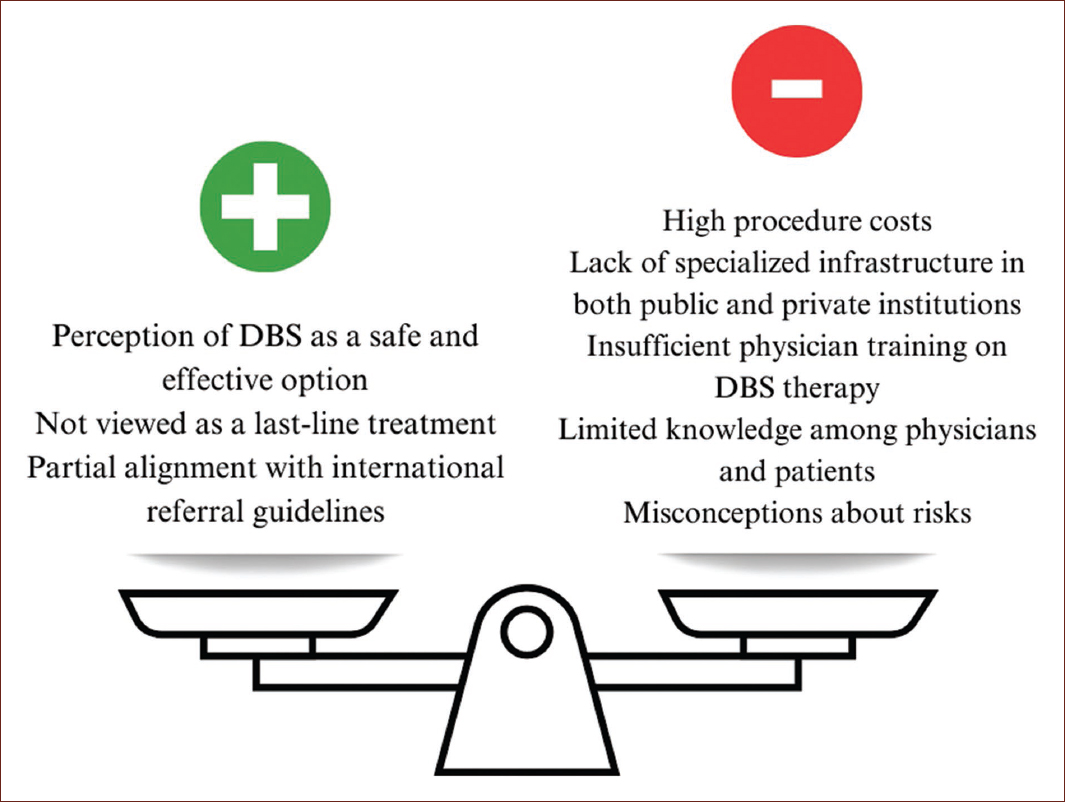
Figure 1 Balance between favorable attitudes and perceived barriers toward deep brain stimulation (DBS) in Mexico. The figure illustrates the balance between favorable attitudes and barriers toward DBS among physicians treating Parkinson’s disease patients in Mexico. On the positive side, it highlights the perception of DBS as a safe, effective technique not limited to being a last-line treatment, as well as partial alignment with international guidelines. However, these attitudes contrast with significant barriers, such as the high cost of the procedure, centralized infrastructure, insufficient knowledge among physicians and patients, and erroneous risk perceptions, which limit its implementation and accessibility.
Discussion
This study identifies critical factors related to the knowledge, attitudes, and barriers toward DBS in Mexico, highlighting both alignment with international recommendations and discrepancies requiring attention. Nationally, attitudes toward DBS are predominantly positive, with physicians perceiving it as a safe and effective treatment that should not be confined to a last-resort option. However, significant barriers – such as high costs, centralized services, and lack of specialized training – were identified, limiting the accessibility and implementation of this advanced therapy.
The unequal distribution of specialized centers, reported by 37.7% of respondents, underscores structural inequalities that force many patients to travel long distances or face prolonged wait times. This contrasts with studies in more developed settings, such as Shih and Tarsy’s work11, which highlight debates over minimum disease duration before DBS referral as a primary challenge in well-resourced systems. Similarly, Lange et al. in Germany identified knowledge deficits among physicians, with only 2% accurately identifying key referral criteria12. These findings suggest that while barriers differ by context, continuous medical education remains a universal necessity.
Most physicians in this study believed that advanced age does not significantly diminish DBS benefits, aligning with international guidelines. However, the 30.4% expressing contrary opinions underscores variability in evidence interpretation. In addition, while 71.0% of respondents identified 5-10 years post-diagnosis as the ideal DBS window, the 24.6% favoring earlier intervention, and 4.3% supporting later implementation reflect the need to strengthen understanding of evidence-based criteria.
Economic barriers emerged as the most prominent challenge, with 79.7% identifying cost as the primary obstacle to access. This finding aligns with previous studies documenting the critical role of financial constraints, even in more developed healthcare systems8. Furthermore, the 21.7% reporting limited knowledge about DBS benefits and safety emphasizes the importance of improving medical training and patient communication.
Although only 5.8% of respondents expressed concerns about surgical risks, these perceptions, combined with knowledge gaps, highlight the need for educational initiatives to dispel misconceptions and promote timely referrals. Collectively, these findings emphasize the necessity of addressing structural, economic, and educational barriers through targeted policies that foster equitable and early access to DBS in Mexico.
This study has several limitations. The small sample size restricts the generalizability of findings to the national level. In addition, the survey-based design may be subject to response bias. Future studies should consider including primary care physicians to broaden the scope of this research and enhance its educational impact. Their involvement could help raise awareness about advanced treatment options for PD among healthcare professionals who play a key role in early diagnosis and patient referral. The exclusion of patient perspectives limits a more comprehensive understanding of barriers to DBS. Finally, the lack of transnational comparisons limits the global contextualization of the results. Despite these limitations, this study provides valuable insights as one of the first systematic investigations into the attitudes, knowledge, and barriers toward DBS in Mexico from the perspective of physicians.
Conclusions
This study highlights predominantly positive attitudes toward DBS among physicians in Mexico, emphasizing its perception as a safe and effective therapeutic option. However, economic barriers, centralized services, lack of knowledge about referral criteria, and misconceptions about risks hinder its implementation and accessibility. Overcoming the identified barriers will require implementing policies focused on adequate financing, decentralization of specialized services, and continuous medical education programs. Informational campaigns targeting physicians and patients could further enhance understanding of DBS as a viable and timely option, optimizing its impact on PD management and patient quality of life. This work underscores the importance of tailoring global strategies to the specific needs of the Mexican context, thereby strengthening equity and effectiveness in access to advanced therapies.

