




 nueva página del texto (beta)
 Inglés (pdf)
 Artículo en XML
 Referencias del artículo
 Traducción automática
 Enviar artículo por email
 Citado por SciELO
  Similares en
SciELO
Similares en
SciELO 
 Permalink
We present a 60-year-old man with an 11-year history of an ileocecal neuroendocrine tumor (NET) with a 1% proliferation index (Ki-67) and carcinoid syndrome (CS) as the first clinical manifestation. Liver metastases were documented by computed tomography and abdominal ultrasound (Figs. 1A and B), with somatostatin receptor expression demonstrated by scintigraphy (Fig. 1C). Positron emission tomography and computed tomography revealed a discrete heterogeneous pathological increase in metastasis metabolism (Fig. 1D). As an initial treatment, surgical resection of the tumor was performed, and somatostatin analogs started. After 11 years, liver metastases and CS persisted despite fifth-line oncologic treatment. During follow-up, echocardiograms were performed periodically, the last two years earlier.
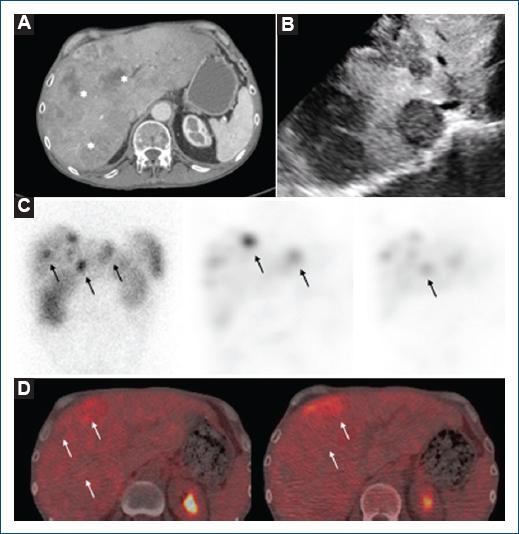
Figure 1 Multimodal imaging metastases. A: computed tomography highlights multiple liver lesions predominantly in the right lobe, with solid aspect and partially confluent that is compatible with liver metastases (asterisks). B: abdominal ultrasound with heterogeneous liver and multiple solid focal lesions. C: scintigraphy reveals multiple active focal deposits of In-111 octreotide in the liver, suggesting the expression of somatostatin receptors in liver metastases (arrows). D: axial positron emission tomography/computed tomography shows most liver metastases without increased metabolism and heterogeneously low 18F-FDG uptake (arrows).
He was admitted with a 4-day history of abdominal pain, jugular plethora, and edema of the lower extremities. The echocardiogram highlighted severe dilation of the right cavities, with thickening, stiffness, and immobility of the pulmonary and tricuspid valves (Figs. 2A and B), with a fixed and semi-open position throughout the heart cycle, conditioning systolic-diastolic free flow between the right cavities and the trunk of the pulmonary artery (Figs. 2C and D). After treatment for right heart failure, the patient was asymptomatic. Due to advanced and treatment-resistant NET-CS, in addition to progressive heart disease, surgical valve replacement was not considered, and he died 6 months later.
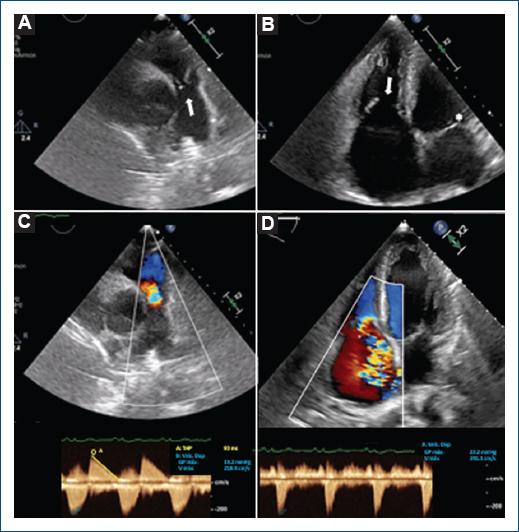
Figure 2 Echocardiogram during admission. A: the short parasternal axis shows the pulmonary valve with thickened and semi-open leaflets in the diastolic phase (cusp separation of 9.9 mm) (arrows). B: the tricuspid valve is seen with thickened and semi-open leaflets in the systolic phase, with a separation of its cusps of 16-17 mm (arroz), while the mitral valve is closed (asterisk). C: using color Doppler, free regurgitant diastolic flow is observed between the right ventricle and the trunk of the pulmonary artery, with 70% occupation of the pulmonary annulus and maximum density pan-diastolic Doppler. The continuous Doppler half-pressure time is 90 ms. The opening of the pulmonary valve is not restricted (slight increase in the maximum systolic velocity of 2.2 m/s, due to the hyperflow component of severe insufficiency). D: in the tricuspid valve, systolic free flow between the right atrium and the ventricle is notable, making it impossible to quantify the regurgitant volume using the PISA method. Continuous Doppler is dense, triangular, with a peak velocity of 2.3 m/s, and it is not suitable for estimating pulmonary pressure. The valve opening is not restricted (peak diastolic velocity < 2 m/s).
Carcinoid heart disease (CHD) is the leading cause of the poor prognosis of metastatic NET with CS1-3. It usually appears early; nevertheless, it can occur at any time. The importance of performing periodic echocardiography studies during follow-up is highlighted for the timely detection of CHD, knowing that surgical valve replacement at the appropriate time could improve survival1-3.

