




 nueva página del texto (beta)
 Inglés (pdf)
 Artículo en XML
 Referencias del artículo
 Traducción automática
 Enviar artículo por email
 Citado por SciELO
  Similares en
SciELO
Similares en
SciELO 
 Permalink
1. Introduction
The investigation of Mesozoic corals in Mexico began with the work of Felix (1891). We know of nearly 90 publications that have at least some citations of Mesozoic coral species, and nearly 60 of those have descriptions and/or illustrations of fossil material (Löser, 1994 and later supplements). Half of the systematic taxonomic investigations were undertaken in the past 25 years. There are two older works that were realized by American workers, Imlay (1940) and Wells (1946). Imlay (1940) erected a new coral species from Durango. Wells (1946) published a small collection of Upper Jurassic and Lower Cretaceous corals collected by Kellum and Imlay in Coahuila, Durango, and Sonora, for which he established five new species. In the present paper, the coral material is examined again, provided with morphometric data, and set into a modern taxonomic context.
2. Study area
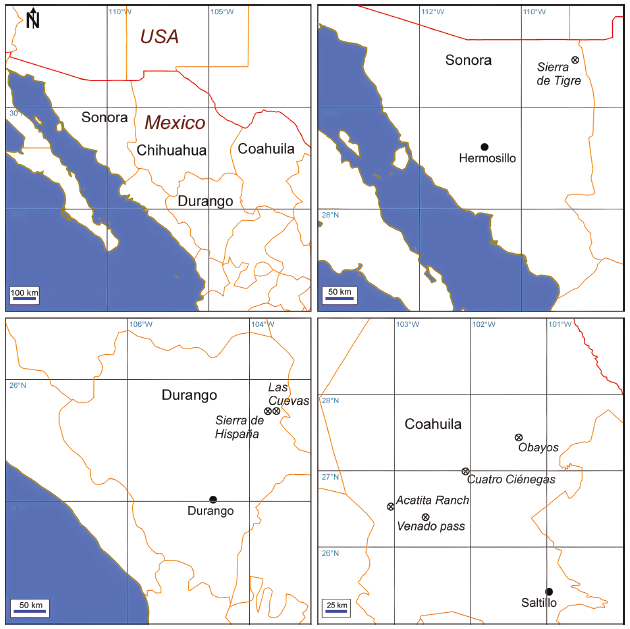
The material comes from the Mexican states Coahuila, Durango, and Sonora (Figure 1). The geology for each of these areas is described by Imlay (1939, 1940), Kellum (1936), and Kelly (1936). Exact localities or sample locations are unknown and geographic coordinates are, therefore, not given.
2.1. COAHUILA
Barril Viejo, SE of Cuatro Ciénegas. Barril Viejo shale, Lower Hauterivian. See Imlay (1940).
Outlier of the Sierra de Venado. Cuchillo Fm, Upper Aptian to Lower Albian with Dufrenoya cf. justinae. See Kellum (1936).
Los Vagos, Potrero de Oballos. Barril Viejo shale, Lower Hauterivian. See Imlay (1940). The place name probably refers to the small village of Obayos NW of Cuatro Ciénegas.
Sierra de Acatita, at the head of the canyon east of the Acatica ranch. Lower Cuchillo fm, Upper Aptian to Lower Albian. See Kellum (1936).
2.2. DURANGO
Outcrop about 4 km south of the Las Cuevas Ranch. La Casita Fm, Kimmerdigian. The geology was described by Kellum (1936) and Imlay (1939). Las Cuevas lies about 13 km SW from the city centre of Torreón.
Outcrop 3.2 km SW of Las Cuevas. Carbonara fm, middle Valanginian. For details see Imlay (1940).
Outcrop at the NW end of the Sierra de España (or Hispaña), about 1.6 km NE of La Goma station. Carbonara fm, middle Valanginian. See Kellum (1936) and Imlay (1940). La Goma lies about 23 km SW of Torreón.
3. Material and methods
The studied material is almost entirely kept at the University of Michigan Museum of Paleontology (UMMP) in Ann Arbor (Mich., USA). One specimen (23343) could not be found. Most specimens are still complete, without polished or thin sections. Some thin sections are available. All specimens were photographed and measured. Their generic taxonomy was updated and the species were determined based on the morphometric data.
It was not possible to prepare the coral specimens, such as cutting, polishing, or taking thin sections. Available thin sections were scanned by passing light through them using a flatbed scanner with an optical resolution of 6,400 dpi. Specimens were scanned with an optical resolution of 4,800 dpi. The images were then transferred to greyscale bitmaps and their quality was amended by histogram contrast manipulation (contrast stretching) where possible.
Corallite dimensions and the septal counts were systematically measured using the scanned thin sections. To achieve statistical significance, in colonial corals the largest number of possible measurements was taken. This number was mainly determined by the size and quality of the thin sections, and the size of the single corallites in relation to the size of the thin sections.
For each type of measurement (such as, for instance, the corallite diameter or septal counts), the following values were obtained (all measurements in millimetres):
n number of measurements.
min-max lowest and highest measured values
μ arithmetic mean (average)
s standard deviation
cv coefficient of variation according to K. Pearson
μ ± s first interval
Thin sections were measured and values were calculated using the Palaeontological Database System PaleoTax, module PaleoTax/Measure (https://www.paleotax.de/measure); for details on the mathematical background, see Löser (2012). Characters that were visible on the fossils were compared against characters on specimens in worldwide fossil coral collections, and an associated image database (29,000 specimens, 17,000 illustrated), located in the Estación Regional de Noroeste (ERNO), Sonora, Mexico. Data storage and processing were carried out using the Paleo-Tax database programme (Löser, 2004).
4. Systematic description
The classification follows Löser (2016). The following abbreviations are used to describe the dimensions of the corals: c, outer diameter of the solitary coral; ccd, distance between corallite centres; clmax, large lumen; clmin, small lumen; septa, number of septa in the adult corallite. The abbreviations used in the synonymy lists follow Matthews (1973): *: earliest valid publication of the species name; v: the specimen was observed; p: the material described in this citation belongs only partly to the present species.
| Superfamily Actinastreoidea
Alloiteau,
1952. |
Remarks: For the morphology of the superfamily refer to Samaniego-Pesqueira et al. (2023).
| Family Actinastreidae Alloiteau, 1952 Genus Stelidioseris Tomes, 1893 |
Type species: Stelidioseris gibbosa Tomes, 1893.
Remarks: For the morphology of the superfamily refer to Samaniego-Pesqueira et al. (2023).
|
Stelidioseris
icaunensis (Orbigny, 1850) Figure 2:1-2 |
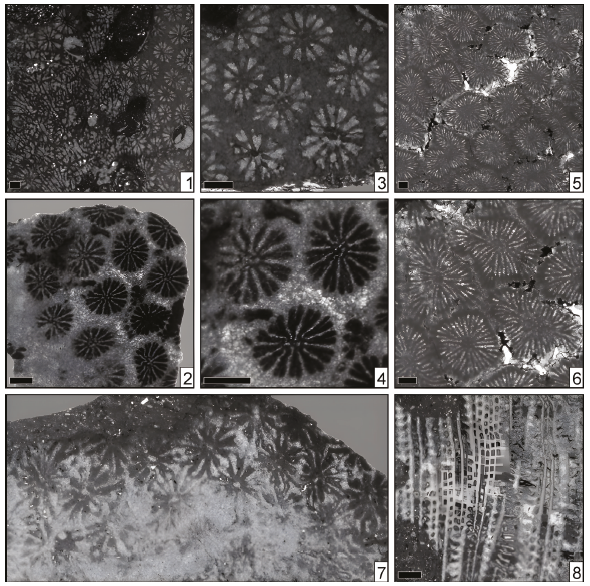
Figure 2 1-2. Stelidioseris icaunensis (Orbigny, 1850), Holotype of Astrocoenia
kellumi, (UMMP 15969). l, transversal thin section. 2,
transversal thin section, detail.
3-4. Eocolumastrea
octaviae (Prever,
1909), Holotype of Stephanocoenia guadalupae
minor, (UMMP 23339). 3, transversal thin section. 4,
transversal thin section, detail.
5-6. Thalamocaeniopsis
neocomiensis (Tomes,
1885), (UMMP 15786). 5, transversal thin section. 6,
transversal thin section, detail.
7-8. Holocoenia
micrantha (Roemer,
1841), Holotype of Astrocoenia hispaniensis,
(UMMP 19345). 7, transversal thin section. 8, longitudinal thin section.
Scale bar 1 mm.
Synonymy:
*v 1850 Prionastraea icaunensis Orbigny, (2), p. 93.
v 1871 Astrocoenia Kunthi - Bölsche, p. 56, pl. 12, fig. 7.
v 1897 Astrocoenia urgoniensis - Koby, p. 58, pl. 15, figs. 5-8
v 1924 Astrocoenia hexamera n.sp. - Fritzsche, p. 318, pl. 3, fig. 7
v 1933 Astrocoenia budaensis n.sp. - Wells, p. 78, pl. 6, fig. 3
v 1933 Siderastraea tuckerae n.sp. - Wells, p. 104, pl. 9, figs. 6, 7
v 1946 Astrocoenia kellumi Wells, n. sp. - Wells, p. 2, pl. 1, fig. 1
v 2020 Stelidioseris icaunensis (Orbigny, 1850) - Löser, Mendicoa and Fernández Mendiola, p. 221, figs. 3a-c
Material: UMMP 15969; 1 thin section.
Dimensions: (UMMP 15969)
| n | min-max | μ | s | cv | p±s | |
| clmin | 20 | 1.34-1.91 | 1.55 | 0.16 | 10.1 | 1.39-1.70 |
| clmax | 20 | 1.72-2.46 | 2.09 | 0.23 | 10.8 | 1.87-2.32 |
| ccd | 20 | 1.55-2.10 | 1.84 | 0.18 | 9.7 | 1.66-2.02 |
| septa | 24 |
Remarks: Systematic measurements of the thin section of the holotype of Astrocoenia kellumi shows clearly synonymy of this species with Stelidioseris icaunensis.
Occurrence: Mexico, Durango, Rancho Las Cuevas Rancho (Kimmeridgian).
Other occurrences: Kimmeridgian to middle Cenomanian, worldwide.
| Superfamily Cladocoroidea
Orbigny,
1851. |
Remarks: For the morphology of the superfamily refer to Löser et al. (2023).
| Family Columastreidae Alloiteau,
1952. |
Description: Plocoid colonies. Septal symmetry regular radial and mostly hexameral. Pali present in some genera. Columella varies: styliform, styliform and double, lamellar, or absent. Coenosteum with costae.
| Genus
Eocolumastrea
Löser and Zell,
2015 |
Type species: Columnocoenia bucovinensis Morycowa, 1971
Description: Plocoid coral with septa in a regular hexameral or decameral symmetry. Columella lamellar or small and styliform. Irregular pali at the first septal cycle, not very pronounced. Coenosteum narrow.
Remarks: The genus received a more detailed study by Garberoglio et al. (2021).
|
Eocolumastrea
octaviae (Prever,
1909) Figure 2: 3-4 |
Synonymy:
*v 1909 Ulastraea Octaviae Prever, p. 91, pl. 5, fig. 5.
v 1946 Stephanocoenia guadalupe minor Wells, n.var. - Wells, p. 3, pl. 1, figs. 2-4
v 2021 Eocolumastrea octaviae (Prever, 1909) - Garberoglio, Löser and Lazo, p. 9, fig. 8 [= here more detailed synonymy]
Material: UMMP 15993, 23339; 2 thin sections.
Dimensions: (UMMP 23339).
| n | min-max | μ | s | cv | p±s | |
| clmin | 25 | 1.32-1.78 | 1.53 | 0.13 | 8.7 | 1.40-1.66 |
| clmax | 25 | 1.65-2.04 | 1.84 | 0.09 | 4.7 | 1.75-1.92 |
| ccd | 30 | 1.51-2.19 | 1.87 | 0.18 | 9.6 | 1.69-2.05 |
| septa | 24 |
Remarks: The present type specimen fits well in the dimensions of E. octaviae.
Occurrences: Mexico, Coahuila, Sierra de Acatita, Acatita ranch (upper Aptian). Mexico, Sonora, Sierra El Tigre, Rancho de King, Cañón Sta. Rosa (upper Aptian to lower Albian).
Other occurrences: Valanginian to lower Cenomanian, world-wide.
| Superfamily Cyclolitoidea
Milne Edwards and Haime,
1849 |
Remarks: For the morphology of the superfamily refer to Löser et al. (2023).
| Family Latomeandridae Fromentel,
1861 |
Remarks: For the morphology of the family refer to Löser et al. (2023).
| Genus
Thalamocaeniopsis
Alloiteau,
1954 |
Type species: Thalamocaeniopsis ouenzensis Alloiteau, 1954
Description: Cerioid colony. Corallite outline polygonal with centres slightly depressed. Symmetry of septa irregular. Synapticulae occasional, mainly in the space between calices. No costae. Columella consists of isolated trabeculae or one more solid element. Wall subcompact, made of synapticulae. Budding extracalicinal.
Remarks: After having been established, the genus was poorly cited in the literature, probably because the first description was poorly illustrated. Thalamocaeniopsis is a common Lower Cretaceous and Cenomanian coral genus with numerous species.
|
Thalamocaeniopsis
neocomiensis (Tomes, 1885) Figure 2: 5-6 |
Synonymy:
*v 1885 Isastraea neocomiensis Tomes, p. 547.
v 1926 Isastraea cf. geometrica Koby - Dietrich, p. 79, pl. 7, fig. 3.
v 1946 Isastrea whitneyi Wells 1932 - Wells, p. 3, pl. 2, figs. 1-3.
1985 Latiastraea whitneyi (Wells, 1932) - Sikharulidze, p. 54, pl. 25, fig. 5.
Material: UMMP 15786; 1 thin section.
Dimensions: (UMMP 15786).
| n | min-max | μ | s | cv | p±s | |
| clmin | 25 | 2.43-3.46 | 2.96 | 0.28 | 9.3 | 2.68-3.24 |
| clmax | 25 | 3.85-5.34 | 4.53 | 0.45 | 10.0 | 4.08-4.98 |
| ccd | 25 | 3.09-4.00 | 3.54 | 0.28 | 8.0 | 3.25-3.82 |
| septa | 25 | 38-55 | 46.08 | 5.04 | 10.9 | 41-51 |
Remarks: This specimen was originally assigned to Isastrea whitneyi Wells, 1932. Isastrea does not occur in the Cretaceous and Isastrea whitneyi belongs to Thalamocaenopsis as the present specimen. The present specimen differs from T. whitneyi by slightly larger dimensions and higher septal counts. T. whitneyi is a junior synonym of T. fleuriausa (Orbigny, 1850).
Occurrence: Mexico, Coahuila, Outlier of Sierra del Venado (upper Aptian to lower Albian).
Other occurrence: Hauterivian of the Eastern Tethys (Georgia), Lower Aptian of the European Boreal (UK) and the Southern Tethys (Tanzania), Lower Albian of the Western Atlantic (Mexico), and the Western Tethys (Spain).
Remarks: For the morphology of the informal group refer to Garberoglio et al. (2022).
Remarks: In older literature, the genus Holocoenia Milne Edwards and Haime, 1851 (and its synomyms Paretallonia Sikharulidze, 1972 and Stereocaenia Alloiteau, 1952) were assigned to the family Thamnasteriidae Reuss, 1864 (Löser, 2009). The Thamnasteriidae (now within the superfamily Rhizangioidea Orbigny, 1851) are characterised by medium-sized trabeculae and interconnected septa, whereas Holocoenia is characterised by smaller trabeculae and free septa. A new family (and superfamily) should be established for Holocoenia and the related genus Etallonasteria Roniewicz, 1987, but the type material of its type species (Astrea micrantha Roemer, 1841) is not available and the type locality (Germany, Niedersachsen, Berklingen; uppermost Valanginian to lowermost Hauterivian) does not yield anymore fossil corals, and comparable collection material is scarce. The genus was revised by Löser (2009) based on a small topotypical specimen.
| Genus
Holocoenia
Milne Edwards and Haime,
1851 |
Type species: Astrea micrantha Roemer, 1841.
Description: Cerioid colony with small co rallites (diameter below 2 mm). Septa confluent, two septal generations differing in septal length. The number of septa vary between 18 and 22, and may differ within one colony. Thick styliform columella. Incomplete wall made of synapticulae. Endotheca absent.
|
Holocoenia
micrantha (Roemer,
1841) Figure 2: 7-8 |
Synonymy:
* 1841 Astraea micrantha Roemer, p. 113, pl. 16, fig. 27.
v 1940 Astrocoenia hispaniensis Imlay, n. sp. - Imlay, p. 138, pl. 1, figs. 21, 22.
v 1964 Stereocaenia triboleti (Koby, 1896) - Morycowa, p. 77, pl. 23, figs. 1-3.
v 1997 Paretallonia bendukidzeae Sikharulidze, 1972 - Baron-Szabo, p. 76, pl. 11, figs. 1, 3, 4.
v 2009 Holocoenia micrantha (Roemer, 1841) - Löser, p. 96, figs. 1, 2a-c.
v 2019 Holocoenia micrantha (Roemer, 1841) - Löser, Arias and Vilas, p. 280, figs. 13.1-3.
Material: UMMP 19345; 1 thin section.
Dimensions: (UMMP 19345)
| n | min-max | μ | s | cv | p±s | |
| clmin | 6 | 1.29-1.55 | 1.42 | 0.10 | 7.0 | 1.32-1.52 |
| clmax | 8 | 1.38-1.98 | 1.65 | 0.20 | 12.2 | 1.45-1.85 |
| ccd | 15 | 1.33-1.85 | 1.54 | 0.18 | 11.6 | 1.36-1.72 |
| septa | 20 |
Remarks: The holotype of Astrocoenia hispaniensis belongs to the comparably rare genus Holocoenia. Astrocoenia Milne Edwards and Haime, 1848 is a Palaeogene genus but was widely used in the 19th and early 20th centuries for material that is now assigned to Actinastrea Orbigny, 1849 and Stelidioseris Tomes, 1893. Holocoenia shows a certain affinity to Stelidioseris, but clearly differs due to the wall made of synapticulae, which is clearly visible in the present specimen.
Occurrence: Mexico, Durango, Las Cuevas (Valanginian).
Other occurrence: Upper Valanginian to lower Hauterivian of the North Africa (Algeria) and the European Boreal (Germany, France), Hauterivian to Barremian of the Western Tethys (Spain, France), lower Barremian of the Western Tethys (France), upper Barremian to lower Aptian of the Central Tethys (Germany), Barremian to lower Aptian of the Central Tethys (Poland).
| Superfamily Misistelloidea
Eliásová,
1976 |
Remarks: For the morphology of the superfamily refer to Löser et al. (2023).
| Family Rayasmiliidae Löser,
2022 |
Description: Solitary and phaceloid corals. The septa are always free. A lamellar columella is present in some genera. One or two septa may be connected to the columella.
| Genus
Rayasmilia
Löser,
2022 |
Type species: Rayasmilia salvata Löser, 2022
Description: Solitary turbinate coral. Septa compact, not connected to each other, in a regular radial symmetry. Septa can be connected to the columella. Wall absent. Epitheca present. Endotheca well developed. Columella lamellar.
|
Rayasmilia
bangoinensis (Liao
and Xia, 1985) Figure 3: 1-2 |
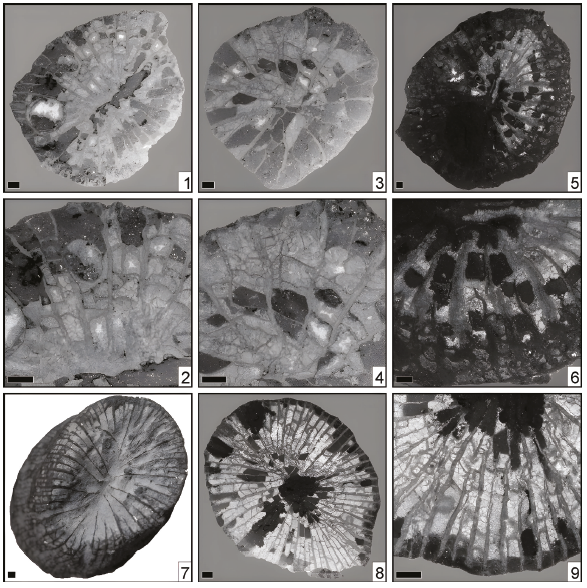
Figure 3 1-2. Rayasmilia bangoinensis (Liao and Xia, 1985), (UMMP 23350#2). 1, transversal
thin section. 2, transversal thin section, detail.
3-4.
Trochophyllia sp., (UMMP 23350#1). 3, transversal
thin section. 4, transversal thin section, detail.
5-6.
Rayasmilia fromenteli (d'Angelis d'Ossat, 1905), Paratype of
Axosmilia mexicana, (UMMP 23349). 5, transversal
thin section. 6, transversal thin section, detail.
7-9.
Trochophyllia communis (Prever, 1909), Holotype of Axosmilia
mexicana, (UMMP 23348). 7, corallite surface. 8, (UMMP
23346#1), transversal thin section. 9, transversal thin section, detail.
Scale bar 1 mm.
Synonymy:
vp 1933 Pleurosmilia saxifisi Wells, p. 62, pl. 2, fig. 17, pl. 5, figs. 1, 2.
vp 1946 Axosmilia mexicana Wells, n.sp. - Wells, p. 6, pl. 1, figs. 6-11
*v 1985 Axosmilia bangoinensis (sp. nov.) - Liao and Xia, p. 146, pl. 8, figs. 6-9.
v 1994 Axosmilia bangoinensis Liao et Xia - Liao and Xia, p. 80, 223, pl. 8, figs. 11, 12.
2002 Aulophyllia belbekensis Kusmicheva, sp. nov. - Kuzmicheva, p. 178, pl. 27, fig. 2.
v 2013a Plesiosmilia hennigi Dietrich, 1926 - Löser, p. 104, fig. 5.10.
v 2013b Plesiosmilia hennigi (Dietrich, 1926) - Löser, fig. 3 fig. 1.
Material: UMMP 23350#2; 1 thin section.
Dimensions: (23350#2).
c 11.8 × 15.6
septa 46
Remarks: Wells doubtfully included this specimen into Axosmilia mexicana, but excluded it from the type series.
Occurrence: Mexico, Coahuila, Barril Viejo, Cuatrocienegas, (lower Hauterivian).
Other occurrences: Berriasian of the Central Tethys (Ukraine), Berriasian to Valanginian of the Southern Tethys (China), Valanginian to Aptian of the Western Atlantic (Mexico), lower Hauterivian of the European Boreal (France), lower Aptian of the Western Atlantic (Mexico), of the Central Tethys (Greece), and of the Western Tethys (Spain), upper Aptian of the Central Tethys (Greece), lower Cenomanian of the Western Atlantic (USA), upper Cenomanian of the Western Tethys (France).
|
Rayasmiliafromenteli (Angelis d'Ossat,
1905) Figure 3: 5-6 |
Synonymy:
*v 1905 Peplosmilia Fromenteli Angelis d'Ossat, p. 242, pl. 17, figs. 6 a-g.
v 1926 Pleurosmilia hennigi n.sp. - Dietrich, p. 87, pl. 7, figs. 6 a-c.
vp 1946 Axosmilia mexicana Wells, n.sp. - Wells, p. 6, pl. 1, figs. 6-11.
1977 Rhipidosmilia tauridae - Babaev and Krasnov, p. 147, text-fig. 9, pl. 43, fig. 3.
v 1991 Axosmilia viai n. sp. - Reig Oriol, p. 8, pl. 1, fig. 6 pl. 3 figs. 7, 8.
v 2008 Plesiosmilia neocomiensis (de Fromentel, 1867) - Löser, p. 55, pl. 4, figs. 2-3.
Material: UMMP 23349; 1 thin section.
Dimensions: (23349).
c 20.5 × 24.9
septa 50
Remarks: This paratype of Axosmilia mexicana can clearly be assigned to Rayasmilia. Axosmilia is a poorly defined genus and should no longer be used. The lectotype of the type species (Caryophyllia extinctorium Michelin, 1841; Muséum National d'Histoire Naturelle Paris M00053) is a small and poorly defined specimen that does not reveal any details about the septal microstructure, the endotheca, or possible pali and/or columella. The genus is used (for instance, as per Vasseur and Lathuilière 2021) in a sense that was arbitrarily defined by Beauvais (1986) and Roniewicz (2008), but not based on proper type material.
Occurrence: Mexico, Coahuila, Los Vagos, Potrero de Oballos (lower Hauterivian).
Other occurrence: Upper Tithonian to Berriasian of the Central Tethys (Ukraine), upper Valanginian to lower Aptian of the Southern Tethys (Tanzania), lower Aptian of the Western Tethys (Spain), upper Aptian to lower Albian of the Western Tethys (Spain).
| Genus
Trochophyllia
Alloiteau,
1952 |
Type species: Montlivaltia melania Fromentel, 1861.
Description: Cylindric or turbinate solitary coral with circular or slightly elliptical outline. No columella, no pali. Endotheca made of large dissepiments. No wall, just a thin epitheca that is often not present. There is microstructural evidence for the position of the genus within the informal group.
|
Trochophyllia
communis (Prever,
1909) Figure 3: 7-9 |
Synonymy:
*v 1909 Trochosmilia communis Prever, p. 106, text-figs. 8-10, pl. 10, fig. 4.
v 1930 Montlivaultia ignorata nom. mut. - Oppenheim, p. 278.
vp 1946 Axosmilia mexicana Wells, n.sp. - Wells, p. 6, pl. 1, figs. 6-11.
vp 1946 Montlivaltia burckhardti Wells, n.sp. - Wells, p. 5, pl. 2, figs. 7-14.
Material: UMMP 23346#1, 23348; 1 thin section.
Dimensions: (23346#1).
c 14.4 × 17.6
septa 78
(23348)
c 14.7 × 20.5
septa 74
Remarks: The figured holotype of Axosmilia mexicana is an unsectioned solitary coral. Fortunately, a thin section of a none-type specimen of Montlivaltia burckhardti from the same locality is available, that shows the same morphology and measurements, and certainly is conspecific.
Occurrence: Mexico, Coahuila, Los Vagos, Potrero de Oballos (lower Hauterivian).
Other occurrences: Lower Aptian of the Central Tethys (Italy), Aptian of the Eastern Tethys (Iran), lower Albian to lower Cenomanian of the Western Tethys (Spain), Coniacian to Santonian of the Central Tethys (Austria).
|
Trochophyllia sp. Figure 3: 3-4 |
Synonymy:
v 1889 Trochosmilia aff. inflexa Reuss - Toula, p. 84, pl. 6, fig. 4.
vp 1946 Axosmilia mexicana Wells, n.sp. - Wells, p. 6, pl. 1, figs. 6-11.
Material: (UMMP 23350); 1 thin section.
Dimensions: (UMMP 23350).
c 12.3 × 13.5
septa 25
Remarks: The specimen 23350 was assigned by Wells to Axosmilia mexicana, but it is not a type specimen.
Occurrence: Mexico, Coahuila, Barril Viejo, Cuatrocienegas (lower Hauterivian).
Other occurrence: Barremian of the Central Tethys (Bulgaria).
|
Rayasmiliidae indet.
coahuilensis
Wells, 1946 Figure 4.1-2 |
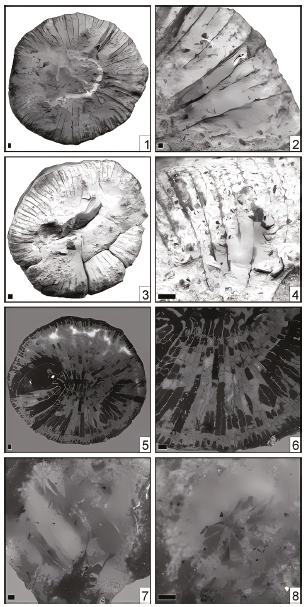
Figure 4 1-2. Rayasmiliidae indet. coahuilensis (Wells, 1946), Holotype of
Montlivaltia coahuilensis, (UMMP 23340). 1, coral
surface. 2, coral surface, detail.
3-4. Montlivaltia
icaunensis
Orbigny, 1850, Syntype of
Montlivaltia burckhardti, (UMMP 23342). 3, coral
surface. 4, coral surface, with details of the
microstructure.
5-6. Montlivaltia subturbinata
Beauvais and M'Rabet, 1977, (UMMP
23345). 5, transversal thin section. 6, transversal thin section,
detail.
7-8. Stylina bucheti de Fromentel, 1856, (UMMP 23347). 7,
transversal thin section. 8, transversal thin section, detail. Scale bar
1 mm.
Synonymy:
*v 1946 Montlivaltia coahuilensis Wells, p. 4, pl. 1, fig. 5, pl. 2, figs. 4-6.
Material: UMMP 23340.
Dimensions: (23340).
c 36.4 × 38.3
septa 100
Description: Solitary cupolate coral. Septa thin, compact, not connected to each other, in a subregular radial symmetry. Septal generations differ by length and thickness. No synapticulae. Endotheca probably by dissepiments. Wall absent. Columella unknown.
Remarks: The holotype is a complete specimen, without any polished surface or thin section. The septa are thin and show very little ornamentation. The specimen does, therefore, not belong to Montlivaltia. The differing thickness of septa is a clear indication of a position in the Rayasmiliidae. Its systematic position cannot be precisely defined without having information about the fine skeletal structure.
Occurrence: Mexico, Coahuila, Los Vagos, Potrero de Oballos (lower Hauterivian).
| Superfamily Montlivaltioidea
Felix,
1900 |
Remarks: For the morphology of the superfamily refer to Löser et al. (2023).
| Family Montlivaltiidae Felix,
1900 |
Description: The ornamentation of septal lateral faces is more pronounced in this family. Generally no columella.
| Genus
Montlivaltia
Lamouroux,
1821 |
Type species: Montlivaltia caryophyllata Lamouroux, 1821.
Description: Solitary turbinate to cylindrical coral. Without columella.
Remarks: Montlivaltia is a generic name that has been misused for nearly 200 years in been applied to any Mesozoic solitary coral. As a result, the genus currently accounts for a ridiculously high number of species, with an overall count of 384 species (Felix, 1925; Lathuilière, 1989; Löser, 2000; Marchal, 1991); that is, 40 in the Triassic, 238 in the Jurassic, 75 in the Cretaceous, and 40 in the Palaeogene. With so many species, it is impossible to assign any of the present material to any existing species; hence, it became a bad strategy to establish new species for our own material. For example, of the 75 Cretaceous species assigned to the genus, only 24 may belong to Montlivaltia, based on the studied type material. On first inspection, most of the remaining species belong to the similar genus Rayasmilia Löser, 2022, that differs completely in its septal microstructure. When comparing the true 24 Cretaceous Montlivaltia species critically against each other, 15 species may remain. The genus became extinct during the Cenomanian (Löser, 2016), so all Palaeogene material needs to be assigned to other genera.
|
Montlivaltia
icaunensis
Orbigny,
1850 Figure 4: 3-4 |
Synonymy:
*v 1850 Montlivaltia icaunensis Orbigny, (2), p. 90.
v 1863 Montlivaultia icaunensis - Fromentel, p. 315, pl. 42, figs. 2, 2 a-b, pl. 78, figs. 3, 3 a, pl. 81, figs. 1, 1 a, 2, 2 a.
vp 1946 Montlivaltia burckhardti Wells, n.sp. - Wells, p. 5, pl. 2, figs. 7-14.
v 2003 Montlivaltia sp. - Baron-Szabo, Hamedani and Senowbari-Daryan, p. 204, pl. 36, fig. 8, pl. 39, fig. 6.
Material: UMMP 23342.
Dimensions: (23342).
c 25 × 28.4mm
septa 94
Remarks: Wells mentioned several specimens and indicated two cotypes, that probably correspond to syntypes. Syntype 23343 could no longer be found. Measurements and illustration are, therefore, based on syntype 23342. The specimen is poorly preserved and damaged. No polished surface or thin section are available. Nevertheless, the ornamentation of the upper margin of the septal and the outline clearly indicate the typical montlivaltiid microstructure. Montlivaltia burckhardti Wells, 1946 is here considered as a junior synonym of Montlivaltia icaunensis because it presents the same measurements and septal counts.
Occurrence: Mexico, Coahuila, Barril Viejo, Cuatrocienegas, (Lower Hauterivian).
Other occurrences: Kimmeridgian to Hauterivian of the European Boreal (Germany, France), Barremian of the Central Tethys (Bulgaria), upper Aptian to Albian of the Eastern Tethys (Iran).
|
Montlivaltia
subturbinata
Beauvais and M'Rabet,
1977 Figure 4: 5-6 |
Synonymy:
v 1882 Trochosmilia spec. - Toula, p. 30, pl. 2, fig. 19.
vp 1946 Montlivaltia burckhardti Wells, n.sp. - Wells, p. 5, pl. 2, figs. 7-14.
* 1977 Montlivaltia subturbinata Beauvais and M'Rabet, p. 111, pl. 2, fig. 6.
1977 Montlivaltia kairouanensis nov. sp. - Beauvais and M'Rabet, p. 114, pl. 3, fig. 5.
Material: UMMP 23345; 1 thin section.
Dimensions: (23345).
c 30.5 × 33.25
septa 152
Remarks: The specimen was named Montlivaltia burckhardti by Wells but it is not a type specimen.
Occurrence: Mexico, Coahuila, Los Vagos, Potrero de Oballos, (Lower Hauterivian).
Other occurrence: Lower Kimmeridgian of the Western Tethys (Spain), upper Kimmeridgian of the European Boreal (Germany), Kimmeridgian to upper Berriasian of the North Africa (Tunisia), Barremian of the Central Tethys (Bulgaria).
| Superfamily Stylinoidea
Orbigny,
1851 |
Remarks: For the morphology of the superfamily refer to Löser et al. (2023).
| Family Stylinidae Orbigny,
1851 |
Description: Colonial (phaceloid, plocoid) corals. Septal symmetry radial, in varying systems, bilateral in one genus. Lonsdaleoid septa absent. Columella well-developed, styliform or lamellar.
| Genus
Stylina
Lamarck,
1816 |
Type species: Stylina insignis Fromentel, 1861.
Description: Plocoid colony. Corallite outline circular. Symmetry of septa regular radial. Costae non-confluent. Columella styliform. Endotheca consists of thin tabulae. Wall compact, septothecal. Coenosteum broad, consisting of costae and exothecal dissepiments.
|
Stylina
bucheti
Fromentel,
1856 Figure 4: 7-8 |
Synonymy:
* 1856 Stylina bucheti Fromentel, p. 857.
v 1889 Placocoenia Kaulbarsi nov. spec. - Toula, p. 82, pl. 5, fig. 12.
v 1946 Placocoenia n.sp. - Wells, p. 5.
1977 Stylina carthagiensis nov. sp. - Beauvais and M'Rabet, p. 106, text-figs. 1, pl. 1, fig. 1.
v 1998 Stylina pyrenaica Alloiteau 1946/47 - Schöllhorn, p. 77.
Material: UMMP 23347; 1 thin section.
Dimensions: (23347).
clmin 3.3-3.4.
clmax 3.6-4.4.
septa 24
Remarks: The specimen is poorly preserved, even the genus Stylina cannot be clearly confirmed.
Occurrence: Mexico, Durango, Las Cuevas, Cuesta del Carbonera, (Valanginian).
Other occurrence: Tithonian of the Central Tethys (France), Kimmeridgian of the European Boreal (Germany), Berriasian of the North Africa (Tunisia), Aptian of the Central Tethys (Bulgaria, Greece), upper Aptian of the Western Tethys (Spain).
5. Discussion
During the period when the Cretaceous corals were established by Imlay and Wells, the general opinion was that material from a hitherto unknown area must be taxonomically new. Therefore, both scientists established new taxa or - in the case of Wells - referred to taxa that he established independently. Wells and Imlay did not invest much time in comparing their finds to species established in Europe, Africa, or Asia. After comparing the coral specimens to type material from other areas, it turned out that all new species are synonyms or could not be assigned to a genus because of the poor state of preservation and/or the absence of thin sections. One species - Rayasmiliidae indet. coahuilensis Wells 1946 - could remain in use, if it could be assigned to a genus. Table 1 gives an overview of the revised collection material.
Table 1 The coral specimens from the Museum of Paleontology of the University of Michigan in Ann Arbor with their revised taxonomy. Bold names in the second column refer to the type status.
| Specimen UM |
Published as | Figured | Type status |
Here assigned to |
|---|---|---|---|---|
| 15786 | Wells (1946): Isastrea whitneyi Wells 1932 - p. 3, pi. 2: 1-3 | pi. 2: 2 | Thalamocaeniopsis neocomiensis | |
| 15969 | Wells (1946): Astrocoenia kellumi Welh, n. sp. - p. 2, pl. 1: 1 | pl. 1: 1 | holotype | Stelidioseris icaunensis |
| 15993 | Wells (1946): Stephanocoenia guadalupe minor Wells, n.var. - p. 3, pl. 1: 2-4 | pl. 1: 4 | Eocolumastrea octaviae | |
| 19345 | Imlay (1940): Astrocoenia hispaniensis Imlay, n.sp.p. 138, pi. 1:21,22 | pi. 1:21,22 | holotype | Holocoenia micrantha |
| 22150 | Wells (1942b): Thamnasteria imlayi Wells, n. sp. -p. 127, pi. 21: 1-3 | pi. 21: 1,2 | holotype | (unassigned) |
| 22156 | Wells (1942b): Stylina arkansasensis Wells, n. sp. - p. 128, pi. 21: 4 | pi. 21: 4 | holotype | (unassigned) |
| 23339 | Wells (1946): Stephanocoenia guadalupe minor Wells, n.var. - p. 3, pl. 1: 2-4 | pi. 1:2,3 | holotype | Eocolumastrea octaviae |
| 23340 | Wells (1946): Montlivaltia coahuilensis Wells, n.sp. - p. 4, pl. 1: 5, pi. 2: 4-6 | pi. 2: 4, 5 | holotype | Rayasmiliidae indet. coahuilensis Wells 1946 |
| 23341 | Wells (1946): Montlivaltia coahuilensis Wells, n.sp. - p. 4,pl. 1: 5,pl. 2: 4-6 | pl. 1: 5 | (unassigned) | |
| 23342 | Wells (1946): Montlivaltia burckhardti Wells, n.sp. - p. 5, pi. 2: 7-14 | pi. 2: 7, 8 | syntype | Montlivaltia icaunensis |
| 23343 | Wells (1946): Montlivaltia burckhardti Wells, n.sp. - p. 5, pi. 2: 7-14 | pi. 2: 13, 14 | syntype | (not available) |
| 23344 | Wells (1946): Montlivaltia burckhardti Wells, n.sp. - p. 5,pl. 2: 7-14 | pi. 2: 11 | (unassigned) | |
| 23345 | Wells (1946): Montlivaltia burckhardti Wells, n.sp. - p. 5,pl. 2: 7-14 | pi. 2: 10 | Montlivaltia subturbinata | |
| 23346#1 | Wells (1946): Montlivaltia burckhardti Wells, n.sp. - p. 5,pl. 2: 7-14 | pi. 2: 14 | Trochophyllia communis | |
| 23346#2 | Wells (1946): Montlivaltia burckhardti Wells, n.sp. - p. 5,pl. 2: 7-14 | (unassigned) | ||
| 23347 | Wells (1946): Placocoenia n.sp. p. 5 | Stylina bucheti | ||
| 23348 | Wells (1946): Axosmilia mexicana Wells, n.sp. -p. 6,pl. 1:6-11 | pl. 1: 8, 9 | holotype | Trochophyllia communis |
| 23349 | Wells (1946): Axosmilia mexicana Wells, n.sp. p. 6,pl. 1:6-11 | paratype | Rayasmiliafromenteli | |
| 23350#1 | Wells (1946): Axosmilia mexicana Wells, n.sp. - p. 6, pi. 1: 6-11 | Trochophyllia sp. | ||
| 23350#2 | Wells (1946): Axosmilia mexicana Wells, n.sp. - p. 6, pi. 1: 6-11 | pl. 1: 10, 11 | Rayasmilia bangoinensis |
The number of species is too low to be able to discuss their palaeobiogeographic relationships. The Valanginian to Hauterivian corals have most joint species with the Barremian to Aptian faunas from the northern margin of the Rhodopes, which corresponds to Bulgaria and Serbia, and also corresponds to the Kimmeridgian of the Northern Tethys (Upper Jurassic of Southern Germany) and the Berriasian to Hauterivian of the epicontinental seas of the NW margin of the African continent (Algeria, Tunisia). The found species have a distribution from the middle Oxfordian to Cenomanian (Figure 5), showing more relationships to Hauterivian to Albian faunas. This is due the rarity of Berriasian to Valanginian faunas. The Berriasian and Valanginian was a time span of a global sea-level fall resulting in regressions and the following erosion, which limited the conservation of shallow marine Berriasian and Valanginian faunas (see also Löser et al. (2021) for discussion).
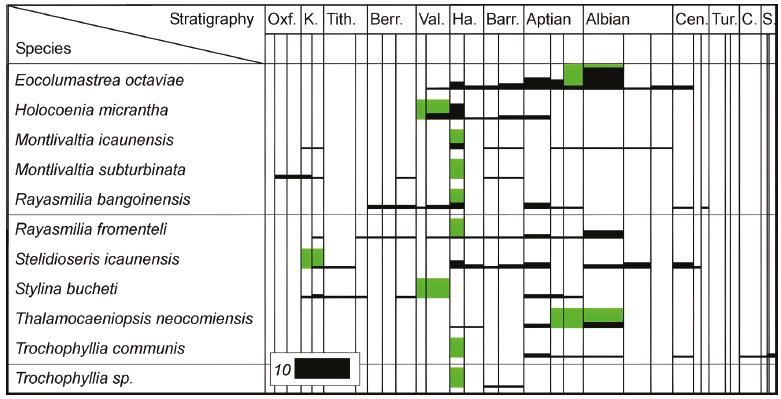
Figure 5 Summarised distribution of species in localities outside of the study area. The thickness of bars corresponds to the number of localities where the species was found. The green bars mark the age of the investigated corals.
Contribution of the author
The author has done all work alone.
Funding
The study has not receive any funding except the yearly assignment of the Universidad Nacional Autónoma de México.
Conflict of interests
It does not exist any conflict of interests.
Handling editor
Francisco J. Vega.

