




 nueva página del texto (beta)
 Inglés (pdf)
 Artículo en XML
 Referencias del artículo
 Traducción automática
 Enviar artículo por email
 Citado por SciELO
  Similares en
SciELO
Similares en
SciELO 
 Permalink
INTRODUCTION
Peritidal carbonate deposits record shallow marine fluctuations on supratidal, intertidal and subtidal facies that are abundant and ubiquitous through the fossil record worldwide (Wright, 1984), but especially abundant during the Cretaceous (Joachimski, 1994; Ferreri et al., 2004; Strasser, 2007; D´ Argenio et al., 2008; Sena, 2014). Along the Sierra Madre Oriental in northeastern Mexico, the Cupido Formation stands out as the most prominent example of peritidal carbonates, covering vast areas in the states of Nuevo Leon, Coahuila, Zacatecas and Durango. If not eroded, the Cupido Formation crowns the uppermost part of northern anticlines from the Sierra Madre Oriental (Padilla y Sánchez, 1985). The Lower Cretaceous Cupido Formation was deposited as a low-amplitude carbonate platform that repeatedly exposed peritidal carbonates (Conklin and Moore, 1977; Wilson and Pialli, 1977; Lehmann et al., 1998, Lehmann et al., 2000). This unit started its accumulation over the Taraises Formation during the Hauterivian (Zwanzinger, 1978; Goldhammer and Johnson, 2001; Humphrey and Díaz, 2003; Murillo-Muñetón and Dorobek, 2003; Ángeles-Villeda et al., 2005) and its deposition continued throughout the Barremian (Lehmann et al., 1998; Wilson, 1999). The upper limit of the Cupido Formation is marked by the contact with the Aptian La Peña Formation, whose type locality is situated at the Mimbre canyon in Parras de la Fuente, Coahuila (Imlay, 1937).
Informally known as the Cupido Limestone in the first descriptions, the Cupido Formation was originally reported as a non-fossiliferous unit (Imlay, 1937), but years later it was recognized and described by Humphrey (1949) as a formation, in Sierra de Los Muertos, Nuevo Leon, and as a fossil-poor deposit (Figure 1). After thirty years the Cupido Formation became acepted as the Cupido Reef (Zwanzinger, 1978). At present, the Cupido Formation is widely known as a fossiliferous unit, that has been interpreted as a patch reef complex platform (Conklin and Moore, 1977; Wilson and Pialli, 1977). The Cupido Formation represents part of an extensive carbonate platform system (Murillo-Muñetón and Dorobek, 2003), that originated as an extensive coastal lagoon with peritidal cyclic carbonates between the Coahuila Block basement and a patch reef belt and a barrier shoal margin (Conklin and Moore, 1977; Wilson and Pialli, 1977; Selvius and Wilson, 1985; Goldhammer et al., 1991; Lehmann et al., 1998). Eventually, the Cupido Formation developed as a reef-rimed carbonate platform composed of corals, stromatoporoids, sponges, rudists, dasycladacean algae and benthic foraminifera (Wilson, 1999). The development of the Cupido Formation occurred in the interior platform and probably was controlled by Milankovitch-driven climatic changes (Lehmann et al., 1998). Most authors consider that the Cupido Carbonate System (including the inner and margin platform, and open marine facies) developed as prograding cycles, ranging from the Late Hauterivian through the Aptian (Humphrey and Díaz, 2003; Zwanziger, 1978; Michalzik, 1988; Guzmán-García, 1991; McFarlan and Menes, 1991; Goldhammer, 1999; Hernández-Trejo, 2003; Murillo-Muñetón and Dorobek, 2003; Eguiluz de Antuñano, 2011). This age has also been confirmed by the presence of Nannoconus bermudez Bronimann, Nannoconus steinmann Keampther and Nannoconus elongatus Bronnimann (Padilla y Sánchez, 1978). The Cupido Formation shows a great variation in thickness (Wilson and Pialli, 1977), including variations of more than 500 m (Conklin and Moore, 1977), between 230 to 800 m in thickness (Tardy, 1973) or even larger variations (Torres de la Cruz et al., 2018).
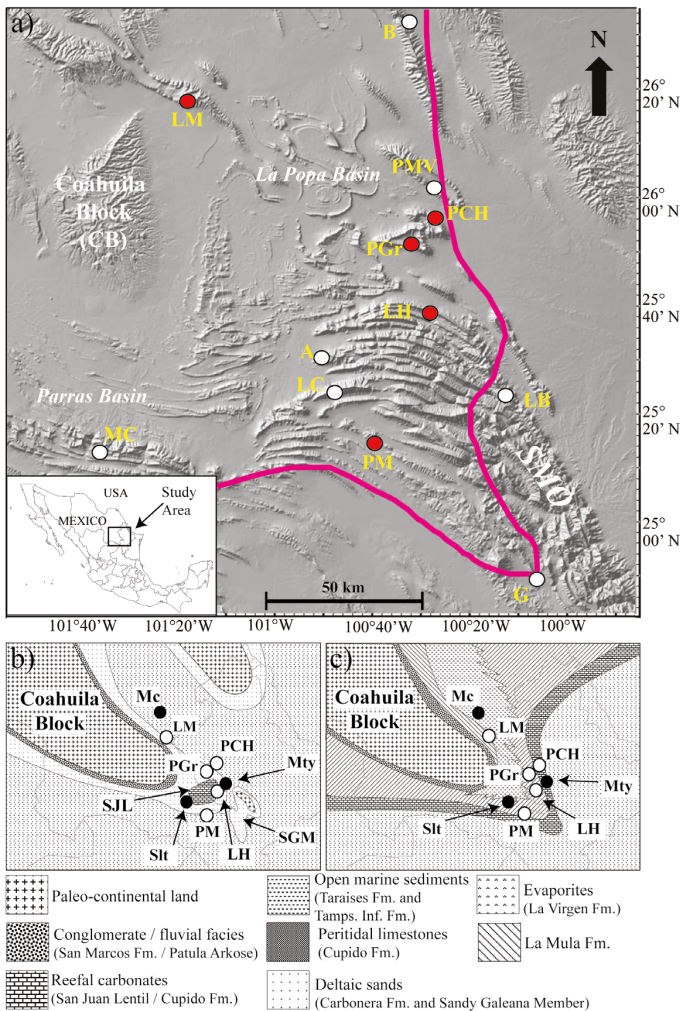
Figure 1 (a) Regional map showing representative outcrops of the Cupido Formation (white bullets), and analyzed outcrops in this work (red bullets). Sierra de Arteaga (A), Galeana (G), Potrero de García (PGr), Puerto México (PM), La Muralla (LM), Potrero Chico (PCH), Potrero Minas Viejas (PMV), Bustamante (B), La Boca (LB), Los Chorros (LC), La Huasteca (LH), and the Mimbre Canyon (MC). Disposition of the Cretaceous platform edge is represented by the pink line (After Wilson, 1999). (b-c) Paleogeographic non-palinspatic reconstruction of the Cupido Formation with localities of the study area with white bullets. (b) Upper Jurassic-Lower Cretaceous and (c) Barremian-lower Aptian. (Mc) Monclova; Monterrey (Mty); Saltillo (Slt); Sandy Galeana Member (SGM); San Juan Lentil (SJL); (Modified after Eguiluz de Antuñano, 1990; Lehmann et al., 1998; Goldhammer and Johnson, 2001; Ocampo-Díaz et al., 2008). Acronyms of localities will be used in the following figures.
The lower part of the Cupido Formation consists of medium dark-grey shale-limestones with stylolites and fractures filled by calcite. The medium part consists of medium to coarse gray mudstone-wackestones intercalated by thin shale layers with sporadic black chert lenses and iron nodules. In contrast, the upper part of the Cupido Formation is characterized by shallow thin-bedded peritidal and subtidal deposits from inner and middle shelf-deposits including laminated mudstones alternating with bioturbation horizons and burrowed skeletal packstones. Precisely within this unit, informally known as Cupidito, it is possible to observe an erosive surface that has produced solution collapse breccias (Conklin and Moore, 1977; Wilson and Pialli, 1977).
Though Cupidito is a well-represented unit in northern Mexico (Conklin and Moore, 1977; Fischer and Jackson, 1999; Lehmann et al., 1999), a long-standing debate exists over whether Cupidito should be interpreted as an informal unit, as a stratigraphic stage, as a hiatus in deposition, or merely as a sedimentary breccia (Figure 1). Over the years the study of the Cupido Formation and the recognition of Cupidito unit (Table 1) has been informally accepted in all field-campaigns (fieldwork) and regional reports (Amsbury, 2000; Lehmann et al., 2000; Torres de la Cruz, 2011; Torres de la Cruz, 2014; Gómez-Mancha, 2016).
Table 1 Previous works on the age of the Cupido Formation.
| Locality | Bottom | Top | Based on | Reference |
|---|---|---|---|---|
| Mimbre canyon (Coahuila) | upper Hauterivian | Barremian | Stratigraphic position. | Imlay, 1937 |
| Northeast Mexico | Hauterivian | lower Aptian | Stratigraphic position. | Conklin and Moore, 1977 |
| Saltillo area | Barremian | lower Aptian | Chofatella, Pseudocyclatnmina. | Wilson and Pialli, 1977 |
| Vaquerias 2 well bore (Burgos basin) | *** | Barremian to lower Aptian | Nannoconus truitti, N. minutus, N. steinmanni, N. elongatus, N. kamptneri, N. wassalli, N. colomi, Globochaete alpina and Microcalamoides diversus. | Cantú-Chapa, 1989 |
| La Pachona mine (Nuevo León) | *** | lower Aptian | Procheloniceras. | Humphrey and Díaz, 2003 |
| Sierra de Parras | *** | upper Barremian to lower Aptian | Saynoceras mexicanum, Parancyloceras sp., Ancyloceras sp. and Hemierioceras sp. | Humphrey and Díaz, 2003 |
| Symon (Durango) | lower Barremian | *** | Pulchellia and Pseudohaploceras. | Humphrey and Díaz, 2003 |
| Bustamante canyon (Nuevo León) | Hauterivian | *** | Association of Vercosella winteri and Salpingoporella cf. annulata. | Murillo-Muñetón and Dorobek, 2003 |
| La Boca canyon (Nuevo León) | upper Hauterivian | lower Aptian | Conorotalites, Coskinolenoides and Caucasella hauterivica. | Ángeles-Villeda et al., 2005 |
| Sierra del Rosario (Durango) | *** | lower Aptian | Chofatella decipiens, Debarina sp., Glomospira sp., Nezzazatinae, textularids, Eggerella sp., Palorbitolina cf. lenticularis, miliolids. | Barragán-Manzo and Díaz-Otero, 2004 |
| Francisco Zarco dam (Durango) | *** | lower Aptian | Palorbitolina cf. lenticularis. | Núñez-Useche et al., 2012 |
| Puerto Mexico (Nuevo León) | *** | lower Aptian-upper Aptian | Toucasia, Pseudotoucasia, Amphitriscoellus, Offneria, Douvillelia. | Torres de la Cruz et al., 2018 |
This work aims to document the Cupidito stratigraphical relationships, lithofacies, microfacies and geochemical characteristics useful for paleogeographic reconstructions within the regional context. Besides, since the Cupidito unit precedes the drowning of the Cupido platform, a detailed characterization is essential. Finally, this facial characterization will add new elements to assess the oil potential of the Cupido Formation, substantiated by the potential results derived from the Totonaca-1 wellbore near to Nuevo Laredo, Mexico (Echanove, 1986).
GEOTECTONIC BACKGROUND
The complete opening of the Gulf of Mexico was marked by rifting and drifting processes during the Jurassic (Goldhammer et al., 1991), and by the closure of the northeastern passive margin at a later cooling stage (Goldhammer et al., 1991; Goldhammer and Johnson, 2001). New accommodation space became available and eventually was occupied by seawater and evaporites from the Minas Viejas Formation. These evaporitic deposits were formed during the same episode and also generated the salt deposits of Louann in Texas and the Campeche Salt Basin (Pindell, 1985). At the same time, these deposits evidence the first Jurassic marine incursion in this region (Kroeger and Stinnesbeck, 2003). Massive limestones from the Zuloaga Formation developed under shallow epicontinental seas, presumably less than 100 m deep (Pessagno and Martin, 2003). The Zuloaga Formation has been considered as a homoclinal carbonate ramp (Eguiluz de Antuñano et al., 2000) covered by La Casita Formation (Upper Jurassic) and derived from a major siliciclastic sedimentary influx, mainly from the Coahuila Block source area (Fortunato and Ward, 1982). Except for the Coahuila Block, most of the structural highs remained underwater during the Upper Jurassic-Lower Cretaceous times (Goldhammer, 1999). During the Barremian and Albian, carbonate platforms (Figure 1) reached their maximal extension around the coast of the Gulf of Mexico (Zwanziger, 1978; Wilson y Ward, 1993; Lehmann et al., 1998; Wilson, 1999) and accumulated a thickness of approximately 2000 m; for instance, in the Cupido and Aurora formations. The Tethys aperture inside the proto-Gulf of Mexico during the Cretaceous also influenced changes in the sea level, causing a shift in the coastline toward the north during the Barremian and lower Aptian (Chávez-Cabello et al., 2005). The Coahuila Block remained as an island where the Cupido Formation eventually deposited as a prograding carbonate platform with frontal reefs to the east (Nuñez-Useche et al., 2014). From the Berriasian throughout the Upper Hauterivian, fluvial and clastic sediments from San Marcos and La Mula formations, respectively, covered the northeastern continental margin of the Coahuila Block. Similar deposits also filled the southern edge of the Burro Peyotes Island (Jones et al., 1984; Goldhammer and Johnson, 2001). The eastern front of the Coahuila Block, the Carbonera and La Casita formations integrated into a deltaic system known as Saltillo Delta, which extended from the Coahuila Block to Saltillo-Monterrey (Ocampo-Díaz, 2011). A coral-rich carbonate lentil (San Juan Lentil) developed over a high relief inherited from this deltaic system at the lower part of the Taraises Formation (Zell et al., 2016). This lentil reflects a transgression, probably induced by oligotrophic conditions and the lack of a continuous sediment supply from the Coahuila Block. At the same time, the Sandy Galeana Member of the Taraises Formation developed with a depocenter in Galeana (Ocampo-Díaz et al., 2008); both deltaic systems line up in a NW-SE orientation. The Cupido sequence was deposited over the homocline ramp of the Taraises Formation (Murillo-Muñetón and Dorobek, 2003). The fluvial-siliciclastic-carbonate succession deposited from the Berriasian to the Hauterivian was covered by a Transgressive System Tract, marked by the upper Taraises Formation (Eguiluz de Antuñano, 1990); this Maximum Flooding Surface was also acknowledged by Lehmann et al. (2000), precisely where the Cupido Formation originated. The Tamaulipas Inferior Formation developed simultaneously with the Cupido Formation deposition along neritic and infra-neritic environments away from the coast (Humphrey and Díaz, 2003).
While a consensus exists for the upper age of the Cupido Formation, its basal age limit shows variations and remains poorly defined and highly depends on the regional geology (Table 1). In the type locality, Sierra de Parras, the basal age for Cupido has been assigned to Late Hauterivian (Imlay, 1937; Humphrey and Díaz, 2003). In Bustamante canyon, Murillo-Muñetón and Dorobek (2003) assigned an Upper Hauterivian to Barremian as the most probable age for the base of Cupido. According to the stratigraphic record of Conorotalites, Coskinolenoides and Caucasella hauterivica, a Late Hauterivian age was assigned for lower Cupido in La Boca canyon (Ángeles-Villeda et al., 2005). Based on the occurrence of the benthic foraminifera Choffatella decipiens, the Cupido Formation corresponds to the Barremian (Wilson, 1999). In the area of Saltillo, Wilson and Pialli (1977) added Choffatella as a stratigraphic marker from the early Cupido Formation as well as in Arteaga canyon, where these foraminifera were reported from the Lower Acatita Formation and the upper Las Uvas Formation of the Coahuila Block (Lehmann et al., 1999); both formations correlate laterally with Cupido/Cupidito and La Peña Formation. Choffatella decipiens was reported at the top of Cupido Formation in Sierra del Rosario in Durango (Barragan-Manzo and Díaz-Otero, 2004); however, this work did not include neither the mid nor the lower part of Cupido Formation. Choffatella decipiens was also reported from La Virgen Formation in Potrero de Menchaca, in the northeastern Coahuila Block (Gutiérrez-Alejandro et al., 2017). Choffatella decipiens is a worldwide foraminifera species that dates back to the Barremian, although some suggest a Hauterivian age (González-Fernández et al., 2014; Guerrero-Moreno, 2018).
METHODS
This study reports seven localities distributed in Nuevo Leon (NL) (numbered with their acronym to simplify regional names, as indicated in Figure 1a). Petrographic analyses included 165 samples; observations were made under a Nikon Microscope with conventional transmitted polarized light. The petrographic analysis was based on the classification guidelines given by Dunham (1962). Samples for stable isotopes (δ 18 O and δ 13 C) were analyzed at the Analytical Laboratory for Paleoclimate Studies (ALPS) in the Jackson School of Geosciences, University of Texas at Austin. Samples were acidified under vacuum at 70 ºC with 100% phosphoric acid. Distilled CO2 was analyzed on a Thermo MAT253 with Kiel IV carbonate preparation device followed by CO2 determination. Isotopic measurements were calibrated using the reference NBS19 and an internal marble standard (ESTREMOZ) with average values for δ 18 O = −5.95 ‰ and for δ 13 C = 1.63 according to Ostermann and Goodkin (2012), with analytical errors for δ 18 O ± 0.08 ‰ and for δ 13 C ± 0.04 ‰.
The resulting δ13C and δ18O values were plotted in a comparative diagram following the data compiled by Hudson (1977), Nelson and Smith (1996) and Moldovanyi and Lohmann (1984). In order to obtain paleotemperature values comparable to similar works reported in literature, Equation 1 from Erez and Luz (1983) and Equation 2 from Anderson and Arthur (1983) were applied in 12 samples. According to Moldovanyi and Lohmann (1984), proposed isotopic studies of the Cupido Formation and in its corresponding formation in Texas (the Sligo Formation) the introduction of a correction factor is needed for paleotemperature estimations. Therefore, our estimations included a -2.0 ‰ (denoted as δw), as the required correction factor from the above equations, that was applied to the δ18O values derived from the Cupido Formation, since this variable changes depending on the age and carbonate type analyzed (Moldovanyi and Lohmann, 1984). Finally, the isotopic values derived from this work were compared with other peritidal carbonates from Cretaceous platforms reported elsewhere in the literature.
For temperature determination, the following equations were used:
Where t (°C) is the estimated temperature, and δ18Oc and δ18Ow are the oxygen isotopic compositions of the carbonate and seawater, respectively; δc is the sample value of δ18O and δw is the δ18O value of ambient seawater. For petrographic analysis, thin sections were prepared and classified following Dunham’s classification (Dunham 1962), and Folk´s classification (1959, 1962) when necessary.
RESULTS
The most representative outcrops of Cupido (Figure 1a) occur in La Huasteca (LH) and in Potrero de García (PGr), where they are accessible, show well-defined lower and upper limits, and most facies occur within a well-exposed continuum. An ideal stratigraphic column from the Cupido Formation (Figure 2) integrates the following localities: La Huasteca (LH), Potrero Chico (PCH), Potrero de García (PGr), and Puerto Mexico (PM). The facies of the Cupido Formation includes mudstones with microfossils (mainly calcareous algae, miliolids and textularids foraminifera) and reef carbonates with packestone-grainstone rudist shells, gastropods, stromatoporoids, and dasycladaceans interbedded with bioturbation horizons alternating with stratiform microbial mats. The basal and middle sections of Cupido contrast in thickness, frequency and microfacies with the upper section, the Cupidito unit.

Figure 2 Idealized stratigraphic column and major macro and microscopic characteristics from the following Cupido Formation oucrops: LH, PCH, PGr, PM and LM. (a) Limestone from the Tamaulipas Superior Formation at LM. (b) Microcalamoides (Applinocrinus) of the Tamaulipas Superior Formation at LH (sample TSLH-01). (c) Domal stromatolites at the upper Cupido Formation in PGr. (d) Alternation between micritic (dark) and microsparitic (light) stromatolitic lamination and evaporitic crystals at PGr (CPG-14). (e) Solution breccia at the base of the Cupidito Member in LH. (f) Lithoclasts on a cripstocrystalline matrix LH (FSB-03). (g) Chondrodonta shells at PCH. (h) Microstructure of a Chondrodonta shell fragment, at PCH (PCH-04). (i) Bioturbation in PM. (j) Microfossils infilling burrows at LH (FSCP06). (k) Rudists and shell fragments on a granular matrix (calcarenite) at PCH. (l) Intraclasts with miliolids on a sparitic cement (PCH-E). (m) Stromatoporoids on the basal reef body of LH. (n) Packstone with shell fragments in a chemically-compacted fabric from the lower reef facies at LH (FSCP-01). (o) Marlstone with pencil cleavage in the Taraises Formation at LH. (p) Echinoid spine on a mudstone from the Taraises Formation at LH (TALH-02).
The basal and middle section of Cupido
The 580 m-longitudinal section in LH comprises three major lithofacies that, from the base (number 1 in Figure 3) to the top (number 2 in Figure 3), include the Taraises-Cupido contact throughout the upper contact with the La Peña Formation (Figure 3). The basal 60 m-section occurs as massive competent dark (dolomitized) to light grey reef limestones; the LH and PGr localities expose a concordant transition between the lower limit of the Cupido and the Taraises formations, where marls, with pencil or acicular cleavage, and argillaceous limestones dominate; this gradual transition from Taraises to Cupido is visible at the microtextural level too (Figure 4a). A prominent breccia containing rock fragments with rudists is exposed in the Cupido basal strata from PCH (Figure 4b), in association with clearly recrystallized deformed fragments generated by ductile deformation (Figure 4c) and with dolomitic crystals (Figure 4d). Reef facies are common in this basal breccia; for instance, in PGr, the breccia is covered by ~100 m-thick-massive rudstone-limestones with miliolids and green algae (Figures 4e-4f). In LH, the basal reef facies are characterized by a massive rudist-stromatoporoid complex (Figures 4g-4h).

Figure 3 Panoramic view of the most representative Cupido Formation outcrop in northeastern Mexico: the south limb of Los Muertos anticline in the LH, Nuevo León (Arrow points to a person as scale). The curly bracket signals the bottom of Cupido (1) and the sequence to the top at the contact with La Peña (2). The dotted line frames the basal collapse breccia (bcb), and upper collapse breccia (ucb) of the Cupidito unit.
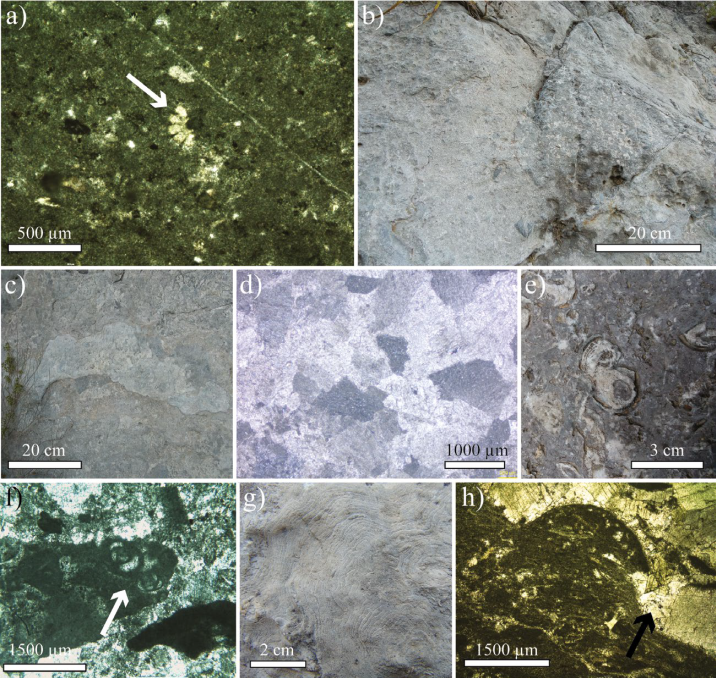
Figure 4 Basal facies of the Cupido Formation. (a) Fragment of an echinoid spine from the Taraises Formation (arrow). (b) Limestone clast with abundant rudists. (c) Ductile deformation on a limestone fragment. (d) Micrograph of well-packed dolomite on the basal breccia at PCH. (e) Toucasia shells from reef facies at PCH. (f) Intraclast with benthic foraminifera (arrow) at the upper part of the PCH reef facies. (g) Detail of Stromatoporoid from the LH lower reef facies. (h) Microphotography of a recrystallized rudist shell (arrow) within a chaotic wackestone matrix.
The basal section of Cupido is followed by a mid-section of peritidal carbonates, which is the thickest section of the Cupido Formation, as evidenced in Figure 3. Approximately 420 m of peritidal carbonates, composed of cyclically-arranged horizons with light to dark gray-medium-bedded bioturbation, alternate with stratiform algal mats (Figures 5a-5d); massive and competent gray dolomitic beds are frequent. This succession consists of wackestones, packestones and grainstones of miliolids, pellets and calcareous green algae remains as burrows infill (Figures 5e-5f). The mid-section ends abruptly with slope breccias followed by thin successive reef limestones that mark a sedimentary package known as the Cupidito unit.
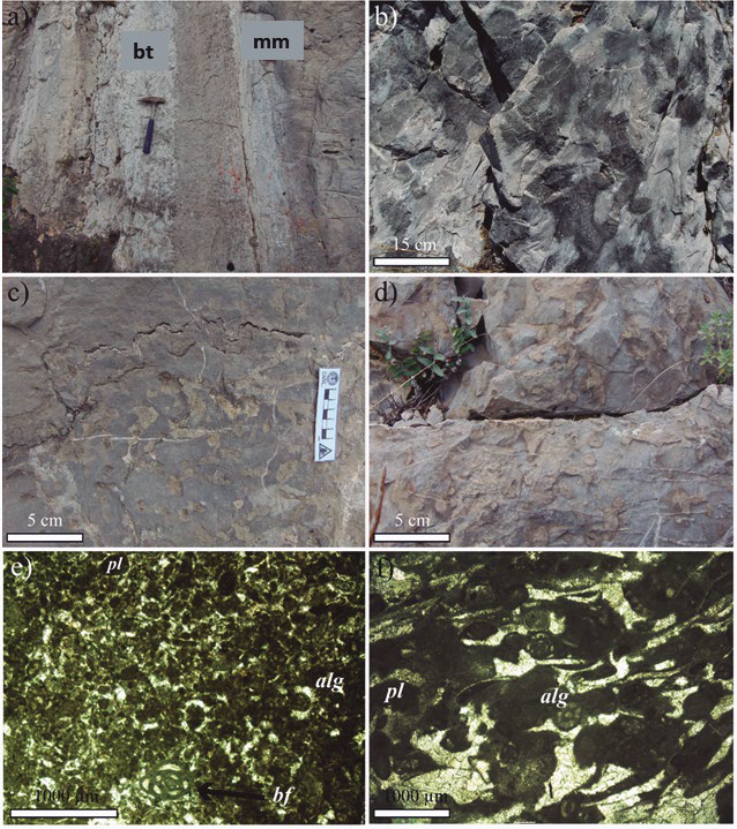
Figure 5 Middle section of Cupido. (a) Alternating facies of stratiform microbial mats (mm) and bioturbation horizons (bt) in LH. (b) Upward size increase of burrows in LH. (c) Coarse infill inside burrows in LC. (d) The shape and size burrows change along the stratigraphic column, PM. (e - f) Grainstone of miliolids, pelloids and calcareous green algae; (bf) benthic foraminifera; (pl) pelloid; (alg) green algae.
The Cupidito unit
The uppermost 120 m of the Cupido Formation are framed by collapse breccias that mark the so-called Cupidito unit (Figures 6a-6c); these breccias are characteristically composed of recrystallized fragments of the Chondrodonta clam and minor minerals such as hematite, glauconite and clays (Figures 6d-6f). The Cupidito unit is a sedimentary package composed of medium-to-thin-bedded horizons of bioturbation alternating with light-coloured-stratiform mats that grade into domal and parabolic stromatolites (Figures 7a, 7c, 7e and 7i). The presence of stromatolites with complex morphologies in Cupidito contrast with the basal and middle sections of Cupido. The mat microstructure is dominated by irregular and wrinkle lamination, either with smooth or granular textures (Figure 7b); dark laminations are thinner and more variable than light laminations; large fenestrae may develop vugular porosity filled with sparitic cements (Figure 7d). The most characteristic facies are relatively thin-mats and bioturbation cycles at the exposed localities of Cupidito in northeastern Mexico (Figures 7f-7g). The bioturbated horizons are mainly identified as firmgrounds with burrows networks (Figures 7i-7j), whose internal infill consists of pellets, miliolids and calcareous green algae within a sparitic matrix (Figures 6f). Chert nodules are well-developed in Cupidito (Figure 7f). These distinctive cyclic horizons extend from 400 to 600 m up to La Peña Formation. In some localities these peritidal carbonates may be truncated by 2-3 m-thick evaporitic horizons, while in other localities Cupidito may be represented by more than one collapse breccia.
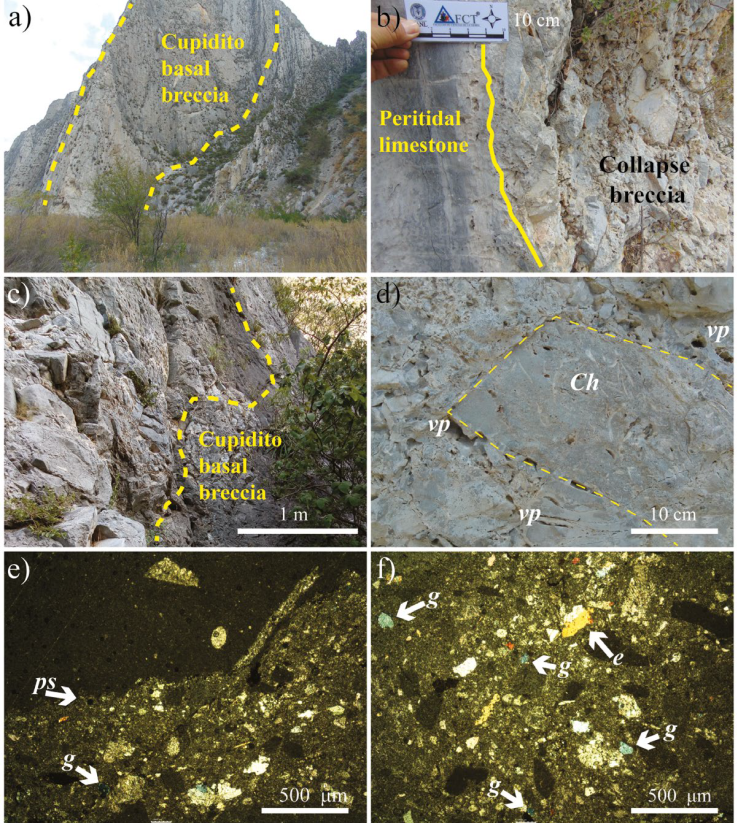
Figure 6 The Cupidito unit. (a) The erosive Sequence Boundary occurs as an irregular dashed line. (b) Basal collapse breccia in LH. (c) Basal breccia in LM. (d) Limestone fragments (yellow dashed line) with abundant Chondrodonta bivalves (Ch), and vugular porosity (vp) in LH. (e and f) Petrographic thin-sections of the basal collapse breccia and irregular grains of hematite, glauconite, clay minerals and some evaporitic crystals in LH. (ps) pressure-solution; (g) glauconite; (e) evaporate crystals.
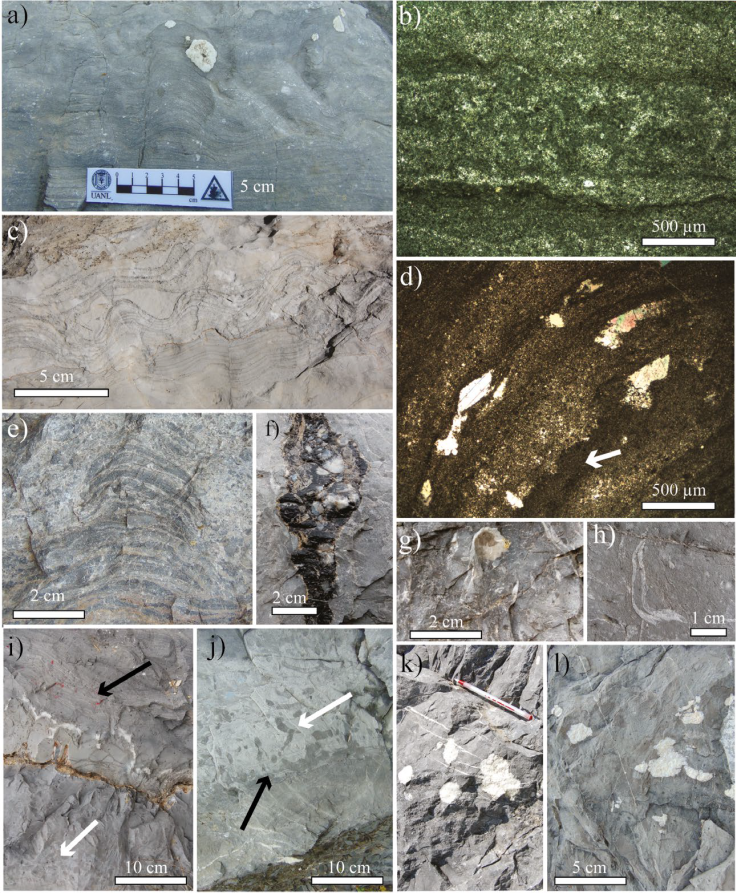
Figure 7 Cupidito Diagnostic Facies. (a, c and e) Domal stromatolites with a higher convexity trend. (b) Fenestral microbial laminated fabric. (d) Lamination couplets with a narrow dark laminae (small arrow) followed by a fenestrated thicker-light laminae. (e) Gently-convex lamination with elongate fenestrae and vugular porosity. (f) Cherty nodules in uppermost Cupidito (PCH and LM). (g-h) Chondrodonta in PM and LM localities. (i-j) Cyclical bioturbation horizons (white arrow) alternating with stratiform microbial mats (black arrow). (k-l) Calcite nodules in Cupido and Cupidito.
Pre-drowning deposits
Despite the lithological contrast between Cupido and La Peña formations, the documentation of the Cupido drowning sequence has been especially complicated because of their geomorphology and restricted access. The use of satellite images was a valuable tool to identify the contact between Cupido and La Peña (Figures 8a-8c). While Cupido tends to form high and steep escarpments (Figure 8c), the erosion of La Peña Formation produces saddle-sediments that remain hidden; this topography severely limits sampling. Instead, the observation of vegetation differences among geological formations is practical and confident to some extend; the vegetal coverage in Cupido clearly differs from the abundant leafy trees oriented in parallel to the bedding of the La Peña Formation. Furthermore, the occurrence of Microcalamoides is an indirect indication of the transition to the Tamaulipas Superior Formation, and therefore is a useful mark especially when the La Peña Formation is not exposed.
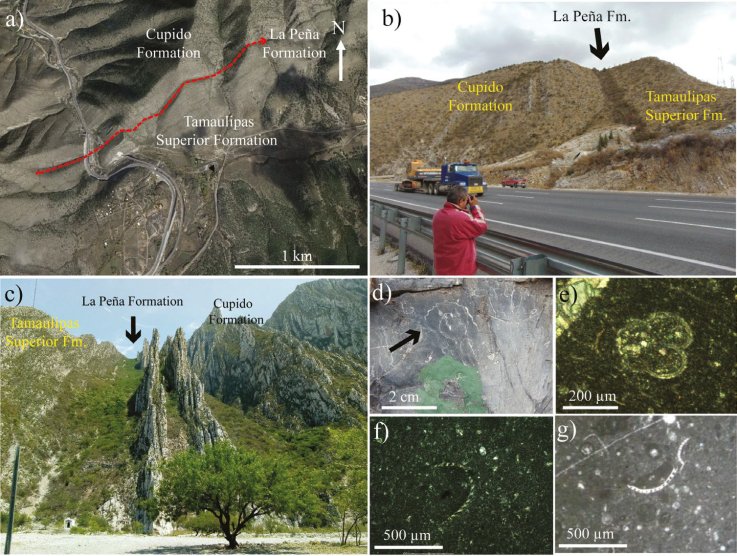
Figure 8 La Peña and Tamaulipas Superior formations. (a) Satellite view of the south flank of LC in red arrow, the La Peña Formation. (b) Panoramic view of the vegetation dividing line among La Peña (black arrow), Cupido and the Tamaulipas Superior formations at LC. (c) A saddle mountain uplift of La Peña Formation in LH. (d) Preserved ammonite, (e) Foraminifera in LC. (f, g) Microcalamoides sp. from the Tamaulipas Superior Formation in LH and PGr.
Carbon and Oxygen Isotopes
The isotopic values and estimated paleotemperatures obtained from the PM, LH, and PGr localities are shown in Table 2. The isotopic values are similar among localities, with a higher variation in δ13C than in δ18O. The estimated paleotemperature renders a range between 23.8 and 48.3 °C (Figure 9), after the applied equations described in the Methods chapter.
Table 2 Carbon and oxygen isotopic values and temperatures estimated for Puerto Mexico (PM), La Huasteca (LH) and Potrero de García (PGr).
| Sample |
|
|
|
|
|---|---|---|---|---|
| Puerto Mexico | ||||
| PM-Cp-str1 | Stromatolitic travertine | -6.79 | -7.52 | - |
| PM-1C-str | Stromatolitic travertine | -7.92 | -7.23 | - |
| 6-CP-PM-02 | Coral | 0.43 | -5.27 | 31.5 |
| Cp-PM-coral | Coral | 0.75 | -5.43 | 32.2 |
| La Huasteca | ||||
| Cpdo-Ht | Grey limestone | 2.91 | -3.98 | 25.3 |
| Ht-Cp-calc. | Dark limestone | 3.41 | -4.89 | 29.6 |
| Ht-0-30b-S12 | Host rock rudist | 3.60 | -3.64 | 23.8 |
| LH-Travertine | Travertine (LH) | -5.59 | -8.07 | - |
| Brechased | Solution breccia | -8.31 | -5.99 | 35 |
| Potrero de García | ||||
| Gr-Cp-str | Stromatolite | 0.93 | -8.56 | 48.3 |
| CpG04 | Microbial mat | 1.71 | -6.83 | 39.2 |
| Gr-CUPIDO FORMATION-MAT | Microbial mat | 2.96 | -5 | 30.2 |
| CpG16 | Mudstone with benthic foraminifera | 2.69 | -5.46 | 32.4 |
| Gr-CUPIDO FORMATION-calcx | Limestone | 2.86 | -4.74 | 28.9 |
| CpG10 | Wackestone with benthic foraminifera | 3.15 | -5.47 | 32.4 |
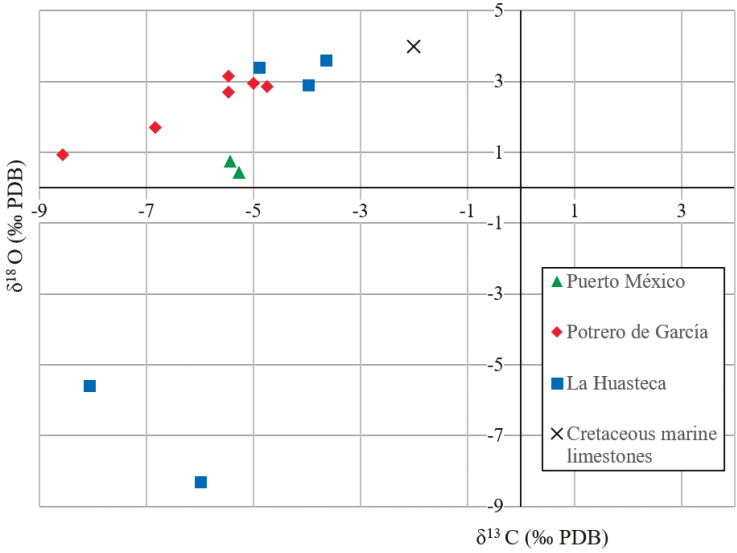
Figure 9 Cross-plot of δ13C PDB vs δ18O PDB values from this work compared with other published isotopic carbonate values (Moldovany and Lohmann, 1984).
A comparison of stable carbon and oxygen isotopes from diverse Cretaceous localities is shown in Table 3, which includes Early Cretaceous Marine Carbonate Baseline from Moldovanyi and Lohmann (1984); a factor correction of 4 has been added to the δ 13 C values and a -2 correction factor has been subtracted from the δ18O values.
Table 3 Comparative δ13C and δ18O for the Cupido Formation and other similar localities.
| Author | Sample | δ13C (‰ PDB) | δ18O (‰ PDB) |
|---|---|---|---|
| Marine limestones indicators | |||
| Moldovanyi and Lohmann (1984) | Early Cretaceous marine carbonate baseline | -2 | 4 |
| This study | Coral (PM) | 0.75 | -5.43 |
| 0.43 | -5.7 | ||
| Guzzy-Arredondo et al. (2007) | Rudist (Bustamante Canyon) | 0.5 | -6.2 |
| 2.5 | -4.4 | ||
| Murillo-Muñetón and Dorobek (2003) | Dark dense micrite | 1.85 | -4.5 |
| 2.19 | -4.79 | ||
| 2.2 | -4.85 | ||
| Micrite of calcisponge | 1.72 | -6.38 | |
| Monroy-Santiago (2012) | Rudist (La Escalera) | 3.95 | -3.25 |
| 3.89 | -3.49 | ||
| Average freshwater limestones indicators | |||
| This study | Collapse breccia (LH) | -8.31 | -5.99 |
| Travertine (LH) | -5.59 | -8.07 | |
| Stromatolitic structure (PM) | -6.79 | -7.51 | |
| -7.92 | -7.22 | ||
| Monroy-Santiago (2012) | Collapse breccia | 1.41 | -3.85 |
| -0.95 | -5.44 | ||
| -1.85 | -5.44 | ||
| -0.3 | -15.45 | ||
| Anhydrite nodules replaced by calcite | 2.2 | -3.12 | |
| -9.19 | -4.965 | ||
| -7.03 | -6.46 | ||
| Travertine | -6.37 | -9.43 | |
| -7.18 | -8.44 | ||
| -4.94 | -8.23 | ||
| -10.75 | -7.4 | ||
| Microbiologically induced | |||
| This study | Stromatolite (PGr) | 0.93 | -8.56 |
| Microbial Mats (PGr) | 2.96 | -5 | |
| 1.71 | -6.83 | ||
| Murillo-Muñetón and Dorobek (2003) | Microbial crust (most frequent and average) | 1.83 | -6.67 |
| Leal-Resendez (2009) and Caballero-Ramirez (2010) | Most frequent values from Cupidito PCH | 4 | -5 |
Cupidito as a sequence boundary
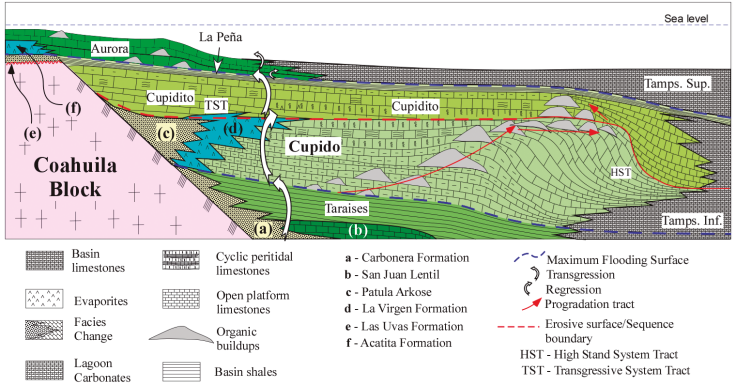
As evidenced in the previous figures from LH and PCH (Figures 3-7), a sequence boundary is characterized by several collapse breccias, whose erosive surfaces overlie the characteristic gray stratiform microbial mats. At the microscopical level, the breccia shows calcitic fragments with pression-solution evidences preserved within an unfossiliferous matrix that contains dolomite crystals and subrounded micritized grains of varying size. The integration of previous data into a theoretical cross section from the regional geology during the Hauterivian-Albian results in the scheme showed in Figure 10, that illustrates the Cupidito unit included as initial hiatus during the Cupido evolution. The Cupidito unit lies between the sequence boundary and La Peña Formation.
The stratigraphic correlation of Cupidito
The Maximum Flooding Surface (MFS) from La Peña Formation has been used as DATUM (base level of stratigraphic columns correlation) in the stratigraphic correlation of Figure 11. The basal Cupido Formation is characterized by a reef biota in most revised localities, except in PCH, where the base is strongly narrowed. The lowermost Cupido strata are marked by a 3-5 m breccia (Figures 4b-4d), and capped by more than 100 meters of massive rudstone reef facies (Figure 4e); in contrast, Cupido is approximately 440 m-thick in PCH. Our observations suggest that peritidal facies dominate in most of the observed vertical profiles, and show a clear trend to be thicker toward the basin. Except for one locality (PM), the Cupidito unit is recognized in all Cupido localities: In PCH starts at 370 m from the base of Cupido; in PGr the lower limit of Cupidito is hidden by recent sediments, nevertheless, it has an estimated thickness of 120 m; in LH, Cupidito has 130 m of thickness and in LM, it has 110 m. The basal PM reef facies consist of several 1-2 m-horizons spaced by several meters, but not fully exposed; using a parallel locality (as clearly explained in Torres de la Cruz et al., 2018) the estimation of Cupido thickness in PM was approximately 680 m. Lastly, the localities that expose the majority of Cupidito diagnostic facies are PG and LH. Likewise, the reef facies average 40 m and 60 m in the PG and LH localities, respectively. A constant feature in all localities is the regularity of La Peña Formation, which is a well-characterized regional seal (Figure 8 and 11).
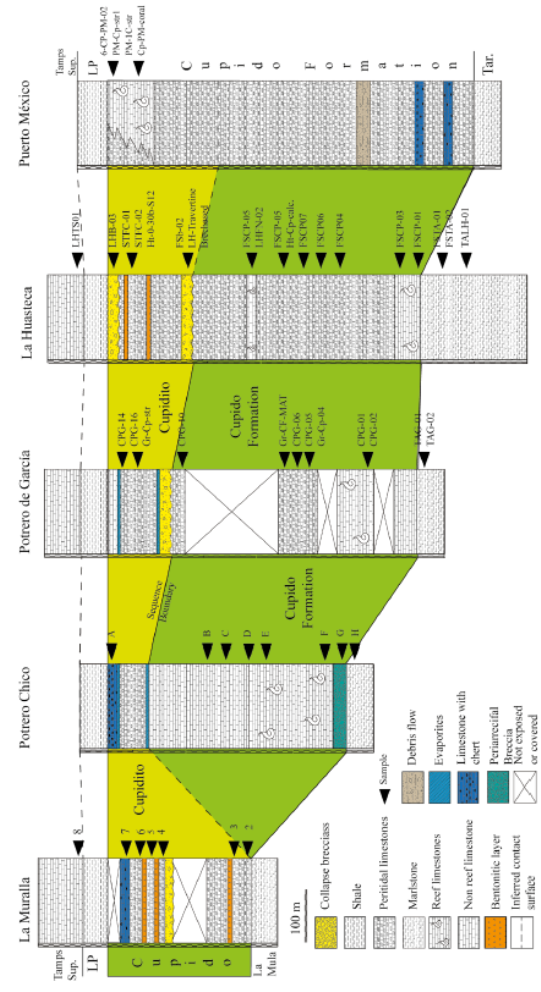
Figure 11 Regional stratigraphic correlation among five localities of the Cupido Formation (Abbreviations are the same as in Figure 2).
DISCUSSION
A Transgressive System Tract (TST) lies within a Sequence Boundary (SB) at the uppermost part of the Cupido lithofacies. Between Cupidito and La Peña Formation, there is a well-characterized transition that corresponds to a Maximum Flooding Surface (MFS) (Eguiluz de Antuñano, 2001), recognized by deep-basin deposits that records the platform drowning during the “Gargas event” (Núñez-Useche et al., 2014). The geological and facies analysis of the revised localities confirms the general interpretation of Cupidito as transgressive-retrogradant carbonate succession deposited before platform drowning. In this case, the Transgressive System Tract would be Cupidito and La Peña Formation would be the Maximum Flooding Surface.
Diagnostic facies in Cupidito
The general geological and sedimentary structures in the exposed outcrops of Cupidito share distinctive characteristics with differences due to regional geological variations. A summary of diagnostic lithofacies and microfacies from the analyzed outcrops from Cupidito are: (1) The presence of limit-collapse-breccias occurring either at the lower and/or upper contacts with Cupidito and La Peña formations, respectively, as observed in LH (Figures 7a and 7c); (2) Well-developed and thin-bedded stratiform microbial mats that frequently grade into stromatolitic with domal or parabolic shapes (Figures 7b and 7d); (3) Chondrodonta , ostreiform shells are common across the thickness of the Cupido Formation, but are characteristically abundant in Cupidito (Figures 7g-7h). (4) The occurrence of Toucasia shells as a monotypic population in 20 cm-thick-beds. (5) Chert nodules occur at the uppermost part of Cupidito; some outcrops such as LM and PCH expose distinctive black nodules (Figure 7f); (6) Although calcitic nodules are widely extended through the middle-upper section of the Cupido Formation, they are especially common in all localities as typical Cupidito diagenetic features (Figure 7k). Although Cupidito is recognizable in most localities, not all of its distinctive features are concurrently exposed. Though sedimentary facies are present in most localities of Cupidito outcrops, the most representative Cupidito locality is La Huasteca (LH), proposed here as the type locality for Cupidito. Additionally, this locality offers a well-preserved sub-vertical stratification, workable dimensions and easy access to document a complete stratigraphic section.
Other additional characteristics as the occurrence of cherty nodules are recognizable at Potrero Chico and La Muralla; however, this could be confused with the basal part of the La Peña Formation. The variation of the orientation of Chondrodontes shells reflects changes in the energy level of the water, most of the shells are parallel to the stratification; in turn, this indicates a rapid winnowing, low sedimentation rates and reworking of deposits (Ayoub-Hannaa and Fürsich, 2011).
Depositional model
The Carbonera Formation in the southeastern part of the Coahuila Block underlies the Cupido Formation and was proposed as a siliciclastic sequence from the Lower Cretaceous (Neocomian) with its source in the Coahuila Block (Eguiluz de Antuñano, 1990). The deltaic sandstones from the Sandy Galeana Member (SGM), with its source in the Tamaulipas Island, has been proposed for localities exposed in areas such as Rayones, Galeana and Potrero Prieto (Ocampo-Díaz et al., 2012). Within this depositional context, the age variation in the base of the Cupido Formation may be related to the late siliciclastic sedimentation that could inhibit or retard the fixation of carbonate sequences; this scenery is congruent with the observation of a high lateral variation of the Cupido Formation, which is the most notable feature in Cupido, especially at its lower limit. In Potrero de Menchaca, the system Cupido/Cupidito overlies La Virgen Formation (Eguiluz de Antuñano, 2011; Gutierrez-Alejandro et al., 2017). In La Muralla (LM), Cupidito is recognizable as a regressive deposits overlying La Mula Formation. The lateral variation of underlying formations is a natural characteristic for extended formations with a transgressive-regressive affinity.
The geographic orientation of the Cupido margin exhibits a sharp “dogleg” morphology that trends toward Galeana (Lehmann et al., 1998) and signal a further effect of the siliciclastic alignment of the Cupido Formation. According to Wilson (1999), a telescopic effect compressed the Cupido strata into a southeast-orientation activated by the Laramide orogeny. Moreover, Kleist et al. (1984) documented a counterclockwise orientation at the southeast corner of the Coahuila Block (in Los Chorros, LC), probably also activated by the Laramide orogeny. These results suggest that the inherited paleo-topography from the siliciclastic alignment of the Saltillo Delta and the Sandy Galeana Member, may have controlled the geometry of the Cupido Formation margin in the Monterrey-Galeana-Saltillo area (Figure 10).
The peculiar occurrence of a basal stratigraphic breccia found only in PCH but not in any other locality, provides further elements to infer a probable talus generated at this point. The fact that a massive body of reef limestones with abundant rudists directly overlies this breccia, suggests an eastward progradation from the very lower part of the Cupido Formation. Reef facies formed by large Toucasia and Chondrodontes quickly prograded after aggradation cycles, as observed in PCH and LH. These reef facies are also present in the basal Cupido Formation in PM (Torres de la Cruz, 2014; Torres de la Cruz et al., 2018). Spongy mud mounds developed along a carbonate ramp (inherited from the Taraises Formation) characterize the base of the Cupido Formation in Bustamante canyon (Murillo-Muñetón and Dorobek, 2003). These mud-mounts evolved to coral-stromatoporoid-rudist bioherms throughout a regressive stage that eventually modified the depositional profile into a reef-rimed platform (Figures 10 and 11). Although, these mud-mounds are not developed (or preserved) in all localities, the presence of morphologically-variable organic buildups is a feature that reflects oligothrophic conditions near the instauration of the MFS of the Taraises Formation, which is likely related to local paleo-reliefs inherited from structures below.
On the other hand, the presence of stratiform microbial mats, commonly indicating restricted conditions of high salinity and low energy (Logan et al., 1974) in cyclic alternation with bioturbation, also suggest several transgressive episodes between regression and subsidence rates that generated embayments. This restricted circulation also promoted intermittent rehydration and evaporative conditions within the platform interior that reflect on the alternating bioturbation/mats facies. These low amplitude and high frequency peritidal limestone are also result of the Milankovitch cycle variations and, to a smaller scale, of the local climatic changes by authigenic processes (Lehmann et al., 1998). Furthermore, the alternation between bioturbated beds and microbial mats indicate uniform shallow paleoenvironmental conditions with periodic eustatic changes related to a flat-topped platform. This platform may have extended as far as LM at the north, and as far as PM to the south (Figure 1). Both localities are linearly separated by 140 km. If tectonic shortening is omitted, which is estimated at least in 37% at the Santa Rosa canyon, Nuevo León (Chávez-Cabello et al., 2011), and in 33% between Monterrey and Aramberri (Eguiluz de Antuñano et al., 2000), then this area used to be larger than the actual size.
These results confirm the general observation that peritidal sequences are mostly present in the platform interior (Figures 10 and 11). The Cupidito Unit (Wilson and Pialli, 1977) defined as retrogradational lagoon limestones that marks the beginning of the drowning episode of Coahuila Block, known as the Gargas event (Barragán Manzo and Díaz-Otero, 2004). The drowning of the Cupido platform in northeastern Mexico has been acknowledged locally and regionally as the “Gargas” and “Selli” events, respectively (Föllmi et al., 1994; Barragán Manzo and Díaz-Otero, 2004; Núñez-Useche et al., 2014). Although the evidences for a drowning platform event are typically provided by seismographical data (Ferreri et al., 2004), there are some field clues that document this event. The most diagnostic characteristics of Cupidito is the development of a collapse breccia generated by a discordant erosive surface (yellow belts in Figure 11) that coincides with a global decrease of the relative sea level approximately 124 Ma ago (Ogg et al., 2004).
As evidenced in LH and PCH, the sequence boundary is characterized by several collapse breccias (Conklin and Moore, 1977). This Sequence Boundary was established in northeastern Mexico either at 112 Ma (Goldhammer, 1999) or at 124 Ma (Eguiluz de Antuñano, 2011). This Sequence Boundary (SB) is classified as Type I according to Van Wagoner et al. (1990). The SB is reported in Texas as the base of the upper part of the Sligo Formation (Eguiluz de Antuñano, 2011; Goldhammer, 1999; Wilson and Pialli, 1977). Nice examples of this breccia are present in LH and PCH, but not in PM or LC. The development of breccias, therefore, may have been selective and especially promoted by topographic highs. In areas where La Virgen was not deposited, Cupidito is only recognizable because of its erosive surface (Eguiluz de Antuñano, 2011).
Paleotemperatures
Moldovanyi and Lohmann (1984) established the Early Cretaceous Marine Limestones Base Line (ECMLBL) with the heaviest isotopic values deriving from the Cupido and Sligo formations limestones (Figure 9), which range between 1.8 ‰ and 4.0 ‰ for δ13C and between -2 ‰ and -5 ‰ for δ18O. Other estimates for δ18O yielded values as low as -2.5 ‰ for oxygen and between 2.5 and 4.0 for δ13C in Aptian-Albian shallow marine carbonates (Scholle and Arthur, 1980). Since organisms generate their skeletons in isotopic equilibrium with sea water (Erez and Luz, 1983), the isotopic values derived from corals, rudists and stromatoporoids from the Cupido Formation may reflect their local paleo-environmental conditions. The values plotted in the second quadrant of Figure 9 corresponds to normal marine limestone according to Hudson (1977), Nelson and Smith (1996), as well as to data reported in the literature (Table 2).
The higher temperature values from lithified microbial mats (39.2 °C) and small stromatolites (48.3 °C) could be explained by the environmental settings where microbialites developed. In contrast, lower temperatures derive from lagoon samples (13.8 and 25.3 °C). The resulting temperatures for PM corals (31.5 °C and 32.2 °C) are similar to values calculated by Leal-Resendez (2009) and Caballero-Ramirez (2010) for the PCH locality. The average temperatures for Cupidito in PCH (oscillating between 31-33 °C), are comparable with early Aptian Equatorial Pacific paleotemperatures derived from the Deep See Drilling Project (30-32 °C) at a paleolatitude of ~20°S (Schouten et al., 2003). According to van Hinsbergen et al. (2015), the Cupido area was located close to paleolatitude 30°N during the Barremian. The PM corals paleotemperature fits well within these values too; furthermore, it is probable that these paleotemperatures are closest to the real Cupido Formation values, since corals need crystalline waters for photosynthesis, which in turn generates low heavy carbon isotope values.
Although the possibility of diagenetic overprinting of primary oxygen and carbon isotopic values may be high by burial and compactation, the comparison of isotopic signals among contemporaneous sections of this complex platform system helps to obtain a general view of diagenetic processes and local differences among localities. The inferred paleotemperatures for most Cretaceous carbonates are always subject to corrections by diagenetic overprint (Fischer et al., 1989; Frank et al., 1999; Frank and Bernet, 2000; Parente et al., 2007), and yet, the extend of diagenetic effects has been scarcely addressed. This data may help to constrain sampling points for isotope analysis, too.
CONCLUSIONS
Because of the large thickness of the Cupido Formation, extensive sedimentary facies are well-exposed in representative localities of northeastern Mexico. Especially relevant are those peritidal carbonate facies that may serve as reservoir rocks and proved analogues overlapped by La Peña Formation as a regional seal.
Based on these results and especially on the proposed model that summarizes the Cupido Formation, it could be speculated that the age variation in the Cupido Formation base could be related to siliciclastic sequences from the Saltillo Delta and the Sandy Galeana Member. Particularly, the basal part of Cupido at PCH is identified by a talus breccia with a progradational affinity at the earliest depositional stage. Under this scenario, it can be inferred that PCH represents a platform edge remains at the beginning of the Cupido deposition. Cupidito may be regarded as a drowning discontinuity between the Cupido Formation and La Peña Formation. Since Cupidito contains scientific and potential economic relevance, this sedimentary unit should be recognized as a formally-acknowledged member of the Cupido Formation, according to the criteria established by the Código Estratigráfico Norteamericano (Barragán et al., 2010).
The analyzed peritidal sequences suggest the development of a top-flat carbonate platform in equilibrium with regression and subsidence events. Both processes maintained the aggradation rate of the Cupido peritidal platform, widely extended in northeastern Mexico at that time. Microbial carbonate horizons indicate embayment episodes that produced restricted circulation and probable hypersaline conditions, excluding most of the benthic biota. A low organic productivity environment may be the result of changes in regression and subsidence rates. The occurrence of numerous bioturbation horizons concentrated mainly toward the platform edge remains an open question.

