

SciELO - Scientific Electronic Library Online

 
vol.34 número3Registro más septentrional de la Raya áspera del Pacífico, Styracura pacifica (Beebe & Tee-Van 1941) (Myliobatiformes: Potamotrygonidae) en las costas del Pacífico mexicano índice de autoresíndice de materiabúsqueda de artículos
Home Pagelista alfabética de revistas  

Servicios Personalizados

Revista

Articulo

Indicadores

Links relacionados

  • No hay artículos similaresSimilares en SciELO

Compartir


Hidrobiológica

versión impresa ISSN 0188-8897

Hidrobiológica vol.34 no.3 Ciudad de México sep./dic. 2024  Epub 23-Ene-2026

https://doi.org/10.24275/nrrd2007 

NOTAS CIENTÍFICAS

Is Blixaea quinquecornis (Dinoflagellata: Peridiniales) a species complex?

¿Es Blixaea quinquecornis (Dinoflagellata: Peridiniales) un complejo de especies?

Ismael Gárate-Lizárraga1 
http://orcid.org/0000-0002-3835-183X

Yuri B. Okolodkov2  * 
http://orcid.org/0000-0003-3421-3429

1Instituto Politécnico Nacional, Centro Interdisciplinario de Ciencias Marinas (IPN-CICIMAR), Departamento de Plancton y Ecología Marina. Av. Instituto Politécnico Nacional s/n, Apdo. Postal 592, La Paz, Baja California Sur, 23096. México

2Laboratorio de Botánica Marina y Planctología, Instituto de Ciencias Marinas y Pesquerías, Universidad Veracruzana (ICIMAP-UV). Mar Mediterráneo 314, Fracc. Costa Verde, Boca del Río, Veracruz, 94294, México


ABSTRACT

Background:

Peridinium quinquecorne is a benthic-planktonic, neritic, tropical-boreal dinoflagellate species, usually with four antapical spines. It exhibits a wide morphological variability, particularly in the number of spines, which has caused a discussion among several authors on its generic position, transferring the species from Peridinium to Blixaea. The genus is currently monotypic. Cells of Blixaea quinquecornis possess a Chaetoceros-like diatom as endosymbiont, which is a unique feature among the so-called “dinotoms” that constitute the family Kryptoperidiniaceae, a well-supported monophyletic group. In Mexican waters, the species is best known from the state of Veracruz, southwestern Gulf of Mexico, where it has caused recurrent blooms; the species has also been reported from other regions of the world.

Methods:

The published literature on the species was revised, with an emphasis on the number of antapical spines.

Goals:

Clarifying the taxonomic status of Blixaea quinquecornis based on the thecal variability.

Results:

In the published literature, the number of the antapical spines emerging from the antapical plates in the dinoflagellate differs among the authors. Both published scanning electron and light microscope images do not allow us to describe the thecal plates in detail and their morphological variability or to conclude if this variability is infra- or interspecific. Our morphological data and the results obtained from the literature do not allow us to confirm the taxonomic status of B. quinquecornis.

Conclusions:

B. quinquecornis probably represents a species complex. Genetic-molecular and thecal-morphological studies are necessary to explain the morphological variability and to characterize different populations of the taxon from different regions through the world.

Keywords: dinoflagellates; Gulf of Mexico; morphology; taxonomy

RESUMEN

Antecedentes:

Peridinium quinquecorne es una especie de dinoflagelado, usualmente con cuatro espinas antapicales, bentónica-planctónica, nerítica, tropical-boreal. Presenta una amplia variación morfológica, en particular, en el número de espinas, lo cual ha provocado que su ubicación genérica se haya puesto en discusión por varios autores, transfiriendo la especie de Peridinium a Blixaea. Actualmente, el género es monotípico. Las células de Blixaea quinquecornis poseen una diatomea similar a Chaetoceros como endosimbionte, lo cual es una característica única entre las llamadas “dinotomeas” que constituyen la familia Kryptoperidiniaceae, un grupo monofilético bien sustentado. En aguas mexicanas, la especie se conoce mejor en el estado de Veracruz, al suroeste del Golfo de México.

Métodos:

Se realizó una revisión de la literatura publicada sobre la especie, con énfasis en el número de las espinas antapicales.

Objetivos:

Aclarar el estatus taxonómico de Blixaea quinquecornis basándose en la variabilidad de las tecas.

Resultados:

En la literatura publicada, el número de espinas antapicales que emergen de las placas antapicales en el dinoflagelado difiere entre los autores. Tanto las imágenes de microscopio electrónico de barrido como las de microscopio de luz publicadas no permiten describir en detalle las placas tecales y su variabilidad morfológica, ni concluir si esta variabilidad es infraespecífica o interespecífica. Nuestros datos morfológicos y los resultados obtenidos de la literatura no nos permiten confirmar el estatus taxonómico de B. quinquecornis.

Conclusiones:

B. quinquecornis, probablemente, representa un complejo de especies. Los estudios genético-moleculares y morfológicos de la teca son necesarios para explicar la variabilidad morfológica y caracterizar diferentes poblaciones del taxón de varias regiones del mundo.

Palabras clave: dinoflagelados; Golfo de México; morfología; taxonomía

Peridinium quinquecorne T.H. Abé 1927 is one of the few known benthic-planktonic dinoflagellates. It is worth mentioning that the author of this species noted that “no corresponding form was found in the genus” (Abé, 1927: 411), highlighting the superficial similarity between this species and Amylax triacantha (Jørgensen) Sournia 1984 (= Gonyaulax triacantha Jörgensen 1899). In Mexican waters, it is best known from the state of Veracruz, southwestern Gulf of Mexico, where it has caused recurrent blooms; the species has also been reported from other regions of the world (see references in Trigueros et al., 2000; Pertola et al., 2006; Aké-Castillo et al., 2014; Okolodkov et al., 2016; Rodríguez-Gómez et al., 2021; Hoppenrath et al., 2023).

The synonymy of Peridinium quinquecorne with Heterocapsa quadridentata F. Stein 1883 has almost always been avoided in the published literature, although the synonymy of the former with Protoperidinium quinquecorne (T.H. Abé) Balech 1974 is widely known. However, Horiguchi & Soto (1994) concluded that the transfer of Peridinium quinquecorne by Balech (1974) to the genus Protoperidinium Bergh 1881 is not appropriate: the former has five cingular plates, unlike Protoperidinium species that possess four cingulars, including a transitional plate.
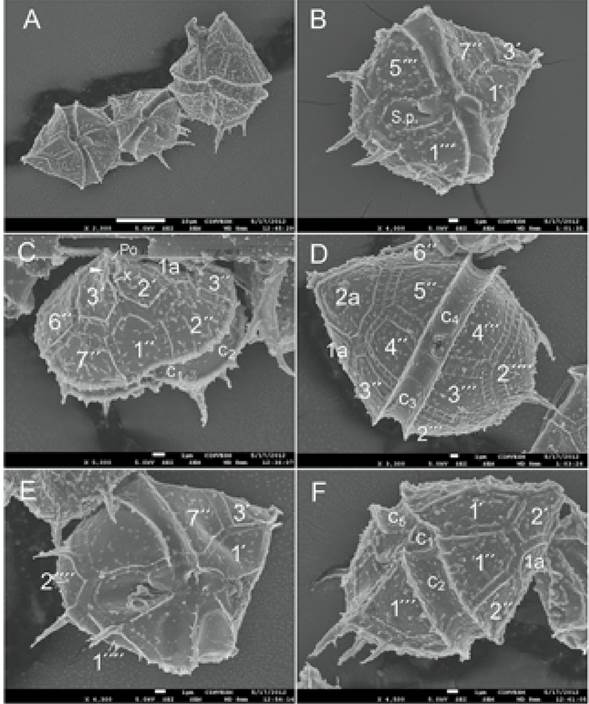
Figure 1 Scanning electron micrographs of Blixaea quinquecornis from a bloom in the coastal waters of Veracruz. A - three polygonal cells in ventral view, showing variability in size; B and E - cells in ventral view, showing variability in the cell size and the number of the antapical spines; C - cell in apical-ventral view, showing the apical pore complex and the apical spine (arrowhead) belonging to the 3’ plate; D - larger rounded cell in dorsal view; F - cell in ventral-left-side view with four antapical spines. Thecal plates: 1´-3´ - apicals; 1´´-7´´ - precingulars; 1´´´-5´´´ - postcingulars; 1´´´´ and 2´´´´ - antapicals; c1-c5 - cingulars; Po - the pore plate; S.p. - the sulcal posterior plate; x - the canal plate. Scale bar: 10 μm in A, 1 μm in B-F. 

Iwataki (2008) noted that H. quadridentata had not been reported from any location since its original description and does not possess the characteristics of the genus Heterocapsa F. Stein emend. Iwataki et Fukuyo 2003. Although the line drawing of the taxon by Stein (1883: 13, pl. IV, fig. 3) is somewhat schematic, considering that the first apical plate (1´) is of ortho-type, the cell shape, its general proportions, the length, position and the number of the antapical spines, slightly attenuated apex and the displacement of the cavozone cingulum give it much in common with the original description and illustrations by Abé (1927). The morphologically similar Amylax triacantha has a different set of thecal features, and Stein’s taxon differs to a still greater extent from all known dinoflagellate species except for Peridinium quinquecorne.

Hansen (1995) states that H. quadridentata is undoubtedly conspecific with Peridinium quinquecorne and introduces a new combination, Peridinium quinquecorne (F. Stein) G. Hansen, noting that whether the name of P. quinquecorne is valid, its assignment to the genus Peridinium Ehrenberg is another question. We completely agree with Hansen’s opinion and that P. quinquecorne should be considered a junior synonym to H. quadridentata. A new variety, Peridinium quinquecorne T.H. Abé var. trispiniferumAké-Castillo et Vásquez 2011, was described, and it has only been reported from Sontecomapan Lagoon (la Laguna de Sontecomapan), southwestern Gulf of Mexico (Aké-Castillo & Vazquez, 2011).

The genus Blixaea (T.H. Abé) Gottschling in Gottschling et al. 2017 is currently monotypic. Cells of Blixaea quinquecornis possess a Chaetoceros-like diatom as endosymbiont (Horiguchi & Pienaar, 1991; Horiguchi & Takano, 2006), which is a unique feature among the so-called “dinotoms” (Imanian et al., 2011) that constitute the family Kryptoperidiniaceae, a well-supported monophyletic group (Gottschling et al., 2017). Cells have a stigma located in the sulcal area.

In the published literature, the number of the antapical spines emerging from the antapical plates in the dinoflagellate differs among the authors. Abé (1927) described the species from Mutsu Bay, northern Japan, based on one and half cells (the hypotheca) having four spines. Most authors also described and illustrated cells with this feature (Abé, 1981; Madariaga et al., 1989; Horiguchi & Pienaar, 1991; Horiguchi & Soto, 1994; Trigueros et al., 2000; Barón-Campis et al., 2005; Faust et al., 2005; Mohammad-Noor et al., 2007; Gárate-Lizárraga & Muñetón-Gómez, 2008; Okolodkov et al., 2016; Hoppenrath et al., 2023). Pertola et al. (2006) illustrated a cell germinated from the sediment from the eastern Baltic Sea with four spines, comparing it to the pictured cell from Belize with five spines. Furthermore, Satta et al. (2010: 116, fig. 2a, b) reported the species in high abundance in surface sediments at two sites in the Western Mediterranean Sea, mentioning five processes on the hypotheca; however, we could clearly distinguish only four spines. The authors could not confirm whether they found “resting cells” or cysts (resting or temporary). Horstmann (1980) described cells from Maribago Bay, Cebu, the Philippines, that usually had five spines and in some more cases, referring to the species as Peridinium cf. quinquecorne, distinguishing two cell shapes, roundish and angular, and noting that the latter is likely characteristic of older cells. According to Horiguchi & Soto (1994), the correct identification of Horstmann’s species has remained enigmatic; however, the morphological characteristics examined by these authors support the bloom-forming species from Maribago Bay being truly Peridinium quinquecorne. They also distinguished and illustrated the two morphotypes described by Horstmann. The same morphotypes were illustrated by Barón-Campis et al. (2005). Horiguchi (1990) reports three to five spines in the cells from Japan, although a cell illustrated in fig. C (p. 138) has six spines. Adachi (1972) describes a dinoflagellate as Peridinium sp. 1 with four to seven antapical spines (cited after Horstmann, 1980).

Abé (1981: 294-295) illustrated the cells with four antapical spines, mentioning that the cells with three spines are also common, and “their length appears to be reversely correlated to the size of the body”. He also distinguished an angular polygonal cell shape in younger specimens and a less angulated form often coupled with broader sutures (in older cells). In addition, the body of younger cells was strongly flattened dorsoventrally, unlike in older cells. It was concluded that the presence of “every intermediate form between these two” suggests their unity.

The question of why Peridinium quinquecorne var. trispiniferum cannot be a new species is reasonable; however, molecular studies should be performed to answer a range of questions about the taxonomic status of the cells that differ in the number of the antapical spines (3, 4, 5 or more) and if there are other features coupled with the number of spines. It is logical to suggest that slight genetic differences, being accumulated, may result in noticeable morphological differences such as the number of antapical spines, which can be indicative of interspecific differences. Despite numerous records of this bloom-forming species, its thecal morphology has not been examined in detail; the study by Horiguchi & Pienaar (1991) is a rare exception. Faust et al. (2005) showed the morphology of the apical pore complex consisting of the pore plate (Po) and the canal plate (x) in scanning electron micrographs. According to Aké-Castillo & Vázquez (2011), some features such as the cell shape, the number and arrangement of thecal plates as well as the presence of spines in general on the hypotheca of var. trispiniferum correspond to those of Peridinium quinquecorne, but the number of spines does not. Therefore, both scanning electron and light microscope images published in the cited literature do not allow us to describe the thecal plates in detail and their morphological variability or to conclude if this variability is infra- or interspecific.

Herein, we describe the morphological variability of the cell shape and some details of the theca of B. quinquecornis sampled during a bloom on 15 July 2008 in the coastal waters in the port of Veracruz, southwestern Gulf of Mexico (Fig. 1A-F). Fixed specimens were examined in a JEOL JSM-7600F (JEOL, Ltd., Tokyo, Japan) scanning electron microscope (SEM) at a working distance of 8 mm, a voltage of 5.0 kV after a preliminary wash in distilled water followed by dehydration in a series of ethanol solutions of increasing concentration (30, 50, 70, 90, and 100%). Specimens were then air dried on 0.5´´ aluminum mounts and sputter-coated with gold-palladium using a Polaron SC7640 High-Resolution Sputter Coater (Quorum Technologies, Newhaven, SXE, UK).

The trichocyst pores are crater-like, and rimmed, 0.14-0.20 μm in diameter, are irregularly distributed through all thecal plates, with a tendency to form rows along their margins (Fig. 1C). Some cells have a short spine belonging to the 3’ plate, inserted ventrally on the right side, near the apical pore complex (Fig. 1C). These morphological peculiarities have not been described in the literature.

Genetic variability and differentiation between populations of the same species with a wide geographical distribution is the principal tendency in speciation of the oceanic holoplanktonic taxa (Pierrot-Bults & Van der Spoel, 1976). It is considered that in the ocean the processes of speciation are slow and, in general, incomplete. Formation of many cryptic species inhabiting marine environments is common (Medlin, 1995). For example, recent studies on some common benthic dinoflagellate species, such as Prorocentrum lima (Ehrenberg) F. Stein and P. hoffmannianum M.A. Faust, proved the existence of species complexes (integrated by several or many cryptic species) rather than individual species under a given Latin species name (Zhang et al., 2015; Cembella et al., 2021). As an object of numerous genetic and biotechnological studies, the brackish-water-marine dinoflagellate Crypthecodinium cohnii (Seligo) Chatton, found associated with decaying macroalgae from the North Sea to Caribbean, by the mid-1990s had contained 52 reported sibling species (Steidinger & Tangen, 1996). Therefore, we consider that Blixaea quinquecornis, a neritic tropical-boreal dinoflagellate with a wide geographical distribution in both marine and brackish waters, including the water column, seagrasses, macroalgae, floating detritus, tropical tidal pools and sediments, tolerating temperatures up to 42oC (Faust et al., 2005), may represent a species complex that should be evaluated in detail through future molecular evidence.

ACKNOWLEDGMENTS

We thank Natalia A. Okolodkova (Mexico City, Mexico) for technical help with the illustrations, Francisco F. Pedroche (Universidad Autónoma Metropolitana - Lerma, Mexico City, Mexico) for giving us advice, and Marcia M. Gowing (Seattle, WA, USA) for improving the English style. We are also grateful to anonymous reviewers for their critical comments that improved the manuscript. The project was partially funded by Instituto Politécnico Nacional, Mexico (grants SIP-20230492 and SIP- 20240611): IGL is a COFAA fellow.

REFERENCES

Abé, T. H. 1927. Report of the biological survey of Mutsu Bay. 3. Notes on the protozoan fauna of Mutsu Bay. I. Peridiniales. Reports of the Tôhoku Imperial University, Series 4, Biology, Sendai, Japan 2 (4): 383-438. [ Links ]

Abé, T. H. 1981. Studies on the family Peridiniidae. Un unfinished monograph on the armoured Dinoflagellata. Academia Scientific Book Inc. Tokyo, Japan. Publications of the Seto Marine Biological Laboratory, Special PublicationSeries 6: 1-409. [ Links ]

Adachi, R. 1972. A taxonomical study of the red organisms. Journal of the Faculty of Fisheries, Prefectural University of Mie 9 (1): 9-145. (Cited after Horstmann, 1980). [ Links ]

Aké-Castillo, J.A. & Vázquez, G. 2011. Peridinium quinquecorne var. trispiniferum var. nov. (Dinophyceae) from a brackish environment. Acta Botanica Mexicana, 94:125-140. DOI:10.21829/abm94.2011.273 [ Links ]

Aké-Castillo, J. A., Y. B. Okolodkov, C. F. Rodríguez-Gómez & G. Campos-Bautista 2014. Florecimientos algales nocivos y contaminación en Veracruz: especies y posibles causas (2002-2012). In: Botello, A.V., J. Rendón von Osten, J. A. Benítez & G. Gold-Bouchot (Eds.). Golfo de México. Contaminación, impacto ambiental, diagnóstico y tendencias. 3a ed. UAC, UNAM-ICMYL, CINVESTAV-Unidad Mérida, México, pp. 133-146. [ Links ]

Balech, E. 1974. El género Protoperidinium Bergh, 1881 (Peridinium Ehr., 1831, partim). Revista del Museo Argentino de Ciencias Naturales “Bernardino Rivadavia”, Hidrobiología 4 (1): 1-78. [ Links ]

Barón-Campis, S.A., D.U. Hernández-Becerril, O. Juárez-Ruíz & C. Ramírez-Camarena. 2005. Marea roja producida por el dinoflagelado Peridinium quinquecorne en Veracruz, México (oct-nov, 2002). Hidrobiológica 15 (1): 73-78. [ Links ]

Cembella A.D., L. M. Durán-Riveroll, U. I. Tarazona-Janampa, Y. B. Okolodkov, R. García-Sandoval, B. Krock, C. Hörstmann & U. John. 2021. Phylogeography and diversity among populations of the toxigenic benthic dinoflagellate Prorocentrum from coastal Reef systems in Mexico. Frontiers in Marine Science 8: Article 716669. DOI:10.3389/fmars.2021.716669 [ Links ]

Faust, M.A., R.W. Litaker, M.W. Vandersea, S.R. Kibler & A.P. Tester. 2005. Dinoflagellate diversity and abundance in two Belizean coral-reef mangrove lagoons: a test of Margalef´s mandala. Atoll Research Bulletin 534: 103-131. [ Links ]

Gárate-Lizárraga, I. & M.S. Muñetón-Gómez. 2008. Bloom of Peridinium quinquecorne Abé in la Ensenada de La Paz, Gulf of California (July 2003). Acta Botanica Mexicana 83: 33-47. DOI: 10.21829/abm83.2008.1059 [ Links ]

Gottschling, M., A. Ž. Čalasan, J. Kretschmann & H. Gu 2017. Two new generic names for dinophytes harbouring a diatom as an endosymbiont, Blixaea and Unruhdinium (Kryptoperidiniaceae, Peridiniales). Phytotaxa 306 (4): 296-300. DOI:10.11646/phytotaxa.306.4.6 [ Links ]

Hansen, G. 1995. Analysis of the thecal plate pattern in the dinoflagellate Heterocapsa rotundata (Lohmann) comb. nov. (=Katodinium rotundatum (Lohmann) Loeblich). Phycologia 34(2): 166-170. DOI:10.2216/i0031-8884-34-2-166.1 [ Links ]

Hoppenrath, M., N. Chomérat, T. Horiguchi, S. A. Murray & L. Rhodes. 2023. Marine benthic dinoflagellates - their relevance for science and society. 2nd ed. E. Schweizerbart´sche Verlagsbuchhandlung (Nägele u. Obermiller) and Senckenberg Gesellschaft für Naturforschung, Germany. 376 p. [ Links ]

Horiguchi, T. 1990. Peridinium quinquecorne Abé. In: Fukuyo, Y., H. Takano, M. Chihara & K. Matsuoka (Eds.). Red tide organisms in Japan - An Illustrated taxonomic guide. Uchida Rokakuho. Tokyo, Japan, pp. 138-139. [ Links ]

Horiguchi, T. & F. B. Soto. 1994. On the identity of a red-tide dinoflagellate in Maribago Bay, Philippines. Bulletin of the Plankton Society of Japan 41 (82): 166-169. [ Links ]

Horiguchi, T. & R. N. Pienaar. 1991. Ultrastructure of a marine dinoflagellate, Peridinium quinquecorne Abé (Peridiniales) from South Africa with particular reference to its chrysophyte endosymbiont. Botanica Marina 34: 123-131. DOI:10.1515/botm.1991.34.2.123 [ Links ]

Horiguchi, T. & Y. Takano 2006. Serial replacement of a diatom endosymbiont in the marine dinoflagellate Peridinium quinquecorne (Peridiniales, Dinophyceae). Phycological Research, 54 (3): 193-200. DOI:10.1111/j.1440-1835.2006.00426.x [ Links ]

Horstmann, U. 1980. Observations on the peculiar diurnal migration of a red tide Dinophyceae in tropical shallow waters. Journal of Phycology 16: 481-485. DOI:10.1111/j.1529-8817.1980.tb03064.x [ Links ]

Imanian, B., J.-F. Pombert & P. J. Keeling 2011. The complete plastid genomes of the two ‘dinotoms’ Durinskia baltica and Kryptoperidinium foliaceum. PLoS One 5 (5): e10711. DOI:10.1371/journal.pone.0010711 [ Links ]

Iwataki, M. 2008. Taxonomy and identification of the armoured dinoflagellate genus Heterocapsa (Peridiniales, Dinophyceae). Plankton Benthos Resources 3: 135-142. DOI:10.3800/pbr.3.135 [ Links ]

Madariaga, I. de, E. Orive & G. T. Boalch. 1989. Primary production in the Gernika estuary during a summer bloom of the dinoflagellate Peridinium quinquecorne Abé. Botanica Marina 32: 159-165. DOI:10.1515/botm.1989.32.2.159 [ Links ]

Medlin, L. K. 1995. Genetic variability and phytoplankton species. In: Pierrot-Bults, A. C. & S. Van der Spoel (Eds.). Pelagic Biogeography ICoPB II. Proceedings of the 2nd International Conference. Final report of SCOR/IOC Working Group 93 “Pelagic Biogeography”, Noordwijkerhout, The Netherlands, 9 July - 14 July 1995, Intergovernmental Oceanographic Commission Workshop Report 142, pp. 257-265. [ Links ]

Mohammad-Noor, N., N. Daugbjerg, Ø. Moestrup & A. Anton. 2007. Marine epibenthic dinoflagellates from Malaysia - a study of live cultures and preserved samples based on light and scanning electron microscopy. Nordic Journal of Botany 24 (6): 629-690. DOI:10.1111/j.1756-1051.2004.tb01938.x [ Links ]

Okolodkov, Y. B., G. Campos-Bautista & I. Gárate-Lizárraga. 2016. Circadian rhythm of a red-tide dinoflagellate Peridinium quinquecorne in the port of Veracruz, Gulf of Mexico, its thecal morphology, nomenclature and geographical distribution. Marine Pollution Bulletin 108 (1-2): 289-296. DOI:10.1016/j.marpolbul.2016.04.047 [ Links ]

Pertola, S., M. A. Faust & H. Kuosa 2006. Survey on germination and species composition of dinoflagellates from ballast tanks and recent sediments in ports on the South Coast of Finland, North-Eastern Baltic Sea. Marine Pollution Bulletin 52: 900-911. DOI:10.1016/j.marpolbul.2005.11.028 [ Links ]

Pierrot-Bults, A. C. & S. Van der Spoel 1976. Speciation in macrozooplankton. In: S. Van der Spoel & A. C. Pierrot-Bults (Eds.). Zoogeography and diversity of plankton. Bunge, Utrecht, The Netherlands, pp. 144-167. [ Links ]

Rodríguez-Gómez, C. F., G. Vázquez, C. A. Maya-Lastra, J. A. Aké-Castillo, C. J. Band-Schmidt, P. Moreno-Casasola & O. Rojas-Soto. 2021. Potential distribution of the dinoflagellate Peridinium quinquecorne and its blooms in continental shelves globally: an environmental and geographic approach. Marine Biology 168: 29. DOI:10.1007/s00227-021-03825-y [ Links ]

Satta, C.T., S. Anglès, E. Garcés, A. Lugliè, B.M. Padedda & N. Sechi. 2010. Dinoflagellate cysts in recent sediments from two semi-enclosed areas of the Western Mediterranean Sea subject to high human impact. Deep-Sea Research II 57: 256-267. DOI:10.1016/j.dsr2.2009.09.013 [ Links ]

Steidinger, K. A. & K. Tangen 1996. Dinoflagellates. In: Tomas, C. R. (Ed.). Identifying marine diatoms and dinoflagellates. Academic Press, Inc., Harcourt Brace & Company. San Diego, New York, Boston, London, Sydney, Tokyo, Toronto, pp. 387-598. [ Links ]

Stein von, F.R.. 1883. Der Organismus der Infusionsthiere nach eigenen Forschungen in systematischer Reihenfolge bearbeitet. III. Abtheilung. II. Hälfte. Die Naturgeschichte der arthrodelen Flagellaten. Leipzig, Germany. 30 p., 25 pl. [ Links ]

Trigueros, J. M., A. Ansotegui & E. Orive 2000. Remarks on morphology and ecology of recurrent dinoflagellate species in the estuary of Urdaibai (northern Spain). Botanica Marina 43: 93-103. DOI:10.1515/BOT.2000.009 [ Links ]

Zhang, H., Y. Li, J. Cen, H. Wang, L. Cui, Y. Dong & S. Lu 2015. Morphotypes of Prorocentrum lima (Dinophyceae) from Hainan Island, South China Sea: morphological and molecular characterization. Phycologia 54 (5): 503-516. DOI:10.2216/15-8.1 [ Links ]

Received: May 21, 2024; Accepted: July 25, 2024

*Corresponding author: Yuri B. Okolodkov: e-mail: yuriokolodkov@yahoo.com

To quote as: Gárate-Lizárraga, I. & Y. B. Okolodkov. 2024. Is Blixaea quinquecornis (Dinoflagellata: Peridiniales) a species complex? Hidrobiológica 34 (3): 211-215.

Creative Commons License This is an open-access article distributed under the terms of the Creative Commons Attribution License