




 texto en
  Inglés (pdf)
 Artículo en XML
 Referencias del artículo
 Traducción automática
 Enviar artículo por email
 Citado por SciELO
  Similares en
SciELO
Similares en
SciELO 
 Permalink

INTRODUCTION
For many years, subsidized programs designed to provide economic opportunities for the young population have generally demonstrated positive results. These schemes have contributed to improvements across a wide range of human development indicators. However, the extent to which such programs effectively mitigate violence and crime remains less clear, requiring further evaluation. Different theoretical frameworks support the relationship between social hardship—or lack of economic opportunities—and criminal behavior. These perspectives suggest that certain interventions, such as subsidized employment programs, could help address the economic needs of the population and, consequently, reduce crime, particularly among youth. In this context, the aim of this article is to analyze whether the implementation of the Jóvenes Construyendo el Futuro (JCF) program, wich offers subsidized training for youth employment, has contributed to reducing intentional homicides in Mexico.
This research draws on two methods to assess the impact of the program: 1) interrupted time series analysis with and without control groups and 2) linear regression analysis. The former allows for examining the impact of an intervention (i.e., the JCF program) on the level and trend of a variable—in this case, intentional homicides—as well as evaluating the statistical significance of these effects (Penfold & Zhang, 2013). Two control cases were selected for this analysis: Baja California and Chiapas. These states were chosen due to their geographic, socioeconomic, and political similarities with the respective treatment cases: Coahuila and Tabasco. Linear regression analyses were conducted to examine the relationship between a dependent variable (i.e., changes in intentional homicide rates) and one or more independent variables (i.e., average number of JCF beneficiaries per capita) (Bangdiwala, 2018). This analysis was conducted by fitting a regression line to actual observations at the state level.
This research contributes to knowledge regarding the efficacy of subsidized youth employment programs in reducing violence, both broadly in Latin America and specifically in Mexico. It begins with a theoretical discussion of youth employment programs and their potential effects on violence, followed by a detailed description of the JCF program. Subsequently, the methods employed in this study are explained, and the results obtained are presented. Finally, conclusions regarding the impact of the JCF program on intentional homicides and violence in Mexico are provided.
EMPLOYMENT AND TRAINING PROGRAMS FOR YOUTH POPULATIONS AND THEIR RELATIONSHIP TO VIOLENCE REDUCTION
The bulk of the literature on initiatives aimed at providing employment opportunities for young people emphasizes generally positive results. These initiatives contribute significantly to improving various aspects of youth human development. A notable example are conditional cash transfer (CCT) programs, designed primarily to alleviate poverty and increase family consumption in the short term, as well as foster human development in the longer term (Cecchini & Madariaga, 2011; Reinecke & Weller, 2014). Initially, these schemes provided monetary transfers to households contingent on compliance with commitments such as attending school or healthcare appointments. More recently, however, some programs have expanded to include non-monetary resources as part of their benefits.
While evidence on their effectiveness generally supports their rationale—depending on their design—for tackling poverty and enhancing human capabilities (Arnold et al., 2011; Bastagli et al., 2016), their potential to contribute to violence reduction remains less explored. Nevertheless, four distinct theoretical perspectives inform the relationship between lack of economic opportunities and violence. The first perspective supporting this link is Social Disorganization Theory (SDT), which argues that structural factors (i.e., social disadvantage and economic hardship) are closely related to crime in specific locations. This association has been documented in both earlier and contemporary research (De Oliveira & Rodrigues, 2013; Kubrin & Weitzer, 2003). According to this theory, structural disadvantages weaken organizational capacities and informal social controls, creating conditions favorable to criminal behavior. This helps explain why crime is unevenly distributed across different areas (Kubrin & Weitzer, 2003).
Recent developments within SDT literature also highlight the role of human agency (Bandura, 2000). From this perspective, community members’ capacity to actively respond to adverse conditions can significantly influence crime outcomes (Kubrin & Weitzer, 2003). Consequently, interventions such as subsidized youth employment programs might strengthen these organizational capabilities, thus reducing conditions favorable to crime.
Another perspective linking unemployment and violence is the epidemiological model for violence prevention. This model builds upon the notion that violence behaves similarly to an epidemic, spreading according to certain risk and protective factors (Akers & Lanier, 2009). According to this framework, reducing or managing risk factors associated with violent behaviors contributes to violence reduction. Common risk factors identified in the literature include drug addiction, early pregnancy, coercive parenting, school dropout, unemployment, household overcrowding, and gang membership (Tanner-Smith et al., 2013). From this perspective, unemployment and limited economic opportunities represent risk factors that increase individuals' likelihood of engaging in violent crime. Therefore, programs generating improved economic opportunities for young populations—such as job training and subsidized employment initiatives— should significantly reduce violence.
Similarly, general strain theory (GST) proposes that individuals engage in violent or criminal behaviors due to negative emotions resulting from their inability to achieve socially valued goals through institutionalized means (Agnew, 1992). Society imposes expectations on youth, creating considerable strain when these expectations cannot be met through socially acceptable pathways, often leading young men and women toward violent and criminal acts (Agnew, 2013). Thus, subsidized employment and training programs expand opportunities for young populations to achieve fulfilling lives through legitimate means, thereby reducing the strain that contributes to crime and violence.
A fourth theoretical perspective linking unemployment and violence is derived from the opportunity framework within the economics of crime, originally proposed by Becker (1968). According to this approach, individuals weigh the costs of committing violent or criminal acts against their potential benefits; if the perceived benefits surpass the costs, they will engage in criminal or violent behavior (Becker, 1968; Tullock, 1969). Consequently, increasing the opportunity cost of crime or violence is crucial for reducing their incidence. When individuals have more to lose by engaging in criminal activities, they are less likely to behave violently (Tullock, 1969). Thus, subsidized employment and training programs may effectively raise the opportunity cost associated with crime and violence, ultimately fostering safer and more peaceful societies. Therefore, expanding employment opportunities for young people should lead to an increased opportunity cost of violence, thereby reducing insecurity.
Altogether, these four theoretical perspectives, despite their differences, converge on the conclusion that improved economic opportunities could mitigate violence. From these perspectives, violence emerges partially from individuals' economic circumstances. Individuals may choose to engage in violent behavior due to low opportunity costs, economic strain, or unfavorable personal circumstances. However, if unemployment decreases and income levels rise, violence should correspondingly decline. Therefore, the primary mechanism through which subsidized employment and training programs can reduce violence is by improving the economic prospects of potential offenders.
Improving the economic outlook for young men (aged 16 to 30) could particularly amplify the violence-reduction effects of subsidized employment and training programs. Indeed, violence is disproportionately concentrated among young men, who are frequently both victims and perpetrators of violent crimes (Agnew, 2013). Thus, addressing economic disadvantages among this demographic group holds considerable potential for substantial reductions in overall violence.
Several programs have been implemented with this idea in mind. Probably, the types of programs that have been most rigorously evaluated, due to their continuity and prevalence in a variety of communities, are summer subsidized youth employment programs, such as the Boston Summer Youth Employment Program, the New York Summer Youth Employment Program, and the One Summer Chicago Plus Program. The idea behind these programs is to provide young people with an employment or training opportunity during the summer, subsidized by the government, with the purpose of improving their economic outlook, as well as keeping young populations busy and away from antisocial activities and behaviors (Heller, 2014; Modestino, 2019). The premise is that, by providing these young people with work experience, training, and an income, they will be able to more easily develop a fulfilling life away from violence and crime. Not all of these programs target the entire youth population most at risk of committing violent or criminal acts; rather, they tend to focus on young men (Lehman, 2021).
Some of these programs have been rigorously evaluated using methods such as randomized control trials to assess their impact on crime and violence. Results indicate significant reductions in violence (Davis & Heller, 2020; Heller, 2014). Communities where these programs have been implemented—especially when targeting youths most at risk—have experienced notable decreases in violent incidents, including homicides. However, the same studies suggest these programs have minimal impact on other crime types and may even lead to increased property crimes (Lehman, 2021). The reduction in violent behavior appears not to stem directly from improved economic conditions, but rather from enhanced socioemotional skills and strengthened community bonds developed through program participation (Modestino, 2019). This would explain why other crime types remain unaffected or even increase. The observed increase in property crime seems related to the new opportunities available to youth within their participation environments, even though these same youths refrain from engaging in violence.
It is worth noting that the decline in violence tends to occur at the end of the programs’ implementation and persists for a considerable period afterward (Davis & Heller, 2020). These interventions appear to reduce violence not by improving economic conditions—there was no significant mid- or long-term improvement in income or employability—but rather through behavioral changes (Modestino, 2019). The increase observed in property crimes in some cases is only present during the program's implementation. Once the program concludes, property crime returns to its usual level. Behavioral changes occur similarly in programs that include mentorship or cognitive behavioral therapy components and in those that solely provide job training. This suggests that behavioral changes stem from the activities performed on the job (Davis & Heller, 2020).
The studies mentioned so far could provide valuable insights in the Mexican context, as they may help address mentoring and employability needs among young people while reducing violence. For instance, a World Bank study analyzed the relationship between young people who are Not in Education, Employment, or Training (NEET) and homicides (De Hoyos et al., 2016). It found a correlation that becomes more evident after 2007, particularly stronger in northern states compared to the rest of the country. During these years, criminal organizations intensified their recruitment of young men to sustain their armed conflicts with rival groups and state forces (Trejo & Ley, 2020). Additionally, the maquila industry—comprising factories primarily located along the border that employ low-cost labor to assemble products for export to the United States— declined significantly due to various economic factors (De Hoyos & Vargas, 2016). These factors appear to explain the relationship between the growing number of NEET young men and the rise in homicides: as this population increased, so did violence. Notably, this context of organized crime recruiting young men does not appear in any of the other experiences with subsidized youth employment programs that have been implemented.
THE JÓVENES CONSTRUYENDO EL FUTURO PROGRAM
The JCF program was designed to target 2.3 million people in Mexico between the ages of 18 and 29 who are unemployed or not attending school, specifically in municipalities with high or very high levels of marginalization and violence (Secretaría del Trabajo y Previsión Social [STPS], 2021). According to the Organization for Economic Cooperation and Development (OECD), 22% of Mexico’s young population is neither working nor studying, a particularly concerning statistic in a country where the average age is 29 (Cervantes, 2022). Although the program pursues multiple objectives, one of its primary concerns is the vulnerability of this population to recruitment by organized crime or involvement in antisocial behavior.
Therefore, one of its main goals is to provide conditions that enable young people to build fulfilling lives away from crime and violence. Its design prioritizes risk factors, particularly economic ones, in alignment with President Andrés Manuel López Obrador’s strategy of addressing the root causes of violence to reduce homicides and, consequently, the national violence crisis (Cruz, 2023). According to the Secretaría del Trabajo y Previsión Social (STPS), the ministry responsible for implementing the program, the municipalities with the highest levels of violence and crime also have the lowest educational attainment and highest unemployment rates (STPS, 2021).
The JCF program builds on the experiences of Germany and Spain in integrating young people into the job market. Germany has implemented a dual system in which students divide their time between school and work in the industrial sector. This approach aims to complement classroom education with practical experience while also facilitating connections between students and potential future employers. In Spain—one of the countries with the highest youth unemployment rates—the Joven Valor program, implemented by Fundación Esplai, combines educational activities with a one-year company training program for individuals between the ages of 18 and 25. Both countries have demonstrated positive results in reducing youth unemployment (STPS, 2021).
In Mexico, the PRONAPRED3 program, implemented during President Enrique Peña Nieto’s administration, offered short-term job training programs in high-violence communities. However, these programs lasted only two to three months and lacked connections with the industrial sector. Additionally, the Capacita-T program, implemented by the Secretaría de Educación Pública (SEP), provided courses designed to help young people return to school, enter the job market, or start a business. Despite its objectives, Capacita-T had a very limited reach. Meanwhile, the Construye- T program, also implemented by the SEP in collaboration with the United Nations Development Program (UNDP), focused on developing socio-emotional skills in young people to prevent school dropouts. In contrast to these approaches, the JCF program is exclusively dedicated to job training for all NEET individuals between the ages of 18 and 29 (STPS, 2021).
The JCF program began in January 2019 and is open to all young people between the ages of 18 and 29 who fall within the NEET category. The program provides a monthly stipend and health insurance through the Instituto Mexicano del Seguro Social (IMSS)4 in exchange for participation in a job training program at a workplace (STPS, 2024). The host workplace—whether a company or a public office—offers the necessary conditions for job training, while the program covers the stipend and medical insurance. All workplaces must adhere to a pre-approved job training plan. The program lasts 12 months, after which participants receive a diploma certifying their training. The monthly stipend has increased from 3 600 mexican pesos (MXN) at the program’s inception to 6 310 MXN as of today (STPS, 2024). According to data reported by the STPS, the program has benefited 2 643 730 young people over nearly five years, achieving universal coverage (Juárez, 2024).
To enroll in the program, young people register on an online platform to certify that they are not currently working or studying. Workplaces also register through the platform, uploading their training plans and undergoing an inspection visit by the STPS. Young candidates then select the workplaces they are interested in and participate in an interview. After completing these steps, beneficiaries begin their training and receive their stipend and health insurance. Once work activities commence, both beneficiaries and workplaces evaluate each other on the platform on a monthly basis (STPS, 2024).
The JCF program has faced criticism regarding cases in which beneficiaries have been charged a fee by workplaces to allow them to train there (Redacción AN, 2019). Additionally, some individuals have reportedly received the stipend without attending their designated workplace. Authorities have attributed these cases to corruption, describing them as isolated incidents (Redacción AN, 2019). The program has also been criticized for allegedly having a higher number of beneficiaries in states governed by the ruling party (Movimiento de Regeneración Nacional [MORENA]), compared to those ruled by the opposition (Soto, 2022).
Despite the criticism, most evaluations—whether experimental or quasi-experimental—have attributed positive outcomes in employment and healthcare access to the program. According to the Consejo Nacional de Evaluación de la Política de Desarrollo Social (CONEVAL),5 the program significantly contributes to improving employment and healthcare access (Juárez, 2022). Additionally, the Comisión Nacional de los Salarios Mínimos6 (CONASAMI) has reported that nearly half of the program’s beneficiaries secure employment upon completion. A study conducted by this institution further found that beneficiaries are twice as likely to find a job compared to non- beneficiaries (Juárez, 2022). However, despite these positive results, no evaluations have been conducted on the program’s impact on violent crime.
RESEARCH DESIGN AND DATA
As mentioned above, this article aims to analyze the impact of the JCF program on intentional homicides. To achieve this, the hypothesis proposed is that the implementation of the program reduces intentional homicides. Thus, the independent variable (treatment) is measured by the average number of beneficiaries per capita, while the dependent variable represents intentional homicide levels. The research design follows a longitudinal approach in its first stage to assess the program’s impact at the national level, while in its second stage, it adopts a cross-sectional approach to examine results at the state level. Accordingly, two methods were employed, one for each stage of analysis: 1) interrupted time series and 2) linear regression.
Interrupted Time Series
First, an interrupted time-series analysis, both with and without control groups, was employed. This quasi-experimental method evaluates the statistical significance of changes in a variable's behavior (i.e., intentional homicides) due to an intervention (i.e., the average number of JCF beneficiaries) over time. The estimation of the interrupted time-series model used intentional homicide data reported at the national level and for each selected state by the Secretariado Ejecutivo del Sistema Nacional de Seguridad Pública (SESNSP).7 This dataset meets the methodological requirements for this approach.
The interrupted time-series analysis assesses changes in both the level and trend of a variable associated with an intervention while controlling for the global trend in the variable of interest (Penfold & Zhang, 2013). This method helps identify the moment of change, examining what occurred before the intervention, what happened immediately after, and what the expected trends would be in a longer post-intervention period (Rodgers & Topping, 2012). One interrupted time- series analysis without a control group was estimated at the national level, while two interrupted time-series analyses with control groups were conducted at the state level.
Tabasco and Coahuila were selected as treatment cases, while Chiapas and Baja California served as control cases. The matching process was based on similarities in various factors, including sociodemographic characteristics, geographic proximity, economic activity, and political and institutional development. The time period considered in this first stage spans from 2015 to 2022. Appropriate autocorrelation tests were conducted to ensure the reliability and robustness of the analyses.
Linear Regression
Second, linear regression was employed as a complementary method in the analysis. This approach is useful for evaluating the relative impact of a predictor variable on a specific outcome. Linear regression assesses the linear relationship between a dependent variable and an independent variable (Zou et al., 2003). Unlike interrupted time-series analysis, which may lead to causal assumptions, linear regression only provides information about the correlation between variables.
Two linear regression models were estimated in this study. The first model examines the relationship between the number of JCF beneficiaries per capita (independent variable) and intentional homicide rates (dependent variable) at the state level. The second model analyzes the relationship between the number of JCF beneficiaries per capita (independent variable) and overall crime rates (dependent variable) at the state level. Both models consider a time frame from 2019 to 2021. The independent variable consists of the average number of beneficiaries per capita over these three years, while the dependent variable represents the change in homicide or crime rates per capita between 2019 and 2021. The dataset meets the methodological requirements for this approach, and the necessary autocorrelation tests were conducted to ensure the reliability of the results.
Data Sources
The data used in this study comes from two main sources. Information on intentional homicides was obtained from the SESNSP, which records official investigations initiated by state attorneys’ offices. Although these official records may be subject to underreporting, they are widely used by various levels of government in Mexico to assess public safety policies and crime trends. Data on the number of JCF program beneficiaries was obtained from the STPS, the institution responsible for the program’s implementation. Finally, data on changes in crime rates was sourced from the Instituto Nacional de Geografía y Estadística (INEGI), the public institution in charge of the national census and most law-mandated surveys in Mexico.
Independent Variable
The JCF program is a social intervention designed to provide temporary employment, job training, and a source of income to young people who are neither studying nor working. The program operates similarly to conditional cash transfer (CCT) programs and is based on the assumption that offering temporary employment, training, and financial support increases young people’s chances of securing a stable job outside of crime and violence. Its primary goal is to reach young men and women within the NEET category and match them with a company willing to train them, while the government provides a stipend to the beneficiary for the duration of the internship. The program was implemented nationwide in 2019, but the number of beneficiaries per capita has varied significantly across states. This variable is operationalized using the average number of beneficiaries per capita.
Dependent Variable
Intentional homicides involve the perpetrator’s knowledge and intent to kill, with intention being their defining characteristic. In Mexico, most homicides are linked to organized crime and are committed using firearms. Over the past two decades, the country has experienced extremely high homicide rates. Various policies have been implemented to address this issue, though efforts have predominantly focused on the deployment of military personnel to curb violence. This study analyzes all intentional homicides, regardless of their connection to organized crime or the type of weapon used in their commission.
RESULTS FOR THE TIME SERIES ANALYSIS
To evaluate the results of the model, it is important to highlight that the use of interrupted time-series analysis allows for the observation of changes in two key aspects of the variable of interest: level and trend. As previously mentioned, level change refers to the variation in the quantity of a variable immediately following an intervention, while trend change refers to the variation in the slope of the trend line before and after the intervention.
Interrupted Time-Series Model at the National Level
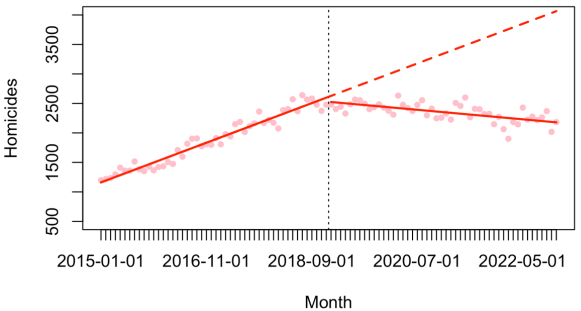
The results presented below (Table 1) indicate that, at the national level, Mexico experienced a significant reduction in the level of intentional homicides (-65.91) following the implementation of the JCF program, and this decrease was statistically significant. Additionally, there was a substantial (-37.89) and statistically significant reduction in the trend of intentional homicides. The analysis suggests that homicide rates stopped increasing nationwide after the implementation of the JCF program, with the trend shifting from a previously upward trajectory to a slightly downward course. This pattern is illustrated in Graph 1. According to these initial findings, the program appears to have been effective in reducing both the level and trend of intentional homicides at the national level. However, further analysis is necessary to determine whether this reduction may have been influenced by other factors unrelated to the program.
Table 1. Interrupted Time Series Analysis at the National Level (Change in Intentional Homicide)
| Variable | Coefficient |
|---|---|
| Time | 30.558 (0.96821)* |
| Level | -65.9123 (38.63941) |
| Trend | -37.8962 (1.32587)* |
| Constant | 1130.9875 (27.04660)* |
| AIC | 1165.229 |
| BIC | 1193.436 |
| LogLik | -571.6143 |
Source: Own elaboration with data of SESNSP (2023).
*Significant at the 1% level (p ( )0.01) | Sample size = 96
Data in brackets are standard errors.
Source: Own elaboration with data of SESNSP (2023).
Graph 1. Interrupted Time-Series at the National Level
Interrupted Time-Series Model for Coahuila with Baja California as Control Group
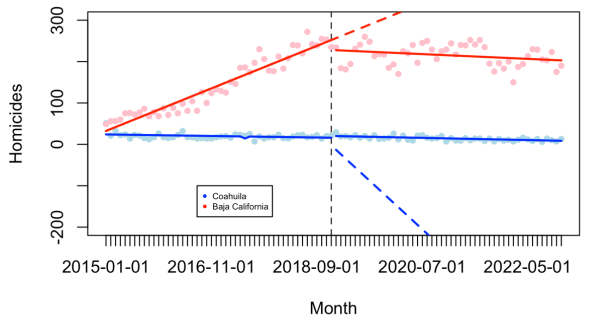
The model results indicate a slight increase in the level of intentional homicides in Coahuila (28.31) compared to Baja California following the implementation of the JCF program, which is statistically significant (p = 0.02). This finding contradicts the hypothesis that the JCF program would reduce violence, as Coahuila ranks as the fourth state with the highest average number of yearly beneficiaries per capita, whereas Baja California has the lowest average number of yearly beneficiaries per capita in the country.
Additionally, compared to Baja California, Coahuila exhibited a slight increase in the trend of homicides (5.12), which was also statistically significant (p = 0.00), further diverging from expectations. Despite these observed increases in homicide levels and trends in Coahuila after the program’s implementation, the magnitude of these changes is relatively small. This may be explained by the fact that Coahuila already had low and stable homicide levels before the program, whereas Baja California had high and increasing homicide rates. Consequently, the program faced greater challenges in achieving homicide reductions in Coahuila due to its initially low levels, while other factors may have contributed to the stabilization of homicides in Baja California.
Table 2 below presents the results of the interrupted time-series model for Coahuila, using Baja California as the control group. Even though the observed changes in homicide levels and trends contradict the hypothesis that the implementation of a program like JCF would reduce intentional homicides, specific conditions—such as Coahuila’s previously low homicide levels and the stabilization of intentional homicides in Baja California due to other potential factors—may be influencing the model’s results. This pattern is illustrated in Graph 2.
Table 2. Interrupted Time Series Analysis for Coahuila with Baja California as Control Group
| Variable | Coeficiente |
|---|---|
| Time | 4.671758 (0.237909)* |
| Coahuila | -3.647751 (9.584235) |
| Coahuila time | -4.840970 (0.336202)* |
| Level | -24.025106 (8.982070)* |
| Trend | -5.193916 (0.343329)* |
| Coahuila level | 28.308631 (12.695513)* |
| Coahuila trend | 5.120774 (0.485346)* |
| Constant | 27.734775 (6.776609)* |
| AIC | 1575.833 |
| BIC | 1621.438 |
| LogLik | -773.9167 |
Source: Own elaboration with data of SESNSP (2023).
*Significant at the 5% level (p()0.05) | Sample size = 192
Data in brackets are standard errors.
Source: Own elaboration with data of SESNSP (2023).
Graph 2. Interrupted Time-Series for Coahuila with Baja California as Control Group
Interrupted time-series model for Tabasco with Chiapas as control group
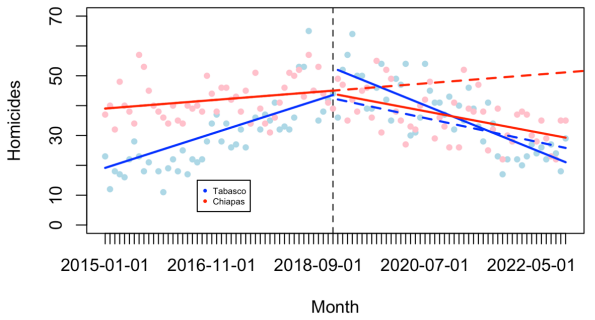
The model results (Table 3) indicate a statistically significant increase in the level of homicides (10.81) in Tabasco compared to the control group, Chiapas, following the implementation of the JCF program. However, the trend in intentional homicides in Tabasco showed a statistically significant reduction (-0.75) since the program’s implementation when compared to Chiapas.
Table 3. Interrupted Time Series Analysis for Tabasco with Chiapas as Control Group
| Variable | Coeficient |
|---|---|
| Time | 0.12543 (0.077154) |
| Tabasco | -19.95651 (3.041408)* |
| Tabasco time | 0.37883 (0.109112)* |
| Level | -1.05587 (3.098288) |
| Trend | -0.43130 (0.105627)* |
| Tabasco level | 10.81220 (4.381640)* |
| Tabasco trend | -0.74587 (0.149380)* |
| Constant | 38.97949 (2.150600)* |
| AIC | 1434.625 |
| BIC | 1486.745 |
| LogLik | -701.3124 |
Source: Own elaboration with data of SESNSP (2023).
*Significant at the 5% level (p()0.05) | Sample size = 192
Data in brackets are standard errors.
This latter finding supports the hypothesis that the JCF program would reduce homicide trends, as Tabasco has the highest average number of yearly program beneficiaries in the country, whereas Chiapas ranks as the fourth state with the lowest number of beneficiaries. However, the increase in homicide levels contradicts the hypothesis and may be attributed to a temporary peak in homicides in Tabasco that coincided with the program’s launch.
In summary, the results confirm that the implementation of the program reduced the homicide trend in Tabasco compared to Chiapas. However, this effect was not observed in homicide levels, as a peak in homicides in Tabasco coincided with the program’s launch. Notably, both states experienced a reduction in intentional homicide trends after the program’s implementation, with the treatment group exhibiting a greater decline. This outcome aligns with the hypothesis that the JCF program would contribute to reducing intentional homicides. This pattern is illustrated in Graph 3.
Source: Own elaboration with data of SESNSP (2023).
Graph 3. Interrupted Time-Series for Tabasco with Chiapas as Control Group
RESULTS OF THE REGRESSION ANALYSIS
Before drawing conclusions, it is essential to compare the results of the interrupted time-series models with those of the regression analysis, which examines the relationship between the annual average number of JCF beneficiaries and intentional homicide rates, as well as the relationship between the annual average number of JCF beneficiaries and changes in crime rates.
Relationship Between Homicides and JCF
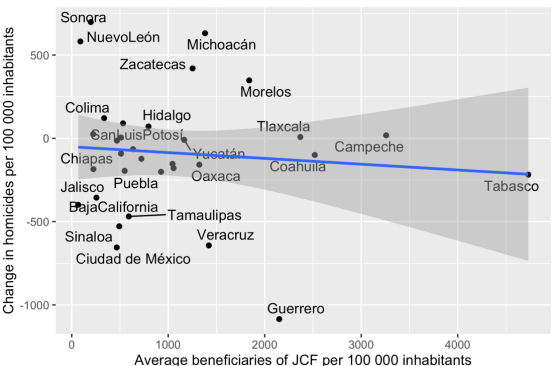
The first regression analysis examines the relationship between the number of JCF beneficiaries in each of the 32 states and the change in homicide rates. The number of JCF beneficiaries is measured as the average rate per 100,000 inhabitants for each state from 2019 to 2021. The change in intentional homicides is defined as the difference in homicide rates per 100,000 inhabitants between 2019 and 2021.
As shown in Table 4, states with a higher number of JCF beneficiaries experienced a slightly greater reduction in intentional homicides (-0.02); however, this effect is not statistically significant. Additionally, the number of beneficiaries does not account for the variance in intentional homicides. This pattern is illustrated in Graph 4.
Table 4. Results of the Regression Analysis for Average JCF Beneficiaries and Change in Homicides
| Variable | Coeficient |
|---|---|
| JCF | -0.02199 (0.04565) |
| Constant | -52.21852 (99.96348) |
| Adjusted R-Squared | -0.0254 |
| F-Statistic | 0.2321° |
Source: Own elaboration with data of STPS (2023) and SESNSP (2023).
°On 1 and 30 dF | Sample size = 32
Data in brackets are standard errors.
Source: Own elaboration with data of STPS (2023) and SESNSP (2023).
Graph 4. Relation Between Homicides and JCF
According to these results, the number of JCF beneficiaries has no significant relationship with changes in intentional homicide rates across Mexico’s states. This finding contradicts the hypothesis that the implementation of the program would lead to a reduction in intentional homicides.
Relation Between Crimes and JCF
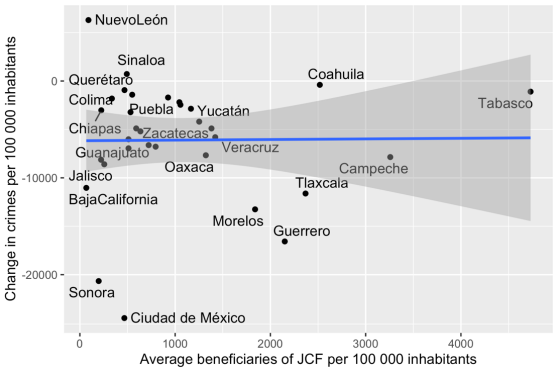
This second regression analysis examines the relationship between the number of JCF beneficiaries in each state and the change in crime rates. The number of JCF beneficiaries is measured as the average rate per 100,000 inhabitants for each state between 2019 and 2021, while the change in crime rates is defined as the difference in crime rates per 100,000 inhabitants between 2019 and 2021.
As shown in Table 5, states with more JCF beneficiaries experienced a slight increase in crime rates (0.00631); however, this effect is not statistically significant. Additionally, the number of beneficiaries does not account for the variance in crime rates. This pattern is illustrated in Graph 5.
Table 5. Results of the Regression Analysis for Average JCF Beneficiaries and change in crime
| Variable | Coeficiente |
|---|---|
| JCF | 0.06318 (1.107) |
| Constant | -6168 (1621) |
| Adjusted R-Squared | -0.03322 |
| F-Statistic | 0.003258° |
Source: Own elaboration with data of STPS (2023) and INEGI (2023).
°On 1 and 30 dF | Sample size = 32
Data in brackets are standard errors.
Source: Own elaboration with data of STPS (2023) and INEGI (2023).
Graph 5. Relation Between Crimes and JCF
Consistent with the results of the previous regression models, the number of JCF beneficiaries has no significant relationship with changes in crime rates across Mexico’s states. This finding contradicts the hypothesis that the implementation of the program would lead to a reduction in crime and violence.
CONCLUSIONS
The research findings allow for several important conclusions regarding the impact of the JCF program on intentional homicides and crime in Mexico. When examining the national-level evolution of intentional homicides, it appears that the program contributed to significant reductions in both the level and trend of homicides. This outcome aligns with the hypothesis that a program addressing risk factors—particularly the lack of opportunities for youth—could reduce intentional homicides in contexts like Mexico.
This result is also consistent with much of the literature from the United States, which indicates that subsidized job programs for youth, particularly those that integrate employment with mentorship or psychological support, lead to significant reductions in violent crime. According to studies conducted in Anglo-Saxon contexts, employment and training programs for youth have been effective in reducing violent crimes, though they have not been shown to decrease other types of crime. The initial analysis presented here suggests that efforts to provide job opportunities, training, and income to young populations in Mexico may support the effectiveness of strategies focused on risk factor reduction—particularly economic risk factors—in curbing gun-related violence in the country.
However, when analyzing the data in greater depth using other methods—such as interrupted time-series and regression analysis—at the state level, the results do not support the premise that the JCF program effectively reduces intentional homicides or crime. While national-level findings suggest reductions in the level and trend of intentional homicides following the program’s implementation and a significant decline in the homicide trend in Tabasco compared to Chiapas, the interrupted time-series analysis for Coahuila, with Baja California as the control group, contradicts these results.
Moreover, the regression analysis examining the relationship between the number of JCF beneficiaries at the state level and changes in intentional homicide rates found no significant association between these variables. Similarly, the regression analysis assessing the relationship between the number of JCF beneficiaries at the state level and changes in overall crime rates also found no significant relationship. The number of JCF beneficiaries per capita in a state does not explain the variance in intentional homicides or crime rates.
Therefore, the findings do not support the hypothesis that the implementation of the JCF program contributed to a reduction in intentional homicides. Further research could explore the underlying causes of the slight national-level reduction in homicide levels and trends, which coincided with the program’s implementation but appears unrelated to it.
It is important to note that several studies (Sumano & Medina, 2022; Sumano, 2023) have shown that the COVID-19 pandemic and the associated confinement measures led to a reduction in certain crimes, such as vehicle theft, home burglaries, and business assaults. Conversely, confinement measures resulted in an increase in domestic violence in most cases.
However, the use of interrupted time-series analysis with control groups helps account for such fluctuations in the dependent variable that may be caused by external interventions unrelated to the program of interest. Therefore, the effects of the COVID-19 pandemic on crime and violence have been controlled for within the applied methods. Additionally, various analyses have indicated that the pandemic did not significantly influence homicide rates in Mexico (Huichol85, 2020). Our own exploratory analysis on this subject supports this conclusion.
A first conclusion drawn from this analysis is that while intentional homicide levels and trends showed reductions following the implementation of the JCF program at the national level, these reductions appear to be associated with external factors unrelated to the program. There is no observable correlation between the implementation of the program and reductions in intentional homicides. Therefore, the findings of this study do not support the hypothesis that the JCF program contributed to a decrease in intentional homicides. Further research could explore the underlying causes of this coincidental national-level reduction in homicides.
A second conclusion is that, despite the lack of conclusive evidence supporting a positive effect of the JCF program on intentional homicides, this does not necessarily suggest that the program should be discontinued. While the program appears to have no impact on intentional homicides, it does not cause harm and may provide other benefits to the youth population. Future studies could examine the broader impact of the JCF program on other variables beyond intentional homicides.
There is substantial evidence supporting the effectiveness of targeting prevention programs toward individuals most at risk (Abt, 2019). Additionally, the literature suggests that outreach programs combining cognitive-behavioral therapy with economic assistance for youth exhibiting antisocial behaviors tend to yield positive results in reducing crime and violence (Blattman, 2022). It is possible that the universal approach of the JCF program limits its ability to reach the youth most at risk of involvement in violence and crime. Furthermore, addressing economic risk factors alone may not be sufficient to achieve meaningful reductions in homicides.
From a public policy perspective, these findings should not be interpreted as justification for discontinuing the program. As previously mentioned, the JCF program does not cause harm and may provide other benefits to youth. In many urban areas of Mexico, violence is highly concentrated among a small group of young men involved in conflicts between rival groups. These individuals often experience trauma and frequently occupy roles as both victims and perpetrators. A revised version of the JCF program that specifically targets youth at the highest risk and incorporates a cognitive-behavioral therapy component may yield better outcomes in reducing crime and violence. Additionally, focusing the program more explicitly on addressing the recruitment of young men by criminal organizations—through the development of targeted policy tools—could enhance its effectiveness in mitigating violence.
Further studies could investigate the factors contributing to the national-level reductions in intentional homicide levels and trends. While homicide rates in Mexico remain high compared to other countries, they have declined significantly in certain areas, such as Mexico City. Understanding the effectiveness of social programs and outreach strategies in the Mexican context could provide valuable insights for governments across Latin America, equipping them with better tools to address the pervasive violence crisis affecting many of their communities.

