




 nueva página del texto (beta)
 Inglés (pdf)
 Artículo en XML
 Referencias del artículo
 Traducción automática
 Enviar artículo por email
 Citado por SciELO
  Similares en
SciELO
Similares en
SciELO 
 Permalink

Introduction
Pachyphytum Link, Klotzsch & Otto (Link et al., 1841) is a genus in the Crassulaceae family with 26 described species, all of them endemic to Mexico, with the state of Guanajuato hosting the highest number of species (nine), including at least four that are endemic to its territory (Hernández-Campos et al., 2025). This genus comprises plants with a generally suffruticose habit, hanging succulent rosettes, cincinnus-shaped lateral inflorescences, flowers characterized by a calyx of five sepals united at the base and appressed to the corolla, and two finger-like appendages inside each petal (Thiede, 2003). A revision of Pachyphytum in Guanajuato state was included in the corresponding Flora del Bajío y de regiones adyacentes treatment (Pérez-Calix, 2008). However, since that publication, new species such as P. confusum Pérez-Calix, Guadián-Marín & I. García (Pérez-Calix et al., 2018), P. viscidum Reyes & de la Cruz-López (Reyes-Santiago et al., 2019), P. meyranii H. Montero, J. Reyes & R. Raya (Montero-Corrales et al., 2025) and P. angustiflorum H. Montero, D. Hernández & A. Gasca-Prieto (Hernández-Campos et al., 2025) have been described from this state.
As the area surrounding Guanajuato, including Hidalgo, Querétaro and San Luis Potosí, has been reported as an important center of endemism for Crassulaceae species by Castro-Castro et al. (2023) and Sosa et al. (2020), explorations in the Sierra de Puruagua within Guanajuato state were conducted in order to have a better understanding of the diversity of Crassulaceae family in this region. This led to the discovery of a plant that, due to its characteristics, belongs to the genus Pachyphytum, but it did not fit well within the variation and distribution of known species. Flowering plants were photographed, collected and morphologically characterized to compare with similar species, concluding that it represents a species new to science.
The objectives of this work were to 1) describe Pachyphytum theodactylum as a new species to science, 2) explore and discuss its morphological affinities with similar taxa, 3) assess its conservation status, 4) provide a distribution map, and 5) present an identification key for the species of Pachyphytum in the state of Guanajuato.
Materials and Methods
During 2023, the authors conducted fieldwork across multiple localities in Guanajuato state aiming to record new places where members of the Crassulaceae family might grow. One of those explorations, near El Chilarillo in the Sierra de Puruagua, led to the discovery of a Pachyphytum species that did not match well with any known species. Subsequent surveys in the next months were conducted in nearby ravines to collect flowering specimens, document morphological variation, phenology, habitat and search for additional populations of this species.
Morphological characterization was performed using fresh material, following the criteria of Pérez-Calix et al. (2018), in order to accurately document measurements, shape and color traits, often lost during drying and preservation for herbarium deposition. The collected material was processed and mounted as herbarium specimens, which will be deposited in the herbaria IBUG and ZON (acronyms following Thiers, 2024).
A morphological comparative analysis was performed reviewing specialized literature (Meyrán and López, 2003; Pérez-Calix, 2008) and specimens deposited in the herbaria IBUG and MEXU (Thiers, 2024), as well as those available on the platform Red de Herbarios Mexicanos (RHM, 2024), to determine the morphologically and geographically closest species. The analysis revealed that P. garciae Pérez-Calix & Glass and P. rzedowskii I. García, E. Pérez-Calix & Meyrán are the most similar taxa. The identification key was elaborated based on specialized literature (Meyrán and López, 2003; Pérez-Calix, 2008). Some measurements and qualitative characters not included in their protologues were obtained from cultivated individuals originating from their respective type localities: El Zapote, Peñamiller, Querétaro for P. garciae and Cerro de la Víbora, Tuxpan, Michoacán for P. rzedowskii.
The conservation status was assessed using the GeoCAT tool (Bachman et al., 2011) to calculate the Extent of Ocurrence (EOO) and Area of Occupancy (AOO), adhering to the IUCN (2022) criteria. The distribution map was generated using QGIS v. 3.34.9 software (QGIS, 2023), incorporating a layer of biogeographic provinces proposed by Morrone et al. (2017) to contextualize the species distribution within a broader ecological framework.
Results
Taxonomy
Pachyphytum theodactylum E. Carreño, A. Gasca-Prieto, Quirarte & J. Caltzonzi sp. nov. Figs. 1, 2.
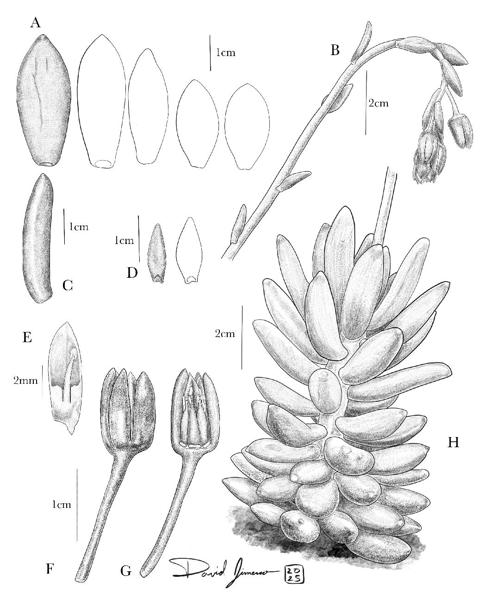
Figure 1: Pachyphytum theodactylum E. Carreño, A. Gasca-Prieto, Quirarte & J. Caltzonzi. A. variation in leaf shape; B. lateral view of the inflorescence; C. lateral view of a leaf; D. adaxial and abaxial faces of the peduncle bracts; E. inner face of the petal; F. lateral view of the flower; G. inner parts of the flower; H. lateral view of a rosette. Illustration based on E. A. Carreño-Plascencia et al.7 (IBUG), by H. David Jimeno Sevilla.
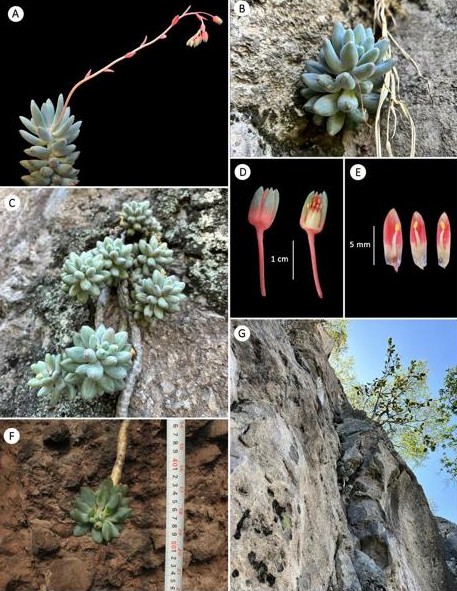
Figure 2: Pachyphytum theodactylum E. Carreño, A. Gasca-Prieto, Quirarte & J. Caltzonzi. A. habit; B. upper-lateral view of a solitary rosette; C. pendant rosettes growing ona vertical slope of extrusive igneous rocks; D. lateral view of the flower (left) and the inner parts of it (right); E. inner face of the petals; F. rosette with a long stem; G. habitat. Photos by Emmanuel Carreño Plascencia and Aureliano Gasca Prieto.
TYPE: MEXICO. Guanajuato, municipio Jerécuaro, a 3.5 km al norte de Puruagua, por el camino hacia El Chilarillo, 2320 m, bosque de pino-encino, 2.III.2025, E. A. Carreño Plascencia et al. 7 (holotype: IBUG!, isotype: ZON!, to distribute).
Pachyphytum theodactylum is morphologically close to P. garciae, but it differs from the latter in its stems dimensions, which reach up to 56 × 1.3 cm (vs. up to 40 × 0.6 cm); peduncle bracts ovate-lanceolate with apex acute (vs. obovate to elliptic with a rounded to obtuse apex); pedicel length of 1.4-2 cm (vs. 0.3-0.8 cm); sepals pink in the basal half and olive-green in the upper half (vs. yellowish in the basal half and greenish in the upper half); sepals with acute apex (vs. rounded to obtuse); antesepalous stamens 0.6 cm long (vs. 1 cm); and styles pink (vs. yellow to reddish near the stigma).
Plants perennial, subshrubby, glabrous, erect to pendant; roots fibrous; stem up to 56 cm long, 1.3 cm in diameter, smooth, with irregular diamond-shaped scars, ochre to grayish in color, branched from the base; rosettes lax, 6-8 cm diameter, with 21-43 leaves, spirally arranged, clustered near the stem apex; leaves 1.5-3.5 cm long, 0.7-1.1 cm wide, 0.6-0.9 cm thick, elliptic-lanceolate to oblong-elliptic in outline, subcylindrical in cross section, the upper ones ascending, the basal ones spreading, bluish-green, pruinose, glaucous, apex acute, rounded or obtuse, sometimes smoothly mucronulate, paler to purplish with age; inflorescence a cincinnus, 1 per rosette, 10-25 cm long; peduncle to 20 cm long, 0.4 cm wide at the base, peach-pink in color; peduncle bracts 6-9, 1.3-1.4 cm long, 0.4-0.6 cm wide, ovate-lanceolate, apex acute, base sagittate, appressed in young peduncle, ascending during anthesis, spirally arranged, pink with violet hues near the apex, persistent, pruinose; cincinnus 5-9 cm long at the end of flowering, glaucous to pinkish, with 3-12 flowers; pedicels 1.4-2 cm long, 0.1 cm in diameter, cylindrical, turbinate, pink; calyx slightly longer than the corolla, 0.5-0.6 cm wide; sepals 5, unequal, 0.9-1 cm long, 0.3-0.5 cm wide, 0.1 cm thick, oblong-lanceolate to lanceolate, apex acute, bicolored, pink in the basal half, olive-green in the upper half, slightly pruinose, appressed to the corolla, fused at the base; corolla subcampanulate, equal to or 0.1 cm shorter than the calyx; petals 5, 0.8-0.9 cm long, 0.2-0.25 cm wide, oblong-lanceolate, apex acute, shortly mucronate, free at the base, imbricate in the upper second third, ascending, pale yellow in the basal half, pink in the upper half, hyaline, with an irregular reddish-pink spot in the upper half of the inner face, slightly pruinose on both surfaces; appendages 2, parallel on each side of the epipetalous stamens, truncate, 1.0-1.5 mm long, pink, hyaline; stamens 10, antisepalous 5, 0.6 cm long, epipetalous 5, 0.4-0.5 cm long, inserted approximately at the middle of the petal, whitish, pinkish near the apex, hyaline; nectary scales 1.8 mm wide, narrowly elliptic-lunulate; carpels 5, erect, 0.6-0.7 cm long, pale yellow; styles 0.2 cm long, pink; stigmas capitate, green; fruits polyfollicular, dehiscing longitudinally in a star-like pattern, brown; seeds 0.5 mm long, reddish-brown.
Habitat and distribution: Pachyphytum theodactylum to date has only been recorded in its type locality, in the Sierra de Puruagua, where it grows exclusively in ravines on vertical slopes of extrusive igneous rocks with a western exposure at an elevation of 2320 m. The vegetation in the area corresponds to a pine-oak forest, with an arboreal stratum composed of Arbutus tessellata P.D. Sørensen, Clethra mexicana DC., Pinus teocote Schied. ex Schltdl. & Cham., Quercus crassifolia Bonpl., and Q. laeta Liebm. In the shrub layer, species such as Croton adspersus Benth., Lobelia laxiflora Kunth, Loeselia mexicana (Lam.) Brand, Montanoa grandiflora Alamán ex DC., Stevia lucida Lag., and Verbesina virgata Cav. are present. Additionally, some rupicolous species growing on the same slope are Laelia autumnalis (Lex.) Lindl., Phlebodium pseudoaureum (Cav.) Lellinger, and Pleopeltis polypodioides (L.) E.G. Andrews & Windham.
Phenology: inflorescences begin to emerge in late December, with the first flowers blooming by the end of February and dehiscent fruits appearing by late March.
Etymology: the species name theodactylum is derived from the Greek words theos meaning “god” and dactylos meaning “finger”, reflecting the common name “deditos de dios” (fingers of God) by which this species is known.
Preliminary conservation status: Pachyphytum theodactylum has only been collected from its type locality, occupying a highly specific ecological niche. It is estimated that this population consists of fewer than 20 mature individuals. The low abundance of specimens represents a threat to its short- and medium-term survival due to potential collection pressures or natural disasters. The results of the AOO (4 km2) and EOO (0 km2), together with the IUCN (2022) criteria B1ab(iii) + B2ab(iii), suggest that P. theodactylum should be provisionally treated under the Critically Endangered (CR) category.
Discussion
Pachyphytum garciae is the species most morphologically similar to P. theodactylum. However, the latter has longer and more robust stems, reaching up to 56 cm in length and 1.3 cm in diameter. The bracts of the new species are longer, ovate-lanceolate with an acute apex, and its pedicels are also longer. The sepals exhibit a pink coloration in the basal half and olive-green in the upper half, with an acute apex. In other floral structures, the appendages are generally paler, the antisepalous stamens shorter, and the styles pink (Table 1).
Table 1: Comparative table between Pachyphytum theodactylum E. Carreño, A. Gasca-Prieto, Quirarte & J. Caltzonzi and related species.
| Pachyphytum theodactylum | Pachyphytum garciae | Pachyphytum rzedowskii | |
| E.Carreño, A. Gasca-Prieto, | Pérez-Calix & Glass | I.García, Pérez-Calix & | |
| Quirarte & J. Caltzonzi | Meyrán | ||
| Stem dimensions (cm) | Up to 56 × 1.3 | Up to 40 × 0.6 | Up to 30 × 1-1.5 |
| Leaf shape | Elliptic-lanceolate to oblong-elliptic | Elliptic, elliptic-oblanceolate, obovate or obovate-spatulate | Obovate to oblanceolate |
| Leaf apex shape | Acute, rounded or obtuse, sometimes smoothly mucronulate | Widely acute | Acute, mucronulate |
| Leaf color | Bluish green | Bluish green | Pinkish at the base, grayish to bluish in the middle and pale pink at the apex |
| Leaf apex pigmentation | Pale bluish green to purplish | Purplish | Light green |
| Peduncle bracts shape | Ovate-lanceolate | Obovate to elliptic | Ovate-lanceolate to ovate-elliptic |
| Peduncle bracts apex | Acute | Rounded to obtuse | Subacute |
| Pedicel length (cm) | 1.4-2 | 0.3-0.8 | 0.3-0.8 |
| Sepal color | Pink in the basal half, olive green in the upper half | Yellowish in the basal half, greenish in the upper half | Green to whitish yellow in the basal half, bluish green close to the apex |
| Sepal apex | Acute | Rounded to obtuse | Subacute to acute |
| Petal color | Pale yellow in the basal half, pink in the upper half | Yellowish in the basal half, pink in the upper half | Pale green in the basal half, bluish green in the upper half |
| Spot in the inner face color | Reddish-pink | Dark pink | Scarlet red |
| Appendages color | Pink hyaline | Reddish | Scarlet red |
| Antisepal stamens lenght (cm) | 0.6 | 1 | 0.6-0.7 |
| Style color | Pink | Yellow to reddish close to the stigma | Reddish brown |
| Vegetation type | Pine-oak forest | Submontane scrubland | Tropical deciduous forest |
| Elevation (m a.s.l.) | 2320 | 1600 | 1800-2150 |
| Biogeographic province | Chihuahuan desert | Sierra Madre Oriental | Trans-Mexican Volcanic Belt |
Pachyphytum theodactylum is also morphologically similar to P. rzedowskii, but can be distinguished by the longer stems in the former. Its leaves are elliptic-lanceolate to oblong-elliptic in outline with a bluish-green color, the peduncle bracts are also longer and elliptic-lanceolate in shape, and the pedicels are comparatively longer. The sepals are pink at the base and green at the top, the petals are pale yellow at the base, turning pink at the top, with a pink spot on the inner side. Finally, the appendages and styles of P. theodactylum are pink (Fig. 3).
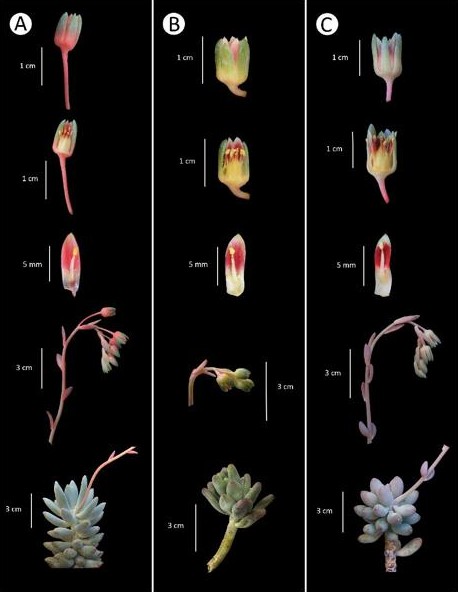
Figure 3: Comparative sheet between the new species and related taxa. A. Pachyphytum theodactylum E. Carreño, A. Gasca-Prieto, Quirarte & J. Caltzonzi; B. Pachyphytum garciae Pérez-Calix & Glass; C. Pachyphytum rzedowskii I.García, E. Pérez-Calix & Meyrán. From top to bottom: lateral view of the flower, gynoecium, inner side of the petal, inflorescence and rosette. Photographs by Aureliano Gasca Prieto, Emmanuel Carreño Plascencia and Jaime Quirarte.
Current phylogenetic evidence confirms that Pachyphytum is a monophyletic genus (de la Cruz-López et al, 2019). However, it also suggests that its traditional division into sections Pachyphytum Moran and Diotostemon (Salm-Dyck) Walther represents artificial groupings. Studies by García-Ruíz (2003) and Carrillo-Reyes et al. (2009) have recovered mixed assemblages of species from both sections, while the work of de la Cruz-López et al. (2019) identified these groups as a polytomy. Despite the challenges of proposing infrageneric classifications within Crassulaceae based on molecular evidence, morphological-based sections and series remain useful tools for species identification (Rosales-Martínez and Hernández-Campos, 2023). Following Thiede’s (2003) sectional proposal, P. theodactylum is assigned to sect. Pachyphytum due to its imbricate bracts in the young cincinnus, corolla slightly shorter than the calyx and the presence of a pink spot on the inner face of the petals. The new species stands out from other members of sect. Pachyphytum by the pink spot on the inner face of the petals, whereas in other species it is typically darker, and by its long pedicels, which can measure up to 2 cm, a feature characteristic of the sect. Diotostemon.
As noted by Castro-Castro et al. (2023), most species of Pachyphytum have a narrow distribution, often restricted to a single biogeographical province. The Chihuahuan Desert province stands out for its richness in this genus, as 16 species occur here, including the one described in this study. Morphologically similar species to P. theodactylum also follow this distribution pattern, with P. garciae restricted to the Sierra Madre Oriental and P. rzedowskii to the Trans-Mexican Volcanic Belt (Fig. 4). Ecological preferences among this group of species are also evident. Pachyphytum theodactylum is found in pine-oak forests at 2360 m above sea level, while P. garciae grows in submontane scrub at 1600 m, and P. rzedowskii inhabits tropical deciduous forests within an elevational range of 1800 to 2150 m.
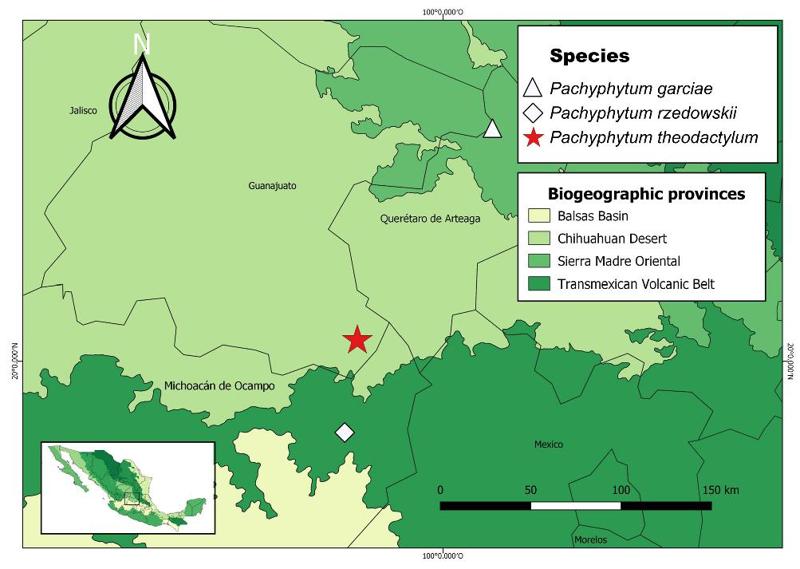
Figure 4: Distribution map of Pachyphytum theodactylum E. Carreño, A. Gasca-Prieto, Quirarte & J. Caltzonzi and related species on a layer of biogeographic provinces sensuMorrone et al. (2017).
The new species is provisionally assessed to the status of CR (Critically Endangered), as it is currently known from a single population comprising few individuals, restricted to a specialized habitat. Wildfires are recurrent in this area during the annual dry season, posing an ongoing threat to the survival of P. theodactylum and the ecosystem it inhabits. Continued exploration in areas with similar environmental conditions is recommended in search of additional populations, along with the planning and eventual implementation of both in situ and ex situ conservation measures. Below we present an identification key for the Pachyphytum species of the state of Guanajuato.
Key to the species of Pachyphytum in Guanajuato
1a. Corolla longer than the calyx ..................................... 2
1b. Corolla equal to or shorter than the calyx .................. 7
2a. Young stems glutinous near the rosette ....................... P. viscidum Reyes & de la Cruz-López
2b. Young stems not glutinous ......................................... 3
3a. Leaves with whitish semi-arc patterns ...................................................... P. compactum Rose
3b. Leaves without whitish semi-arc patterns ................. 4
4a. Petals uniformly colored ............................................ 5
4b. Petals bicolored ......................................................... 6
5a. Petals bright yellow ............................................ P. meyranii H. Montero, J. Reyes & R. Raya
5b. Petals dark pink to reddish ............................................. P. hookeri (Salm-Dyck) A. Berger
6a. Petals yellowish at base and reddish at apex, without red spot on inner surface …………………………………………………………………………………... P. brevifolium Rose
6b. Petals pale yellow at base, greenish yellow close to the apex, with a red spot on inner surface .......................................................... P. angustiflorum H. Montero, D. Hernández & A. Gasca-Prieto
7a. Leaves glaucous, pruinose ................................................................................................................... P. theodactylum E. Carreño, A. Gasca-Prieto, Quirarte & J. Caltzonzi
7b. Leaves neither glaucous nor pruinose ....................... 8
8a. Leaves cylindrical or subcylindrical in cross section …………………... P. viride E. Walther
8b. Leaves not cylindrical or subcylindrical in cross section .................................................... 9
9a. Sepals uniformly colored in glaucous green .............................................. P. fittkaui Moran
9b. Sepals bicolored, pink in the base and olive green in the upper portion .............................................................. P. confusum Pérez-Calix, Guadián-Marín & I. García

