




 nueva página del texto (beta)
 Inglés (pdf)
 Artículo en XML
 Referencias del artículo
 Traducción automática
 Enviar artículo por email
 Citado por SciELO
  Similares en
SciELO
Similares en
SciELO 
 Permalink

Introduction
The genus Polycarpon L. (Caryophyllaceae), as traditionally circumscribed, includes about 16 species which are distributed in tropical and temperate regions of the world (Iamonico and Domina, 2015). The studies by Kool et al. (2007) demonstrated the polyphyly of this genus using DNA sequence data from the chloroplast rps16 intron and nuclear RPB2 regions, highlighting three different clades with high support values, i.e. 1) the P. coquimbense suffruticosum aggregate (from South America), 2) P. prostratum (Forssk.) Asch. & Schweinf. (tropical, widespread), and (3) the P. tetraphyllum aggregate (main diversity in the Mediterranean region). The first two clades must be excluded from Polycarpon since their members lack the synapomorphy for this genus, i.e. the capsule dehiscence by valves that elastically roll inwards. On the one hand, P. coquimbense Gereau & Martic. and P. suffruticosum Griseb., together with P. anomalum Hassl., were transferred by Iamonico (2015a) to the new genus Augustea Iamonico, endemic from South America (Argentina, Bolivia, Chile, and Paraguay). On the other hand, P. prostratum should be recognized under Polycarpaea Lam. The remaining members (Polycarpon sensu stricto) represent a polyploid complex that can be treated as a single species, P. tetraphyllum (L.) L. (see e.g., Kool et al., 2007; Hernández-Ledesma et al., 2015). Accordingly, Iamonico (2013, 2015b, c, d, 2017a), Iamonico and Domina (2015), and Iamonico and Zanotti (2022) proposed to recognize the various taxa at subspecies rank.
The flora of South America would comprise two Polycarpon species, i.e. P. tetraphyllum L. (with two subspecies: P. tetraphyllum subsp. apurense (Kunth) Iamonico & Zanotti and P. tetraphyllum subsp. tetraphyllum) and P. urbanianum Muschl. (see Iamonico and Zanotti, 2022; POWO, 2025).
As part of the ongoing studies on Polycarpon (e.g., Iamonico, 2015a, b, c, d, 2017a, b; Iamonico and Domina, 2015; Iamonico and Zanotti, 2022), which are part of the Caryophyllales Network project (coordinator: N. Korotkova, Freie Universität Berlin, Germany), we here present a note on the taxa occurring in South America. Specifically, a Polycarpon population found in the Apurímac region (southern-central Peru) displays morphological features which do not fit those of any other known taxon; accordingly, we here propose to describe a new taxon.
Material and Methods
The present research is based on field surveys, analysis of the relevant literature (including protologues), and search and examination of specimens (including types) preserved in the herbaria B, BM, COL, HOXA, HSP, HUT, MOL, P, PAL, RO, SI, U, USM, W, and WAG (herbarium acronyms according to Thiers ( 2025, continuously updated)).
The morphological characters were measured using both a millimeter ruler and Olympus SZX10 and NSZ-405 1X-4.5X stereomicroscopes (Olympus SZX10 Hachioji, Tokyo, Japan; NSZ-405 1X-4.5X, China). Other characters were evaluated under a Hitachi FESEM (Field Emission Scanning Electron Microscope, HI-0841-0001, Hitachi High-Tech Corporation, headquartered in Tokyo, Japan).
The Articles of the International Code of Nomenclature for Algae, Fungi, and Plants (hereafter reported as ICN; Turland et al., 2018).
The Conservation status for the new Polycarpon tetraphyllum subsp. peruvianus was proposed according to the criteria by IUCN (2016). Specifically, AOO and EOO were calculated using 2 × 2 km grid cells in the freeware QGIS program (QGIS Development Team, 2025).
Results
Three subspecies of Polycarpon tetraphyllum are recognized in South America, i.e. P. tetraphyllum subsp. apurense (from Argentina, Colombia, Paraguay, and Venezuela), P. tetraphyllum subsp. tetraphyllum (alien in most of the countries), and P. tetraphyllum subsp. peruvianum subsp. nov. (endemic to Peru). Polycarpon urbanianum, previously considered as a Peruvian endemic, is here demonstrated to be not a species of Polycarpon and has been proposed for a rejection by Iamonico and Montesinos-Tubeé (2025).
Polycarpon tetraphyllum (L.) L., Syst. Nat., ed. 10, 2: 881. 1759.
≡ Mollugo tetraphylla L., Sp. Pl. 1: 89. 1753.
TYPE: ITALY. Narbonia. Herb. Clifford 28, Mollugo 2 (lectotype (designated by Burtt and Lewis 1952: 339): BM000557701!; image of the lectotype available at JSTOR, 2025a).
Polycarpon tetraphyllum L. subsp. apurense (Kunth) Iamonico & C.A. Zanotti, Bonblandia 31(1): 93. 2022.
≡ Polycarpon apurense Kunth, Nov. Gen. Sp. 6: 40. 1823.
TYPE: VENEZUELA. Apure: In humidis rio Apure, III.1800, A. J. A. Bonpland 5534 (lectotype (designated by Iamonico and Zanotti, 2022: 93): P04925644!, image of the lectotype available at MNHN, 2025).
Polycarpon depressum sensu Rorhback (1872: 257) pro minima parte.
Polycarpon depressum sensuPedersen (1987: 268) pro minima parte.
Polycarpon depressum sensuGereau and Marticorena (1995: 152)pro minima parte.
Distribution and habitat: Argentina (Corrientes, Entre Ríos, Misiones), Colombia (Vichada), Paraguay (Department Central), Venezuela (Amazonas, Apure, Barinas, Bolivar, Delta Amacuro, Guayana), where it grows on riverbanks and humid places at elevation of 0-500 m (Fig. 1).
The subspecies’ presence is doubtful in Peru where Macbride (1937: 627) reported the species as occurring “Probably”. No specimens of P. tetraphyllum subsp. apurense collected in Peru were traced, but it is not impossible that the species could be present in this country.
Additional examined material: ARGENTINA. Corrientes, Empedrado, Estancia “Las Tres Marias”, on almost bare sands, foot of the bank of the Rio Paraná, about 1-2 m, 22.VIII.1951, Pedersen 1152 (P04925767). COLOMBIA. Vichada, Entrada del raudal San Borja, Ventanas, 17.III.1971, Pinto and Sastre 1323 (COL000401650). PARAGUAY, Asunción, distrito Santa María de la Asunción. Ribera del Río Paraguay, Itá Enramada, IX.1971, Schinini 3964 (SI). VENEZUELA, Amazonas, Pto. Ayacucho airport, 5°40'N 67°40'W, 100 m, sandy beach and adjacent laja, 03.IV.1984, Gentry and Stein 46280 (U1886783). Apure, distrito Pedro Camejo, 9 km directly, in a straight line WNW of Paso de Cinaruco Chalana along the banks of the Rio Cinaruco, 6°35'N 67°35'W, 60 m, sand bar with mostly annual herbs, 02.V.1977, Davidse and Gonzáles 12492 (L3751387); distrito Pedro Camejo, 2.5 km up-stream from the mouth of the Rio Campanaro at its junction with the Rio Orinoco directly west of Isla La Urbana, 7°10'N 76°3'W, 30 m, sand bar in river, 05.V.1977, Davidse and Gonzáles 12702 (WAG1396615). Barinas, a lo largo de los márgenes del Río Cáparo, entre campamento Cachicamo y Boca de Garza, este de El Cantón, 12.IV.1968, Steyermark 102274 (COL000401648). Guayana, Angustura, 1864, de Grosuordy 13 (P04325763); Caicara, 1864, de Grosuordy 13 (P04925762).
Polycarpon tetraphyllum L. subsp. peruvianum Montesinos & Iamonico, subsp. nov. Fig. 2.
TYPE: PERU. Huánuco, Yarowilca, Choras, Restos Arqueológicos de Garu, on rocky slopes with tussock grasslands, 3800 m, 7.V.2017, D. Montesinos 5451 (holotype: HSP!, isotypes: B 10 0761273!, HUT!, RO!).
Polycarpon tetraphyllum subsp. peruvianum is similar to P. tetraphyllum subsp. diphyllum (Cav.) O. Bolòs & Font Quer and P. tetraphyllum subsp. tetraphyllum, from which it differs by the shape of the stipules (triangular-acuminate vs. ovate to lanceolate and acute in the other two subspecies), the arrangement and colour of the leaves (green and mostly in whorls of 4 vs. purplish or reddish, the lower nodes opposite in P. tetraphyllum subsp. diphyllum), dense inflorescence (vs. lax in P. tetraphyllum subsp. tetraphyllum), length of the petals (1.5-2.0 mm long vs. 0.5-1.0 mm long in the other two subspecies), and number of stamens (5 vs. 3-4 in the other two subspecies). Moreover, the habitat is different, i.e. rocky and dry soils, whereas P. tetraphyllum subsp. diphyllum occurs in sandy soil (especially along seacoasts) and P. tetraphyllum subsp. tetraphyllum in typical disturbed-human-made areas.
Annual herb, (4-)5-13(-17) cm tall; stems ascending, glabrous or distally pubescent, branched; leaves mostly in whorls of 4, the distal ones sometimes opposite, shortly petiolate, green, blade ovate or obovate, 3-10 × 1-5 mm, not fleshy, sparsely ciliate, base cuneate, margin entire, apex obtuse, stipules 2, triangular, 0.9-2.5 mm long, as long as or longer than the peduncles of flowers, white-silvery scarious, apex acuminate, pubescent; inflorescences of dichasial terminal cymes densely flowered; flowers bisexual; sepals 5, ovate or lanceolate, 1.7-2.5 mm long, glabrous, keeled, margin whitish, membranous, apex acute and mucronate; petals 5, bilobed, 1.5-2.0 mm long, as long as the sepals or slightly shorter, white, apex obtuse; stamens 5, free, shorter than the sepals; anthers white; gynoecium with 1 pistil, 1 style and 3-loculed ovary, stigmas 5; loculicidal capsule ovoid, 1.9-2.1 × 1.5-1.7 mm, dehiscent by 3 twisting valves; seeds 40-50 per fruit, oblong, ca. 0.5 mm in diameter, brown, dorsally verrucose with cells more or less hexagonal, margins brown.
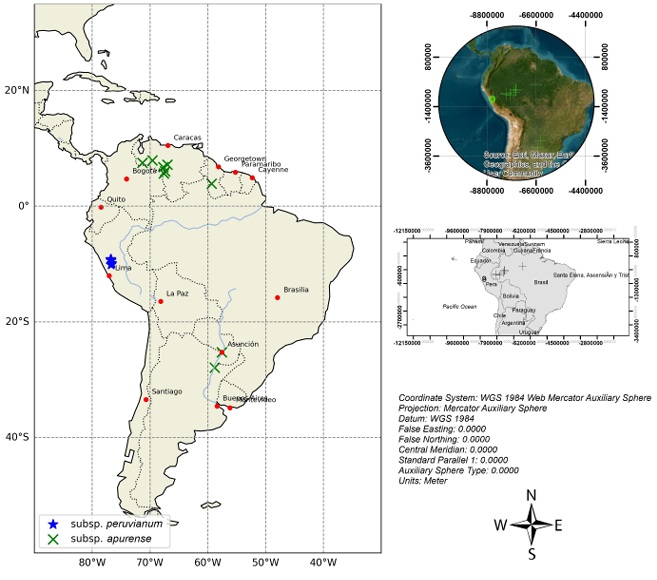
Figure 1: Distribution map of Polycarpon tetraphyllum subsp. apurense (Kunth) Iamonico & Zanotti and subsp. peruvianum Montesinos & Iamonico.
Etymology: the specific epithet is derived from the name of the country Peru, honoring its geographic origin. This designation highlights the species natural distribution within the Peruvian territory and acknowledges the nation’s rich biodiversity.
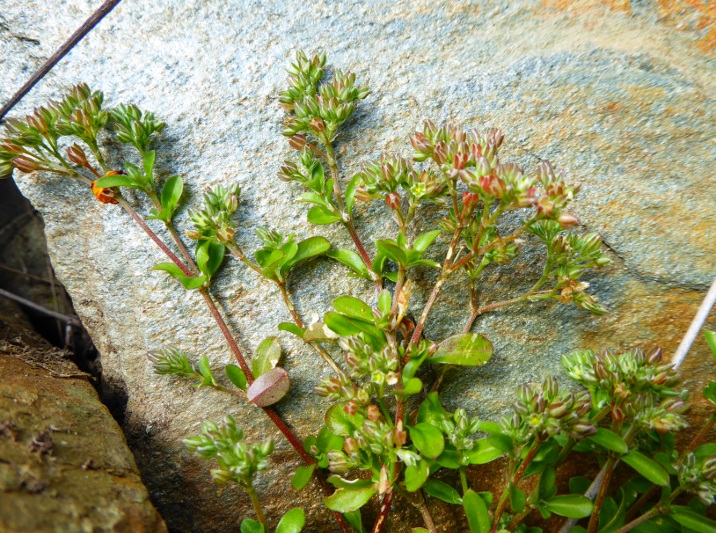
Figure 2: Polycarpon tetraphyllum subsp. peruvianum Montesinos & Iamonico from Huánuco (D. Montesinos 5451). Photo by D. Montesinos.
Distribution and habitat: endemic to Apurímac region (south Peru), where it grows in rocky and dry soils (Fig. 1).
Proposed vernacular name: Peruvian Manyseed (English), Yaku Qura, Paray Pacha Qura (quechua).
Preliminary conservation status: Polycarpon tetraphyllum subsp. peruvianum appears to be a common annual during the wet season in Peru, particularly in rocky and dry habitats. Field surveys and herbarium records indicate a stable and widespread presence across multiple localities in southern Peru. Based on available data, its Extent of Occurrence (EOO) is estimated to be approximately 12,000 km², whereas Area of Occupancy (AOO) is around 60 km². Based on criterion B1 (EOO is less than 20,000 km²), P. tetraphyllum subsp. peruvianum could be assessed as Vulnerable (VU).
Taxonomic notes: Polycarpon tetraphyllum subsp. peruvianum is the seventh annual Polycarpon subspecies to add to the currently recognized ones, i.e. P. tetraphyllum subsp. alsinifolium (Biv.) Iamonico & Domina (Mediterranean; Iamonico, 2017b)), P. tetraphyllum subsp. depressum (Nutt.) Iamonico (endemic to California; Iamonico, 2015b), P. tetraphyllum subsp. diphyllum (Mediterranean-Macaronesian; Iamonico, 2017b), P. tetraphyllum subsp. dunense (P.Fraga & Rosselló) Iamonico (endemic to the island Menorca (Baleares, Spain); Iamonico, 2015c), P. tetraphyllum subsp. arabicum (Boiss.) Iamonico (Eastern Mediterranean-Arabian area; Iamonico, 2017a), P. tetraphyllum subsp. tetraphyllum (Europe, North and North-eastern Tropical Africa, Middle east, India and Sri Lanka; Iamonico, 2017b; POWO, 2025).
Additional examined material: PERU. Áncash, Huánuco, Huamalies, Jircán, Road from Arancay to Jircán, 3220 m, 18.VII.2016, D. Montesinos 4713 (B 10 0745303, HSP, HUT, RO). Huamalies, Jircán, Tarapampa, 2775 m, 16.V.2017, D. Montesinos 5620 (B 10 0761258, HSP, HUT, MOL, RO). Huamalies, Tantamayo, Hospedaje Don Eladio de Tantamayo, 3526 m, 22.VII.2016, D. Montesinos 4775 (B 10 0745210, HSP, HUT, RO). Huari, Huacchis, Chucman Punta, 3250 m, 10.V.2017, D. Montesinos 5504 (B 10 0761267, HSP, HUSA, HUT, MO, MOL, RO, USM). Rapayán, Huashgo, 3120 m, 20.VII.2016, D. Montesinos 4747 (B 10 0745300, HSP, HUT, RO). Lauricocha, Baños, Chiquia, 3540 m, 19.V.2017, D. Montesinos 5660 (B 10 0761259, HUT, HSP, RO). Lauricocha, Jesús, Resto Arqueológico de Chiquia, 3540 m, 29.IV.2022, D. Montesinos 9381 (B 10 1228110, HOXA). Lima, Canta, Lachaqui, Taraca en camino hacia Arahuay, 3480 m, 29.VI.1998, G. Vilcapoma 4850 (MOL, USM).
Polycarpon tetraphyllum L. subsp. tetraphyllum
Distribution and habitat: central and southern Europe, western Asia, India, Sri Lanka, Macaronesia to north and eastern Africa where it grows mainly in human-made habitat. It is alien in western Canada and USA, widespread in South America, southern Africa, Japan, southeastern Australia and northern New Zealand.
Additional examined material: ALGERIA. Algiers, Alger, M. Brichi s.n. (RO). AUSTRALIA. New South Wales, Cumberland, near Sidney, s.d., Alameda Co., near North Hall, 24.IX.1906, W. A. Setchell coll. s.n. (RO). AUSTRIA. Wien, Bezirk Böcklinstraße 23 und Josef-Gall-Gasse, 04.VII.2010, R. Diran s.n. (W); 16, Bezirk, raum Konstantingasse - Odoakergasse Wögingergasse, 16.IX.2011, W. Adler s.n. (W). GREECE. Central Greece, Athens, 10.VI.1893, T. Heldreich s.n. (RO). ITALY. Friuli-Venezia Giulia, ager Tergestinus, Tergeste in ruderatis, VIII.1917, C. Marchesetti s.n. (RO); Lazio, Tenuta di Castel Porziano, Tor Paterno, B. Anzalone 12809 (RO); Piedmont, Torino, Parco del Valentino, E. Ferrari 596 (RO); Sicily, Caltanissetta, ferrata a San Cataldo, V.1900, I. Di Giovanni s.n. (RO); Palermo alla Pizzuta, VI.1900, I. Di Giovanni s.n. (RO); Tuscany, Grosseto, agro di Roccastrada, loc. Pian di Muro verso Sticciano, 27.VIII.2010, F. Selvi s.n. (PAL89164). PORTUGAL. Centro, Coimbra, Cumiada, A. Moller 331 (RO).
Discussion
POWO (2025) reported three species of Polycarpon in South America, i.e. P. apurense Kunth (northeastern Argentina, Colombia, Paraguay and Venezuela), P. tetraphyllum (alien in most of the countries; absent in French Guyana, Guyana, Paraguay and Suriname), and P. urbanianum (endemic to Peru). Recently, Iamonico and Zanotti (2022) clarified the identity of Kunth’s P. apurense by typifying the name on a Bonpland’s specimen deposited in P (barcode P04925644) and proposing to transfer the taxon at subspecies rank of P. tetraphyllum. According to these authors, the number of Polycarpon species occurring in South America would be two: P. tetraphyllum (with subsp. tetraphyllum and subsp. apurense) and P. urbanianum. Concerning the latter taxon, no detailed paper was published up to now and the name appears to be untypified. Therefore, we here investigated in detail Muschler’s name to verify its correct application.
Muschler (1911: 452-453) validly described Polycarpon urbanianum by providing a detailed description; a syntype (ICN Art 9.6) was cited: “Peru: Cordillera blanca prope Huaraz, in formatione plantis caespitosis pulvinaribusque composita, 4300-4400 m (Weberbauer n. 2985, Specimina florigena fructiferaque 14. Maii 1903. - Herb. Berol.)”. According to the HUH-Index of Botanists (2013), Weberbauer’s herbarium and types are deposited in the herbaria B, MOL, and USM. Collections in B were mostly destroyed during the Second World War, while no Weberbauer’s specimen useful for the typification purpose was traced in MOL and USM. Lacking original material, a neotypification is required according to the ICN Art. 9.8.
However, the neotypification of Muschler’s name is a difficult issue. Firstly, at elevations of 4300-4400 m no Polycarpon taxon occurs in Peru, based on our personal investigation on field. Second, after checking the original description by Muschler (1911: 452-453) we verified that the morphology of P. urbanianum cannot be ascribed to any known member of Polycarpon. This species is an annual species and six taxa in Polycarpon are annuals: i.e. P. tetraphyllum subsp. depressum (Nutt.) Iamonico, P. tetraphyllum subsp. arabicum (Boiss.) Iamonico, P. tetraphyllum subsp. diphyllum (Cav.) O. Bolòs & Font Quer, P. tetraphyllum subsp. dunense (P.Fraga & Rossellò) Iamonico, P. tetraphyllum subsp. alsinifolium (Biv.) Ball, and P. tetraphyllum subsp. tetraphyllum (the latter two subspecies can also be perennials). Based on the height of the plant described by Muschler (1911: 452), i.e. 2-4 cm, we can exclude both P. tetraphyllum subsp. alsinifolium (5-20 cm) and P. tetraphyllum subsp. tetraphyllum (8-35 cm). Concerning the remaining three subspecies, P. tetraphyllum subsp. depressum has sepals of 0.5-0.7 mm long and lax inflorescences (sepals 1-2 mm long and inflorescence is dense in P. urbanianum), P. tetraphyllum subsp. diphyllum has leaves 8-12 mm long, and ovate-lanceolate stipules of up to 2.5 mm long (leaves 6-8 mm long and triangular stipules 1 mm long in P. urbanianum), P. tetraphyllum subsp. dunense has ovate, obtuse sepals that are not keeled (lanceolate, acute, and keeled in P. urbanianum), P. tetraphyllum subsp. arabicum has spatulate leaves and brown seeds (leaves not spatulate and reddish seeds in P. urbanianum). Furthermore, P. tetraphyllum subsp. depressum, P. tetraphyllum subsp. dunense, and P. tetraphyllum subsp. arabicum are endemics to, respectively, California (western USA) and Baja California (Mexico), Balearic Islands (Spain, in the Mediterranean Sea), and the Arabian Peninsula plus Egypt.
As a consequence, Muschler’s Polycarpon urbanianum does not belong to Polycarpon. It can be noted that MacBride (1937: 628), in his Flora of Peru, stated that P. urbanianum is “otherwise like P. englerianum, a species currently recognized as Drymaria engleriana (Muschl.) Baehni & J.F. MacBr.” (see e.g., POWO, 2025). Based on our knowledge of the group and extensive analysis of Muschler’s (1911) work, his description of Polycarpon urbanianum cannot be ascribed to D. engleriana, since several key morphological traits described by Muschler are inconsistent with the current concept of D. engleriana. Specifically, P. urbanianum is described as an annual species with a low, dense caespitose growth form, whereas D. engleriana can be annual or biennial, typically forming a densely grassy habit. The root system of P. urbanianum consists of very thin, whitish-yellow roots measuring 5-6 cm long, while D. engleriana has shorter, yellow roots of 3-5 cm long. Stem morphology also differs, with P. urbanianum having thicker stems (0.5-1.0 mm diameter at the base) compared to 0.5 mm diameter observed in D. engleriana. The leaf structure presents further discrepancies: P. urbanianum has ovate-lanceolate leaves that are usually acute or very acute, with a long petiole and whitish squamiform pubescence, whereas D. engleriana has oblanceolate or obovate-oblanceolate leaves, which are obtuse or acute, with shorter petioles and curly hairs. Additionally, Muschler’s description indicates differences in inflorescence structure, with P. urbanianum displaying compound dichasia with shortened secondary branches and curled pedicelled flowers, in contrast to D. engleriana, which lacks curls and has mostly subsessile flowers. The calyx lobes of P. urbanianum are smaller (outer lobes 1 mm, inner lobes almost 2 mm long) compared to those of D. engleriana (outer lobes 2 mm long, inner lobes almost 3 mm), and petal presence is inconsistent, with P. urbanianum consistently having five petals, while D. engleriana sometimes lacks them. These discrepancies suggest possible misinterpretations in Muschler’s description, particularly regarding inflorescence branching, calyx size, and petal presence. A proposal for rejection was prepared (Iamonico and Montesinos-Tubeé, 2025; see also Bittrich, 1993).
In addition to the literature data, we came across to geographically isolated Polycarpon populations growing at high elevation in Central Peru. Plants are annual and show some peculiar characteristics in comparison with the other currently known annual taxa, especially with P. tetraphyllum subsp. diphyllum (Cav.) O. Bolòs & Font Quer and P. tetraphyllum subsp. tetraphyllum. We have here proposed to treat this Peruvian population as a new subspecies of P. tetraphyllum (subsp. peruvianum subsp. nov.).
A diagnostic key of the South American taxa belonging to Polycarpon is proposed below.
Key to South American Polycarpon taxa
1a. Perennial herb; leaves linear to lanceolate, in whorls of 5; habitat: riverbanks and humid places ........................................................... P. tetraphyllum L. subsp. apurense (Kunth) Iamonico & C.A. Zanotti
1b. Annual herb (subsp. tetraphyllum sometimes perennial); leaves usually ovate or obovate, in whorls of 4 ............ 2
2a. Stipules ovate, usually acute; inflorescence lax; petals 0.5-0.7 mm long; stamens 3-4; habitat: disturbed-human-made areas ........................................................................... P. tetraphyllum L. subsp. tetraphyllum
2b. Stipules triangular, acuminate; inflorescence dense; petals 1.5-2.0 mm long; stamens 5; habitat: rocky and dry soils ....................................................... P. tetraphyllum L. subsp. peruvianum Montesinos & Iamonico

