




 nueva página del texto (beta)
 Inglés (pdf)
 Artículo en XML
 Referencias del artículo
 Traducción automática
 Enviar artículo por email
 Citado por SciELO
  Similares en
SciELO
Similares en
SciELO 
 Permalink

Introduction
Coccoloba P. Browne is one of the most species-rich genera of tropical trees in Polygonaceae, with approximately 150-200 species distributed in the American continent and the Caribbean islands (Howard, 1961; Melo, 2004; Acevedo-Rodríguez and Strong, 2012; Hernández-Ledesma et al., 2015; Koenemann and Burke, 2020). They are trees of 4-30 m tall, rarely shrubs and lianas, morphologically hermaphrodite, although most species are functionally unisexual, with an ochrea, small flowers with five tepals, 8-10 stamens, and the fruit being a diclesium or acrosarcum (Melo, 2004; Burke et al., 2010; Ortiz-Díaz and Ancona, 2025).
Lindau (1891) recognized 13 species in the sect. Campderia. Almost a century later, Brandbyge (1989) described Coccoloba ecuadorensis Brandbyge as a new species within this section, although Howard (1992) recognized it as a synonym of Coccoloba williamsii Standl. The species of this section have a well-developed and membranaceous ochreola that surrounds the pedicel above its base. The fruit is a diclesium, the achene being partially or totally covered by the lobes of the fruiting perianth, which is dry, acrid, indehiscent and loose or strongly adherent. Furthermore, the hypanthium or receptacle in some species expands below the middle of the achene; it is membranaceous and not attached to the achene. The sect. Coccoloba is differentiated from the sect. Campderia by the absence or reduction of the ochreola at the base of the fruit pedicel. Its fruit is an acrosarcum, the achene being surrounded by an accreted fleshy exocarp derived from the receptacle or perianth tube. In some species this exocarp surrounds completely the achene, leaving the perianth lobes as a crown, while in others the exocarp covers more than half of the achene, leaving the apex free, which is enveloped by the perianth lobes (for a further description of the types of fruit, see Spjut, 1994).
Phylogenetic studies in Polygonaceae have supported the monophyly of the genus Coccoloba (Sanchez et al., 2009; Burke et al., 2010; Koenemann and Burke, 2020). However, the infrageneric classification has not been verified from a phylogenetic point of view. Therefore, in this work, we follow the morphological criterion proposed by Lindau (1891) to recognize the section Campderia, since there are characters that clearly differentiate it from the other sections.
In Coccoloba, the most important characters for delimiting the species are the inflorescence, fruits and the mature leaves (Ortiz-Díaz and Ancona, 2025; Ancona et al. in press). The flowers in this genus are small, without morphological variation, so they have no taxonomic value (Ortiz-Díaz and Ancona, 2025; Ancona et al. in press). Therefore, for this review greater emphasis was placed on specimens with mature fruits. It is advisable for Coccoloba collections to have mature fruits and leaves to facilitate their identification. During the review of herbarium specimens for the taxonomic treatment of the genus Coccoloba in Mexico and Central America, for the Flora of Veracruz and the Flora Mesoamericana, specimens with the presence of diclesium-type fruits were located, which do not correspond to any of the 14 species currently recognized in the sect. Campderia. Therefore, this work aims to 1) describe and illustrate eight new species of Coccoloba sect. Campderia from Mexico and Central America; 2) present the distribution map and conservation status for these new species; 3) update the number of species in Coccoloba sect. Campderia and 4) present a nomenclatural update for Coccoloba section Eucoccoloba.
Materials and Methods
During the review of herbarium specimens for the taxonomic treatment of the genus Coccoloba from Mexico and Central America, more than 2000 specimens deposited in the herbaria B, BM, F, MEXU, MO, NY, UADY and US were examined (acronyms follow Thiers, 2024+). For the identification of the specimens, type specimens were consulted, as well as the general collections housed in virtual herbaria, including those maintained by JSTOR Global Plants (JSTOR, 2024) and the Red de Herbarios Mexicanos (RHM, 2024).
The distribution map was created in QGIS v. 3.34.11 (QGIS Development Team, 2024), using the geographic coordinates of the herbarium labels recorded in the field by the collectors. The conservation status of the new species was assessed using the International Union for Conservation of Nature (IUCN) Red List Criteria (IUCN, 2012; 2024). We relied on criterion B, with geographical distribution assessed both as extent of occurrence (EOO) or area of occupancy (AOO), as implemented in the GeoCAT software (Bachman et al., 2011). The GeoCAT tool estimated EOO and AOO of the new species based on 2 × 2 km cells.
Results
Taxonomy
Coccoloba burgeri J.J. Ancona, P. Hern.-Led. & J.J. Ortiz-Díaz, sp. nov.Fig. 1.
TYPE: COSTA RICA. Guanacaste, Alajuela, Cantón de Upala, Parque Nacional Cordillera de Guanacaste, Estación San Ramón, Dos Ríos, sendero La Tepescuintle, 550 m, 10°52'50"N, 85°24'05"W, 21.IV.1993, R. Espinoza 849 (holotype: MO!, isotype: CR!).
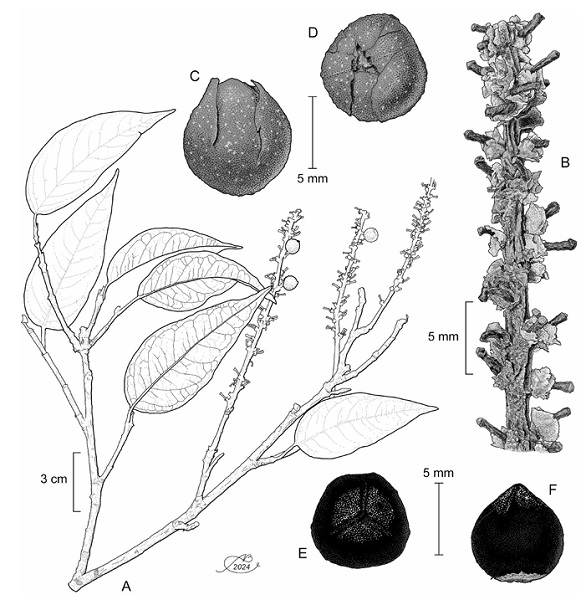
Figure 1: Coccoloba burgeri J.J. Ancona, P. Hern.-Led. & J.J. Ortiz-Díaz. A. branch showing leaves and fruits; B. details of the inflorescence; C. diclesium lateral view; D. diclesium polar view; E. achene lateral view; F. achene polar view. Illustrations by Alfonso Barbosa.
Coccoloba burgeri is similar to Coccoloba schippii Lundell, distinguished by ovate or ovate-lanceolate leaf blades, 6-9 × 2-3.5 cm (vs. narrowly lanceolate or narrowly lanceolate-elliptic (8)10-15 × 4.5-6 cm); pedicel 2-5 mm (vs. 1-2 mm); diclesium 7-8 mm long, glandular-punctate (vs. 5-6, not glandular-punctate); achene black (vs. light brown).
Trees or shrubs, hermaphroditic, up to 7 m tall; branches striate, glabrous, lenticellate; ochrea tubular, 3-5 mm long, glabrous, pulverulent; leaves simple, alternate; petioles 1-1.7(2) × 1.19-1.79 mm, striate, glabrous, not glandular-punctate, arising at the base of the ochrea; leaf blades 6-9 × 2-3.5 cm, ovate or ovate-lanceolate, chartaceous to coriaceous, glabrous on both surfaces, margin entire, base obtuse to rounded, apex acuminate to largely acuminate; venation brochidodromous, reticulate, 6-11 pairs of secondary nerves; primary nerve glabrous, abaxially prominent; inflorescence racemiform, terminal or axillar, laxiflorous, solitary, 5-12.5 cm long; rachis strongly ribbed 1.1-2.5 mm diameter, striate, glabrous to sparsely puberulent; bracteole minute, up to 1 mm long, cymbiform, black or dark brown, scabrid to puberulent, not glandular-punctate, margin glabrous, apex acute; ochreola 1-1.2 mm long, membranaceous, scabrid, apex 2-lobate, light brown, surrounding the pedicel; pedicels in flower 1-1.5 mm long, pedicels in fruit 2-5 mm long, glabrous or scabrid to pulverulent; flowers not seen; fruit a diclesium glandular-punctate, 7-8 × 6.5-8.5 mm, globose or subglobose, glabrous, base rounded, not abruptly contracted at junction with pedicel, apex rounded to obtuse; hypanthium expanded but without covering the achene, tepals accrescent, membranaceous, completely covering the achene; achene 6-7 × 6-7 mm, globose or subglobose, black, smooth, glossy, base rounded or truncate, apex obtuse.
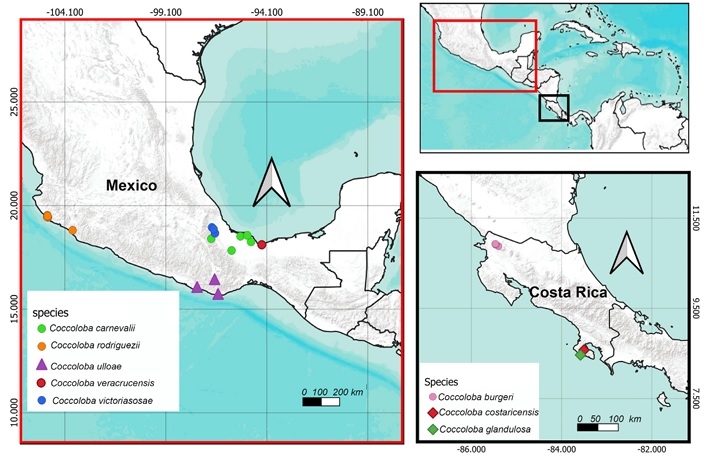
Distribution and habitat: Coccoloba burgeri is until now endemic to Costa Rica (Fig. 2), inhabiting very humid forests or evergreen forests.
Etymology: the specific epithet honors the American botanist William C. Burger (1932-2022), who was one of the main specialists of the flora of Costa Rica in the 20th century.
Phenology: floral buds in February; fruits from March to May.
Preliminary conservation status: based on the available data, the AOO is 12 km2 and the EOO is calculated as 5.07 km2. Given the extremely narrow geographic distribution and the small number of occurrences (four), we propose a preliminary conservation status of Critically Endangered (CR B1ab(iii)+2ab(iii)).
Notes: it is unknown whether this species is functionally unisexual, because we have only observed specimens with fruits. In the “Manual de Plantas de Costa Rica” (Soto, 2014) the only specimen cited as Coccoloba escuintlensis Lundell is misdetermined as such, as it actually corresponds to C. burgeri. The latter can be clearly distinguished from C. escuintlensis by having ovate or ovate-lanceolate leaves, functionally unisexual flowers and ovoid fruits of 7-8 × 6.5-8.5 mm, while C. escuintlensis has broadly elliptic leaves, strictly hermaphroditic flowers and globose fruits of 6.5-7 × 6.5-7 mm. Additionally, C. escuintlensis is a species that is only distributed in Chiapas and Guatemala.
Representative specimens examined: COSTA RICA. Guanacaste, cantón de Liberia, Cuenca del Tempisque, Estación Cacao, bosque en la entrada a la estación, 900-1000 m, 10°54'36"N, 85°27'36"W, 3.V.2000, L. Acosta 1137 (MO); Cuenca del Tempisque, Estación Cacao, camino a la Sima, 1100 m, 10°55'39"N, 85°28'12"W, 18.III.1998, A. Rodríguez 3145 (INB, MO); Estación Cacao, Cerro Cacao, 1100 m, 10°55'43"N, 85°28'10"W, 11.II.1995, R. Villalobos 60 (INB, MO).
Coccoloba carnevalii J.J. Ancona, P. Hern.-Led. & J.J. Ortiz-Díaz, sp. nov. Fig. 3.
TYPE: MEXICO. Veracruz, municipality Ángel R. Cabada, Laguna Colorada, 18°31'18"N, 95°24'12"W, 29.III.1995, G. Castillo-Campos et al. 13951 (holotype: IEB!, isotype: XAL!).
Coccoloba carnevalii is similar to C. schippii, but it is distinguished by ovate to long ovate-lanceolate leaf blades (vs. narrowly lanceolate or narrowly lanceolate-elliptic), abaxially glandular-punctate; diclesium 7-8 mm long, glandular-punctate (vs. 5-6 mm, not glandular-punctate); achene ovoid (vs. trigonous).
Trees hermaphroditic, up to 25 m tall; branches striate, glabrous, lenticellate; ochrea tubular, 6-10 mm long, glabrous, glandular-punctate; leaves simple, alternate; petioles 11-18 × 1.4-1.9 mm, striate, glabrous, glandular-punctate, arising at the base of the ochrea; leaf blades (9-)11-18 (>22 when young) × 4.5-6.5(8) cm, ovate to long ovate-lanceolate, membranaceous to subcoriaceous, glabrous on both surfaces, abaxially glandular-punctate, margin entire, undulate, apex acuminate to long acuminate, base attenuate to rounded; venation brochidodromous, primary nerve glabrous, 9-11 pairs of secondary nerves; primary nerve glabrous, abaxially prominent; inflorescence racemiform, terminal or axillar, laxiflorous, solitary or 2-3-fasciculated in brachyblasts, 3-9.5 cm long; rachis strongly ribbed, 0.8-1.1 mm diameter, striate, puberulent to pulverulent; bracteole up to 1 mm long, lanceolate, dark brown, puberulent, deciduous, apex acute; ochreola campanulate, 3(4)-lobate, membranaceous, glabrous, light brown, surrounding the pedicel, 1-1.5 mm long; pedicels in flower 1-1.2 mm long, pedicels in fruit 1.2-1.5 mm long, puberulent, thicker; flower aestivation quincuncial, whorls 2, outer tepals 3, inner tepals 2, alternate; hypanthium 1-1.5 mm long, glabrous, campanulate; outer tepals membranaceous, glabrous, 2-2.2 × 2 mm; inner tepals membranaceous, glabrous, 2 × 1.4-1.8 mm; stamens 8, soldiers at the base, 3 mm long, filaments 3-3.5 mm long, anthers 0.5 mm long; ovary 2-2.5 mm long, trigonous, glabrous, styles 3, 1-1.2 mm long, stigma ovoid; fruit a diclesium, 7-8 × 5.5-6 mm, globose to subglobose, glabrous, sparsely glandular-punctate, base rounded, not abruptly contracted at junction with pedicel, apex rounded to obtuse; hypanthium expanded to the base of the achene, membranaceous, tepals accrescent, membranaceous, completely covering the achene; achene 5-5.5 × 4.5-5 mm, globose, base rounded or truncate, apex obtuse, brown, smooth, glossy.
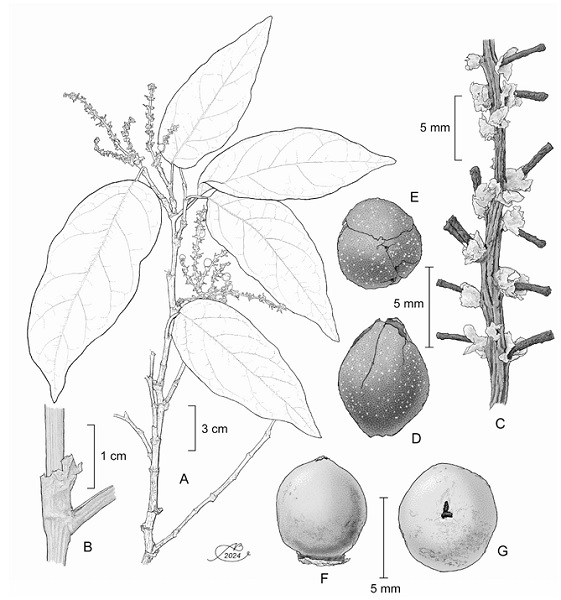
Figure 3: Coccoloba carnevalii J.J. Ancona, P. Hern.-Led. & J.J. Ortiz-Díaz. A. branch showing leaves and fruits; B. ochrea; C. details of the inflorescence; D. diclesium lateral view; E. diclesium polar view; F. achene lateral view; G. achene polar view. Illustrations by Alfonso Barbosa.
Distribution and habitat: this species is endemic to Mexico, in Veracruz and Puebla (Fig. 2). Inhabiting high evergreen forest and medium sub-evergreen forest.
Etymology: the specific epithet honors Dr. Germán Carnevali Concha, botanist at the Centro de Investigación Científica de Yucatán (CICY), specialist in floristic studies of the Yucatán Peninsula and taxonomist of Orchidaceae.
Phenology: collected with flowers and fruits from March to June.
Preliminary conservation status: due to its small AOO corresponding to 24 km2, its EOO of 11 771 km2, six localities and nine known collections (all located outside protected areas and threatened by fragmentation of their habitat for agriculture and urban growth of the cities of Veracruz and Puebla) and the quality of the habitat due to anthropogenic impacts, it is proposed that C. carnevalii be considered as Endangered (EN B1ab(iii)+B2ab(iii)), following the IUCN criteria (IUCN, 2024).
Notes: most flowers in Coccoloba are hermaphroditic, but functionally unisexual. We have observed during the revision of the genus for the Flora Mesoamericana and the Flora of Veracruz that functionally male trees have two or more fasciculate flowers per bracteole and the stamens are twice as large as the ovary. On the other hand, trees that are functionally female only have one flower per bracteole and the ovary is twice as large as the stamens. In C. carnevalii, it seems that the trees are strictly hermaphroditic. In this species the flowers are solitary, one per bracteole and the ovary and stamens are of the same dimensions, that is, there is no reduction of any of the sexual organs as observed in other species.
In various herbaria collections, some specimens of Coccoloba carnevalii were misidentified as C. montana Standl. However, this species is found in the sect. Paniculatae, that includes species with inflorescence in panicles and acrosarcum-type fruit. Moreover, C. montana is a species from the highlands of El Salvador and Guatemala.
Representative specimens examined: MEXICO. Puebla, municipality San Sebastián Tlacotepec, Tololuco, 500 m del puente colgante, 58 m, 6.IV.2006, I. Acosta 2993 (IEB). Veracruz, municipality Playa Vicente, ejido Piedra de Cal, 11.X.1971, J. Chavelas et al. Es-4292 (MEXU). Municipality San Andrés Tuxtla, Laguna Escondida, estación de Biología Tropical Los Tuxtlas, 200 m, 18°34'00"N, 95°04'00"W, 16.IV.1986, S. Sinaca-Colín and F. Chigo-Seba 613 (MEXU); San Andrés Tuxtla, lote 67, Estación de Biología Tropical Los Tuxtlas, 200 m, 18°34'00"N, 95°04'00"W, 23.IV.1985, S. Sinaca-Colín 1185 (MEXU). Municipality Santiago Tuxtla, camino al Vigía de Santiago Tuxtla, 500 m, 12.V.1965, M. Sousa 2416 (MEXU); arriba de San Fernando, 650 m, 14.V.1970, A. Gómez-Pompa 4866 (MEXU). Municipality Soteapan, brecha hacia el ejido Santa Marta, al N de Soteapan, 578 m, 18°15.5'00"N, 94°52.7'00"W, 29.V.2010, A. Campos-Villanueva and R. Coates 6886 (MEXU); Sierra Cruz Tetela, a 2 km aprox., al sureste de Motzorongo, 300 m, 18°40'00"N, 96°40'00"W, 11.IV.1986, R. Robles 612 (IEB); a 1 km del ejido Motzorongo, 300 m, 18°40'00"N, 96°40'00"W, 11.IV.1986, R. Robles 617 (IEB).
Coccoloba costaricensis J.J. Ancona, P. Hern.-Led. & J.J. Ortiz-Díaz, sp. nov. Fig. 4.
TYPE: COSTA RICA. Puntarenas, Cantón de Golfito, península de Osa, 100 m, 08°34'30"N, 83°30'23"W, 29.V.1995, M. Moraga 238 (holotype: UADY!, isotypes: CR!, MO!).
Coccoloba costaricensis is similar to C. lehmannii Lindau ex Hieron., but can be clearly distinguished by the presence of membranaceous leaves, longer pedicels of 5-8 mm (vs. 3-5 mm), accrescent tepals, almost completely covering the achene, leaving the upper half exposed (vs. accrescent tepals completely covering the achene).
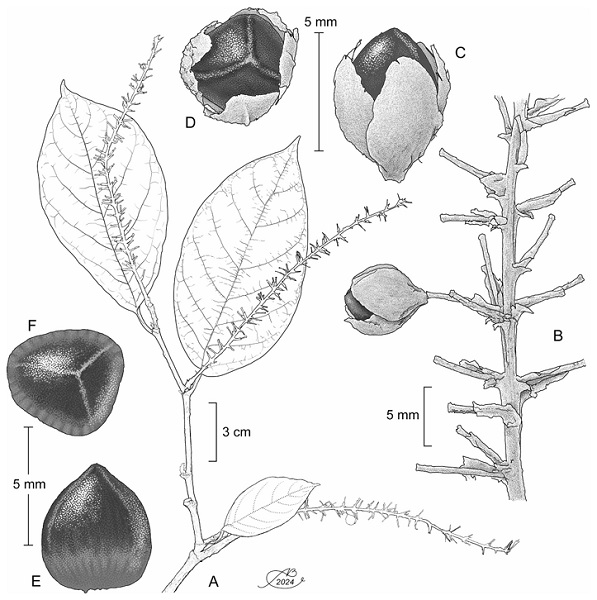
Figure 4: Coccoloba costaricensis J.J. Ancona, P. Hern.-Led. & J.J. Ortiz-Díaz. A. branch showing leaves and fruits; B. details of the inflorescence; C. diclesium lateral view; D. diclesium polar view; E. achene lateral view; F. achene polar view. Illustrations by Alfonso Barbosa.
Trees hermaphroditic, up to 10 m tall; branches striate, glabrous, lenticellate; ochrea tubular, up to 10 mm long, glabrous, pulverulent; leaves simple, alternate; petioles 10-15 × 1.57-2.22 mm, striate, glabrous, arising at the base of the ochrea; leaf-blades 11-18 × 6.5-9.5 cm, elliptic to ovate-elliptic, membranaceous to papery, glabrous on both surfaces, margin entire, base attenuate, apex acuminate to largely acuminate; venation brochidodromous, reticulate, primary nerve glabrous, 9-11 pairs of secondary nerves; primary nerve glabrous, abaxially prominent; inflorescence racemiform, terminal or axillar, laxiflorous, solitary, 11-18 cm long; rachis strongly ribbed, 0.98-1.75 mm diameter, striate, puberulent to scabrid; bracteole 1-1.2 mm long, cymbiform, black or dark brown, scabrid to puberulent, not glandular-punctate, margin glabrous, apex acuminate; ochreola 3-4 mm long, membranaceous, corrugate, apex lacerate, light brown, surrounding the pedicel; pedicel in fruit 5-8 mm, scabrid to puberulent; flowers not seen; fruit a diclesium, 5-6.5 × 5-5.5 mm, subglobose, glabrous, striate, base rounded, abruptly contracted at junction with pedicel, apex rounded to obtuse; hypanthium not expanded, tepals accrescent, membranaceous, free from the base, almost completely covering the achene, leaving the apex uncovered; achene 5-5.5 × 5-5.5 mm, subglobose to 3-lobate, brown, smooth, glossy, base rounded or truncate, apex obtuse.
Distribution and habitat: Coccoloba costaricensis is endemic to Costa Rica (Fig. 2), inhabiting humid forests and riparian forests.
Etymology: the specific epithet of this species refers to Costa Rica, where it was collected.
Phenology: collected with fruits in May.
Preliminary conservation status: currently, only the type locality of the new species is known. According to the IUCN Red List criteria (IUCN, 2024), the conservation status of the new species should be classified as Data Deficient (DD). It is obvious that further research and extensive fieldwork are needed to locate new populations.
Notes: it is not known whether this species is functionally unisexual, because we have only observed specimens with fruits. Coccoloba costaricensis is easily distinguished from other species of Coccoloba sect. Campderia, because the achene is almost completely covered by the accrescent tepals, leaving the apex of the achene exposed.
Coccoloba glandulosa J.J. Ancona, P. Hern.-Led. & J.J. Ortiz-Díaz, sp. nov.Fig. 5.
TYPE: COSTA RICA. Puntarenas, Parque Nacional Corcovado Sirena, Ollas Trail/Skyway Trail, 50 m, 08°28'N, 83°35'W, 1.VII.1989, C. Kernan and P. Phillips 1201 (holotype: UADY!, isotypes: CR!, MO!).
Coccoloba glandulosa is similar to C. escuintlensis, but it is clearly distinguished by leaf blades 19-30 × 12-16 cm (vs. 9-17 × 7-9 cm); flowers with glandular dots on adaxial surface of tepals and ovary; diclesium glandular-punctate. In C. escuintlensis the glandular points are absent.
Trees hermaphroditic, functionally unisexual, up to 18 m tall; branches striate, glabrous, lenticellate; ochrea tubular, up to 10 mm long, glabrous, pulverulent; leaves simple, alternate; petioles 19-23 × 1.75-2.25 mm, striate, glabrous, squamate, sparsely glandular-punctate, arising at the base of the ochrea; leaf blades (15-)19-30 × 12-16 cm, ovate-lanceolate or oblong-elliptic, membranaceous to papery, glabrous on both surfaces, margin entire, apex acuminate to largely acuminate, base subcordate; venation brochidodromous, reticulate, primary nerve glabrous, 9-11 pairs of secondary nerves; primary nerve glabrous, abaxially prominent; inflorescence racemiform, terminal or axillar, laxiflorous, solitary, 7.5-12.5 cm long; rachis strongly ribbed 1.1-2.5 mm diameter, striate, puberulent, with brown or ferruginous trichomes; bracteole 1.5-2 mm long, cymbiform, black or dark brown, scabrid to puberulent, not glandular-punctate, margin glabrous, apex acuminate; ochreola 3.5-4 mm long, membranaceous, corrugate, apex lacerate, light brown, surrounding the pedicel; pedicels in flower up to 2 mm long, pedicels in fruit 4-4.5 mm long, thicker, scabrid to pulverulent; flower aestivation quincuncial, whorls 2, outer tepals 3, inner tepals 2, alternate; functionally male flowers not seen; functionally female flowers solitary, 2-3 mm long; hypanthium 1 mm long, glabrous, infundibuliform, glandular-punctate; outer tepals 1.5-2 mm long, 2 mm wide, ovate, coriaceous, glabrous, glandular-punctate; inner tepals 1.5-2 mm long, 1.3 mm wide, elliptic-oblong, membranaceous, glabrous, glandular-punctate; stamens 10, soldiers at the base, 1 mm long, filaments filiform, base wide, 0.5-0.8 mm long, anthers 0.5 mm long; ovary 1 mm long, ovoid, trilobate, glabrous, glandular-punctate, styles 3, 1 mm long, stigma petaloid; fruit a diclesium, 7-8 × 5-6.5 mm, ovoid, glabrous, striate, base rounded, abruptly contracted at junction with pedicel, apex rounded to obtuse; hypanthium not expanded, tepals accrescent, membranaceous, free at the base, completely covering the achene; achene 5-6 × 6 mm, ovoid, 3-lobate, brown, smooth, glossy, base rounded or truncate, apex obtuse.
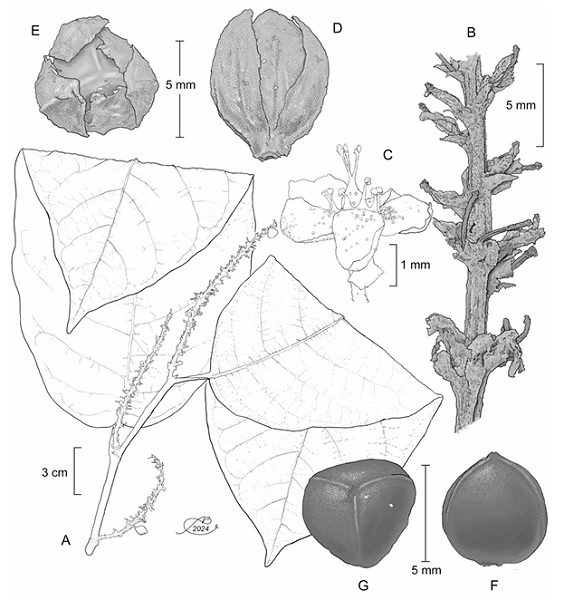
Figure 5: Coccoloba glandulosa J.J. Ancona, P. Hern.-Led. & J.J. Ortiz-Díaz. A. branch showing leaves and fruits; B. details of the inflorescence; C. flower; D. diclesium lateral view; E. diclesium polar view; F. achene lateral view; G. achene polar view. Illustrations by Alfonso Barbosa.
Distribution and habitat: Coccoloba glandulosa is endemic to Costa Rica (Fig. 2), inhabiting humid forests and riparian forests.
Etymology: The specific epithet of this species refers to the glandular dots on the tepals and ovary.
Phenology: collected with flowers and fruits in July.
Preliminary conservation status: currently, only the type locality of the new species is known. According to the IUCN Red List criteria (IUCN, 2024), the conservation status of the new species should be classified as Data Deficient (DD). It is obvious that further research and extensive fieldwork are needed to locate new populations.
Notes: In the “Manual of Plants of Costa Rica” (Soto, 2014) the only specimen cited as Coccoloba lehmannii is misidentified and actually corresponds to C. glandulosa, that is differentiated from C. lehmannii by the large leaf blades of 19-30 cm long and petioles of 19-23 mm long. Furthermore, it is the only species in Coccoloba that has so far been described with glandular points on the tepals and ovary. These floral characters in Polygonaceae were to date only known from species of Persicaria (L.) Mill. and Antigonon Endl. (Ancona and Knapp, 2025; Ortiz-Díaz and Burke, 2025).
Coccoloba rodriguezii J.J. Ancona, P. Hern.-Led. & J.J. Ortiz-Díaz, sp. nov. Fig. 6.
TYPE: MEXICO. Jalisco, municipality La Huerta, Rancho Cuixmala, Río Cuixmala Valley, 3 km by road NE of Puerto Vallarta-Barra de Navidad Hwy (Hwy 200), 30 m, 19°26'00"N, 104°56'00"W, 25.X.1990, E. J. Lott et al. 2889 (holotype: MEXU!).
Coccoloba rodriguezii is similar to Coccoloba floribunda (Benth.) Lindau, but it can be distinguished by petioles 5-9(-13) mm long (vs. 4 mm), pubescent to densely hirsute on adaxial surface, with yellowish trichomes; blade narrowly elliptic with acuminate or long-acuminate apex (vs. broadly elliptic with rounded apex); diclesium ovoid (vs. pyramidal-trilobed); achene with 6-8 longitudinal grooves or slits (vs. achene without longitudinal grooves or slits).
Shrubs or trees, hermaphroditic, 3-7 m tall; branches striate, glabrous, lenticellate; ochrea tubular, 3-5 mm long, pubescent to densely hirsute, with yellowish trichomes; leaves simple, alternate; petioles 5-9(13) × 1.3-1.79 mm, pubescent to densely hirsute only on the adaxial surface, with yellowish trichomes, arising at the base of the ochrea; leaf-blades 6-7(11) × 1.5-2.5(4) cm, narrow elliptic, coriaceous, abaxially glabrous, adaxially sparsely puberulous, with yellowish trichomes, margin entire, sparsely ciliate, apex acuminate or long-acuminate, base attenuate to cuneate; venation brochidodromous, reticulate, primary nerve densely pilose or pubescent, with yellowish trichomes, 7-9 pairs of secondary nerves; primary nerve glabrous, abaxially prominent; inflorescence racemiform, terminal or axillar, densiflorous, solitary, 3-6 cm long; rachis terete to angular, not ribbed, up to 1 mm diameter, striate, sparsely to densely puberulent and pulverulent, with yellowish trichomes; bracteole 0.5 mm long, cymbiform, black or dark brown, puberulent and pulverulent, apex acute; ochreola membranaceous, light brown, surrounding the pedicel, 0.5 mm long; pedicels in flower not seen, pedicels in fruit 1.2-1.5 mm long, glabrous or puberulent and pulverulent; flowers not seen; fruit a diclesium, 6-6.5 × 5 mm, ovoid to subglobose, glabrous, base rounded, abruptly contracted at junction with pedicel, apex rounded to obtuse; hypanthium not expanded, tepals accrescent, membranaceous, completely covering the achene; achene 5 × 4.5-5 mm, ovoid-pyramidal, brown-yellowish, smooth, glossy, slightly 3-lobed, with 6-8 longitudinal grooves or slits, base rounded or truncate, brown, apex obtuse.
Distribution and habitat: Coccoloba rodriguezii is endemic to Colima and Jalisco, Mexico (Fig. 2). This species inhabits tropical dry forests on the lowland slopes of the Pacific Coast, at elevations of 20 to 100 m.
Etymology: the specific epithet honors Dr. Aarón Rodriguez Contreras, Botanist at the Centro Universitario de Ciencias Biológicas y Agropecuarias, of the Universidad de Guadalajara, specialist in taxonomy and systematics of various angiosperm families.
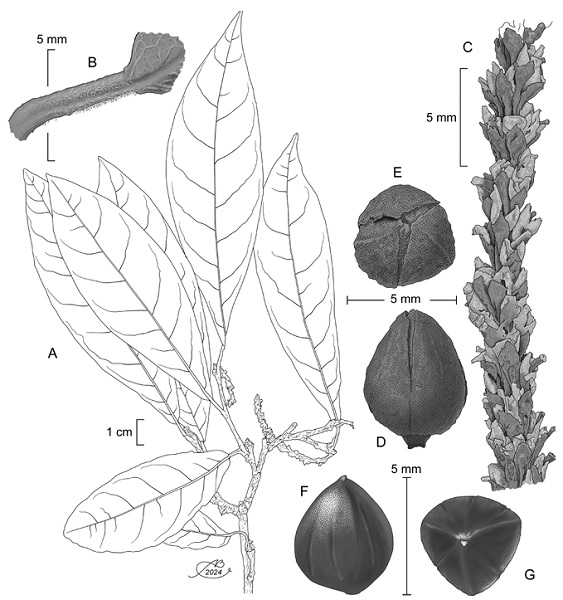
Figure 6: Coccoloba rodriguezii J.J. Ancona, P. Hern.-Led. & J.J. Ortiz-Díaz. A. branch showing leaves and inflorescence; B. petiole with trichomes; C. details of the inflorescence; D. diclesium lateral view; E. diclesium polar view; F. achene lateral view; G. achene polar view. Illustrations by Alfonso Barbosa.
Phenology: collected with fruits from August to November.
Preliminary conservation status: based on the available data, the AOO is 20 km2. The EOO is calculated as 5.07 km2. Given the extremely narrow geographic distribution and the small number of localities (three) and of occurrences (five), under the IUCN Red List criteria (IUCN, 2024), we propose a preliminary IUCN Red List Assessment of Critically Endangered (CR B1ab(iii)+2ab(iii)).
Notes: it is not known whether this species is functionally unisexual, because we have only observed specimens with fruits. In various herbaria, some specimens of Coccoloba rodriguezii were misidentified as C. venosa L. and C. floribunda. However, C. venosa is a widely distributed species that ranges from South America to Chiapas (Mexico). The leaves of C. venosa are much broader and longer than those of C. rodriguezii, while C. floribunda is easily recognized by the rounded or obtuse apex of the leaf blade.
Representative specimens examined: MEXICO. Colima, municipality Ixtlahuacán, 2.5 km en línea recta al SO de San Miguel del Ojo de Agua, 18°48'35"N, 103°42'58"W, 17.VIII.2002, G. Ibarra-Manríquez 5633 (MEXU). Jalisco, municipality La Huerta, Rancho Cuixmala, Arroyo Cajones, 19°27'00"N, 104°58'00"W, 14.I.1991, E. Lott et al. 3276 (MEXU); Rancho Cuixmala, Cumbres 1, Arroyo Cajones, 19.VIII.1991, E. Lott et al. 3792 (MEXU); Rancho Cuixmala, N of the Puerto Vallarta - Barra de Navidad hwy, Cumbres 1, arroyo to W-NW of El Mirador, 19°32'00"N, 104°58'00"W, 23.VIII.1991, E. Lott et al. 3885 (MEXU); Rancho Cuixmala, Arroyo Cajones, 19°26'30"N, 104°59'00"W, 3.XI.1991, E. Lott et al. 4060 (MEXU); Rancho Cuixmala, Arroyo Cajones, 19°30'00"N, 104°57'00"W, 14.IX.1991, A.C. Sanders et al. 12256 (MEXU); entre Laguna Salada y bordo de vena del Río Cuixmala - Rancho El Limbo, 6.VI.1986, A. Pérez J. 1957 (MEXU).
Coccoloba ulloae J.J. Ancona, P. Hern.-Led. & J.J. Ortiz-Díaz, sp. nov. Fig. 7.
TYPE: MEXICO. Oaxaca, municipality San Pedro Pochutla, Finca Montecristo, 19 km al NE de la desviación que está a 4 km al N de Chacalapa, 26.IV.1986, R. Cedillo 2305 (holotype: IEB!, isotype: MO!).
Coccoloba ulloae is similar to C. escuintlensis, but it is distinguished by leaf blades oblong-lanceolate, 3 or 4 times longer than wide (vs. broadly elliptic, 2 times longer than wide); expanded hypanthium covering the base of the achene (vs. unexpanded hypanthium).
Trees, hermaphroditic, up to 25 m tall; branches striate, glabrous, lenticellate; ochrea tubular, up to 1 cm long, deciduous, glabrous; leaves simple, alternate; petioles 2-2.5 × 1.6-2.8 mm, striate, glabrous, arising at the base of the ochrea; leaf blades (13)17-19 × 4-4.7 cm, oblong to oblong-lanceolate, chartaceous to coriaceous, glabrous on both surfaces, margin entire, apex long, base obtuse to rounded; venation brochidodromous, reticulate, 6-11 pairs of secondary nerves; primary nerve glabrous, abaxially prominent; inflorescence racemiform, terminal or axillar, laxiflorous, solitary, 4.5-8(13.5) cm long; rachis strongly ribbed, 1.1-2.5 mm diameter, striate, sparsely puberulent, pulverulent; bracteole minute, up to 1 mm long, cymbiform, black or dark brown, scabrid to puberulent, not glandular-punctate, margin glabrous, apex acute; ochreola 1-1.5 mm long, membranaceous, puberulent, apex 2-lobate, light brown, surrounding the pedicel; pedicels in flower not seen, pedicels in fruit 3.5-4 mm long, sparsely scabrid to pulverulent; flowers not seen; fruit a diclesium, 8-9.5 × 8-9 mm, globose or subglobose, glabrous, base rounded, abruptly contracted at junction with pedicel, apex rounded to obtuse; hypanthium expanded below the middle of the achene, tepals accrescent, membranaceous, completely covering the achene; achene 7-7.7 × 6.5-7.5 mm, globose or subglobose, brown, smooth, glossy, base rounded or truncate, apex obtuse.
Distribution and habitat: endemic to Oaxaca, Mexico (Fig. 2), where it inhabits the tropical rain forest, at elevations of 450 to 650 m.
Etymology: the specific epithet honors Dr. Carmen Ulloa Ulloa, Senior Curator of the Missouri Botanical Garden herbarium and general editor of the Flora Mesoamericana.
Phenology: collected with fruits from December to April.
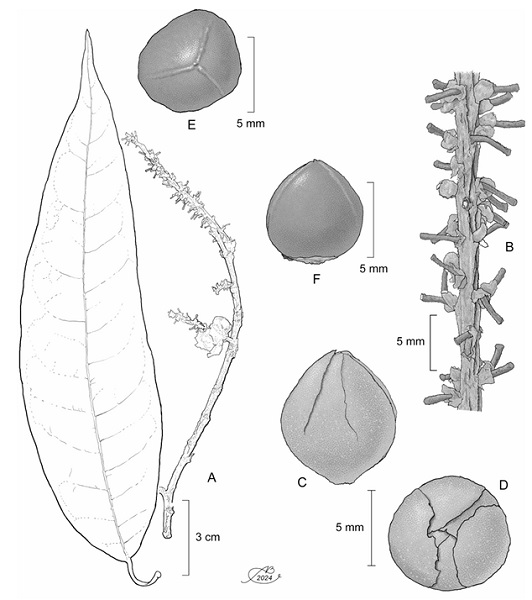
Figure 7: Coccoloba ulloae J.J. Ancona, P. Hern.-Led. & J.J. Ortiz-Díaz. A. branch showing leaves and inflorescence; B. details of the inflorescence; C. diclesium lateral view; D. diclesium polar view; E. achene polar view; F. achene lateral view. Illustrations by Alfonso Barbosa.
Preliminary conservation status: According to available data, the AOO is 12 km2 and the EOO was estimated at 4058 km2. Given the narrow geographic distribution and the small number of localities (two) and of occurrences (three), under the IUCN Red List criteria (IUCN Standards and Petitions Committee, 2024), we propose a preliminary IUCN Red List Assessment of Critically Endangered (CR B1ab(iii)+2ab(iii)).
Notes: it is not known whether this species is functionally unisexual, because we only observed specimens with fruits.
Representative specimens examined: MEXICO. Oaxaca, municipality San Pedro Pochutla, distrito Pochutla, San Pedro Pochutla - Rio Concordia 1 km, al NE de la Finca Cafetalera Concordia, entrada 5 km de Chacalapa carr. Pochutla - Oaxaca, 670 m, 18.III.1983, P. Tenorio et al. 3539 (MEXU); Norte de Pochutla, 450 m, 9.XII.1968, E. S. Blanco 101 (MEXU).
Coccoloba veracrucensis J.J. Ancona, P. Hern.-Led. & J.J. Ortiz-Díaz, sp. nov. Fig. 8.
TYPE: MEXICO. Veracruz, Coatzacoalcos, a 800 m al E de los quemadores de Pemex, La Cangrejera, 23 m, 18°06'48"N, 94°20'57"W, 1.IV.2003, C. H. Ramos and E. Martínez 2201 (holotype: MEXU!).
Coccoloba veracrucensis is similar to C. williamsii Standl., distinguished by non-prominent secondary veins on the abaxial leaf surface; inflorescence laxiflorous, pedicel 4-5 mm long (vs. 1-2.5 mm); diclesium reddish brown, 5-6 mm long; achene light brown, with conical apex (vs. black diclesium, 8-9 mm long; achene black, with apex markedly trigonous).
Trees hermaphroditic, up to 10 m tall; branches striate, glabrous, lenticellate; ochrea tubular, up to 10 mm long, glabrous, deciduous; leaves simple, alternate; petioles 20-25 × 3-4 mm, striate, glabrous, arising at the base of the ochrea; leaf blades 17-21 × 7.5-9.5 cm, elliptic to broadly elliptic, subcoriaceous to coriaceous, glabrous on both surfaces, margin wavy, base rounded or subcordate, apex acuminate; venation brochidodromous, reticulate, 7-9 pairs of secondary nerves; primary nerve glabrous, abaxially prominent; inflorescence racemiform, terminal or axillar, laxiflorous, solitary, 6-8 cm long; rachis strongly ribbed, 0.98-1.15 mm diameter, striate, puberulent to puberulous; bracteole 1-1.2 mm long, triangular, light brown, puberulent to puberulous, not glandular-punctate, margin glabrous, apex acuminate; ochreola 1-1.4 mm long, campanulate, 2-3-lobate, membranaceous, light brown, surrounding the pedicel; pedicels in flower not seen, pedicels in fruit 4-5 mm, puberulent to puberulous; flowers not seen; fruit a diclesium reddish brown, 5-6 × 6-7 mm, ovoid, glabrous, base rounded, abruptly contracted at junction with pedicel, apex obtuse; hypanthium expanded, covering the base of the achene, tepals accrescent, membranaceous; achene 4.5-5 × 4.5 mm, ovoid, brown, smooth, glossy, base rounded or truncate, apex obtuse.
Distribution and habitat: Coccoloba veracrucensis is known only from the type locality. It is endemic to Veracruz, Mexico (Fig. 2), inhabiting humid forests and riparian forests.
Etymology: the specific epithet of this species refers to the state of Veracruz, where it was collected.
Phenology: collected with fruits in April.
Preliminary conservation status: currently, only the type locality of the new species is known. According to the IUCN Red List criteria (IUCN, 2024), the conservation status of the new species should be classified as Data Deficient (DD). Clearly, more research and extensive fieldwork are needed to locate new populations and assess the conservation status of this new species.
Notes: it is not known whether this species is functionally unisexual, because we have only observed specimens with fruits.
Coccoloba victoriasosae J.J. Ancona, P. Hern.-Led. & J.J. Ortiz-Díaz, sp. nov. Fig. 9.
TYPE: MEXICO. Veracruz, municipality Tezonapa, sierra Cruz Tetela, ejido de Motzorongo, 300 m, 18°40'N, 96°40'W, 11.IV.1986, R. Robles 595 (holotype: XAL!, isotypes IEB!, MEXU!).
Coccoloba victoriasosae is similar to C. schippii, it is distinguished by the black or dark green lamina when dried, abaxially glandular-punctate (vs. reddish brown lamina when dried, abaxially not glandular-punctate); inflorescences laxiflorous; pedicel 4-5 mm long, ochreola covering base of pedicel (vs. 1-2 mm, ochreola as long as pedicel); diclesium, 7-8 mm long (vs. 5-6 mm).
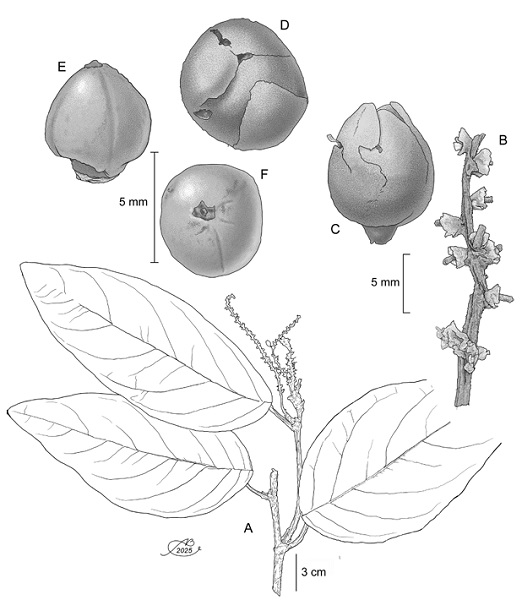
Figure 8: Coccoloba veracrucensis J.J. Ancona, P. Hern.-Led. & J.J. Ortiz-Díaz. A. branch showing leaves and inflorescence; B. details of the inflorescence; C. diclesium lateral view; D. diclesium polar view; E. achene lateral view; F. achene polar view. Illustrations by Alfonso Barbosa.
Trees hermaphroditic, up to 18 m tall; branches striate, glabrous, lenticellate; ochrea tubular, 4-8 mm long, glabrous, pulverulent; leaves simple, alternate; petioles 7-15 × 1.15-1.55 mm, striate, glabrous, arising at the base of the ochrea; leaf blades 9-14 × 3.5-5.5 cm, narrowly elliptic-lanceolate, membranaceous, black or dark green, glabrous on both surfaces, margin entire, apex largely acuminate, base obtuse to subcordate; venation brochidodromous, reticulate, 9-11 pairs of primary nerves, primary nerve glabrous; inflorescence racemiform, terminal or axillary, laxiflorous, solitary, 5-12.5 cm long; rachis strongly ribbed 1.19-1.59 mm diameter, striate, puberulent to pulverulent; bracteole 1 mm long, cymbiform, black or dark brown, puberulent, not glandular-punctate, margin glabrous to sparsely ciliated, apex acuminate; ochreola 1.5-2 mm long, membranaceous, campanulate, apex lacerate, light brown, surrounding the pedicel; pedicels in flower up to 2 mm long, pedicels in fruit 4-5 mm, thicker, puberulent and pulverulent; flower aestivation quincuncial, whorls 2, outer tepals 3, inner tepals 2, alternate; solitary, 2-3.5 mm long; hypanthium 1-1.5 mm long, glabrous, infundibuliform, not glandular-punctate; outer tepals 2-2.5 × 2 mm, ovate, coriaceous, glabrous, not glandular-punctate; inner tepals 2-2.5 × 1.5 mm, elliptic-oblong, membranaceous, glabrous, not glandular-punctate; stamens 8, soldiers at the base, 1.5-1.7 mm long, filaments filiform, with wide base, 1.3-1.5 mm long, anthers 0.5 mm long; ovary 1.5 mm long, ovoid, trilobate, glabrous, glandular-punctate, style 3, 1 mm long, stigma capitate; fruit a diclesium, 7-8 × 5.5-6 mm, ovoid, glabrous, smooth, base rounded, abruptly contracted at junction with pedicel, apex rounded to obtuse; hypanthium expanded, covering the base of the achene, membranaceous, glandular-punctate; tepals accrescent, membranaceous, completely covering the achene rarely glandular-punctate; achene 6-6.5 × 6-6.5 mm, globose, brown, smooth, glossy, base rounded or truncate, apex obtuse.
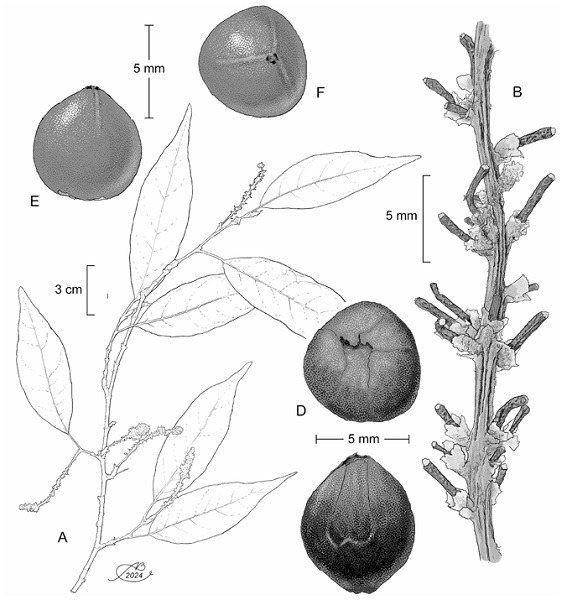
Figure 9: Coccoloba victoriasosae J.J. Ancona, P.Hern.-Led. & J.J. Ortiz-Díaz. A. branch showing leaves and fruits; B. details of the inflorescence; C. diclesium lateral view; D. diclesium polar view; E. achene polar view; F. achene lateral view. Illustrations by Alfonso Barbosa.
Distribution and habitat: endemic to Veracruz, Mexico. It grows in medium sub-evergreen forest, at elevations from 300 to 900 m.
Etymology: the specific epithet honors Dr. Victoria Sosa, research botanist at the Instituto de Ecología, A.C., specialist in taxonomy and evolutionary systematics of various groups of plants in Mexico.
Phenology: collected with flowers and fruits from April to May.
Preliminary conservation status: based on the available data, the EOO is calculated as 834.26 km2 and the AOO as 16 km2. Given its narrow geographic distribution and the small number of localities (three) and of occurrences (five), under the IUCN Red List criteria (IUCN, 2024), we propose a preliminary IUCN Red List Assessment of Critically Endangered (CR B1ab(iii)+2ab(iii)).
Notes: it seems that the trees of C. victoriasosae are strictly hermaphroditic. In this species the flowers are solitary, one per bracteole and the ovary and stamens are of the same dimensions, without any reduction of any of the sexual organs as observed in other species.
Representative specimens examined: MEXICO. Veracruz, municipality Atoyac, Miraflores 6 km al NW de Atoyac, 900 m, 18°57'N, 96°49'W, 18.V.1985, R. Acevedo and R. Acosta 188 (XAL); ejido La Esperanza, 700 m, 18°52'N, 96°44'W, 22.IV.1986, R. Acevedo 888 (XAL). Municipality Tezonapa, 2 km aprox. al sureste de Motzorongo, 350 m, 18°40'N, 96°40'W, 11.IV.1986, R. Robles 612 (MEXU, XAL); 1 km al noreste de Motzorongo, 300 m, 18°40'N, 96°40'W, 11.IV.1986, R. Robles 617 (MEXU, XAL); 3 km al sureste de Palacios, 350 m, 18°40'N, 96°40'W, 7.V.1986, R. Robles 685 (XAL).
Nomenclatural update of Coccoloba section Eucoccoloba
In the most complete treatment of Coccoloba to date, Lindau (1891)) recognized four sections, two of which were described by him: Coccoloba sect. PaniculataeMeisner (1855), Coccoloba sect. RhigiaGrisebach (1866), Coccoloba sect. EucoccolobaLindau (1891), and Coccoloba sect. CampderiaLindau (1891). Lindau described Coccoloba sect. Eucoccoloba. However, Article 21.3 of the Internacional code of nomenclature for algae, fungi and plants (Turland et al., 2018) states that the epithet in the name of a subdivision of a genus should not be formed from the name of the genus to which it belongs by adding the prefix Eu-, which is corrected here. This section is the largest, with approximately 100 species (more than 80% of the genus), while the other sections include seven to 27 species.
Coccoloba sect. Coccoloba
≡ Coccoloba sect. EucoccolobaLindau, Bot. Jahrb. Syst.: 209. 1891, nom. inval.
TYPE: Coccoloba uvifera (L.)L., Syst. Nat. ed. 10(2):1006. 1759.
Discussion
Species diversity in Coccoloba sect. Campderia
Campderia Benth. was published in 1844 by G. Bentham as a new genus of Polygonaceae with a single species, Campderia floribunda Benth. Later, Lindau (1891) transferred the species of Campderia to the genus Coccoloba under the section Coccoloba sect. Campderia. In this way Lindau recognized 13 species in the section, of which Coccoloba bilbergii Lindau and C. excoriata L. are currently synonyms of C. obtusifolia Jacq. and Coccoloba venosa, respectively. Coccoloba alagoensis Wedd. is a species described by Weddel and which Lindau (1891) placed as part of the sect. Campderia because of the similarity of its inflorescences with the rest of the species of this section. However, Lindau did not observe the fruits of this species. Here, we have observed specimens with fruits, and they do not correspond to the diclesium fruit. Therefore, we have discarded this species as part of the Coccoloba sect. Campderia; its inclusion in another section of the genus is pending.
After reviewing herbarium specimens and literature, 28 species with racemiform or spiciform inflorescences with diclesia were identified, including the new species described here, plus Coccoloba schippii, which is considered here as a different species from C. escuintlensis. We recognize the presence of 12 species in Mexico and 13 in Central America, of which only 6 are shared (Table 1). Hereafter, we present an identification key for these species.
Table 1: Currently recognized species of Coccoloba sect. Campderia Lindau. *=species recognized in this work; †=species recognized by Lindau (1891); ¥=species recognized by Howard (1992). Mex=Mexico; CA=Central America; SA=South America.
| Species of Coccoloba sect. Campderia Lindau | |||
| Mex | CA | SA | |
| *Coccoloba acuminata Kunth | X | X | X |
| *Coccoloba burgeri J.J. Ancona, P.Hern.-Led. & J.J. Ortiz-Díaz | X | ||
| †Coccoloba caracasana Meisn. | X | X | X |
| *Coccoloba carnevalii J.J. Ancona, P.Hern.-Led. & J.J. Ortiz-Díaz | X | ||
| *Coccoloba costaricensis J.J. Ancona, P.Hern.-Led. & J.J. Ortiz-Díaz | X | ||
| †Coccoloba cruegeri Lindau | X | ||
| *Coccoloba darienensis R.A. Howard | X | ||
| *Coccoloba escuintlensis Lundell | X | X | |
| †Coccoloba floribunda (Benth.) Lindau | X | X | |
| *Coccoloba glandulosa J.J. Ancona, P.Hern.-Led. & J.J. Ortiz-Díaz | X | ||
| †Coccoloba gracilis Kunth | X | ||
| *Coccoloba lehmannii Lindau ex Hieron. | X | ||
| *Coccoloba lindeniana (Benth.) Lindau | X | ||
| *Coccoloba molinae Standl. & L.O. Williams | X | X | |
| *Coccoloba obtusifolia Jacq. (= Coccoloba bilbergii Lindau) | X | X | |
| †Coccoloba ovata Benth. | X | ||
| †Coccoloba paraguariensis Lindau | X | ||
| †Coccoloba persicaria Wedd. | X | ||
| †Coccoloba peruviana Lindau | X | ||
| *Coccoloba rodriguezii J.J. Ancona, P.Hern.-Led. & J.J. Ortiz-Díaz | X | ||
| †Coccoloba ruiziana Lindau | X | ||
| *Coccoloba schippii Lundell | X | X | |
| †Coccoloba trianaei Lindau | X | ||
| *Coccoloba ulloae J.J. Ancona, P.Hern.-Led. & J.J. Ortiz-Díaz | X | ||
| *Coccoloba venosa L. (=Coccoloba excoriata L.) | X | ||
| *Coccoloba veracrucensis J.J. Ancona, P.Hern.-Led. & J.J. Ortiz-Díaz | X | ||
| *Coccoloba victoriasosae J.J. Ancona, P.Hern.-Led. & J.J. Ortiz-Díaz | X | ||
| ¥Coccoloba williamsii Standl.(=Coccoloba ecuadorensis Brandbyge) | X | X | |
Key for the identification of Coccoloba sect. Campderia species from Mexico and Central America
1a. Leaves pubescent or puberulous …………………… C. lindeniana (Benth.) Lindau
1b. Leaves glabrous …………………………………………..……………………… 2
2a. Leaf blade broadly oblong or suborbicular, apex rounded or slightly emarginate …………………………………………………………………….... C. caracasana Meisn.
2b. Leaf blade broadly or narrowly elliptic, broadly lanceolate, ovate, ovate-lanceolate or oblong-lanceolate, apex acute, rounded, acuminate or long acuminate ………………..……3
3a. Leaf blade apex rounded or obtuse ……………………………………….………... 4
3b. Leaf blade apex acute, attenuate, acuminate or long acuminate ……….………….. 5
4a. Adaxial leaf blade darker than abaxial surface; inflorescences densiflorous; diclesium black, 6-7 × 5 mm, not glandular-punctate; achene 5-5.5 × 4-5 mm ………………………………………………………………. C. floribunda (Benth.) Lindau
4b. Adaxial leaf blade the same color as abaxial surface; inflorescence laxiflorous; diclesium reddish brown, 5 × 4.5-5 mm, glandular punctate; achene 4.5-5 × 4.5-5 mm …………………………………………………………………………... C. obtusifolia Jacq.
5a. Leaf blade ovate or ovate-lanceolate ………………………………………………. 6
5b. Leaf blade broadly or narrowly elliptic, broadly lanceolate or oblong-lanceolate ... 7
6a. Petiole not glandular-punctate; leaf blade 6-9 × 2-3.5 cm; ochreola 2 lobate; diclesium, 7-8 × 6.5-8.5 mm; achene 6-7 × 6-7 mm ………………………………………….. C. burgeri J.J. Ancona, P. Hern.-Led. & J.J. Ortiz-Díaz
6b. Petiole glandular-punctate; leaf blade (9-)11-18(>22 when young) × 4.5-6.5(8) cm; ochreola 3-4 lobate; diclesium, 7-8 mm long, 5.5-6 mm diameter; achene 5-5.5 mm long, 4.5-5 mm diameter ……..……. C. carnevalii J.J. Ancona, P. Hern.-Led. & J.J. Ortiz-Díaz
7a. Leaf blade oblong to oblong-lanceolate, 3 to 5 times longer than wide ………………………………….…. C. ulloae J.J. Ancona, P. Hern.-Led. & J.J. Ortiz-Díaz
7b. Leaf blade broadly, narrowly elliptic or broadly lanceolate, 1 to 2 times longer than wide ………………………………………………………………………...…………….. 8
8a. Petiole with trichomes …………………………………………………..…………. 9
8b. Petiole glabrous ………………………………………………………….………. 10
9a. Leaf blade elliptic or long-lanceolate; petiole puberulent or strigose, with trichomes evenly distributed on the petiole; inflorescence laxiflorous, more than 10 cm long …………………………………….…………………………………... C. acuminata Kunth
9b. Leaf blade narrowly elliptic; petiole pubescent to densely hirsute only on the adaxial surface, inflorescence densiflorous, 3-6 cm long …………………………………………….. C. rodriguezii J.J. Ancona, P. Hern.-Led. & J.J. Ortiz-Díaz
10a. Leaf blade abaxially glabrous except for clusters of hairs in the axils of the veins; bracteoles with ciliate margin, cilia hyaline or silvery; pedicel equal to or shorter than the ochreola; diclesium 4.5-6 mm long …………………… C. molinae Standl. & L.O. Williams
10b. Leaf blade abaxially glabrous without clusters of hairs in the axils of the veins; bracteole without cilia pedicel 2 or 3 times longer than the ochreola, diclesium more than 6 mm long .…….….………………………………….…………………………………… 11
11a. Leaf blade narrow, 2-6 cm wide ……….………………………………………. 12
11b. Leaf blade broad, 9-46 cm wide ………………………………………….……… 15
12a. Leaf blade elliptic, apex acute or short acuminate …………………………….…. 13
12b. Leaf blade narrowly lanceolate, apex long lanceolate …………….………………. 14
13a. Inflorescence densiflorous, hirsute; pedicel 2-3 mm long, bracteole hirsute; ochreola hirsute, not glandular-punctate; diclesium 5-6 × 5 mm, black …. C. darienensis R.A. Howard
13b. Inflorescence laxiflorous, puberulous to puberulent; pedicel 3-5 mm long, bracteole puberulous to puberulent; ochreola puberulous to puberulent, glandular-punctate; diclesium 8-9 × 6 mm, reddish-brown ..…..……………………….... C. lehmannii Lindau ex Hieron.
14a. Leaf blade narrowly lanceolate or narrowly lanceolate-elliptic, coriaceous to subcoriaceous; inflorescence densiflorous; pedicel 1-2 mm long; ochreola as long as pedicel; diclesium 5-6 mm long …………………………………………………... C. schippii Lundell
14b. Leaf blade narrowly elliptic-lanceolate, membranaceous; inflorescence laxiflorous; pedicel 4-5 mm long, ochreola covering the base of pedicel; diclesium, 7-8 mm long …………………………….…. C. victoriasosae J.J. Ancona, P. Hern.-Led. & J.J. Ortiz-Díaz
15a. Leaf blade subcoriaceous to coriaceous, apex acute or short acuminate ………….. 16
15b. Leaf blade membranaceous to papery, apex long acuminate ………..………….. 17
16a. Inflorescence densiflorous; pedicel 1-2.5 mm long; diclesium 8-9 mm long, black; black achene, with apex markedly trigonous …………………………… C. williamsii Standl.
16b. Inflorescence laxiflorous; pedicel 2-4 mm long; diclesium 5-6 mm long, reddish brown; light brown achene, with apex conical ……………………………………………….. C. veracrucensis J.J. Ancona, P. Hern.-Led. & J.J. Ortiz-Díaz
17a. Petiole 10-15 mm long; accrescent tepals almost completely covering the achene, leaving the apex uncovered …. C. costaricensis J.J. Ancona, P. Hern.-Led. & J.J. Ortiz-Díaz
17b. Petiole 19-25 mm long; accrescent tepals in the fruit completely covering the achene …...…………………………………..……………………………………………………. 18
18a. Leaf blade 19-30 × 12-16 cm; hypanthium, outer tepal, inner tepal, ovary and diclesium glandular-punctate … C. glandulosa J.J. Ancona, P. Hern.-Led. & J.J. Ortiz-Díaz
18b. Leaf blade 9-17 × 7-9 cm; hypanthium, outer tepal, inner tepal, ovary and diclesium not glandular-punctate ………………..………………….…….… C. escuintlensis Lundell

