




 nueva página del texto (beta)
 Inglés (pdf)
 Artículo en XML
 Referencias del artículo
 Traducción automática
 Enviar artículo por email
 Citado por SciELO
  Similares en
SciELO
Similares en
SciELO 
 Permalink

Introduction
Phosphorus is vital for energy transfer in plants and root development; low amount of available phosphorus may be due to immobilization according to the soil texture (Gen-Jiménez et al., 2025).
Soils derived from volcanic ash are deficient in plant-available phosphorus (P) due to their high retention capacity (> 85%; Valle, Carrasco, Pnochet, Soto, and Mac Donald, 2015; Vásconez, and Pinochet, 2018). It is, therefore, necessary to fertilize these soils with high amounts of P to increase the soil P supply during the growing season (Rodríguez, Pinochet, and Matus, 2001). The soil P availability is often determined through chemical extraction indices that reflect the available P fraction, such as Mehlich 1, Bray 1, and Olsen (Ryan, and Rashid, 2018). These indices have been validated through calibrations between yield and crop P uptake, allowing their use as diagnostic tools for soil fertility (Sandaña, and Pinochet, 2016; Vásconez, and Pinochet, 2018). However, the soil has a heterogeneous distribution of available P content, i.e., there will be soil spots with a high P content and other areas with a low P content, which contrasts with the assumption that the soil is homogeneous before any extraction (Pinochet, 19951). P is an immobile nutrient in the soil, i.e., phosphates have low solubility, short distance diffusion, and depend on the adsorption sites. It is assumed that these adsorption sites are not dependent on soil structure. Therefore, we hypothesized that soil structure (i.e., a network porous system) is a key factor in soil functions (Bronick, and Lal, 2005), providing substantial amounts of available P, and therefore, P availability determined through Olsen P overestimates available P over time. This research aimed to evaluate the role of soil structure on phosphorus availability in pastures under two levels of structuring (tilled and untilled).
Materials and Methods
Soil samples were collected at a pasture at the Estación Experimental Agropecuaria Austral (EEAA) of the Universidad Austral de Chile (39° 46’ S, 73° 13’ W, 12 meters of altitude) located in the city of Valdivia, Chile. The mean annual temperature there is between 11-12 °C and the mean annual precipitation is between 1800-2400 mm (González-Reyes, and Muñoz, 2013; Dörner et al., 2022).
Southern Chilean soils derived from volcanic ash have developed in mesic temperature and udic moisture regimes are classified as Duric Hapludand (CIREN, 2003) or Silandic Andosol (IUSS Working Group WRB, 2022), are characterized by a highly reactive non-crystalline clay fraction (i.e., allophane and imogolite) (Clunes, and Pinochet, 2021). These soils have values of extractable aluminum in ammonium acetate of > 800 mg kg-1 (Clunes, Dörner, and Pinochet, 2021), rpH values of ≥ 9.4 (Valle et al., 2015), pH in water 5.4-5.8 (Zúñiga et al., 2023), high soil organic matter content (> 12%; Matus, Rumpel, Neculman, Panichini, and Mora, 2014; Bravo et al., 2020) and low bulk density < 0.9 Mg m-3 (Dörner et al., 2022).
Soil Sampling and Design
To evaluate the effect of pasture management on soil structure and P availability, disturbed soil samples were collected with an auger, and undisturbed soil samples were collected in steel cylinders (h =5.60 cm and Ø = 7.15 cm) at a depth of 0-20 cm (depth commonly used to evaluate soil fertility; Rodríguez et al., 2001 and which represents the genetic Ap horizon; Bravo et al., 2020). Samples were collected from two pasture conditions: i) naturalized-degraded pasture > 10 years or untilled (T1) and ii) sown pasture < 1 year or tilled (T2). To evaluate the spatial dependency of P availability, the sampling in T1 and T2 was conducted following a grid pattern (20 m × 20 m) using the center of the plots as a reference.
Laboratory Analyses
For the disturbed soil samples, the Olsen P methodology (Olsen P, classic) was used to determine soil P availability (Sadzawka et al., 2006). However, for the undisturbed soil samples, modifications to the classic methodology were made to adjust the analysis (Olsen P, cylinder). Briefly, the cylinders with soil were placed in Buchner funnels and connected to a vessel that received an extractant solution of NaHCO3 (0.5 M - pH 8.5). For each sample, 4 L of NaHCO3 was applied, maintaining the soil: solution ratio (1:2.5) of the classical methodology (Sadzawka et al., 2006) to avoid variations in the chemical equilibrium during the extraction process. The ratio was adjusted considering the bulk density of the soil (0.75 Mg m-3 according to Dörner et al., 2022). The solution was applied to the soil using drippers, which allowed homogeneous percolation inside the cylinder with soil. Once all the solution had been received, it was homogenized and filtered. Then, 5 mL of the filtrate was collected in a glass container and 20 mL of the color development reagent was added. Finally, it was left to stand for 60 min for the colorimetric reading of molybdenum blue using a spectrophotometer (Sadzawka et al., 2006). The activated charcoal application and shaking process were not carried out.
Olsen P Statistical Analysis
The Olsen P extraction method (classic and cylinder) and the soil conditions (tilled and untilled) were assessed with a two-way ANOVA with interaction using the ‘lm’ procedure in R Studio (R Core Team, 2020). Means and standard errors were estimated with the package ‘emmeans’ (Lenth, 2023).
Olsen P spatial dependency was modeled for each combination of tillage levels and P extraction method with a 2-dimensional P-splines linear mixed model, as proposed by Boer (2023), and implemented in the R-Package LMMsolver as indicated in Equation (1).
Where p ij is the observation at the ith position on the row coordinates and the jth position on the columns. x i and y j are the row and column positions, which are fitted as linear covariates. s(x) i is the smooth (p-spline) component along the rows and s(y) j is the smooth (p-spline) component along the columns with 20 segments in both directions. ϵ ij is a homogeneous residual.
Results were visualized as; i) the difference between the predicted surfaces and the mean of the observed Olsen P at each combination of extraction method and soil condition (expressed as a percentage of the mean), and ii) the difference between the predicted surface for the classic and the cylinder method.
Results and Discussion
Comparison of Olsen P Classic and Olsen P Cylinder Methods
Olsen P was measured with the classic method and in a soil cylinder. There was a strong effect of the soil processing method (P < 0.001, the mean of the classical method was 14.2 mg kg-1, the mean of the cylinder method was 9.4 mg kg-1, and the s.e.m - 0.6 mg kg-1). In contrast, the main effect of the tillage and the soil by tillage interactions were non-significant. Furthermore, the difference between the classical method and the cylinder method was of similar magnitude, regardless of the soil and the Olsen P level, as shown by the points below the 1:1 line in Figure 1 (except for two samples that had much higher Olsen P values at the classic method and that corresponded to samples obtained in untilled soil). When removing both extreme points that were observed in the classic method, both methods were positive and linearly associated (P = 0.048, Figure 1). However, the slope in the equation was small (y = 3.91 + 0.48x, Figure 1), suggesting that the Olsen P effectively available (cylinder method) might be lower than the Olsen P obtained by the classic method. The higher values for the classic method suggest that soil sample homogenization destroys the soil aggregates and releases the Olsen P stored, making it more detectable during the quantification procedure. The Olsen P determination in cylinders showed that while the concentration of available P in the tilled samples decreased (between 4 and 17 mg kg-1), the variability in the untilled increased (Figure 2C). Soil structure, as a parameter of soil function, greatly affects nutrient cycling, thus influencing the nutrients available to roots (Vogel et al., 2018; Clunes et al., 2021). Soil structure indicators, such as aggregate stability, water movement, and pore connectivity, allow for the partial assessment of this function because nutrient storage and recycling also depend on soil chemical properties (Rabot, Wiesmeier, Schlü, and Vogel, 2018). Therefore, P could be stored in the soil both chemically and physically because P is indirectly involved in soil aggregation. While it is true that we do not provide measurements of soil vegetation cover, below-ground biomass production, colonization of arbuscular mycorrhizal fungi, and the formation of phosphate bonding agents, we recognize these properties as valuable elements that help to understand the role of physical protection in the P availability in the soil (Bronick, and Lal, 2005; Borie et al., 2019). It is essential to relate the effect of soil structure on P availability in pastures because an average estimate from a representative number of samples (homogenizing the soil condition and disrupting the soil aggregates) results in an overestimation of available P and therefore an over-fertilization, which leads to an unbalanced and inefficient nutrient use. This effect is supported by the differences in Olsen P concentration, which was obtained in extreme conditions of the experiment (14 mg kg-1 in tilled-classic vs. 8 mg kg-1 untilled-cylinder), as shown in Table 1.
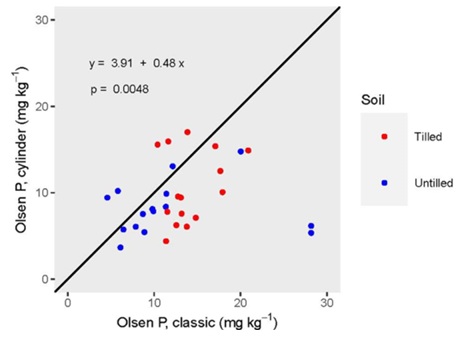
Figure 1: Association between the Olsen P determined by the classic method (Olsen P, classic) in disturbed soil samples (Tilled) and the Olsen P determined in undisturbed soil samples (Olsen P, cylinder; Untilled). The black line represents the 1:1 relationship.
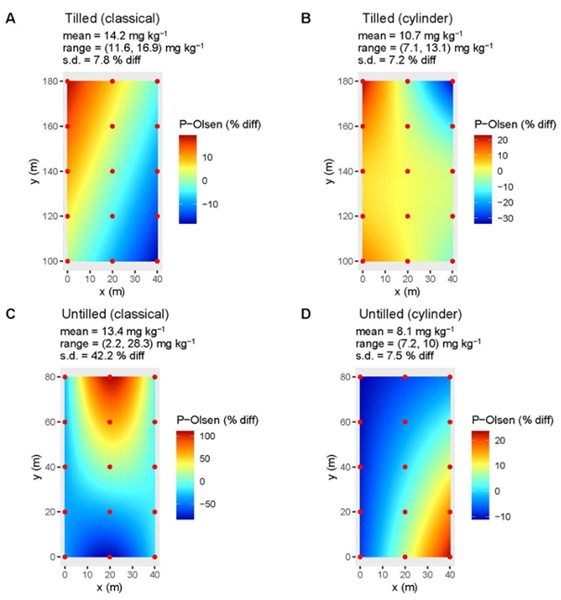
Figure 2: P-spline predicted surfaces for Olsen P for A) Tilled soil, classical method, B) Tilled soil, cylinder method, C) Untilled, classical method, and D) Untilled, cylinder method. Color scale is proportional to the percentage of change at each grid position, relative to the mean of the predicted surface. The mean and the range of the predicted surface are indicated below the title for each combination of soil and method. The standard deviation is expressed as the percentage of change in relation to each mean.
Spatial variation of soil Olsen P
Although there was variation in the Olsen P for the four combinations of soil Olsen P, the spatial dependence was very low. This is reflected in the low effective dimensions for the linear and spline spatial components, and in the predicted surfaces (Figure 2). In most cases, the variation was low, with ranges within the ± 20% variation, relative to the mean of the observed Olsen P, leading to standard deviations of 7.8% (tilled, classic, Figure 2A), 7.2 % (tilled, cylinder, Figure 2B) and 7.5% (untilled, cylinder, Figure 2D). The exception was one point in the untilled, classical, which had 28.4 mg kg-1 Olsen P, leading to a standard deviation of 42.2% (expressed as a percentage of difference compared to the mean of the observations, Figure 2C).
It has been reported that factors such as reduced pasture growth due to drought or lack of irrigation in the summer, water accumulation in areas of the pasture during winter, poor grazing frequency and less palatable species can result in reduced nutrient removal from the pasture and hence greater spatial variability of P in a permanent pasture (Cotching, Taylor, and Corkrey, 2020). In addition, P accumulation in the upper centimeters of soil in the degraded permanent pasture may also be due to the prolonged period during which this soil was undisturbed (Nze-Memiaghe, Cambouris, Ziadi, Karam, and Perron, 2021), which for this study was over 10 years (Descalzi, López, Kemp, Dörner, and Ordóñez, 2020). In general, a sampling depth of 0 to 20 cm is recommended for soil fertility tests, leading to a mixing of soil layers; in the case of untilled permanent pastures, the spatial variability of P presents points with higher P concentrations (Toor et al., 2020). In this context, the decision to collect 0 to 20 cm disturbed soil samples aims to define whether the soil has the Olsen P concentration required for adequate pasture nutrition, which, for Andosols, should be around 20 mg kg-1 (Vistoso, Iraira, and Sandaña, 2021). This critical value is due to the formation of complexes between Al- or Fe- and colloidal material (organic carbon, allophane, and imogolite) that permit the retention of large quantities of soil organic P (Redel et al., 2016). Werner et al. (2017) reported that in soil aggregates from P-rich areas, P was co-located with aluminum, iron oxides, and hydroxides, while in soil aggregates from P-depleted areas, the phosphorous was bonded to the soil organic carbon. This would be related to P accretion areas or small “pockets” through a process of re-sorption in soil aggregates (Pinochet, 1995). This hypothesis has not yet been probed, but it is an interesting approach that supports the idea of physical protection of P proposed in this preliminary study. Therefore, the amount of soil P available for plants should be above the critical level at which the crop does not respond to the application of P fertilizer, which ensures a high crop yield without causing severe risks of contaminating the agroecosystem (Díaz, and Torrent, 2016).
Pastures on volcanic soils in southern Chile have high organic P storage (848-1065 mg kg-1), and the availability of this nutrient is mainly regulated by the formation of amorphous Al-Po complexes (Redel et al., 2016). Phosphate fertilizer applications increase the concentration of available P in the soil solution, which allows for a rapid diffusion of P to the root system and, thus, an increased P uptake by plants (Vistoso et al., 2021). However, underestimating the initial P content in the soil using chemical extraction methods that do not consider the soil structure in which the root system grows and from which it absorbs P, results in an inefficient and far from rational application of phosphate fertilizers.
Conclusions
Through the approach presented, this preliminary report seeks to spotlight the importance of soil structure on nutrient availability, especially for P, an immobile and highly retention nutrient in volcanic soils.
Soil structure plays a relevant role in the capacity to deliver available P over space and time. The above can be particularly relevant in agroecosystems that promote soil conservation, including zero tillage, natural pastures such as steppes, and sown areas when aggregate formation begins.
We are conscious that the limitations of this preliminary experiment should be considered for future research in the area, such as the relationship between soil P availability rate and plant P uptake, site climatic conditions, and soil P supply during the growing season.

